REVIEW 2 major objections 4 minor 2 cited by
Heat kernel for higher-order differential operators and generalized exponential functions
T0 review · 2 major / 4 minor · reviewed 2026-08-14 · deepseek-v4-flash
Pith's one-line read The heat kernel of (−Δ)^ν is exactly a generalized exponential function, and its asymptotics split sharply between oscillatory-exponential integer order and power-law fractional order.
desk verdict Solid paper: restates a known representation but adds systematic asymptotics and a clear warning about WKB nonuniformity; the main gap is the unproven gamma-ratio expansion behind the full integer-ν series. read the letter →
The pith
A machine-rendered reading of the paper's core claim, the machinery that carries it, and where it could break.
The reading
What carries the argument
The central object is the generalized exponential function $E_{\nu,\alpha}(z)$ of Eq. (1.4), a two-parameter entire function for $\nu>1/2$ that reduces to $\exp(z)$ at $\nu=1$ and to a Bessel–Clifford function as $\nu\to\infty$. Its Mellin–Barnes integral (3.1) turns the heat kernel problem into the theory of Fox–Wright $\Psi$- and Fox $H$-functions: the ratio of gamma functions in the integrand is expanded by Eq. (A.7), and the inverse Mellin transform (4.6) converts each term into an exponential. For integer $N$, the sine-factor decomposition (4.8)–(4.11) splits the kernel into $N$ 'second-kind' generalized exponentials whose phases are exactly the fractional-power branches of the Hamilton–Jacobi action, which is the mechanism that produces the oscillatory exponential asymptotics.
What would settle it
Evaluate the momentum integral (2.2) numerically to high precision for $N=3$, $d=4$, $\tau=1$ over a range of $x$, compare it with the truncated exact series (1.4), and test whether the leading two-branch asymptotic formula (4.22) reproduces the oscillation period, amplitude, and the prefactor $x^{-d(N-1)/(2N-1)}$; a mismatch in any of these would falsify the central asymptotic claim.
Extended reading notes
Core claim
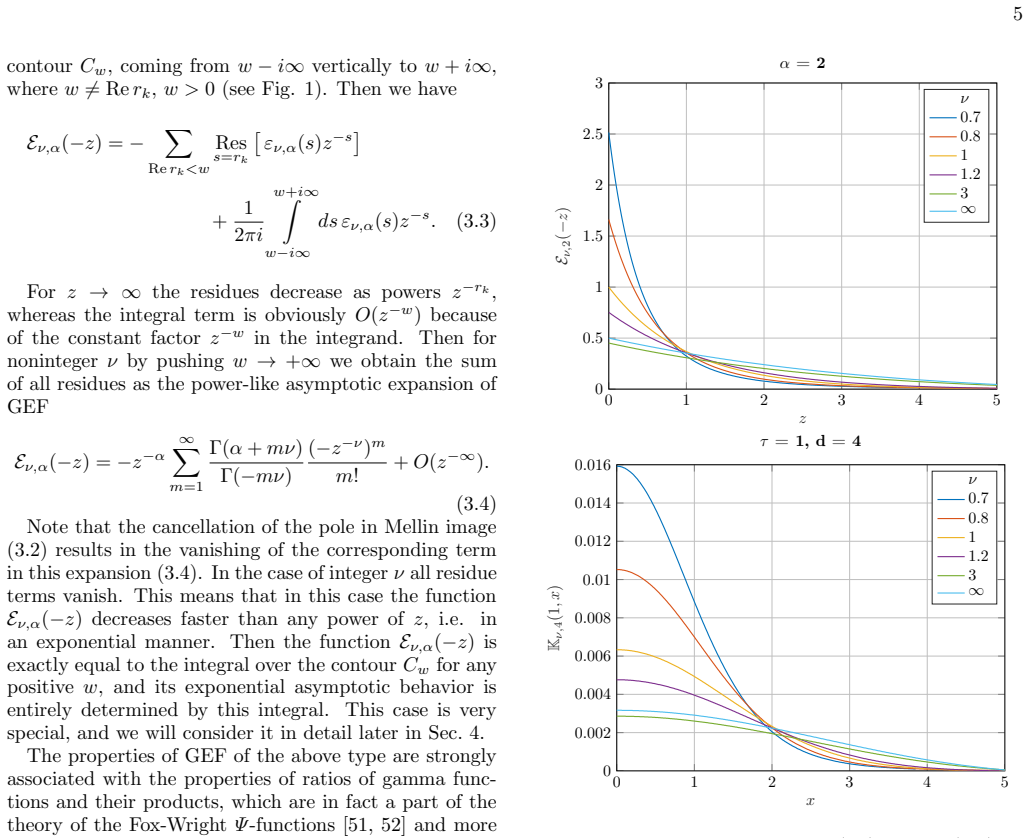
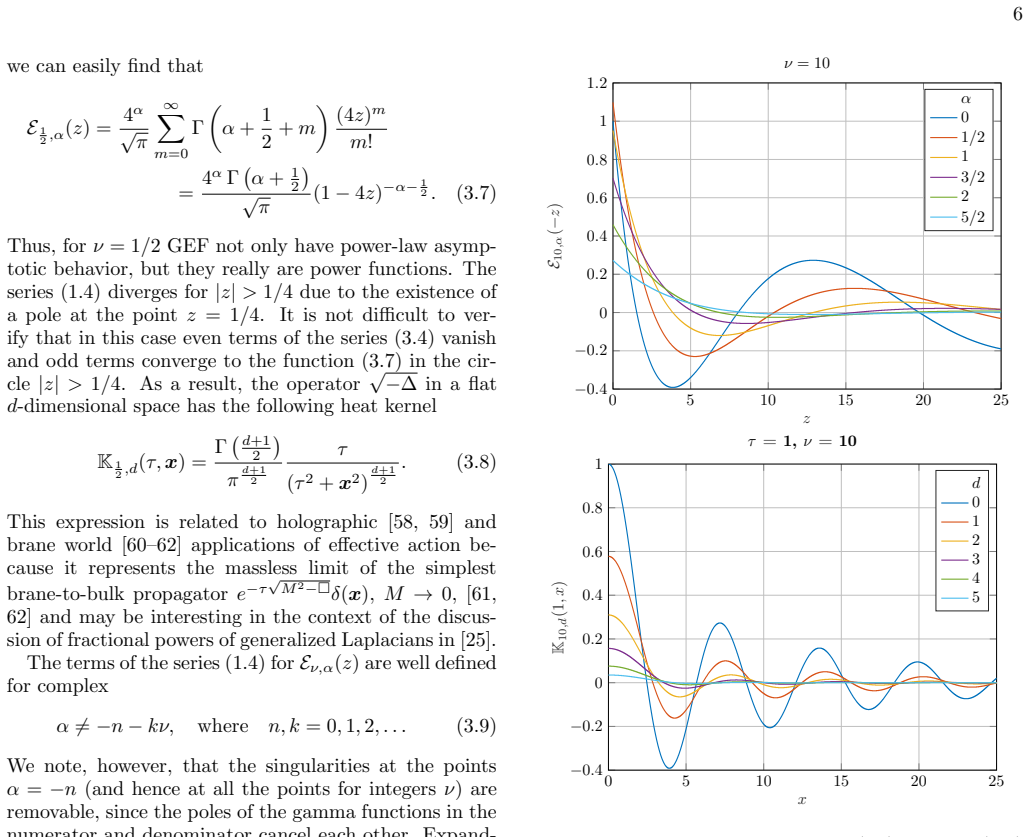
For $F=(-\Delta)^{\nu}$ in flat space the heat kernel is exactly $$K_{\nu,d}(\tau,x)=\frac{1}{(4\pi\$tau^{{1/\nu}}$)^{d/2}}\,E_{\nu,d/2}\!\left(-\frac{$x^{2}$}{4\$tau^{{1/\nu}}$}\right),\qquad E_{\nu,\$\alpha$}(z)=\frac{1}{\nu}\sum_{m=0}^{\infty}\frac{\Gamma((\$\alpha$+m)/\nu)}{\Gamma(\$\alpha$+m)}\frac{z^m}{m!}.$$ The function $E_{\nu,\alpha}$ is a Fox–Wright $\Psi$-function, so its Mellin–Barnes representation controls all asymptotics. For noninteger $\nu$ the large-$z$ (small-$\tau$ or large-$\lvert x\rvert$) limit is a power series in $z^{-\nu}$, while for integer $N$ all residues cancel and the kernel becomes a sum of $N$ exponential branches with phases $\phi_j=\pi(1-N+2j)/(2N-1)$. The two complex-conjugate dominant branches reproduce the semiclassical Pauli–Van Vleck amplitude with a definite choice of phase, and the same result follows from steepest descent. The expansion is shown to be nonuniform at $x=0$ for $N>1$, so the coincidence limit must be taken from the exact GEF rather than from its asymptotics.
Load-bearing premise
The asymptotic formulas for the integer-order kernel rest on an asymptotic expansion for ratios of gamma-function products quoted from Fox H-function theory, whose coefficients the paper only describes as systematically calculable and whose region of validity is not stated; if that expansion fails or is nonuniform in the sector where it is used, the claimed exponential and oscillatory asymptotics would not follow.
Editorial extensions
If this is right
- For a local higher-derivative operator of order $2N$, the short-proper-time expansion runs in powers $\tau^{j/N}$ with coefficients built from GEF values at zero, not from the nonuniform WKB expansion.
- For nonlocal operators $(-\Delta)^{\nu}$ with noninteger $\nu$, the heat kernel decays as a power law at large separation, so the standard semiclassical $\hbar$-expansion does not apply to these kernels.
- The exact GEF representation provides the building block for the curved-space expansion announced by the authors, in which generalized heat-kernel coefficients obey recurrent equations.
- The heat kernel of $\sqrt{-\Delta}$ in flat space is exactly the power-law kernel of Eq. (3.8), which is the massless limit of a simple brane-to-bulk propagator.
Reading between the lines
- A natural consequence the authors leave implicit is that UV calculations in higher-derivative gravity should work with split-point GEF kernels rather than only with coincidence-limit heat-kernel coefficients, since the nonuniformity means the diagonal expansion cannot see the full short-distance structure.
- The integer-versus-fractional dichotomy suggests a concrete diagnostic: local higher-derivative propagators should show damped oscillations at large separation, while nonlocal noninteger-order propagators should show algebraic tails; numerical studies of such propagators could test this directly.
- The exact closed form at $\nu=1/2$ hints that other rational values $\nu=p/q$ may also reduce to known special functions, and working these out would give explicit exact heat kernels that independently check the Fox-H asymptotic machinery.
- The paper notes that a uniform asymptotic expansion valid across $x\to0$ is open; finding one would cure the coincidence-limit problem and is a testable mathematical extension.
Signed reviews
Editorial analysis
A structured set of objections, weighed in public.
Referee Report
Summary. The paper studies the heat kernel K_{ν,d}(τ,x) = e^{-τ(-Δ)^ν}δ(x) in flat d-dimensional Euclidean space. It derives the exact representation K_{ν,d}(τ,x) = (4πτ^{1/ν})^{-d/2} E_{ν,d/2}(-x^2/(4τ^{1/ν})), where E_{ν,α}(z) is a two-parameter generalized exponential function defined by a Taylor series of gamma-function ratios. The function is identified with a Fox–Wright Ψ-function, and several representations are given: a Mellin–Barnes integral, a Bessel–Clifford integral, and a closed form for ν=1/2. The paper then studies large-z asymptotics, finding power-law falloff for noninteger ν and oscillatory exponential behavior for integer ν. For integer N, a complete asymptotic expansion is claimed via the Mellin–Barnes representation and the theory of Fox H-functions, and it is compared with the Pauli–Van Vleck/WKB ansatz and with steepest descent. The paper concludes that the WKB heat-kernel expansion is not uniform in the coincidence limit x=0 for ν>1, and announces upcoming applications to higher-derivative and Horava–Lifshitz-type operators.
Significance. If the main results hold, the paper provides a useful explicit building block for heat kernels of higher-derivative and nonlocal operators, and it correctly identifies why a naive WKB ansatz cannot be used for such operators. The exact formula (1.3), the Mellin–Barnes representation, the ν=1/2 closed form, and the exact normalization check in Sec. 4.3 are cleanly derived and appear trustworthy. The leading-order integer-N asymptotics are independently confirmed by steepest descent in Sec. 4.2, which makes the main qualitative conclusion robust. However, the claimed complete asymptotic expansion for integer N depends on an imported gamma-ratio expansion whose proof, validity sector, coefficients, and remainder estimates are not given in the manuscript. The paper therefore is reliable in its leading-order physics but does not yet fully establish its central all-orders asymptotic claims.
major comments (2)
- [§4.1 and Appendix A/B, Eqs. (4.16)–(4.20)] The definition of E_{ν,α}(z) by the Taylor series (1.4) is problematic for ν<1/2, because, as the paper itself states in Sec. 3, that series diverges and is only asymptotic for z→0 in this regime. The derivation of Eq. (1.3) in Sec. 2 from equality of derivatives at x=0 is therefore incomplete for such ν; equality of formal Taylor coefficients does not determine a non-analytic function. The authors should define E_{ν,α}(z) globally via the Mellin–Barnes representation (3.1) or the Bessel–Clifford integral (2.16), and state explicitly that (1.4) is the convergent Taylor expansion for ν>1/2 but only a formal or asymptotic series for ν<1/2. Since Eq. (1.3) is asserted for generic ν, this clarification is needed to make the main exact statement precise.
- [§4.3, Eqs. (4.32)–(4.34)] The argument that the WKB expansion fails to reproduce the initial condition is weakened by an unjustified termwise integration of an asymptotic expansion. Eq. (4.32) sums all N branches K^(j), but footnote 3 acknowledges that branches with j≠0,N−1 are exponentially subdominant and should be discarded; moreover, an asymptotic expansion cannot be integrated termwise near x=0 without uniformity control. The nonuniformity conclusion is nevertheless correct and can be made cleanly: the exact value (4.34) is finite and nonzero at x=0, while the asymptotic expansion (4.22) is singular at x=0 for N>1. Please restate Sec. 4.3 so that the logical gap in the integration argument is removed and the nonuniformity claim rests on the direct comparison of (4.22) with (4.34).
minor comments (4)
- [Eq. (3.10)] The expression (n/ν)! in Eq. (3.10) is only meaningful when n/ν is a nonnegative integer; please state this condition explicitly before using the notation.
- [Eq. (3.11)] The symbol d^β/dz^β in Eq. (3.11) is not defined for noninteger β; if a fractional integro-differentiation operator is intended, specify the convention, or restrict the identity to integer β with a remark about the fractional extension.
- [Sec. 4] The switch between ν and N in Sec. 4 is introduced explicitly, but a short remark in the text or a footnote clarifying that N denotes positive integers while ν is generic would improve readability.
- [Figs. 2–4] The figures are informative, but the overlapping curves in Fig. 3 would be easier to read with additional line styles or markers, and the figure captions could state the value of the fixed parameters more prominently.
Circularity Check
No significant circularity: the heat-kernel formula is derived from the Fourier representation, and the imported asymptotic machinery is external to the authors.
full rationale
The central result (1.3) is derived self-containedly from the momentum-space representation (2.2), with no fitted parameters and no input that already contains the target formula. The GEF is defined independently by the Taylor series (1.4), and the heat-kernel coefficients are matched to it through the direct computation (2.7)-(2.8). The large-z asymptotics for integer powers rest on the standard Fox H-function expansion (A.7), which is attributed to independent external references [53]-[57] and to the classical theory of Stirling-series expansions; the paper's own Appendix B is only a sketch of that standard procedure. The assertion that the coefficients Em are 'systematically calculable' without giving explicit bounds or remainder estimates is a completeness/rigor limitation (correctness risk), not circularity. Self-citations such as [6] and [69] provide context, standard technique, or a generic Hamilton-Jacobi statement, and they do not carry the derivation of the claimed results. The forward citation [71] only advertises future applications and is not load-bearing. Therefore no step reduces by construction to its own inputs.
Assumptions & free parameters
assumptions (3)
- standard math The asymptotic expansion (A.7) of the ratio of gamma function products is valid for the parameters µ, a, β of Eqs. (4.14)-(4.15) in the sector relevant for the Mellin inversion.
- domain assumption For noninteger ν, the operator (−∆)^ν is defined via the Fourier transform as a pseudodifferential operator.
- domain assumption In the steepest descent analysis, only the N saddle points with cos φ_j < 0 contribute to the asymptotics; the other N−1 points are discarded as exponentially growing.
invented entities (1)
-
Generalized exponential function E_{ν,α}(z)
independent evidence
Cite this review
Pith. "Pith review of Heat kernel for higher-order differential operators and generalized exponential functions." pith.science (2026). https://pith.science/paper/LAZA4FO3
@misc{pith2026190802161,
  author       = {Pith},
  title        = {Pith review of: Heat kernel for higher-order differential operators and generalized exponential functions},
  year         = {2026},
  howpublished = {\url{https://pith.science/paper/LAZA4FO3}},
  note         = {Machine review of arXiv:1908.02161}
}
abstract
We consider the heat kernel for higher-derivative and nonlocal operators in $d$-dimensional Euclidean space-time and its asymptotic behavior. As a building block for operators of such type, we consider the heat kernel of the minimal operator - generic power of the Laplacian - and show that it is given by the expression essentially different from the conventional exponential Wentzel-Kramers-Brillouin (WKB) ansatz. Rather it is represented by the generalized exponential function (GEF) directly related to what is known in mathematics as the Fox-Wright $\varPsi$-functions and Fox $H$-functions. The structure of its essential singularity in the proper time parameter is different from that of the usual exponential ansatz, which invalidated previous attempts to directly generalize the Schwinger-DeWitt heat kernel technique to higher-derivative operators. In particular, contrary to the conventional exponential decay of the heat kernel in space, we show the oscillatory behavior of GEF for higher-derivative operators. We give several integral representations for the generalized exponential function, find its asymptotics and semiclassical expansion, which turns out to be essentially different for local operators and nonlocal operators of noninteger order. Finally, we briefly discuss further applications of the GEF technique to generic higher-derivative and pseudodifferential operators in curved space-time, which might be critically important for applications of Horava-Lifshitz and other UV renormalizable quantum gravity models.
Figures

Figures from the paper (1 more)

Forward citations
Cited by 2 Pith papers
-
From Matrix Models to Gaussian Molecules and the Einstein-Hilbert Action
The free energy of a D-dimensional matrix model with Gaussian heat-kernel propagator equals the Einstein-Hilbert action with cosmological constant, constants fixed by graph invariants of ribbon graphs.
-
Multiple Mellin-Barnes integrals in Schwinger-DeWitt technique
Series representations of N-fold Mellin-Barnes integrals for basis and complete kernels of operator functions are obtained in non-resonant and resonant cases and linked to UV/IR asymptotics.
Reference graph
Works this paper leans on
-
[71]
A. V. Pskhu, Partial Differential Equations of Fractional Order (Nauka, Moscow, 2005) (in Russian)
work page 2005
-
[1]
INTRODUCTION Physical phenomena in higher derivative and nonlocal field theories are essentially different from conventional local quantum field theory (QFT) with the wave oper- ators of second order in space-time derivatives. There are numerous manifestations of this difference including the problem with unitarity which arises due to higher- derivative (Ostr...
arXiv 1908
-
[2]
For ν = 1 this integral defines the well-known fundamental solution (1.2)
THE HEA T KERNEL OF THE POWER OF LAPLACIAN For the operator F = (−∆)ν its heat kernel Kν,d(τ, x) =e−τ(−∆)ν δ(x) (2.1) has an obvious momentum space representation Kν,d(τ, x) = ∫ ddk (2π)d exp ( −k2ντ +ikx ) , (2.2) where k = | k| = √ k2 and kx = kaxa. For ν = 1 this integral defines the well-known fundamental solution (1.2). Note that the heat kernel (2.2)...
-
[3]
This rep- resentation can be obtained by converting the series (1.4) s Cw w C ××××××× lk 0−1 × × × × α rkα+ν FIG
GENERALIZED EXPONENTIAL FUNCTIONS AND THEIR PROPER TIES Various properties of GEF follow from the Mellin- Barnes integral representation of this function. This rep- resentation can be obtained by converting the series (1.4) s Cw w C ××××××× lk 0−1 × × × × α rkα+ν FIG. 1. The location of the poles of εν,α(s) and the contours C and Cw on the complex s plane...
-
[4]
The series (1.4) diverges for|z|> 1/4 due to the existence of a pole at the point z = 1/4
(3.7) Thus, for ν = 1/2 GEF not only have power-law asymp- totic behavior, but they really are power functions. The series (1.4) diverges for|z|> 1/4 due to the existence of a pole at the point z = 1/4. It is not difficult to ver- ify that in this case even terms of the series (3.4) vanish and odd terms converge to the function (3.7) in the cir- cle|z| > 1/...
-
[5]
INTEGER POWER OF LAPLACIAN AND SEMICLASSICAL EXP ANSION As we see, the asymptotic behavior of GEF Eν,α(−z) at z →∞ is critically different for noninteger and in- teger values of ν. It is power-law for noninteger ν cor- responding to the nonlocal operator ( −∆)ν and quasi- exponential O(z−∞) for integer ν corresponding to local differential operators of orde...
-
[6]
Obviously, there is no such a discrepancy in the case of N = 1 with a single j = 0 branch of the heat kernel expansion, so that the coincidence limit y = x can be directly taken in the asymptotic expansion (1.1). 3 There is additional controversy with the result (4.33)—while all K(j) N,d(τ, x) withj⁄= 0 andj⁄=N− 1 are exponentially subdomi- nant and shoul...
-
[7]
func- torial property
CONCLUSIONS Thus we obtained the expression (1.3) for the heat ker- nel Kν,d(τ, x) of the operator (−∆)ν in thed-dimensional flat space, which is a direct generalization of the well- known heat kernel (1.2) to local higher derivative and nonlocal (pseudodifferential) operators. This general- ization is represented in terms of the newly introduced two-parame...
Show all 86 references
-
[8]
Renormalization of higher-derivative quan- tum gravity,
K. S. Stelle, “Renormalization of higher-derivative quan- tum gravity,” Phys. Rev. D16, 953–969 (1977)
1977
-
[9]
Quantum field theory in curved space- time,
G. W. Gibbons, “Quantum field theory in curved space- time,” in General Relativity. An Einstein Centenary Sur- vey (Cambridge University Press, Cambridge, England,
-
[10]
Background field calculations in curved spacetime (I). General formalism and application to scalar fields,
I. Jack and H. Osborn, “Background field calculations in curved spacetime (I). General formalism and application to scalar fields,” Nucl. Phys. B234, 331–364 (1984)
1984
-
[11]
Proof of summed form of proper time expansion for propagator in curved space-time,
I. Jack and L. Parker, “Proof of summed form of proper time expansion for propagator in curved space-time,” Phys. Rev. D31, 2439–2451 (1985)
1985
-
[12]
Background Fermi fields and Schwinger–DeWitt proper-time method,
Choonkyu Lee and Chaiho Rim, “Background Fermi fields and Schwinger–DeWitt proper-time method,” Nucl. Phys. B255, 439–464 (1985)
1985
-
[13]
The generalized Schwinger–DeWitt technique in gauge theories and quan- tum gravity,
A. O. Barvinsky and G. A. Vilkovisky, “The generalized Schwinger–DeWitt technique in gauge theories and quan- tum gravity,” Phys. Rep. 119, 1–74 (1985)
1985
-
[14]
Beyond the Schwinger–DeWitt technique: Converting loops into trees and in-in currents,
A. O. Barvinsky and G. A. Vilkovisky, “Beyond the Schwinger–DeWitt technique: Converting loops into trees and in-in currents,” Nucl. Phys. B282, 163–188 (1987)
1987
-
[15]
Covariant pertur- bation theory (II). Second order in the curvature. General algorithms,
A. O. Barvinsky and G. A. Vilkovisky, “Covariant pertur- bation theory (II). Second order in the curvature. General algorithms,” Nucl. Phys. B333, 471–511 (1990)
1990
-
[16]
A. O. Barvinsky, Yu. V. Gusev, V. V. Zhytnikov, and G. A. Vilkovisky, Covariant Perturbation Theory (IV). Third order in the Curvature , Tech. Rep. SPIRES-HEP: PRINT-93-0274 (Report of the University of Manitoba, Winnipeg, 1993) arXiv:0911.1168v1 [hep-th]
1993 arXiv
-
[17]
Nonperturbative late time asymptotics for the heat kernel in gravity theory,
A. O. Barvinsky, Yu. V. Gusev, V. F. Mukhanov, and D. V. Nesterov, “Nonperturbative late time asymptotics for the heat kernel in gravity theory,” Phys. Rev. D68, 105003 (2003), arXiv:0306052 [hep-th]
2003
-
[18]
I. G. Avramidi, Heat Kernel and Quantum Gravity , Lec- ture Notes in Physics Monographs No. 64 (Springer- Verlag, Berlin, Heidelberg, 2000)
2000
-
[19]
Heat kernel approach in quantum field theory,
I. G. Avramidi, “Heat kernel approach in quantum field theory,” Nucl. Phys. B, Proc. Suppl. 104, 3–32 (2002), arXiv:0107018 [math-ph]
2002
-
[20]
Heat kernel expansion: user’s man- ual,
D. V. Vassilevich, “Heat kernel expansion: user’s man- ual,” Phys. Rep. 388, 279–360 (2003), arXiv:0306138 [hep-th]
2003
-
[21]
Hadamard, Le Probl` eme de Cauchy et les `Equations aux d ´Eriv´ ees Partielles Lin´ eaires Hyperboliques(Her- mann et Cie, Paris, 1932)
J. Hadamard, Le Probl` eme de Cauchy et les `Equations aux d ´Eriv´ ees Partielles Lin´ eaires Hyperboliques(Her- mann et Cie, Paris, 1932)
1932
-
[22]
Some properties of the eigenfunctions of the Laplace-operator on Rieman- nian manifolds,
S. Minakshisundaram and A. Pleijel, “Some properties of the eigenfunctions of the Laplace-operator on Rieman- nian manifolds,” Can. J. Math. 1, 242–256 (1949)
1949
-
[23]
Eigenfunctions on Riemannian manifolds,
S. Minakshisundaram, “Eigenfunctions on Riemannian manifolds,” J. Indian Math. Soc. 17, 158–165 (1953)
1953
-
[24]
Complex powers of an elliptic operator,
R. T. Seeley, “Complex powers of an elliptic operator,” in Singular Integrals, Proc. Sympos. Pure Math., Vol. 10 (Amer. Math. Soc., Chicago, Ill, 1967) pp. 288–307
1967
-
[25]
The spectral geometry of a Riemannian manifold,
P. B. Gilkey, “The spectral geometry of a Riemannian manifold,” J. Differ. Geom. 10, 601–618 (1975)
1975
-
[26]
Recursion relations and the asymptotic behavior of the eigenvalues of the Laplacian,
P. B. Gilkey, “Recursion relations and the asymptotic behavior of the eigenvalues of the Laplacian,” Compositio Math. 38, 201–240 (1979)
1979
-
[27]
Die Eigenzeit in der Klassischen- und in der Quantennechanik,
V. Fock, “Die Eigenzeit in der Klassischen- und in der Quantennechanik,” Phys. Z. Sowjetunion 12, 404–425 (1937)
1937
-
[28]
On gauge invariance and vacuum polar- ization,
J. Schwinger, “On gauge invariance and vacuum polar- ization,” Phys. Rev. 82, 664–679 (1951)
1951
-
[29]
B. S. DeWitt, Dynamical Theory of Groups and Fields (Gordon and Breach, New York, 1965)
1965
-
[30]
Logarithmic terms in asymptotic expansions of heat operator traces,
P. B. Gilkey and G. Grubb, “Logarithmic terms in asymptotic expansions of heat operator traces,” Com- mun. Partial Differ. Equations 23, 777–792 (1998)
1998
-
[31]
P. B. Gilkey, Asymptotic Formulae in Spectral Geometry (Chapman and Hall/CRC, Boca Raton, London, New York, Washington, DC, 2003)
2003
-
[32]
Heat kernel asymptotics for roots of generalized Laplacians,
C. B¨ ar and S. Moroianu, “Heat kernel asymptotics for roots of generalized Laplacians,” Int. J. Math. 14, 397– 412 (2003)
2003
-
[33]
Heat ker- nel estimates for the fractional Laplacian with Dirich- let conditions,
K. Bogdan, T. Grzywny, and M. Ryznar, “Heat ker- nel estimates for the fractional Laplacian with Dirich- let conditions,” Ann. Probab. 38, 1901–1923 (2010), 15 arXiv:0905.2626 [math.PR]
2010 arXiv
-
[34]
Heat kernel estimates for pseudodifferential operators, fractional Laplacians and Dirichlet-to-Neumann operators,
H. Gimperlein and G. Grubb, “Heat kernel estimates for pseudodifferential operators, fractional Laplacians and Dirichlet-to-Neumann operators,” J. Evol. Equations 14, 49–83 (2014), arXiv:1302.6529 [math.AP]
2014 arXiv
-
[35]
The spectral geometry of the higher order Laplacian,
P. B. Gilkey, “The spectral geometry of the higher order Laplacian,” Duke Math. J. 47, 511–528 (1980)
1980
-
[36]
Invariants of the heat equa- tion,
H. D. Fegan and P. Gilkey, “Invariants of the heat equa- tion,” Pac. J. Math. 117, 233–254 (1985)
1985
-
[37]
Heat equation asymptotics of “nonminimal
P. B. Gilkey, Th. P. Branson, and S. A. Fulling, “Heat equation asymptotics of “nonminimal” operators on dif- ferential forms,” J. Math. Phys. (N.Y.) 32, 2089–2091 (1991)
1991
-
[38]
Heat equation asymptotics of elliptic operators with non-scalar leading symbol,
Th. P. Branson, P. B. Gilkey, and A. Pierzchalski, “Heat equation asymptotics of elliptic operators with non-scalar leading symbol,” Math. Nachr. 166, 207–215 (1994)
1994
-
[39]
Renormalizable asymptotically free quantum theory of gravity,
E. S. Fradkin and A. A. Tseytlin, “Renormalizable asymptotically free quantum theory of gravity,” Nucl. Phys. B201, 469–491 (1982)
1982
-
[40]
Asymptotic free- dom in higher-derivative quantum gravity,
I. G. Avramidy and A. O. Barvinsky, “Asymptotic free- dom in higher-derivative quantum gravity,” Phys. Lett. B159, 269–274 (1985)
1985
-
[41]
E. T. Tomboulis, Superrenormalizable gauge and grav- itational theories , Tech. Rep. UCLA/97/TEP/2 (1997) arXiv:9702146 [hep-th]
1997
-
[42]
Super-renormalizable multidimensional quantum gravity,
L. Modesto, “Super-renormalizable multidimensional quantum gravity,” Astron. Rev. 8, 4–33 (2013), arXiv:1202.3151 [hep-th]
2013 arXiv
-
[43]
Heat kernel methods for Lifshitz theories,
A. O. Barvinsky, D. Blas, M. Herrero-Valea, D. V. Nesterov, G. P´ erez-Nadal, and Ch. F. Steinwachs, “Heat kernel methods for Lifshitz theories,” J. High Energy Phys. 2017 (2017), 10.1007/JHEP06(2017)063, arXiv:1703.04747 [hep-th]
2017 arXiv
-
[44]
Ho˘ rava gravity is asymptotically free in 2+1 dimensions,
A. O. Barvinsky, D. Blas, M. Herrero-Valea, S. M. Sibiryakov, and C. F. Steinwachs, “Ho˘ rava gravity is asymptotically free in 2+1 dimensions,” Phys. Rev. Lett. 119, 211301 (2017), arXiv:1706.06809 [hep-th]
2017 arXiv
-
[45]
Higher-derivative op- erators and DeWitts WKB ansatz,
Hae Won Lee and Pong Youl Pac, “Higher-derivative op- erators and DeWitts WKB ansatz,” Phys. Rev. D33, 1012 (1986)
1986
-
[46]
New algorithm for asymptotic expansions of the heat kernel,
Hae Won Lee, Pong Youl Pac, and Hyun Kuk Shin, “New algorithm for asymptotic expansions of the heat kernel,” Phys. Rev. D35, 2440–2447 (1987)
1987
-
[47]
One-loop coun- terterms for the dimensional regularization of arbi- trary Lagrangians,
P. I. Pronin and K. V. Stepanyantz, “One-loop coun- terterms for the dimensional regularization of arbi- trary Lagrangians,” Nucl. Phys. B485, 517–544 (1997), arXiv:9605206 [hep-th]
1997
-
[48]
Singularities of Green functions of the products of the Laplace type operators,
I. G. Avramidi, “Singularities of Green functions of the products of the Laplace type operators,” Phys. Lett. B403, 280–284 (1997), arXiv:9703005 [hep-th]
1997
-
[49]
Green functions of higher-order differ- ential operators,
I. G. Avramidi, “Green functions of higher-order differ- ential operators,” J. Math. Phys. (N.Y.) 39, 2889–2909 (1998), arXiv:9707040 [hep-th]
1998
-
[50]
New algorithm for computing the coef- ficients in the heat kernel expansion,
V. P. Gusynin, “New algorithm for computing the coef- ficients in the heat kernel expansion,” Phys. Lett. B225, 233–239 (1989)
1989
-
[51]
Seeley–Gilkey coefficients for fourth- order operators on a Riemannian manifold,
V. P. Gusynin, “Seeley–Gilkey coefficients for fourth- order operators on a Riemannian manifold,” Nucl. Phys. B333, 296–316 (1990)
1990
-
[52]
Asymptotics of the heat kernel for non- minimal differential operators,
V. P. Gusynin, “Asymptotics of the heat kernel for non- minimal differential operators,” Ukr. Math. J. 43, 1432– 1441 (1991)
1991
-
[53]
Local heat ker- nel asymptotics for nonminimal differential operators,
V. P. Gusynin and E. V. Gorbar, “Local heat ker- nel asymptotics for nonminimal differential operators,” Phys. Lett. B270, 29–36 (1991)
1991
-
[54]
Heat kernel expansion for nonminimal differential oper- ations and manifolds with torsion,
V. P. Gusynin, E. V. Gorbar, and V. V. Romankov, “Heat kernel expansion for nonminimal differential oper- ations and manifolds with torsion,” Nucl. Phys. B362, 449–471 (1991)
1991
-
[55]
Heat kernel expansion for operators con- taining a root of the Laplace operator,
E. V. Gorbar, “Heat kernel expansion for operators con- taining a root of the Laplace operator,” J. Math. Phys. (N.Y.) 38, 1692–1699 (1997), arXiv:9602018 [hep-th]
1997
-
[56]
Superdiffusion and stable laws,
V. M. Zolotarev, V. V. Uchaikin, and V. V. Saenko, “Superdiffusion and stable laws,” Zh. Eksp. Teor. Fiz. 115, 1411–1425 (1999)
1999
-
[57]
Heat kernel for flat general- ized Laplacians with anisotropic scaling,
A. Mamiya and A. Pinzul, “Heat kernel for flat general- ized Laplacians with anisotropic scaling,” J. Math. Phys. (N.Y.) 55 (2014), 10.1063/1.4882157, arXiv:1308.2706 [hep-th]
2014 arXiv
-
[58]
The asymptotic expansion of the gener- alized hypergeometric function,
E. M. Wright, “The asymptotic expansion of the gener- alized hypergeometric function,” J. London Math. Soc. 10, 286–293 (1935)
1935
-
[59]
The asymptotic expansion of the general- ized hypergeometric function,
E. M. Wright, “The asymptotic expansion of the general- ized hypergeometric function,” Proc. London Math. Soc. 46, 389–408 (1940)
1940
-
[60]
Asymptotic expansions and analytic continuations for a class of Barnes-integrals,
B. L. J. Braaksma, “Asymptotic expansions and analytic continuations for a class of Barnes-integrals,” Compositio Math. 15, 239–341 (1964)
1964
-
[61]
O. I. Marichev, Handbook of Integral Transforms of Higher Transcendental Functions: Theory and Algorith- mic Tables (Ellis Horwood Limited, Chichester, 1983)
1983
-
[62]
H. M. Srivastava and H. L. Manocha, A Treatise on Gen- erating Functions (Ellis Horwood Limited, New York, 1984)
1984
-
[63]
A. M. Mathai, R. K. Saxena, and H. J. Haubold, TheH- Function: Theory and Applications (Springer, New York, Dordrecht, Heidelberg, London, 2010)
2010
-
[64]
A. A. Kilbas and M. Saigo, H-Transforms: Theory and Applications (Chapman and Hall/CRC, Boca Raton, London, New York, Washington, DC, 2004)
2004
-
[65]
Anti–de Sitter space and holography,
E. Witten, “Anti–de Sitter space and holography,” Adv. Theor. Math. Phys. 2, 253–291 (1998), arXiv:9802150 [hep-th]
1998
-
[66]
D = 4 super Yang– Mills, D = 5 gauged supergravity and D = 4 confor- mal supergravity,
Hong Liu and A. A. Tseytlin, “ D = 4 super Yang– Mills, D = 5 gauged supergravity and D = 4 confor- mal supergravity,” Nucl. Phys. B533, 88–108 (1998), arXiv:9804083 [hep-th]
1998
-
[67]
Strong inter- actions and stability in the DGP model,
M. A. Luty, M. Porrati, and R. Rattazzi, “Strong inter- actions and stability in the DGP model,” J. High Energy Phys. , 029 (2003), arXiv:0303116 [hep-th]
2003
-
[68]
Quantum effective action in spacetimes with branes and boundaries,
A. O. Barvinsky and D. V. Nesterov, “Quantum effective action in spacetimes with branes and boundaries,” Phys. Rev. D73, 066012 (2006), arXiv:0512291 [hep-th]
2006
-
[69]
Schwinger–DeWitt technique for quantum effective action in brane in- duced gravity models,
A. O. Barvinsky and D. V. Nesterov, “Schwinger–DeWitt technique for quantum effective action in brane in- duced gravity models,” Phys. Rev. D81, 085018 (2010), arXiv:0911.5334 [hep-th]
2010 arXiv
-
[70]
S. G. Samko, A. A. Kilbas, and O. I. Marichev, Frac- tional Integrals and Derivatives: Theory and Applica- tions (Gordon and Breach, Singapore, 1993)
1993
-
[72]
The fundamental solutions for the frac- tional diffusion-wave equation,
F. Mainardi, “The fundamental solutions for the frac- tional diffusion-wave equation,” Appl. Math. Lett. 9, 23– 28 (1996)
1996
-
[73]
Wright func- tions as scale-invariant solutions ot the diffusion-wave equation,
R. Gorenflo, Y. Luchko, and F. Mainardi, “Wright func- tions as scale-invariant solutions ot the diffusion-wave equation,” Journal of computational and applied mathe- 16 matics 118, 175–191 (2000)
2000
-
[74]
The fun- damental solution of the space-time fractional diffusion equation,
F. Mainardi, Y. Luchko, and G. Pagnini, “The fun- damental solution of the space-time fractional diffusion equation,” Fractional Calculus Appl. Anal. 4, 153–192 (2001), arXiv:0702419 [cond-mat]
2001
-
[75]
The semiclassical expansion,
C. DeWitt-Morette, “The semiclassical expansion,” Ann. Phys. (N.Y.) 97, 367–399 (1976)
1976
-
[76]
Unitarity approach to quantum cos- mology,
A. O. Barvinsky, “Unitarity approach to quantum cos- mology,” Phys. Rep. 230, 237–367 (1993)
1993
-
[77]
M. V. Fedoryuk, Asymptotics: Integrals and Series (Nauka, Moscow, 1987) (in Russian)
1987
-
[78]
The heat kernel expansion and recurrence relations for higher order minimal operators,
A. O. Barvinsky, P. I. Pronin, and W. Wachowski, “The heat kernel expansion and recurrence relations for higher order minimal operators,” To be published
-
[79]
Towards understanding the ultraviolet behavior of quantum loops in infinite-derivative theories of gravity,
S. Talaganis, T. Biswas, and A. Mazumdar, “Towards understanding the ultraviolet behavior of quantum loops in infinite-derivative theories of gravity,” Classical Quan- tum Gravity 32, 215017 (2015), arXiv:1412.3467 [hep- th]
2015 arXiv
-
[80]
Consis- tent higher derivative gravitational theories with stable de Sitter and anti–de Sitter backgrounds,
T. Biswas, A. S. Koshelev, and A. Mazumdar, “Consis- tent higher derivative gravitational theories with stable de Sitter and anti–de Sitter backgrounds,” Phys. Rev. D95, 043533 (2017), arXiv:1606.01250 [gr-qc]
2017 arXiv
-
[81]
Fractional Derivative Regulariza- tion in QFT,
V. E. Tarasov, “Fractional Derivative Regulariza- tion in QFT,” Adv. High Energy Phys. 2018 (2018), 10.1155/2018/7612490, article ID 7612490, arXiv:1805.08566 [hep-th]
2018 arXiv
-
[82]
The asymptotic expansion of Legendre function of large degree and order,
R. C. Thorne, “The asymptotic expansion of Legendre function of large degree and order,” Phil. Trans. R. Soc. A 249, 597–620 (1957)
1957
-
[83]
V. E. Tarasov, Fractional Dynamics: Applications of Fractional Calculus to Dynamics of Particles, Fields and Media (Springer, Heidelberg, Dordrecht, London, New York, 2010)
2010
-
[84]
On the gener- alized Wright function,
A. A. Kilbas, M. Saigo, and J. J. Trujillo, “On the gener- alized Wright function,” Fractional Calculus Appl. Anal. 5, 437–460 (2002)
2002
-
[85]
Fractional calculus of the generalized Wright function,
A. A. Kilbas, “Fractional calculus of the generalized Wright function,” Fractional Calculus Appl. Anal. 8, 113–126 (2005)
2005
-
[86]
Lavault, Fractional calculus and generalized Mittag– Leffler type functions, Tech
Ch. Lavault, Fractional calculus and generalized Mittag– Leffler type functions, Tech. Rep. LIPN, Universit´ e Paris 13 (2017) arXiv:1703.01912 [math]
2017 arXiv
Reviewed August 14, 2026 · model on record in the stance chip above.
Discussion (0). Continue with ORCID to comment.