REVIEW 3 major objections 7 minor 68 references
VecFontLLM claims to be the first system to synthesize complex Chinese vector glyphs directly in the vector domain, without raster generation or vectorization, using an anchor-guided generation process.
Reviewed by Pith at T0; open to challenge. T0 means a machine referee read the full paper against a public rubric. the ladder, T0–T4 →
T0 review · deepseek-v4-flash
2026-08-01 18:34 UTC pith:LB45KYLM
load-bearing objection Real anchor-to-curve decomposition with honest failure cases, but the 'first time/SOTA' claim needs missing baselines, error bars, and a softer mechanistic story. the 3 major comments →
VecFontLLM: Anchor-Guided Direct Synthesis of Chinese Vector Fonts
The pith
A machine-rendered reading of the paper's core claim, the machinery that carries it, and where it could break.
Core claim
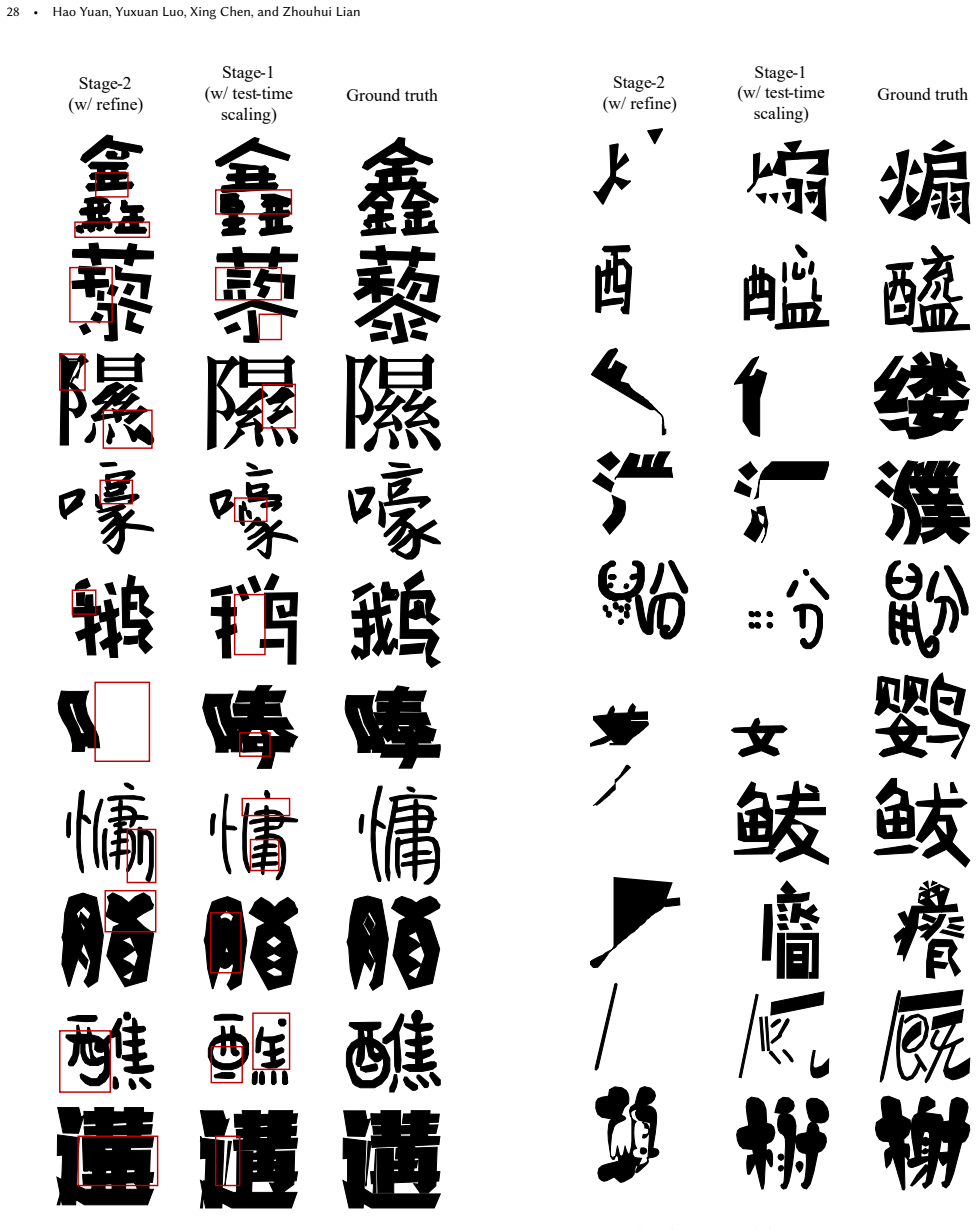
The paper claims that for the first time, high-quality few-shot synthesis of complex Chinese vector glyphs can be performed directly in the vector domain, without raster generation or vectorization. The evidence is a three-stage pipeline in which a multimodal large language model first predicts an anchor scaffold—the endpoints of every path segment—so that the coarse layout of components and contours is fixed before any Bézier control points are generated, then refines that scaffold, and finally completes Bézier control points to recover local curvature and style. On several Chinese font datasets, the paper shows that this anchor-to-curve staging outperforms previous vector-domain generators
What carries the argument
The central object is the anchor: the endpoint of each M, L, and C path segment. By generating only anchors first, the model fixes the coarse layout of components and contours, then fills in Bézier control points to recover curvature and style. This decomposition is carried by a vector style encoder that embeds SVG instructions and aggregates them with a 1D-CNN and Transformer, trained with a supervised contrastive objective, alongside a multimodal LLM backbone that receives content image features and style features; the same architecture is fine-tuned separately for the three stages. At test time, a confidence-guided generation chain samples multiple candidate components, scores them by tok
Load-bearing premise
The load-bearing premise is that a glyph's coarse layout is fully captured by the endpoint positions of its path segments (anchors), with Bézier control points contributing only local curvature and style; if an ambiguous endpoint polygon cannot determine the true component arrangement, Stages 1–2 cannot fix layout errors and the whole pipeline inherits them.
What would settle it
Construct a set of Chinese glyphs whose path-segment endpoints are identical, or nearly identical, across two different valid component layouts, and test whether Stage-1/2 resolves them correctly; if the model consistently fails on such ambiguous anchor scaffolds, the anchor decomposition is insufficient. A simpler check: measure how often Stage-2 refinement rewrites the topology of the Stage-1 scaffold (e.g., changes component boundaries or contour nesting); frequent topology changes would indicate that anchors carry too little layout information.
If this is right
- If the central claim holds, font designers get editable, resolution-independent vector glyphs from one or a few style exemplars, with no raster-to-vector conversion step.
- The anchor-to-curve staging suggests that long structured vector sequences are better generated by first fixing global structure and then local geometry, a principle that could extend beyond fonts to icons, diagrams, and other SVG graphic classes.
- Style interpolation of vector glyphs becomes possible through linearly interpolated style features, opening a path to continuous font morphing and design-space exploration.
- Lightweight fine-tuning with roughly 75 glyphs per font adapts the model to a new style, implying that the method can be adopted for font libraries at modest annotation cost.
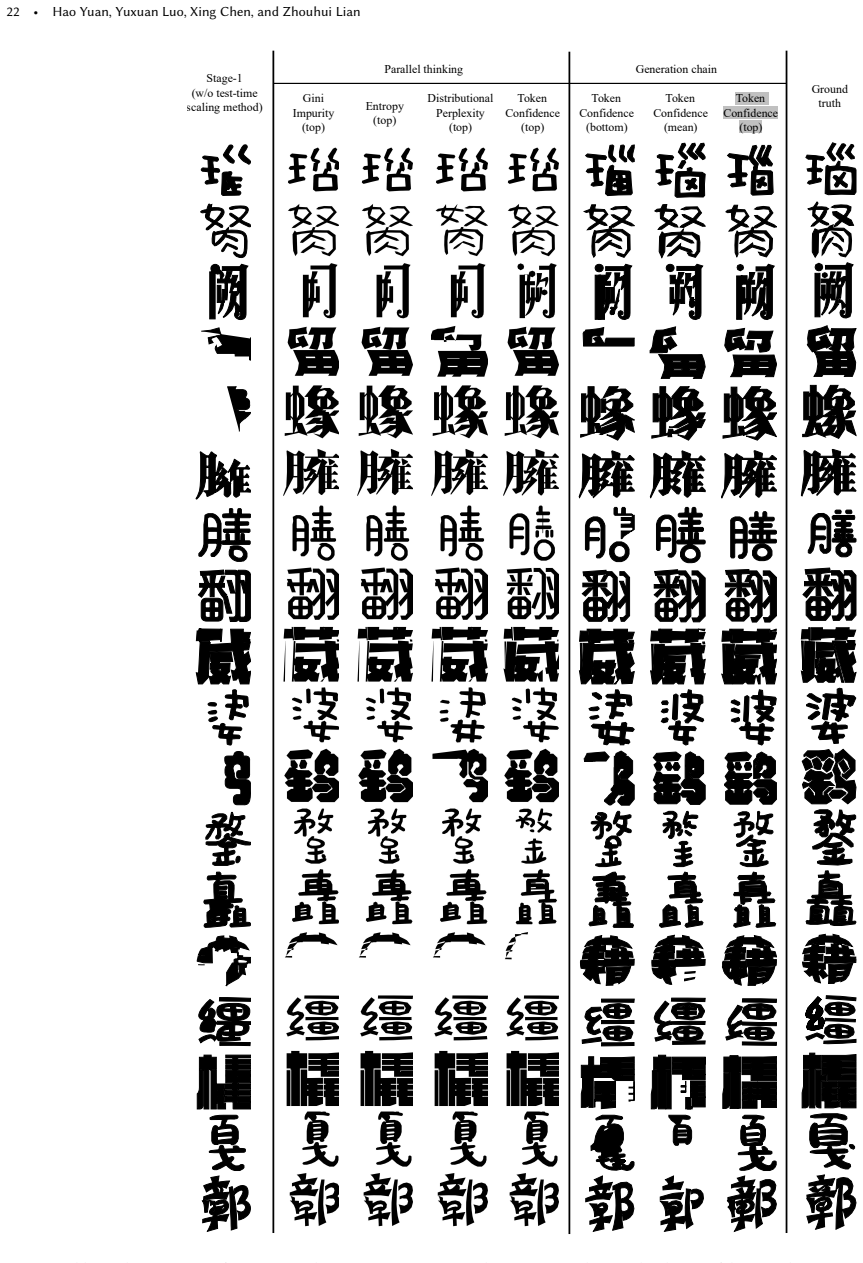
- Confidence-guided test-time scaling improves structural reliability for complex characters, making autoregressive vector generation more robust and suggesting a general strategy for long-sequence structured output.
Where Pith is reading between the lines
- Editorial inference: The anchor-sufficiency assumption—that a glyph's coarse layout is determined by path-segment endpoints alone—is not formally proven in the paper; a stress test on glyphs with long curved strokes whose endpoint polygons are ambiguous would reveal whether the decomposition has a hard ceiling.
- Editorial inference: The paper's finding that generated command distributions are close to real fonts suggests a distribution-level fidelity measure for vector fonts that goes beyond rasterized-image metrics like FID or LPIPS; this could become a standard evaluation axis for vector-domain generative models.
- Editorial inference: The three-stage decomposition (scaffold, refine, complete curves) is a natural fit for other structured vector formats with global layout and local style, such as circuit schematics or architectural drawings, where the same decoupling could improve autoregressive generation.
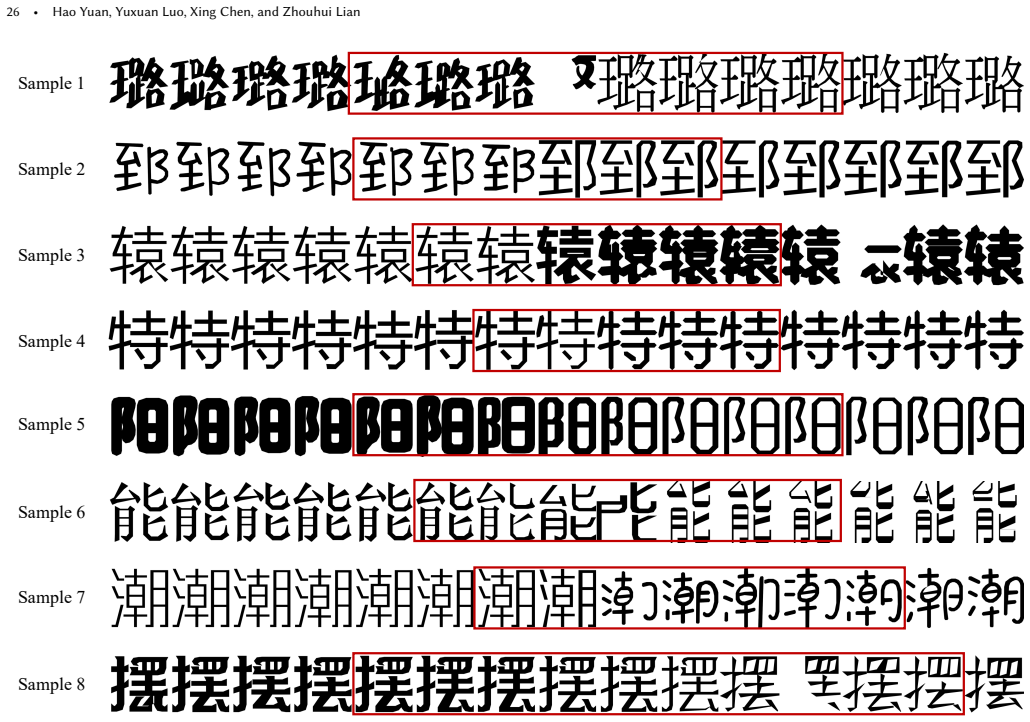
- Editorial inference: The failure cases shown in the appendix—collapse into meaningless token sequences for dense glyphs with many short strokes—point to a ceiling of discrete-token autoregressive generation; a latent-continuous anchor model, which the paper itself suggests as future work, may be needed to push further.
Editorial analysis
A structured set of objections, weighed in public.
Referee Report
Summary. The paper proposes VecFontLLM, an MLLM-based system for few-shot Chinese vector font synthesis that generates vector glyphs directly without intermediate rasterization. The key idea is to decompose generation into three stages: (Stage-1) construction of an initial 'anchor scaffold' consisting of path-segment endpoints, (Stage-2) refinement of that scaffold, and (Stage-3) completion of Bézier control points conditioned on the refined scaffold. The model uses a vector style encoder with contrastive training and a confidence-guided test-time generation chain that selects high-confidence component-level candidates. Experiments compare against older vector-domain baselines (DeepVecFont, DeepVecFont-V2, DualVector) and image-domain methods (MX-Font, CG-GAN, NTF, FontDiffuser), reporting large gains in FID/SSIM and competitive LPIPS/L1/RMSE. The paper claims, 'for the first time, high-quality few-shot synthesis of complex Chinese vector glyphs directly in the vector domain.'
Significance. If the results hold, this is a meaningful step toward editable vector-output font generation. The anchor-guided decomposition is a clean and intuitive idea, and the reported quantitative gains over older vector baselines are substantial. The confidence-guided component-level generation chain is also an interesting adaptation of test-time scaling to structured vector output. The paper is honest about some failure cases in its appendices. However, the 'first-time / state-of-the-art' claim is currently under-supported because recent vector-domain methods cited in the paper are not evaluated, and no repeated-run statistics are reported. The theoretical claim about anchor sufficiency is asserted rather than demonstrated. Despite these issues, the core empirical contribution is defensible and addressable in revision.
major comments (3)
- [§4.2, Table 1; §2 Related Work] The claim of 'state-of-the-art' and 'for the first time' is not fully supported by the chosen comparison set. VecFusion (Thamizharasan et al. 2024a), DiffVecFont (Liu et al. 2025), and VecGlypher (Huang et al. 2026) are cited in §2 but never evaluated as baselines. The only vector-domain competitors are DeepVecFont, DeepVecFont-V2, and DualVector, all of which predate these works. Without results for recent direct-vector synthesis methods, the superiority claim is incomplete. In addition, all tables report single numbers without error bars or repeated-seed statistics; given the sampling sensitivity shown in Table 6, the reported gains cannot be assessed for statistical reliability.
- [§3.1 and Appendix B.1] The central decomposition assumes that anchor (segment-endpoint) placement fixes the coarse layout, while Bézier control points only add local curvature/style. This is not guaranteed for cubic Bézier segments: with endpoints and path order fixed, control points can move a curve to either side of another component, create loops, or change containment. Stage-3 is conditioned on the refined scaffold and cannot revise component grouping, contour order, or nesting already fixed in Stage-1/2. The 'anchor-to-curve' ablation in Table 5 compares the full multi-stage pipeline with direct generation, which also differs in stage-specific data and conditioning; it does not isolate whether the anchor scaffold itself carries the layout. As a concrete test, I suggest an oracle experiment: condition Stage-3 on ground-truth anchors (and on deliberately corrupted anchors) to measure whether Stage-3 can cor
- [§4.1.1 (HBTS) and Table 3] The Hard Base Test Set is defined as '6,582 failure cases produced by the Stage-1 model on BTS.' Evaluating the confidence-guided test-time scaling on this self-selected hard set is circular to a degree: the model's own failure distribution determines the evaluation set. The improvements in Table 3 (e.g., FID 20.6 -> 17.6 for the generation chain) may not generalize to the full BTS or to an independent hard set defined by character complexity. The claim that component-level selection 'filters uncertain structures earlier' should be validated on the full BTS or on a hard set selected by criteria independent of the model. As reported, the comparison measures relative improvement on the model's own failure subset.
minor comments (7)
- [Abstract and §5] The abstract claims 'high-quality' synthesis and 'for the first time' without the caveats that appear in Appendix G and §5, where the authors acknowledge generation failures on highly complex glyphs and unstable interpolation between distant styles. I recommend softening the wording to reflect those limitations.
- [Appendix D.1, Eq. (11)] The 'token confidence' measure C_TC_i = -1/V * sum_j log p_i(j) is unusual: it is the negative average log-probability over the whole vocabulary, which is essentially a transformed perplexity rather than a token-level confidence. It also diverges when any p_i(j)=0. Please clarify why this is a confidence measure, define its behavior for zero probabilities, or compute it on the top-k distribution as hinted in the text.
- [Table 3 and Fig. 19] The aggregation fractions (t%, b%) for the top/bottom rows are not specified in Table 3; Fig. 19 mentions top-45% only for the generation chain. Please report the exact fractions used for all rows so the comparison is reproducible.
- [Fig. 7] The claim that command distributions are 'close to real fonts' is only qualitative. A numerical distance (e.g., KL divergence or total variation) between the generated and ground-truth distributions would make the claim testable.
- [§3.2, Eq. (1)] The notation 'W_A ∈ R^{d_E×8d_E}' should be 'R^{8d_E×d_E}' or the text should explicitly say the concatenated vector has dimension 8d_E before projection; the current notation is ambiguous.
- [§4.4, Table 4] The OCR accuracy of the proposed method is lower than the image-domain baselines in most settings. The discussion should acknowledge this directly, not only state that vector outputs remain recognizable, so readers can calibrate the 'recognition quality' claim.
- [Table 8] Typo: 'steming' should be 'stemming'; 'K-V cache' should be 'KV cache.'
Circularity Check
No circular derivation found; anchor-guided decomposition is a testable modeling choice, not an input–output identity.
full rationale
The paper's central claim is empirical: an anchor-guided MLLM directly synthesizes Chinese vector glyphs. The three-stage pipeline is trained with autoregressive cross-entropy on ground-truth vector sequences (Eqs. 3–4) and evaluated on held-out sets (BTS, UFTS, UCTS, STS) against external raster and vector baselines using rendering metrics, OCR, and human studies. The anchor-scaffold decomposition is a modeling assumption about the roles of segment endpoints versus Bézier control points, but it is not derived from, nor does it reduce to, the outputs it predicts: Stage-1 anchors are ground-truth endpoints, Stage-2 refines them, and Stage-3 predicts control points conditioned on the refined scaffold; each stage's target is independent of the conditioning by construction, and the ablation in Table 5 directly compares the full pipeline against direct generation. Self-citations (DeepVecFont-V2, HFH-Font, Cai et al., CalliReader) appear in related work, representation choices, and baselines, but the central synthesis claim does not rest on any unverified self-citation chain or imported uniqueness theorem. The HBTS test set is self-referential—it is built from Stage-1 failures (Section 4.1.1)—and the confidence-guided scaling study is therefore potentially optimistic, but the improvement is measured against ground-truth rendering metrics, and the confidence scores are heuristics rather than fitted predictors of those metrics, so this is a selection-bias limitation, not circularity by construction. Appendix G explicitly acknowledges residual failures and inaccuracies, further showing the method is not presented as a forced consequence of its assumptions. No step reduces to its own inputs by definition or fit; the paper contains at most minor, non-load-bearing self-citations.
Axiom & Free-Parameter Ledger
free parameters (7)
- Sampling temperature =
0.8
- Top-k sampling =
50
- Beam size =
4
- Confidence aggregation top/bottom fractions (t%, b%) =
top-45% used for best generation chain; b% not specified
- Number of component candidates in generation chain =
10
- Number of glyph candidates in parallel thinking =
20
- Learned neural-network weights =
trained on 80% of Basis Fonts dataset
axioms (5)
- domain assumption Path-segment endpoints (anchors) fully capture coarse glyph layout; Bézier control points only carry local curvature and style.
- domain assumption Contour orientation (clockwise outer, counterclockwise holes) yields a valid <component> decomposition of Chinese glyphs.
- domain assumption Token-level confidence correlates with structural correctness of generated SVG components.
- domain assumption The 6,763-character set and 345 training fonts are sufficient to represent all components of unseen characters for compositional generalization.
- domain assumption A contrastive vector style encoder trained with same-font positive pairs learns font-level style independent of character content.
read the original abstract
Direct generation of Chinese vector fonts is a challenging and ongoing problem. A Chinese vector glyph contains complex component structure, anchor layout, and B\'ezier curve details, which work at different scales, but a standard vector sequence writes them together in one long sequence, making the task of vector font synthesis challenging. Existing direct vector generators often fail on complex characters, while raster-domain methods must vectorize the synthesized glyph images afterward. To address the above-mentioned problem, this paper proposes VecFontLLM, an anchor-guided multimodal large language model for direct few-shot synthesis of Chinese vector fonts. Our key idea is to generate vector glyphs through anchors rather than a standard vector sequence. Specifically, the proposed VecFontLLM first predicts and refines an anchor scaffold that fixes the coarse layout of components and contours, and then completes B\'ezier control points to recover local curvature and style. At test time, a confidence-guided generation chain samples multiple component candidates and continues synthesis from the highest-confidence one, improving stability for complex glyphs. This work demonstrates, for the first time, high-quality few-shot synthesis of complex Chinese vector glyphs directly in the vector domain, without raster generation or vectorization. Experiments on several Chinese font datasets show substantial improvements over existing vector font synthesis methods, competitive glyph rendering quality against raster-domain baselines, and vector command distributions close to real fonts.
Figures





Reference graph
Works this paper leans on
-
[1]
Communications of the ACM , volume=
Generative adversarial networks , author=. Communications of the ACM , volume=. 2020 , publisher=
2020
-
[2]
Advances in neural information processing systems , volume=
Denoising diffusion probabilistic models , author=. Advances in neural information processing systems , volume=
-
[3]
Proceedings of the IEEE/CVF conference on computer vision and pattern recognition , pages=
High-resolution image synthesis with latent diffusion models , author=. Proceedings of the IEEE/CVF conference on computer vision and pattern recognition , pages=
-
[4]
Advances in Neural Information Processing Systems , volume=
Deepsvg: A hierarchical generative network for vector graphics animation , author=. Advances in Neural Information Processing Systems , volume=
-
[5]
arXiv preprint arXiv:1704.03477 , year=
A neural representation of sketch drawings , author=. arXiv preprint arXiv:1704.03477 , year=
-
[6]
Proceedings of the IEEE/CVF International Conference on Computer Vision , pages=
A learned representation for scalable vector graphics , author=. Proceedings of the IEEE/CVF International Conference on Computer Vision , pages=
-
[7]
ACM Transactions on Graphics (TOG) , volume=
Deepvecfont: synthesizing high-quality vector fonts via dual-modality learning , author=. ACM Transactions on Graphics (TOG) , volume=. 2021 , publisher=
2021
-
[8]
Proceedings of the IEEE/CVF conference on computer vision and pattern recognition , pages=
Deepvecfont-v2: Exploiting transformers to synthesize vector fonts with higher quality , author=. Proceedings of the IEEE/CVF conference on computer vision and pattern recognition , pages=
-
[9]
IEEE MultiMedia , volume=
Scalable vector graphics , author=. IEEE MultiMedia , volume=. 2003 , publisher=
2003
-
[10]
Proceedings of the IEEE/CVF Conference on Computer Vision and Pattern Recognition , pages=
Vecfusion: Vector font generation with diffusion , author=. Proceedings of the IEEE/CVF Conference on Computer Vision and Pattern Recognition , pages=
-
[11]
International Conference on Computational Visual Media , pages=
DiffVecFont: Fusing Dual-Mode Reconstruction Vector Fonts via Masked Diffusion Transformers , author=. International Conference on Computational Visual Media , pages=. 2025 , organization=
2025
-
[12]
Proceedings of the Computer Vision and Pattern Recognition Conference , pages=
Starvector: Generating scalable vector graphics code from images and text , author=. Proceedings of the Computer Vision and Pattern Recognition Conference , pages=
-
[13]
Proceedings of the Computer Vision and Pattern Recognition Conference , pages=
Chat2SVG: Vector Graphics Generation with Large Language Models and Image Diffusion Models , author=. Proceedings of the Computer Vision and Pattern Recognition Conference , pages=
-
[14]
ACM Transactions on Graphics (TOG) , volume=
Iconshop: Text-guided vector icon synthesis with autoregressive transformers , author=. ACM Transactions on Graphics (TOG) , volume=. 2023 , publisher=
2023
-
[15]
Proceedings of the Computer Vision and Pattern Recognition Conference , pages=
Empowering llms to understand and generate complex vector graphics , author=. Proceedings of the Computer Vision and Pattern Recognition Conference , pages=
-
[16]
arXiv preprint arXiv:2504.06263 , year=
Omnisvg: A unified scalable vector graphics generation model , author=. arXiv preprint arXiv:2504.06263 , year=
-
[17]
arXiv preprint arXiv:2203.11171 , year=
Self-consistency improves chain of thought reasoning in language models , author=. arXiv preprint arXiv:2203.11171 , year=
-
[18]
arXiv preprint arXiv:2305.11860 , year=
Let's Sample Step by Step: Adaptive-Consistency for Efficient Reasoning and Coding with LLMs , author=. arXiv preprint arXiv:2305.11860 , year=
-
[19]
arXiv preprint arXiv:2402.13212 , year=
Soft self-consistency improves language model agents , author=. arXiv preprint arXiv:2402.13212 , year=
-
[20]
arXiv preprint arXiv:2311.08298 , year=
A survey of confidence estimation and calibration in large language models , author=. arXiv preprint arXiv:2311.08298 , year=
-
[21]
arXiv preprint arXiv:2403.04696 , year=
Fact-checking the output of large language models via token-level uncertainty quantification , author=. arXiv preprint arXiv:2403.04696 , year=
-
[22]
arXiv preprint arXiv:2502.18581 , year=
Scalable best-of-n selection for large language models via self-certainty , author=. arXiv preprint arXiv:2502.18581 , year=
-
[23]
arXiv preprint arXiv:2508.15260 , year=
Deep think with confidence , author=. arXiv preprint arXiv:2508.15260 , year=
-
[24]
arXiv preprint arXiv:1312.6114 , year=
Auto-encoding variational bayes , author=. arXiv preprint arXiv:1312.6114 , year=
-
[25]
Proceedings of the AAAI Conference on Artificial Intelligence , volume=
Cg-gan: An interactive evolutionary gan-based approach for facial composite generation , author=. Proceedings of the AAAI Conference on Artificial Intelligence , volume=
-
[26]
Proceedings of the IEEE/CVF international conference on computer vision , pages=
Multiple heads are better than one: Few-shot font generation with multiple localized experts , author=. Proceedings of the IEEE/CVF international conference on computer vision , pages=
-
[27]
Proceedings of the AAAI conference on artificial intelligence , volume=
Fontdiffuser: One-shot font generation via denoising diffusion with multi-scale content aggregation and style contrastive learning , author=. Proceedings of the AAAI conference on artificial intelligence , volume=
-
[28]
Proceedings of the IEEE/CVF conference on computer vision and pattern recognition , pages=
Neural transformation fields for arbitrary-styled font generation , author=. Proceedings of the IEEE/CVF conference on computer vision and pattern recognition , pages=
-
[29]
Proceedings of the 29th ACM international conference on multimedia , pages=
Zigan: Fine-grained chinese calligraphy font generation via a few-shot style transfer approach , author=. Proceedings of the 29th ACM international conference on multimedia , pages=
-
[30]
European conference on computer vision , pages=
Few-shot compositional font generation with dual memory , author=. European conference on computer vision , pages=. 2020 , organization=
2020
-
[31]
Proceedings of the IEEE/CVF conference on computer vision and pattern recognition , pages=
Dg-font: Deformable generative networks for unsupervised font generation , author=. Proceedings of the IEEE/CVF conference on computer vision and pattern recognition , pages=
-
[32]
Proceedings of the AAAI conference on artificial intelligence , volume=
Strokegan: Reducing mode collapse in chinese font generation via stroke encoding , author=. Proceedings of the AAAI conference on artificial intelligence , volume=
-
[33]
International Journal of Computer Vision , volume=
Diff-font: Diffusion model for robust one-shot font generation , author=. International Journal of Computer Vision , volume=. 2024 , publisher=
2024
-
[34]
ACM Transactions on Graphics (TOG) , volume=
HFH-font: Few-shot Chinese font synthesis with higher quality, faster speed, and higher resolution , author=. ACM Transactions on Graphics (TOG) , volume=. 2024 , publisher=
2024
-
[35]
Neural computation , volume=
Long short-term memory , author=. Neural computation , volume=. 1997 , publisher=
1997
-
[36]
Advances in neural information processing systems , volume=
Attention is all you need , author=. Advances in neural information processing systems , volume=
-
[37]
Proceedings of the IEEE , volume=
Gradient-based learning applied to document recognition , author=. Proceedings of the IEEE , volume=. 2002 , publisher=
2002
-
[38]
arXiv preprint arXiv:2305.06161 , year=
Starcoder: may the source be with you! , author=. arXiv preprint arXiv:2305.06161 , year=
-
[39]
Proceedings of the IEEE/CVF Conference on Computer Vision and Pattern Recognition , pages=
Vectorfusion: Text-to-svg by abstracting pixel-based diffusion models , author=. Proceedings of the IEEE/CVF Conference on Computer Vision and Pattern Recognition , pages=
-
[40]
Proceedings of the IEEE/CVF Conference on Computer Vision and Pattern Recognition , pages=
Dualvector: Unsupervised vector font synthesis with dual-part representation , author=. Proceedings of the IEEE/CVF Conference on Computer Vision and Pattern Recognition , pages=
-
[41]
Proceedings of the IEEE/CVF Conference on Computer Vision and Pattern Recognition , pages=
Svgdreamer: Text guided svg generation with diffusion model , author=. Proceedings of the IEEE/CVF Conference on Computer Vision and Pattern Recognition , pages=
-
[42]
ACM Transactions on Graphics (TOG) , volume=
Text-to-vector generation with neural path representation , author=. ACM Transactions on Graphics (TOG) , volume=. 2024 , publisher=
2024
-
[43]
Proceedings of the IEEE/CVF Conference on Computer Vision and Pattern Recognition , pages=
Nivel: Neural implicit vector layers for text-to-vector generation , author=. Proceedings of the IEEE/CVF Conference on Computer Vision and Pattern Recognition , pages=
-
[44]
arXiv preprint arXiv:2209.14988 , year=
Dreamfusion: Text-to-3d using 2d diffusion , author=. arXiv preprint arXiv:2209.14988 , year=
-
[45]
arXiv preprint arXiv:2501.12948 , year=
Deepseek-r1: Incentivizing reasoning capability in llms via reinforcement learning , author=. arXiv preprint arXiv:2501.12948 , year=
-
[46]
arXiv preprint arXiv:2407.10972 , year=
Vgbench: Evaluating large language models on vector graphics understanding and generation , author=. arXiv preprint arXiv:2407.10972 , year=
-
[47]
Proceedings of the IEEE/CVF Conference on Computer Vision and Pattern Recognition , pages=
SVGEditBench: A Benchmark Dataset for Quantitative Assessment of LLM's SVG Editing Capabilities , author=. Proceedings of the IEEE/CVF Conference on Computer Vision and Pattern Recognition , pages=
-
[48]
arXiv preprint arXiv:2505.24499 , year=
Reason-SVG: Hybrid Reward RL for Aha-Moments in Vector Graphics Generation , author=. arXiv preprint arXiv:2505.24499 , year=
-
[49]
Proceedings of the 33rd ACM International Conference on Multimedia , pages=
SVGen: Interpretable Vector Graphics Generation with Large Language Models , author=. Proceedings of the 33rd ACM International Conference on Multimedia , pages=
-
[50]
Proceedings of the 33rd ACM International Conference on Multimedia , pages=
SVGThinker: Instruction-Aligned and Reasoning-Driven Text-to-SVG Generation , author=. Proceedings of the 33rd ACM International Conference on Multimedia , pages=
-
[51]
arXiv preprint arXiv:2510.22684 , year=
RoboSVG: A Unified Framework for Interactive SVG Generation with Multi-modal Guidance , author=. arXiv preprint arXiv:2510.22684 , year=
-
[52]
arXiv preprint arXiv:2510.11341 , year=
InternSVG: Towards Unified SVG Tasks with Multimodal Large Language Models , author=. arXiv preprint arXiv:2510.11341 , year=
-
[53]
arXiv preprint arXiv:2503.06472 , year=
CalliReader: Contextualizing Chinese Calligraphy via an Embedding-Aligned Vision-Language Model , author=. arXiv preprint arXiv:2503.06472 , year=
-
[54]
arXiv preprint arXiv:2510.18234 , year=
DeepSeek-OCR: Contexts Optical Compression , author=. arXiv preprint arXiv:2510.18234 , year=
-
[55]
Advances in neural information processing systems , volume=
Supervised contrastive learning , author=. Advances in neural information processing systems , volume=
-
[56]
Advances in neural information processing systems , volume=
Gans trained by a two time-scale update rule converge to a local nash equilibrium , author=. Advances in neural information processing systems , volume=
-
[57]
Proceedings of the IEEE conference on computer vision and pattern recognition , pages=
The unreasonable effectiveness of deep features as a perceptual metric , author=. Proceedings of the IEEE conference on computer vision and pattern recognition , pages=
-
[58]
IEEE transactions on image processing , volume=
Image quality assessment: from error visibility to structural similarity , author=. IEEE transactions on image processing , volume=. 2004 , publisher=
2004
-
[59]
Proceedings of the IEEE conference on computer vision and pattern recognition , pages=
Rethinking the inception architecture for computer vision , author=. Proceedings of the IEEE conference on computer vision and pattern recognition , pages=
-
[60]
Advances in neural information processing systems , volume=
Imagenet classification with deep convolutional neural networks , author=. Advances in neural information processing systems , volume=
-
[61]
arXiv preprint arXiv:2505.20793 , year=
Rendering-Aware Reinforcement Learning for Vector Graphics Generation , author=. arXiv preprint arXiv:2505.20793 , year=
-
[62]
arXiv preprint arXiv:1409.1556 , year=
Very deep convolutional networks for large-scale image recognition , author=. arXiv preprint arXiv:1409.1556 , year=
-
[63]
2017 , publisher=
Classification and regression trees , author=. 2017 , publisher=
2017
-
[64]
The Bell system technical journal , volume=
A mathematical theory of communication , author=. The Bell system technical journal , volume=. 1948 , publisher=
1948
-
[65]
2026 , eprint=
Beyond Patches: Global-aware Autoregressive Model for Multimodal Few-Shot Font Generation , author=. 2026 , eprint=
2026
-
[66]
2026 , eprint=
VecGlypher: Unified Vector Glyph Generation with Language Models , author=. 2026 , eprint=
2026
-
[67]
arXiv preprint arXiv:2510.14528 , year=
Paddleocr-vl: Boosting multilingual document parsing via a 0.9 b ultra-compact vision-language model , author=. arXiv preprint arXiv:2510.14528 , year=
-
[68]
2020 , eprint=
Visual Transformers: Token-based Image Representation and Processing for Computer Vision , author=. 2020 , eprint=
2020
discussion (0)
Sign in with ORCID, Apple, or X to comment. Anyone can read and Pith papers without signing in.