REVIEW 4 major objections 6 minor 14 references
Supporting stylists by recommending fashion style
T0 review · 4 major / 6 minor · reviewed 2026-08-14 · deepseek-v4-flash
Pith's one-line read Style fit between clothes can be learned from curated outfits alone, with no images or attributes.
desk verdict A clear, honest applied paper that makes a good case for item2vec on stylist outfits, but the central ground-truth assumption is untested and the evaluation has fixable gaps. read the letter →
The pith
A machine-rendered reading of the paper's core claim, the machinery that carries it, and where it could break.
The reading
What carries the argument
The load-bearing object is the word2vec/item2vec embedding trained on outfit co-occurrences: each product is a word and each outfit is a context sentence, with the objective to maximize the conditional log-probability of each product given the others in the same outfit under negative sampling. To keep the signal about inter-category compatibility, only heterogeneous dyads are used—two products that occupy different functional slots (shirt, over_shirt, suit, jacket, belt, trouser, shoes, other)—and negative samples are drawn from the same slot and the same time window, so the model compares a candidate against the current stock rather than across seasons. The style-fit score averages the cosine similarities between each item's target vector and the other's context vector, and the outfit score averages these pair scores over the incomplete outfit.
What would settle it
Take the trained model and give it a held-out outfit with one product removed, choosing the negative candidates from the same functional slot and the same time window. If the model cannot rank the genuinely packed product above chance (or above a random-pair baseline), the co-occurrence signal is not carrying style fit. Additionally, ask independent stylists to rate whether the same pairs fit and measure agreement: if agreement is near chance, the ground truth itself collapses.
Extended reading notes
Core claim
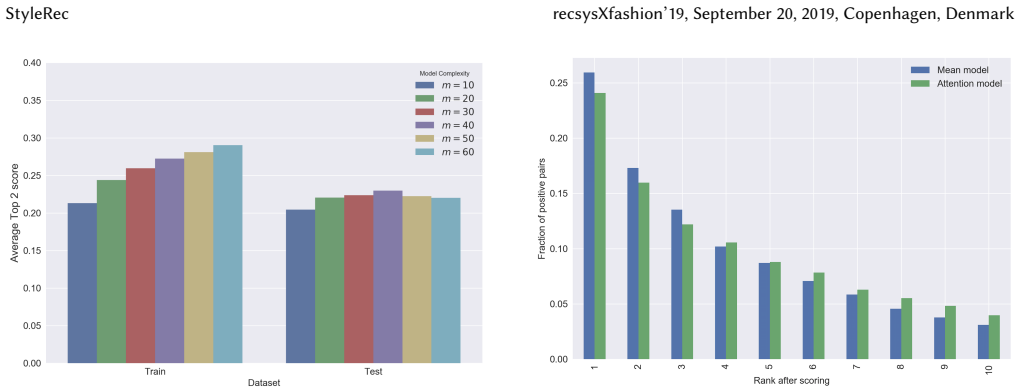
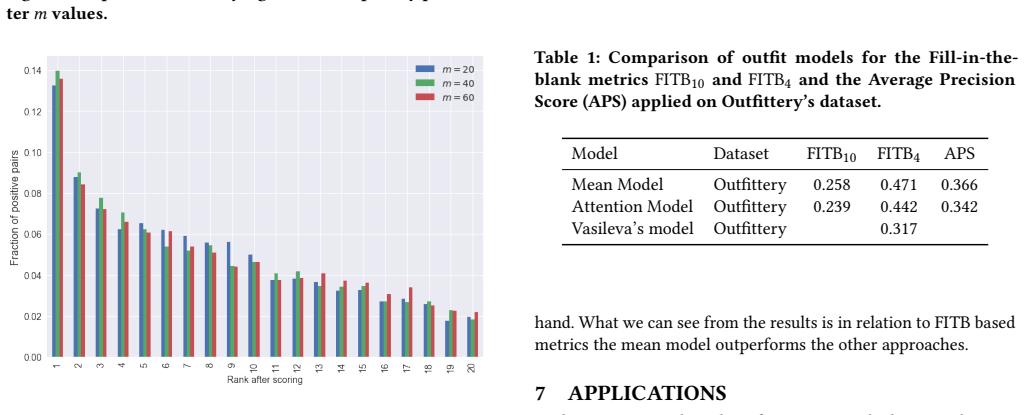
The central claim is that a latent style embedding for each fashion product can be learned solely from the context in which products appear together, exploiting stylist curations as implicit ground truth. On the authors' in-house dataset, the learned target and context spaces produce a pair-wise style-fit score that places the genuinely packed item at the top of a 20-item list with top-2 accuracy around 0.23, and the item-to-outfit mean model reaches a Fill-in-the-Blank accuracy of 0.471 for outfits of size four (FITB4). The authors report that the embeddings cluster by functional slot and, within slots, by pattern, color, formality, and item type. They further report that the simple mean model outperforms a slot-weighted attention model, and that a previously published image-and-text-based model, evaluated on the same data, scores substantially lower (FITB4 of 0.317). The paper concludes that item embeddings in latent space allow style-fit questions to be tackled both for item-to-item and item-to-outfit relations.
Load-bearing premise
The load-bearing premise is that the outfits stylists actually send to customers are reliable ground truth for style fit, so that co-occurrence in those outfits reflects compatibility rather than stock availability, season, customer taste, or price sensitivity.
Editorial extensions
If this is right
- Article ranking: the pair model can sort an entire stock by style fit to a given reference article, ranking compatible items above same-slot alternatives.
- Outfit completion: the mean model can score a candidate product against an incomplete outfit, and outperformed the attention model in the reported evaluation.
- No image or attribute data required: because the input is only product identifiers and outfit co-occurrence, the same pipeline transfers to any item catalog with curated sets.
- Automated outfit creation: beam search over a fixed slot order plus mean-model scoring generates outfits, though the authors note a tendency to prefer popular products.
- Domain specificity of existing models: the comparison indicates that an image- and text-based model trained on another dataset transfers poorly, doing little better than random scoring on the authors' data.
Reading between the lines
- If co-occurrence is partly driven by stock availability, season, or customer-specific constraints, the embedding will encode those confounds as style fit; a direct diagnostic would be to hold out entire time windows and see if the fit score still predicts future co-occurrence.
- The mean model's success over attention suggests that pair scores already carry the category-relation information; a stricter test would compare slot weights learned per category pair on a much larger dataset before concluding attention is unnecessary.
- The same co-occurrence-only recipe could apply to other curated domains such as furniture sets, meal pairings, or product bundles, wherever experts compose compatible combinations.
- Because embeddings are trained only on co-occurrence, item popularity and frequency biases may dominate; the paper's own subsampling step hints that rare-product representation needs explicit handling.
Signed reviews
Editorial analysis
A structured set of objections, weighed in public.
Referee Report
Summary. The paper proposes a method for learning fashion-item compatibility ('style fit') embeddings from stylist-curated outfit co-occurrence data at Outfittery. Treating products as words and outfits as sentences, the authors apply word2vec with negative sampling constrained to items in the same functional slot and time window, yielding a pair model (Eq. 7). They then extend the pair model to outfit-level scoring via a parameter-free mean model (Eq. 9) and a slot-pair attention model (Eq. 10). Evaluation is performed on held-out outfits for fill-in-the-blank (FITB) and average precision (APS) tasks, with a comparison against the pretrained Vasileva et al. baseline and qualitative t-SNE visualizations. The central claimed contribution is that style fit can be scored for item-to-item and item-to-outfit relations without image or attribute data.
Significance. If the central claim holds, the paper offers a practical and conceptually clean approach to fashion compatibility: style fit derived purely from co-occurrence in expert-curated outfits, with no need for images or product attributes. The strengths of the paper include the use of a large real-world production dataset (~300,000 outfits), a held-out evaluation protocol, an explicit negative-sampling scheme controlling for functional slot and time window, and a parameter-free outfit model that outperforms a more complex attention variant. The paper also honestly notes limitations, such as the cold-start issue and the model's tendency to prefer popular products. However, as presented, the quantitative evidence does not yet establish that the embeddings capture style fit as opposed to generic co-occurrence regularities; the absence of random-pair/popularity baselines and the lack of statistical significance testing leave the central claim under-supported. The significance to the recommender-systems community would be higher if these confounds were addressed.
major comments (4)
- [§2, §5, §6] The central assumption that stylist-curated outfits are a ground-truth signal for style fit is never tested. Positive and negative pairs are both generated from the outfit-creation process, so the model may be learning co-occurrence regularities driven by stock availability, customer-specific preferences, seasonal constraints, or stylist habits rather than a general notion of style compatibility. The paper should include a random-pair baseline and a popularity/frequency baseline (e.g., ranking by product frequency within the same functional slot) to isolate the co-occurrence signal. Without such baselines, the reported FITB/APS scores are consistent with an item2vec model predicting held-out co-occurrence, which weakens the load-bearing claim that the embedding space captures style fit.
- [§5.1.1, Fig. 4] The embedding dimension m is selected based on test performance ('the best performing parameter gets a value of 0.28... the overall best performing value for m is at 40'), and no error bars, confidence intervals, or significance tests are reported. This makes the reported Top-2/FITB/APS numbers optimistic and makes it unclear whether differences such as the mean model's FITB4 of 0.471 versus the attention model's 0.442 are meaningful. The authors should perform model selection on a validation split, report variance across multiple train/test splits, and include a significance test or at least bootstrap confidence intervals for the headline comparisons.
- [§6.3, Table 1] The comparison against Vasileva et al. does not support the strength of the claim. As the paper itself notes, the pretrained model is trained on women's fashion with text attributes and is 'not 100% comparable', and its FITB4 drops from 0.576 to 0.317 on Outfittery data. The table also omits FITB10 and APS for the Vasileva model, so the conclusion that the mean model 'outperforms the other approaches' rests on a single partially comparable score. A stronger baseline would be a simple co-occurrence or popularity model trained on the same data; without it, the external baseline does not isolate what the embeddings have learned.
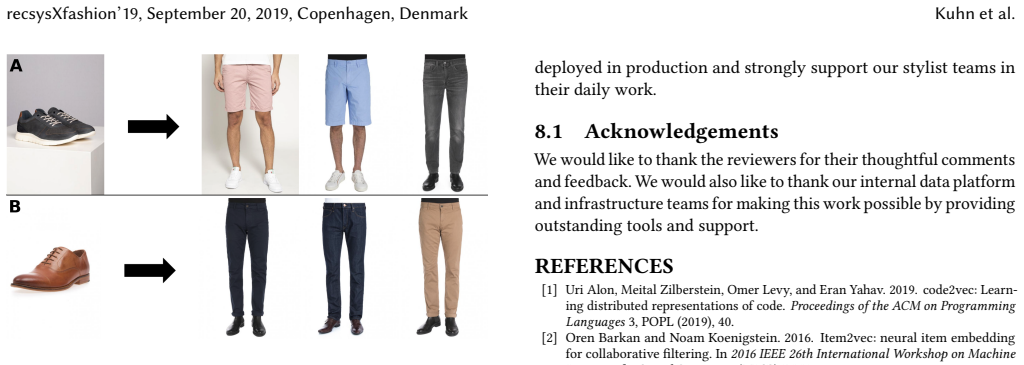
- [§7] The paper states, 'We are aware that this model tends to prefer popular products. It remains to investigate if such outfits are diverse enough.' This is a direct admission of a potential frequency confound in the rank-based applications. Since popularity broadly correlates with co-occurrence frequency, the qualitative ranking results in Fig. 7 and the beam-search outfits in Fig. 8 may reflect popularity rather than style fit. The authors should at least quantify this effect, for example by reporting whether the recommended items' frequency ranks are substantially different from a popularity-based ranking.
minor comments (6)
- [§5.1.1] The evaluation description states 'we compute precision at 2, reported as Top 2 score' but does not specify how the list of 20 items (1 positive, 19 negatives) is constructed for the pair model. Please clarify whether the negatives are sampled uniformly from the same slot and time window as in training, and whether the reported score is averaged over all target products.
- [§5.1.1] The term 'hit rate for each rank position' is defined as 1/rank, which is actually reciprocal rank, not a hit rate. Consider renaming it to avoid confusion with the standard hit-rate-at-k metric.
- [§6.1] In the caption of Fig. 3, 'stylstic' should be 'stylistic'.
- [§6.3] In the sentence 'Vaisleva's model performs substantially worse...', the author name is misspelled as 'Vaisleva' instead of 'Vasileva'.
- [§2] The description of the negative-sampling scheme in §2.1.2 says negatives share 'functional slot' with the positive context product, but the mathematical definition in Eq. (6) draws negative samples without explicitly stating this constraint. Please align the notation with the sampling procedure.
- [§8] The cold-start discussion is brief and dismissive: 'we get new training data every day' addresses data availability but not the quality of embeddings for products with only a few co-occurrences. A short analysis of embedding quality versus product frequency would strengthen the discussion.
Circularity Check
No significant circularity: the model is a self-contained item2vec application evaluated on held-out co-occurrence, with an external baseline.
full rationale
The derivation chain is self-contained. The paper trains a word2vec-style pair model (Eq. 5-6) directly on positive and negative product pairs sampled from stylist outfits (Section 2), then evaluates the resulting pair and outfit scores on held-out products and outfits from the same sampling process (Sections 5-6). The only fitted quantities are the embedding vectors, the attention weights, and standard hyperparameters (m, rho, Npair); none of these fitted quantities is subsequently reported as a prediction of itself. The evaluation metrics (Top 2, hit rate, APS, FITB) are computed on held-out instances, not on training instances, and the paper includes an external pretrained baseline (Vasileva et al.). The explicit assumption in Section 2 that stylist outfits constitute ground truth for style fit is a data-validity assumption, not a circular derivation: the model's output is co-occurrence likelihood, and the claim that this captures style fit rests on that assumption, but the assumption is not derived from the model and the model is not derived from the assumption. There are no self-citations, no imported uniqueness theorems, no ansatz smuggled in via citation, and no fitted parameter renamed as a prediction. The absence of random-pair or popularity baselines and of stylist-agreement measurements is a correctness and validity concern, not a circularity concern under the criteria of this review.
Assumptions & free parameters
free parameters (7)
- embedding dimension m =
40 (selected via test performance, Fig. 4)
- number of negative samples per positive pair Npair =
80
- positive-subsampling threshold rho =
0.0002
- AdaGrad learning rate =
1.0
- training epochs =
30 for pair model, 10 for attention model
- attention slot-pair weights alpha =
trained (values not reported)
- number of negative query products Noutfit =
19
assumptions (5)
- domain assumption Curated outfits are valid ground truth for style fit.
- domain assumption Style fit can be inferred from product co-occurrence alone, without images or attributes.
- domain assumption Negative pairs from the same functional slot and time window form a proper background distribution.
- domain assumption Outfit style fit is reducible to a sum or average of pairwise fit scores.
- domain assumption The word2vec negative-sampling objective produces embeddings whose pairwise cosine similarity reflects style fit.
Cite this review
Pith. "Pith review of Supporting stylists by recommending fashion style." pith.science (2026). https://pith.science/paper/LB4DPT3G
@misc{pith2026190809493,
  author       = {Pith},
  title        = {Pith review of: Supporting stylists by recommending fashion style},
  year         = {2026},
  howpublished = {\url{https://pith.science/paper/LB4DPT3G}},
  note         = {Machine review of arXiv:1908.09493}
}
read the original abstract
Outfittery is an online personalized styling service targeted at men. We have hundreds of stylists who create thousands of bespoke outfits for our customers every day. A critical challenge faced by our stylists when creating these outfits is selecting an appropriate item of clothing that makes sense in the context of the outfit being created, otherwise known as style fit. Another significant challenge is knowing if the item is relevant to the customer based on their tastes, physical attributes and price sensitivity. At Outfittery we leverage machine learning extensively and combine it with human domain expertise to tackle these challenges. We do this by surfacing relevant items of clothing during the outfit building process based on what our stylist is doing and what the preferences of our customer are. In this paper we describe one way in which we help our stylists to tackle style fit for a particular item of clothing and its relevance to an outfit. A thorough qualitative and quantitative evaluation highlights the method's ability to recommend fashion items by style fit.
Figures


Figures from the paper (4 more)

Reference graph
Works this paper leans on
-
[1]
Uri Alon, Meital Zilberstein, Omer Levy, and Eran Yahav. 2019. code2vec: Learn- ing distributed representations of code. Proceedings of the ACM on Programming Languages 3, POPL (2019), 40
work page 2019
-
[2]
Oren Barkan and Noam Koenigstein. 2016. Item2vec: neural item embedding for collaborative filtering. In 2016 IEEE 26th International Workshop on Machine Learning for Signal Processing (MLSP) . IEEE, 1–6
2016
-
[3]
Duchi, Elad Hazan, and Yoram Singer
John C. Duchi, Elad Hazan, and Yoram Singer. 2011. Adaptive Subgradient Methods for Online Learning and Stochastic Optimization. Journal of Machine Learning Research 12 (07 2011), 2121–2159
work page 2011
-
[4]
Jingcheng Du, Peilin Jia, Yulin Dai, Cui Tao, Zhongming Zhao, and Degui Zhi
-
[5]
Markus Freitag and Yaser Al-Onaizan. 2017. Beam Search Strategies for Neural Machine Translation. CoRR abs/1702.01806 (2017). arXiv:1702.01806 http://arxiv. org/abs/1702.01806
arXiv 2017
-
[6]
Yoav Goldberg and Omer Levy. 2014. word2vec Explained: deriving Mikolov et al. ’s negative-sampling word-embedding method.arXiv preprint arXiv:1402.3722 (2014)
arXiv 2014
-
[7]
Xintong Han, Zuxuan Wu, Yu-Gang Jiang, and Larry S Davis. 2017. Learning fashion compatibility with bidirectional lstms. In Proceedings of the 25th ACM international conference on Multimedia . ACM, 1078–1086
2017
-
[8]
Hanbit Lee, Jinseok Seol, and Sang-goo Lee. 2017. Style2Vec: Representation Learning for Fashion Items from Style Sets
work page 2017
Show all 14 references
-
[9]
Tomas Mikolov, Kai Chen, Greg Corrado, and Jeffrey Dean. 2013. Efficient estimation of word representations in vector space.arXiv preprint arXiv:1301.3781 (2013)
2013 arXiv
-
[10]
Mariya I Vasileva, Bryan A Plummer, Krishna Dusad, Shreya Rajpal, Ranjitha Kumar, and David Forsyth. 2018. Learning type-aware embeddings for fashion compatibility. In Proceedings of the European Conference on Computer Vision (ECCV). 390–405
2018
-
[11]
Ashish Vaswani, Noam Shazeer, Niki Parmar, Jakob Uszkoreit, Llion Jones, Aidan N Gomez, Łukasz Kaiser, and Illia Polosukhin. 2017. Attention is all you need. In Advances in neural information processing systems . 5998–6008
2017
-
[12]
Andreas Veit, Balazs Kovacs, Sean Bell, Julian McAuley, Kavita Bala, and Serge Belongie. 2015. Learning visual clothing style with heterogeneous dyadic co- occurrences. In Proceedings of the IEEE International Conference on Computer Vision. 4642–4650
2015
-
[13]
Mu Zhu. 2004. Recall, precision and average precision. (09 2004)
2004
-
[2019]
BMC genomics 20, 1 (2019), 82
Gene2vec: distributed representation of genes based on co-expression. BMC genomics 20, 1 (2019), 82
2019
Reviewed August 14, 2026 · model on record in the stance chip above.
Discussion (0). Continue with ORCID to comment.