REVIEW 3 major objections 3 minor 5 references
Motile Escherichia coli-laden Droplets Exhibit Reduced Adhesion and Anomalous Wetting Behavior
T0 review · 3 major / 3 minor · reviewed 2026-08-15 · deepseek-v4-flash
Pith's one-line read Live, swimming E. coli lower droplet adhesion to surfaces, and more bacteria lower it further, by opposing capillary flow and promoting contact-line depinning.
desk verdict A quantitative but not yet watertight case that bacterial motility reduces droplet adhesion; the dead control is the weak link. read the letter →
The pith
A machine-rendered reading of the paper's core claim, the machinery that carries it, and where it could break.
The reading
What carries the argument
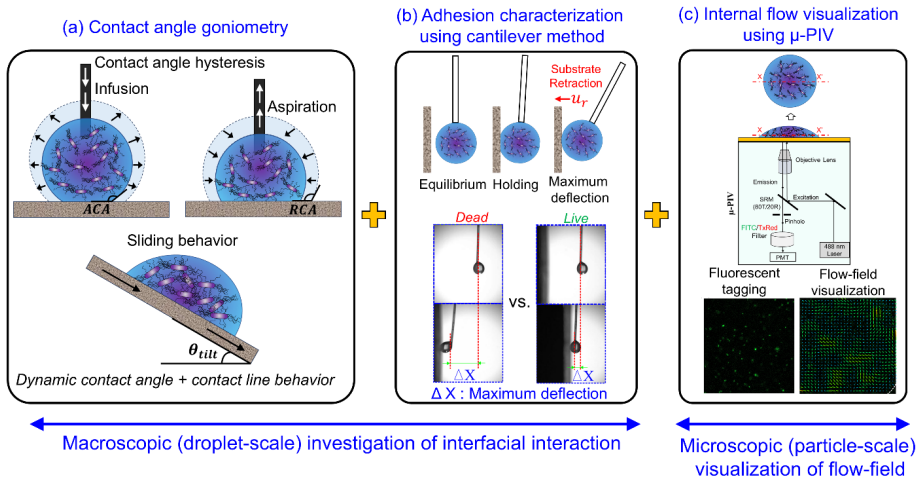
The load-bearing mechanism is flagellar run-and-tumble motility, the alternating straight swimming and reorientation that lets E. coli exert its own forces on the surrounding fluid and swim upstream (positive rheotaxis). The paper tracks the competition between this active swimming and the evaporation-driven capillary flow with micro-particle image velocimetry, and quantifies the resulting organization with a temporally resolved two-point Pearson correlation of velocity components: live suspensions keep peak correlations near 0.96 that decay slowly across the roughly 200 µm observation window, while dead suspensions decorrelate within about 40 µm. The proposed link to adhesion is that these coordinated, intermittently reversing flows agitate and repeatedly depin the triple contact line, an effect quantified on the force side by the cantilever relation $F_{\mathrm{adh}} = k\Delta X$, where $k$ is the cantilever spring constant and $\Delta X$ the maximum deflection at detachment.
What would settle it
A decisive test would measure cantilever adhesion for viable non-motile mutants at the same concentration and on the same superhydrophobic surface: the paper's claim predicts that droplets with mutant cells stick near the dead-cell value (about 39 µN at $10^7$ CFU/mL) rather than the live-cell value (about 9 µN). If the mutant droplets also show low adhesion, the reduction is not caused by swimming.
Extended reading notes
Core claim
The central claim is that motile E. coli inside a sessile droplet actively oppose the evaporation-driven capillary flow that normally carries particles toward the triple contact line, and that this opposition—amplified into coordinated, direction-reversing collective motion at higher concentrations—mechanically disturbs the contact line, promotes depinning, and therefore lowers the force needed to detach the whole droplet. Direct force measurements support the claim: at about $10^7$ CFU/mL, live droplets showed an adhesion near 9 µN against roughly 39 µN for dead droplets, with live-droplet adhesion decreasing statistically significantly as concentration increased and dead-droplet adhesion increasing slightly. Micro-PIV and particle tracking show that dead bacteria passively ride the capillary flow toward the contact line, whereas live bacteria exhibit around-zero mean net velocity, frequent directional reversals, and long-range spatial correlations. The paper argues this is positive rheotaxis: flagellated cells swim upstream against the shear near the wall, and at high density their coordinated swimming promotes frequent contact-line depinning events that reduce adhesion.
Load-bearing premise
The live-versus-dead comparison assumes that dead bacteria are an inert stand-in for non-motile cells, but the alcohol-killing step leaves clumps of cell debris that could themselves pin the contact line and raise adhesion, so part of the measured difference may come from clumping rather than from the absence of swimming.
Editorial extensions
If this is right
- On superhydrophobic surfaces, conventional contact angle measurements cannot predict how strongly a biologically active droplet sticks, because a one-pixel baseline error can change the inferred work of adhesion by roughly 35 percent or more.
- Within the first hundred seconds after deposition, droplets carrying live motile bacteria are easier to remove than droplets carrying inert particles of the same size, and this removal advantage grows with bacterial concentration.
- Because increasing the concentration of live bacteria lowers adhesion while the opposite holds for dead cells, contamination load does not simply make a droplet harder to clean at early timescales.
- Sliding behavior of live droplets is governed by frequent depinning events rather than by macroscopic receding angle or hysteresis, so droplet roll-off models based only on these angles will misclassify active biological droplets.
- The cantilever-deflection method, rather than goniometry, is needed to resolve subtle adhesion differences between live and dead bacterial suspensions.
Reading between the lines
- The paper does not test whether the effect extends to other motile species, but if it does, the viability of airborne pathogens changes their physical persistence on surfaces: a droplet of living, swimming bacteria should roll off a repellent surface more readily than one containing inactivated cells, which would alter fomite-contamination patterns.
- A cleaner control than alcohol-killed cells would be viable but non-motile mutants (for example, flagellar-knockout strains) or dead cells prepared without lysis; the paper's own limitation note acknowledges that aggregates in the dead sample could contribute to pinning, so the true size of the motility effect is not yet isolated.
- The correlation data imply a quantitative prediction the authors did not make: the adhesion reduction should scale with an activity ratio of swimming strength to capillary flow strength, so that on surfaces or under humidity conditions with weaker evaporation-driven flow, the same bacterial concentration should produce even larger relative adhesion reductions.
- If the depinning mechanism is robust, it could be exploited deliberately—for example, by maintaining conditions that sustain motility in deposited droplets—as a passive cleaning strategy, rather than designing surfaces only for low surface energy.
Signed reviews
Editorial analysis
A structured set of objections, weighed in public.
Referee Report
Summary. This manuscript investigates how flagellar motility of E. coli within sessile droplets affects droplet-surface adhesion and wetting. Using a cantilever-deflection method on superhydrophobic NeverWet surfaces, the authors report that live-bacteria-laden droplets exhibit lower adhesion than dead-bacteria-laden droplets, and that adhesion decreases with increasing live-bacteria concentration while increasing (nonsignificantly) for dead ones. Micro-PIV on glass shows that live bacteria have lower net velocity toward the contact line and stronger spatial correlations than dead bacteria, which is interpreted as rheotactic resistance and collective motion. Sliding experiments on PMMA show more frequent stick-slip and earlier depinning for live droplets, which inert-particle and surface-tension-matched proxy suspensions do not reproduce. The authors conclude that bacterial motility alone reorganizes internal flow and weakens contact-line pinning, thereby reducing droplet adhesion.
Significance. If the causal claim survives, this would be a novel and useful result for self-cleaning and antifouling surface design, combining a direct droplet-scale adhesion measurement with internal flow visualization. The paper's strengths include the cantilever-based adhesion quantification, the inclusion of falsifiable proxy experiments (surface-tension-matched fluids and inert particles), and the careful statistical treatment of PIV velocity data. The central live-vs-dead comparison, however, is not a clean test of motility because the inactivation protocol likely introduces aggregates, and the mechanistic chain is assembled from measurements on three different substrates. The paper's own limitation section acknowledges the aggregate issue but does not resolve it, leaving the magnitude of the motility contribution uncertain.
major comments (3)
- [Study Scope and Limitations; Fig. S4; Fig. 3(d)] The live-vs-dead contrast is the sole experimental basis for attributing reduced adhesion to motility, but the dead control is confounded by aggregation. Dead cells were produced by suspension in 70% IPA, which can lyse cells; the authors' own DLS (Fig. S4) reports a high polydispersity index for the dead sample and notes possible aggregates from lysis products. Since the authors themselves argue, citing refs. 45-46 and 50, that inert microparticles increase contact-line pinning and adhesion, larger aggregates in the dead sample could independently raise adhesion. The dead samples do show the expected inert-particle signature: higher adhesion (about 39 µN vs about 9 µN at 10^7 CFU/mL) and a monotonically increasing adhesion with concentration, although the latter is not statistically significant. Without a clean non-motile control, such as heat-killed cells with confirmed absence of aggregates or a motile-deficient strain, the adhesion difference cannot be uniquely attributed to the absence of swimming. This issue is acknowledged in the Study Scope and Limitations but is not experimentally controlled; it is load-bearing for the central claim.
- [Microscopic visualization of internal motion dynamics; Sliding Behavior Explains Near Contact Line Dynamics] The mechanistic inference is assembled across mismatched substrates. Adhesion is measured on superhydrophobic NeverWet surfaces, PIV is performed on clean glass, and sliding experiments on PMMA. Since contact-line pinning and droplet retention depend strongly on substrate roughness, chemistry, and wettability, the claim that the observed internal flow organization promotes depinning on the NeverWet surface is an extrapolation. In particular, the proxy sliding experiments (Fig. S7 and Supporting Videos S6-S7) demonstrate only that surface tension and 1-µm polystyrene beads cannot reproduce the live-droplet sliding behavior on PMMA; they do not test the adhesion scenario on NeverWet, and the proxy particles do not mimic the aggregated morphology of the dead cells. A bridging experiment, for example PIV on the actual adhesion substrate or adhesion measurement on the PIV substrate, is needed to support the causal chain.
- [Direct quantification of surface adhesion using cantilever method; Fig. S5] The passive surface-tension channel is not excluded on the adhesion substrate. Live droplets at 10^7 CFU/mL have surface tension 65.82 +/- 1.6 mN/m versus about 72 mN/m for water and dead droplets, and Fig. S5 shows a further time-dependent decrease to about 57.5 mN/m during the measurement window. The proxy suspensions used to rule out surface-tension effects (Fig. S7) were characterized only in sliding experiments on PMMA, not in cantilever adhesion on NeverWet. On a superhydrophobic surface, the capillary adhesion force can scale directly with surface tension, so the lower adhesion of live droplets may be in part a passive consequence of lower surface tension rather than of motility-induced depinning. The manuscript should either measure adhesion of a surface-tension-matched passive suspension on NeverWet or provide a quantitative argument showing that the observed roughly 30 µN reduction cannot be explained by the surface tension difference.
minor comments (3)
- [Sliding Behavior Explains Near Contact Line Dynamics of Bacterial Droplets] The figure containing the sliding data is referenced in the text as 'Figure 8' but is captioned 'Figure 6'; the in-text references to 'Figure 6c' and 'Figure 6a' in the same section should be corrected to the actual figure number and panels.
- [Dynamic Wetting Characterization via Contact Angle Goniometry] The sentence 'It leads to inaccurate identification of the baseline of the droplet, thereby causing the propagation of substantial systematic errors' is missing a clear antecedent for 'It'; consider rephrasing to identify the source of the error, such as optical noise or baseline misidentification.
- [Materials and Methods - Wetting & adhesion measurements] The statistical description 'two-way ANOVA (Tukey) test' should be clarified as 'two-way ANOVA followed by Tukey's post hoc test'.
Circularity Check
No significant circularity: all load-bearing measurements are direct and the central claim is not defined in terms of its own output.
full rationale
The paper's central chain—live E. coli droplets show lower cantilever-measured adhesion than IPA-killed droplets, with adhesion decreasing at higher live-cell concentration—is based on directly measured forces (F = kΔX), directly measured contact angles, and PIV velocity fields; there is no fitted parameter that is later renamed a prediction and no equation in which the output is introduced as an input. The only author-overlap citations (refs 45–48; e.g. 'The procedure for adhesion measurement is discussed in greater detail in our previous works') are methodological descriptions of the cantilever technique and are not load-bearing for the motility mechanism; the method is also anchored to an external reference (ref. 44). The live-vs-dead control is the main validity risk, not a circularity: the authors acknowledge in 'Study Scope and Limitations' that '70% IPA treatment used for preparing dead bacterial samples may introduce lysis products' and that 'DLS indicated the presence of potential agglomerates in the dead samples,' which could influence interfacial behavior. That is an experimental confound (aggregates as an alternative pinning explanation), not a reduction of the paper's claim to its own inputs. The proxy sliding tests with surface-tension-matched liquids and 1-μm polystyrene beads provide an external falsification attempt, and the mechanism is interpreted using established external literature on rheotaxis and quorum sensing rather than self-citations. Score 1 reflects only the minor methodological self-citations and the acknowledged confound; no circular step is present.
Assumptions & free parameters
assumptions (5)
- domain assumption Evaporation-driven capillary flow in pinned sessile droplets carries suspended particles toward the contact line (Deegan 1997).
- domain assumption E. coli exhibit positive rheotaxis, swimming upstream near solid surfaces (Hill et al. 2007; Marcos et al. 2012).
- domain assumption Quorum sensing allows collective coordinated motion at high cell concentrations (Miller and Bassler 2001).
- standard math The cantilever-deflection method measures the characteristic droplet adhesion force at the point of depinning or detachment (prior work of the same group, references 45-48).
- domain assumption Fluorescent staining with SYTO 9 and propidium iodide does not significantly alter E. coli motility.
Cite this review
Pith. "Pith review of Motile Escherichia coli-laden Droplets Exhibit Reduced Adhesion and Anomalous Wetting Behavior." pith.science (2026). https://pith.science/paper/LB5ELBYJ
@misc{pith2026251024535,
  author       = {Pith},
  title        = {Pith review of: Motile Escherichia coli-laden Droplets Exhibit Reduced Adhesion and Anomalous Wetting Behavior},
  year         = {2026},
  howpublished = {\url{https://pith.science/paper/LB5ELBYJ}},
  note         = {Machine review of arXiv:2510.24535}
}
read the original abstract
Hypothesis: Bacterial contamination of surfaces poses a major threat to public health. Designing effective antibacterial or self-cleaning surfaces requires understanding how bacteria-laden droplets interact with solid substrates and how readily they can be removed. We hypothesize that bacterial motility critically influences the early-stage surface interaction (i.e., surface adhesion) of bacteria-laden droplets, which cannot be captured by conventional contact angle goniometry. Experiments: Sessile droplets containing live and dead Escherichia coli (E. coli) were studied to probe their wetting and interfacial behavior. Contact angle goniometry was used to probe dynamic wetting, while a cantilever-deflection-based method was used to quantify adhesion. Internal flow dynamics were visualized using micro-particle image velocimetry (PIV) and analyzed statistically. Complementary sliding experiments on moderately wettable substrates were performed to assess contact line mobility under tilt. Findings: Despite lower surface tension, droplets containing live bacteria exhibited lower surface adhesion forces than their dead counterparts, with adhesion further decreasing at higher bacterial concentrations. Micro-PIV revealed that flagellated live E. coli actively resist evaporation-driven capillary flow via upstream migration, while at higher concentrations, collective dynamics emerge, producing spatially coherent bacterial motion despite temporal variability. These coordinated flows disrupt passive transport and promote depinning of the contact line, thereby reducing adhesion. Sliding experiments confirmed enhanced contact line mobility and frequent stick-slip motion in live droplets, even with lower receding contact angles and higher hysteresis. These findings provide mechanistic insight into droplet retention, informing the design of self-cleaning/antifouling surfaces.
Figures


Figures from the paper (3 more)


Reference graph
Works this paper leans on
-
[1]
Supporting Videos Supporting Video S1: Concentration dependence of surface adhesion of live bacteria -laden droplets Supporting Video S2: Concentration dependence of surface adhesion of dead bacteria laden droplets Supporting Video S3: Evolution of the velocity field of the live bacterial tracers within the droplet Left panel illustrates the temporal evol...
-
[2]
1% (wt/v) ammonium molybdate is used for staining
Supporting Figures Figure S1: Transmission electron microscopy (TEM) images of the stained bacteria samples at two different magnifications, which clearly show the presence of flagella responsible for the motility. 1% (wt/v) ammonium molybdate is used for staining. Scale bar 500 nm. Figure S2: Scanning electron microscopy (SEM) of the superhydrophobic Nev...
-
[15]
We are particularly interested in the fourth quadrant ( 3𝜋 2 − 2𝜋), which exclusively corresponds to velocity vectors that simultaneously satisfy 𝑈 > 0 and 𝑉 < 0, i.e., velocity vectors those are clearly directed toward the three -phase contact line (TCL) (see sign convention in Figure 5(c)). To quantify this directional bias, we compute the total number ...
-
[829]
https://doi.org/10.1038/39827. (28) Blount, Z. D. The Unexhausted Potential of E. Coli. eLife 4, e05826. https://doi.org/10.7554/eLife.05826. (29) E. Coli in Motion; Berg, H. C., Ed.; Biological and Medical Physics, Biomedical Engineering; Springer: New York, NY, 2004. https://doi.org/10.1007/b97370. (30) Patteson, A. E.; Gopinath, A.; Goulian, M.; Arrati...
-
[5963]
https://doi.org/10.1073/pnas.1703997114. (27) Deegan, R. D.; Bakajin, O.; Dupont, T. F.; Huber, G.; Nagel, S. R.; Witten, T. A. Capillary Flow as the Cause of Ring Stains from Dried Liquid Drops. Nature 1997, 389 (6653), 827–
Reviewed August 15, 2026 · model on record in the stance chip above.
Discussion (0). Continue with ORCID to comment.