REVIEW 3 major objections 6 minor 98 references
Qutrit neural quantum kernels beat matched quantum neural nets on binary and three-class tasks, and the SU(3) parameterization choice strongly shapes both training and accuracy.
Reviewed by Pith at T0; open to challenge. T0 means a machine referee read the full paper against a public rubric. the ladder, T0–T4 →
T0 review · grok-4.5
2026-07-30 15:58 UTC pith:LBXPBFGF
load-bearing objection Solid, honest design study extending NQKs to qutrits; useful ablations, incremental novelty, and a real but overstated QNN-vs-kernel comparison caveat. the 3 major comments →
Qutrit-Based Neural Quantum Kernels for Classification Tasks
The pith
A machine-rendered reading of the paper's core claim, the machinery that carries it, and where it could break.
Core claim
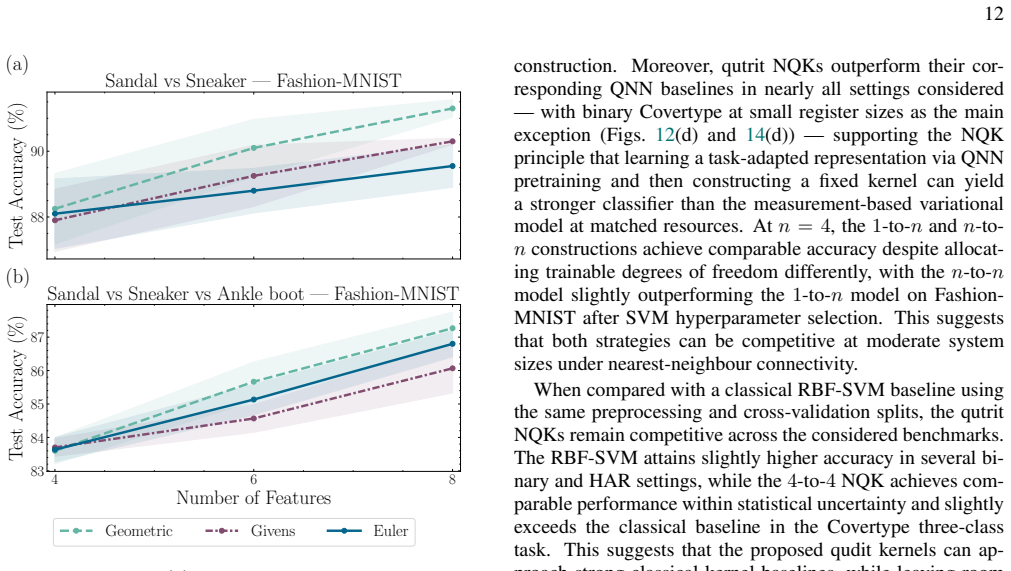
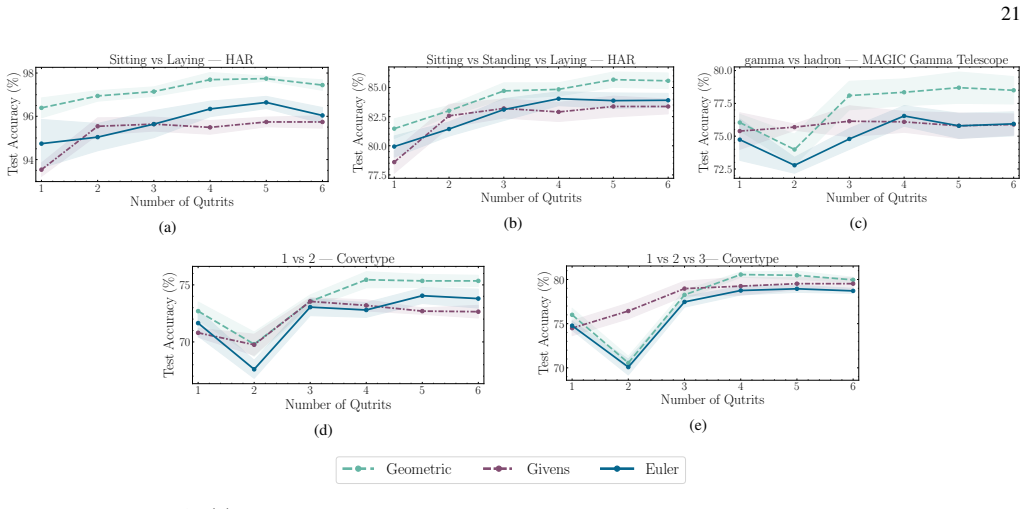
On four standard benchmarks, for both binary and three-class problems, qutrit neural quantum kernels improve over the matched pretrained QNN classifiers in nearly all configurations tested, and performance can rise with encoded feature count and with system size, though gains often saturate and depend on dataset and on how SU(3) unitaries are parameterized; the unitary parameterization itself materially changes optimization behavior and final accuracy.
What carries the argument
Neural quantum kernels (NQKs): pretrain a data-reuploading qutrit QNN (optionally grown progressively), freeze its circuit as the embedding, and form an embedding quantum kernel from state overlaps; two lifts are used—1-to-n (replicate a trained single-qutrit map with fixed entanglement) and n-to-n (train the full multi-qutrit embedding).
Load-bearing premise
All reported gains come from ideal noiseless simulations with fixed circuit depth, nearest-neighbour entanglement, heavy random restarts, and PCA-compressed features, so the claimed QNN-to-kernel lift may not survive noise, finite shots, or different preprocessing.
What would settle it
Rerun the same Fashion-MNIST and Covertype binary and three-class protocols with realistic noise and finite-shot overlap estimates: if the 1-to-4 and 4-to-4 NQKs no longer beat the matched QNN baselines, or if the geometric SU(3) edge disappears, the central empirical claim fails to transfer.
If this is right
- Task-adapted qutrit embeddings used as fixed kernels are a practical alternative to end-to-end variational readout at matched resources.
- Feature budget and register size are useful but saturating knobs; more is not automatically better once p and n are moderate.
- SU(3) parameterization must be treated as a first-class design choice, not an implementation detail, because it changes both trainability and accuracy.
- 1-to-n and n-to-n constructions can reach similar accuracy at n=4 despite different trainable freedom, so the simpler replicated map remains competitive at moderate size.
- Qutrit NQKs can stay competitive with classical RBF-SVMs on the same splits while offering a direct three-class computational-basis interface.
Where Pith is reading between the lines
- If noise and shot noise erase the kernel lift first on n-to-n (deeper joint training) rather than 1-to-n, hardware-era designs may prefer replicated single-qutrit maps with fixed entanglers.
- The geometric parameterization’s more symmetric generator coupling may explain its smoother feature scaling; testing whether random or learned feature-to-coordinate assignments close the gap for Euler and Givens forms would isolate inductive bias from expressivity.
- Extending the same NQK pipeline to d>3 would test whether extra local generators buy multiclass headroom or mainly increase barren-plateau and calibration cost.
- Because kernel construction reduced sensitivity to the pretraining loss in the three-class ablations, hybrid “train embedding, convex readout” pipelines may be a general stabilizer for qudit classifiers beyond this architecture.
Editorial analysis
A structured set of objections, weighed in public.
Referee Report
Summary. The manuscript extends neural quantum kernels from qubits to qutrits. It generalizes the data-reuploading embedding to local SU(3) blocks, introduces qutrit SUM and controlled-rotation entanglers, and studies both 1-to-n and n-to-n kernel constructions for binary and three-class classification. Noiseless simulations on Fashion-MNIST, HAR, MAGIC, and Covertype examine feature budget, system size, three SU(3) parameterizations, and cost-function sensitivity. The authors report that the resulting NQKs outperform matched QNN baselines in nearly all settings, that gains from additional features and qutrits are dataset-dependent and often saturate, and that the Geometric SU(3) parameterization usually performs best and shows more favorable training diagnostics. The NQKs are broadly competitive with, but do not clearly exceed, an RBF-SVM baseline.
Significance. If the reported comparisons hold up, this is a useful systematic design study for qudit quantum machine learning and a natural extension of NQKs beyond qubits. Its strengths are the breadth of the empirical protocol: two kernel constructions, binary and multiclass tasks, four datasets, three SU(3) parameterizations, matched circuit baselines, stratified five-fold evaluation with preprocessing fitted only on training folds, standard errors, a classical RBF-SVM comparison, and informative cost-function and training-diagnostics appendices. The claims are generally hedged and the paper does not overstate them as a quantum advantage. Its significance is primarily methodological guidance for qutrit model design under ideal simulation, rather than evidence of near-term practical superiority over classical methods.
major comments (3)
- [Sec. III B; Tables II and VI] The evaluation protocol does not state where the SVM regularization C—and the RBF baseline’s C and γ—are selected. If the grid search uses the held-out fold’s test accuracy, Tables II and VI and the QNN-versus-NQK comparisons are optimistically biased; if an inner training split or nested cross-validation was used, this needs to be stated explicitly. Because several reported differences are only about 1–3 percentage points, the selection protocol is load-bearing. Please use nested model selection or a fixed validation split, and preferably report paired fold-level differences in addition to fold means and standard errors.
- [Sec. II A; Eqs. (20)–(21); Figs. 4–7; Table II] The central QNN-to-NQK comparison is asymmetric in readout capacity. The QNN predicts from a fixed threshold on one ⟨Sz⟩ value, or an argmax over three probabilities on one qutrit, whereas the NQK receives a tuned SVM over a kernel of the full n-qutrit feature states. The manuscript itself characterizes the mechanism as replacing the QNN’s fixed measurement rule with an optimized readout. Consequently, the lift may reflect readout capacity or access to richer state information rather than the qutrit kernel construction specifically. A frozen-embedding control is needed: for the same trained circuits, train a logistic/linear or kernel SVM on all single-qutrit outcome probabilities or a richer fixed set of low-order moments, using the same nested tuning; a validation-tuned binary threshold would also be useful. If this control matches the NQK, the conclusion should be narrowed to an SVM-re
- [Sec. III E 1, Eqs. (10)–(12); Appendix D, Fig. 20] The parameterization ablation compares Geometric, Euler, and Givens coordinates at the same learning rate and with the same sequential assignment of the first p coordinates, but these coordinates have different nonlinear roles, effective ranges, and Jacobian scales. The larger gradient norms reported for the Geometric form may therefore indicate a different parameter-space metric or effective optimization step size rather than intrinsically more favorable optimization. To support the comparatively strong conclusion that the unitary representation affects optimization behaviour, please add a learning-rate/optimization-budget sweep or a Jacobian-normalized encoding-scale comparison, or explicitly restrict the claim to the present fixed optimizer and coordinate-scaling protocol.
minor comments (6)
- [Abstract and Sec. IV] Please state in the abstract that all experiments are ideal, noiseless state-vector simulations at fixed depth L=6. The limitation is appropriately acknowledged later, but including it in the abstract would prevent the performance claims from being read as hardware results.
- [Secs. II B 4 and III E 1] The statement that features enter “symmetrically” in the Geometric parameterization is potentially misleading because the su(3) generators do not commute. “Jointly through a linear combination before exponentiation” would be more precise.
- [Sec. III B] Please specify how the fixed per-class subsamples are drawn, whether the same subsamples and fold assignments are used across all models, and how many independent optimization runs are used at each progressive-growth step for n>1. A code/data availability statement with seeds would also improve reproducibility.
- [Figs. 4–7 and Appendix B] Several qualitative phrases such as “saturates,” “non-monotonic,” and “marginal” would be easier to assess if the captions or tables reported the numerical paired differences and uncertainties at the relevant values of n and p.
- [Table VI and Appendix B] Typographical issues include “97.69±00.33,” “qutrit NQK’s,” and the missing period in “Fig 15.” There is also a duplicated comma in the reference to “Sec. II A 1,,” in Sec. III B.
- [References] Refs. [11] and [50] appear to cite the same Nature Physics paper by Liu, Arunachalam, and Temme. Please consolidate duplicate references and check the reference list for similar redundancies.
Circularity Check
Empirical architecture study with no circular derivation: reported gains are measured, not forced by definition or self-citation.
full rationale
The paper extends Neural Quantum Kernels from qubits to qutrits and reports cross-validated classification accuracy under controlled ablations (feature budget p, system size n, 1-to-n vs n-to-n, SU(3) parameterizations) on four external benchmarks, plus a classical RBF-SVM baseline. The central claim—that qutrit NQKs improve over matched QNN baselines in nearly all settings—is an empirical comparison of two predictors built from the same pretrained embedding, not a first-principles derivation. Kernel entries are Hilbert–Schmidt overlaps of frozen feature states (Eqs. 3–4); SVM coefficients are fit on the training kernel matrix and scored on held-out folds. Nothing equates reported test accuracy to a fitted input by construction. Self-citations to the authors’ prior NQK work supply the method being generalized (progressive growth, 1-to-n / n-to-n), not the accuracy numbers or the SU(3) ablation outcomes. Hyperparameter search (C, restarts) and the acknowledged readout asymmetry (fixed QNN threshold/argmax vs SVM) are experimental-design issues, not circular reductions. No uniqueness theorem, smuggled ansatz-as-theorem, or renaming of a known law appears. Score 0 is appropriate.
Axiom & Free-Parameter Ledger
free parameters (5)
- Circuit depth L =
6
- Encoded feature budget p and PCA truncation =
p ≤ 8 (often fixed at 8)
- QNN optimizer hyperparameters =
LR=0.006 (1-qutrit), 0.002 (growth); WD=1e-5; 70/20 epochs; 7000 restarts
- SVM regularization C (and RBF γ for baseline) =
C in {0.01,0.1,1,10,100}; γ in {scale,0.001,0.01,0.1,1}
- Entangling ansatz angles / fixed SUM pattern =
nearest-neighbour CR1·CR4·CR6 or fixed SUM3
axioms (5)
- domain assumption Embedding quantum kernels from pure-state overlaps k(xi,xj)=|⟨0|S(xi)†S(xj)|0⟩|² are valid PSD kernels for classical SVM training.
- domain assumption Noiseless, infinite-shot simulation of qutrit circuits is a meaningful proxy for comparing architectures.
- ad hoc to paper Progressive growth with zero-init on new qutrits/entanglers is a fair scalable training strategy for n-to-n embeddings.
- ad hoc to paper Sequential assignment of the first p coordinates in each SU(3) parameterization is a reasonable feature-encoding convention.
- standard math Standard linear algebra / SU(d) representation theory for qutrit unitaries and controlled gates.
invented entities (1)
-
Qutrit neural quantum kernel (1-to-n and n-to-n constructions)
no independent evidence
read the original abstract
Neural quantum kernels (NQKs) construct quantum kernels by pretraining a quantum neural network (QNN) and subsequently reusing the trained circuit as a task-adapted embedding. Extending this framework to qudits, with local unitaries in $\mathrm{SU}(d)$, provides a natural route to richer data embeddings through the increased local degrees of freedom and a direct interface for multiclass classification via intrinsically multi-level quantum systems. In this work, focusing on qutrits ($d=3$), we extend NQKs to the qudit setting and perform a systematic study of key design choices, including the number of encoded features, the number of qutrits, the kernel construction (1-to-$n$ and $n$-to-$n$), and the parameterization of $\mathrm{SU}(3)$ unitaries. Across binary and three-class tasks on four benchmark datasets, qutrit NQKs improve over the corresponding QNN baselines in nearly all settings considered and can benefit from scaling both the feature budget and the system size, although the magnitude of these gains may saturate, is dataset-dependent, and depends on the chosen parameterization. In particular, an ablation over $\mathrm{SU}(3)$ parameterizations shows that the unitary representation can substantially impact both optimization behaviour and classifier performance. These findings highlight the potential of qudit-based quantum models not only as a straightforward generalization of qubit-based architectures, but also as a promising means to better exploit complex data structures in quantum machine learning.
Figures






Reference graph
Works this paper leans on
-
[1]
Pretraining a data re-uploading QNN as a scalable quantum embedding In Neural Quantum Kernels, the quantum embedding is re- alized by a parameterized quantum circuit trained in a super- vised manner. The architecture considered in [54] follows a data re-uploading structure [21], in which the classical fea- tures are encoded repeatedly throughout the circu...
-
[2]
Kernel construction We consider two neural quantum kernel constructions: the n-to-nand1-to-napproaches, which are summarized in Fig
-
[3]
Both constructions define an EQK by (i) learning a task- adapted quantum feature map via QNN pretraining and (ii) freezing the resulting embedding to construct the EQK ac- cording to Eq. (3). a.n-to-nNQK.Following [54], then-to-nconstruction trains ann-qubit data re-uploading QNN using the progressive growth strategy described in Sec. II A 1. After traini...
-
[4]
The computational basis is given by the set of orthonormal states [33, 77, 78] |0⟩,|1⟩,
Qudit preliminaries Aquditis a generalization of the qubit to ad-dimensional Hilbert spaceH d. The computational basis is given by the set of orthonormal states [33, 77, 78] |0⟩,|1⟩, . . . ,|d−1⟩. An arbitrary pure state can be expressed as |ψ⟩= d−1X k=0 ck|k⟩, wherec k ∈Cand Pd−1 k=0 |ck|2 = 1. Single-qudit unitary evolutions are described by operators U...
-
[5]
Add a second qubit and initialize using previous parameters
-
[6]
1: Progressive-growth training strategy used to scale the data re-uploading QNN embedding
Add a third qubit and initialize using previous parameters Initialize |0⟩ Initialize Up to n Initialize θ⋆=argminfcost(θ(1)) fcost(θ) S(2) θ(x)|0⟩ fcost(θ,φ) |0⟩ θ⋆,φ⋆=argminfcost(θ,φ)|0⟩ fcost(θ,φ) |0⟩ |0⟩ S(3) θ(x) Update Update Update FIG. 1: Progressive-growth training strategy used to scale the data re-uploading QNN embedding. Training starts from a ...
-
[7]
Training a n-qubit QNN (b)
-
[8]
Training a 1-qubit QNN |0⟩ |0⟩ S(n) θ⋆,φ⋆(x)
-
[9]
EQK construction |0⟩ |0⟩ S(n) θ⋆,φ⋆(xi)†S(n) θ⋆,φ⋆(xj) Find |0⟩ Sθ(x) Layer 1 Find |0⟩
-
[10]
2: Schematic description of the two neural quantum kernel constructions considered in this work
EQK construction |0⟩ Sθ⋆(xj) kij=P0 U(x)U(θ1) E U(x)U(θL) U(x)U(θ(1) l) U(x)U(θ(n) l) Sθ⋆(xi)† Layer L Layer l FIG. 2: Schematic description of the two neural quantum kernel constructions considered in this work. (a)n-to-n: an n-qubit QNN is trained to obtain optimized embedding parameters(θ ⋆,φ ⋆), which are then frozen and used to construct the EQK by e...
-
[11]
In this work we consider two families of entangling primitives, which are used in different kernel constructions
Qutrit entangling primitives To construct multiqutrit embeddings we combine local SU(3)blocks with two-qutrit entangling operations. In this work we consider two families of entangling primitives, which are used in different kernel constructions. a. SUM (generalized C X) gate.A standard generaliza- tion of the qubit controlled-Xto qudits is the SUM gate, ...
-
[12]
precomputed
From qubits to qutrits The extension from qubit-based NQKs to qutrits is con- ceptually straightforward since the overall data re-uploading architecture, the progressive growth strategy, and the subse- quent kernel construction remain unchanged, while the circuit building blocks are promoted from localSU(2)operations to localSU(3)unitaries. Concretely, fo...
-
[13]
ERDF A way of making Europe
Effect ofSU(3)parameterization We next examine how the choice of single-qutritSU(3)pa- rameterization impacts performance. We compare theGeo- metric(Lie-algebra exponential) form (Eq. 10), theEuler- anglesdecomposition (Eq. 11), and theGivens-rotationform (Eq. 12), keeping the rest of the experimental setup un- changed. This choice affects performance alr...
2020
-
[14]
Biamonte, P
J. Biamonte, P. Wittek, N. Pancotti, P. Rebentrost, N. Wiebe, and S. Lloyd, Quantum machine learning, Nature549, 195 (2017)
2017
-
[15]
G. Carleo, I. Cirac, K. Cranmer, L. Daudet, M. Schuld, N. Tishby, L. V ogt-Maranto, and L. Zdeborov´a, Machine learn- ing and the physical sciences, Reviews of Modern Physics91, 10.1103/revmodphys.91.045002 (2019)
-
[16]
Dunjko and H
V . Dunjko and H. J. Briegel, Machine learning & artificial in- telligence in the quantum domain: a review of recent progress, Reports on Progress in Physics81, 074001 (2018)
2018
-
[17]
Benedetti, E
M. Benedetti, E. Lloyd, S. Sack, and M. Fiorentini, Parame- terized quantum circuits as machine learning models, Quantum Science and Technology4, 043001 (2019)
2019
-
[18]
Farhi and H
E. Farhi and H. Neven, Classification with Quantum Neural Networks on Near Term Processors (2018)
2018
-
[19]
Skolik, S
A. Skolik, S. Jerbi, and V . Dunjko, Quantum agents in the Gym: a variational quantum algorithm for deep Q-learning, Quantum 6, 720 (2022)
2022
-
[20]
M. Schuld, A. Bocharov, K. M. Svore, and N. Wiebe, Circuit- centric quantum classifiers, Physical review. A/Physical review, A101, 10.1103/physreva.101.032308 (2020)
-
[21]
Gyurik and V
C. Gyurik and V . Dunjko, On establishing learning separations between classical and quantum machine learning with classical data (2022)
2022
-
[22]
R. Sweke, J.-P. Seifert, D. Hangleiter, and J. Eisert, On the Quantum versus Classical Learnability of Discrete Distribu- tions, Quantum 10.22331/q-2021-03-23-417 (2021)
-
[23]
S. Jerbi, L. M. Trenkwalder, H. P. Nautrup, H. J. Briegel, and V . Dunjko, Quantum Enhancements for Deep Reinforcement Learning in Large Spaces, PRX Quantum2, 10.1103/prxquan- tum.2.010328 (2021)
doi:10.1103/prxquan- 2021
-
[26]
Jadhav, A
A. Jadhav, A. Rasool, and M. Gyanchandani, Quantum Ma- chine Learning: Scope for real-world problems, Procedia Com- puter Science218, 2612 (2023)
2023
-
[27]
J. R. McClean, S. Boixo, V . N. Smelyanskiy, R. Babbush, and H. Neven, Barren plateaus in quantum neural network training landscapes, Nature Communications9, 4812 (2018)
2018
-
[28]
Cerezo, A
M. Cerezo, A. Sone, T. V olkoff, L. Cincio, and P. J. Coles, Cost function dependent barren plateaus in shallow parametrized 15 quantum circuits, Nature Communications12, 1791 (2021)
2021
-
[29]
Z. Holmes, K. Sharma, M. Cerezo, and P. J. Coles, Connect- ing Ansatz Expressibility to Gradient Magnitudes and Bar- ren Plateaus, PRX Quantum3, 10.1103/prxquantum.3.010313 (2022)
-
[30]
Fontana, D
E. Fontana, D. Herman, S. Chakrabarti, N. Kumar, R. Yalovet- zky, J. Heredge, S. H. Sureshbabu, and M. Pistoia, Characteriz- ing barren plateaus in quantum ans ¨atze with the adjoint repre- sentation, Nature Communications15, 7171 (2024)
2024
-
[31]
Thanasilp, S
S. Thanasilp, S. Wang, M. Cerezo, and Z. Holmes, Exponential concentration in quantum kernel methods, Nature communica- tions15, 5200 (2024)
2024
-
[33]
Ragone, B
M. Ragone, B. N. Bakalov, F. Sauvage, A. F. Kemper, C. Or- tiz Marrero, M. Larocca, and M. Cerezo, A lie algebraic theory of barren plateaus for deep parameterized quantum circuits, Na- ture Communications15, 7172 (2024)
2024
-
[34]
P ´erez-Salinas, A
A. P ´erez-Salinas, A. Cervera-Lierta, E. Gil-Fuster, and J. I. Latorre, Data re-uploading for a universal quantum classifier, Quantum4, 226 (2020)
2020
-
[35]
A. P ´erez-Salinas, M. Y . Rad, A. Barthe, and V . Dunjko, Univer- sal approximation of continuous functions with minimal quan- tum circuits, Physical Review Research7, 10.1103/t49h-jmty (2025)
-
[36]
M. Schuld, R. Sweke, and J. J. Meyer, Effect of data encod- ing on the expressive power of variational quantum-machine- learning models, Physical review. A/Physical review, A103, 10.1103/physreva.103.032430 (2021)
-
[37]
Casas and A
B. Casas and A. Cervera-Lierta, Multidimensional fourier se- ries with quantum circuits, Physical Review A107, 062612 (2023)
2023
-
[38]
A. Barthe and A. P ´erez-Salinas, Gradients and fre- quency profiles of quantum re-uploading models (2023), arXiv:2311.10822 [quant-ph]
Pith/arXiv arXiv 2023
-
[39]
De Souza Farias, L
T. De Souza Farias, L. Friedrich, and J. Maziero, A short review on qudit quantum machine learning (2025)
2025
-
[40]
Gokhale, J
P. Gokhale, J. M. Baker, C. Duckering, N. C. Brown, K. R. Brown, and F. T. Chong,Asymptotic improvements to quantum circuits via qutrits(2019) pp. 554–566
2019
-
[41]
A. Pavlidis and E. Floratos, Quantum-Fourier-transform-based quantum arithmetic with qudits, Physical review. A/Physical re- view, A103, 10.1103/physreva.103.032417 (2021)
-
[42]
Gedik, I
Z. Gedik, I. A. Silva, B. C ¸ akmak, G. Karpat, E. L. G. Vidoto, D. O. Soares-Pinto, E. R. deAzevedo, and F. F. Fanchini, Com- putational speed-up with a single qudit, Scientific Reports5, 14671 (2015)
2015
-
[43]
Y . Deller, S. Schmitt, M. Lewenstein, S. Lenk, M. Federer, F. Jendrzejewski, P. Hauke, and V . Kasper, Quantum approx- imate optimization algorithm for qudit systems, Physical re- view. A/Physical review, A107, 10.1103/physreva.107.062410 (2023)
-
[44]
Roca-Jerat, J
S. Roca-Jerat, J. Rom ´an-Roche, and D. Zueco, Qudit machine learning, Machine Learning Science and Technology5, 015057 (2024)
2024
-
[45]
Anand, J
N. Anand, J. Marshall, J. Saied, E. Rieffel, and A. Morello, Qudit Designs and Where to Find Them (2026)
2026
-
[46]
Y . Wang, Z. Hu, B. C. Sanders, and S. Kais, Qudits and High-Dimensional Quantum Computing, Frontiers in Physics 8, 10.3389/fphy.2020.589504 (2020)
arXiv 2020
-
[47]
Ringbauer, M
M. Ringbauer, M. Meth, L. Postler, R. Stricker, R. Blatt, P. Schindler, and T. Monz, A universal qudit quantum processor with trapped ions, Nature Physics18, 1053 (2022)
2022
-
[48]
M. S. Blok, V . V . Ramasesh, T. Schuster, K. O’Brien, J. M. Kreikebaum, D. Dahlen, A. Morvan, B. Yoshida, N. Y . Yao, and I. Siddiqi, Quantum Information Scrambling on a Super- conducting Qutrit Processor, Physical Review X11, 021010 (2021)
2021
-
[49]
A. Mandilara, B. Dellen, U. Jaekel, T. Valtinos, and D. Syvridis, Classification of data with a qudit, a geometric approach, Quantum Machine Intelligence6, 10.1007/s42484-024-00146- 3 (2024)
-
[50]
N. L. Wach, M. S. Rudolph, F. Jendrzejewski, and S. Schmitt, Data re-uploading with a single qudit, Quantum Machine Intel- ligence5, 10.1007/s42484-023-00125-0 (2023)
-
[51]
Valtinos, A
T. Valtinos, A. Mandilara, and D. Syvridis, The Gell-Mann fea- ture map of qutrits and its applications in classification tasks, in Quantum Computing, Communication, and Simulation IV, V ol. 12911, edited by P. R. Hemmer and A. L. Migdall, International Society for Optics and Photonics (SPIE, 2024) p. 129110O
2024
-
[52]
Acar and ˙I
E. Acar and ˙I. Yılmaz, Unlocking the high dimensional’ po- tential: Comparative analysis of qubits and qutrits in varia- tional quantum neural networks, Neurocomputing623, 129404 (2025)
2025
-
[53]
L. C. Souza and R. Portugal, Single-qudit quantum neural net- works for multiclass classification, Quantum Information Pro- cessing24, 10.1007/s11128-025-04998-x (2025)
-
[54]
D. H. Useche, A. Giraldo-Carvajal, H. M. Zuluaga-Bucheli, J. A. Jaramillo-Villegas, and F. A. Gonz ´alez, Quantum mea- surement classification with qudits, Quantum Information Pro- cessing21, 10.1007/s11128-021-03363-y (2021)
-
[55]
M. C. Lai ˜no, V . Chobanova, and M. L. Mart ´ınez, Qutrits for physics at the LHC (2025)
2025
-
[56]
Havl´ıˇcek, A
V . Havl´ıˇcek, A. D. C´orcoles, K. Temme, A. W. Harrow, A. Kan- dala, J. M. Chow, and J. M. Gambetta, Supervised learning with quantum-enhanced feature spaces, Nature567, 209 (2019)
2019
-
[57]
Schuld and N
M. Schuld and N. Killoran, Quantum Machine Learning in Feature Hilbert Spaces, Physical Review Letters122, 040504 (2019)
2019
-
[58]
Bartkiewicz, C
K. Bartkiewicz, C. Gneiting, A. ˇCernoch, K. Jir´akov´a, K. Lemr, and F. Nori, Experimental kernel-based quantum machine learning in finite feature space, Scientific Reports10, 12356 (2020)
2020
-
[59]
Huang, M
H.-Y . Huang, M. Broughton, M. Mohseni, R. Babbush, S. Boixo, H. Neven, and J. R. McClean, Power of data in quantum machine learning, Nature Communications12, 2631 (2021)
2021
-
[60]
E. Peters, J. Caldeira, A. Ho, S. Leichenauer, M. Mohseni, H. Neven, P. Spentzouris, D. Strain, and G. N. Perdue, Machine learning of high dimensional data on a noisy quantum proces- sor, npj Quantum Information7, 10.1038/s41534-021-00498-9 (2021)
-
[61]
Kusumoto, K
T. Kusumoto, K. Mitarai, K. Fujii, M. Kitagawa, and M. Ne- goro, Experimental quantum kernel trick with nuclear spins in a solid, npj Quantum Information7, 94 (2021)
2021
-
[62]
Schuld, Supervised quantum machine learning models are kernel methods (2021)
M. Schuld, Supervised quantum machine learning models are kernel methods (2021)
2021
-
[63]
Y . Liu, S. Arunachalam, and K. Temme, A rigorous and ro- bust quantum speed-up in supervised machine learning, Nature Physics17, 1013 (2021)
2021
-
[64]
Kyriienko and E
O. Kyriienko and E. B. Magnusson, Unsupervised quantum ma- chine learning for fraud detection (2022)
2022
-
[65]
Y . Wu, B. Wu, J. Wang, and X. Yuan, Quantum Phase Recog- nition via Quantum Kernel Methods, Quantum7, 981 (2023)
2023
-
[66]
Tomasi, S
J. Tomasi, S. Anthoine, and H. Kadri, Benign Overfitting with Quantum Kernels (2025). 16
2025
-
[67]
P. Rodriguez-Grasa, Y . Ban, and M. Sanz, Neural quantum ker- nels: Training quantum kernels with quantum neural networks, Physical Review Research7, 10.1103/xphb-x2g4 (2025)
-
[68]
Rodriguez-Grasa, R
P. Rodriguez-Grasa, R. Farzan-Rodriguez, G. Novelli, Y . Ban, and M. Sanz, Satellite image classification with neural quantum kernels, Machine Learning Science and Technology6, 015043 (2025)
2025
-
[69]
Rodriguez-Grasa, P
P. Rodriguez-Grasa, P. Zhelnin, C. A. Arg ¨uelles, and M. Sanz, Neutrino Telescope Event Classification on Quantum Comput- ers (2025)
2025
-
[70]
Sch ¨olkopf and A
B. Sch ¨olkopf and A. J. Smola,Learning with Kernels: Support Vector Machines, Regularization, Optimization, and Beyond, Adaptive Computation and Machine Learning (MIT Press, Cambridge, MA, 2002) p. 644
2002
-
[71]
Schuld and F
M. Schuld and F. Petruccione, Quantum models as kernel meth- ods, inMachine Learning with Quantum Computers(Springer International Publishing, Cham, 2021) pp. 217–245
2021
-
[72]
Buhrman, R
H. Buhrman, R. Cleve, J. Watrous, and R. De Wolf, Quantum fingerprinting, Physical Review Letters87, 167902 (2001)
2001
-
[73]
Fanizza, M
M. Fanizza, M. Rosati, M. Skotiniotis, J. Calsamiglia, and V . Giovannetti, Beyond the Swap Test: Optimal Estimation of Quantum State Overlap, Physical Review Letters124, 060503 (2020)
2020
-
[74]
Cincio, Y
L. Cincio, Y . Subas ¸ı, A. T. Sornborger, and P. J. Coles, Learn- ing the quantum algorithm for state overlap, New Journal of Physics20, 113022 (2018)
2018
-
[75]
Gil-Fuster, J
E. Gil-Fuster, J. Eisert, and V . Dunjko, On the expressivity of embedding quantum kernels, Machine Learning: Science and Technology5, 025003 (2024)
2024
-
[76]
Lloyd, M
S. Lloyd, M. Schuld, A. Ijaz, J. Izaac, and N. Killoran, Quantum embeddings for machine learning (2020)
2020
-
[77]
Blank, D
C. Blank, D. K. Park, J.-K. K. Rhee, and F. Petruccione, Quan- tum classifier with tailored quantum kernel, npj Quantum Infor- mation6, 57 (2020)
2020
-
[78]
J. M. K ¨ubler, S. Buchholz, and B. Sch¨olkopf, The inductive bias of quantum kernels, inProceedings of the 35th International Conference on Neural Information Processing Systems, NIPS ’21 (Curran Associates Inc., Red Hook, NY , USA, 2021)
2021
-
[79]
The Impact of Feature Embedding Placement in the Ansatz of a Quantum Kernel in QSVMs
I. Salmenper ¨a, I. Kuhtarskis, V . De Griend Arianne Meijer, and J. K. Nurminen, The Impact of Feature Embedding Placement in the Ansatz of a Quantum Kernel in QSVMs, arXiv (Cornell University) 10.48550/arxiv.2409.13147 (2024)
work page internal anchor Pith review Pith/arXiv arXiv doi:10.48550/arxiv.2409.13147 2024
-
[80]
N. Shirai, K. Kubo, K. Mitarai, and K. Fujii, Quantum tan- gent kernel, Physical Review Research6, 10.1103/physrevre- search.6.033179 (2024)
-
[81]
S. S. Vedaie, M. Noori, J. S. Oberoi, B. C. Sanders, and E. Za- hedinejad, Quantum Multiple Kernel Learning (2020)
2020
-
[82]
T. Hubregtsen, D. Wierichs, E. Gil-Fuster, P.-J. H. S. Derks, P. K. Faehrmann, and J. J. Meyer, Training quantum embed- ding kernels on near-term quantum computers, Physical re- view. A/Physical review, A106, 10.1103/physreva.106.042431 (2022)
-
[83]
Ghukasyan, J
A. Ghukasyan, J. S. Baker, O. Goktas, J. Carrasquilla, and S. K. Radha, Quantum-Classical Multiple kernel learning (2023)
2023
discussion (0)
Sign in with ORCID, Apple, or X to comment. Anyone can read and Pith papers without signing in.