REVIEW 3 major objections 4 minor 2 cited by
Scalable feedforward 3D editing is learned from semantic-part transformations, via a 102K-pair dataset and a feedforward editor that needs no mask at test time.
Reviewed by Pith at T0; open to challenge. T0 means a machine referee read the full paper against a public rubric. the ladder, T0–T4 →
T0 review · deepseek-v4-flash
2026-08-02 12:57 UTC pith:LCAE4DUW
load-bearing objection A solid dataset-plus-model contribution with a genuine evaluation caveat: the main benchmark shares its generator with the training data, so the headline SOTA numbers need an independent appearance-edit benchmark before they fully convince. the 3 major comments →
Feedforward 3D Editing Learns from Semantic-Part Transformation
The pith
A machine-rendered reading of the paper's core claim, the machinery that carries it, and where it could break.
Core claim
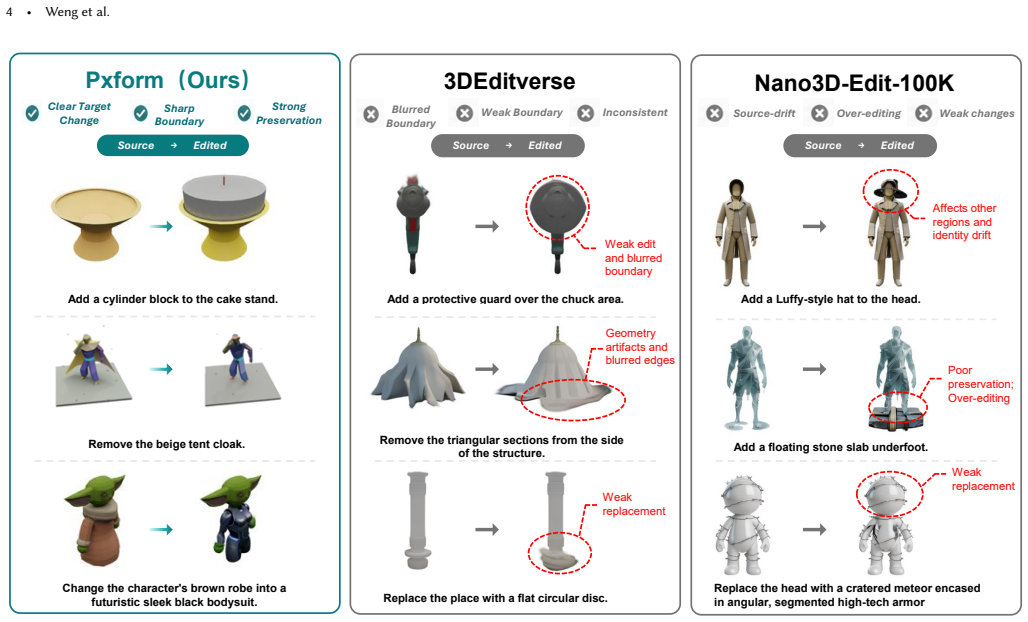
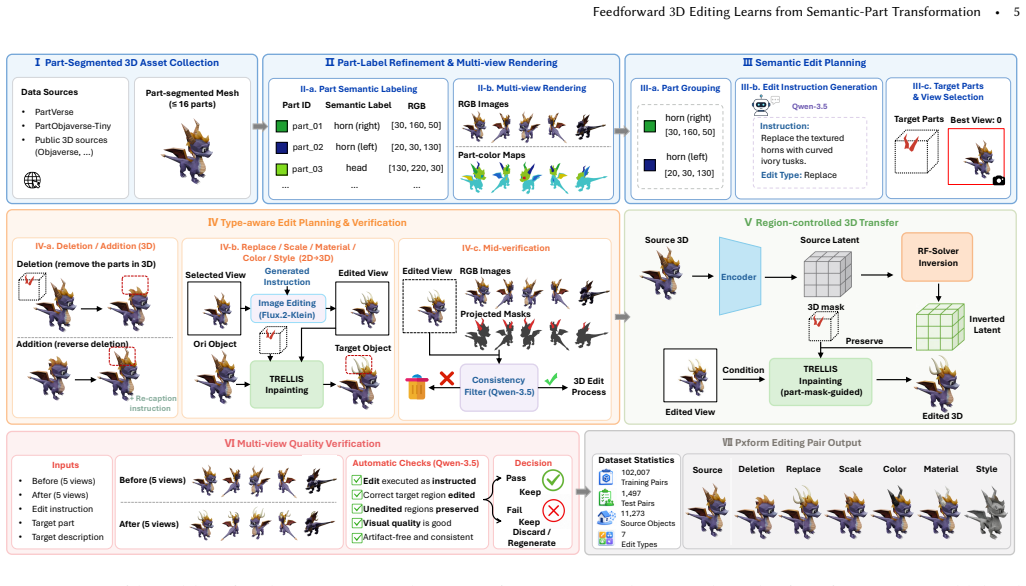
The central claim is that consistent, semantically grounded paired data is the missing ingredient for feedforward 3D editing, and that grounding edits in semantic parts is what makes the pairs consistent. The paper's own statement is that high-quality semantic-part supervision substantially improves scalable 3D editing. Concretely, Pxform's after states are produced by editing a selected 3D part while everything outside the part mask is carried over, yielding sharp boundaries and strong preservation that image-mediated datasets lack. PartFlow then learns from these pairs: a trainable source-latent branch lets the pretrained backbone keep source identity; a mask-aware velocity preservation lo
What carries the argument
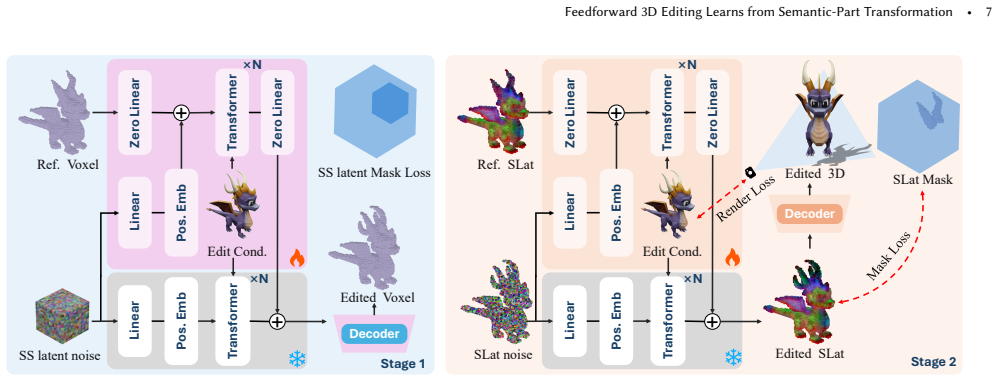
Semantic-part transformation is the central unit: each edit is anchored to a concrete 3D part or grouped set of parts with a semantic label, and the before/after pair is required to leave everything outside that part unchanged. This is what Pxform is made of and what makes the supervision localizable. PartFlow's machinery is a source-latent conditioning branch added to a pretrained two-stage 3D flow model: the branch injects the source asset's compressed representation so the backbone edits rather than regenerates, and two auxiliary losses carry the preservation argument. Mask-aware velocity preservation compares the predicted flow velocity against the source velocity in unedited regions, us
Load-bearing premise
The load-bearing premise is that every Pxform 'after' mesh is true ground truth — specifically, that the latent-inversion-and-inpainting step changes only the targeted part, and that the vision-language verification gates correctly accept only edits that were executed well and preserved everything else; if either fails, the training targets and the benchmark share the same errors and PartFlow's measured gains partly measure similarity to the generator, not editing quality.
What would settle it
On a random sample of Pxform pairs, measure the difference between before and after strictly outside the selected part mask, for example Chamfer distance and mean color change on the preserved region. Substantial outside-mask drift would falsify the dataset's preservation guarantee. In addition, run a human rater study on a subset of accepted pairs asking whether the edit was executed, localized to the right part, and free of artifacts; if human agreement with the pipeline's gate is low, the gate is too lenient and the reported benchmark improvements are inflated.
If this is right
- Deployment becomes a single feedforward pass: an editor that obeys an instruction and preserves the source asset without requiring the user to supply a 3D region mask.
- One training recipe now covers both geometry edits (add, delete, replace, scale) and appearance edits (color, material, style) from the same paired data, rather than separate pipelines.
- The mask-aware velocity preservation loss gives a transferable mechanism for keeping unedited regions stable in any flow-based 3D generative model.
- Pxform's test split provides a ready benchmark for reporting before/after consistency, edit locality, and preservation, not just visual similarity.
Where Pith is reading between the lines
- Beyond the paper: if part-grounded pairs are the real driver, the same recipe should scale to unannotated 3D collections by adding an automatic part-segmentation step, potentially multiplying dataset size well beyond 100K.
- Beyond the paper: the benchmark's ground truth is generated by the same pipeline that produced the training pairs, so PartFlow's gains could partly reflect reproducing the pipeline's inversion behavior; a human-preference study or an independently re-rendered ground truth would test whether the gains represent editing quality.
- Beyond the paper: the appearance edits sidestep physically based material parameters; extending part-grounded pairing to PBR attributes would test whether the method transfers to production material editing, which the paper lists as future work.
Editorial analysis
A structured set of objections, weighed in public.
Referee Report
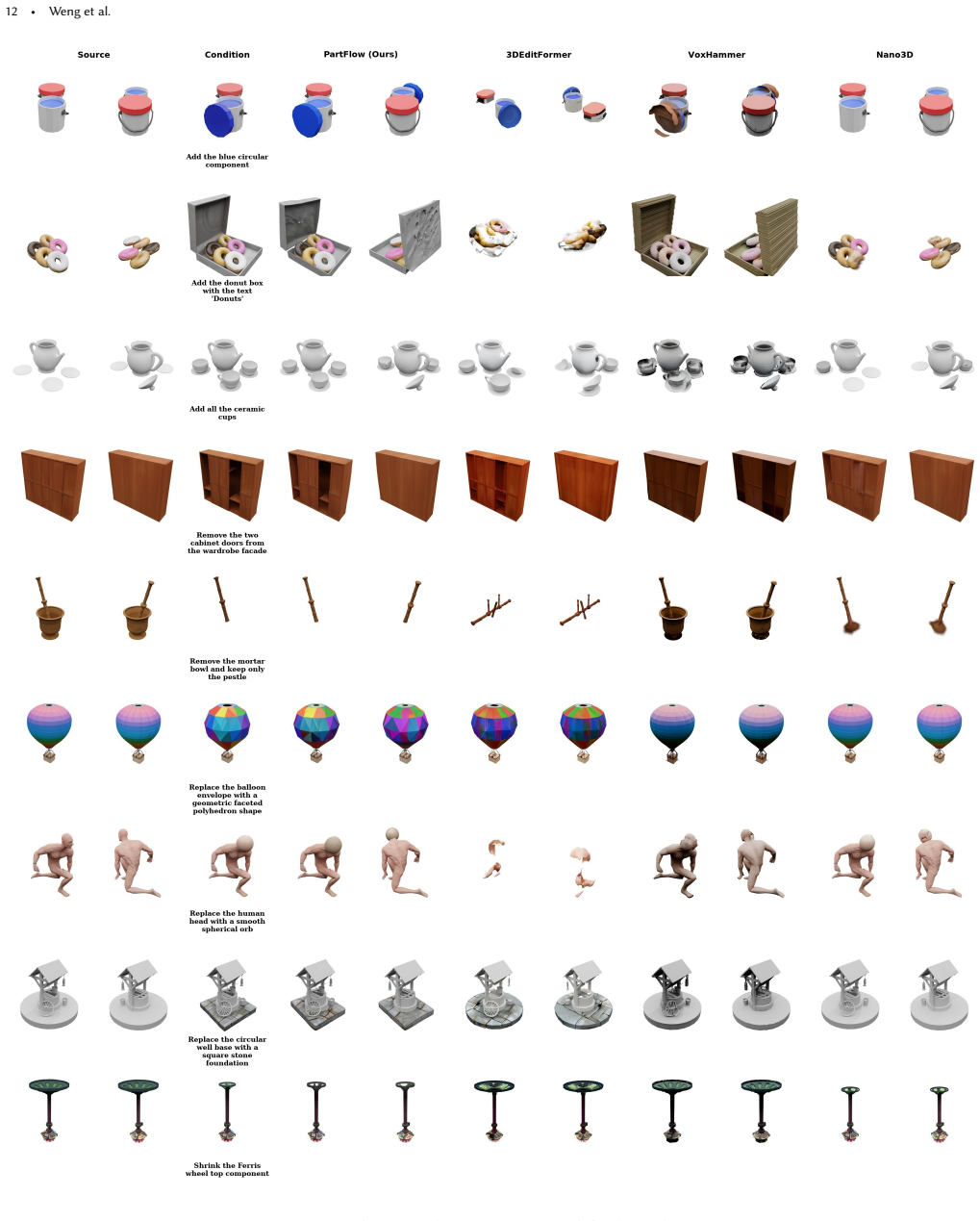
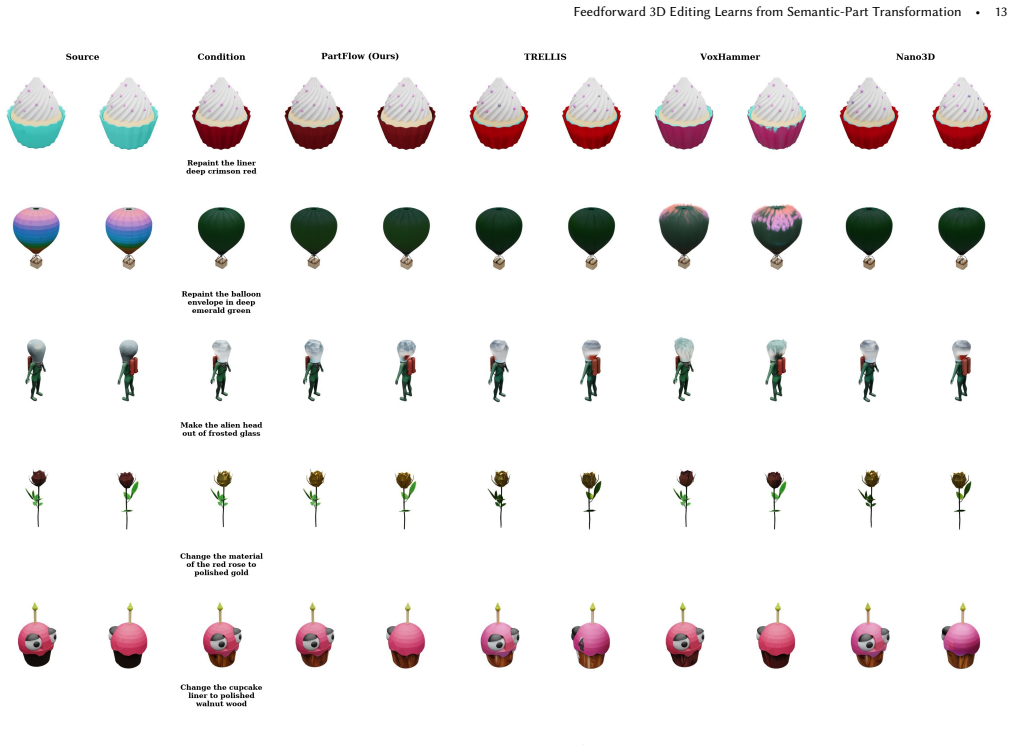
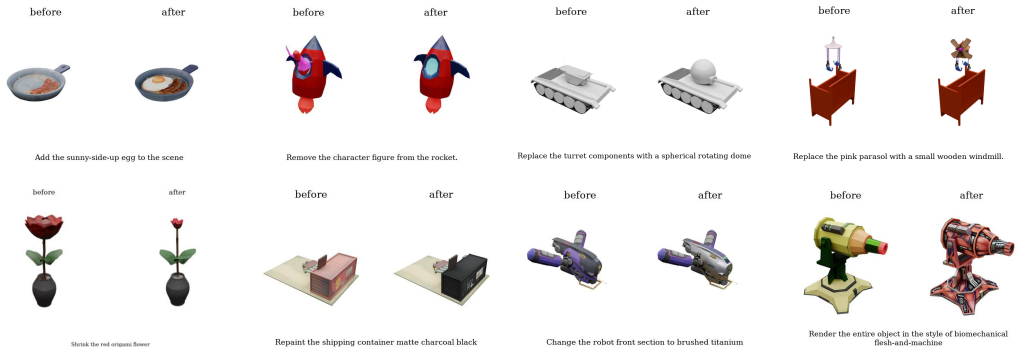
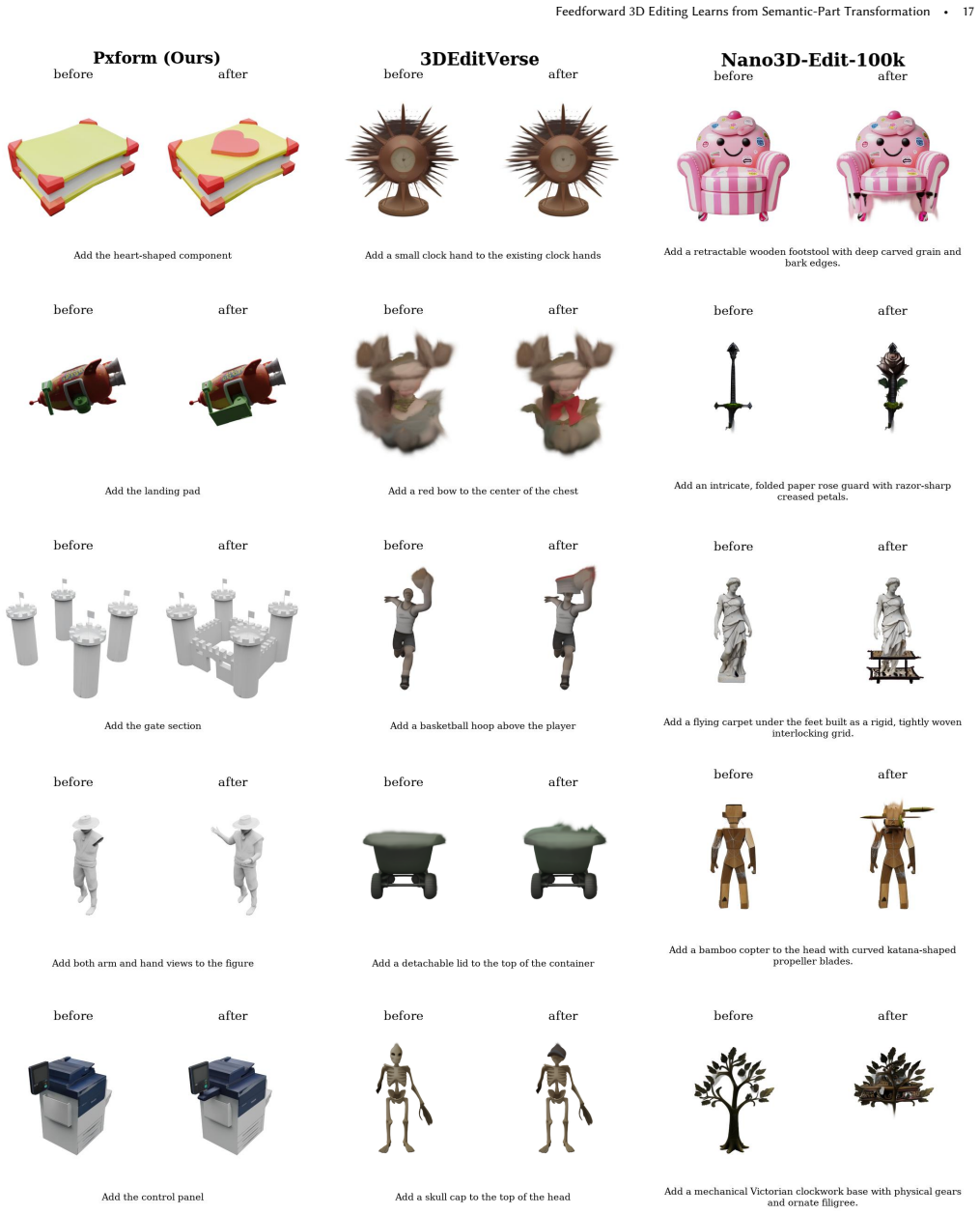
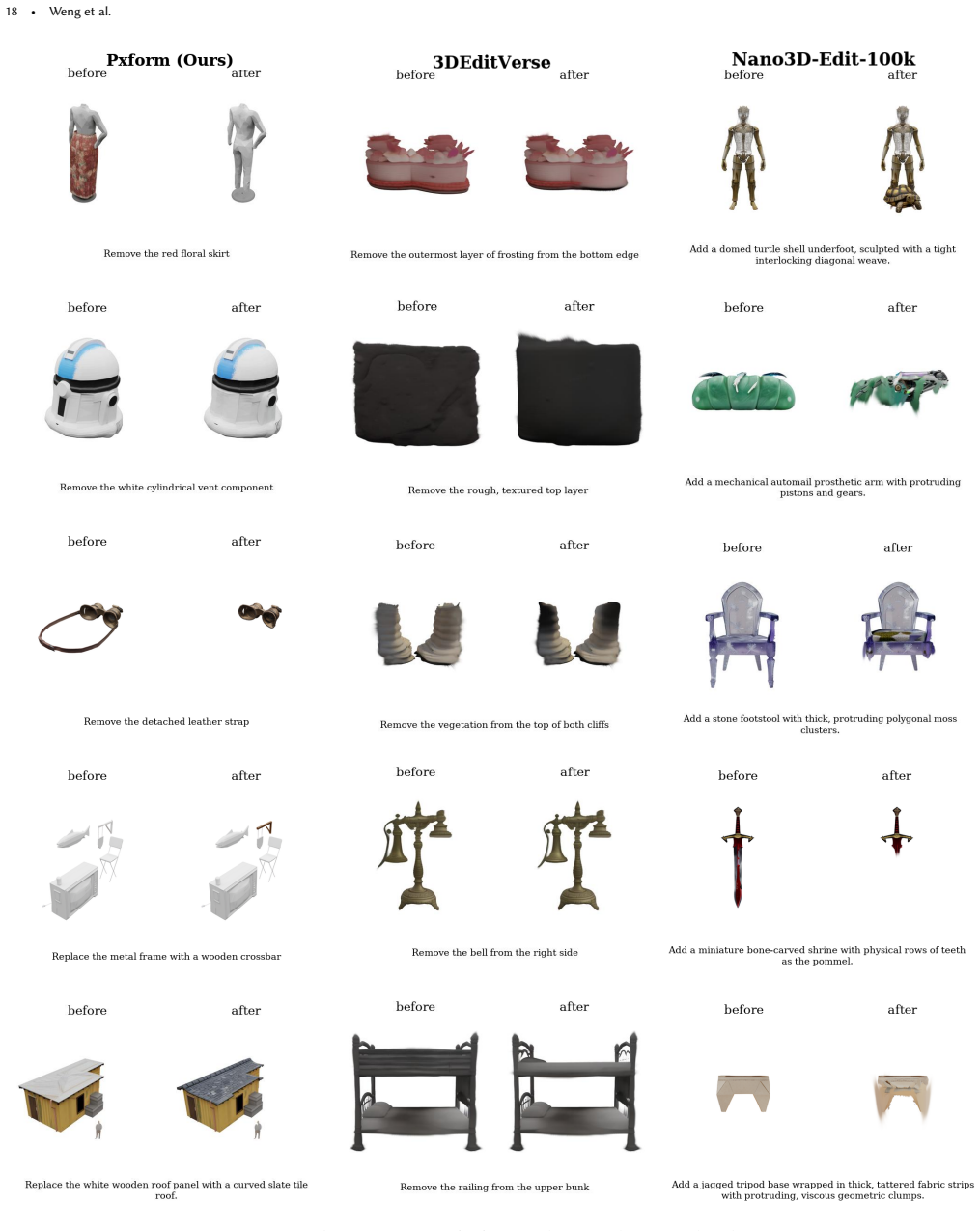
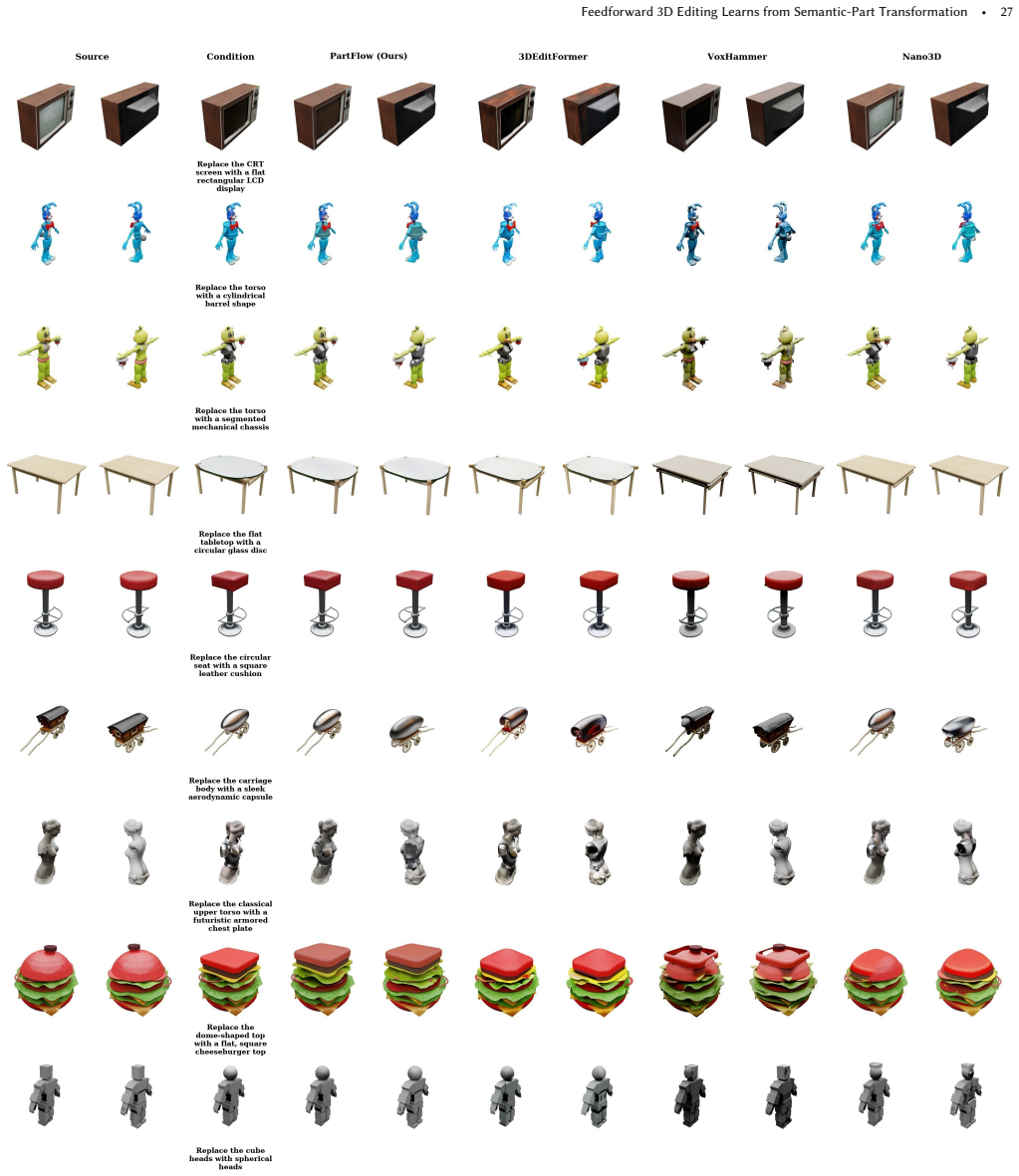
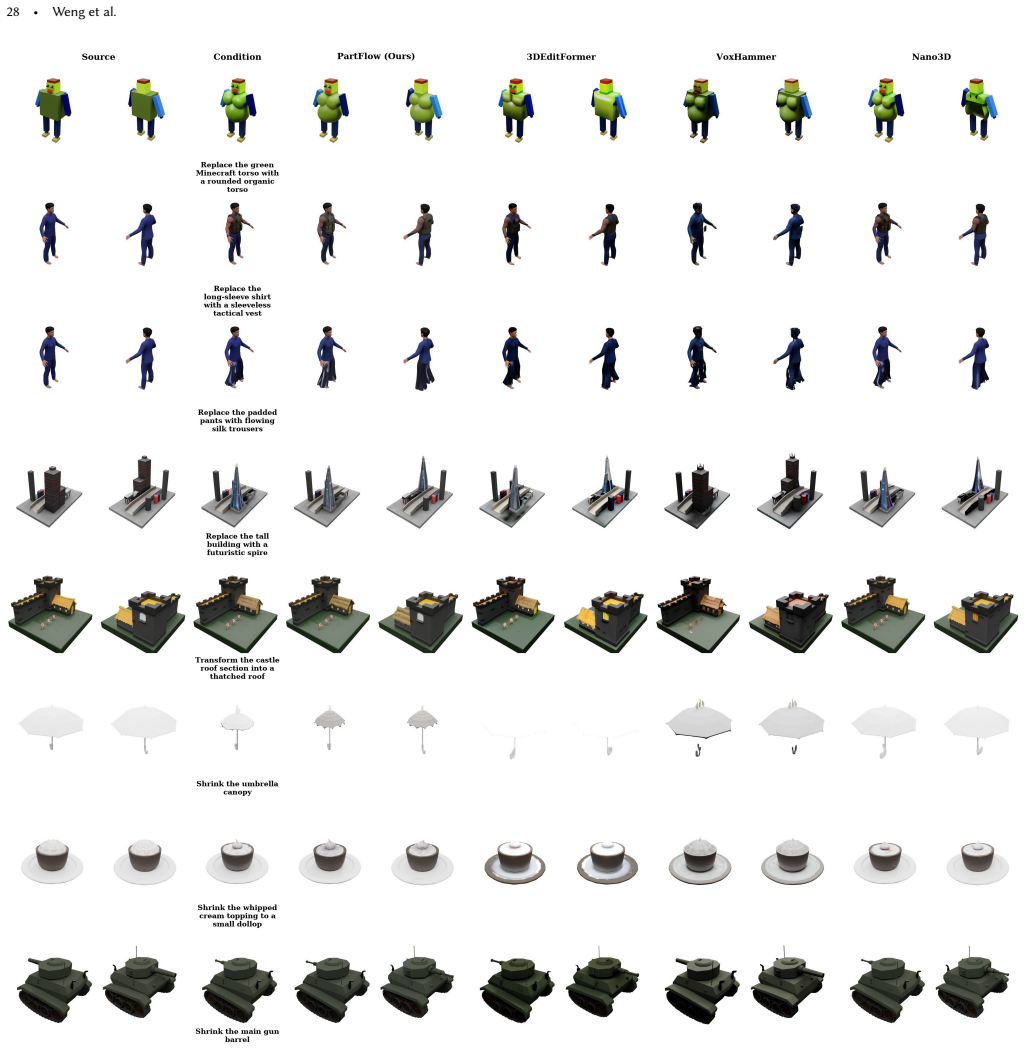
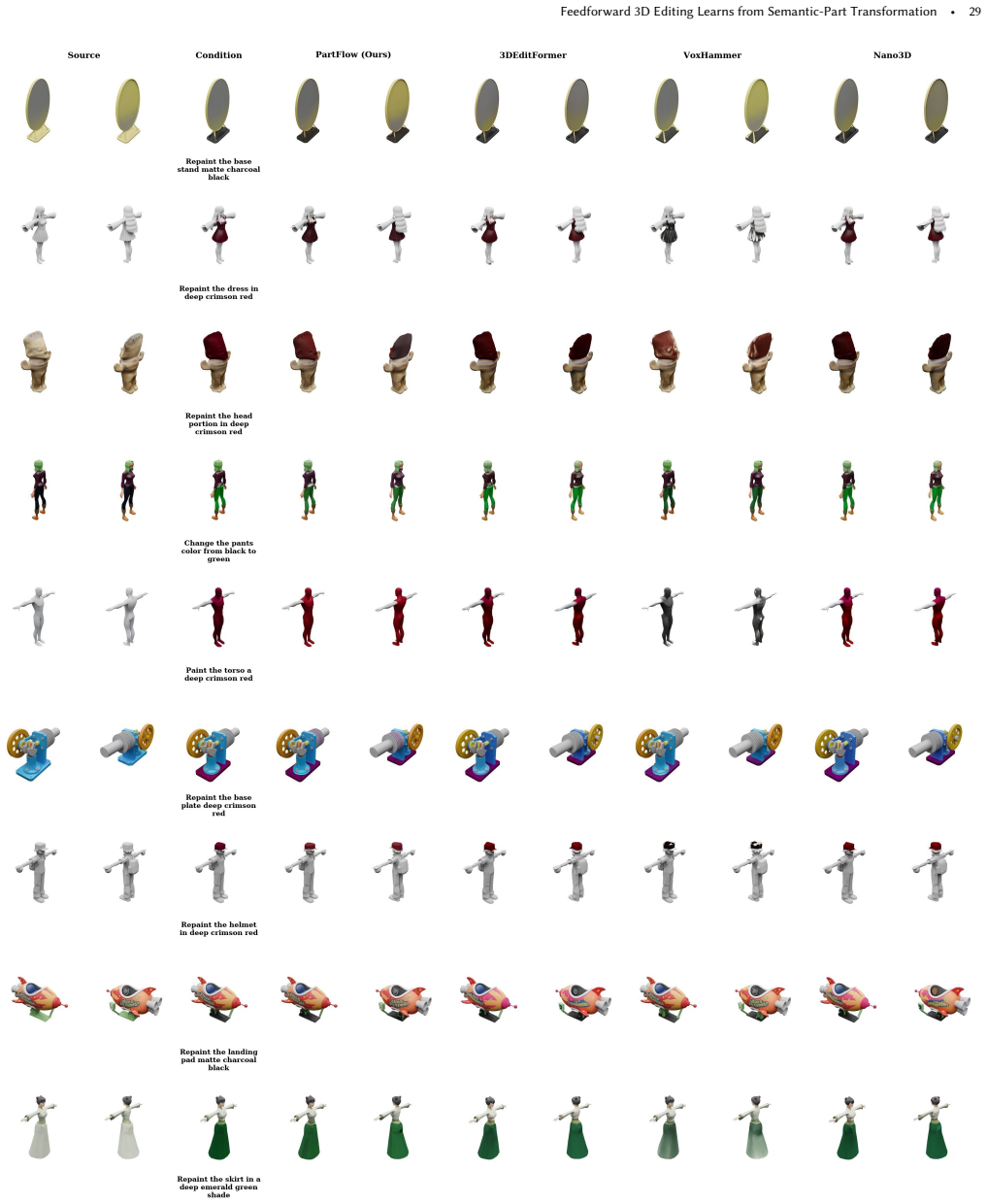
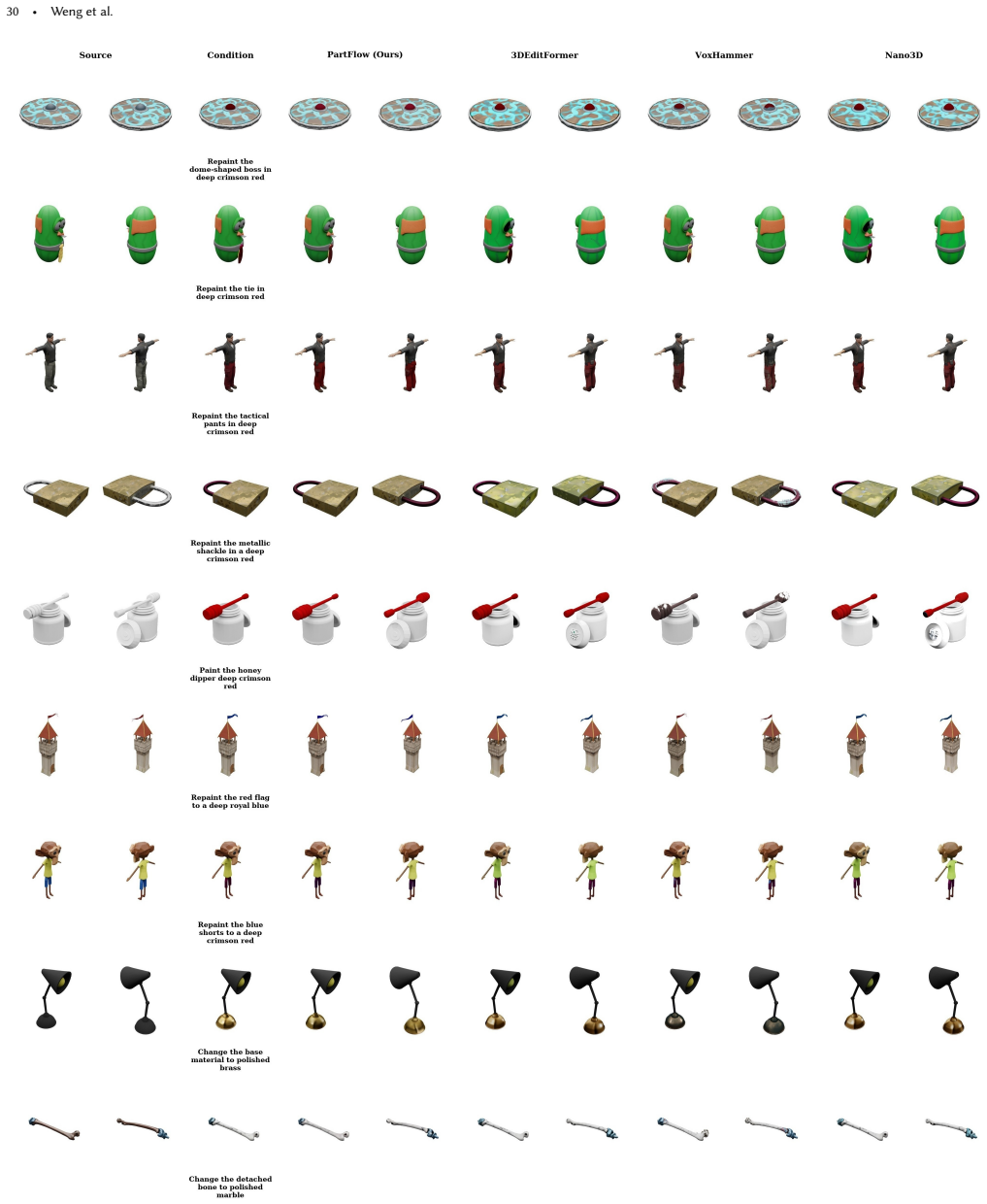
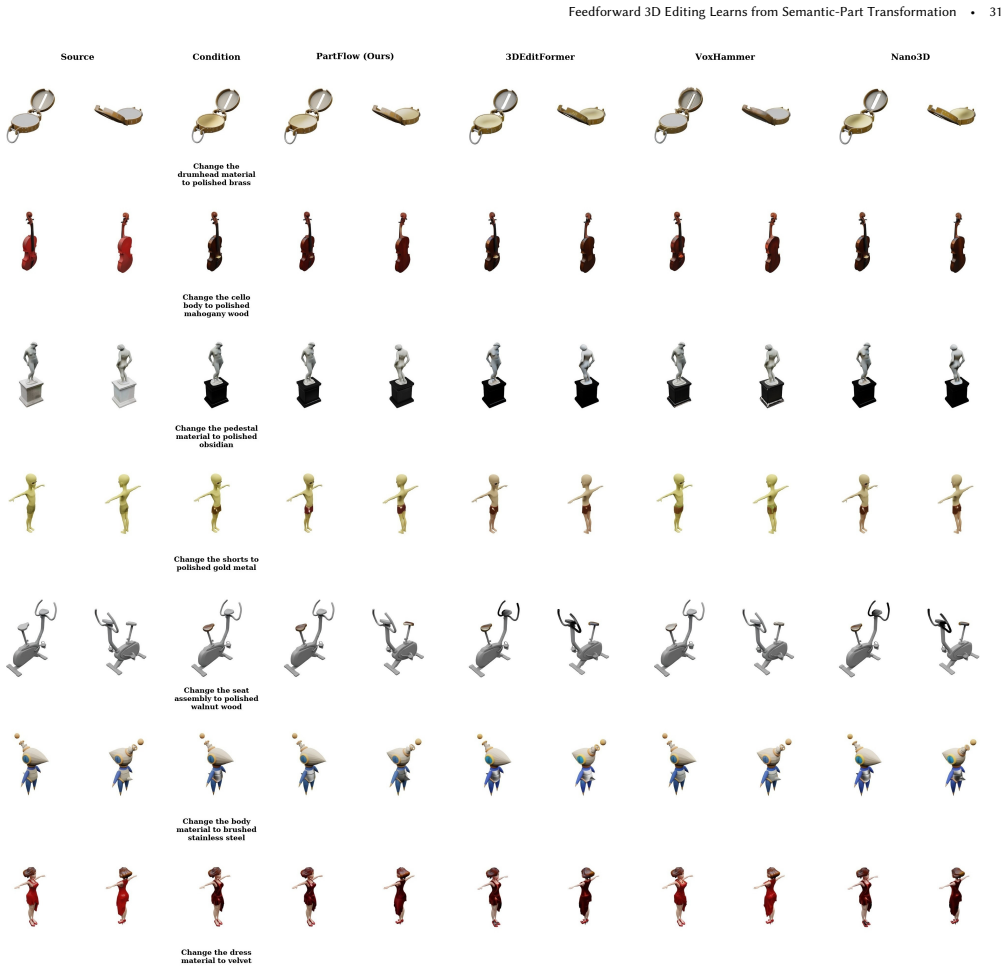
Summary. The manuscript introduces Pxform, a large paired 3D editing dataset of 102,007 training and 1,497 test pairs covering seven edit types (addition, deletion, local replacement, local scaling, local color, local material, global style), constructed by grounding edits in semantic 3D parts and transferring 2D edit references back to 3D via RF-Solver inversion and part-mask-guided TRELLIS inpainting. It then proposes PartFlow, a ControlNet-style feedforward editor on the TRELLIS backbone, with mask-aware velocity preservation and render-space consistency losses. The paper claims state-of-the-art performance on the authors' Uni3DEdit-Bench (shape and appearance splits) and on the external Edit3D-Bench add/remove tasks. The internal architecture and objective are coherent, and the external add/remove results provide partial independent evidence; however, the main benchmark is derived from the same data-generation pipeline that produced the training targets, and the global-style edit type is not evaluated, so the central SOTA claim is not fully supported as stated.
Significance. If the claims are established, the paper would make a useful contribution: a semantically grounded 3D editing dataset with explicit part-level localization, a feedforward editing architecture that does not require a 3D mask at inference, and a two-stage supervision scheme that is clearly described (Eqs. 2-7). The ablation in Table 3 shows that the mask-aware velocity preservation loss is important, and Table 5 offers external evidence on add/remove geometry, which is a strength. The significance is currently tempered by the closed-loop evaluation design: Uni3DEdit-Bench is carved from the Pxform test split, whose ground-truth after-states are generated by the same pipeline that produced PartFlow's training targets, and the benchmark omits the paper's headline global-style edit type. Independent human or external evaluation on appearance edits would materially raise confidence.
major comments (3)
- [§5.1, §3.2, Tables 2 and 4] The SOTA claim rests on Uni3DEdit-Bench, described in §5.1 as a manually curated subset of the Pxform test split. The after-states in that test split are produced by the §3.2 pipeline: RF-Solver inversion, TRELLIS part-mask-guided inpainting, and Qwen-3.5 quality gates. PartFlow is a ControlNet-style adapter on the same TRELLIS flow backbone, trained on those same after-latents. Thus the benchmark measures similarity to the outputs of the very generator that defines both training targets and test ground truth. The large CD improvement over Nano3D in Table 2 (11.80 → 5.09) may partly reflect distributional match to TRELLIS outputs rather than independently verified editing quality. Table 5 is genuinely external but only covers add/remove geometry; it does not validate the color, material, or style edits. Please add (i) human or independent-judge evaluation on all edit types, and (ii) a de
- [§3.1, §5.1, §5.3] Global style transformation is listed as one of Pxform's seven edit types in §3.1 and is repeated in the abstract and conclusion, but no benchmark or experiment evaluates it. §5.1 defines the shape split (1,265 samples: deletion, addition, replacement, scaling) and the appearance split (232 samples: color, material). No style samples appear in Tables 2-4, and Table 5 covers only add/remove. Therefore a stated component of the central claim (“seven edit types” and “global style transformation”) is untested. Either add a global-style evaluation split and results, or remove style from the headline claims.
- [§3.2, §5.2, Tables 2 and 4] The automated quality gates (Qwen-3.5) are used during Pxform construction to accept or reject after-states. Because the benchmark ground truth is drawn from this same Pxform test split, any leniency or systematic bias of the gates (e.g., accepting edits that do not actually execute the instruction, or accepting geometry drift in the preserved regions) is shared by the training targets and the evaluation references. Moreover, all reported metrics compare against the generated after-renderings: CD, NC, F1, PSNR, SSIM, LPIPS, and DINO-I do not verify whether the requested semantic operation was performed. On appearance edits, a model that preserves the source and ignores the instruction could still score well on PSNR/SSIM, and a model that reproduces TRELLIS-specific artifacts could score well on CD/LPIPS. Please add an independent instruction-alignment metric (human rating or a VLM not us
minor comments (4)
- [§A.1] The loss weights λ_SS_mask, λ_SLat_mask, and λ_render are not specified; the appendix only gives training steps and batch size. These are needed for reproducibility, especially because the mask-loss ablation in Table 3 is highly sensitive.
- [§5.3] Minor wording: “Table 2 reports quantitative results the shape-edit split” is missing “on”.
- [Table 1] Pxform is marked ✓ for Style coverage in Table 1, but the experimental section contains no style evaluation. This inconsistency should at least be noted in the table caption or text.
- [Various] The project page is mentioned but no release repository or dataset download link is given. Since the paper's contribution is a dataset and a model, a concrete release plan is important for verification.
Circularity Check
No significant circularity: benchmark co-derived with training data is an evaluation-validity concern, not a derivation cycle.
full rationale
Under the strict definition of circularity used here—a claimed result reducing by equation or by a fitted parameter to its own inputs—this paper is not circular. PartFlow's losses (Eqs. 2, 3, 5-7) are standard flow-matching plus auxiliary preservation/render terms; no equation defines the predicted edited latent or rendered image as the ground-truth target by construction. The closest concern is evaluative: Uni3DEdit-Bench is 'a manually curated benchmark built from the Pxform test split' (Sec. 5.1), and Pxform's after-states are generated in-house via 'RF-Solver-based latent inversion and part-mask-guided TRELLIS inpainting' (Sec. 3.2), so appearance-edit metrics partly measure distributional match to the same generator that produced training targets. This is a benchmark-validity/generalization confound, not a circular derivation: the test split is held out, no test after-state is used in training, the benchmark is described as manually curated, and PartFlow must still map unseen instructions and source assets to outputs. External Edit3D-Bench (Table 5) independently supports geometry add/remove. The limitations in A.4 concern PBR materials and static-only editing; global-style edits are absent from the benchmark splits—both are coverage gaps, not circular steps. Hence score 0.
Axiom & Free-Parameter Ledger
free parameters (3)
- Loss weights λ_mask, λ_render, λ_mse, λ_ds
- Scale edit factor range =
0.3–0.85
- Part-count filtering threshold =
≤16 parts
axioms (6)
- domain assumption Flow-matching objective and TRELLIS latent codec are valid and invertible enough for edit supervision
- domain assumption RF-Solver inversion plus part-mask-guided TRELLIS inpainting preserves regions outside the mask
- domain assumption LLM/VLM judgments (Qwen-3.5 for alignment and quality gates) are reliable proxies for edit correctness and preservation
- domain assumption Part-segmented assets from PartVerse/PartObjaverse-Tiny have semantically correct part labels adequate for edit grounding
- ad hoc to paper FLUX.2-Klein produces 2D edit references that are 3D-consistent enough to serve as edit conditions
- standard math Standard flow-matching math and Gaussian rendering
read the original abstract
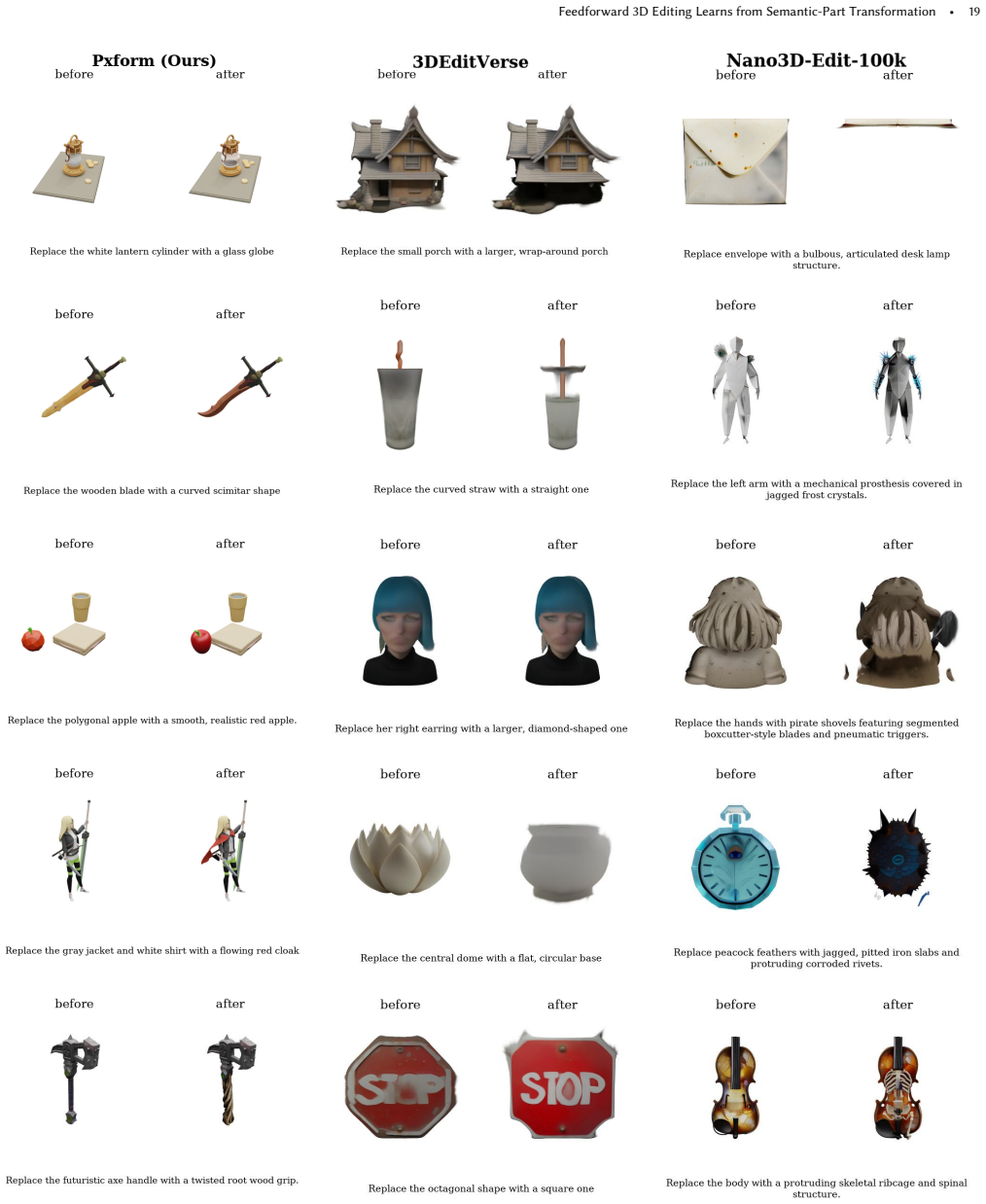
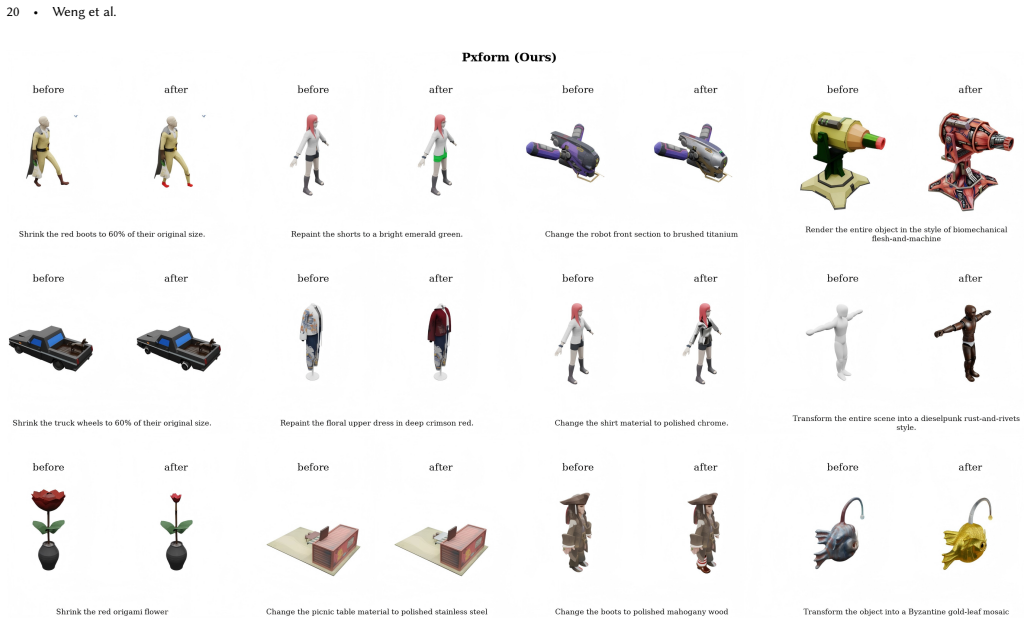
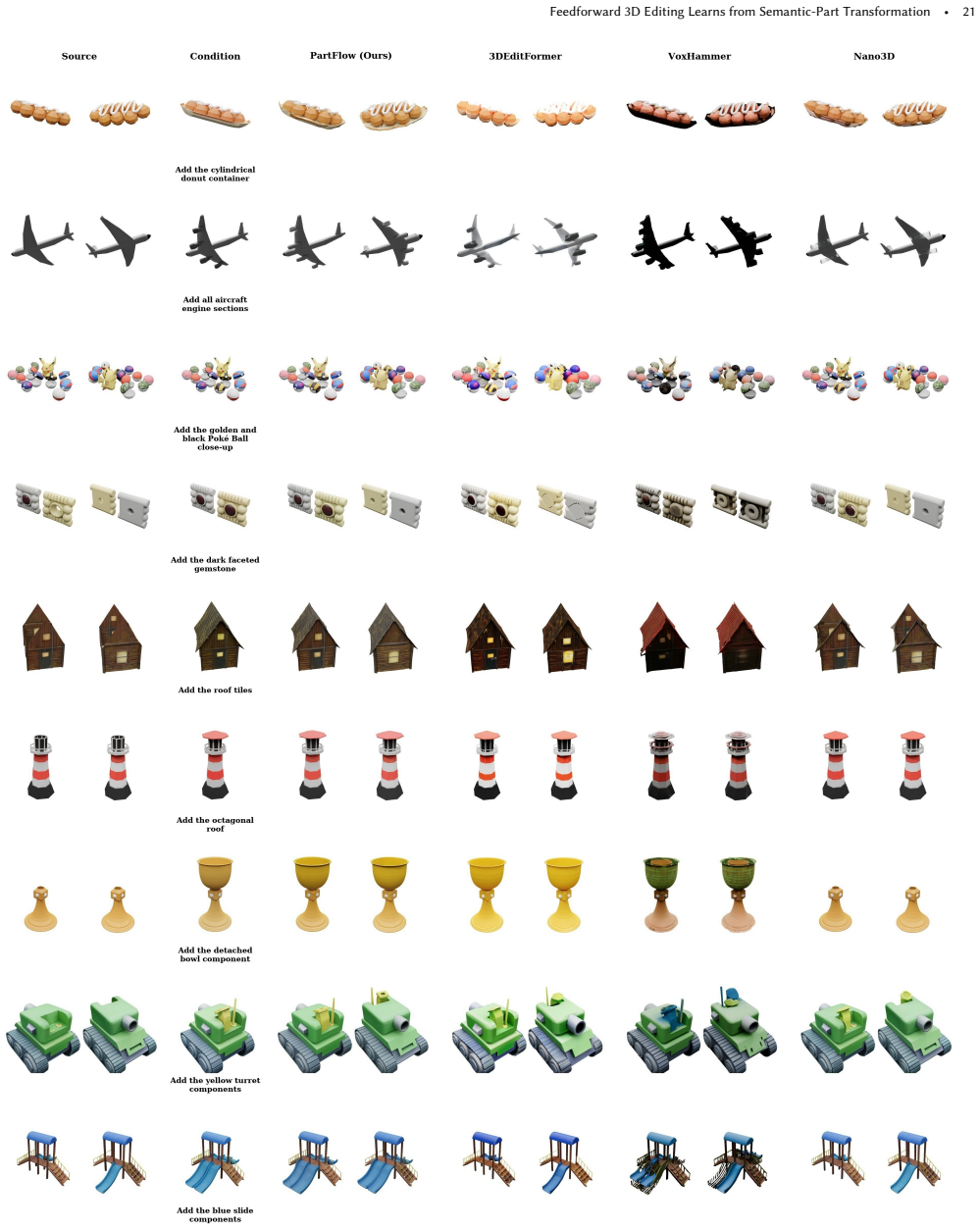
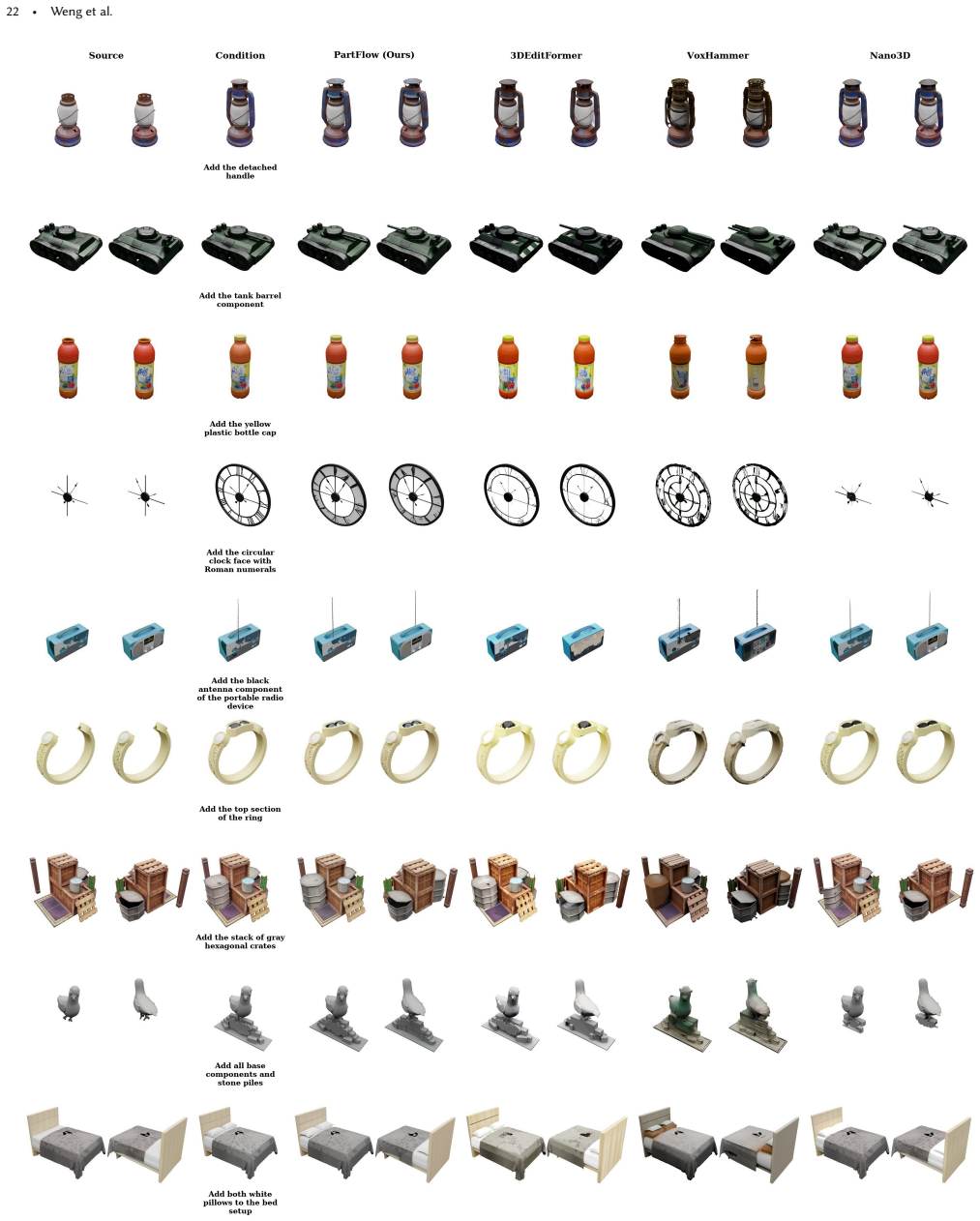
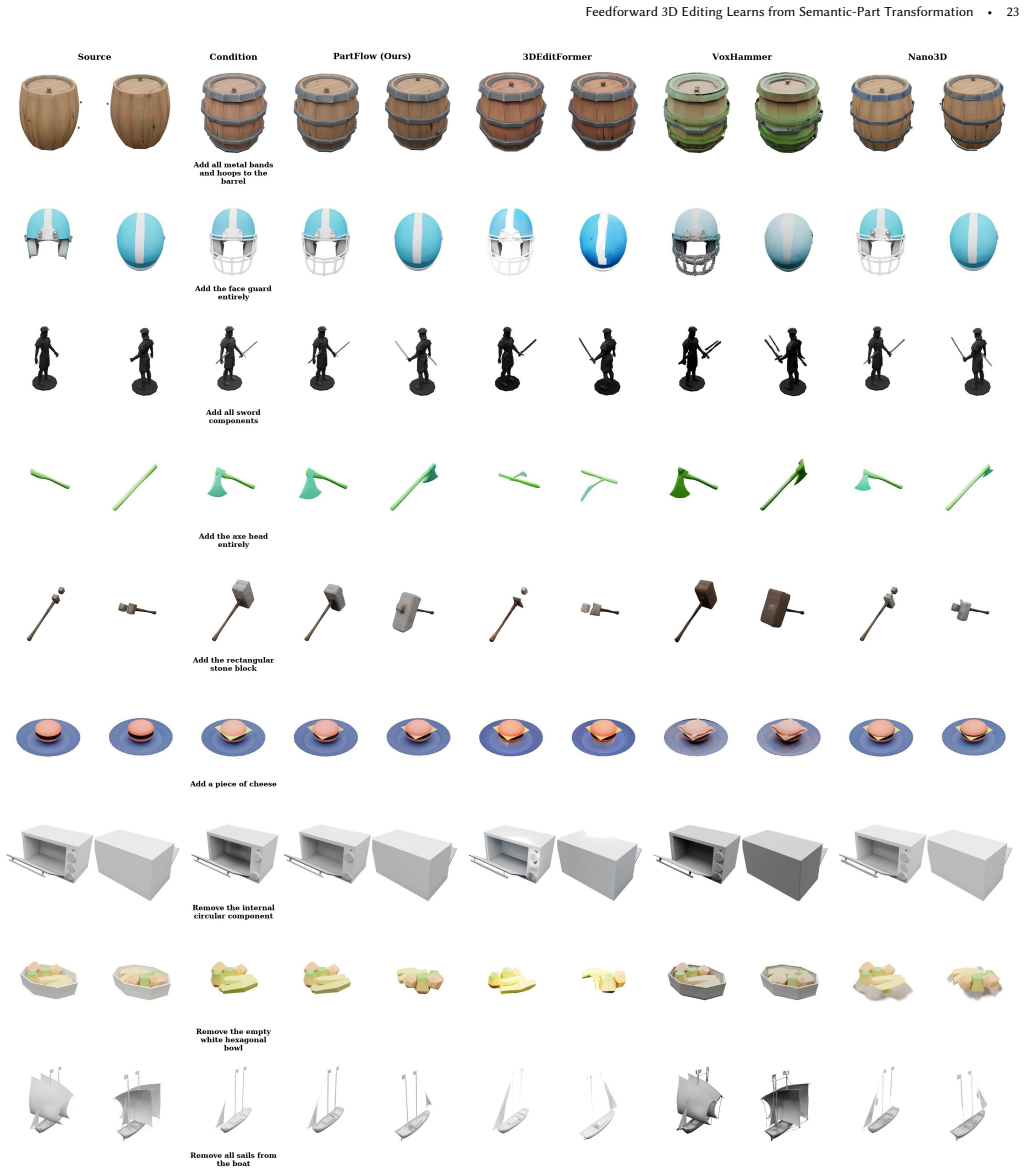
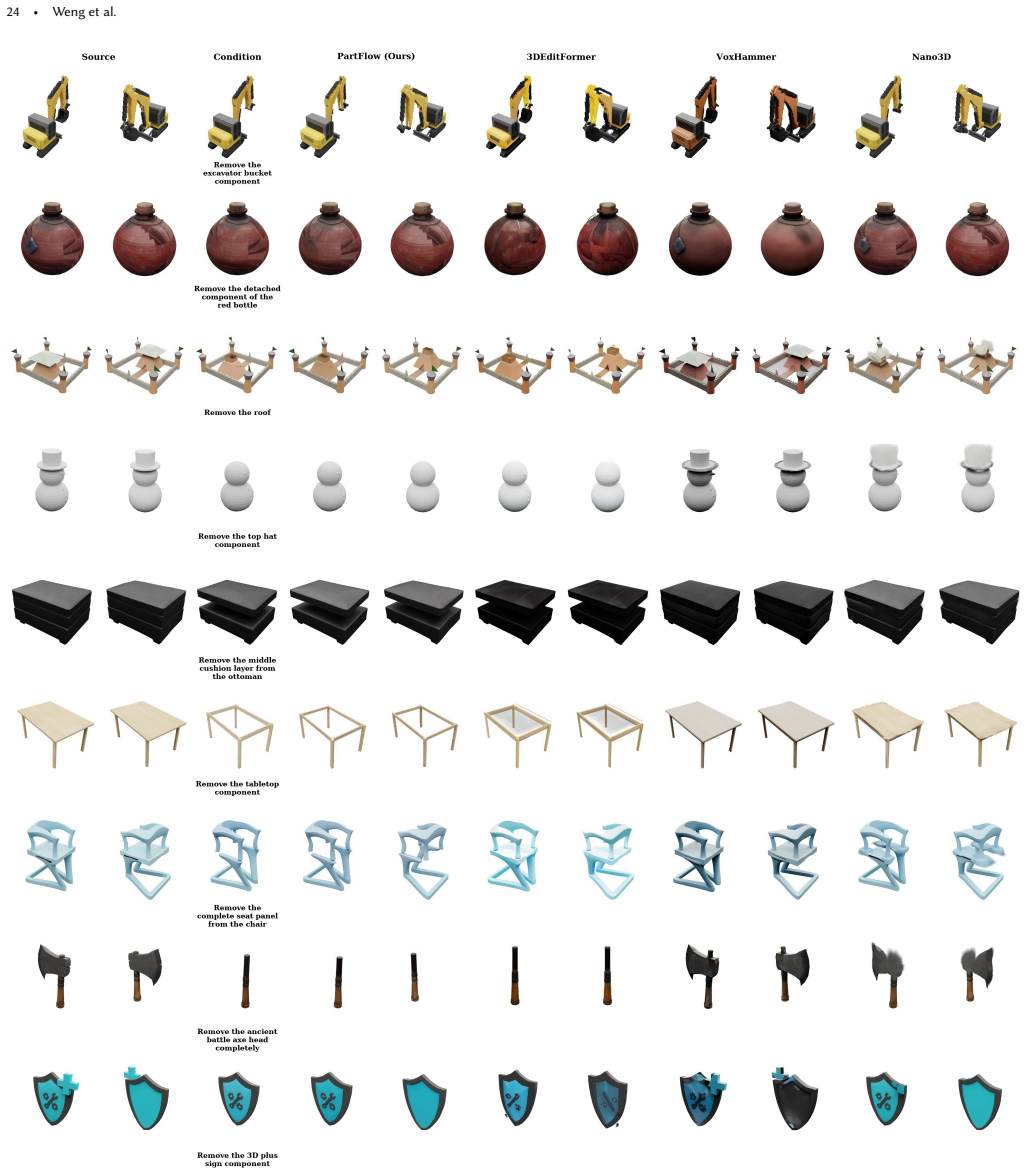
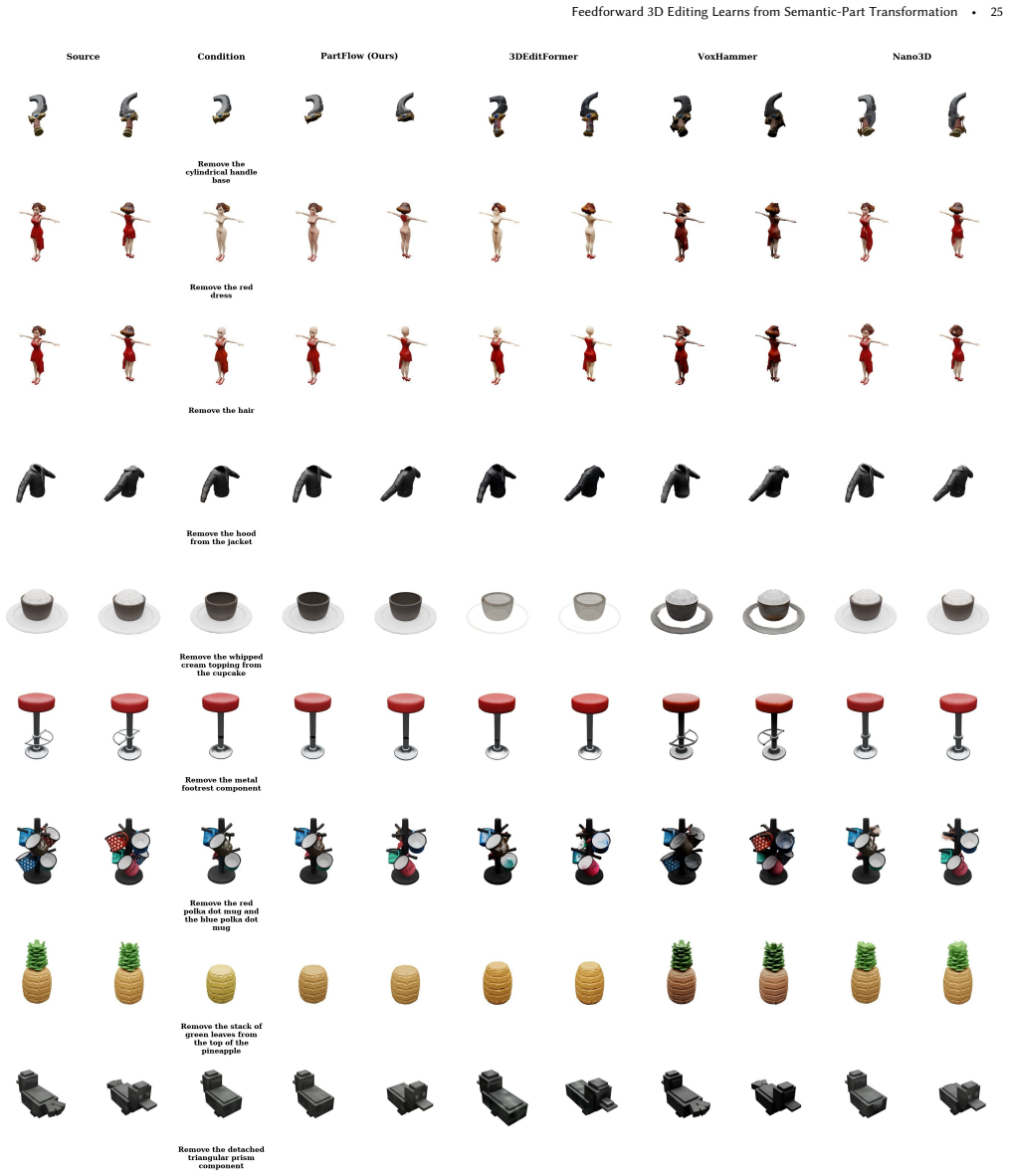
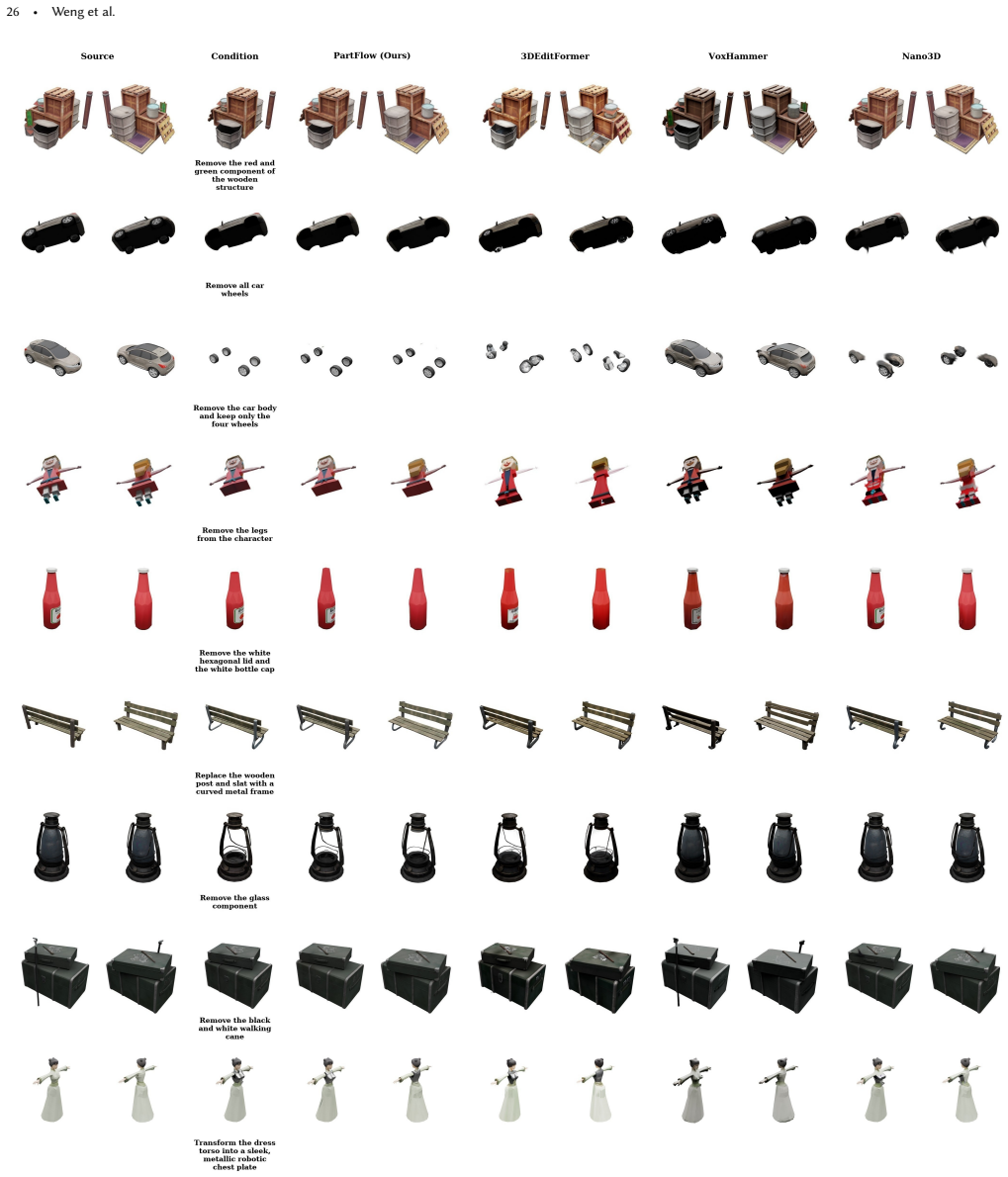
3D editing is a fundamental capability for scalable 3D content creation. While image editing has rapidly evolved toward large-scale feedforward generative paradigms, 3D AI generation remains dominated by training-free editing pipelines. A central challenge of feedforward 3D editing lies in the lack of high-quality paired supervision. Editable 3D assets require simultaneous preservation of geometry, multi-view consistency, structural coherence, and localized edit controllability. Existing 3D editing datasets often rely on independently generated assets, image-mediated reconstruction or narrow edit taxonomies, leading to inaccurate localization, weak preservation, blurred edit boundaries, and limited semantic consistency. In this work, we introduce a new perspective: scalable feedforward 3D editing should be learned from semantic-part transformations. Based on this insight, we propose Pxform, a high-quality 3D editing dataset with over 100K consistent before/after editing pairs across seven edit types. Instead of treating objects as unstructured shapes, our pipeline grounds edits directly in semantic 3D parts. Built upon Pxform, we further propose PartFlow, a feedforward 3D editing network that injects source-aware latent control into pretrained 3D generative priors. PartFlow introduces mask-aware velocity preservation and render-space consistency supervision to jointly improve edit fidelity and source preservation, while requiring no 3D edit mask during inference. Extensive experiments demonstrate that high-quality semantic-part supervision substantially improves scalable 3D editing, enabling PartFlow to achieve state-of-the-art performance on both geometric and appearance editing benchmarks.
Figures

Forward citations
Cited by 2 Pith papers
-
One Video, One World: Turning Monocular Video into Physical 4D Scenes
OVOW reconstructs instance-level, simulation-ready 4D mesh scenes from monocular video via a four-stage training-free pipeline and introduces a new benchmark for structured Video-to-4D evaluation.
-
Video Models as Native 4D Renderers: World-Grounded Conditioning from Animated Mesh
Conditioning a video diffusion model on animated-mesh G-buffer maps (tracking + world position + normals) improves camera-and-object control over depth conditioning in the authors' 68-video benchmark.
Reference graph
Works this paper leans on
-
[1]
Generate exactly the requested number of edits according to the quota
-
[2]
Select valid target parts from the supplied part list
-
[3]
Group repeated instances into one edit when they form a semantic unit, e.g., both wheels or all chair legs
-
[4]
Group semantically coupled components when appropriate, e.g., eyes, nose, and mouth as a head-level edit
-
[5]
InProceedings of the IEEE/CVF Conference on Computer Vision and Pattern Recognition
Wonder3D: Single Image to 3D using Cross-Domain Diffusion. InProceedings of the IEEE/CVF Conference on Computer Vision and Pattern Recognition. Changfeng Ma, Yang Li, Xinhao Yan, Jiachen Xu, Yunhan Yang, Chunshi Wang, Zibo Zhao, Yanwen Guo, Zhuo Chen, and Chunchao Guo. 2025b. P3-SAM: Native 3D 10•Weng et al. Part Segmentation. arXiv:2509.06784 [cs.CV] doi...
-
[6]
Native and Compact Structured Latents for 3D Generation.arXiv preprint arXiv:2512.14692(2025). arXiv:2512.14692 [cs.CV] https://arxiv.org/abs/2512.14692 Jianfeng Xiang, Zelong Lv, Sicheng Xu, Yu Deng, Ruicheng Wang, Bowen Zhang, Dong Chen, Xin Tong, and Jiaolong Yang. 2024. Structured 3D Latents for Scalable and Versatile 3D Generation.arXiv preprint arXi...
Pith/arXiv arXiv 2025
-
[7]
new_part_desc
Produce target descriptions and after-edit descriptions suitable for downstream editing and verification. Rules: R1. selected_part_ids must be a subset of the input part list. R2. No two edits may share the same (edit_type, selected_part_ids) pair. R3. Global edits must use selected_part_ids = []. R4. Deletion cannot target the primary structural body. R5...
-
[11]
Avoid deleting the primary structural body of the object
-
[12]
Use clear English imperative edit instructions
-
[2023]
InProceedings of the IEEE/CVF Conference on Computer Vision and Pattern Recognition
Objaverse: A Universe of Annotated 3D Objects. InProceedings of the IEEE/CVF Conference on Computer Vision and Pattern Recognition. 13142–13153. https://arxiv.org/abs/2212.08051 Shaocong Dong, Lihe Ding, Xiao Chen, Yaokun Li, Yuxin Wang, Yucheng Wang, Qi Wang, Jaehyeok Kim, Chenjian Gao, Zhanpeng Huang, Zibin Wang, Tianfan Xue, and Dan Xu. 2025. From One ...
Pith/arXiv arXiv 2025
-
[2024]
arXiv preprint arXiv:2412.08629(2024)
FlowEdit: Inversion-Free Text-Based Editing Using Pre-Trained Flow Models. arXiv preprint arXiv:2412.08629(2024). arXiv:2412.08629 [cs.CV] https://arxiv.org/ abs/2412.08629 Zeqiang Lai, Yunfei Zhao, Zibo Zhao, Haolin Liu, Qingxiang Lin, Jingwei Huang, Chunchao Guo, and Xiangyu Yue. 2025. LATTICE: Democratize High-Fidelity 3D Generation at Scale.arXiv prep...
Pith/arXiv arXiv 2024
-
[2025]
arXiv:2512.21185 [cs.CV] https: //arxiv.org/abs/2512.21185 Heewoo Jun and Alex Nichol
UltraShape 1.0: High-Fidelity 3D Shape Generation via Scalable Geometric Refinement.arXiv preprint arXiv:2512.21185(2025). arXiv:2512.21185 [cs.CV] https: //arxiv.org/abs/2512.21185 Heewoo Jun and Alex Nichol. 2023. Shap-E: Generating Conditional 3D Implicit Functions.arXiv preprint arXiv:2305.02463(2023). Bernhard Kerbl, Georgios Kopanas, Thomas Leimkühl...
arXiv 2025
-
[9795]
Efros, Aleksander Holynski, and Angjoo Kanazawa
https://openaccess.thecvf.com/content_ICCV_2019/html/Gkioxari_Mesh_R- CNN_ICCV_2019_paper.html Ayaan Haque, Matthew Tancik, Alexei A. Efros, Aleksander Holynski, and Angjoo Kanazawa. 2023. Instruct-NeRF2NeRF: Editing 3D Scenes with Instructions. In Proceedings of the IEEE/CVF International Conference on Computer Vision. Zexin He and Tengfei Wang. 2023. Op...
arXiv 2023
discussion (0)
Sign in with ORCID, Apple, or X to comment. Anyone can read and Pith papers without signing in.