REVIEW 5 major objections 6 minor 26 references
Dimensions of Vulnerability in Visual Working Memory: An AI-Driven Approach to Perceptual Comparison
T0 review · 5 major / 6 minor · reviewed 2026-08-06 · deepseek-v4-flash
Pith's one-line read Perceptual comparisons between a remembered object and a similar AI-generated image systematically pull later memory reports toward the similar item, and the pull is strongest for visual dimensions such as shape, color, and texture rather…
desk verdict Interesting question and clever stimulus method, but the reported accuracy and bias numbers are mutually incompatible with the paper's own Eq. 4, so the headline claims are not currently supported. read the letter →
The pith
A machine-rendered reading of the paper's core claim, the machinery that carries it, and where it could break.
The reading
What carries the argument
The carrying object is the stimulus wheel: a circular arrangement of images whose angular position encodes a smooth change along one or two predefined behavior-based object dimensions. Image wheels are generated from a source image by combining dimensional guidance (matching CLIP embeddings to circular coordinates in the dimension-pair plane), smoothness guidance (neighboring images stay close in CLIP space), CLIP guidance (preserving global similarity to the source), and pixel guidance via img2img initialization. Dimension wheels use only dimensional guidance, so all images match the target dimension activations but do not visually resemble each other. The bias score, $|\theta_{\text{Report}} - \theta_{\text{Target}}|$, converts the participant's wheel choice into a continuous measure of how far memory shifted toward the induction item.
What would settle it
A norming study in which naive raters order each wheel by the intended dimension, matched with a similarity-rating control showing that semantic and visual pairs are equal in low-level image similarity, would settle the claim: if raters cannot recover the intended ordering, or if visual pairs are simply more perceptually similar, the observed asymmetry is an artifact of stimulus construction.
Extended reading notes
Core claim
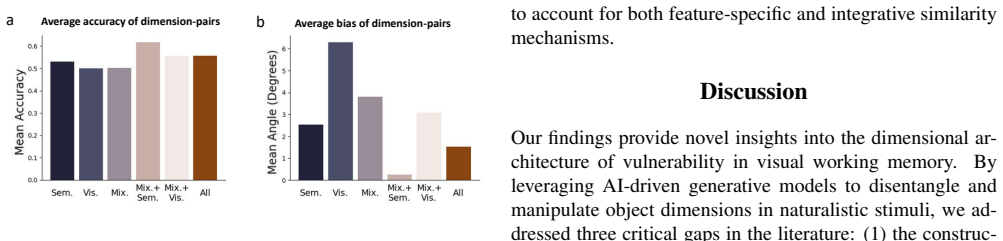
The central claim is that similarity-induced memory bias, previously shown with simple colors and shapes, generalizes to naturalistic objects and is organized by object dimensions. Using image wheels generated by smoothly editing latent dimension activations, the authors find that a probe judged similar to the memorized item pulls later memory reports toward itself, measured as angular bias. Using dimension wheels, where images share abstract dimension activations but not low-level visual similarity, they find the same distortion, showing that abstract dimension similarity alone is sufficient. Across both paradigms, visual dimensions produce stronger distortion than semantic dimensions: in the image-wheel experiment, visual dimensions averaged 13.210 degrees of bias versus 10.053 degrees for semantic dimensions; in the dimension-wheel experiment, the corresponding values were 6.290 degrees versus 2.530 degrees.
Load-bearing premise
The central premise is that the generated wheels actually vary along the intended behavioral dimensions and that the visual/semantic labels are not confounded with low-level image similarity; if that premise fails, the visual-semantic asymmetry would not reflect memory organization.
Editorial extensions
If this is right
- If visual dimensions are systematically more vulnerable, then tasks that rely on shape, texture, or color details should show stronger retroactive distortion than tasks emphasizing category or function.
- Similarity-induced bias is not limited to low-level features; abstract dimension activations alone can pull memory, so models of visual working memory should incorporate multidimensional similarity rather than perceptual distance only.
- The wheel paradigm offers a controlled way to map a vulnerability landscape across object dimensions for naturalistic stimuli, which the authors use to identify which features carry memory errors.
- The visual-semantic asymmetry supports the idea that semantic or schematic representations stabilize memory, and it predicts that enhancing semantic encoding should reduce distortion.
- The method extends to any behaviorally defined dimension, so the same framework could be used to test memory distortion for dimensions not included in the current 42-dimension set.
Reading between the lines
- The paper does not establish why visual dimensions are more vulnerable; a norming study measuring perceived step size per wheel would separate the possibility that visual wheels simply vary more perceptibly from the claim that visual coding is intrinsically more fragile.
- If dimension wheels isolate dimension similarity from low-level similarity, the same paradigm could be applied to attention or decision-making to ask whether dimensional structure predicts biases beyond memory.
- Individual differences are a natural next test: people with stronger semantic organization should show a smaller visual-semantic gap, a prediction the group-level data cannot address.
- The generative-wheel approach could be turned into a general ruler for other memory systems, such as episodic memory, where the visual-semantic asymmetry might invert.
Editorial analysis
A structured set of objections, weighed in public.
Referee Report
Summary. The paper introduces an AI-driven framework that generates two types of stimulus wheels—image wheels created through dimension editing and dimension wheels generated by dimension activation values—to study similarity-induced memory biases in visual working memory. Two online experiments (N=100 and N=146) use a 12-item report wheel and measure accuracy and bias after a perceptual comparison with an induction item. The authors conclude that similar object dimensions, like similar images, can induce memory distortions and that visual dimensions are more vulnerable than semantic dimensions. I identify load-bearing problems with the bias metric, the internal consistency of the reported numbers, the absence of inferential statistics, and the lack of stimulus validation.
Significance. The central question—whether naturalistic object dimensions differ in their susceptibility to similarity-induced memory distortion—is timely and interesting, and the idea of using dimension-controlled generative wheels is creative and could be a useful tool for visual working memory research. However, the current paper does not provide a verifiable analysis: the dependent variable as defined cannot measure the reported direction of distortion, the reported values contradict the stated discrete-choice procedure, and no inferential statistics are presented. The absence of baseline reporting and stimulus-validation data further weakens the empirical contribution.
major comments (5)
- [Behavioral Measures and Analysis, Eq. (4); Image Wheels Induction Experiment, Interpretation] Equation (4) defines the bias score as |θReport − θTarget|, an absolute angular deviation; this metric cannot indicate whether the report is displaced toward the induction item or away from it. Yet the Results and Interpretation sections repeatedly state that the distortions are "toward the induced items" and that higher bias scores indicate "stronger distortion toward the induction direction." A signed deviation relative to the induction item, or a direct comparison with the no-induction baseline, is required to support the directional claim. The baseline condition is mentioned in the design but its accuracy and bias values are never reported, so the paper does not establish that any distortion is induced by the comparison phase at all.
- [Behavioral Measures and Analysis; Figures 3 and 4] The reported accuracy and bias values are numerically incompatible with Eq. (4) and the described 12-item discrete wheel. With 12 items, every incorrect response deviates by at least 30° from the target, so mean absolute bias must be at least (1 − accuracy) × 30°. For the image-wheel experiment, overall accuracy 0.470 implies a minimum bias of 15.9°, but 10.780° is reported; for the dimension-wheel experiment, accuracy 0.556 implies a minimum of 13.3°, but 1.520° is reported. The subcondition values violate the same bound. This impossibility means that either the response was continuous rather than discrete, the accuracy and bias were computed on different trial subsets (the Figure 3 caption contains the embedded note "下方的是经过置信度筛选过的", i.e., the displayed values are confidence-filtered), or the actual metric was signed and Eq. (4) is incorrect. In every case the manuscript as written does not permit verification of the headline results.
- [Image Wheels Induction Experiment, Results; Dimension Wheels Induction Experiment, Results] No inferential statistics are reported anywhere in the paper. The Results sections claim that visual dimensions "showed significantly lower performance compared to semantic dimensions" and that the visual–semantic difference was "significantly larger" in the dimension-wheel experiment, but no test statistics, p-values, confidence intervals, standard errors, or effect sizes are given. Without these, the central claims of significant memory distortion and differential vulnerability across dimension types are unsupported. The paper also does not report the number of excluded participants, the rate of low-confidence trial exclusions, or the threshold used.
- [Dimension-Guided Wheel Generation; Table 1] The validity of the stimulus wheels is not established. The image wheels and dimension wheels are generated with the authors' CoCoG model, but there are no norming data showing that angular position along a wheel corresponds to a smooth, monotonic change in the intended dimension, or that the dimension wheels differ in dimension activation while matching on low-level image similarity. The classification of the 42 dimensions into visual, semantic, and mixed categories (Table 1) is a manual judgment with no inter-rater reliability or independent validation. If the dimension labels are confounded with low-level image similarity, the central comparison between visual and semantic dimensions is invalid.
- [Image Wheels Induction Experiment, Stimuli and Task Design] The participant-selection and trial-exclusion criteria are neither fully specified nor quantified. The text states that participants with below-40% baseline accuracy are excluded and that low-confidence trials are excluded, and the figure captions indicate that the displayed values are confidence-filtered, but no filter rates, thresholds, or the number of trials removed are reported. This is not only a reproducibility problem; it is one of the possible sources of the arithmetic inconsistency described above.
minor comments (6)
- [Abstract and Design] The abstract says "three VWM experiments," but the paper describes two experiment types (image wheel and dimension wheel) plus a baseline condition within each; this discrepancy should be clarified.
- [Behavioural Measures, Eq. (4)] The example following Eq. (4) says a 15° deviation is possible, but with a 12-item wheel the minimum nonzero absolute deviation is 30°; this inconsistency illustrates the need to clarify whether responses are discrete or continuous.
- [Stimuli and Task Design] The sentence "The interstimulus interval is determined based on the results of the pre-test" does not state the actual ISI value used in the experiment; please specify the value and the pre-test results.
- [Figures 3 and 4] The figure captions contain editorial annotations in Chinese ("FIG5:", "FIG6:", "下方的是经过置信度筛选过的") that should be removed or translated and explained in the main text.
- [Throughout] There are typographical errors that should be corrected, including "sythetic" (Introduction), "accuarcy" (Dimension Wheels Induction Experiment, Interpretation), and "reference" (Figure 2).
- [Data and Code Availability] No data or code availability statement is provided; for an AI-driven stimulus-generation method, sharing the generation code and stimulus sets would substantially improve reproducibility.
Circularity Check
No significant circularity: the main empirical claims are measured with behavioral responses to stimuli generated via externally grounded dimensions, not re-derived from the model's own outputs.
full rationale
I walked the paper's derivation chain and found no step where a prediction or first-principles result reduces by construction to its own inputs. The stimulus wheels are generated using the authors' CoCoG model (cited as Wei et al., 2024a,b), but the model is used as a tool, not as an oracle for the results. The dimension space is anchored to externally collected THINGS behavioral similarity data (Hebart et al., 2020), and the dependent variable is a participant's memory report on a wheel; this is a behavioral measurement, not a quantity computed from the model. There is no fitted parameter that is later renamed as a prediction: accuracy and bias are directly observed responses, and no model fitting to those responses is reported. The visual-versus-semantic categorization in Table 1 is a manual labeling assumption, but labeling assumptions are not circularity; they are validity threats. The paper also does not invoke a uniqueness theorem or forbid alternatives via its own prior work. The only notable issue is an internal inconsistency unrelated to circularity: Eq. 4 defines bias as the absolute angular deviation |θReport − θTarget|, which cannot distinguish 'distortion toward the induction item' from distortion away from it, and on a 12-item discrete wheel the reported mean biases (e.g., 10.780°, 1.520°) are not multiples of 30°, suggesting either continuous responses, confidence-filtered subsets, or a misstated metric. This is a correctness and reporting problem, not a circularity problem, and per the review rules it does not raise the circularity score. Overall, the central behavioral claims are self-contained against the inputs; score 0.
Assumptions & free parameters
free parameters (3)
- Induction item arc (angular distance from memory item) =
60 degrees
- Interstimulus interval (ISI) =
Not reported (set from pre-test)
- Confidence filtering threshold =
Not defined
assumptions (4)
- domain assumption The CoCoG model's dimension activation values accurately reflect human behavioral object dimensions, and generated wheels change smoothly and monotonically along the selected dimensions.
- ad hoc to paper The manual categorization of the 42 THINGS dimensions into visual, semantic, and mixed categories (Table 1) is valid and free of confounds.
- domain assumption The THINGS behavioral dimension space (Hebart et al., 2019, 2020) is a complete and valid representation of object dimensions relevant to visual working memory.
- standard math Standard assumptions of continuous-report tasks (reliable angle mapping, roughly normal response error, no systematic response bias) hold.
invented entities (2)
-
Image wheel
-
Dimension wheel
Cite this review
Pith. "Pith review of Dimensions of Vulnerability in Visual Working Memory: An AI-Driven Approach to Perceptual Comparison." pith.science (2026). https://pith.science/paper/LCNYC46C
@misc{pith2026250722067,
  author       = {Pith},
  title        = {Pith review of: Dimensions of Vulnerability in Visual Working Memory: An AI-Driven Approach to Perceptual Comparison},
  year         = {2026},
  howpublished = {\url{https://pith.science/paper/LCNYC46C}},
  note         = {Machine review of arXiv:2507.22067}
}
read the original abstract
Human memory exhibits significant vulnerability in cognitive tasks and daily life. Comparisons between visual working memory and new perceptual input (e.g., during cognitive tasks) can lead to unintended memory distortions. Previous studies have reported systematic memory distortions after perceptual comparison, but understanding how perceptual comparison affects memory distortions in real-world objects remains a challenge. Furthermore, identifying what visual features contribute to memory vulnerability presents a novel research question. Here, we propose a novel AI-driven framework that generates naturalistic visual stimuli grounded in behaviorally relevant object dimensions to elicit similarity-induced memory biases. We use two types of stimuli -- image wheels created through dimension editing and dimension wheels generated by dimension activation values -- in three visual working memory (VWM) experiments. These experiments assess memory distortions under three conditions: no perceptual comparison, perceptual comparison with image wheels, and perceptual comparison with dimension wheels. The results show that similar dimensions, like similar images, can also induce memory distortions. Specifically, visual dimensions are more prone to distortion than semantic dimensions, indicating that the object dimensions of naturalistic visual stimuli play a significant role in the vulnerability of memory.
Figures


Figures from the paper (1 more)
Reference graph
Works this paper leans on
-
[1]
write newline
" write newline " cite write " FUNCTION editor.postfix editor num.names #1 > "( )" "( )" if FUNCTION editor.trans.postfix editor num.names #1 > "( )" "( )" if FUNCTION trans.postfix translator num.names #1 > "( )" "( )" if FUNCTION authors.editors.reflist.apa5 'field := 'dot := field num.names 'numnames := numnames 'format.num.names := format.num.names na...
-
[2]
asp2021greater APACrefauthors Asp, I E. , St \"o rmer, V S. \ Brady, T F. APACrefauthors \ 2021 . Greater visual working memory capacity for visually matched stimuli when they are perceived as meaningful Greater visual working memory capacity for visually matched stimuli when they are perceived as meaningful . Journal of cognitive neuroscience 33 5 902--918
work page 2021
-
[3]
bracci2023understanding APACrefauthors Bracci, S. \ Op de Beeck, H P. APACrefauthors \ 2023 . Understanding human object vision: a picture is worth a thousand representations Understanding human object vision: a picture is worth a thousand representations . Annual review of psychology 74 1 113--135
work page 2023
-
[4]
brady2022role APACrefauthors Brady, T F. \ St \"o rmer, V S. APACrefauthors \ 2022 . The role of meaning in visual working memory: Real-world objects, but not simple features, benefit from deeper processing. The role of meaning in visual working memory: Real-world objects, but not simple features, benefit from deeper processing. Journal of Experimental Ps...
work page 2022
-
[5]
brady2016working APACrefauthors Brady, T F. , St \"o rmer, V S. \ Alvarez, G A. APACrefauthors \ 2016 . Working memory is not fixed-capacity: More active storage capacity for real-world objects than for simple stimuli Working memory is not fixed-capacity: More active storage capacity for real-world objects than for simple stimuli . Proceedings of the Nati...
work page 2016
-
[6]
chung2023no APACrefauthors Chung, Y H. , Brady, T F. \ St \"o rmer, V S. APACrefauthors \ 2023 . No fixed limit for storing simple visual features: Realistic objects provide an efficient scaffold for holding features in mind No fixed limit for storing simple visual features: Realistic objects provide an efficient scaffold for holding features in mind . Ps...
work page 2023
-
[7]
chunharas2022adaptive APACrefauthors Chunharas, C. , Rademaker, R L. , Brady, T F. \ Serences, J T. APACrefauthors \ 2022 . An adaptive perspective on visual working memory distortions. An adaptive perspective on visual working memory distortions. Journal of Experimental Psychology: General 151 10 2300
work page 2022
-
[8]
cowan2008differences APACrefauthors Cowan, N. APACrefauthors \ 2008 . What are the differences between long-term, short-term, and working memory? What are the differences between long-term, short-term, and working memory? Progress in brain research 169 323--338
work page 2008
Show all 26 references
-
[9]
, Pereira, A E
fukuda2022working APACrefauthors Fukuda, K. , Pereira, A E. , Saito, J M. , Tang, T Y. , Tsubomi, H. \ Bae, G Y. APACrefauthors \ 2022 . Working memory content is distorted by its use in perceptual comparisons Working memory content is distorted by its use in perceptual compar...
2022
-
[10]
, Dickter, A H
hebart2019things APACrefauthors Hebart, M N. , Dickter, A H. , Kidder, A. , Kwok, W Y. , Corriveau, A. , Van Wicklin, C. \ Baker, C I. APACrefauthors \ 2019 . THINGS: A database of 1,854 object concepts and more than 26,000 naturalistic object images Things: A database of 1,85...
2019
-
[11]
, Zheng, C Y
hebart2020revealing APACrefauthors Hebart, M N. , Zheng, C Y. , Pereira, F. \ Baker, C I. APACrefauthors \ 2020 . Revealing the multidimensional mental representations of natural objects underlying human similarity judgements Revealing the multidimensional mental representatio...
2020
-
[12]
APACrefauthors \ 2019
karras2019style APACrefauthors Karras, T. APACrefauthors \ 2019 . A Style-Based Generator Architecture for Generative Adversarial Networks A style-based generator architecture for generative adversarial networks . arXiv preprint arXiv:1812.04948
2019 arXiv
-
[13]
, Hebart, M N
kramer2023features APACrefauthors Kramer, M A. , Hebart, M N. , Baker, C I. \ Bainbridge, W A. APACrefauthors \ 2023 . The features underlying the memorability of objects The features underlying the memorability of objects . Science advances 9 17 eadd2981
2023
-
[14]
\ Vogel, E K
luck1997capacity APACrefauthors Luck, S J. \ Vogel, E K. APACrefauthors \ 1997 . The capacity of visual working memory for features and conjunctions The capacity of visual working memory for features and conjunctions . Nature 390 6657 279--281
1997
-
[15]
meng2021sdedit APACrefauthors Meng, C. , He, Y. , Song, Y. , Song, J. , Wu, J. , Zhu, J Y. \ Ermon, S. APACrefauthors \ 2021 . Sdedit: Guided image synthesis and editing with stochastic differential equations Sdedit: Guided image synthesis and editing with stochastic different...
2021 arXiv
-
[16]
, Zheng, C Y
muttenthaler2022vice APACrefauthors Muttenthaler, L. , Zheng, C Y. , McClure, P. , Vandermeulen, R A. , Hebart, M N. \ Pereira, F. APACrefauthors \ 2022 . VICE: Variational interpretable concept embeddings Vice: Variational interpretable concept embeddings . Advances in Neural...
2022
-
[17]
, Bae, G Y
saito2024judgments APACrefauthors Saito, J M. , Bae, G Y. \ Fukuda, K. APACrefauthors \ 2024 . Judgments during perceptual comparisons predict distinct forms of memory updating. Judgments during perceptual comparisons predict distinct forms of memory updating. Journal of Exper...
2024
-
[18]
, Duncan, K
saito2023comparing APACrefauthors Saito, J M. , Duncan, K. \ Fukuda, K. APACrefauthors \ 2023 . Comparing visual memories to similar visual inputs risks lasting memory distortion. Comparing visual memories to similar visual inputs risks lasting memory distortion. Journal of Ex...
2023
-
[19]
, Kolisnyk, M
saito2023perceptual APACrefauthors Saito, J M. , Kolisnyk, M. \ Fukuda, K. APACrefauthors \ 2023 . Perceptual comparisons modulate memory biases induced by new visual inputs Perceptual comparisons modulate memory biases induced by new visual inputs . Psychonomic Bulletin & Rev...
2023
-
[20]
, Markov, Y
sasin2023meaningful APACrefauthors Sasin, E. , Markov, Y. \ Fougnie, D. APACrefauthors \ 2023 . Meaningful objects avoid attribute amnesia due to incidental long-term memories Meaningful objects avoid attribute amnesia due to incidental long-term memories . Scientific reports ...
2023
-
[21]
, Hong, Y
scotti2021visual APACrefauthors Scotti, P S. , Hong, Y. , Leber, A B. \ Golomb, J D. APACrefauthors \ 2021 . Visual working memory items drift apart due to active, not passive, maintenance. Visual working memory items drift apart due to active, not passive, maintenance. Journa...
2021
-
[22]
\ Machizawa, M G
vogel2004neural APACrefauthors Vogel, E K. \ Machizawa, M G. APACrefauthors \ 2004 . Neural activity predicts individual differences in visual working memory capacity Neural activity predicts individual differences in visual working memory capacity . Nature 428 6984 748--751
2004
-
[23]
, Zhang, C
wei2025synthesizing APACrefauthors Wei, C. , Zhang, C. , Zou, J. , Deng, H. , Heinke, D. \ Liu, Q. APACrefauthors \ 2025 . Synthesizing Images on Perceptual Boundaries of ANNs for Uncovering and Manipulating Human Perceptual Variability Synthesizing images on perceptual bounda...
2025 arXiv
-
[24]
, Zou, J
wei2024cocog2 APACrefauthors Wei, C. , Zou, J. , Heinke, D. \ Liu, Q. APACrefauthors \ 2024 1 . CoCoG-2: Controllable generation of visual stimuli for understanding human concept representation Cocog-2: Controllable generation of visual stimuli for understanding human concept ...
2024 arXiv
-
[25]
, Zou, J
wei2024cocog1 APACrefauthors Wei, C. , Zou, J. , Heinke, D. \ Liu, Q. APACrefauthors \ 2024 2 . CoCoG: Controllable Visual Stimuli Generation based on Human Concept Representations Cocog: Controllable visual stimuli generation based on human concept representations . arXiv pre...
2024 arXiv
-
[26]
, Pereira, F
zheng2019revealing APACrefauthors Zheng, C Y. , Pereira, F. , Baker, C I. \ Hebart, M N. APACrefauthors \ 2019 . Revealing interpretable object representations from human behavior Revealing interpretable object representations from human behavior . arXiv preprint arXiv:1901.02915
2019 arXiv
Reviewed August 6, 2026 · model on record in the stance chip above.
Discussion (0). Sign in to comment.