REVIEW 5 major objections 7 minor 44 references
DiffNMR: Diffusion Models for Nuclear Magnetic Resonance Spectra Elucidation
T0 review · 5 major / 7 minor · reviewed 2026-08-06 · deepseek-v4-flash
Pith's one-line read DiffNMR claims that NMR spectra can be decoded into molecular structures by a conditional discrete diffusion process over molecular graphs, reaching 68.26% top-1 accuracy on molecules up to 15 heavy atoms when the molecular formula is…
desk verdict Useful new architecture for NMR elucidation, but the missing head-to-head baselines make the central 'competitive' claim unsupported as written. read the letter →
The pith
A machine-rendered reading of the paper's core claim, the machinery that carries it, and where it could break.
The reading
What carries the argument
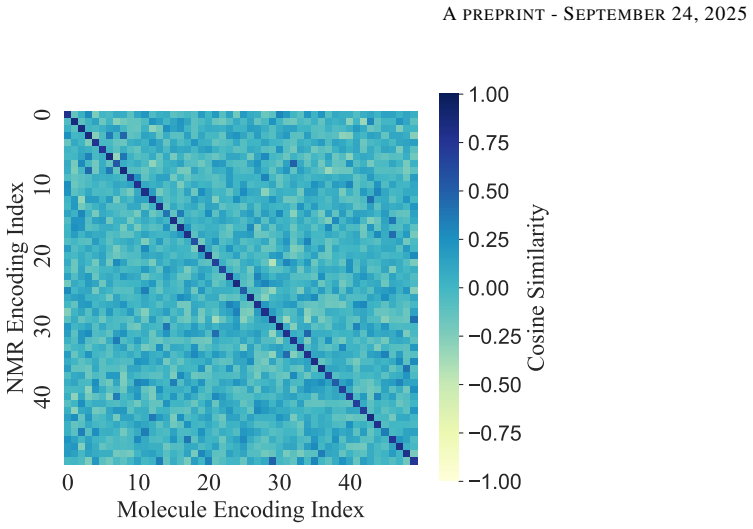
The central object is a conditional discrete graph diffusion model in the style of DiGress: a Markov noise process independently corrupts node and edge types, and a graph transformer denoiser $\phi_\theta(G_t, t, y)$ predicts the clean graph $G_0$ with the conditioning vector $y$ injected through FiLM layers. The conditioning vector is produced by an NMR encoder that embeds chemical shifts with radial basis functions (Gaussian kernels centered across the shift range), encodes 1H and 13C peaks in separate transformers, and fuses them with bidirectional cross-attention. Two pretraining stages support the pipeline: a diffusion autoencoder establishes the molecular latent space, and contrastive learning (InfoNCE) aligns NMR embeddings to that space; at inference, cosine-similarity filtering and retrieval initialization from the training database steer the denoising process.
What would settle it
Run DiffNMR on a held-out set of experimental 1H and 13C NMR spectra with known structures, recorded under a different solvent or reference than the simulated CDCl3 defaults, and compare top-1 accuracy and Tanimoto similarity with the reported benchmark numbers; a large drop in accuracy would contradict the transferability premise.
Extended reading notes
Core claim
The paper's central claim is that a conditional discrete diffusion model can perform de novo structure elucidation from 1H and 13C NMR spectra with accuracy comparable to autoregressive transformer models. The model treats a molecule as a graph and learns a reverse diffusion process that iteratively repairs noise-corrupted atom and bond types, conditioned on an NMR-derived vector through FiLM modulation. The NMR encoder uses radial basis functions for chemical shifts, separate transformers for each nucleus, and bidirectional cross-attention to fuse them; two pretraining stages first learn molecular representations with a diffusion autoencoder and then align the NMR space to the molecular space with an InfoNCE contrastive loss. On the MSD dataset of simulated spectra, the authors report top-1 accuracy of 68.26% with molecular formula and 58.83% without it for molecules up to 15 heavy atoms, and they report that retrieval initialization plus similarity filtering raises top-1 accuracy on the no-formula, up-to-25-heavy-atom set from 35.76% to 58.47% while raising average Tanimoto similarity from 0.71 to 0.82.
Load-bearing premise
The load-bearing premise is that NMR spectra simulated computationally with default parameters are faithful enough to real experimental spectra that the accuracy measured on the simulated MSD benchmark will transfer to practical structure elucidation; all reported results come from simulated data, and the paper does not test on experimental spectra.
Editorial extensions
If this is right
- NMR-based elucidation no longer needs predefined fragment libraries or hand-coded assembly rules; the same conditional diffusion decoder generates the whole graph.
- Because the molecular and spectral spaces are aligned by contrastive learning, the decoder can in principle be reconditioned by any encoder that maps into the same latent space.
- Retrieval initialization both improves accuracy and shortens the denoising chain, which points to database-augmented inference as a scalable route for larger molecules.
- The accuracy drop between 20 and 25 heavy atoms is attributed to data density rather than model capacity, so larger and more diverse training sets are a direct lever for improvement.
- Even incorrect top-1 predictions retain high Tanimoto similarity to the target, so the sampled candidates can serve as chemically relevant hypotheses for manual refinement.
Reading between the lines
- A direct test of the framework's practical value would be fine-tuning or evaluating on experimental spectra recorded under conditions outside the simulated CDCl3 default; the paper's RBF encoding is designed to be continuous, but cross-domain transfer is not shown.
- The contrastive alignment that powers similarity filtering is a reusable spectrum-to-structure retrieval mechanism; it could support database search independently of the diffusion decoder.
- The two-stage pretraining suggests a modular route to multi-modal elucidation: additional spectroscopies such as IR, MS, or 2D NMR could be attached as aligned encoders without retraining the molecular decoder.
- If simulated-to-experimental transfer fails, the headline accuracies would overstate real-world performance; a held-out experimental benchmark with known structures would settle the question.
Editorial analysis
A structured set of objections, weighed in public.
Referee Report
Summary. DiffNMR proposes a conditional discrete diffusion model, built on the DiGress framework, for de novo molecular structure elucidation from 1H and 13C NMR spectra. The system has three main components: a graph-transformer molecular encoder, a specialized NMR encoder that uses RBF encoding for chemical shifts and bidirectional cross-attention to fuse 1H and 13C information, and a graph diffusion decoder conditioned on the NMR representation via FiLM. Training proceeds through two pretraining stages (a diffusion autoencoder for molecular graphs, then contrastive alignment of the NMR encoder to the frozen molecular encoder) followed by joint fine-tuning. At inference, the method can use retrieval initialization from the training set and cosine-similarity-based filtering of generated candidates. Experiments on the simulated MSD dataset report Top-1 accuracies up to 68.26% for molecules with ≤15 heavy atoms when the molecular formula is provided, along with ablations showing benefits of pretraining, RBF encoding, similarity filtering, and retrieval initialization.
Significance. If the central claim of competitiveness with autoregressive approaches were properly supported, DiffNMR would be a useful contribution: it brings discrete graph diffusion to NMR structure elucidation, a domain currently dominated by autoregressive transformers, and it includes several well-motivated components (RBF shift encoding, two-stage pretraining, retrieval-based sampling) that are clearly ablated. The paper also releases code on GitHub, which aids reproducibility. However, the main empirical claim is currently unfalsifiable as stated because no same-split baseline is included, and the retrieval-initialization experiments use the training set as the retrieval database, which risks leaking structural information. These issues, together with the absence of error bars and the reliance on simulated spectra only, substantially weaken the significance of the reported accuracies.
major comments (5)
- [§2.3, Tables 1-2; abstract and §3] The central claim that DiffNMR achieves "competitive performance relative to autoregressive approaches" is not supported by any baseline evaluated on the same data and split. The only prior-work numbers cited in the Introduction (refs [22] and [24]) come from different datasets, different evaluation protocols, and different formula conditions, so they cannot establish competitiveness. Without a direct comparison—e.g., a transformer encoder-decoder or DeepSPInN variant trained and tested on the same MSD split—the headline accuracy of 68.26% (Table 1) and the retrieval-initialization gains (Table 2) have no reference point. This is a load-bearing gap: the paper's motivation and conclusions are framed specifically in opposition to autoregressive models.
- [§2.4, Table 2, text "Here, we use the training set as the retrieval database."] Retrieval initialization draws the starting molecule from the training set, which can leak information about test molecules because training and test molecules in MSD are drawn from the same USPTO-derived distribution. The reported improvements from retrieval initialization (e.g., accuracy rising from 35.76% to 49.70% for ≤25 HAC without filtering) may partly reflect nearest-neighbor memorization rather than the diffusion model's generative capability. To quantify the true contribution, the retrieval database must be disjoint from the training set (e.g., a held-out validation set), and the retrieval-only baseline (nearest neighbor without any diffusion steps) should be reported.
- [§4.4 and Table 1] The mechanism by which the molecular formula is provided as a condition is never described. Table 1 compares results with and without the formula, but Section 4, which defines the condition vector y and the NMR encoder, does not state how the formula (e.g., as a count vector, SMILES fragment, or embedding) enters the model. This omission makes the main table irreproducible, and it is particularly important because the formula condition is a major source of the reported accuracy gain (e.g., 58.83% to 68.26% for ≤15 HAC). Please specify the exact conditioning implementation and, ideally, include an ablation on how the formula is encoded.
- [§2.3, Tables 1-2 and Figure 6] No error bars, standard deviations, or significance tests are reported for any accuracy or Tanimoto value. Diffusion sampling is stochastic—the method generates multiple candidates and, with random initialization, the denoising process is not deterministic—so the difference between 60.13% and 61.18% in Table 2, or between 20% improvements in Figure 6, could easily be within sampling noise. Please report mean ± std over at least three independent runs (or fix and report all random seeds) for all quantitative claims.
- [§2.2, §3 and the abstract] All reported results use simulated spectra from MSD (generated with MestReNova default parameters), and the paper never evaluates on experimental NMR data. The conclusion that DiffNMR "offers a promising framework for automating NMR-based structure elucidation" is therefore a claim about practical utility that rests on the unvalidated premise that simulation-to-experiment transfer is trivial. At minimum, the paper should acknowledge this domain-shift risk explicitly, and ideally it should include a small evaluation on experimental spectra or a discussion of how the model is expected to handle noise, peak-picking errors, and solvent differences.
minor comments (7)
- [§4.5, Eq. (15)] The FiLM formulation appears mistyped: "FiLM(X1, X2) = X1W1 + (X1W2) ⊙ X2 + W2" suggests that the bias term is a parameter matrix W2 rather than a bias vector, and the standard FiLM uses a modulation vector computed from the condition, not from X2. Please clarify the dimensions and correct the equation.
- [§4.2, Eq. (2) and the cosine schedule] The cosine schedule for α_t is written with unbalanced parentheses: αt = cos(0.5π(t/T + s)/(1 + s))^2. Please check the formula against the original DiGress paper and correct the typesetting, as the current expression is ambiguous.
- [§4.5, first sentence] The sentence "We employ a graph transformer network[] as denoising network" contains an empty citation placeholder. Please fill in the appropriate reference or remove the brackets.
- [Figure 6 and its caption] The text in §2.5 refers to "Figure 6(a)" for the RBF-versus-discrete comparison, but Figure 6(a) is described in the caption as the pretraining comparison. The order of panels in the figure appears to be inconsistent with the in-text references; reorder the panels or adjust the text so that the descriptions match.
- [Table 2, ≤20 row, "√ √" column] The value "61.18 %" contains a space before the percent sign, which is inconsistent with other entries. Please make the formatting uniform.
- [§2.3, "It’s obvious"] The phrase "It’s obvious" is informal for a research paper; consider replacing it with a more neutral phrasing such as "The results show" or "As expected".
- [Figures 2 and 3 captions] The strings beginning with "/uni000000..." in the captions appear to be encoding artifacts from the PDF generation. They should be removed or replaced with the intended text, as they are not readable chemical information.
Circularity Check
No significant circularity: the reported results are held-out empirical evaluations, and the inference-time retrieval and filtering mechanisms are legitimate procedures rather than reductions to fitted inputs.
full rationale
DiffNMR's derivation chain is not circular. The core claim is an empirical accuracy figure (Table 1, e.g., 68.26% top-1 for 1H+13C with formula on molecules with <=15 heavy atoms), obtained by training a conditional discrete diffusion model with a standard cross-entropy denoising objective (Eq. 5) and evaluating against ground-truth structures. The two-stage pretraining (diffusion autoencoder then contrastive learning) is a standard representation-learning pipeline; the molecular encoder is kept frozen during contrastive alignment, and no test-set result is used to define the model. The retrieval-initialization and similarity-filtering mechanisms select or rank candidates using cosine similarity in the contrastively learned space, which is a self-consistent inference procedure, not a circular reduction. The fact that the training set is used as the retrieval database could raise a generalization or data-split concern, but that is an experimental-validity issue, not a case where a prediction is equivalent by construction to its input. The paper's 'competitive' claim is weakened by the absence of any baseline under the same evaluation protocol, and the reliance on MestReNova-simulated spectra raises real-world transfer concerns; both are evidence and correctness issues explicitly outside the scope of circularity analysis. No specific equation or passage can be quoted where a reported prediction reduces to a fitted parameter, a self-cited uniqueness result, or a renamed known result.
Assumptions & free parameters
free parameters (4)
- InfoNCE temperature tau =
not reported
- RBF bandwidth sigma =
adaptive, unspecified
- Number of RBF bins B =
not reported
- Diffusion steps T =
500 or 200 in examples
assumptions (3)
- standard math DiGress discrete diffusion framework (Eq. 1-4) is valid as described
- domain assumption MSD simulated spectra are accurate proxies for experimental NMR
- domain assumption Test set is disjoint from training set
Cite this review
Pith. "Pith review of DiffNMR: Diffusion Models for Nuclear Magnetic Resonance Spectra Elucidation." pith.science (2026). https://pith.science/paper/LCYT6A5V
@misc{pith2026250708854,
  author       = {Pith},
  title        = {Pith review of: DiffNMR: Diffusion Models for Nuclear Magnetic Resonance Spectra Elucidation},
  year         = {2026},
  howpublished = {\url{https://pith.science/paper/LCYT6A5V}},
  note         = {Machine review of arXiv:2507.08854}
}
read the original abstract
Nuclear Magnetic Resonance (NMR) spectroscopy is a central characterization method for molecular structure elucidation, yet interpreting NMR spectra to deduce molecular structures remains challenging due to the complexity of spectral data and the vastness of the chemical space. In this work, we introduce DiffNMR, a novel end-to-end framework that leverages a conditional discrete diffusion model for de novo molecular structure elucidation from NMR spectra. DiffNMR refines molecular graphs iteratively through a diffusion-based generative process, ensuring global consistency and mitigating error accumulation inherent in autoregressive methods. The framework integrates a two-stage pretraining strategy that aligns spectral and molecular representations via diffusion autoencoder (Diff-AE) and contrastive learning, the incorporation of retrieval initialization and similarity filtering during inference, and a specialized NMR encoder with radial basis function (RBF) encoding for chemical shifts, preserving continuity and chemical correlation. Experimental results demonstrate that DiffNMR achieves competitive performance for NMR-based structure elucidation, offering an efficient and robust solution for automated molecular analysis.
Figures


Figures from the paper (4 more)



Reference graph
Works this paper leans on
-
[22]
Frank Hu, Michael S Chen, Grant M Rotskoff, Matthew W Kanan, and Thomas E Markland. Accurate and efficient structure elucidation from routine one-dimensional nmr spectra using multitask machine learning. ACS Central Science, 10(11):2162–2170, 2024
work page 2024
-
[24]
Learning the language of nmr: Structure elucidation from nmr spectra using transformer models
Marvin Alberts, Federico Zipoli, and Alain C Vaucher. Learning the language of nmr: Structure elucidation from nmr spectra using transformer models. 2023
work page 2023
-
[1]
Julie Pollak, Moses Mayonu, Lin Jiang, and Bo Wang. The development of machine learning approaches in two-dimensional nmr data interpretation for metabolomics applications. Analytical Biochemistry, 695:115654, 2024
work page 2024
-
[2]
Assisting and accelerating nmr assignment with restrained structure prediction
Sirui Liu, Haotian Chu, Yuhao Xie, Fangming Wu, Ningxi Ni, Chenghao Wang, Fangjing Mu, Jiachen Wei, Jun Zhang, Mengyun Chen, et al. Assisting and accelerating nmr assignment with restrained structure prediction. bioRxiv, pages 2023–04, 2023
work page 2023
-
[3]
Thomas Kuballa, Katja H Kaltenbach, Jan Teipel, and Dirk W Lachenmeier. Liquid nuclear magnetic resonance (nmr) spectroscopy in transition—from structure elucidation to multi-analysis method. Separations, 10(11):572, 2023
work page 2023
-
[4]
Detecting submicromolar analytes in mixtures with a 5 min acquisition on 600 mhz nmr spectrometers
Congcong Zhang, Li Xu, Qingxia Huang, Yulan Wang, and Huiru Tang. Detecting submicromolar analytes in mixtures with a 5 min acquisition on 600 mhz nmr spectrometers. Journal of the American Chemical Society, 145(47):25513–25517, 2023
work page 2023
-
[5]
Prediction of 1h nmr coupling constants with associative neural networks trained for chemical shifts
Yuri Binev, Maria MB Marques, and João Aires-de Sousa. Prediction of 1h nmr coupling constants with associative neural networks trained for chemical shifts. Journal of chemical information and modeling, 47(6):2089–2097, 2007
work page 2007
-
[6]
Jie Li, Jiashu Liang, Zhe Wang, Aleksandra L Ptaszek, Xiao Liu, Brad Ganoe, Martin Head-Gordon, and Teresa Head-Gordon. Highly accurate prediction of nmr chemical shifts from low-level quantum mechanics calculations using machine learning. Journal of chemical theory and computation, 20(5):2152–2166, 2024
work page 2024
Show all 44 references
-
[7]
Ultra-fast and accurate electron ionization mass spectrum matching for compound identification with million-scale in-silico library
Qiong Yang, Hongchao Ji, Zhenbo Xu, Yiming Li, Pingshan Wang, Jinyu Sun, Xiaqiong Fan, Hailiang Zhang, Hongmei Lu, and Zhimin Zhang. Ultra-fast and accurate electron ionization mass spectrum matching for compound identification with million-scale in-silico library. Nature Comm...
2023
-
[8]
Computer assisted structure elucidation (case): current and future perspectives
Mikhail Elyashberg and Dimitris Argyropoulos. Computer assisted structure elucidation (case): current and future perspectives. Magnetic Resonance in Chemistry, 59(7):669–690, 2021
2021
-
[9]
Enhancing efficiency of natural product structure revision: leveraging case and dft over total synthesis
Mikhail Elyashberg, Sriram Tyagarajan, Mihir Mandal, and Alexei V Buevich. Enhancing efficiency of natural product structure revision: leveraging case and dft over total synthesis. Molecules, 28(9):3796, 2023
2023
-
[10]
Impact of noise on inverse design: the case of nmr spectra matching
Dominik Lemm, Guido Falk von Rudorff, and O Anatole V on Lilienfeld. Impact of noise on inverse design: the case of nmr spectra matching. Digital Discovery, 3(1):136–144, 2024
2024
-
[11]
Cross-modal retrieval between 13c nmr spectra and structures based on focused libraries
Hanyu Sun, Xi Xue, Xue Liu, Hai-Yu Hu, Yafeng Deng, and Xiaojian Wang. Cross-modal retrieval between 13c nmr spectra and structures based on focused libraries. Analytical Chemistry, 96(15):5763–5770, 2024
2024
-
[12]
Machine learning-assisted structure annotation of natural products based on ms and nmr data
Guilin Hu and Minghua Qiu. Machine learning-assisted structure annotation of natural products based on ms and nmr data. Natural Product Reports, 40(11):1735–1753, 2023
2023
-
[13]
Nuclear magnetic resonance and artificial intelligence
Stefan Kuhn, Rômulo Pereira de Jesus, and Ricardo Moreira Borges. Nuclear magnetic resonance and artificial intelligence. Encyclopedia, 4(4):1568–1580, 2024
2024
-
[14]
Deep learning-assisted spectrum–structure correlation: state-of-the-art and perspectives
Xin-Yu Lu, Hao-Ping Wu, Hao Ma, Hui Li, Jia Li, Yan-Ti Liu, Zheng-Yan Pan, Yi Xie, Lei Wang, Bin Ren, et al. Deep learning-assisted spectrum–structure correlation: state-of-the-art and perspectives. Analytical Chemistry, 96(20):7959–7975, 2024
2024
-
[15]
A framework for automated structure elucidation from routine nmr spectra
Zhaorui Huang, Michael S Chen, Cristian P Woroch, Thomas E Markland, and Matthew W Kanan. A framework for automated structure elucidation from routine nmr spectra. Chemical Science, 12(46):15329–15338, 2021
2021
-
[16]
Reinforcement learning: A survey
Leslie Pack Kaelbling, Michael L Littman, and Andrew W Moore. Reinforcement learning: A survey. Journal of artificial intelligence research, 4:237–285, 1996. 14 A PREPRINT - S EPTEMBER 24, 2025
1996
-
[17]
Deep reinforcement learning: A brief survey
Kai Arulkumaran, Marc Peter Deisenroth, Miles Brundage, and Anil Anthony Bharath. Deep reinforcement learning: A brief survey. IEEE Signal Processing Magazine, 34(6):26–38, 2017
2017
-
[18]
Deep reinforcement learning for molecular inverse problem of nuclear magnetic resonance spectra to molecular structure
Bhuvanesh Sridharan, Sarvesh Mehta, Yashaswi Pathak, and U Deva Priyakumar. Deep reinforcement learning for molecular inverse problem of nuclear magnetic resonance spectra to molecular structure. The Journal of Physical Chemistry Letters, 13(22):4924–4933, 2022
2022
-
[19]
Deepspinn-multimodal deep learning for molecular structure prediction from infrared and nmr spectra
Sriram Devata, Bhuvanesh Sridharan, Sarvesh Mehta, Yashaswi Pathak, Siddhartha Laghuvarapu, Girish Varma, and Deva Priyakumar. Deepspinn-multimodal deep learning for molecular structure prediction from infrared and nmr spectra. 2023
2023
-
[20]
Transformer in transformer
Kai Han, An Xiao, Enhua Wu, Jianyuan Guo, Chunjing Xu, and Yunhe Wang. Transformer in transformer. Advances in neural information processing systems, 34:15908–15919, 2021
2021
-
[21]
Attention is all you need
Ashish Vaswani, Noam Shazeer, Niki Parmar, Jakob Uszkoreit, Llion Jones, Aidan N Gomez, Łukasz Kaiser, and Illia Polosukhin. Attention is all you need. Advances in neural information processing systems, 30, 2017
2017
-
[23]
Unraveling molecular structure: A multimodal spectroscopic dataset for chemistry
Marvin Alberts, Oliver Schilter, Federico Zipoli, Nina Hartrampf, and Teodoro Laino. Unraveling molecular structure: A multimodal spectroscopic dataset for chemistry. Advances in Neural Information Processing Systems, 37:125780–125808, 2024
2024
-
[25]
Deep autoregressive networks
Karol Gregor, Ivo Danihelka, Andriy Mnih, Charles Blundell, and Daan Wierstra. Deep autoregressive networks. In International Conference on Machine Learning, pages 1242–1250. PMLR, 2014
2014
-
[26]
Diffusion-based graph generative methods
Hongyang Chen, Can Xu, Lingyu Zheng, Qiang Zhang, and Xuemin Lin. Diffusion-based graph generative methods. IEEE Transactions on Knowledge and Data Engineering, 2024
2024
-
[27]
Structured denoising diffusion models in discrete state-spaces
Jacob Austin, Daniel D Johnson, Jonathan Ho, Daniel Tarlow, and Rianne Van Den Berg. Structured denoising diffusion models in discrete state-spaces. Advances in neural information processing systems, 34:17981–17993, 2021
2021
-
[28]
Digress: Discrete denoising diffusion for graph generation
Clement Vignac, Igor Krawczuk, Antoine Siraudin, Bohan Wang, V olkan Cevher, and Pascal Frossard. Digress: Discrete denoising diffusion for graph generation. arXiv preprint arXiv:2209.14734, 2022
2022 arXiv
-
[29]
Madgen–mass-spec attends to de novo molecular generation
Yinkai Wang, Xiaohui Chen, Liping Liu, and Soha Hassoun. Madgen–mass-spec attends to de novo molecular generation. arXiv preprint arXiv:2501.01950, 2025
2025 arXiv
-
[30]
Diffusion models in vision: A survey
Florinel-Alin Croitoru, Vlad Hondru, Radu Tudor Ionescu, and Mubarak Shah. Diffusion models in vision: A survey. IEEE Transactions on Pattern Analysis and Machine Intelligence, 45(9):10850–10869, 2023
2023
-
[31]
Denoising diffusion probabilistic models
Jonathan Ho, Ajay Jain, and Pieter Abbeel. Denoising diffusion probabilistic models. Advances in neural information processing systems, 33:6840–6851, 2020
2020
-
[32]
Transformer for graphs: An overview from architecture perspective
Erxue Min, Runfa Chen, Yatao Bian, Tingyang Xu, Kangfei Zhao, Wenbing Huang, Peilin Zhao, Junzhou Huang, Sophia Ananiadou, and Yu Rong. Transformer for graphs: An overview from architecture perspective. arXiv preprint arXiv:2202.08455, 2022
2022 arXiv
-
[33]
Heterogeneous graph transformer
Ziniu Hu, Yuxiao Dong, Kuansan Wang, and Yizhou Sun. Heterogeneous graph transformer. In Proceedings of the web conference 2020, pages 2704–2710, 2020
2020
-
[34]
Gnn-film: Graph neural networks with feature-wise linear modulation
Marc Brockschmidt. Gnn-film: Graph neural networks with feature-wise linear modulation. In International Conference on Machine Learning, pages 1144–1152. PMLR, 2020
2020
-
[35]
Crossvit: Cross-attention multi-scale vision trans- former for image classification
Chun-Fu Richard Chen, Quanfu Fan, and Rameswar Panda. Crossvit: Cross-attention multi-scale vision trans- former for image classification. In Proceedings of the IEEE/CVF international conference on computer vision, pages 357–366, 2021
2021
-
[36]
Multi-modality cross attention network for image and sentence matching
Xi Wei, Tianzhu Zhang, Yan Li, Yongdong Zhang, and Feng Wu. Multi-modality cross attention network for image and sentence matching. In Proceedings of the IEEE/CVF conference on computer vision and pattern recognition, pages 10941–10950, 2020
2020
-
[37]
Diffusion autoen- coders: Toward a meaningful and decodable representation
Konpat Preechakul, Nattanat Chatthee, Suttisak Wizadwongsa, and Supasorn Suwajanakorn. Diffusion autoen- coders: Toward a meaningful and decodable representation. In Proceedings of the IEEE/CVF conference on computer vision and pattern recognition, pages 10619–10629, 2022. 15 ...
2022
-
[38]
Diffusion model as representation learner
Xingyi Yang and Xinchao Wang. Diffusion model as representation learner. In Proceedings of the IEEE/CVF International Conference on Computer Vision, pages 18938–18949, 2023
2023
-
[39]
Diffusion models and representation learning: A survey
Michael Fuest, Pingchuan Ma, Ming Gui, Johannes Schusterbauer, Vincent Tao Hu, and Bjorn Ommer. Diffusion models and representation learning: A survey. arXiv preprint arXiv:2407.00783, 2024
2024 arXiv
-
[40]
Diffusion-based representation learning
Korbinian Abstreiter, Sarthak Mittal, Stefan Bauer, Bernhard Schölkopf, and Arash Mehrjou. Diffusion-based representation learning. arXiv preprint arXiv:2105.14257, 2021
2021 arXiv
-
[41]
Graph contrastive learning with augmentations
Yuning You, Tianlong Chen, Yongduo Sui, Ting Chen, Zhangyang Wang, and Yang Shen. Graph contrastive learning with augmentations. Advances in neural information processing systems, 33:5812–5823, 2020
2020
-
[42]
Contrastive representation learning: A framework and review
Phuc H Le-Khac, Graham Healy, and Alan F Smeaton. Contrastive representation learning: A framework and review. Ieee Access, 8:193907–193934, 2020
2020
-
[43]
Cross-modal retrieval between 13c nmr spectra and structures for compound identification using deep contrastive learning
Zhuo Yang, Jianfei Song, Minjian Yang, Lin Yao, Jiahua Zhang, Hui Shi, Xiangyang Ji, Yafeng Deng, and Xiaojian Wang. Cross-modal retrieval between 13c nmr spectra and structures for compound identification using deep contrastive learning. Analytical Chemistry, 93(50):16947–16955, 2021
2021
-
[44]
The generation of a unique machine description for chemical structures-a technique developed at chemical abstracts service
Harry L Morgan. The generation of a unique machine description for chemical structures-a technique developed at chemical abstracts service. Journal of chemical documentation, 5(2):107–113, 1965. 16
1965
Reviewed August 6, 2026 · model on record in the stance chip above.
Discussion (0). Sign in to comment.