REVIEW 3 major objections 6 minor 83 references
The star-formation response of a simulated major merger is set by which stellar-feedback recipe the code uses.
Reviewed by Pith at T0; open to challenge. T0 means a machine referee read the full paper against a public rubric. the ladder, T0–T4 →
In nine matched cosmological simulations of a Milky Way-progenitor major merger at z≈4.5, the timing and strength of the merger-induced starburst depend on whether the code uses kinetic, thermal, or delayed-cooling stellar feedback.
T0 review reviewed 2026-08-01 challenge →
load-bearing objection A useful, visually rich AGORA comparison of one major merger across nine codes; the SFR-feedback grouping is plausible and mechanistically supported, but one run per code and a biased baseline method leave the central causal claim suggestive rather than decisive. the 3 major comments →
The AGORA High-resolution Galaxy Simulations Comparison Project. IX - Part 1: Effects of a Major Galaxy Merger on Star Formation of a Milky Way-mass Galaxy Progenitor
The pith
A machine-rendered reading of the paper's core claim, the machinery that carries it, and where it could break.
The reading
Core claim
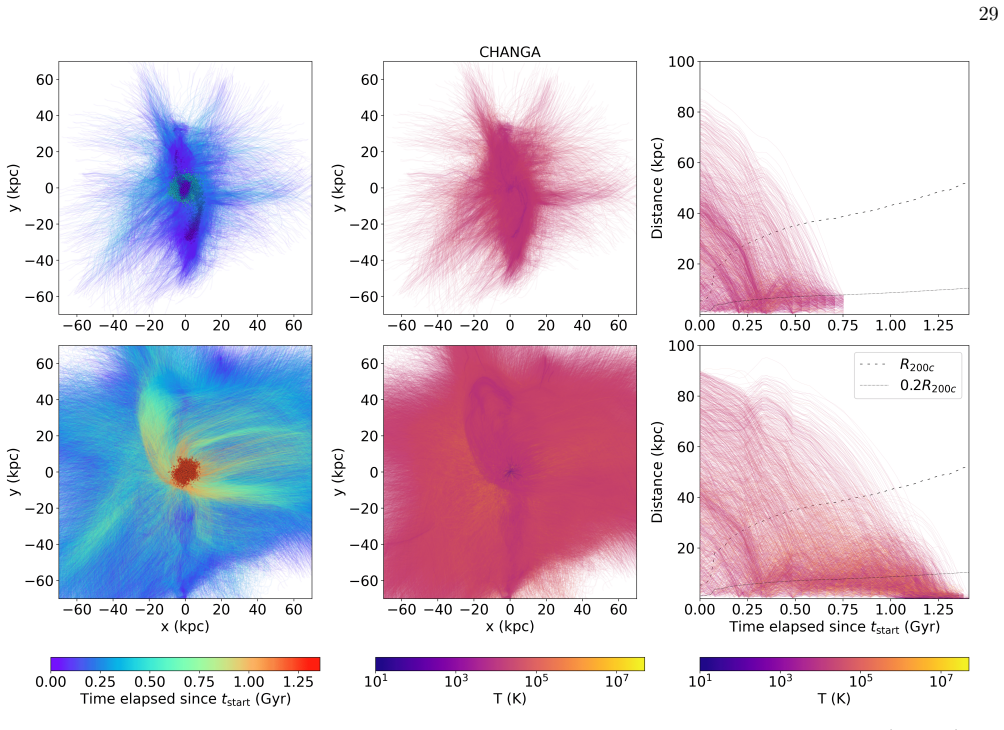
The central discovery is a three-way split in the star-formation history of the same major merger when the only systematic change is the stellar feedback prescription. Simulations whose supernova feedback includes a kinetic channel (momentum injected into surrounding gas) form an extended starburst that peaks between first periapsis and first apoapsis and declines before the galaxies coalesce; simulations using only thermal feedback (heat injection) continue to increase their SFR after coalescence; and simulations adding delayed cooling or radiation pressure to thermal feedback show strong short-timescale SFR fluctuations superimposed on either trend. Gas particle tracking shows the kinetic-
What carries the argument
The organizing object is the feedback type, in particular whether a code's supernova scheme injects momentum (kinetic feedback) or only heat (thermal feedback), and whether it adds delayed cooling or radiation pressure. The suite provides nine calibrated simulations of one halo and one merger, so the feedback recipe is the main controlled variable. The analysis then uses orbit definitions (infall, first passage, coalescence, post-coalescence based on stellar-core distance and velocity) and tracks pre-star gas particles in Lagrangian codes to expose the causal path: kinetic feedback, possibly aided by momentum kicks opposite to infall, lets gas from the secondary collapse into the primary cen
Load-bearing premise
The paper attributes the spread in star-formation behavior to the feedback type while running only one simulation per code, so uncontrolled run-to-run chaotic divergence could in principle masquerade as a feedback effect.
What would settle it
Concrete: rerun one thermal-only code with a kinetic channel enabled and one kinetic code with it disabled, keeping all other settings fixed; if the SFR pattern does not flip accordingly, the central claim is falsified. Also, multiple seeded runs per code would test the chaos contamination.
If this is right
- Merger-triggered starburst timing and amplitude are not converged predictions of cosmological galaxy formation; they vary by roughly an order of magnitude in SFR depending on the feedback recipe.
- Kinetic feedback codes form their burst early, before coalescence, while thermal-only codes keep forming stars long after the remnant relaxes, so merger-stage classification alone does not fix the expected SFR response.
- Delayed cooling and radiation pressure produce episodic, small-amplitude SFR fluctuations that can masquerade as merger-driven bursts on short timescales.
- The inverse burst-fraction–gas-fraction correlation, found independently of feedback model, gives a candidate scaling relation that can be compared with observational burst-efficiency estimates.
- Because the response is so feedback-sensitive, observed post-merger SFR histories could constrain which feedback modes operate at high redshift.
Where Pith is reading between the lines
- If the grouping holds in larger samples, the timing of the post-merger SFR peak relative to coalescence could be used as an observational diagnostic of the dominant feedback channel in high-redshift galaxies.
- The paper's own caveat that identical runs can diverge chaotically by factor-of-two stellar mass implies the true test requires multiple realizations per code; ensemble runs would separate feedback-driven trends from run-to-run stochasticity.
- A code whose superbubble scheme expels gas shows its strongest starburst about 550 Myr after coalescence, implying surveys selecting mergers by morphological disturbance will miss a fraction of merger-driven star formation since the peak burst can occur after the remnant has relaxed.
- One testable extension: rerun the same feedback model with kinetic feedback added or removed within a single code, holding everything else fixed, to confirm the causal claim without cross-code confounding.
Editorial analysis
A structured set of objections, weighed in public.
Referee Report
Summary. This AGORA IX Part 1 paper uses the nine-code CosmoRun cosmological zoom-in suite to study a major galaxy merger at z≈4.5 in a Milky Way-mass progenitor. The authors define merger stages with a new coalescence criterion, track gas particles in particle-based codes, and compare the resulting SFR evolution across codes. Their central claim is that the merger-induced star formation response is strongly shaped by the stellar feedback prescription: codes with kinetic feedback show a pronounced pre-coalescence starburst; codes with thermal-only feedback show prolonged SFR growth into the post-coalescence stage; and codes with delayed cooling or radiation pressure show short-timescale SFR fluctuations. They also introduce a method to compute a burst fraction without an isolated control sample and report a feedback-independent anti-correlation between burst fraction and gas fraction.
Significance. If the central claim holds, the paper would demonstrate that the star formation response to major mergers is not a robust prediction of cosmological hydrodynamics but depends sensitively on subgrid stellar feedback prescriptions. This is an important and timely result, as it would imply that observed merger-induced starbursts can be used as a discriminating testbed for feedback models. The paper has notable strengths: the initial conditions and calibration are shared across codes, the halo finder and merger-stage definitions are carefully described, the gas-particle tracking provides a physical mechanism, and the authors are transparent about their caveats, including the lack of repeat runs. The new burst-fraction estimator is a useful methodological contribution, even if its assumptions need validation. The significance is conditional: the qualitative patterns are clear from the figures, but the causal attribution to feedback type is not fully secured by the current experimental design.
major comments (3)
- [§4.3 (second caveat) and §2.1] The paper's headline result—that feedback type 'strongly shapes' the SFR evolution—rests on one realization per code, with no repeat runs or chaos experiments. The authors themselves cite Keller et al. (2019), who found factor-of-two stellar-mass scatter between otherwise identical runs, with divergence amplified during mergers. With n=1 per code, the observed grouping of SFR curves could in principle be a stochastic realization effect rather than a causal consequence of feedback type. The within-group agreement across different code architectures is encouraging, but it does not replace replication. To make the causal claim load-bearing, the authors should either provide repeat runs for at least a subset of codes, or explicitly soften the language to 'correlated with' and present the feedback-type attribution as a plausible interpretation rather than a demonstrated cause.
- [§3.3, Eq. (2), Figs. 10–11] The burst-fraction method assumes that sSFR remains constant over the ~0.6–0.8 Gyr merger timescale in the absence of mergers with μ>1:10. This is an unvalidated assumption, and the baseline sSFR is chosen as the minimum sSFR in a 100-Myr pre-infall window. Taking the minimum rather than, say, the mean or median maximizes the inferred excess star formation and therefore the burst fraction. No sensitivity test is provided to show how f_sb or the R²=0.74 gas-fraction anti-correlation depends on this baseline choice. Since the gas-fraction correlation is claimed to be feedback-independent and is a key secondary result, the robustness of f_sb to alternative baseline definitions and window lengths should be demonstrated. At minimum, the authors should report how much f_sb and the correlation change under reasonable variations of the baseline definition.
- [§3.1 and §3.2.4] The three-way classification into 'kinetic', 'thermal-only', and 'delayed cooling/radiation pressure' feedback groups is not a clean partition: ART-I and GADGET-3 appear in both the kinetic group and the delayed-cooling/radiation-pressure group. The short-timescale 'bursty' behavior is asserted from visual inspection of Fig. 4, but no quantitative burstiness metric is provided. Additionally, the gas-particle tracking that directly supports the kinetic-feedback mechanism is limited to GADGET-3, GADGET-4, and GIZMO; ART-I's inclusion in the kinetic group is inferred from its SFR curve and phase plots, not from direct particle tracing. The authors should quantify the short-timescale variability (e.g., a scatter or burstiness parameter) and explicitly state which parts of the mechanistic explanation are directly traced versus inferred from the SFR morphology.
minor comments (6)
- [§3.1, third bullet] Typo: 'RASMES' should be 'RAMSES'.
- [§3.2.4] Typo: 'GAGDET-3' should be 'GADGET-3'.
- [§2.3 / Fig. 2] The phrase 'top 10%-bound star particles' is unclear; consider 'the 10% most bound star particles'.
- [§3.3 / Fig. 11] The gas-fraction correlation is based on only seven codes, with GEAR evaluated at a different time and GADGET-3/GADGET-4 excluded. A brief statement of the effective n and the sensitivity to those choices would help the reader calibrate the strength of the R² values.
- [§4.1] The comparison with Ferreira et al. (2025) uses one merger per code against a sample-averaged observational result; the authors note this, but the point could be made more prominently when interpreting the 'six out of nine' agreement.
- [Table 1 / Table 3] The naming of codes is inconsistent (e.g., 'Art-I' vs 'ART-I', 'Gadget-3' vs 'GADGET-3' in various places). Please normalize to the table style throughout.
Circularity Check
No circular derivation; central SFR-feedback comparison is independent of its inputs.
full rationale
The paper's central claim is that SFR evolution during the target merger groups by stellar feedback type. The feedback type is an a priori property of each code setup (Table 1), not a parameter fit to the SFR patterns; the SFR evolution is the measured output, not an input. The nine-code suite shares initial conditions and calibration targets from earlier AGORA papers, but those citations are legitimate methodological references and do not smuggle in the conclusion. The baseline sSFR used to define the burst fraction (Section 3.3) is chosen as the minimum pre-merger sSFR and is explicitly a counterfactual assumption; the resulting baseline stellar mass is the integral of that assumed constant sSFR, not an independent prediction, so the burst fraction is a defined metric rather than a fitted parameter renamed as a prediction. The acknowledged n=1 stochasticity caveat (Section 4.3) is an underdetermination and correctness-risk concern, not circularity. No equation reduces to itself, and no load-bearing uniqueness claim is imported from the authors' prior work. Score 1 reflects only minor self-referential methodological framing, not actual circularity.
Axiom & Free-Parameter Ledger
free parameters (5)
- baseline sSFR per code =
quoted per code in Fig. 10 (order 1e-9/yr)
- coalescence thresholds in Eq. 1 =
0.025 R200c; vrel/σv < 0.1
- subgrid feedback energies/delays per code =
e.g., E_SN from 4e49 erg/Msun to 5e52 erg/SN; T_delay 5-10 Myr (Table 1)
- star formation efficiency epsilon =
0.01
- SFR averaging timescale =
10 Myr
axioms (6)
- ad hoc to paper Constant sSFR baseline: in the absence of mergers with μ>1:10, a galaxy's sSFR remains constant over ~0.6-0.8 Gyr
- domain assumption Very minor mergers (1:100<μ<1:10) contribute negligibly to SFR changes compared to the target merger
- domain assumption The nine CosmoRun simulations differ essentially only in hydro solver and stellar feedback; shared initial conditions, cosmology, cooling, and calibration make discrepancies attributable to feedback
- domain assumption Numerical stochasticity and chaotic divergence are subdominant to feedback-type differences
- domain assumption The subgrid star formation recipe dρ*/dt = ε ρ_gas / t_ff with n_H > 1 cm^-3 is an adequate description of star formation
- standard math WMAP7/9+SNe+BAO cosmological parameters and MUSIC initial conditions are the correct background
Cite this review
Pith. "Pith review of The AGORA High-resolution Galaxy Simulations Comparison Project. IX - Part 1: Effects of a Major Galaxy Merger on Star Formation of a Milky Way-mass Galaxy Progenitor." pith.science (2026). https://pith.science/paper/LD5TOEKE
@misc{pith2026260721709,
  author       = {Pith},
  title        = {Pith review of: The AGORA High-resolution Galaxy Simulations Comparison Project. IX - Part 1: Effects of a Major Galaxy Merger on Star Formation of a Milky Way-mass Galaxy Progenitor},
  year         = {2026},
  howpublished = {\url{https://pith.science/paper/LD5TOEKE}},
  note         = {Machine review of arXiv:2607.21709}
}
abstract
Given their highly nonlinear dynamics and sensitivity to initial conditions, galaxy mergers are a compelling area to conduct a simulation code comparison. We perform a comparative study of a major galaxy merger at $z \approx 4.5$ in cosmological zoom-in hydrodynamic simulations of a Milky Way-mass galaxy progenitor. The comparison employs the AGORA CosmoRun suite of nine well-calibrated, state-of-the-art numerical codes, each adopting a different stellar feedback scheme. We find that the evolution of the star formation rate (SFR) during the interaction is strongly shaped by the stellar feedback type. Using kinetic feedback in the feedback model drives a pronounced merger-induced starburst that starts to subside before coalescence; using thermal feedback without kinetic feedback yields prolonged SFR growth even after coalescence; and using delayed cooling or radiation pressure results in highly fluctuating SFR. Tracking gas particles in particle-based codes reveals that kinetic feedback facilitates gas inflow from the secondary galaxy onto the primary galaxy between the first periapsis and apoapsis, thus producing an earlier and more prominent starburst. In contrast, thermal feedback, augmented by superbubble or delayed-cooling feedback, suppresses gas cooling, creates a more extended gas distribution, and hinders strong starbursts during the merger. We also observe an inverse correlation between burst fraction and pre-merger gas fraction that is independent of feedback models. Overall, these results highlight the sensitivity of simulated galaxy mergers' star formation response to stellar feedback prescriptions. This study indicates that galaxy mergers may serve as a good testbed for stellar feedback processes in cosmological simulations.
Figures


Reference graph
Works this paper leans on
-
[1]
Adamo, A., Atek, H., Bagley, M. B., et al. 2025, Nature Astronomy, 9, 1134, doi: 10.1038/s41550-025-02624-5 Anglés-Alcázar, D., Faucher-Giguère, C.-A., Kereˇ s, D., et al. 2017, Monthly Notices of the Royal Astronomical Society, 470, 4698, doi: 10.1093/mnras/stx1517
-
[2]
Barnes, J. E., & Hernquist, L. 1996, The Astrophysical Journal, 471, 115, doi: 10.1086/177957
doi:10.1086/177957 1996
-
[3]
Barrow, K. S. S., Nguyen, T. H., & Skrabacz, E. 2026a, The Astrophysical Journal, 999, 72, doi: 10.3847/1538-4357/ae2eb4
-
[4]
Barrow, K. S. S., Nguyen, T. H., Roca-Fàbrega, S., et al. 2026b, The AGORA High-resolution Galaxy Simulations Comparison Project. XI: Solving the Non-Spherical Morphology and Evolution of Dark Matter Halos with Haskap Pie, arXiv, doi: 10.48550/arXiv.2605.24097
-
[6]
Bryan, G. L., Norman, M. L., O’Shea, B. W., et al. 2014, The Astrophysical Journal Supplement Series, 211, 19, doi: 10.1088/0067-0049/211/2/19
-
[7]
Casteels, K. R. V., Conselice, C. J., Bamford, S. P., et al. 2014, Monthly Notices of the Royal Astronomical Society, 445, 1157, doi: 10.1093/mnras/stu1799
-
[8]
Ceverino, D., Klypin, A., Klimek, E. S., et al. 2014, Monthly Notices of the Royal Astronomical Society, 442, 1545, doi: 10.1093/mnras/stu956
-
[9]
2023, Monthly Notices of the Royal Astronomical Society, 523, 3709, doi: 10.1093/mnras/stad1626
Chaikin, E., Schaye, J., Schaller, M., et al. 2023, Monthly Notices of the Royal Astronomical Society, 523, 3709, doi: 10.1093/mnras/stad1626
-
[10]
Cole, S., Lacey, C. G., Baugh, C. M., & Frenk, C. S. 2000, Monthly Notices of the Royal Astronomical Society, 319, 168, doi: 10.1046/j.1365-8711.2000.03879.x
arXiv 2000
-
[11]
Conroy, C., & Wechsler, R. H. 2009, The Astrophysical Journal, 696, 620, doi: 10.1088/0004-637X/696/1/620
-
[12]
Dekel, A. 2008, Monthly Notices of the Royal Astronomical Society, 384, 386, doi: 10.1111/j.1365-2966.2007.12730.x
arXiv 2008
-
[13]
Duan, Q., Conselice, C. J., Harvey, T., et al. 2026, Monthly Notices of the Royal Astronomical Society, 546, stag008, doi: 10.1093/mnras/stag008
-
[14]
2015, Monthly Notices of the Royal Astronomical Society, 452, 1502, doi: 10.1093/mnras/stv1416
Dubois, Y., Volonteri, M., Silk, J., et al. 2015, Monthly Notices of the Royal Astronomical Society, 452, 1502, doi: 10.1093/mnras/stv1416
-
[15]
Duncan, K., Conselice, C. J., Mundy, C., et al. 2019, The Astrophysical Journal, 876, 110, doi: 10.3847/1538-4357/ab148a
-
[16]
Ellison, S. L., Patton, D. R., Simard, L., & McConnachie, A. W. 2008, The Astronomical Journal, 135, 1877, doi: 10.1088/0004-6256/135/5/1877
-
[17]
2017, Monthly Notices of the Royal Astronomical Society, 465, 1934, doi: 10.1093/mnras/stw2920
Fensch, J., Renaud, F., Bournaud, F., et al. 2017, Monthly Notices of the Royal Astronomical Society, 465, 1934, doi: 10.1093/mnras/stw2920
-
[18]
Ferreira, L., Ellison, S. L., Patton, D. R., et al. 2025, Monthly Notices of the Royal Astronomical Society: Letters, 538, L31, doi: 10.1093/mnrasl/slaf004
-
[19]
Ferreira, L., Bickley, R. W., Ellison, S. L., et al. 2024, Monthly Notices of the Royal Astronomical Society, 533, 2547, doi: 10.1093/mnras/stae1885
-
[20]
2017, Gas Accretion onto Galaxies, 430, 323, doi: 10.1007/978-3-319-52512-9_14
Fraternali, F. 2017, Gas Accretion onto Galaxies, 430, 323, doi: 10.1007/978-3-319-52512-9_14
-
[21]
2014, Monthly Notices of the Royal Astronomical Society, 445, 175, doi: 10.1093/mnras/stu1654
Genel, S., Vogelsberger, M., Springel, V., et al. 2014, Monthly Notices of the Royal Astronomical Society, 445, 175, doi: 10.1093/mnras/stu1654
-
[22]
2026, Galaxies, 14, 14, doi: 10.3390/galaxies14020014
Granizo, P., Oku, Y., & Nagamine, K. 2026, Galaxies, 14, 14, doi: 10.3390/galaxies14020014
-
[23]
2012, The Astrophysical Journal, 746, 125, doi: 10.1088/0004-637X/746/2/125
Haardt, F., & Madau, P. 2012, The Astrophysical Journal, 746, 125, doi: 10.1088/0004-637X/746/2/125
-
[24]
Hahn, O., & Abel, T. 2011, Monthly Notices of the Royal Astronomical Society, 415, 2101, doi: 10.1111/j.1365-2966.2011.18820.x
arXiv 2011
-
[25]
2020, Monthly Notices of the Royal Astronomical Society, 493, 3716, doi: 10.1093/mnras/staa459
Torrey, P. 2020, Monthly Notices of the Royal Astronomical Society, 493, 3716, doi: 10.1093/mnras/staa459
-
[26]
2013, The Astrophysical Journal Supplement Series, 208, 19, doi: 10.1088/0067-0049/208/2/19
Hinshaw, G., Larson, D., Komatsu, E., et al. 2013, The Astrophysical Journal Supplement Series, 208, 19, doi: 10.1088/0067-0049/208/2/19
-
[27]
Hopkins, P. F. 2015, Monthly Notices of the Royal Astronomical Society, 450, 53, doi: 10.1093/mnras/stv195
-
[28]
Hopkins, P. F., Cox, T. J., Younger, J. D., & Hernquist, L. 2009, The Astrophysical Journal, 691, 1168, doi: 10.1088/0004-637X/691/2/1168
-
[29]
F., Croton, D., Bundy, K., et al
Hopkins, P. F., Croton, D., Bundy, K., et al. 2010, The Astrophysical Journal, 724, 915, doi: 10.1088/0004-637X/724/2/915
-
[30]
F., Wetzel, A., Kereˇ s, D., et al
Hopkins, P. F., Wetzel, A., Kereˇ s, D., et al. 2018, Monthly Notices of the Royal Astronomical Society, 477, 1578, doi: 10.1093/mnras/sty674
-
[31]
Hung, C.-L., Hayward, C. C., Smith, H. A., et al. 2016, The Astrophysical Journal, 816, 99, doi: 10.3847/0004-637X/816/2/99
-
[32]
Jetley, P., Gioachin, F., Mendes, C., Kale, L. V., & Quinn, T. 2008, in 2008 IEEE International Symposium on Parallel and Distributed Processing (Miami, FL, USA: IEEE), 1–12, doi: 10.1109/IPDPS.2008.4536319 31
arXiv 2008
-
[33]
Quinn, T. R. 2010, in Proceedings of the 2010 ACM/IEEE International Conference for High Performance Computing, Networking, Storage and
2010
-
[34]
Analysis, SC ’10 (USA: IEEE Computer Society), 1–11, doi: 10.1109/SC.2010.49
-
[35]
2024, The Astrophysical Journal, 964, 123, doi: 10.3847/1538-4357/ad245b
Jung, M., Roca-Fàbrega, S., Kim, J.-H., et al. 2024, The Astrophysical Journal, 964, 123, doi: 10.3847/1538-4357/ad245b
-
[36]
Jung, M., Kim, J.-h., Nguyen, T. H., et al. 2025, The AGORA High-resolution Galaxy Simulations Comparison Project. VIII: Disk Formation and Evolution of Simulated Milky Way Mass Galaxy Progenitors at $1, arXiv, doi: 10.48550/arXiv.2505.05720
-
[37]
2021, Monthly Notices of the Royal Astronomical Society, 500, 2036, doi: 10.1093/mnras/staa3236
Katsianis, A., Xu, H., Yang, X., et al. 2021, Monthly Notices of the Royal Astronomical Society, 500, 2036, doi: 10.1093/mnras/staa3236
-
[38]
2015, Monthly Notices of the Royal Astronomical Society, 452, 2845, doi: 10.1093/mnras/stv1500
Kaviraj, S., Devriendt, J., Dubois, Y., et al. 2015, Monthly Notices of the Royal Astronomical Society, 452, 2845, doi: 10.1093/mnras/stv1500
-
[39]
Keller, B. W., Kruijssen, J. M. D., & Wadsley, J. W. 2020, Monthly Notices of the Royal Astronomical Society, 493, 2149, doi: 10.1093/mnras/staa380
-
[40]
Keller, B. W., Wadsley, J., Benincasa, S. M., & Couchman, H. M. P. 2014, Monthly Notices of the Royal Astronomical Society, 442, 3013, doi: 10.1093/mnras/stu1058
-
[41]
Keller, B. W., Wadsley, J. W., Wang, L., & Kruijssen, J. M. D. 2019, Monthly Notices of the Royal Astronomical Society, 482, 2244, doi: 10.1093/mnras/sty2859
-
[42]
2025, The AGORA High-resolution Galaxy Simulations Comparison Project
Kim, H., Kim, J.-h., Jung, M., et al. 2025, The AGORA High-resolution Galaxy Simulations Comparison Project. X: Formation and Evolution of Galaxies at the High-redshift Frontier, arXiv, doi: 10.48550/arXiv.2511.04435
-
[43]
2013, The Astrophysical Journal Supplement Series, 210, 14, doi: 10.1088/0067-0049/210/1/14
Kim, J.-h., Abel, T., Agertz, O., et al. 2013, The Astrophysical Journal Supplement Series, 210, 14, doi: 10.1088/0067-0049/210/1/14
-
[44]
2016, The Astrophysical Journal, 833, 202, doi: 10.3847/1538-4357/833/2/202
Kim, J.-h., Agertz, O., Teyssier, R., et al. 2016, The Astrophysical Journal, 833, 202, doi: 10.3847/1538-4357/833/2/202
-
[45]
Komatsu, E., Smith, K. M., Dunkley, J., et al. 2011, The Astrophysical Journal Supplement Series, 192, 18, doi: 10.1088/0067-0049/192/2/18
-
[46]
Kravtsov, A. V., Klypin, A. A., & Khokhlov, A. M. 1997, The Astrophysical Journal Supplement Series, 111, 73, doi: 10.1086/313015
doi:10.1086/313015 1997
-
[47]
2019, The Astrophysical Journal, 883, 132, doi: 10.3847/1538-4357/ab3e4a
Li, S., Berczik, P., Chen, X., et al. 2019, The Astrophysical Journal, 883, 132, doi: 10.3847/1538-4357/ab3e4a
-
[48]
Lotz, J. M., Jonsson, P., Cox, T. J., & Primack, J. R. 2008, Monthly Notices of the Royal Astronomical Society, 391, 1137, doi: 10.1111/j.1365-2966.2008.14004.x —. 2010, Monthly Notices of the Royal Astronomical Society, 404, 575, doi: 10.1111/j.1365-2966.2010.16268.x
arXiv 2008
- [49]
-
[50]
2015, Computational Astrophysics and Cosmology, 2, 1, doi: 10.1186/s40668-015-0007-9
Menon, H., Wesolowski, L., Zheng, G., et al. 2015, Computational Astrophysics and Cosmology, 2, 1, doi: 10.1186/s40668-015-0007-9
-
[51]
Mihos, J. C., & Hernquist, L. 1994a, The Astrophysical Journal, 437, L47, doi: 10.1086/187679 —. 1994b, The Astrophysical Journal, 425, L13, doi: 10.1086/187299
-
[52]
Nagamine, K., Shimizu, I., Fujita, K., et al. 2021, The Astrophysical Journal, 914, 66, doi: 10.3847/1538-4357/abfa16 Nu˜ nez-Casti˜ neyra, A., Nezri, E., Devriendt, J., & Teyssier, R. 2020, Monthly Notices of the Royal Astronomical Society, 501, 62, doi: 10.1093/mnras/staa3233
-
[53]
2024, The Astrophysical Journal, 975, 183, doi: 10.3847/1538-4357/ad77d3
Oku, Y., & Nagamine, K. 2024, The Astrophysical Journal, 975, 183, doi: 10.3847/1538-4357/ad77d3
-
[54]
Pan, H.-A., Lin, L., Sánchez, S. F., Barrera-Ballesteros, J. K., & Hsieh, B.-C. 2025, The Astrophysical Journal, 982, 130, doi: 10.3847/1538-4357/adbbd2
-
[55]
Park, J., Smith, R., & Yi, S. K. 2017, The Astrophysical Journal, 845, 128, doi: 10.3847/1538-4357/aa81c6
-
[56]
Patton, D. R., Wilson, K. D., Metrow, C. J., et al. 2020, Monthly Notices of the Royal Astronomical Society, 494, 4969, doi: 10.1093/mnras/staa913
-
[57]
2018, Monthly Notices of the Royal Astronomical Society, 473, 4077, doi: 10.1093/mnras/stx2656
Pillepich, A., Springel, V., Nelson, D., et al. 2018, Monthly Notices of the Royal Astronomical Society, 473, 4077, doi: 10.1093/mnras/stx2656
-
[58]
Qu, Y., Helly, J. C., Bower, R. G., et al. 2017, Monthly Notices of the Royal Astronomical Society, 464, 1659, doi: 10.1093/mnras/stw2437
-
[59]
Quai, S., Byrne-Mamahit, S., Ellison, S. L., Patton, D. R., & Hani, M. H. 2023, Monthly Notices of the Royal Astronomical Society, 519, 2119, doi: 10.1093/mnras/stac3713
-
[60]
Reeves, A. M. M., & Hudson, M. J. 2023, Monthly Notices of the Royal Astronomical Society, 527, 2037, doi: 10.1093/mnras/stad3211
-
[61]
2022, Monthly Notices of the Royal Astronomical Society, 516, 4922, doi: 10.1093/mnras/stac2557
Renaud, F., Segovia Otero, Á., & Agertz, O. 2022, Monthly Notices of the Royal Astronomical Society, 516, 4922, doi: 10.1093/mnras/stac2557
-
[62]
Revaz, Y., & Jablonka, P. 2012, Astronomy & Astrophysics, 538, A82, doi: 10.1051/0004-6361/201117402 32 Roca-Fàbrega, S., Kim, J.-h., Hausammann, L., et al. 2021, The Astrophysical Journal, 917, 64, doi: 10.3847/1538-4357/ac088a Roca-Fàbrega, S., Kim, J.-H., Primack, J. R., et al. 2024, The Astrophysical Journal, 968, 125, doi: 10.3847/1538-4357/ad43de Ro...
-
[63]
Rodriguez-Gomez, V., Genel, S., Vogelsberger, M., et al. 2015, Monthly Notices of the Royal Astronomical Society, 449, 49, doi: 10.1093/mnras/stv264 Rodríguez Montero, F., Davé, R., Wild, V., Anglés-Alcázar, D., & Narayanan, D. 2019, Monthly Notices of the Royal Astronomical Society, 490, 2139, doi: 10.1093/mnras/stz2580
-
[64]
Romano, L. E. C., Nagamine, K., & Hirashita, H. 2022a, Monthly Notices of the Royal Astronomical Society, 514, 1441, doi: 10.1093/mnras/stac1385 —. 2022b, Monthly Notices of the Royal Astronomical Society, 514, 1461, doi: 10.1093/mnras/stac1386
-
[65]
2017, Monthly Notices of the Royal Astronomical Society, 466, 11, doi: 10.1093/mnras/stw3034
Rosdahl, J., Schaye, J., Dubois, Y., Kimm, T., & Teyssier, R. 2017, Monthly Notices of the Royal Astronomical Society, 466, 11, doi: 10.1093/mnras/stw3034
-
[66]
Rupke, D. S. N., Kewley, L. J., & Barnes, J. E. 2010, The Astrophysical Journal, 710, L156, doi: 10.1088/2041-8205/710/2/L156
-
[67]
Schaye, J., Crain, R. A., Bower, R. G., et al. 2015, Monthly Notices of the Royal Astronomical Society, 446, 521, doi: 10.1093/mnras/stu2058
-
[68]
Scudder, J. M., Ellison, S. L., Momjian, E., et al. 2015, Monthly Notices of the Royal Astronomical Society, 449, 3719, doi: 10.1093/mnras/stv588
-
[69]
2019, Monthly Notices of the Royal Astronomical Society, 484, 2632, doi: 10.1093/mnras/stz098
Shimizu, I., Todoroki, K., Yajima, H., & Nagamine, K. 2019, Monthly Notices of the Royal Astronomical Society, 484, 2632, doi: 10.1093/mnras/stz098
-
[70]
Smith, B. D., Bryan, G. L., Glover, S. C. O., et al. 2017, Monthly Notices of the Royal Astronomical Society, 466, 2217, doi: 10.1093/mnras/stw3291
-
[71]
Smith, M. C., Sijacki, D., & Shen, S. 2018, Monthly Notices of the Royal Astronomical Society, 478, 302, doi: 10.1093/mnras/sty994
-
[72]
Springel, V. 2005, Monthly Notices of the Royal Astronomical Society, 364, 1105, doi: 10.1111/j.1365-2966.2005.09655.x —. 2010, Monthly Notices of the Royal Astronomical Society, 401, 791, doi: 10.1111/j.1365-2966.2009.15715.x
arXiv 2005
-
[73]
Springel, V., Frenk, C. S., & White, S. D. M. 2006, Nature, 440, 1137, doi: 10.1038/nature04805
-
[74]
Springel, V., & Hernquist, L. 2003, Monthly Notices of the Royal Astronomical Society, 339, 289, doi: 10.1046/j.1365-8711.2003.06206.x
arXiv 2003
-
[75]
2021, Monthly Notices of the Royal Astronomical Society, 506, 2871, doi: 10.1093/mnras/stab1855
Springel, V., Pakmor, R., Zier, O., & Reinecke, M. 2021, Monthly Notices of the Royal Astronomical Society, 506, 2871, doi: 10.1093/mnras/stab1855
-
[76]
Stewart, K. R. 2009, Invisible Major Mergers: Why the Definition of a Galaxy Merger Ratio Matters, arXiv. https://arxiv.org/abs/0902.2214
Pith/arXiv arXiv 2009
-
[77]
Stewart, K. R., Bullock, J. S., Barton, E. J., & Wechsler, R. H. 2009, The Astrophysical Journal, 702, 1005, doi: 10.1088/0004-637X/702/2/1005
-
[78]
Strawn, C., Roca-Fàbrega, S., Primack, J. R., et al. 2024, The Astrophysical Journal, 962, 29, doi: 10.3847/1538-4357/ad12cb
-
[79]
2002, Astronomy & Astrophysics, 385, 337, doi: 10.1051/0004-6361:20011817
Teyssier, R. 2002, Astronomy & Astrophysics, 385, 337, doi: 10.1051/0004-6361:20011817
-
[80]
Thorp, M. D., Ellison, S. L., & Galicia, A. 2024, Astronomy & Astrophysics, 690, L4, doi: 10.1051/0004-6361/202451662
-
[81]
Toomre, A. 1964, The Astrophysical Journal, 139, 1217, doi: 10.1086/147861 Villalobos, Á., De Lucia, G., Weinmann, S. M., Borgani, S., & Murante, G. 2013, Monthly Notices of the Royal Astronomical Society: Letters, 433, L49, doi: 10.1093/mnrasl/slt056
doi:10.1086/147861 1964
This paper was first reviewed by deepseek-v4-flash on August 1, 2026.
discussion (0)
Sign in with ORCID, Apple, or X to comment. Anyone can read and Pith papers without signing in.