REVIEW 4 major objections 5 minor 2 cited by
Comparative Analysis of Lightweight CNNs for Resource-Constrained Devices: Predictive Performance, Efficiency Trade-offs, and Initialization Effects
T0 review · 4 major / 5 minor · reviewed 2026-08-15 · deepseek-v4-flash
Pith's one-line read The paper benchmarks five lightweight CNNs under one shared protocol and claims EfficientNetV2-S leads in accuracy on all three datasets.
desk verdict The abstract and the body report different experiments: the paper's leading claims about EfficientNetV2 and EfficientNet-B0 are untraceable to the presented results, and the pretrained-vs-scratch comparison is internally mislabeled, so the paper is not ready for peer review. read the letter →
The pith
A machine-rendered reading of the paper's core claim, the machinery that carries it, and where it could break.
The reading
What carries the argument
The mechanism that carries the argument is the shared evaluation protocol: all models are fine-tuned for 50 epochs under the same preprocessing and augmentation stack (ImageNet normalization, random horizontal flips, random crops with padding, AutoAugment, CutMix, and MixUp), and compared on top-1 accuracy, macro F1, top-5 accuracy, parameter count, FP32 storage, and multiply-accumulate operations. The protocol is what turns the results from scattered literature numbers into an architecture ranking; the pretrained-versus-scratch arm isolates the effect of initialization by holding the rest of the pipeline fixed.
What would settle it
Re-run the five models on the three datasets with every hyperparameter logged and fixed identically, including learning rate, batch size, optimizer, scheduler, augmentation policy, and early-stopping criterion; if EfficientNetV2-S no longer ranks first on all three, or if a scratch-trained model matches the pretrained one once trained beyond 50 epochs, the paper's rankings and pretraining conclusion are overturned.
Extended reading notes
Core claim
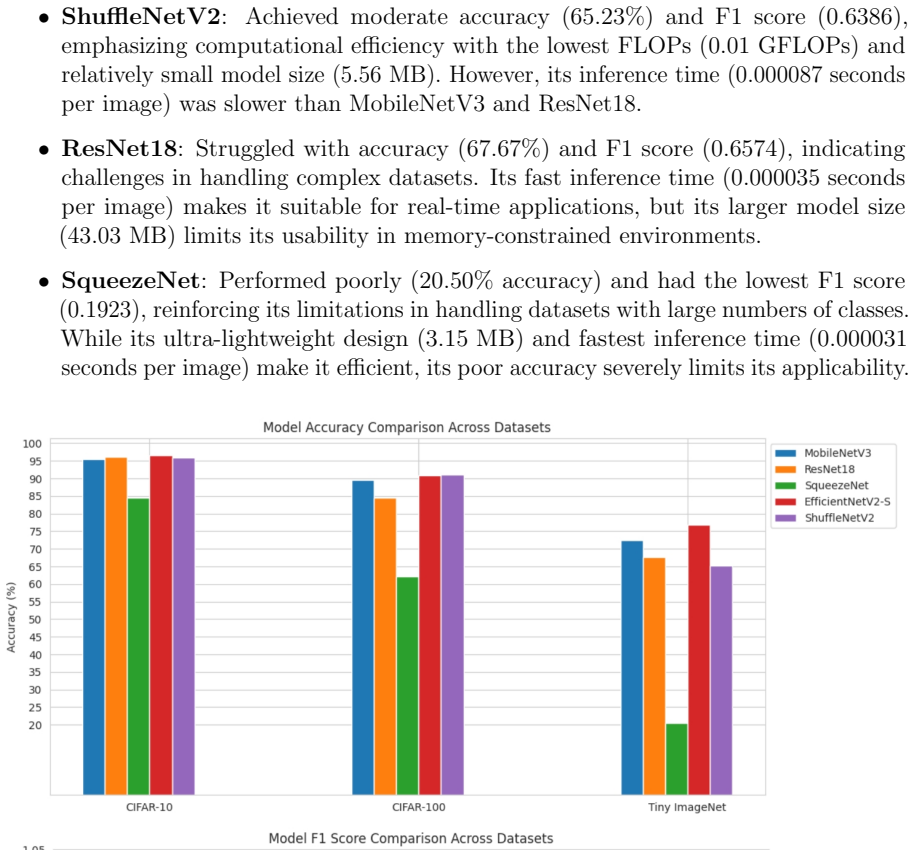
The paper claims that architecture rankings among lightweight CNNs are only trustworthy when models are compared under a shared training recipe, and that doing so for five established models yields a clear ordering. EfficientNetV2-S tops all three datasets in the body's tables (96.53% on CIFAR-10, 90.82% on CIFAR-100, 76.87% on Tiny ImageNet), with MobileNetV3-Small close behind (95.49%, 89.62%, 72.54%) at roughly a tenth of the storage. The abstract states an even stronger headline — 97.57%, 86.98%, 78.73% — and an EfficientNet-B0 comparison within 0.85 points at about 21% of the parameters and 14% of the MACs on Tiny ImageNet, though B0 is absent from the body's tables. On the pretraining question, the paper reports that ImageNet-pretrained MobileNetV3-Small beats its randomly initialized counterpart by 3.23 points on CIFAR-10, 4.61 on CIFAR-100, and 7.90 on Tiny ImageNet, concluding that transfer learning matters most for harder, higher-class datasets.
Load-bearing premise
The rankings depend on the assumption that the untracked per-model training details — final learning rates, batch sizes, optimizers, schedulers, and early-stopping choices — do not determine which model wins, so the reported 50-epoch protocol represents each architecture fairly.
Editorial extensions
If this is right
- On CIFAR-10 and CIFAR-100, the accuracy spread among EfficientNetV2-S, MobileNetV3-Small, and ShuffleNetV2 is small, so storage and speed can decide the choice without much accuracy cost.
- For Tiny ImageNet-scale tasks, EfficientNetV2-S is the stronger accuracy pick, while SqueezeNet collapses to 20.5% and should be avoided when class count is high.
- For ultra-low-resource deployments, MobileNetV3-Small is the paper's recommended default, since it keeps within about one to four points of the leader while using far fewer parameters and FLOPs.
- Pretrained weights are worth more on harder datasets: the gap grows from 3.23 points on CIFAR-10 to 7.90 on Tiny ImageNet, so scratch training is most defensible for simple tasks.
- Model size alone is not a proxy for accuracy: SqueezeNet is smallest and fastest but trails badly, while ResNet18 is fast but heavy.
Reading between the lines
- The abstract's EfficientNet-B0 claim is not backed by the body's experiments; treating it as a confirmed result would require adding B0 to the same protocol. This is an editorial caution, not a paper claim.
- The pretraining gap may be inflated by the fixed 50-epoch budget, which likely under-trains randomly initialized models; a test would be to train scratch models to convergence and see how much of the 7.90-point Tiny ImageNet gap remains.
- The FLOPs and parameter counts in the paper are theoretical; on actual edge hardware, memory bandwidth and quantization could reorder models, so measuring on-device latency and energy would be a natural extension.
- Extending the protocol to newer NAS-designed models such as FBNet or RegNet, and to int8-quantized versions of these five, would show whether the rankings survive deployment constraints.
Signed reviews
Editorial analysis
A structured set of objections, weighed in public.
Referee Report
Summary. The paper claims to benchmark five lightweight CNNs (MobileNetV3-Small, ResNet18, SqueezeNet, EfficientNetV2-S, and ShuffleNetV2) on CIFAR-10, CIFAR-100, and Tiny ImageNet, reporting accuracy, F1 score, inference time, FLOPs, and model size. It also reports a pretrained-versus-scratch comparison, concluding that transfer learning helps, that EfficientNetV2-S is most accurate, that MobileNetV3-Small offers the best accuracy-efficiency balance, and that SqueezeNet is fastest and most compact. The abstract of the arXiv posting additionally claims seven models, top-5 accuracy, FP32 parameter storage, MACs, and a comparison with EfficientNet-B0, reporting EfficientNetV2-S accuracies of 97.57%, 86.98%, and 78.73%; the body reports EfficientNetV2 accuracies of 96.53%, 90.82%, and 76.87% and never mentions EfficientNet-B0. The manuscript's experimental protocol is underspecified, and the transfer-learning section is internally contradictory.
Significance. If the results were reliable, the paper would provide a useful practical reference for selecting lightweight architectures under memory and compute constraints, especially because it evaluates multiple datasets and several efficiency metrics in a single protocol. The multi-dataset scope and the explicit attention to FLOPs and model size are commendable features. However, the central claims are not traceable to the reported experiments: the abstract and body describe different numbers and different model sets, the pretrained-versus-scratch comparison is mislabeled, and the training protocol omits per-model hyperparameters and seeds. Without those details, the architecture rankings and the transfer-learning advantage cannot be verified, so the paper's current contribution is primarily a set of unconfirmed empirical observations rather than a reproducible benchmark.
major comments (4)
- [Abstract vs. Sections 4.1–4.3] The abstract reports that EfficientNetV2-S reaches 97.57%, 86.98%, and 78.73% top-1 accuracy on CIFAR-10, CIFAR-100, and Tiny ImageNet, and that EfficientNet-B0 remains within 0.85 percentage points while using only about 21% of the parameters and 14% of the MACs; the body's Tables 1–3 report EfficientNetV2 accuracies of 96.53%, 90.82%, and 76.87% and never mention EfficientNet-B0. The abstract also advertises seven CNNs, top-5 accuracy, macro F1, FP32 parameter storage, and MACs, none of which appear in the body. Because the paper's central ranking claim rests on numbers that cannot be traced to the reported experiments, the headline results are not verifiable from the manuscript.
- [Sections 4.4–4.5, Figures 9–10] The transfer-learning comparison is internally contradictory. Table 4 is headed 'Pretrained vs. Scratch-Trained MobileNetV3' and lists MobileNetV3 scratch accuracies, but Figures 9–10 are captioned for EfficientNetV2, and Section 4.5 states that pretrained EfficientNetV2 achieved 96.53% versus 92.51% on CIFAR-10; 92.51% is the MobileNetV3 scratch value from Table 4. There is therefore no matched pretrained-versus-scratch comparison for EfficientNetV2, and the claim in Section 4.5 that pretraining provides an 'immense value of transfer learning' is not supported by the data as presented. The post hoc selection in Section 3.2 of MobileNetV3 for scratch training because of its pretrained performance also makes the later 'best balance' conclusion partly a re-description of that choice.
- [Section 3.4, Tables 1–3] The training protocol is underspecified in a way that affects the central ranking claims. Section 3.4 states that learning rate, batch size, optimizer, scheduler, and early stopping were tuned, but no final values are reported for any model or dataset, no random seeds are given, and all tables appear to report single runs. Under these conditions, the observed ordering (for example, EfficientNetV2 over MobileNetV3 by 1.04 points on CIFAR-10) cannot be attributed to architecture quality rather than to per-model tuning choices. The same problem affects the augmentation claims in Sections 2.3 and 3.3.1, which assert that SqueezeNet and ShuffleNetV2 degraded under additional augmentations but present no experimental results for augmentation policies.
- [Tables 1–3] The efficiency metrics are reported at a precision that undermines the trade-off analysis. FLOPs are listed as 0.00 GFLOPs for SqueezeNet on CIFAR-10 and CIFAR-100 and for ShuffleNetV2 on CIFAR-10 and CIFAR-100, which makes it impossible to distinguish models that the text claims differ in FLOPs; model size is given only in MB, with no reported parameter counts or distinction between pretrained and scratch checkpoint sizes. Since the paper's practical recommendations depend on comparing parameter and FLOP efficiency, the tables need more precise values and a clear statement of how the efficiency metrics were computed.
minor comments (5)
- [Title, abstract, and Section 1] The manuscript is internally inconsistent about the number of models evaluated: the title and introductory abstract say five, while the arXiv abstract says seven; please harmonize these descriptions.
- [Section 4.4 heading, Section 5] The model name is spelled inconsistently as both 'MobileNetV3' and 'MobilenetV3' (for example, the Section 4.4 heading and parts of the conclusion); please use a single convention throughout.
- [Figure 6 caption] The caption misspells 'Comparison' as 'Comaprison'; please correct the typo.
- [References [10], [12], [23]] References [10] and [23] are duplicate entries for the same ShuffleNetV2 paper, and reference [12] (Radosavovic et al., 'RegNet: Designing Network Design Spaces') is cited in Section 2.2 as arguing that training from scratch can yield competitive results, which does not appear to match the cited paper's content; please correct these citations.
- [Section 3.3.1 and Section 6] Section 3.3.1 lists AutoAugment, CutMix, and MixUp as applied augmentations, while Section 6 describes these as future work; please clarify which augmentations were actually used in the reported experiments.
Circularity Check
No circular derivation: this is an empirical benchmark; its internal inconsistencies are correctness flaws, not circularity.
full rationale
This paper reports an empirical benchmark of five CNN architectures on three datasets; it contains no formal derivation chain, no fitted-parameter prediction, and no load-bearing self-citation. The architecture rankings are outputs of the described training protocol, not consequences of the paper's definitions or assumptions. The only self-referential element is the statement in Section 3.2 that MobileNetV3 was selected for additional scratch training after showing promising pretrained performance, which makes the 'best balance' framing partly post hoc; however, that selection does not define the reported accuracy numbers or force the ranking, so it is not circularity under the requested definitions. The serious problems in this manuscript are consistency and support: the abstract reports EfficientNetV2-S accuracies of 97.57/86.98/78.73 and an EfficientNet-B0 comparison with 21% parameters and 14% MACs, while the body reports 96.53/90.82/76.87 and has no EfficientNet-B0 row; Table 4 is labeled 'Pretrained vs. Scratch-Trained MobileNetV3,' but Figures 9-10 and Section 4.5 discuss EfficientNetV2 and compare 96.53% with 92.51%, a value that belongs to MobileNetV3's scratch column. These are data-integrity and reproducibility flaws that belong in a correctness review, not in a circularity score. Because no load-bearing claim reduces by construction or by self-citation to its own input, the circularity score is 0.
Assumptions & free parameters
free parameters (5)
- per-model learning rate =
not reported (range 0.001 to 0.0001)
- per-model batch size =
not reported (range 32 to 128)
- per-model optimizer choice =
not reported (Adam or SGD)
- learning-rate scheduler and early-stopping patience =
not reported
- per-model augmentation policy =
not reported
assumptions (4)
- domain assumption All models are compared fairly under the same 50-epoch fine-tuning protocol.
- domain assumption Pretrained and randomly initialized models can be compared after the same number of epochs.
- domain assumption ImageNet normalization statistics are appropriate inputs for CIFAR-10, CIFAR-100, and Tiny ImageNet.
- domain assumption FLOPs, model size, and inference time on a P100 proxy deployment cost on edge devices.
Cite this review
Pith. "Pith review of Comparative Analysis of Lightweight CNNs for Resource-Constrained Devices: Predictive Performance, Efficiency Trade-offs, and Initialization Effects." pith.science (2026). https://pith.science/paper/LDB6Y2G2
@misc{pith2026250503303,
  author       = {Pith},
  title        = {Pith review of: Comparative Analysis of Lightweight CNNs for Resource-Constrained Devices: Predictive Performance, Efficiency Trade-offs, and Initialization Effects},
  year         = {2026},
  howpublished = {\url{https://pith.science/paper/LDB6Y2G2}},
  note         = {Machine review of arXiv:2505.03303}
}
read the original abstract
Lightweight convolutional neural networks are often compared using results obtained with different training recipes, input settings, and pretrained checkpoints. Such differences make architecture rankings difficult to interpret. This study presents a controlled benchmark of seven established CNNs across CIFAR-10, CIFAR-100, and Tiny ImageNet under a shared fine tuning protocol. The evaluation reports top-1 accuracy, macro F1, top-5 accuracy, parameter count, FP32 parameter storage, and multiply accumulate operations. EfficientNetV2-S records the highest observed top-1 accuracy on all three datasets, reaching 97.57%, 86.98%, and 78.73%. EfficientNet-B0 remains within 0.85 percentage points of EfficientNetV2-S across the three datasets while requiring only about 21% of its parameters and 14% of its multiply accumulate operations on Tiny ImageNet. It therefore offers a favorable general balance between predictive performance and computational demand. MobileNetV3-Small is a strong candidate for ultra low resource settings. It uses about 40% of the parameters and 15% of the multiply accumulate operations of EfficientNet-B0 while retaining competitive accuracy. A matched comparison of ImageNet pretrained and randomly initialized EfficientNet-B0 and MobileNetV3-Small models shows that the pretrained advantage is substantially larger on CIFAR-100 and Tiny ImageNet than on CIFAR-10 under the fixed protocol. The results provide a focused reference for selecting established lightweight CNNs when predictive quality, parameter storage, and theoretical computation must be considered together.
Figures


Figures from the paper (7 more)




Forward citations
Cited by 2 Pith papers
-
Do Newer Lightweight CNNs Perform Better Under Resource Constraints? A Controlled Multigenerational Study of Architecture, Initialization, Training Budget, and Efficiency
Controlled benchmarks of nine lightweight CNNs find that newer architectures deliver selective rather than universal improvements in accuracy and efficiency under fixed training protocols.
-
Toward Edge General Intelligence with Agentic AI and Agentification: Concepts, Technologies, and Future Directions
A survey that organizes agentic AI for 6G edge networks into four pillars, compactness, efficiency, knowledge and reasoning, and migration, and illustrates them with prior case studies.
Reference graph
Works this paper leans on
-
[1]
Deep learning,
Y. LeCun, Y. Bengio, and G. Hinton, “Deep learning,”Nature, vol. 521, no. 7553, pp. 436–444, 2015
2015
-
[2]
Imagenet: A large-scale hierarchical image database,
J. Denget al., “Imagenet: A large-scale hierarchical image database,” inCVPR, 2009, pp. 248–255
work page 2009
-
[3]
Learning both weights and connections for efficient neural networks,
S. Han, J. Pool, J. Tran, and W. J. Dally, “Learning both weights and connections for efficient neural networks,” inNeurIPS, vol. 28, 2015
work page 2015
-
[4]
Mobilenets: Efficient convolutional neural networks for mobile vision applications,
A. G. Howardet al., “Mobilenets: Efficient convolutional neural networks for mobile vision applications,”arXiv preprint arXiv:1704.04861, 2017
arXiv 2017
-
[5]
Mobilenetv2: Inverted residuals and linear bottlenecks,
M. Sandleret al., “Mobilenetv2: Inverted residuals and linear bottlenecks,” inCVPR, 2018, pp. 4510–4520
work page 2018
-
[6]
A. Howardet al., “Searching for mobilenetv3,” inICCV, 2019, pp. 1314–1324
work page 2019
-
[7]
Squeezenet: Alexnet-level accuracy with 50x fewer parameters and ¡0.5mb model size,
F. Iandolaet al., “Squeezenet: Alexnet-level accuracy with 50x fewer parameters and ¡0.5mb model size,”arXiv preprint arXiv:1602.07360, 2016
arXiv 2016
-
[8]
Efficientnetv2: Smaller models and faster training,
M. Tan and Q. Le, “Efficientnetv2: Smaller models and faster training,” inICML, 2021, pp. 10 096–10 106
work page 2021
Show all 26 references
-
[9]
Deep residual learning for image recognition,
K. Heet al., “Deep residual learning for image recognition,” inCVPR, 2016, pp. 770–778
2016
-
[10]
Shufflenet v2: Practical guidelines for efficient cnn architecture design,
N. Maet al., “Shufflenet v2: Practical guidelines for efficient cnn architecture design,” inECCV, 2018, pp. 116–131
2018
-
[11]
Do better imagenet models transfer better?
S. Kornblith, M. Norouzi, H. Lee, and G. Hinton, “Do better imagenet models transfer better?” inCVPR, 2019, pp. 2661–2671
2019
-
[12]
Regnet: Designing network design spaces,
I. Radosavovicet al., “Regnet: Designing network design spaces,” inCVPR, 2020, pp. 734–743
2020
-
[13]
Learning multiple layers of features from tiny images,
A. Krizhevsky, “Learning multiple layers of features from tiny images,” University of Toronto, Tech. Rep., 2009
2009
-
[14]
Mixup: Beyond empirical risk minimization,
H. Zhanget al., “Mixup: Beyond empirical risk minimization,” inICLR, 2018
2018
-
[15]
A survey on image data augmentation for deep learning,
C. Shorten and T. M. Khoshgoftaar, “A survey on image data augmentation for deep learning,”Journal of Big Data, vol. 6, no. 1, pp. 1–48, 2019
2019
-
[16]
Cutmix: Regularization strategy to train strong classifiers with localizable features,
S. Yunet al., “Cutmix: Regularization strategy to train strong classifiers with localizable features,” inICCV, 2019, pp. 6023–6032
2019
-
[17]
Efficient deep learning for edge computing platforms,
D. Hanet al., “Efficient deep learning for edge computing platforms,”IEEE Trans- actions on Neural Networks and Learning Systems, vol. 32, no. 1, pp. 45–57, 2021
2021
-
[18]
Fbnet: Hardware-aware efficient convnet design via differentiable neural architecture search,
Y. Wuet al., “Fbnet: Hardware-aware efficient convnet design via differentiable neural architecture search,” inCVPR, 2019, pp. 10 734–10 742. 21
2019
-
[19]
A comprehensive survey of deep learning-based lightweight object detection models for edge devices,
P. Mittal, “A comprehensive survey of deep learning-based lightweight object detection models for edge devices,”Artificial Intelligence Review, vol. 57, p. 242, 2024
2024
-
[20]
Evolution toward intelligent communications: Impact of deep learning applications on the future of 6g technology,
M. Abd Elaziz, M. A. Al-qaness, A. Dahou, S. H. Alsamhi, L. Abualigah, R. A. Ibrahim, and A. A. Ewees, “Evolution toward intelligent communications: Impact of deep learning applications on the future of 6g technology,”Wiley Interdisciplinary Reviews: Data Mining and Knowledge ...
2024
-
[21]
Image super- resolution using generative adversarial networks with efficientnetv2,
S. AlTakrouri, N. M. Noor, N. Ahmad, T. Justinia, and S. Usman, “Image super- resolution using generative adversarial networks with efficientnetv2,”International Journal of Advanced Computer Science and Applications, vol. 14, no. 2, 2023
2023
-
[22]
Pneumonia detection using deep convolutional neural net- works,
P. MohammadiNasab, “Pneumonia detection using deep convolutional neural net- works,” 2023
2023
-
[23]
Shufflenet v2: Practical guidelines for efficient cnn architecture design,
N. Ma, X. Zhang, H.-T. Zheng, and J. Sun, “Shufflenet v2: Practical guidelines for efficient cnn architecture design,” inProceedings of the European conference on computer vision (ECCV), 2018, pp. 116–131
2018
-
[24]
Randaugment: Practical automated data augmentation with a reduced search space,
E. D. Cubuket al., “Randaugment: Practical automated data augmentation with a reduced search space,” inNeurIPS, 2020
2020
-
[25]
Grad-cam: Visual explanations from deep networks via gradient-based localization,
R. R. Selvarajuet al., “Grad-cam: Visual explanations from deep networks via gradient-based localization,” inICCV, 2017, pp. 618–626
2017
-
[26]
A unified approach to interpreting model predictions,
S. M. Lundberg and S.-I. Lee, “A unified approach to interpreting model predictions,” NeurIPS, vol. 30, 2017. 22
2017
Reviewed August 15, 2026 · model on record in the stance chip above.
Discussion (0). Continue with ORCID to comment.