REVIEW 4 major objections 5 minor 1 cited by
Non-coherent Detection and Bit Error Rate for an Ambient Backscatter Link in Time-Selective Fading
T0 review · 4 major / 5 minor · reviewed 2026-08-14 · deepseek-v4-flash
Pith's one-line read This paper derives exact asymptotic bit error rates for a non-coherent ambient backscatter receiver under time-selective fading, using a direct sample-averaging test statistic, and shows that a multi-antenna receiver cancels the ambient…
desk verdict A genuinely useful first analysis of non-coherent ambient backscatter under time-selective fading, but the 'exact asymptotic BER' claim leans on an unproved concentration step and an unresolved AoA estimation issue. read the letter →
The pith
A machine-rendered reading of the paper's core claim, the machinery that carries it, and where it could break.
The reading
What carries the argument
The load-bearing object is the test statistic $Z$, the arithmetic mean of the received samples; choosing $Z$ keeps the receiver linear and avoids estimating the signal energy. Under the first-order autoregressive (AR) channel model, in which each channel gain is a scaled copy of the previous gain plus a new Gaussian innovation, $Z$ conditioned on each hypothesis is zero-mean circularly symmetric complex Gaussian, so detection reduces to comparing $|Z|^2$ with the optimal threshold $T=\ln(\mathrm{Var}_1/\mathrm{Var}_0)\,\mathrm{Var}_1\mathrm{Var}_0/(\mathrm{Var}_1-\mathrm{Var}_0)$. The argument that makes this true is Lemma 1: the correlated sum $S_N=\sum_{n_1,n_2}\rho^{|n_1-n_2|}x[n_1]x^*[n_2]$ satisfies $\mathbb{E}[S_N]=\Theta(N)$ and $\mathrm{Var}[S_N]=\Theta(N)$, so the scaled mean concentrates at its expected value and every conditional variance becomes a closed-form expression. For the multi-antenna receiver the additional machinery is direct-link cancellation: each antenna output is phase-rotated by the direct link's inter-element phase $\phi_1$ and subtracted from the first antenna, then the residual noise is whitened and the signal is projected along the effective array response, producing the antenna gain $G=\tilde a^*\hat K_{\tilde W}^{-1}\tilde a$ that multiplies the backscatter variance and lets the BER fall with SNR.
What would settle it
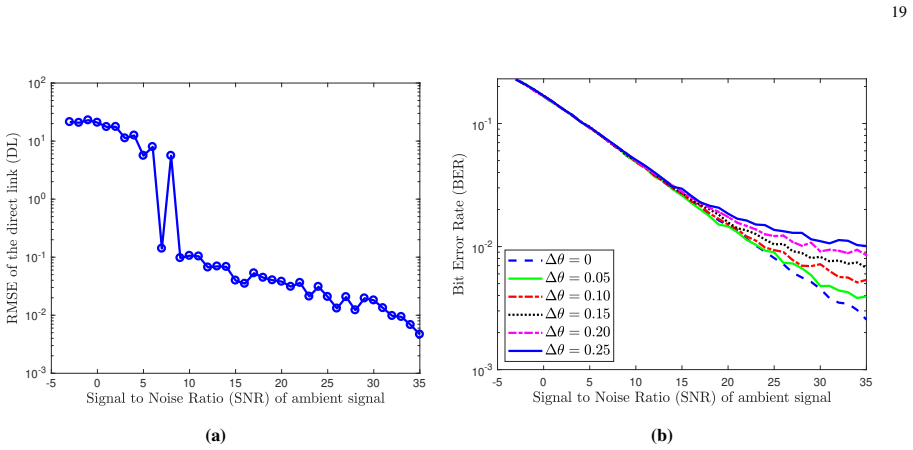
Run a Monte-Carlo BER for the multi-antenna receiver using the paper's own preamble-based cross-correlation estimator for the two arrival angles instead of assuming them known, and compare with Theorem 2. If the measured BER develops a floor as SNR grows, or if the gap to the perfect-angle curve does not close with larger sample size $N$, the practical version of the central claim fails; the paper already reports that its analogous estimator for the backscatter-link angle has poor RMSE.
Extended reading notes
Core claim
On the paper's own terms, the central claim is that OOK detection in an ambient backscatter link under time-selective Rayleigh fading becomes a closed-form threshold test once the receiver uses the sample mean $Z=\frac{1}{N}\sum_{n=1}^N y[n]$ as its test statistic instead of average energy. For each hypothesis the asymptotic conditional law of $Z$ is circularly symmetric complex Gaussian, $H_i: Z\sim\mathcal{CN}(0,\mathrm{Var}_i)$, with variances given in Lemmas 2 and 3; the BER follows from the exponential law of $|Z|^2$ as $P_{\mathrm{SA}}(e)=\frac12-\frac12 e^{-T_{\mathrm{SA}}/\mathrm{Var}_1^{\mathrm{SA}}}+\frac12 e^{-T_{\mathrm{SA}}/\mathrm{Var}_0^{\mathrm{SA}}}$. At high SNR this expression approaches a positive floor because the direct link scales both variances with the same SNR. In the multi-antenna case, the paper proves that subtracting the direct link with its known phase progression, whitening the residual noise, and combining along the effective array response yields a scalar statistic whose hypothesis-dependent variance is the backscatter term multiplied by an antenna gain $G$; the averaged BER in Theorem 2 then vanishes as SNR grows. The enabler is a concentration result: the correlated sum $S_N=\sum_{n_1,n_2}\rho^{|n_1-n_2|}x[n_1]x^*[n_2]$ has expectation and variance both of order $N$, so the scaled sample mean concentrates and all conditional variances become explicit functions of the channel correlations, ambient symbol mean and energy, and $N$.
Load-bearing premise
The multi-antenna result depends on the receiver knowing the exact arrival angles of both the direct signal from the power source and the reflected backscatter signal; if those angles are not known precisely, the direct-link cancellation is imperfect and the claimed BER improvement does not follow.
Editorial extensions
If this is right
- A single-antenna receiver using direct averaging has a positive BER floor at high SNR, so it is not viable by itself in the presence of the ambient power source's direct link.
- A multi-antenna receiver that knows the direct-link angle of arrival removes that floor; its BER falls with SNR and improves with the antenna gain $G$.
- With more than two antennas the receiver gains angular resolution, allowing it to separate the backscatter link from the direct link even when the two arrival angles nearly coincide.
- Because the test statistic is a linear average, timing errors within an ambient symbol period barely change the BER, relaxing synchronization requirements.
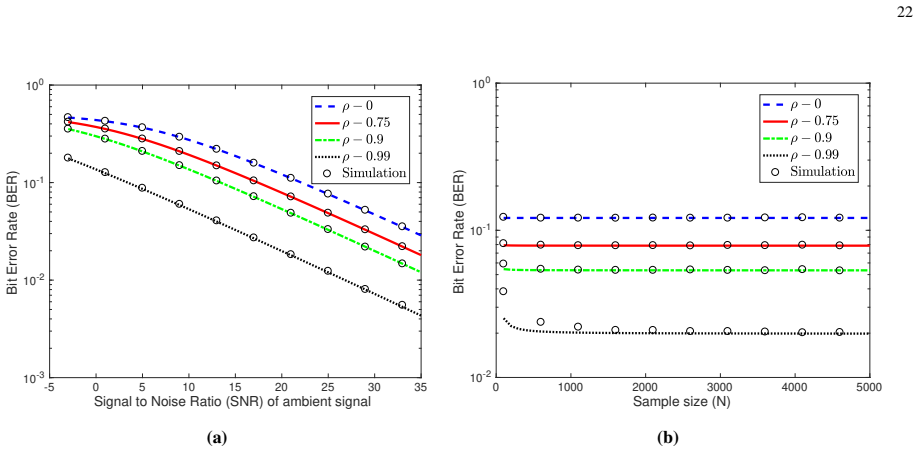
- The BER improves as channel gains become more correlated in time and saturates as the averaging window $N$ grows; a first-order AR model reproduces the BER of Jakes-model fading closely.
Reading between the lines
- A natural extension the paper leaves implicit is to substitute the estimated arrival angles from its own preamble estimator into Theorem 2 and quantify the BER degradation as a function of angle-estimation error; the poor RMSE it reports for the backscatter angle suggests this degradation could be significant.
- The same direct-averaging detector can likely be analyzed under higher-order AR channel models, because the concentration lemma only needs finite moments of the ambient symbols; closed-form conditional variances should survive.
- The single-antenna floor is driven by the direct link, so a hybrid design that cancels only the dominant direct path would quantify how much angular spread a receiver tolerates before the multi-antenna advantage disappears.
- The detection rule is a threshold on $|Z|^2$, so the BER depends on the ambient symbol distribution only through its mean and average energy; shaping those two moments is a concrete, testable way to improve non-coherent performance.
Signed reviews
Editorial analysis
A structured set of objections, weighed in public.
Referee Report
Summary. The paper studies an ambient backscatter link under time-selective Rayleigh fading modeled by first-order autoregressive (AR) processes, and proposes a non-coherent receiver based on the sample mean of received signal samples (direct averaging) rather than the conventional energy-average detector. For a single-antenna receiver, Theorem 1 gives a closed-form asymptotic BER for binary OOK detection, while Theorem 2 gives the corresponding BER for a multi-antenna receiver that cancels the direct-link interference using known angle-of-arrival (AoA) information. The derivations rest on a claimed concentration result for the correlated quadratic sum M_N (Lemma 1), which is then used to approximate conditional distributions of the test statistic by complex Gaussians under both hypotheses. Numerical Monte Carlo simulations are presented for a range of correlation coefficients, antenna numbers, sample sizes, and timing offsets, and the AR model is compared against Jakes' channel model.
Significance. If the analytical results are correct, the paper offers a useful and novel tractable model of non-coherent ambient backscatter detection in time-selective fading, and the direct-averaging receiver is a genuinely different architecture from the energy-averaging receivers in the prior literature. The BER expressions are parameter-free in the sense that no parameters are fitted to the simulation results, and the MA receiver demonstrates a clear BER improvement over the SA receiver. These strengths make the paper worth pursuing. However, the central concentration step is only sketched, and the antenna-gain formula in Lemma 4 is incorrect as printed; both issues affect the main BER claims and require a substantive revision before the paper can be considered reliable.
major comments (4)
- [Section III-A, Lemma 1, Appendix A] The concentration of M_N is the foundation of Lemmas 2 and 3, but the proof of Lemma 1 is only a sketch. In particular, the claimed Theta(N) growth of Var[S_N] is said to follow because the coefficient of |E[X]|^4 is proportional to N through a cancellation between the sum over i1 neq j1 neq i2 neq j2 of rho^{|i1-j1|+|i2-j2|} and (sum over n1 neq n2 of rho^{|n1-n2|})^2; this cancellation is asserted rather than demonstrated. Since (37) uses the replacement M_N approximately equal to E[M_N], the variance decay in Lemma 1 is load-bearing for the Gaussian approximation in Lemma 2, and the analogous replacement for M^b_N in (39)-(40) has no proof at all. Please supply a complete proof of the variance bound or state the concentration property as an explicit technical assumption and verify it in simulation.
- [Section III-B2, Appendix C, Lemma 5] Under H1, the received sample contains the product h_b[n] h_t[n] x[n]; after conditioning on h_b[n] the sample is Gaussian, but the variance in (40) still depends on the random quadratic form M^b_N. Appendix C says only that this sequence can be shown to asymptotically converge to its expectation; no lemma or proof establishes this convergence, and Lemma 1 does not cover the extra h_b factor. Lemma 5 and Theorem 2 inherit the same unproved step for the MA receiver. The phrase exact asymptotic BER in the abstract and contributions therefore overstates what is shown; the BER results are conditional on an unproved concentration or normal-approximation step.
- [Section IV-A, Lemma 4, Remark 4] The closed-form antenna gain is incorrect. For M_r = 2, the printed formula in (23) gives G = 1/2 - cos(phi2 - phi1) - 1/2 = -cos(phi2 - phi1), which is negative for most angles and contradicts Remark 4's stated value G = 2 sin^2((phi2 - phi1)/2). Recomputation of the quadratic form a-tilde^* K-tilde^{-1} a-tilde gives the constant term M_r - 1/M_r instead of (M_r - 1)/M_r, i.e. G = M_r - 1/M_r - (2/M_r) [sin((M_r-1)Delta/2)/sin(Delta/2)] cos(M_r Delta/2) - (1/M_r) [sin^2((M_r-1)Delta/2)/sin^2(Delta/2)] with Delta = phi2 - phi1. Because G enters Var^{MA}_1 in Lemma 5 and therefore Theorem 2, the MA BER formula and the MA numerical results need to be recomputed with the corrected expression. In particular, the corrected formula gives G tending to 0 as Delta tends to 0 for every M_r, so Remark 4's claim of a non-zero gain when the two AoAs coincide is not supported.
- [Section IV-A and Section V-B] The MA gain result depends on the receiver knowing both phase offsets phi1 and phi2: phi1 is used in the interference cancellation in (19), and phi2 is needed to form the combining vector in (20) and (22). Section V-B provides an estimator only for e^{-j phi1} and explicitly leaves estimation of the backscatter-link AoA for future work, noting that the analogous method does not result in good RMSE performance. The paper's main positive result, the BER improvement of the MA receiver, is therefore demonstrated only under an idealized assumption, and the sensitivity analysis in Fig. 4b varies only the DL AoA error. The manuscript should either provide an estimator for phi2, characterize the BER as a function of both AoA estimation errors, or clearly delimit the contribution as an idealized upper bound.
minor comments (5)
- [Section III-B2] In the definition of M^b_N, the term x*_2[n2] should be x*[n2].
- [Equation (18)] The notation with K^{-1}/K^{-1} and related expressions is ambiguous; please write K^{-1} and K-1 explicitly.
- [Appendix A] In the proof of Lemma 1, the relation E[S_N] = Theta[n] should read Theta(N).
- [Remark 5] Remark 5 states that the average BER is an increasing function of the correlation factor, while Section VI and Figs. 6-7 show that BER improves, i.e., decreases, with increasing rho; please reconcile the wording.
- [Equation (20)] The m-th entry of the effective array response should read 2j sin(m(phi2-phi1)/2) e^{j m(phi2-phi1)/2}; the displayed version omits the factor j and uses ambiguous parentheses.
Circularity Check
No significant circularity: the BER derivations are closed-form functions of the declared AR(1) model parameters, and the few self-citations are non-load-bearing.
full rationale
The paper's chain is self-contained. The test statistic Z = (1/N) sum y[n] is defined from the signal model in (7)-(9); Lemmas 1-3 compute moments of the quadratic forms M_N and M_N^b under H0/H1; Lemma 5 repeats this for the whitened MA effective signal; Theorems 1-2 then evaluate the likelihood-ratio BER from the resulting CN(0, Var_i) distributions. No parameter is fitted to the BER curves the theorems predict; all variances are explicit functions of the declared parameters (rho_r, rho_b, rho_t, sigma_h^2, sigma_n^2, alpha, M_r, and moments of X). The self-citations [1], [2], and [7] are earlier conference versions or baseline special cases; the one in-proof citation, 'which is given by [2]' in Appendix D, is immediately re-derived as a standard likelihood-ratio test and is therefore not load-bearing. The reviewer's concern that M_N^b 'can be shown to asymptotically converge to its expectation' without a supplied proof is an omitted auxiliary concentration proof, i.e., a correctness/completeness gap, not circularity: the BER formulas are not assumed in that claim, and the claim is not equivalent to the theorem statements by construction. Likewise, the admitted assumption that phi1 and phi2 are 'assumed to be perfectly known at the receiver' and the stated lack of a good BL-AoA estimator are model limitations that affect practical validity, but they are not circular steps in the derivation of the BER expressions.
Assumptions & free parameters
assumptions (4)
- domain assumption Time-selective Rayleigh fading is modeled as a first-order autoregressive process h[n] = ρ h[n-1] + sqrt(1-ρ^2) g[n] (eq. (4)).
- domain assumption The ambient symbol sequence x[n] is i.i.d. with finite higher-order moments up to the order needed in Lemma 1.
- ad hoc to paper The phase offsets φ1 and φ2 (equivalently the angles of arrival of the direct and backscatter links) are perfectly known at the receiver for the MA analysis.
- domain assumption The backscatter symbol duration is N times the ambient symbol duration, so a single backscatter bit b is constant over the N received samples.
Cite this review
Pith. "Pith review of Non-coherent Detection and Bit Error Rate for an Ambient Backscatter Link in Time-Selective Fading." pith.science (2026). https://pith.science/paper/LDEIS325
@misc{pith2026190805657,
  author       = {Pith},
  title        = {Pith review of: Non-coherent Detection and Bit Error Rate for an Ambient Backscatter Link in Time-Selective Fading},
  year         = {2026},
  howpublished = {\url{https://pith.science/paper/LDEIS325}},
  note         = {Machine review of arXiv:1908.05657}
}
read the original abstract
This paper focuses on the non-coherent detection in ambient backscatter communication, which is highly appealing for systems where the trade-off between signaling overhead and the actual data transmission is very critical. Modeling the time-selective fading channel as a first-order autoregressive (AR) process, we propose a new receiver architecture based on the direct averaging of the received signal samples for detection, which departs significantly from the energy averaging-based receivers considered in the literature. For the proposed setup, we characterize the exact asymptotic bit error rate (BER) for both single-antenna (SA) and multi-antenna (MA) receivers, and demonstrate the robustness of the new architecture to timing errors. Our results demonstrate that while the direct-link (DL) interference from the ambient power source leads to a BER floor in the SA receiver, the MA receiver can remove this interference by estimating the angle of arrival (AoA) of the DL. The analysis further quantifies the effect of improved angular resolution on the BER as a function of the number of receive antennas. A key intermediate result of our analysis is the derivation of a new concentration result for a general sum sequence that is central to the derivation of the conditional distributions of the received signal.
Figures


Figures from the paper (5 more)




Forward citations
Cited by 1 Pith paper
-
Design of Ambient Backscatter Training for Wireless Power Transfer
A balanced (+1/-1) backscatter training sequence per ambient symbol cancels direct-link interference, letting retrodirective wireless power transfer focus energy on the backscattering receiver.
Reference graph
Works this paper leans on
-
[1]
Multi-antenna non-coherent detection of ambient backscatter under time-selective fading,
J. K. Devineni and H. S. Dhillon, “Multi-antenna non-coherent detection of ambient backscatter under time-selective fading,” Proc., IEEE Globecom , Dec. 2020
work page 2020
-
[2]
Non-coherent signal detection and bit error rate for an ambient backscatter link under fast fading,
——, “Non-coherent signal detection and bit error rate for an ambient backscatter link under fast fading,” Proc., IEEE Globecom, Dec. 2019
work page 2019
-
[3]
Ambient backscatter: Wireless communication out of thin air,
V . Liu, A. Parks, V . Talla, S. Gollakota, D. Wetherall, and J. R. Smith, “Ambient backscatter: Wireless communication out of thin air,” Proc., ACM SIGCOMM, Aug. 2013
work page 2013
-
[4]
Passive Wi-Fi: Bringing low power to Wi-Fi transmissions,
B. Kellogg, V . Talla, S. Gollakota, and J. R. Smith, “Passive Wi-Fi: Bringing low power to Wi-Fi transmissions,”Symposium on NSDI, vol. 16, pp. 151–164, Mar. 2016
work page 2016
-
[5]
BackFi: high throughput Wi-Fi backscatter,
D. Bharadia, K. Joshi, M. Kotaru, and S. Katti, “BackFi: high throughput Wi-Fi backscatter,” Proc., ACM SIGCOMM, pp. 283–296, Aug. 2015
work page 2015
-
[6]
Wide-area wireless communication challenges for the internet of things,
H. S. Dhillon, H. Huang, and H. Viswanathan, “Wide-area wireless communication challenges for the internet of things,” IEEE Commun. Mag. , vol. 55, no. 2, pp. 168–174, Feb. 2017
work page 2017
-
[7]
Ambient backscatter systems: Exact average bit error rate under fading channels,
J. K. Devineni and H. S. Dhillon, “Ambient backscatter systems: Exact average bit error rate under fading channels,” IEEE Trans. Green Commun. and Networking , vol. 3, no. 1, pp. 11–25, Mar. 2019
work page 2019
-
[8]
Signal detection and BER analysis for RF-powered devices utilizing ambient backscatter,
K. Lu, G. Wang, F. Qu, and Z. Zhong, “Signal detection and BER analysis for RF-powered devices utilizing ambient backscatter,” Proc., Intl. Conf. on Wireless Commun. & Sig. Proc. (WCSP) , Oct. 2015
work page 2015
Show all 48 references
-
[9]
Uplink detection and BER analysis for ambient backscatter communication systems,
G. Wang, F. Gao, Z. Dou, and C. Tellambura, “Uplink detection and BER analysis for ambient backscatter communication systems,” Proc., IEEE Globecom , Dec. 2015
2015
-
[10]
Ambient backscatter communication systems: Detection and performance analysis,
G. Wang, F. Gao, R. Fan, and C. Tellambura, “Ambient backscatter communication systems: Detection and performance analysis,” IEEE Trans. Commun. , vol. 64, no. 11, pp. 4836 – 4846, Nov. 2016
2016
-
[11]
Semi-Coherent Detection and Performance Analysis for Ambient Backscatter System,
J. Qian, F. Gao, G. Wang, S. Jin, and H. Zhu, “Semi-Coherent Detection and Performance Analysis for Ambient Backscatter System,” IEEE Trans. Commun. , vol. 65, no. 12, Dec. 2017
2017
-
[12]
Noncoherent Detections for Ambient Backscatter System,
——, “Noncoherent Detections for Ambient Backscatter System,” IEEE Trans. Wireless Commun. , vol. 16, no. 3, Mar. 2017
2017
-
[13]
Uplink detection and BER performance for wireless communication systems with ambient backscatter and multiple receiving antennas,
Y . Liu, Z. Zhong, G. Wang, and D. Hu, “Uplink detection and BER performance for wireless communication systems with ambient backscatter and multiple receiving antennas,” Proc., Intl. Conf. on Commun. and Networking in China (ChinaCom), pp. 79 – 84, Aug. 2015
2015
-
[14]
Statistical Covariance Based Signal Detection for Ambient Backscatter Communication Systems,
T. Zeng, G. Wang, Y . Wang, Z. Zhong, and C. Tellambura, “Statistical Covariance Based Signal Detection for Ambient Backscatter Communication Systems,” Proc., IEEE Veh. Technology Conf. (VTC) , Sep. 2016
2016
-
[15]
Modulation in the Air: Backscatter Communication over Ambient OFDM Carrier,
G. Yang, Y .-C. Liang, R. Zhang, and Y . Pei, “Modulation in the Air: Backscatter Communication over Ambient OFDM Carrier,” IEEE Trans. Commun. , vol. 66, no. 3, Mar. 2018
2018
-
[16]
Noncoherent backscatter communications over ambient OFDM signals,
M. A. El Mossallamy, M. Pan, R. J ¨antti, K. G. Seddik, G. Y . Li, and Z. Han, “Noncoherent backscatter communications over ambient OFDM signals,” IEEE Trans. Commun. , 2019
2019
-
[17]
Symbol detection of ambient backscatter systems with manchester coding,
Q. Tao, C. Zhong, H. Lin, and Z. Zhang, “Symbol detection of ambient backscatter systems with manchester coding,” IEEE Trans. Wireless Commun. , vol. 17, no. 6, pp. 4028–4038, 2018
2018
-
[18]
New Coding and Detection Schemes for Ambient Backscatter Communication Systems,
Y . Liu, G. Wang, Z. Dou, and Z. Zhong, “New Coding and Detection Schemes for Ambient Backscatter Communication Systems,” IEEE Access, Mar. 2017
2017
-
[19]
Blind channel estimation in ambient backscatter communication systems with multiple-antenna reader,
W. Zhao, G. Wang, S. Atapattu, and B. Ai, “Blind channel estimation in ambient backscatter communication systems with multiple-antenna reader,” in 2018 IEEE/CIC Intl. Conf. on Commun. in China (ICCC) , 2018, pp. 320–324
2018
-
[20]
Noncoherent multiantenna receivers for cognitive backscatter system with multiple RF sources,
H. Guo, Q. Zhang, D. Li, and Y .-C. Liang, “Noncoherent multiantenna receivers for cognitive backscatter system with multiple RF sources,” arXiv preprint, arXiv:1808.04316 , 2018
2018 arXiv
-
[21]
Constellation learning-based signal detection for ambient backscatter communication systems,
Q. Zhang, H. Guo, Y .-C. Liang, and X. Yuan, “Constellation learning-based signal detection for ambient backscatter communication systems,” IEEE J. Sel. Areas Commun. , vol. 37, no. 2, pp. 452–463, 2018
2018
-
[22]
Exploiting multiple antennas for cognitive ambient backscatter communi- cation,
H. Guo, Q. Zhang, S. Xiao, and Y .-C. Liang, “Exploiting multiple antennas for cognitive ambient backscatter communi- cation,” IEEE Internet of Things Journal , vol. 6, no. 1, pp. 765–775, 2018. 32
2018
-
[23]
Joint channel estimation, interference cancellation, and data detection for ambient backscatter communications,
D. Darsena, G. Gelli, and F. Verde, “Joint channel estimation, interference cancellation, and data detection for ambient backscatter communications,” in 2018 IEEE 19th Intl. Workshop on SPAWC , 2018, pp. 1–5
2018
-
[24]
Turbocharging ambient backscatter communication,
A. N. Parks, A. Liu, S. Gollakota, and J. R. Smith, “Turbocharging ambient backscatter communication,” Proc., ACM SIGCOMM, pp. 1–12, Aug. 2014
2014
-
[25]
Hybrid beamformer design for high dynamic range ambient backscatter receivers,
R. Duan, E. Menta, H. Yi ˘gitler, and R. J ¨antti, “Hybrid beamformer design for high dynamic range ambient backscatter receivers,” arXiv preprint, arXiv:1901.05323 , 2019
1901 arXiv
-
[26]
Lorea: A backscatter architecture that achieves a long communication range,
A. Varshney, O. Harms, C. Perez-Penichet, C. Rohner, F. Hermans, and T. V oigt, “Lorea: A backscatter architecture that achieves a long communication range,” Proc., ACM on Embedded Network Sensor Systems (SenSys 17) , no. 50, Nov. 2017
2017
-
[27]
FM backscatter: Enabling connected cities and smart fabrics,
A. Wang, V . Iyer, V . Talla, J. R. Smith, and S. Gollakota, “FM backscatter: Enabling connected cities and smart fabrics,” in Symposium on Networked Systems Design and Implementation (NSDI 17) , 2017, pp. 243–258
2017
-
[28]
Characterization of fast fading vector channels for multi-antenna communication systems,
G. Raleigh, S. N. Diggavi, A. F. Naguib, and A. Paulraj, “Characterization of fast fading vector channels for multi-antenna communication systems,” in Proc. of 1994 28th Asilomar Conf. on Signals, Systems and Computers , vol. 2. IEEE, 1994, pp. 853–857
1994
-
[29]
Deconstructing multiantenna fading channels,
A. M. Sayeed, “Deconstructing multiantenna fading channels,” IEEE Trans. Signal Processing, vol. 50, no. 10, pp. 2563– 2579, 2002
2002
-
[30]
Wireless backhaul networks: Capacity bound, scalability analysis and design guidelines,
H. S. Dhillon and G. Caire, “Wireless backhaul networks: Capacity bound, scalability analysis and design guidelines,” IEEE Trans. Wireless Commun. , vol. 14, no. 11, pp. 6043–6056, 2015
2015
-
[31]
Joint spatial division and multiplexing-the large-scale array regime,
A. Adhikary, J. Nam, J.-Y . Ahn, and G. Caire, “Joint spatial division and multiplexing-the large-scale array regime,” IEEE Trans. Information Theory , vol. 59, no. 10, pp. 6441–6463, 2013
2013
-
[32]
Joint spatial division and multiplexing for mm-wave channels,
A. Adhikary, E. Al Safadi, M. K. Samimi, R. Wang, G. Caire, T. S. Rappaport, and A. F. Molisch, “Joint spatial division and multiplexing for mm-wave channels,” IEEE J. Sel. Areas Commun. , vol. 32, no. 6, pp. 1239–1255, 2014
2014
-
[33]
Massive-mimo meets hetnet: Interference coordination through spatial blanking,
A. Adhikary, H. S. Dhillon, and G. Caire, “Massive-mimo meets hetnet: Interference coordination through spatial blanking,” IEEE J. Sel. Areas Commun. , vol. 33, no. 6, pp. 1171–1186, 2015
2015
-
[34]
St ¨uber, Principles of Mobile Communication
G. St ¨uber, Principles of Mobile Communication . Springer International Publishing, 2017
2017
-
[35]
Autoregressive modeling for fading channel simulation,
K. E. Baddour and N. C. Beaulieu, “Autoregressive modeling for fading channel simulation,” IEEE Trans. Wireless Commun., vol. 4, no. 4, pp. 1650–1662, 2005
2005
-
[36]
Space-time coding and kalman filtering for time-selective fading channels,
Z. Liu, X. Ma, and G. B. Giannakis, “Space-time coding and kalman filtering for time-selective fading channels,” IEEE Trans. Commun., vol. 50, no. 2, pp. 183–186, 2002
2002
-
[37]
Multi-input multi-output fading channel tracking and equalization using kalman estimation,
C. Komninakis, C. Fragouli, A. H. Sayed, and R. D. Wesel, “Multi-input multi-output fading channel tracking and equalization using kalman estimation,” IEEE Tran. on Signal Processing , vol. 50, no. 5, pp. 1065–1076, 2002
2002
-
[38]
On the use of first-order autoregressive modeling for rayleigh flat fading channel estimation with kalman filter,
S. Ghandour-Haidar, L. Ros, and J.-M. Brossier, “On the use of first-order autoregressive modeling for rayleigh flat fading channel estimation with kalman filter,” Signal Processing, vol. 92, no. 2, pp. 601–606, 2012
2012
-
[39]
On verifying the first-order markovian assumption for a rayleigh fading channel model,
H. S. Wang and P.-C. Chang, “On verifying the first-order markovian assumption for a rayleigh fading channel model,” IEEE Trans. Vehicular Technology, vol. 45, no. 2, pp. 353–357, 1996
1996
-
[40]
Analytical approach to the backscattering from UHF RFID transponder,
F. Fuschini, C. Piersanti, F. Paolazzi, and G. Falciasecca, “Analytical approach to the backscattering from UHF RFID transponder,” IEEE Antennas and Wireless Propagation Letters , vol. 7, pp. 33–35, 2008
2008
-
[41]
Antenna theory: analysis and design, john wiley & sons,
C. A. Balanis, “Antenna theory: analysis and design, john wiley & sons,” New York, 1997
1997
-
[42]
Improving backscatter radio tag efficiency,
A. Bletsas, A. G. Dimitriou, and J. N. Sahalos, “Improving backscatter radio tag efficiency,” IEEE Trans. Microwave Theory Tech, vol. 58, no. 6, pp. 1502–1509, 2010
2010
-
[43]
Noncoherent detection for ambient backscatter communications over OFDM signals,
D. Darsena, “Noncoherent detection for ambient backscatter communications over OFDM signals,” IEEE Access, vol. 7, pp. 159 415–159 425, 2019
2019
-
[44]
Optimal non-coherent detector for ambient backscatter communication system,
S. Guruacharya, X. Lu, and E. Hossain, “Optimal non-coherent detector for ambient backscatter communication system,” arXiv preprint, arXiv:1911.10105 , 2019
1911 arXiv
-
[45]
Fundamentals of wireless communication,
D. Tse and P. Viswanath, “Fundamentals of wireless communication,” Cambridge University Press , 2005
2005
-
[46]
Mengali, Synchronization techniques for digital receivers
U. Mengali, Synchronization techniques for digital receivers . Springer Science & Business Media, 2013
2013
-
[47]
Pahlavan and A
K. Pahlavan and A. H. Levesque, Wireless information networks. John Wiley & Sons, 2005
2005
-
[48]
Updating the inverse of a matrix,
W. W. Hager, “Updating the inverse of a matrix,” SIAM review, vol. 31, no. 2, pp. 221–239, 1989
1989
Reviewed August 14, 2026 · model on record in the stance chip above.
Discussion (0). Continue with ORCID to comment.