REVIEW 4 major objections 4 minor 22 references
UHP Detection: LVLMs have their Unique Hallucination Pattern in the Consistency Space
T0 review · 4 major / 4 minor · reviewed 2026-08-05 · deepseek-v4-flash
Pith's one-line read Hallucinations in vision-language models are not one uncertainty score: the paper claims they form a structured, model-specific pattern across four consistency probes, and a 14-feature black-box classifier reads that pattern better than pri
desk verdict A genuinely new black-box detector design with strong results, but the load-bearing semantic-preservation assumption is unverified and the headline claim is overstated—worth reviewing, needs revision. read the letter →
The pith
A machine-rendered reading of the paper's core claim, the machinery that carries it, and where it could break.
The reading
What carries the argument
The central object is a two-axis consistency space. The perturbation-modality axis contrasts image transformations (10 fixed operations, screened by a scene-composition similarity score) with text transformations (paraphrases of a factual statement, generated by an LLM). The logical-polarity axis contrasts the affirmative statement (built assuming the answer is 'yes') with its contradiction (built assuming 'no'). Their intersection yields four consistency groups — ITA, ITC, FSTA, FSTC. For each group, question-aligned agreement (QA) measures how often the group's True/False judgments align with the model's original answer, with the alignment reversed for contradictory groups; pairwise agreem
What would settle it
Annotate the 2,000 test samples for whether each of the 10 image transformations actually preserves the factual content (e.g., an object deleted by a grid mask) and whether each paraphrase preserves the truth value of the claim. Recompute detection restricted to samples where every perturbation is clean. If the 14-feature classifier's AUC advantage over single-score baselines collapses on that subset, the pattern was partly an artifact of content-changing perturbations rather than a hallucination signature. A positive-control experiment would instead show the pattern persisting under guarantee
Extended reading notes
Core claim
UHP Detection claims that a hallucinated answer is marked not by high uncertainty in general, but by a characteristic pattern across four behavioral probes: the model's judgments on affirmative and negated factual statements under image perturbations, and its judgments on the same statements under textual paraphrases. For each group it computes question-aligned agreement (how often judgments match the model's original answer, polarity flipped for contradictory groups) and pairwise agreement (within-group agreement), plus six cross-group differences — 14 features total. A lightweight classifier on these features detects hallucinations with large gains over black-box and white-box baselines on
Load-bearing premise
The method assumes the 10 image transformations and the paraphrase model never change what is actually true about the image or the statement; if a perturbation alters the facts, the four groups measure content shifts instead of the model's uncertainty pattern.
Editorial extensions
If this is right
- Fully black-box detection: because only model outputs are used, the same detector can flag hallucinations in closed-source models where logits and hidden states are unavailable.
- Cross-benchmark transfer: a classifier trained on AMBER retains competitive performance on PhD (e.g., 69.5 AUC-ROC on InternVL-4B), so the learned pattern describes the model, not dataset artifacts.
- Budget parity: with the same roughly 10-inference budget as baselines, the method still outperforms them, meaning the gains come from the structured feature design rather than from extra compute.
- Every probe matters: ablations removing any single consistency group cost 3–9 AUC-ROC points on AMBER and more on PhD; both perturbation modalities and both polarities contribute complementary signals.
- Logical coherence is informative: a model that accepts both a claim and its negation under different perturbations is systematically more likely to be hallucinating.
Reading between the lines
- The model-specific patterns suggest the same 14-feature vector could double as a behavioral fingerprint: detecting a model's characteristic failure mode, or attributing an output to a model, from its consistency signature alone.
- Because detection needs only outputs, a natural deployment is to gate answers at an API: abstain or flag when the pattern signals hallucination, or use the pattern to pick among candidate generations.
- The reliance on the paraphrase generator and the ten image transforms is the fragile joint: if future work adds an automated guarantee that paraphrases preserve truth value and transforms preserve facts, the pattern could be certified; without it, part of the signal may depend on perturbation quality.
- If hallucination patterns transfer across tasks for the same model, then a targeted route to reliability is to fine-tune against the pattern itself (reducing cross-polarity inconsistency) rather than against error labels alone.
Editorial analysis
A structured set of objections, weighed in public.
Referee Report
Summary. The paper proposes UHP Detection, a fully black-box hallucination detector for LVLMs. It constructs a 14-dimensional feature vector from four consistency groups formed by crossing perturbation modality (image vs. text) with logical polarity (affirmative vs. contradictory statement). For each group it computes question-aligned agreement (QA) and pairwise agreement (PA), and adds six between-group absolute differences, then trains a lightweight classifier on these features. The method is evaluated on AMBER and PhD across InstructBLIP-7B, Qwen2.5-VL, and InternVL-4B, with comparisons to white-box and black-box baselines, ablations, and cross-dataset transfer experiments. The central claim is that hallucinations manifest as structured, model-specific consistency patterns and that UHP Detection consistently outperforms prior methods.
Significance. If the claims hold, this is a useful contribution: it provides a black-box detector that requires no access to internal model states, reports large gains over several baselines on two benchmarks, and includes code release, extensive ablations, and cross-dataset transfer evidence. The idea of modeling uncertainty as a structured pattern across perturbation modality and logical polarity is sensible and goes beyond single-metric uncertainty estimates. However, the paper's central claims are currently overstated, and a key assumption about semantic preservation of perturbations is not validated. The cross-dataset generalization and ablation results are strengths, but the lack of variability estimates and the unverified content-preservation of image transformations leave the quantitative claims fragile.
major comments (4)
- [Section D.2, Table 2] The abstract and Section F claim UHP Detection 'consistently outperforms' prior black-box and white-box baselines, but Table 2 shows the opposite on PhD with InstructBlip-7B: AvgEnt achieves AUC-ROC 63.16 vs. UHP 60.45 and AUC-PR 45.87 vs. 44.28. Section D.2 acknowledges only the AUC-PR gap and calls it 'slightly edges out,' omitting the AUC-ROC shortfall. This contradiction between the stated claim and the paper's own results is load-bearing and must be corrected, either by restricting the claim to 'in most settings' or by reporting all cases transparently.
- [Section C.2.2, Appendix B, Eqs. (1)-(2)] The method assumes that the 10 image transformations preserve the factual content relevant to the binary question. The scene-composition similarity score (Haque et al., 2025) is a global structural measure and does not guarantee that a specific queried object, attribute, or relation survives transformations such as grid mask (similarity 0.9995), motion blur (0.9899), elastic transform, or noise. If any transformation changes the truth value of the statement, then QA(G) and PA(G) measure content shift rather than uncertainty or hallucination. Since 8 of the 14 features are within-group agreements and the 6 between-group features are differences of QA values, the classifier can learn a content-shift signature instead of the claimed hallucination pattern. Appendix B's assertion that 'high similarity scores demonstrate that these transformations preserve the original factual content' is an u
- [Section D.1] All experiments use a single random 2,000-instance split per dataset with an 80/20 train/test partition. No standard deviations, confidence intervals, or multiple random seeds are reported. This is especially problematic where reported margins are small or negative (e.g., PhD, InstructBlip-7B, where UHP is behind AvgEnt). The 'consistent improvements' and ablation conclusions require repeated splits or bootstrap estimates to rule out split-specific artifacts.
- [Section C.2.2, Appendix A] The textual paraphrases and factual statement generation are also not checked for logical equivalence with respect to the image. Phi-2 is used to generate affirmative/contradictory statements and paraphrases, but no verification (e.g., human annotation or an NLI-based check) ensures that a paraphrase preserves the truth value of the original statement. If a paraphrase changes meaning, the FSTA and FSTC features are contaminated in the same way as content-shifting image transformations. The authors should provide at least a small-scale validation of paraphrase equivalence.
minor comments (4)
- [Section D.5, Table 6] The inference-budget comparison in Table 6 counts only LVLM inferences (10 for I2-T2), while Section E (Limitations) states that factual statement generation and transformation require 3 additional Phi-2 LLM inferences. For a fair comparison, these should be included or explicitly justified as negligible.
- [Section C.4] The sentence 'We also compute six between-group agreement features and Altogether, this yields fourteen scalar consistency features per sample' contains a grammatical error and unclear phrasing; please revise.
- [Table 4] The formatting of the I10-T2 row is broken: '85.1285.0366.5785.2581.0151.36' appears to be a single unspaced string. This makes the table difficult to read.
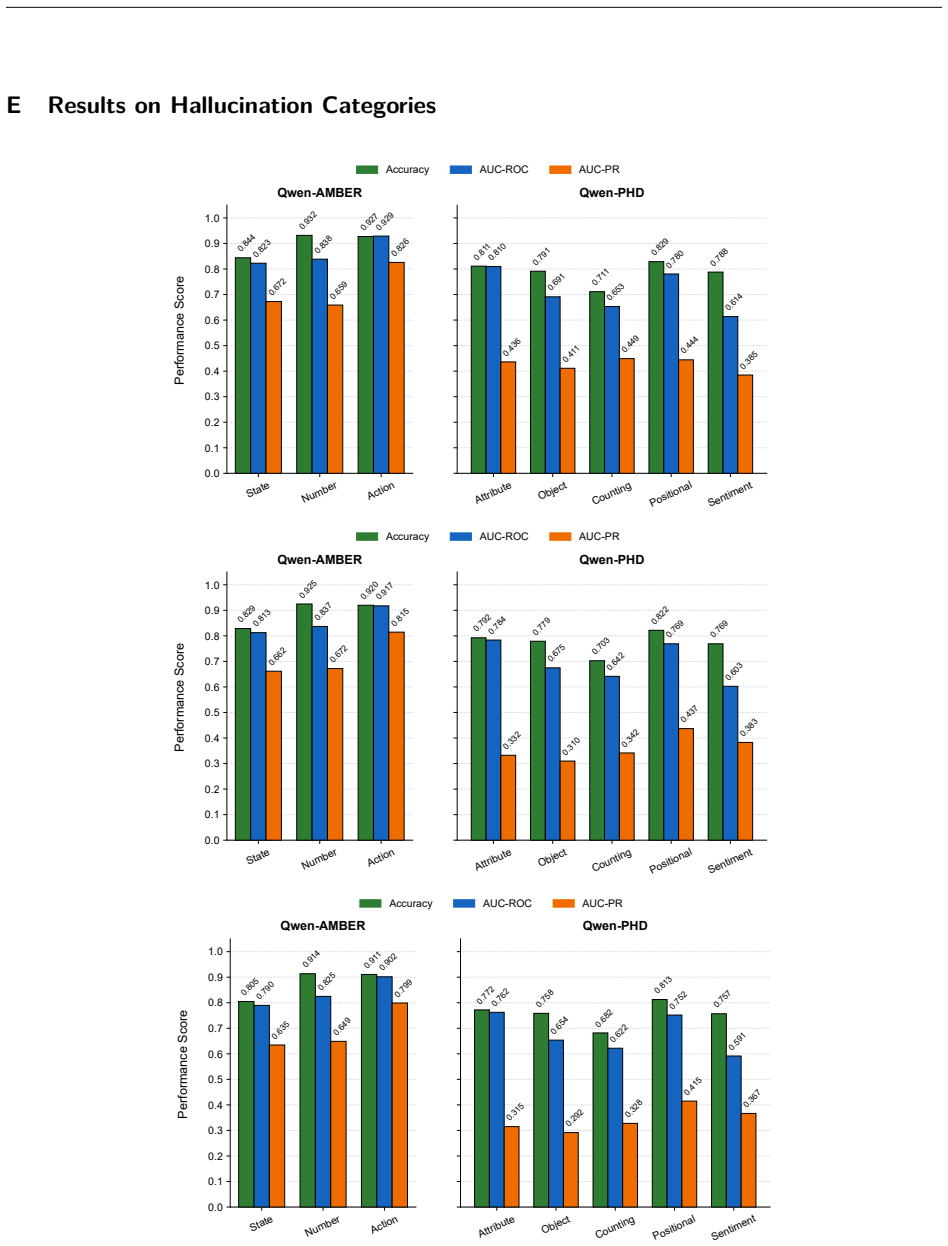
- [Appendix E] The hallucination-category plots (Figure 5) lack axis legends and error bars, and the caption does not specify which model is shown for the 'three detection methods' (the text mentions Qwen only in labels). Please make the figure self-contained.
Circularity Check
No circularity: features are model-output statistics; labels are only supervision targets, and evaluation is held-out/cross-dataset.
full rationale
UHP Detection trains a supervised classifier on 14 consistency features derived solely from model outputs under image/text perturbations and logical polarity. The hallucination labels from AMBER/PhD are used only as the supervision target; they never enter Eqs. (1)-(3), where QA is defined against the model's own original answer and PA/BG are functions of model predictions alone. The claimed 'unique hallucination pattern' is therefore an empirical, testable regularity rather than an input to feature construction. Evaluation is performed on held-out 20% splits and via cross-dataset transfer, so the reported predictions are not forced by construction. No self-citation chain, imported uniqueness theorem, or ansatz-smuggling citation is present. The main load-bearing assumption—that the 10 image transformations and Phi-2 paraphrases preserve factual content—is an empirical validity concern, not a circular reduction: the scene-composition similarity metric is an external measure, and Appendix B's inference from high similarity scores to factual-content preservation is an unsupported non-sequitur rather than a definitional equivalence. Thus no significant circularity is found.
Assumptions & free parameters
free parameters (3)
- classifier parameters =
selected by validation (8 classifiers, hyperparameter grids)
- perturbation budget (N=10 images, M=4 text variants) =
I10-T4 in full configuration
- scene composition similarity threshold for retaining transformations =
not stated numerically
assumptions (4)
- domain assumption Logical consistency: an LVLM that judges a statement true should judge its negation false; violations of this are informative about hallucination.
- domain assumption The 10 image transformations and the Phi-2 paraphrases preserve factual content of the image and statements.
- domain assumption Ground truth labels in AMBER and PhD are correct and the binary yes/no mapping of the model's response into {0,1} is deterministic and accurate.
- domain assumption The sampled 2,000 instances per dataset are representative of the benchmarks.
Cite this review
Pith. "Pith review of UHP Detection: LVLMs have their Unique Hallucination Pattern in the Consistency Space." pith.science (2026). https://pith.science/paper/LDGTPY5S
@misc{pith2026260803817,
  author       = {Pith},
  title        = {Pith review of: UHP Detection: LVLMs have their Unique Hallucination Pattern in the Consistency Space},
  year         = {2026},
  howpublished = {\url{https://pith.science/paper/LDGTPY5S}},
  note         = {Machine review of arXiv:2608.03817}
}
abstract
Large vision--language models (LVLMs) demonstrate strong multimodal reasoning capabilities but remain prone to hallucination, where model predictions are not grounded in visual evidence. Existing black-box hallucination detection methods estimate uncertainty through a single consistency metric, implicitly assuming that model uncertainty can be adequately characterized by a single measure. However, hallucinations exhibit diverse manifestations of uncertainty across different behavioral probes, making a single measure insufficient to characterize their underlying behavior. We propose \emph{Unique Hallucination Pattern (UHP) Detection}, a fully black-box framework that models hallucination as a structured uncertainty pattern defined by two axes: perturbation modality (image vs.\ text) and logical polarity (a statement vs.\ its negation). Their intersection produces four complementary consistency groups that capture distinct manifestations of model uncertainty, from which both within-group and between-group features are extracted to train a lightweight classifier. Through comprehensive experiments on AMBER and PhD across three LVLMs, UHP Detection consistently outperforms prior black-box and white-box baselines, with improvements of up to $+18.72\%$ AUC-ROC and $+20.07\%$ AUC-PR over the strongest black-box methods. Extensive ablation studies demonstrate that each consistency group contributes complementary information and that their combination forms a structured hallucination pattern. Furthermore, cross-dataset evaluation shows that this learned pattern generalizes across benchmarks, indicating that hallucination behavior reflects a model-specific consistency pattern. \textbf{Code is publicly available at} https://github.com/amirezzati/uhpdet.
Figures


Figures from the paper (2 more)

Reference graph
Works this paper leans on
-
[1]
Shuai Bai, Keqin Chen, Xuejing Liu, Jialin Wang, Wenbin Ge, Sibo Song, Kai Dang, Peng Wang, Shijie Wang, Jun Tang, et al. Qwen2. 5-vl technical report.arXiv preprint arXiv:2502.13923,
-
[5]
Lm-polygraph: Uncer- tainty estimation for language models.arXiv preprint arXiv:2311.07383,
Ekaterina Fadeeva, Roman Vashurin, Akim Tsvigun, Artem Vazhentsev, Sergey Petrakov, Kirill Fedyanin, Daniil Vasilev, Elizaveta Goncharova, Alexander Panchenko, Maxim Panov, et al. Lm-polygraph: Uncer- tainty estimation for language models.arXiv preprint arXiv:2311.07383,
-
[6]
Llama-adapter v2: Parameter-efficient visual instruction model.arXiv preprint arXiv:2304.15010,
Peng Gao, Jiaming Han, Renrui Zhang, Ziyi Lin, Shijie Geng, Aojun Zhou, Wei Zhang, Pan Lu, Conghui He, Xiangyu Yue, et al. Llama-adapter v2: Parameter-efficient visual instruction model.arXiv preprint arXiv:2304.15010,
-
[7]
SushantGautam, MichaelARiegler, andPålHalvorsen. Hedge: Hallucinationestimationviadensegeometric entropy for vqa with vision-language models.arXiv preprint arXiv:2511.12693,
-
[8]
13 Md Redwanul Haque, Manzur Murshed, Manoranjan Paul, and Tsz-Kwan Lee
URLhttps://arxiv.org/abs/2306.11644. 13 Md Redwanul Haque, Manzur Murshed, Manoranjan Paul, and Tsz-Kwan Lee. A novel image similarity metric for scene composition structure.arXiv preprint arXiv:2508.05037,
-
[9]
An embodied generalist agent in 3d world.arXiv preprint arXiv:2311.12871,
Jiangyong Huang, Silong Yong, Xiaojian Ma, Xiongkun Linghu, Puhao Li, Yan Wang, Qing Li, Song- Chun Zhu, Baoxiong Jia, and Siyuan Huang. An embodied generalist agent in 3d world.arXiv preprint arXiv:2311.12871,
-
[10]
Language models (mostly) know what they know.arXiv preprint arXiv:2207.05221,
Saurav Kadavath, Tom Conerly, Amanda Askell, Tom Henighan, Dawn Drain, Ethan Perez, Nicholas Schiefer, Zac Hatfield-Dodds, Nova DasSarma, Eli Tran-Johnson, et al. Language models (mostly) know what they know.arXiv preprint arXiv:2207.05221,
-
[12]
Chunyuan Li, Cliff Wong, Sheng Zhang, Naoto Usuyama, Haotian Liu, Jianwei Yang, Tristan Naumann, Hoi- fung Poon, and Jianfeng Gao. Llava-med: Training a large language-and-vision assistant for biomedicine in one day.Advances in Neural Information Processing Systems, 36:28541–28564, 2023a. Junnan Li, Dongxu Li, Silvio Savarese, and Steven Hoi. Blip-2: Boot...
Show all 22 references
-
[13]
Evaluating object hallucination in large vision-language models.arXiv preprint arXiv:2305.10355, 2023c
Yifan Li, Yifan Du, Kun Zhou, Jinpeng Wang, Wayne Xin Zhao, and Ji-Rong Wen. Evaluating object hallucination in large vision-language models.arXiv preprint arXiv:2305.10355, 2023c. Zhen Lin, Shubhendu Trivedi, and Jimeng Sun. Generating with confidence: Uncertainty quantificat...
-
[14]
Selfcheckgpt: Zero-resource black-box hallucination detection for generative large language models
Potsawee Manakul, Adian Liusie, and Mark Gales. Selfcheckgpt: Zero-resource black-box hallucination detection for generative large language models. InProceedings of the 2023 conference on empirical methods in natural language processing, pp. 9004–9017,
2023
-
[15]
Kosmos-2: Grounding multimodal large language models to the world.arXiv preprint arXiv:2306.14824,
Zhiliang Peng, Wenhui Wang, Li Dong, Yaru Hao, Shaohan Huang, Shuming Ma, and Furu Wei. Kosmos-2: Grounding multimodal large language models to the world.arXiv preprint arXiv:2306.14824,
-
[16]
Defining and quantifying visual hallucinations in vision-language models
Vipula Rawte, Aryan Mishra, Amit Sheth, and Amitava Das. Defining and quantifying visual hallucinations in vision-language models. InProceedings of the 5th Workshop on Trustworthy NLP (TrustNLP 2025), pp. 501–510,
2025
-
[17]
Understanding visual detail hallucinations of large vision-language models
14 Xiaoxi Sun, Jianxin Liang, Yueqian Wang, Huishuai Zhang, and Dongyan Zhao. Understanding visual detail hallucinations of large vision-language models. InProceedings of the Thirty-Fourth International Joint Conference on Artificial Intelligence, pp. 1900–1908,
1900
-
[18]
Llama 2: Open foundation and fine-tuned chat models.arXiv preprint arXiv:2307.09288,
Hugo Touvron, Louis Martin, Kevin Stone, Peter Albert, Amjad Almahairi, Yasmine Babaei, Nikolay Bash- lykov, Soumya Batra, Prajjwal Bhargava, Shruti Bhosale, et al. Llama 2: Open foundation and fine-tuned chat models.arXiv preprint arXiv:2307.09288,
-
[19]
Amber: An llm-free multi-dimensional benchmark for mllms hallucination evaluation.arXiv preprint arXiv:2311.07397, 2023a
Junyang Wang, Yuhang Wang, Guohai Xu, Jing Zhang, Yukai Gu, Haitao Jia, Jiaqi Wang, Haiyang Xu, Ming Yan, Ji Zhang, et al. Amber: An llm-free multi-dimensional benchmark for mllms hallucination evaluation.arXiv preprint arXiv:2311.07397, 2023a. Wenhai Wang, Jiangwei Xie, Chuan...
-
[20]
Minigpt-4: Enhancing vision- language understanding with advanced large language models.arXiv preprint arXiv:2304.10592,
Deyao Zhu, Jun Chen, Xiaoqian Shen, Xiang Li, and Mohamed Elhoseiny. Minigpt-4: Enhancing vision- language understanding with advanced large language models.arXiv preprint arXiv:2304.10592,
-
[21]
Diverging towards hallucination: Detection of failures in vision-language models via multi-token aggregation.arXiv preprint arXiv:2505.11741,
Geigh Zollicoffer, Minh Vu, and Manish Bhattarai. Diverging towards hallucination: Detection of failures in vision-language models via multi-token aggregation.arXiv preprint arXiv:2505.11741,
-
[22]
B.Image Transformations Visual examples of semantic-equivalent transformations
15 ♂list-olTable of Contents A.Prompt Construction Details on factual statement extraction and L VLM prompts. B.Image Transformations Visual examples of semantic-equivalent transformations. C.Classifier Selection & Hyperparameter Tuning Hyperparameter search spaces for linear ...
2000
-
[2022]
Medical hallucinations in foundation models and their impact on healthcare.arXiv preprint arXiv:2503.05777,
Yubin Kim, Hyewon Jeong, Shan Chen, Shuyue Stella Li, Mingyu Lu, Kumail Alhamoud, Jimin Mun, Cristina Grau, Minseok Jung, Rodrigo Gameiro, et al. Medical hallucinations in foundation models and their impact on healthcare.arXiv preprint arXiv:2503.05777,
-
[2023]
Unified hallucination detection for multimodal large language models.arXiv preprint arXiv:2402.03190, 2024a
Xiang Chen, Chenxi Wang, Yida Xue, Ningyu Zhang, Xiaoyan Yang, Qiang Li, Yue Shen, Lei Liang, Jinjie Gu, and Huajun Chen. Unified hallucination detection for multimodal large language models.arXiv preprint arXiv:2402.03190, 2024a. Zhe Chen, Jiannan Wu, Wenhai Wang, Weijie Su, ...
2023 arXiv
-
[2024]
Minigpt-v2: large language model as a unified interface for vision-language multi-task learning.arXiv preprint arXiv:2310.09478,
Jun Chen, Deyao Zhu, Xiaoqian Shen, Xiang Li, Zechun Liu, Pengchuan Zhang, Raghuraman Krishnamoor- thi, Vikas Chandra, Yunyang Xiong, and Mohamed Elhoseiny. Minigpt-v2: large language model as a unified interface for vision-language multi-task learning.arXiv preprint arXiv:2310.09478,
-
[2025]
Hallucination of multimodal large language models: A survey.arXiv preprint arXiv:2404.18930,
Zechen Bai, Pichao Wang, Tianjun Xiao, Tong He, Zongbo Han, Zheng Zhang, and Mike Zheng Shou. Hallucination of multimodal large language models: A survey.arXiv preprint arXiv:2404.18930,
Reviewed August 5, 2026 · model on record in the stance chip above.
Discussion (0). Sign in to comment.