REVIEW 4 major objections 7 minor 41 references
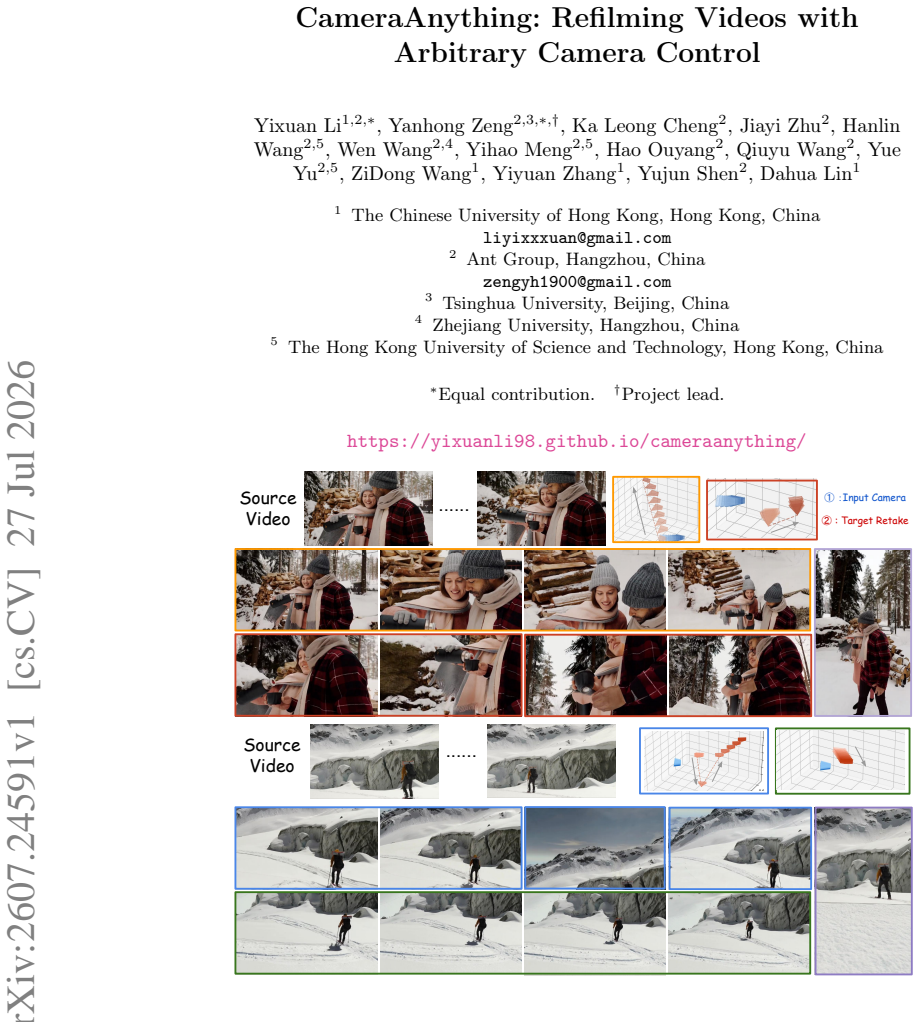
One video model can reshoot a clip with new viewpoint, focal length, resolution, and shot cuts in a single pass.
Reviewed by Pith at T0; open to challenge. T0 means a machine referee read the full paper against a public rubric. the ladder, T0–T4 →
T0 review · grok-4.5
2026-07-31 11:02 UTC pith:LDMCL76I
load-bearing objection Real unification of multi-shot retakes with focal/resolution control, but the intrinsic story is mostly synthetic crops and the real-data edge is thin. the 4 major comments →
CameraAnything: Refilming Videos with Arbitrary Camera Control
The pith
A machine-rendered reading of the paper's core claim, the machinery that carries it, and where it could break.
Core claim
A single latent video diffusion model can jointly obey target extrinsic pose (including abrupt multi-shot cuts), focal length, and native output resolution when both camera conditioning and spatial positional encoding are built from per-pixel Plücker rays and resolution-aware 3D RoPE on the target latent, trained with orthogonally sampled synchronized synthetic multi-camera pairs.
What carries the argument
Per-pixel Plücker ray injection into resolution-aware 3D RoPE in self-attention: each target token gets a 6-DoF ray (origin and direction) that encodes pose and focal length, applied as a phase shift alongside RoPE whose spatial coordinates come from the target latent grid, so viewpoint, zoom, and resolution change together without cropping or outpainting.
Load-bearing premise
Geometry and appearance learned almost entirely from synthetic multi-camera scenes with animated characters transfer well enough to real videos—even when source cameras are noisy estimates—that the model stays geometrically faithful.
What would settle it
On real videos with independently measured ground-truth target cameras and lenses, check whether generated frames match the commanded pose, focal length, and resolution (rotation/translation error and reconstruction metrics) as well as they do on held-out synthetic scenes; a large real-world drop would falsify the transfer claim.
If this is right
- A continuous single-take can be turned into a multi-shot edit with specified cuts inside one generation pass.
- Focal length and camera path can be changed together, enabling effects such as dolly zoom without separate optical and motion stages.
- The same source can be re-rendered at native portrait, landscape, or square resolutions without crop-or-outpaint pipelines.
- Cinematic retakes and cross-device reformatting become feasible from ordinary single-camera footage rather than multi-camera capture or full 3D rebuilds.
Where Pith is reading between the lines
- If Plücker-on-target-RoPE is the binding constraint, the same injection pattern may extend to other intrinsics (aperture, shutter) once paired data exist.
- Heavy reliance on synthetic multi-view pairs suggests that real multi-camera or light-field corpora would be the highest-leverage next training signal for closing residual real-world geometry gaps.
- Native resolution control via target-grid RoPE could generalize to other video editors that today still fix aspect ratio at training time.
Editorial analysis
A structured set of objections, weighed in public.
Referee Report
Summary. CameraAnything fine-tunes Wan2.1-T2V-1.3B for video-to-video camera editing by concatenating source and target tokens, representing cameras with per-pixel Plücker rays, injecting them through zero-initialized RoPE phase shifts, and recomputing 3D-RoPE coordinates for target-resolution latent grids. A structured Unreal Engine/BEDLAM dataset supplies synchronized single-shot, multi-shot, and re-focal clips, while independent sampling of extrinsic, focal, and aspect-ratio edits is intended to disentangle the three control axes. The reported results improve synthetic reconstruction and ViPE-estimated camera errors over prior extrinsic-only methods and show qualitative multi-shot and resolution adaptation. The extrinsic and synthetic focal results are credible, but the central unification claim is not yet adequately tested on real intrinsic control or on resolution changes requiring content beyond the source frustum.
Significance. If validated, a single generative editor supporting viewpoint changes, cinematic cuts, focal changes, and output-format adaptation would be useful for video post-production and would advance beyond extrinsic-only systems such as ReCamMaster. The paper has real strengths: a structured paired-data protocol, explicit re-focal pairs with identical trajectories, an orthogonal multi-task training design, representation/injection ablations, per-configuration synthetic metrics, external ViPE-based pose evaluation on real footage, and a human-preference study. These make the extrinsic-control contribution and the synthetic focal supervision reasonably persuasive. However, the evidence presently supports a narrower claim than “arbitrary” joint intrinsic/extrinsic control: real focal adherence is unmeasured, and the main resolution evaluation appears to test crop-like recomposition rather than generation outside the source view.
major comments (4)
- [§3, §5.1, Table 6] All raw footage is rendered at 832×832 and aspect variants are produced by parameterized center crops. The sole synthetic resolution configuration is described as the source “re-encoded at portrait resolution (832×480)”; Table 6 gives it PSNR 20.54, close to focal-only (21.78) and far above extrinsic edits (~14.5). Thus, as described, the benchmark does not establish editing where the target frustum contains content absent from the source, despite the claims “without cropping or outpainting” and cross-platform adaptation in Fig. 1. Please add crop/recompose versus FOV-expanding or cross-aspect cases, including evaluation of newly visible regions, or narrow the claim.
- [§5.1–5.2, Tables 2 and 5] The real-world evaluation contains no focal or FOV adherence metric: RotErr/TransErr measure only extrinsics, VBench is generic perceptual quality, and the user study visualizes target pose rather than explicitly scoring focal alignment. This is load-bearing because focal control is one of the paper’s two main intrinsic-control novelties, while §5.1 trains sources only from the fixed-focal subset. Please report real focal/FOV adherence using estimated intrinsics or a controlled human/geometric protocol, with uncertainty and sensitivity to source-camera estimation errors.
- [§5.1, Tables 1 and 6] The “Ours” PSNR of 15.88 appears to average the five non-resolution configurations in Table 6, including focal-only and extrinsic+focal cases. ReCamMaster supports only extrinsic conditioning, yet the manuscript does not state what intrinsic parameters it receives in those cases. The aggregate comparison therefore conflates missing focal-control capability with camera-following quality. Likewise, outpainting baselines are compared on a crop-like resolution case without specifying their masks or instructions. Please report per-configuration baseline results and exact conditioning, and use capability-matched subsets for claims of superiority.
- [Tables 1–3] No sample-level variance or paired significance is reported. This matters because the real resolution differences are tiny (e.g., Table 2 Aesthetic 0.5198 versus 0.5166 and Imaging 0.6732 versus 0.6728), while the selected Plücker+RoPE variant in Table 3 improves PSNR/SSIM over AdaLN only slightly and has worse LPIPS (0.372 versus 0.368). Please provide per-video standard deviations or bootstrap confidence intervals and paired tests, and qualify “best reconstruction fidelity” and “consistently well” accordingly.
minor comments (7)
- [§5.1] “Source portrait” is paired with the resolution 832×480, which is landscape under the usual width×height convention. Please clarify the resolution ordering and intended aspect-ratio terminology.
- [§4.3, Table 4] The term “identity samples” is not precisely defined. §4.3 says an all-identity draw is promoted to a focal-change sample, whereas Table 4 suggests identity samples are important for decoupling. Please state exactly which dimensions are held fixed in these samples.
- [§4.2, Eq. (6), Fig. 3] Clarify whether Plücker-conditioned phase shifts are applied to source tokens, target tokens, or both, and how their relative phases are composed in self-attention. Figure 3 suggests both cameras are used, while the surrounding prose emphasizes the target latent.
- [§4.1–4.2, Eqs. (1) and (3)] Specify the mapping from pixel-space Plücker rays to VAE latent tokens after spatial stride and patchification. Also note the principal-point convention in Eq. (1); many geometry pipelines use (W−1)/2 and (H−1)/2 rather than W/2 and H/2.
- [Appendix B, Table 5] The user study should report question wording, randomization, tie handling, confidence intervals, and whether focal-control cases were shown to a baseline that cannot accept focal instructions.
- [§3, §5.1, Appendix A] Please provide release status and sufficient details for reproducing the dataset and training: focal/FOV distributions, crop parameterization, trajectory sampler, train/test scene split, sampling seeds, inference settings, and whether code or rendered data will be available.
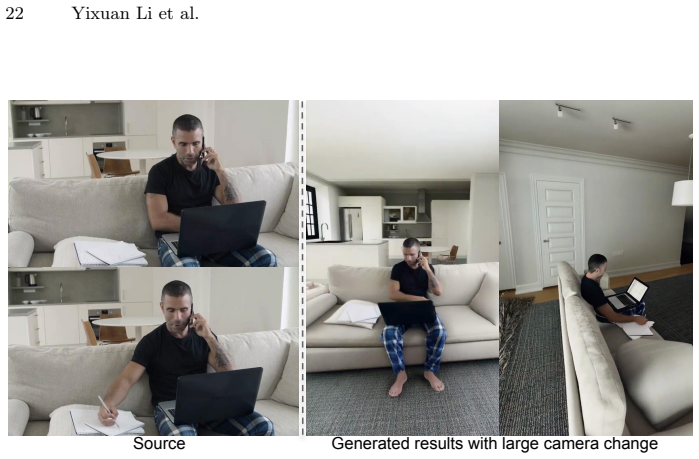
- [Appendix A, Figs. 5–9] “Our dataset have about 300,000 videos” should be “has”; the large figure legends would also benefit from clearer trajectory labels and explicit indication of which regions are newly synthesized.
Circularity Check
No circularity: standard supervised video-to-video training with held-out metrics, not predictions forced by definition or self-citation.
full rationale
CameraAnything is an engineering/ML systems paper, not a first-principles derivation. The load-bearing chain is: (1) represent target cameras as per-pixel Plücker rays and inject them via RoPE phase shifts into a frozen Wan2.1 DiT, with resolution-aware 3D RoPE on the target latent grid; (2) train on paired source/target clips from a self-built Unreal multi-camera corpus under an orthogonal sampling schedule over extrinsics, focal length, and aspect ratio; (3) evaluate reconstruction (PSNR/SSIM/LPIPS), camera error (ViPE RotErr/TransErr), VBench, and human preference on held-out synthetic scenes and real videos. None of these steps reduces a claimed prediction to its own fitted input or definition. Ablations (Tables 3–4) compare representation/injection and training variants empirically; baselines (ReCamMaster, TrajectoryCrafter, Follow-Your-Canvas, VACE) are external. Self-built synthetic data and citations to prior camera encodings (Plücker, RoCE) are normal methodological choices, not uniqueness theorems or self-citation chains that force the result. Concerns that resolution supervision is mostly center-crops of square renders, or that real-world focal adherence is unmeasured, are evaluation-validity issues—not circularity under the stated patterns. Score 0; steps empty.
Axiom & Free-Parameter Ledger
free parameters (4)
- Orthogonal task sampling probabilities =
0.2/0.4/0.4; p_focal=0.5; p_aspect=0.2
- Fine-tuning hyperparameters =
20k steps, 5e-5, bs=32
- Resolution training buckets =
{480×832,...,320×320} listed set
- Synthetic focal set / FOV sampling range =
18–50mm-equivalent patterns
axioms (6)
- domain assumption Pinhole camera model with intrinsics from horizontal FOV and extrinsics as c2w matrices, poses normalized to first source frame.
- domain assumption Per-pixel Plücker rays uniquely encode the joint effect of extrinsics and intrinsics for each token and adapt when resolution/FOV change.
- ad hoc to paper Injecting camera geometry as RoPE phase shifts (RoCE-style) steers attention without destroying the pretrained generative prior when zero-initialized.
- domain assumption Synchronized UE5 multi-camera renders with BEDLAM humans are sufficient supervision for real-world camera-controlled editing.
- domain assumption Frame-dimension concatenation of source and noisy target latents enables content-consistent video-to-video generation in Wan2.1 DiT.
- domain assumption ViPE-estimated poses are accurate enough to score camera following on real videos.
invented entities (2)
-
CameraAnything orthogonal multi-task training protocol (independent extrinsic/focal/resolution sampling with identity promotion)
no independent evidence
-
Structured 20-clip UE multi-camera scene package (Groups A/B/C including re-focal and multi-shot)
no independent evidence
read the original abstract
We introduce CameraAnything, the first unified framework for camera controlled video editing that enables joint control of both intrinsic and extrinsic camera parameters. Existing approaches either rely on expensive 3D reconstruction to achieve full camera functionality or restrict editing to extrinsic parameter manipulation. Moreover, the coupled influence of intrinsic and extrinsic parameters on video appearance makes disentangled modeling particularly challenging. To address this, we adopt per-pixel Pl\"ucker ray injection alongside resolution-aware 3D RoPE in self-attention, building both camera conditioning and spatial positional encoding on the target latent to jointly control camera position, focal length, and native resolution editing without cropping or outpainting. To overcome the scarcity of paired training data, we further develop a scalable synthetic pipeline that constructs diverse dynamic scenes through structured multi-camera recording and generates synchronized videos with varied camera configurations. With a tailored orthogonal training strategy, CameraAnything enables expressive video reshooting with arbitrary viewpoint control, focal length adjustment, resolution adaptation, and multi-shot transitions within a single generation process, offering strong practical value for cinematic video editing and cross-platform content adaptation in video production.
Figures



Reference graph
Works this paper leans on
-
[1]
Adobe: Dolly zoom shot: Definition and examples.https://www.adobe.com/ sg / creativecloud / video / production / cinematography / camera - shots - and - angles/dolly-zoom-shot.html(2026), accessed: 2026-06-30
2026
-
[2]
In: ICCV (2025)
Bai, J., Xia, M., Fu, X., Wang, X., Mu, L., Cao, J., Liu, Z., Hu, H., Bai, X., Wan, P., et al.: Recammaster: Camera-controlled generative rendering from a single video. In: ICCV (2025)
2025
-
[3]
In: ICLR (2025)
Bai, J., Xia, M., Wang, X., Yuan, Z., Liu, Z., Hu, H., Wan, P., ZHANG, D.: Syn- cammaster: Synchronizing multi-camera video generation from diverse viewpoints. In: ICLR (2025)
2025
-
[4]
In: CVPR
Black, M.J., Patel, P., Tesch, J., Yang, J.: BEDLAM: A synthetic dataset of bod- ies exhibiting detailed lifelike animated motion. In: CVPR. pp. 8726–8737. IEEE (2023)
2023
-
[5]
In: Proceedings of the AAAI Conference on Artificial Intelligence
Chen, Q., Ma, Y., Wang, H., Yuan, J., Zhao, W., Tian, Q., Wang, H., Min, S., Chen, Q., Liu, W.: Infinite-canvas: Higher-resolution video outpainting with ex- tensive content generation. In: Proceedings of the AAAI Conference on Artificial Intelligence. vol. 39, pp. 2150–2158 (2025)
2025
-
[6]
arXiv preprint arXiv:2511.17185 (2025)
Chen, Y., Ye, Z., Fang, Z., Chen, X., Zhang, X., Liu, J., Wang, N., Liu, H., Zhang, G.: Postcam: Camera-controllable novel-view video generation with query-shared cross-attention. arXiv preprint arXiv:2511.17185 (2025)
Pith/arXiv arXiv 2025
-
[7]
Epic Games: Unreal Engine.https://www.unrealengine.com/(2023), accessed: 2026-06-30
2023
-
[8]
arXiv preprint arXiv:2601.05239 (2026)
Fu, X., Tang, S., Shi, M., Liu, X., Gu, J., Liu, M.Y., Lin, D., Lin, C.H.: Plenoptic video generation. arXiv preprint arXiv:2601.05239 (2026)
arXiv 2026
-
[9]
Gao, R., Hołyński, A., Henzler, P., Brussee, A., Martin-Brualla, R., Srinivasan, P., Barron, J.T., Poole, B.: Cat3d: create anything in 3d with multi-view diffusion models.In:Proceedingsofthe38thInternationalConferenceonNeuralInformation Processing Systems. pp. 75468–75494 (2024)
2024
-
[10]
In: ICLR (2025)
He, H., Xu, Y., Guo, Y., Wetzstein, G., Dai, B., Li, H., Yang, C.: Cameractrl: Enabling camera control for text-to-video generation. In: ICLR (2025)
2025
-
[11]
In: ICCV (2025)
He, H., Yang, C., Lin, S., Xu, Y., Wei, M., Gui, L., Zhao, Q., Wetzstein, G., Jiang, L., Li, H.: Cameractrl ii: Dynamic scene exploration via camera-controlled video diffusion models. In: ICCV (2025)
2025
-
[12]
arXiv preprint arXiv:2512.05672 (2025)
Hong, Y., Lee, S., Chung, H., Ye, J.C.: Inversecrafter: Efficient video recapture as a latent domain inverse problem. arXiv preprint arXiv:2512.05672 (2025)
Pith/arXiv arXiv 2025
-
[13]
arXiv preprint arXiv:2506.05554 (2025)
Hu, T., Peng, H., Liu, X., Ma, Y.: Ex-4d: Extreme viewpoint 4d video synthesis via depth watertight mesh. arXiv preprint arXiv:2506.05554 (2025)
Pith/arXiv arXiv 2025
-
[14]
Huang, J., Zhou, Q., Rabeti, H., Korovko, A., Ling, H., Ren, X., Shen, T., Gao, J., Slepichev, D., Lin, C., Ren, J., Xie, K., Biswas, J., Leal-Taixé, L., Fidler, S.: Vipe: Video pose engine for 3d geometric perception. CoRRabs/2508.10934(2025)
Pith/arXiv arXiv 2025
-
[15]
arXiv preprint arXiv:2512.25075 (2025)
Huang, Z., Jeong, H., Chen, X., Gryaditskaya, Y., Wang, T.Y., Lasenby, J., Huang, C.H.: Spacetimepilot: Generative rendering of dynamic scenes across space and time. arXiv preprint arXiv:2512.25075 (2025)
arXiv 2025
-
[16]
In: CVPR (2024)
Huang, Z., He, Y., Yu, J., Zhang, F., Si, C., Jiang, Y., Zhang, Y., Wu, T., Jin, Q., Chanpaisit, N., et al.: Vbench: Comprehensive benchmark suite for video genera- tive models. In: CVPR (2024)
2024
-
[17]
arXiv preprint (2025) CameraAnything: Refilming Videos with Arbitrary Camera Control 17
HunyuanWorld, T.: Hunyuanworld 1.0: Generating immersive, explorable, and in- teractive 3d worlds from words or pixels. arXiv preprint (2025) CameraAnything: Refilming Videos with Arbitrary Camera Control 17
2025
-
[18]
In: Proceedings of the IEEE/CVF International Conference on Computer Vision
Jiang, Z., Han, Z., Mao, C., Zhang, J., Pan, Y., Liu, Y.: Vace: All-in-one video creation and editing. In: Proceedings of the IEEE/CVF International Conference on Computer Vision. pp. 17191–17202 (2025)
2025
-
[19]
In: Proceedings of the IEEE/CVF Conference on Computer Vision and Pattern Recognition
Kong,X.,Liu,S.,Lyu,X.,Taher,M.,Qi,X.,Davison,A.J.:Eschernet:Agenerative model for scalable view synthesis. In: Proceedings of the IEEE/CVF Conference on Computer Vision and Pattern Recognition. pp. 9503–9513 (2024)
2024
-
[20]
Advances in Neural Information Processing Systems (2025)
Li, R., Yi, B., Liu, J., Gao, H., Ma, Y., Kanazawa, A.: Cameras as relative posi- tional encoding. Advances in Neural Information Processing Systems (2025)
2025
-
[21]
Lin, Z., Cen, S., Jiang, D., Karhade, J., Wang, H., Mitra, C., Ling, T., Huang, Y., Liu, S., Chen, M., Zawar, R., Bai, X., Du, Y., Gan, C., Ramanan, D.: Towards understanding camera motions in any video. CoRRabs/2504.15376(2025)
Pith/arXiv arXiv 2025
-
[22]
arXiv preprint arXiv:2512.05115 (2025)
Liu, T., Chen, Z., Huang, Z., Xu, S., Zhang, S., Ye, C., Li, B., Cao, Z., Li, W., Zhao, H., et al.: Light-x: Generative 4d video rendering with camera and illumination control. arXiv preprint arXiv:2512.05115 (2025)
arXiv 2025
-
[23]
In: Proceedings of the SIGGRAPH Asia 2025 Conference Papers
Luo, Y., Shi, X., Bai, J., Xia, M., Xue, T., Wang, X., Wan, P., Zhang, D., Gai, K.: Camclonemaster: Enabling reference-based camera control for video generation. In: Proceedings of the SIGGRAPH Asia 2025 Conference Papers. pp. 1–10 (2025)
2025
-
[24]
In: The Twelfth International Conference on Learning Representations (2024)
Miyato, T., Jaeger, B., Welling, M., Geiger, A.: Gta: A geometry-aware attention mechanism for multi-view transformers. In: The Twelfth International Conference on Learning Representations (2024)
2024
-
[25]
arXiv preprint arXiv:2511.19827 (2025)
Park, B., Kim, B.H., Chung, H., Ye, J.C.: Redirector: Creating any-length video retakes with rotary camera encoding. arXiv preprint arXiv:2511.19827 (2025)
arXiv 2025
-
[26]
Pont-Tuset, J., Perazzi, F., Caelles, S., Arbeláez, P., Sorkine-Hornung, A., Gool, L.V.: The 2017 DAVIS challenge on video object segmentation. CoRR abs/1704.00675(2017)
Pith/arXiv arXiv 2017
-
[27]
arXiv preprint arXiv:2506.13697 (2025)
Seo, J., Han, J., Jung, J., Jin, S., Lee, J., Narihira, T., Fukuda, K., Shibuya, T., Ahn, D., Hu, S., et al.: Vid-camedit: Video camera trajectory editing with generative rendering from estimated geometry. arXiv preprint arXiv:2506.13697 (2025)
Pith/arXiv arXiv 2025
-
[28]
Advances in Neural Information Processing Systems34, 19313–19325 (2021)
Sitzmann, V., Rezchikov, S., Freeman, B., Tenenbaum, J., Durand, F.: Light field networks: Neural scene representations with single-evaluation rendering. Advances in Neural Information Processing Systems34, 19313–19325 (2021)
2021
-
[29]
Song, C., Yang, Y., Zhao, T., Li, R., Zhang, C.: Worldforge: Unlocking emergent 3d/4dgenerationinvideodiffusionmodelviatraining-freeguidance.arXivpreprint arXiv:2509.15130 (2025)
arXiv 2025
-
[30]
Neurocomputing568, 127063 (2024)
Su, J., Ahmed, M., Lu, Y., Pan, S., Bo, W., Liu, Y.: Roformer: Enhanced trans- former with rotary position embedding. Neurocomputing568, 127063 (2024)
2024
-
[31]
arXiv preprint arXiv:2511.12921 (2025)
Sun, H., Shen, L., Peng, Z., Wang, K., Wu, S., Zang, Y., Liu, T., Huang, Z., Zeng, X., Cao, Z., et al.: Generative photographic control for scene-consistent video cinematic editing. arXiv preprint arXiv:2511.12921 (2025)
arXiv 2025
-
[32]
arXiv preprint arXiv:1812.01717 (2019)
Unterthiner, T., van Steenkiste, S., Kurach, K., Marinier, R., Michalski, M., Gelly, S.: Fvd: A new metric for video generation. arXiv preprint arXiv:1812.01717 (2019)
Pith/arXiv arXiv 2019
-
[33]
arXiv preprint arXiv:2503.20314 (2025)
Wan, T., Wang, A., Ai, B., Wen, B., Mao, C., Xie, C.W., Chen, D., Yu, F., Zhao, H., Yang, J., et al.: Wan: Open and advanced large-scale video generative models. arXiv preprint arXiv:2503.20314 (2025)
Pith/arXiv arXiv 2025
-
[34]
arXiv preprint arXiv:2512.05076 (2025)
Wang, Y., Zhang, Q., Cai, S., Wu, T., Ackermann, J., Kuang, Z., Zheng, Y., Rajič, F., Tang, S., Wetzstein, G.: Bullettime: Decoupled control of time and camera pose for video generation. arXiv preprint arXiv:2512.05076 (2025)
arXiv 2025
-
[35]
arXiv preprint arXiv:2512.10286 (2025) 18 Yixuan Li et al
Wu, X., Chen, X., Wang, Y., Qiao, Y.: Shotdirector: Directorially controllable multi-shot video generation with cinematographic transitions. arXiv preprint arXiv:2512.10286 (2025) 18 Yixuan Li et al
arXiv 2025
-
[36]
arXiv preprint arXiv:2511.21024 (2025)
Yang, Q., Yang, Y., Zeng, Y., Hu, X., Li, B., Yue, H., Yang, J., Jiang, P.T.: Cam- eramaster: Unified camera semantic-parameter control for photography retouching. arXiv preprint arXiv:2511.21024 (2025)
arXiv 2025
-
[37]
In: Proceedings of the IEEE/CVF International Conference on Computer Vision (ICCV)
Yu, M., Hu, W., Xing, J., Shan, Y.: Trajectorycrafter: Redirecting camera trajec- tory for monocular videos via diffusion models. In: Proceedings of the IEEE/CVF International Conference on Computer Vision (ICCV). pp. 100–111 (October 2025)
2025
-
[38]
In: Proceedings of the Computer Vision and Pattern Recognition Conference
Yuan, Y., Wang, X., Sheng, Y., Chennuri, P., Zhang, X., Chan, S.: Generative photography: Scene-consistent camera control for realistic text-to-image synthesis. In: Proceedings of the Computer Vision and Pattern Recognition Conference. pp. 7920–7930 (2025)
2025
-
[39]
arXiv preprint arXiv:2512.07237 (2025)
Zhang, C., Li, B., Wei, M., Cao, Y.P., Gambardella, C.C., Phung, D., Cai, J.: Unified camera positional encoding for controlled video generation. arXiv preprint arXiv:2512.07237 (2025)
arXiv 2025
-
[40]
In: CVPR (2018)
Zhang, R., Isola, P., Efros, A.A., Shechtman, E., Wang, O.: The unreasonable effectiveness of deep features as a perceptual metric. In: CVPR (2018)
2018
-
[41]
Zhong, L., Li, F., Huang, Y., Liu, J., Pei, R., Song, F.: Outdreamer: Video out- painting with a diffusion transformer. arXiv preprint arXiv:2506.22298 (2025) CameraAnything: Refilming Videos with Arbitrary Camera Control 19 CameraAnything: Refilming Videos with Arbitrary Camera Control Supplementary Material A Dataset Details Scene construction.Our datas...
Pith/arXiv arXiv 2025
discussion (0)
Sign in with ORCID, Apple, or X to comment. Anyone can read and Pith papers without signing in.