REVIEW 4 major objections 5 minor 63 references
DUET: A Diversity-Quality Duet of Distillation Experts for Two-Step Video Generation
T0 review · 4 major / 5 minor · reviewed 2026-08-11 · deepseek-v4-flash
Pith's one-line read DUET shows that in two-step video generation, relaying a diversity-preserving sCM step into a quality-oriented DMD step yields DMD-level quality with about twice DMD's diversity at identical inference cost.
desk verdict Noise-level expert duet is a simple, plausible way to dodge the quality-diversity trade-off in two-step video distillation, though missing a DMD-DMD relay control leaves the mechanism slightly underdetermined. read the letter →
The pith
A machine-rendered reading of the paper's core claim, the machinery that carries it, and where it could break.
The reading
What carries the argument
The load-bearing object is the noise-level expert duet: a relay sampler in which a consistency-model expert $f^{\text{sCM}}_\theta$ predicts a clean endpoint from pure noise, the prediction is re-noised to the switch time $\tau$ via $R_\tau(\hat{x}_0, \epsilon) = (1-\tau)\hat{x}_0 + \tau\epsilon$, and a DMD expert $g^{\text{DMD}}_\phi$ maps that intermediate latent to the final clean video. Because the two experts are trained independently with their native objectives, no tunable ratio between the consistency and distribution-matching losses is needed. The switch time $\tau = 0.8$ is chosen from the curvature of the teacher's flow-matching ODE trajectory, which is high in the semantic-formation regime and low in the detail-refinement regime. The adaptation stage adds a second mechanism: CM-GRPO reinforcement learning applied to the sCM expert's Gaussian relay kernel, steering structures toward high-reward layouts, plus continued DMD training that uses the sCM expert's own relay latents as the backward simulation, repairing the distribution gap $p_{\text{sCM}}^\tau \neq p_{\text{DMD}}^\tau$ that the paper flags as Eq. (9).
What would settle it
Measure the actual gap between the two relay distributions on the Wan2.1 backbone: generate a batch of intermediate latents $x^{\text{sCM}}_\tau$ by running the sCM expert and re-noising at $\tau = 0.8$, and a batch of the DMD expert's native intermediate latents at the same noise level, then compute a feature-space distance such as MMD or Fréchet distance. If the gap is large where the base DUET relay still produces clean videos, the relay-interface explanation of the gains is wrong; if the gap shrinks after the DMD-side retraining in DUET+, the repair story is confirmed. A second decisive test is to rerun the whole DUET pipeline on a different backbone, such as Wan2.1-14B, and check whether the roughly two-fold diversity advantage over DMD survives.
Extended reading notes
Core claim
The paper's central claim is that the quality–diversity trade-off between the two dominant few-step distillation approaches is not intrinsic to the two-step budget but a symptom of asking one set of parameters to realize two conflicting noise-to-data mappings. DUET instead splits the denoising schedule by noise level: a coverage-seeking sCM expert takes the high-noise interval $[1,\tau]$, where layout, composition, and motion are decided, and a mode-seeking DMD expert takes the low-noise interval $[\tau,0]$, where edges, texture, and color are refined. The two experts are trained separately with their native objectives, so no loss coefficient mediates between them; at inference they relay through a re-noising operator with switch time $\tau = 0.8$ chosen from the curvature of the teacher's flow-matching trajectory. The measured outcome is that DUET reaches DMD-comparable quality (VBench aggregate 83.96 versus 84.38) while preserving more than twice DMD's same-prompt diversity (0.1512 versus 0.0727), and that DUET+, which steers the sCM expert with CM-GRPO and retrains the DMD expert on the sCM expert's actual relay latents, raises quality to DMD's level (84.40) while keeping the diversity advantage (0.1521).
Load-bearing premise
The relay works only if the intermediate latents that the sCM expert produces and that are re-noised at time $\tau$ stay close enough to the latents the DMD expert saw during its own training; the paper flags this gap explicitly as $p_{\text{sCM}}^\tau \neq p_{\text{DMD}}^\tau$, and the DUET+ adaptation exists precisely to repair it.
Editorial extensions
If this is right
- At the same cost of two network evaluations, DUET delivers the sharp appearance of DMD and the diverse layouts of sCM together, so practitioners no longer have to choose between the two in the two-step regime.
- Because the experts are trained independently with their native losses, the method needs no tuned ratio between consistency and distribution-matching objectives, avoiding the gradient conflicts that loss-level combinations such as rCM must fight.
- The diversity that the duet preserves gives downstream preference optimization room to work: DUET+'s CM-GRPO steering and relay-latent DMD retraining improve quality while keeping the diversity gain, unlike the common init-then-DMD recipe whose inherited diversity collapses.
- Switch time $\tau = 0.8$ is selected from the teacher's ODE curvature, a backbone-agnostic criterion, so the same division of labor should transfer to other flow-matching video models without re-tuning.
Reading between the lines
- A general pattern this result suggests: whenever one distilled expert consumes another expert's outputs, the consumer should be trained on the actual intermediate distribution it will see at inference; the paper's relay-latent retraining is the repair, and the same repair likely applies to any pipelined multi-expert sampler.
- Curvature-based switch-time selection could be automated into an adaptive schedule for step budgets beyond two, or even chosen per prompt, rather than fixed at 0.8.
- The same high-noise/low-noise role split could extend beyond text-to-video: image distillation, autoregressive video models, and other modalities with trajectory-level and distribution-level students of one teacher are natural testbeds.
- One testable extension is to combine DUET's role split with explicit mode-collapse diagnostics on the DMD side; if the diversity gain is really structural, adding repulsive corrections should be unnecessary, whereas if it is fragile, such corrections would close the remaining gap.
Editorial analysis
A structured set of objections, weighed in public.
Referee Report
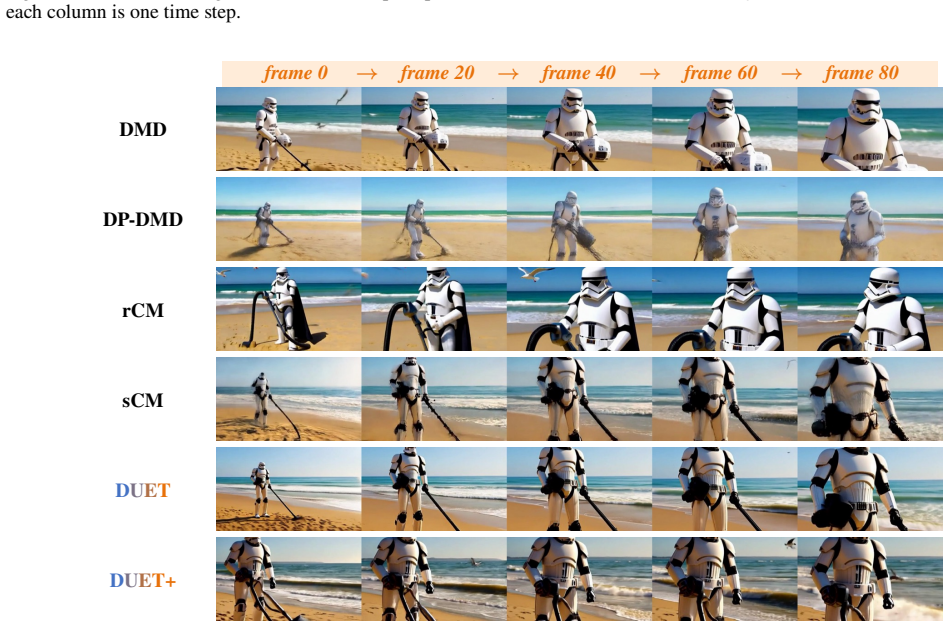
Summary. The paper proposes DUET, a two-step video-generation sampler that assigns a consistency-model (sCM) expert to the high-noise interval and a distribution-matching (DMD) expert to the low-noise interval, connected by a re-noising step at switch time tau=0.8. A second variant, DUET+, adapts the sCM expert with a reward-guided GRPO update (CM-GRPO) and the DMD expert by continuing its training on the relay latents. On Wan2.1-T2V-1.3B, the paper reports that DUET preserves roughly twice DMD's same-prompt diversity (average .1512 vs .0727) while raising VBench quality to 83.96 versus DMD's 84.38, and that DUET+ reaches 84.40 quality while retaining diversity .1521. The authors interpret these results as evidence that 'noise-level expert specialization' reconciles quality and diversity in the extreme few-step regime.
Significance. If the empirical claims hold, the paper offers a surprisingly simple design principle for the two-step regime: keep the two dominant distillation paradigms separate and let each act on the noise interval where its inductive bias is most beneficial. The work is significant because it directly challenges the prevailing loss-level combination strategy (e.g., rCM) and because the two-step setting provides a clean stress test of the quality-diversity trade-off. The paper is unusually explicit about its limitations: it acknowledges the relay-interface distribution gap (Eq. 9) and states that the public rCM checkpoint may underperform the official rCM. The evaluation uses external metrics (VBench and embedding-based diversity), and the key hyperparameter tau is ablated rather than used to force the result, so the headline differences are not derived from the method's own inputs.
major comments (4)
- [§5.3 / Table 1; §4.2 Eq. (6)] The attribution of the diversity gain to the sCM expert's identity is underdetermined because the DUET sampler differs from the DMD baseline in two respects: the first-step expert and the intermediate re-noising time (tau=0.8). Since DMD-style multi-step sampling already injects fresh Gaussian noise at its intermediate step, the confound is not the presence of re-noising but the specific noise level used. The authors should run a DMD-DMD control with the same tau=0.8, the same re-noising operator (Eq. 4), and two network evaluations. If this control's diversity stays near DMD's .0727, the sCM expert is the causal source; if it approaches DUET's .1512, the reported diversity advantage is a schedule artifact and the central 'expert specialization' interpretation needs revision.
- [§5.3 / Table 1] The primary quantitative claims lack confidence intervals or significance tests. The diversity gap between DUET (.1512) and DMD (.0727) is large, but the quality gaps are small: DUET (83.96) is within 0.4 points of DMD (84.38), and DUET+ (84.40) is essentially tied with DMD. Without standard errors or bootstrap confidence intervals over prompts/seeds, the reader cannot judge whether the claimed 'DMD-level quality' is distinguishable from noise. Please report uncertainty estimates at least for the headline quality and diversity averages in Table 1.
- [§5.1 / App. C.1] The rCM comparison relies on a public checkpoint that, as the authors note, was not trained under the rCM paper's settings and may underperform the official rCM. This weakens the Q3 comparison against loss-level combinations. The authors should either train rCM on the same synthetic dataset under the same compute budget, or explicitly qualify all rCM numbers as lower bounds and temper the statement that loss-level combinations cannot achieve the DUET trade-off. The current caveat is disclosed but buried in the appendix; it should be reflected in the main-text claims about rCM.
- [§5.4 / Table 3] The reward function for DUET+ (HPSv3) was selected after observing its effect on the same VBench quality dimensions that are reported as headline results in Table 1. This retrospective selection can inflate the reported DUET+ quality. Please clarify whether the evaluation was split into a validation set for reward selection and a held-out test set, and discuss the potential optimism in the DUET+ numbers. At minimum, state explicitly that the reward ablation is exploratory and not a test-set hyperparameter search.
minor comments (5)
- [§5.3] The text says DUET's diversity is 'slightly lower' than sCM's, but Table 1 shows .1512 vs .1865, a 19% relative reduction. This is not 'slight'; please rephrase or provide a quantitative comparison.
- [Table 1] The column abbreviations SC, BC, TF, MS, DD, AQ, and IQ are not expanded in the table caption. Please expand them in the caption or add a footnote for self-contained readability.
- [§5.1] Please specify the exact native two-step sampling schedule used for the DMD baseline (intermediate time value and the distribution of the re-noising variable). This is needed to make the Table 1 comparison fully reproducible and to assess the confound discussed in the major comments.
- [§4.2 / Eq. (8)] Equation (8) defines the curvature measure only up to proportionality. Please provide the exact normalization or formula used to generate Figure 3, so that tau=0.8 can be reproduced from the teacher trajectory.
- [Appendix E] The qualitative diversity evidence is presented through first-frame stills. Since the diversity metric is computed on video embeddings, consider adding a temporal-diversity metric or a short qualitative note on motion diversity, or explicitly state that first frames are only a proxy.
Circularity Check
No significant circularity: DUET's quality and diversity claims rest on external benchmarks and ablations, not on definitions or fitted inputs.
full rationale
The DUET sampler is defined as an inference-time relay (Eqs. 6-7) between independently trained sCM and DMD experts, and the central claims are empirical: Table 1 reports VBench quality and ViCLIP/DINO/CLIP same-prompt diversity, all external to the method's construction. The switch time tau=0.8 is selected from teacher ODE curvature (Eq. 8, Figure 3) and then ablated in Table 2; it is not fitted to the reported diversity or quality numbers. The paper explicitly flags the relay-interval distribution gap (Eq. 9) as a limitation and introduces DUET+ to address it, which is an honest assumption rather than a circular step. The only same-author citation (FlashMol, Wei et al. 2026) is used for an unrelated application mention (molecule generation) and is not load-bearing for any DUET claim. The rCM checkpoint caveat in Appendix C.1 is a training-data/setting disclosure, not a circularity. The absence of a DMD-DMD relay control could leave the diversity mechanism experimentally underdetermined, but that is a confound to be resolved by additional measurements, not a circular reduction: the diversity gain is not true by construction. No step in the derivation chain reduces to its inputs.
Assumptions & free parameters
free parameters (5)
- switch time tau =
0.8
- CM-GRPO reward function =
HPSv3
- CM-GRPO group size =
16
- advantage clipping strength =
5.0
- update counts per round (N_sCM, N_critic) =
5 and 5
assumptions (5)
- domain assumption The teacher flow-matching ODE (Eq. 2) faithfully models the video data distribution.
- domain assumption sCM preserves sample diversity and DMD is mode-seeking, so the quality-diversity trade-off exists.
- ad hoc to paper Teacher trajectory curvature marks the boundary between semantic formation and detail refinement, justifying tau=0.8.
- ad hoc to paper The re-noised sCM latents are close enough to DMD's training distribution for the DMD expert to refine them (p_sCM_tau approximately p_DMD_tau).
- domain assumption The CM-GRPO update (Eq. 10) optimizes the intended reward and does not collapse the sCM expert's diversity.
Cite this review
Pith. "Pith review of DUET: A Diversity-Quality Duet of Distillation Experts for Two-Step Video Generation." pith.science (2026). https://pith.science/paper/LDU2FEHY
@misc{pith2026260809637,
  author       = {Pith},
  title        = {Pith review of: DUET: A Diversity-Quality Duet of Distillation Experts for Two-Step Video Generation},
  year         = {2026},
  howpublished = {\url{https://pith.science/paper/LDU2FEHY}},
  note         = {Machine review of arXiv:2608.09637}
}
read the original abstract
Diffusion models have enabled high-quality video generation in recent years, but the high cost of iterative sampling hinders their practical deployment. Few-step distillation alleviates this cost, yet exposes a quality--diversity trade-off between its two dominant paradigms: trajectory-level distillation (e.g., sCM) favors diversity, whereas distribution-level distillation (e.g., DMD) favors quality. Targeting extreme two-step video generation, we introduce DUET, which reconciles the two paradigms through a noise-level duet of experts: an sCM expert takes the high-noise step to lay out diverse structure, and a DMD expert takes the low-noise step to refine appearance detail. Since the two experts are trained independently with their native objectives, DUET sidesteps the optimization difficulties of loss-level combinations and delivers quality and diversity jointly rather than trading one for the other. We further identify the relay interface and the high-noise stage as the remaining bottlenecks, and address them with RL-guided expert adaptation, yielding DUET+. With the Wan2.1-T2V-1.3B backbone, DUET lifts the two-step quality of sCM close to the level of DMD while retaining nearly all of its structural diversity---about twice that of DMD---and DUET+ further improves overall quality while preserving this diversity advantage. Together, these results establish noise-level expert specialization as a simple, effective paradigm for reconciling diversity and quality in two-step video generation.
Figures


Figures from the paper (17 more)



Reference graph
Works this paper leans on
-
[1]
arXiv preprint arXiv:2210.02747 , year=
Flow matching for generative modeling , author=. arXiv preprint arXiv:2210.02747 , year=
-
[2]
2024 , url=
Video generation models as world simulators , author=. 2024 , url=
2024
-
[3]
arXiv preprint arXiv:2604.03118 , year=
Salt: Self-consistent distribution matching with cache-aware training for fast video generation , author=. arXiv preprint arXiv:2604.03118 , year=
-
[4]
arXiv preprint arXiv:2512.16776 , year=
Kling-Omni Technical Report , author=. arXiv preprint arXiv:2512.16776 , year=
-
[5]
arXiv preprint arXiv:2501.00103 , year=
Ltx-video: Realtime video latent diffusion , author=. arXiv preprint arXiv:2501.00103 , year=
-
[6]
Proceedings of the IEEE/CVF international conference on computer vision , pages=
Emerging properties in self-supervised vision transformers , author=. Proceedings of the IEEE/CVF international conference on computer vision , pages=
-
[7]
arXiv preprint arXiv:2510.22200 , year=
Longcat-video technical report , author=. arXiv preprint arXiv:2510.22200 , year=
-
[8]
arXiv preprint arXiv:2412.03603 , year=
Hunyuanvideo: A systematic framework for large video generative models , author=. arXiv preprint arXiv:2412.03603 , year=
Show all 63 references
-
[9]
International conference on machine learning , pages=
Learning transferable visual models from natural language supervision , author=. International conference on machine learning , pages=. 2021 , organization=
2021
-
[10]
International Conference on Learning Representations , volume=
Internvid: A large-scale video-text dataset for multimodal understanding and generation , author=. International Conference on Learning Representations , volume=
-
[11]
Proceedings of the IEEE/CVF international conference on computer vision , pages=
Scalable diffusion models with transformers , author=. Proceedings of the IEEE/CVF international conference on computer vision , pages=
-
[12]
arXiv preprint arXiv:2510.08431 , year=
Large scale diffusion distillation via score-regularized continuous-time consistency , author=. arXiv preprint arXiv:2510.08431 , year=
-
[13]
arXiv preprint arXiv:2602.03139 , year=
Diversity-Preserved Distribution Matching Distillation for Fast Visual Synthesis , author=. arXiv preprint arXiv:2602.03139 , year=
-
[14]
arXiv preprint arXiv:2602.24289 , year=
Mode seeking meets mean seeking for fast long video generation , author=. arXiv preprint arXiv:2602.24289 , year=
-
[15]
Advances in Neural Information Processing Systems , volume=
Self forcing: Bridging the train-test gap in autoregressive video diffusion , author=. Advances in Neural Information Processing Systems , volume=
-
[16]
arXiv preprint arXiv:2603.08703 , year=
Hiar: Efficient autoregressive long video generation via hierarchical denoising , author=. arXiv preprint arXiv:2603.08703 , year=
-
[17]
arXiv preprint arXiv:2402.03300 , year=
Deepseekmath: Pushing the limits of mathematical reasoning in open language models , author=. arXiv preprint arXiv:2402.03300 , year=
-
[18]
arXiv preprint arXiv:2605.15190 , year=
RAVEN: Real-time Autoregressive Video Extrapolation with Consistency-model GRPO , author=. arXiv preprint arXiv:2605.15190 , year=
-
[19]
Proceedings of the IEEE/CVF International Conference on Computer Vision , pages=
Hpsv3: Towards wide-spectrum human preference score , author=. Proceedings of the IEEE/CVF International Conference on Computer Vision , pages=
-
[20]
Advances in Neural Information Processing Systems , volume=
Improving video generation with human feedback , author=. Advances in Neural Information Processing Systems , volume=
-
[21]
arXiv preprint arXiv:2503.20314 , year=
Wan: Open and advanced large-scale video generative models , author=. arXiv preprint arXiv:2503.20314 , year=
-
[22]
arXiv preprint arXiv:2605.23458 , year=
One-Forcing: Towards Stable One-Step Autoregressive Video Generation , author=. arXiv preprint arXiv:2605.23458 , year=
-
[23]
arXiv preprint arXiv:2604.21931 , year=
Seeing Fast and Slow: Learning the Flow of Time in Videos , author=. arXiv preprint arXiv:2604.21931 , year=
-
[24]
arXiv preprint arXiv:2602.02214 , year=
Causal Forcing: Autoregressive Diffusion Distillation Done Right for High-Quality Real-Time Interactive Video Generation , author=. arXiv preprint arXiv:2602.02214 , year=
-
[25]
Proceedings of the IEEE/CVF Conference on Computer Vision and Pattern Recognition , pages=
From slow bidirectional to fast autoregressive video diffusion models , author=. Proceedings of the IEEE/CVF Conference on Computer Vision and Pattern Recognition , pages=
-
[26]
arXiv preprint arXiv:2601.09881 , year=
Transition Matching Distillation for Fast Video Generation , author=. arXiv preprint arXiv:2601.09881 , year=
-
[27]
Proceedings of the IEEE/CVF Conference on Computer Vision and Pattern Recognition , pages=
Frequency-Aware Flow Matching for High-Quality Image Generation , author=. Proceedings of the IEEE/CVF Conference on Computer Vision and Pattern Recognition , pages=
-
[28]
Advances in neural information processing systems , volume=
Improved distribution matching distillation for fast image synthesis , author=. Advances in neural information processing systems , volume=
-
[29]
Advances in neural information processing systems , volume=
Phased consistency models , author=. Advances in neural information processing systems , volume=
-
[30]
International Conference on Learning Representations , volume=
Simplifying, stabilizing and scaling continuous-time consistency models , author=. International Conference on Learning Representations , volume=
-
[31]
International Conference on Learning Representations , volume=
One step diffusion via shortcut models , author=. International Conference on Learning Representations , volume=
-
[32]
arXiv preprint arXiv:2511.13649 , year=
Distribution matching distillation meets reinforcement learning , author=. arXiv preprint arXiv:2511.13649 , year=
-
[33]
Consistency models , author=
-
[34]
arXiv preprint arXiv:2202.00512 , year=
Progressive distillation for fast sampling of diffusion models , author=. arXiv preprint arXiv:2202.00512 , year=
-
[35]
Proceedings of the IEEE/CVF conference on computer vision and pattern recognition , pages=
One-step diffusion with distribution matching distillation , author=. Proceedings of the IEEE/CVF conference on computer vision and pattern recognition , pages=
-
[36]
arXiv preprint arXiv:2010.02502 , year=
Denoising diffusion implicit models , author=. arXiv preprint arXiv:2010.02502 , year=
2010 arXiv
-
[37]
arXiv preprint arXiv:2403.06807 , year=
Multistep consistency models , author=. arXiv preprint arXiv:2403.06807 , year=
-
[38]
Advances in neural information processing systems , volume=
Hyper-sd: Trajectory segmented consistency model for efficient image synthesis , author=. Advances in neural information processing systems , volume=
-
[39]
arXiv preprint arXiv:2410.14895 , year=
Truncated consistency models , author=. arXiv preprint arXiv:2410.14895 , year=
-
[40]
International Conference on Learning Representations , volume=
Consistency trajectory models: Learning probability flow ode trajectory of diffusion , author=. International Conference on Learning Representations , volume=
-
[41]
Advances in Neural Information Processing Systems , volume=
Mean flows for one-step generative modeling , author=. Advances in Neural Information Processing Systems , volume=
-
[42]
Advances in Neural Information Processing Systems , volume=
Align your flow: Scaling continuous-time flow map distillation , author=. Advances in Neural Information Processing Systems , volume=
-
[43]
Proceedings of the IEEE/CVF International Conference on Computer Vision , pages=
Sana-sprint: One-step diffusion with continuous-time consistency distillation , author=. Proceedings of the IEEE/CVF International Conference on Computer Vision , pages=
-
[44]
arXiv preprint arXiv:2605.07020 , year=
FlashMol: High-Quality Molecule Generation in as Few as Four Steps , author=. arXiv preprint arXiv:2605.07020 , year=
-
[45]
International Conference on Machine Learning , year=
Score identity distillation: Exponentially fast distillation of pretrained diffusion models for one-step generation , author=. International Conference on Machine Learning , year=
-
[46]
arXiv preprint arXiv:2502.21148 , year=
One-step diffusion models with f-divergence distribution matching , author=. arXiv preprint arXiv:2502.21148 , year=
-
[47]
Advances in Neural Information Processing Systems , volume=
One-step diffusion distillation through score implicit matching , author=. Advances in Neural Information Processing Systems , volume=
-
[48]
Advances in Neural Information Processing Systems , volume=
Multistep distillation of diffusion models via moment matching , author=. Advances in Neural Information Processing Systems , volume=
-
[49]
Advances in Neural Information Processing Systems , volume=
EM distillation for one-step diffusion models , author=. Advances in Neural Information Processing Systems , volume=
-
[50]
European Conference on Computer Vision , year=
Adversarial diffusion distillation , author=. European Conference on Computer Vision , year=
-
[51]
arXiv preprint arXiv:2403.12015 , year=
Fast high-resolution image synthesis with latent adversarial diffusion distillation , author=. arXiv preprint arXiv:2403.12015 , year=
-
[52]
Proceedings of the IEEE/CVF Conference on Computer Vision and Pattern Recognition , year=
Ufogen: You forward once large scale text-to-image generation via diffusion gans , author=. Proceedings of the IEEE/CVF Conference on Computer Vision and Pattern Recognition , year=
-
[53]
arXiv preprint arXiv:2501.08316 , year=
Diffusion adversarial post-training for one-step video generation , author=. arXiv preprint arXiv:2501.08316 , year=
-
[54]
Advances in Neural Information Processing Systems , volume=
Autoregressive adversarial post-training for real-time interactive video generation , author=. Advances in Neural Information Processing Systems , volume=
-
[55]
arXiv preprint arXiv:2602.07345 , year=
Optimizing few-step generation with adaptive matching distillation , author=. arXiv preprint arXiv:2602.07345 , year=
-
[56]
arXiv preprint arXiv:2211.01324 , year=
ediff-i: Text-to-image diffusion models with an ensemble of expert denoisers , author=. arXiv preprint arXiv:2211.01324 , year=
-
[57]
Proceedings of the IEEE/CVF Conference on Computer Vision and Pattern Recognition , pages=
Ernie-vilg 2.0: Improving text-to-image diffusion model with knowledge-enhanced mixture-of-denoising-experts , author=. Proceedings of the IEEE/CVF Conference on Computer Vision and Pattern Recognition , pages=
-
[58]
European Conference on Computer Vision , pages=
Switch diffusion transformer: Synergizing denoising tasks with sparse mixture-of-experts , author=. European Conference on Computer Vision , pages=. 2024 , organization=
2024
-
[59]
Advances in Neural Information Processing Systems , volume=
Remix-dit: Mixing diffusion transformers for multi-expert denoising , author=. Advances in Neural Information Processing Systems , volume=
-
[60]
Forty-second International Conference on Machine Learning , year=
Diff-MoE: Diffusion Transformer with Time-Aware and Space-Adaptive Experts , author=. Forty-second International Conference on Machine Learning , year=
-
[61]
International Conference on Learning Representations , volume=
T-stitch: Accelerating sampling in pre-trained diffusion models with trajectory stitching , author=. International Conference on Learning Representations , volume=
-
[62]
International Conference on Learning Representations , volume=
Denoising diffusion step-aware models , author=. International Conference on Learning Representations , volume=
-
[63]
Proceedings of the IEEE/CVF International Conference on Computer Vision , pages=
Dual-expert consistency model for efficient and high-quality video generation , author=. Proceedings of the IEEE/CVF International Conference on Computer Vision , pages=
Reviewed August 11, 2026 · model on record in the stance chip above.
Discussion (0). Continue with ORCID to comment.