REVIEW 4 major objections 6 minor 110 references
Extended Inductive Reasoning for Personalized Preference Inference from Behavioral Signals
T0 review · 4 major / 6 minor · reviewed 2026-08-07 · deepseek-v4-flash
Pith's one-line read A 7B model turns scattered behavioral signals into explicit user preferences, beating its backbone by 15.49% on average.
desk verdict A genuinely new streaming preference-inference recipe, but the headline Accjud gain is compromised by reusing the same judge for data filtering, RL reward, and evaluation. read the letter →
The pith
A machine-rendered reading of the paper's core claim, the machinery that carries it, and where it could break.
The reading
What carries the argument
The load-bearing object is the pair $(r,d)$ — an extended reasoning chain and the explicit preference description it produces — generated by the model as $M(E,\hat{d})$, where $\hat{d}$ is the stored preference from earlier signals. The streaming mechanism uses $\hat{d}$ as a compressed summary of history, so each new batch of signals only needs to be combined with the description, not the raw past. Training is driven by the offline reward $R_{\mathrm{jud}}$ (Eq. 7): a preference-judging model $f_R$ scores the user's preferred and non-preferred responses under the generated description, and the reward is 1 when the preferred response gets the higher score. Two stages push this object: cold-start supervised fine-tuning on filtered synthetic traces, then GRPO reinforcement learning without a KL penalty, using the same judge reward. The paper's analyses identify $R_{\mathrm{jud}}$ as the reward that gives stable training and better downstream generation than a response-likelihood reward.
What would settle it
Evaluate the same AlignXplore weights on a held-out preference benchmark scored by a different judge (a second reward model, or human pairwise annotations) and compare with the backbone under the same protocol; if the 15.49% gap shrinks to near zero or reverses, the gain is largely an artifact of optimizing the single Qwen2.5-7B-Instruct judge rather than a general ability to infer preferences.
Extended reading notes
Core claim
AlignXplore is a preference inference model that generates an extended reasoning chain $r$ and an explicit preference description $d$ from a set of behavioral signals $E$, optionally conditioned on a previously inferred description $\hat{d}$. Its training is two-stage: cold-start supervised fine-tuning on synthetic reasoning traces produced by a teacher model, filtered by the offline reward, followed by group-relative policy optimization (GRPO) in which the reward is whether the inferred preference flips a downstream judge's pairwise choice toward the user's preferred response. The paper's central empirical claim is that this recipe improves average preference-judging accuracy over the backbone by 15.49% on in-domain and out-of-domain benchmarks, and that the streaming variant, which refines an existing description rather than re-reading history, gives both lower latency and better accuracy as behavioral signals accumulate. The authors also claim the resulting descriptions transfer across input formats and downstream judge models, and that the model stays accurate when preference directions are reversed, which they take as evidence it learned genuine inductive patterns rather than dataset bias.
Load-bearing premise
The load-bearing premise is that the fixed judge model's pairwise preference scores faithfully represent the user's true preferences — that judge filters the synthetic data, supplies the RL reward, and is the main evaluation metric — and the paper itself notes there was no real interaction testbed to validate the result online.
Editorial extensions
If this is right
- If the central claim holds, a preference profile can be maintained as a short description that is updated incrementally, so growing user histories do not require re-encoding all past interactions at every personalization call.
- Because the descriptions are model-agnostic, the same inferred profile can personalize different downstream models for judging or generation, which the paper demonstrates across several judge models.
- A small (7B) model treated this way can approach or exceed the preference-inference accuracy of much larger models, suggesting reasoning length and training signal matter more than raw scale for this task.
- Training signal choice matters: rewarding accurate preference judging is more stable and effective than rewarding response-generation likelihood, which the paper attributes to noise in probability-based rewards.
- The observed robustness to reversed preferences implies the model learns directional preference patterns from the signals rather than memorizing a fixed bias from the training distribution.
Reading between the lines
- My inference: because the synthetic data, RL reward, and main metric all use the same Qwen2.5-7B-Instruct judge, the cleanest test of the claim is to re-score everything with a different judge or with human annotations; the authors do not run this test.
- My inference: the streaming mechanism is effectively a learned compression of user state, which suggests the same idea could transfer to other long-horizon personalization settings, such as conversational agents that update a user model after every exchange.
- My inference: the paper's stated lack of a real interaction testbed means the inductive reasoning capability is only demonstrated offline; real-world deployment would require checking that inferred preferences actually improve live user satisfaction.
- My inference: a natural extension is to let preferences drift over time explicitly; the paper only reverses early signals, so its streaming refinement has not been tested under long-term preference change.
Editorial analysis
A structured set of objections, weighed in public.
Referee Report
Summary. The paper introduces AlignXplore, a 7B model trained to perform extended inductive reasoning for personalized preference inference. Given a set of behavioral signals (comparative judgments or user-generated content), the model generates an explicit preference description together with a reasoning chain. Training combines cold-start supervised fine-tuning on synthetic data produced by QwQ-32B with GRPO reinforcement learning, where the reward is an offline preference-judging accuracy. The authors report an average improvement of 15.49% over the backbone across the in-domain ALIGNXtest and out-of-domain P-SOUPS benchmarks, and they demonstrate streaming inference (incrementally updating a preference description without reprocessing all historical signals), input-format generalization, cross-model transferability, and robustness to preference reversal. The paper also presents analyses comparing reward modeling strategies and documenting the progressive refinement of reasoning patterns during training.
Significance. If the empirical claims hold up, the paper makes a useful contribution: it formulates preference inference as an inductive reasoning task, provides an explicit and interpretable preference representation, enables streaming inference, and releases code. The two-stage training recipe and the comparison of judging-based versus generation-based rewards are informative for future work on personalized alignment. The central outstanding risk is that the headline evaluation metric Accjud is computed with the same judge model that filters the synthetic training data and supplies the RL reward, so the reported gains may partly reflect optimization of that particular judge rather than genuine inductive preference inference. The out-of-domain results, GPT-4 win rates, and transfer to alternative judges provide partial mitigation, but they do not fully decouple the training objective from the evaluation metric. The significance of the paper therefore depends on a relatively narrow, fixable issue: whether the reported improvements persist under a held-out judge and human evaluation.
major comments (4)
- [§3.3, §4.2, Eqs. 7, 8, 10, Table 2] The primary evaluation metric Accjud uses Qwen2.5-7B-Instruct as the judge, and the same judge is used to filter the cold-start data (Eq. 8) and as the RL reward (Eqs. 7 and 10). This means the model is trained and selected against the exact function used to report the headline 15.49% improvement. The gains in Table 2 could therefore reflect reward hacking or overfitting to the judge's particular biases rather than improved inductive preference inference. I recommend adding a held-out judge that was never used in data filtering, reward computation, or model selection, and reporting Accjud under that judge. Human-annotated preference accuracy on a sample of test cases would also help. The alternative judges in Table 4 are only partial mitigation: QwQ-32B generated the synthetic cold-start data, and all judge models may share training corpora with Qwen2.5-7B-Instruct. Appendix C explicitly acknowledges the absence of a real LLM-user interaction test platform, which is an additional reason to require a clean held-out judge.
- [§4.2, Table 2] No confidence intervals or standard errors are reported for any Accjud values. The claim that the best result is significantly better than others (p < 0.05 with pairwise t-test) is not sufficient without effect sizes and interval estimates, especially because multiple comparisons are made across many baselines and settings. The reader cannot assess whether differences such as 71.47 versus 65.33 on ALIGNXtest, or 83.00 versus 45.83 on P-SOUPS Style, are stable or driven by a small number of test items. I request bootstrap confidence intervals or exact binomial intervals for each reported Accjud value, and for the GPT-4 win rates in Table 3.
- [§3.2, Appendix A.1] The cold-start data generation relies on 'key preference dimensions φ' that are supplied by the dataset in advance, and the teacher model is prompted with these dimensions to generate reasoning chains and preference descriptions. The paper should clarify that φ is used only to synthesize training data and is not provided at test time; otherwise, the claim of model-agnostic inference at test time is overstated. In addition, the filtering thresholds in Eq. 8 (e.g., the number of generated chains G, the acceptance criterion 'selecting only the samples that achieve optimal reward scores,' and the consistency filter described in Appendix A.1) are not quantified. These are important reproducibility details, since the quality and diversity of Dcold depend directly on them.
- [§4.3, Table 4] The cross-model transferability experiment uses QwQ-32B and DeepSeek-R1-671B as alternative preference judging models. While these judges were not used as RL rewards, QwQ-32B is the teacher model that generated the cold-start synthetic data, so it is not a truly independent judge for the purposes of separating learning from judge overfitting. A judge with no role in data generation or training, preferably from a different model family and not trained on the same preference corpora, would make the transferability evidence decisive.
minor comments (6)
- [§3.2, Eq. 8] The symbol is inconsistently written as Rjud in Eq. 7 and Rjudge in Eq. 8; please standardize to one name.
- [§4.2, Tables 2 and 4] The metric is written as 'ACCjud' in some places and 'Accjud' in others; please unify the notation.
- [Appendix A.3, Figure 6] The y-axis of Figure 6 is labeled 'Reward,' but the accompanying text says the figure shows generation length curves. The axis labels and caption should be corrected to reflect the plotted quantity.
- [§3.3, Eq. 10] The RL data distribution Drl is used in Eq. (10) but is not defined before its first appearance; please define it explicitly (e.g., constructed from the same ALIGNX instances as Dcold, with empty or dynamically generated historical preferences).
- [References] There are several typographical issues in the reference list, such as 'V olume1' in references [6] and [53], and a missing comma in reference [40]. These should be cleaned up.
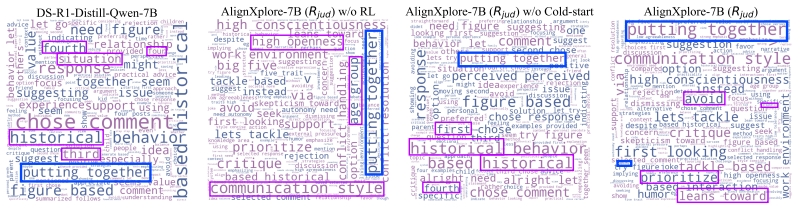
- [§4.6, Figure 5] The word clouds are described as showing 'frequently occurring words,' but no quantitative measure (e.g., TF-IDF threshold or word frequency cutoff) is given. Adding the exact criteria for inclusion in the word cloud would make the qualitative claim more reproducible.
Circularity Check
Primary offline gains are measured with the same Qwen2.5-7B-Instruct judge used for cold-start filtering and as the RL reward; external checks prevent full circularity.
-
fitted input called prediction
[Section 3.1 Eq. 7; Section 3.2 Eq. 8; Section 3.3 Eq. 10; Section 4.1; Table 2]
"In our main experiments, we primarily use Rjud for both training and evaluation, while analyzing Rgen in subsequent ablation studies."
Eq. 7 instantiates Rjud as a preference-judge reward. Eq. 8 filters cold-start data by R(ri,di)=1, and the GRPO objective in Eqs. 10-12 uses Ri computed from Eq. 7 as the RL reward. The paper's primary offline metric is Accjud, reported in Table 2 'using Qwen2.5-7B-Instruct as the preference judging model,' and Section 4.1 states 'We primarily focus on Accjud as it aligns with our training objective.' Thus AlignXplore is trained, via data filtering and RL, to maximize the exact judge score that constitutes the headline metric. The claimed 15.49% improvement over the backbone therefore reduces, by construction, to better optimization of this particular judge's preferences rather than necessarily better inductive preference inference.
full rationale
The paper has one central circular loop: the same preference-judging reward is used for synthetic-data filtering (Eq. 8), RL optimization (Eqs. 10-12), and the primary evaluation metric (Table 2, Accjud). Because the headline offline numbers are computed with the same Qwen2.5-7B-Instruct judge that supplies the training reward, the reported gains are partly a comparison between a model optimized on that judge and a backbone that was not, so the improvement could reflect judge overfitting rather than general preference inference. This is not, however, a fully self-referential derivation: the paper also reports GPT-4 pairwise win rates (Table 3), cross-model judging with QwQ-32B and DeepSeek-R1 (Table 4), the out-of-domain P-SOUPS benchmark, and preference-reversal robustness tests, none of which were used as RL rewards. The reuse of the authors' ALIGNX benchmark [38] is a normal dataset citation and is mitigated by the independent P-SOUPS evaluation. Appendix C also concedes the absence of a real-user test platform. On balance, one load-bearing evaluation loop is circular, but external checks keep the contribution from entirely reducing to the judge, so the score is 6 rather than higher.
Assumptions & free parameters
free parameters (3)
- Data consistency filter thresholds =
at least 5 preference dimensions; no conflicting preference directions
- Number of behavioral signals per round (T=4) =
4
- Reward filter threshold for cold-start data =
R(r,d)=1 only
assumptions (5)
- domain assumption User preferences are adequately represented by pairwise comparative judgments (preferred vs rejected responses) in the training and test sets.
- domain assumption The fixed judge model Qwen2.5-7B-Instruct's preference scores are a valid proxy for human preference alignment.
- ad hoc to paper The key preference dimensions phi used to prompt the teacher are known and supplied in advance.
- domain assumption Teacher-generated reasoning chains filtered by the reward constitute valid demonstrations of inductive preference inference.
- domain assumption GRPO without KL penalty is a safe optimization choice.
Cite this review
Pith. "Pith review of Extended Inductive Reasoning for Personalized Preference Inference from Behavioral Signals." pith.science (2026). https://pith.science/paper/LFDEA7LI
@misc{pith2026250518071,
  author       = {Pith},
  title        = {Pith review of: Extended Inductive Reasoning for Personalized Preference Inference from Behavioral Signals},
  year         = {2026},
  howpublished = {\url{https://pith.science/paper/LFDEA7LI}},
  note         = {Machine review of arXiv:2505.18071}
}
read the original abstract
Large language models (LLMs) have demonstrated significant success in complex reasoning tasks such as math and coding. In contrast to these tasks where deductive reasoning predominates, inductive reasoning-the ability to derive general rules from incomplete evidence, remains underexplored. This paper investigates extended inductive reasoning in LLMs through the lens of personalized preference inference, a critical challenge in LLM alignment where current approaches struggle to capture diverse user preferences. The task demands strong inductive reasoning capabilities as user preferences are typically embedded implicitly across various interaction forms, requiring models to synthesize consistent preference patterns from scattered signals. We propose AlignXplore, a model that leverages extended reasoning chains to enable systematic preference inference from behavioral signals in users' interaction histories. Such explicit preference articulation enables efficient streaming inference: when new behavioral signals emerge, the model can directly build upon previously inferred preference descriptions rather than reprocessing historical signals from scratch, while also supporting iterative refinement to the inferred preferences. We develop AlignXplore by combining cold-start training based on synthetic data with subsequent online reinforcement learning. Through extensive experiments, we demonstrate that AlignXplore achieves substantial improvements over the backbone model by an average of 15.49\% on in-domain and out-of-domain benchmarks, while maintaining strong generalization ability across different input formats and downstream models. Further analyses establish best practices for preference inference learning through systematic comparison of reward modeling strategies, while revealing the emergence of human-like inductive reasoning patterns during training.
Figures


Figures from the paper (3 more)


Reference graph
Works this paper leans on
-
[1]
Josh Achiam, Steven Adler, Sandhini Agarwal, Lama Ahmad, Ilge Akkaya, Florencia Leoni Aleman, Diogo Almeida, Janko Altenschmidt, Sam Altman, Shyamal Anadkat, et al. Gpt-4 technical report. arXiv preprint arXiv:2303.08774, 2023
arXiv 2023
-
[2]
A general language assistant as a laboratory for alignment
Amanda Askell, Yuntao Bai, Anna Chen, Dawn Drain, Deep Ganguli, Tom Henighan, Andy Jones, Nicholas Joseph, Ben Mann, Nova DasSarma, et al. A general language assistant as a laboratory for alignment. arXiv preprint arXiv:2112.00861, 2021. 11
arXiv 2021
-
[3]
Training a helpful and harmless assistant with reinforcement learning from human feedback
Yuntao Bai, Andy Jones, Kamal Ndousse, Amanda Askell, Anna Chen, Nova DasSarma, Dawn Drain, Stanislav Fort, Deep Ganguli, Tom Henighan, et al. Training a helpful and harmless assistant with reinforcement learning from human feedback. arXiv preprint arXiv:2204.05862, 2022
arXiv 2022
-
[4]
Language models are few-shot learners
Tom Brown, Benjamin Mann, Nick Ryder, Melanie Subbiah, Jared D Kaplan, Prafulla Dhariwal, Arvind Neelakantan, Pranav Shyam, Girish Sastry, Amanda Askell, et al. Language models are few-shot learners. Advances in neural information processing systems, 33:1877–1901, 2020
1901
-
[5]
Modeling individual preference evolution and choice in a dynamic group setting
Murali Chandrashekaran, Beth A Walker, James C Ward, and Peter H Reingen. Modeling individual preference evolution and choice in a dynamic group setting. Journal of Marketing Research, 33(2):211–223, 1996
1996
-
[6]
PAL: Sample- efficient personalized reward modeling for pluralistic alignment
Daiwei Chen, Yi Chen, Aniket Rege, Zhi Wang, and Ramya Korlakai Vinayak. PAL: Sample- efficient personalized reward modeling for pluralistic alignment. InThe Thirteenth International Conference on Learning Representations, 2025
2025
-
[7]
Mark Chen, Jerry Tworek, Heewoo Jun, Qiming Yuan, Henrique Ponde de Oliveira Pinto, Jared Kaplan, Harri Edwards, Yuri Burda, Nicholas Joseph, Greg Brockman, Alex Ray, Raul Puri, Gretchen Krueger, Michael Petrov, Heidy Khlaaf, Girish Sastry, Pamela Mishkin, Brooke Chan, Scott Gray, Nick Ryder, Mikhail Pavlov, Alethea Power, Lukasz Kaiser, Mohammad Bavarian...
2021
-
[8]
Towards reasoning era: A survey of long chain-of-thought for reasoning large language models
Qiguang Chen, Libo Qin, Jinhao Liu, Dengyun Peng, Jiannan Guan, Peng Wang, Mengkang Hu, Yuhang Zhou, Te Gao, and Wanxiang Che. Towards reasoning era: A survey of long chain-of-thought for reasoning large language models. arXiv preprint arXiv:2503.09567, 2025
arXiv 2025
Show all 110 references
-
[9]
Rm-r1: Reward modeling as reasoning, 2025
Xiusi Chen, Gaotang Li, Ziqi Wang, Bowen Jin, Cheng Qian, Yu Wang, Hongru Wang, Yu Zhang, Denghui Zhang, Tong Zhang, Hanghang Tong, and Heng Ji. Rm-r1: Reward modeling as reasoning, 2025
2025
-
[10]
On the measure of intelligence
François Chollet. On the measure of intelligence. arXiv preprint arXiv:1911.01547, 2019
1911 arXiv
-
[11]
Flashattention-2: Faster attention with better parallelism and work partitioning
Tri Dao. Flashattention-2: Faster attention with better parallelism and work partitioning. arXiv preprint arXiv:2307.08691, 2023
2023 arXiv
-
[12]
Deepseek-r1: Incentivizing reasoning capability in llms via reinforcement learning, 2025
DeepSeek-AI. Deepseek-r1: Incentivizing reasoning capability in llms via reinforcement learning, 2025
2025
-
[13]
Hierarchical neural story generation
Angela Fan, Mike Lewis, and Yann Dauphin. Hierarchical neural story generation. In Proceedings of the 56th Annual Meeting of the Association for Computational Linguistics (V olume1: Long Papers), pages 889–898, 2018
2018
-
[14]
Children’s learning and transfer of inductive reasoning rules: Studies of proximal development
Roberta A Ferrara, Ann L Brown, and Joseph C Campione. Children’s learning and transfer of inductive reasoning rules: Studies of proximal development. Child development, pages 1087–1099, 1986
1986
-
[15]
Theodoropoulos, and Neil R
Jan-Philipp Fränken, Nikos C. Theodoropoulos, and Neil R. Bramley. Algorithms of adaptation in inductive inference. Cognitive Psychology, 137:101506, 2022
2022
-
[16]
Cognitive behaviors that enable self-improving reasoners, or, four habits of highly effective stars
Kanishk Gandhi, Ayush Chakravarthy, Anikait Singh, Nathan Lile, and Noah D Goodman. Cognitive behaviors that enable self-improving reasoners, or, four habits of highly effective stars. arXiv preprint arXiv:2503.01307, 2025
2025 arXiv
-
[17]
Generative adversarial nets
Ian Goodfellow, Jean Pouget-Abadie, Mehdi Mirza, Bing Xu, David Warde-Farley, Sherjil Ozair, Aaron Courville, and Yoshua Bengio. Generative adversarial nets. In Advances in neural information processing systems, pages 2672–2680, 2014. 12
2014
-
[18]
A survey on personalized alignment – the missing piece for large language models in real-world applications, 2025
Jian Guan, Junfei Wu, Jia-Nan Li, Chuanqi Cheng, and Wei Wu. A survey on personalized alignment – the missing piece for large language models in real-world applications, 2025
2025
-
[19]
AMOR: A recipe for building adaptable modular knowledge agents through process feedback
Jian Guan, Wei Wu, zujie wen, Peng Xu, Hongning Wang, and Minlie Huang. AMOR: A recipe for building adaptable modular knowledge agents through process feedback. In The Thirty-eighth Annual Conference on Neural Information Processing Systems, 2024
2024
-
[20]
Training large language models to reason in a continuous latent space, 2024
Shibo Hao, Sainbayar Sukhbaatar, DiJia Su, Xian Li, Zhiting Hu, Jason Weston, and Yuandong Tian. Training large language models to reason in a continuous latent space, 2024
2024
-
[21]
Inductive reasoning
Brett K Hayes, Evan Heit, and Haruka Swendsen. Inductive reasoning. Wiley interdisciplinary reviews: Cognitive science, 1(2):278–292, 2010
2010
-
[22]
Properties of inductive reasoning
Evan Heit. Properties of inductive reasoning. Psychonomic bulletin & review, 7:569–592, 2000
2000
-
[23]
Induction: Processes of inference, learning, and discovery
John H Holland. Induction: Processes of inference, learning, and discovery. MIT press, 1986
1986
-
[24]
The curious case of neural text degeneration
Ari Holtzman, Jan Buys, Li Du, Maxwell Forbes, and Yejin Choi. The curious case of neural text degeneration. In International Conference on Learning Representations, 2020
2020
-
[25]
Open-reasoner-zero: An open source approach to scaling up reinforcement learning on the base model, 2025
Jingcheng Hu, Yinmin Zhang, Qi Han, Daxin Jiang, Xiangyu Zhang, and Heung-Yeung Shum. Open-reasoner-zero: An open source approach to scaling up reinforcement learning on the base model, 2025
2025
-
[26]
Livecodebench: Holistic and contamination free evaluation of large language models for code
Naman Jain, King Han, Alex Gu, Wen-Ding Li, Fanjia Yan, Tianjun Zhang, Sida Wang, Ar- mando Solar-Lezama, Koushik Sen, and Ion Stoica. Livecodebench: Holistic and contamination free evaluation of large language models for code. In The Thirteenth International Conference on Lea...
-
[27]
Personalized soups: Per- sonalized large language model alignment via post-hoc parameter merging
Joel Jang, Seungone Kim, Bill Yuchen Lin, Yizhong Wang, Jack Hessel, Luke Zettlemoyer, Hannaneh Hajishirzi, Yejin Choi, and Prithviraj Ammanabrolu. Personalized soups: Per- sonalized large language model alignment via post-hoc parameter merging. arXiv preprint arXiv:2310.11564, 2023
-
[28]
Other solutions to nash’s bargaining problem.Econometrica: Journal of the Econometric Society, pages 513–518, 1975
Ehud Kalai and Meir Smorodinsky. Other solutions to nash’s bargaining problem.Econometrica: Journal of the Econometric Society, pages 513–518, 1975
1975
-
[29]
Do llms understand user preferences? evaluating llms on user rating prediction
Wang-Cheng Kang, Jianmo Ni, Nikhil Mehta, Maheswaran Sathiamoorthy, Lichan Hong, Ed Chi, and Derek Zhiyuan Cheng. Do llms understand user preferences? evaluating llms on user rating prediction. arXiv preprint arXiv:2305.06474, 2023
2023 arXiv
-
[30]
Adam: A method for stochastic optimization
Diederik P Kingma. Adam: A method for stochastic optimization. arXiv preprint arXiv:1412.6980, 2014
2014 arXiv
-
[31]
Cognitive trait modelling: The case of inductive reasoning ability
Kinshuk, Taiyu Lin, and Paul McNab. Cognitive trait modelling: The case of inductive reasoning ability. Innovations in Education and Teaching International, 43(2):151–161, 2006
2006
-
[32]
Hannah Rose Kirk, Andrew Michael Bean, Bertie Vidgen, Paul Rottger, and Scott A. Hale. The past, present and better future of feedback learning in large language models for subjective human preferences and values. In The 2023 Conference on Empirical Methods in Natural Language...
2023
-
[33]
Federatedscope-llm: A comprehensive package for fine-tuning large language models in federated learning
Weirui Kuang, Bingchen Qian, Zitao Li, Daoyuan Chen, Dawei Gao, Xuchen Pan, Yuexiang Xie, Yaliang Li, Bolin Ding, and Jingren Zhou. Federatedscope-llm: A comprehensive package for fine-tuning large language models in federated learning. In Proceedings of the 30th ACM SIGKDD Co...
2024
-
[34]
Compo: Community preferences for language model personalization
Sachin Kumar, Chan Young Park, Yulia Tsvetkov, Noah A Smith, and Hannaneh Ha- jishirzi. Compo: Community preferences for language model personalization. arXiv preprint arXiv:2410.16027, 2024
2024 arXiv
-
[35]
Lake, Tomer D
Brenden M. Lake, Tomer D. Ullman, Joshua B. Tenenbaum, and Samuel J. Gershman. Building machines that learn and think like people. Behavioral and Brain Sciences, 40:e253, 2017. 13
2017
-
[36]
In-context reinforcement learning with algorithm distillation
Michael Laskin, Luyu Wang, Junhyuk Oh, Emilio Parisotto, Stephen Spencer, Richie Steiger- wald, DJ Strouse, Steven Stenberg Hansen, Angelos Filos, Ethan Brooks, maxime gazeau, Himanshu Sahni, Satinder Singh, and V olodymyr Mnih. In-context reinforcement learning with algorithm...
2023
-
[37]
Aligning to thousands of preferences via system message generalization
Seongyun Lee, Sue Hyun Park, Seungone Kim, and Minjoon Seo. Aligning to thousands of preferences via system message generalization. arXiv preprint arXiv:2405.17977, 2024
2024 arXiv
-
[38]
From 1,000,000 users to every user: Scaling up personalized preference for user-level alignment, 2025
Jia-Nan Li, Jian Guan, Songhao Wu, Wei Wu, and Rui Yan. From 1,000,000 users to every user: Scaling up personalized preference for user-level alignment, 2025
2025
-
[39]
Let’s verify step by step
Hunter Lightman, Vineet Kosaraju, Yura Burda, Harri Edwards, Bowen Baker, Teddy Lee, Jan Leike, John Schulman, Ilya Sutskever, and Karl Cobbe. Let’s verify step by step. arXiv preprint arXiv:2305.20050, 2023
2023 arXiv
-
[40]
Simpo: Simple preference optimization with a reference-free reward
Yu Meng, Mengzhou Xia, and Danqi Chen. Simpo: Simple preference optimization with a reference-free reward. arXiv preprint arXiv:2405.14734, 2024
2024 arXiv
-
[41]
The link between deductive reasoning and mathematics
Kinga Morsanyi, Teresa McCormack, and Eileen O’Mahony. The link between deductive reasoning and mathematics. Thinking & Reasoning, 24(2):234–257, 2018
2018
-
[42]
The con- ceptARC benchmark: Evaluating understanding and generalization in the ARC domain
Arsenii Kirillovich Moskvichev, Victor Vikram Odouard, and Melanie Mitchell. The con- ceptARC benchmark: Evaluating understanding and generalization in the ARC domain. Transactions on Machine Learning Research, 2023
2023
-
[43]
User-llm: Efficient llm contextualization with user embeddings
Lin Ning, Luyang Liu, Jiaxing Wu, Neo Wu, Devora Berlowitz, Sushant Prakash, Bradley Green, Shawn O’Banion, and Jun Xie. User-llm: Efficient llm contextualization with user embeddings. arXiv preprint arXiv:2402.13598, 2024
2024 arXiv
-
[44]
Learning and sustaining shared normative systems via bayesian rule induction in markov games
Ninell Oldenburg and Tan Zhi-Xuan. Learning and sustaining shared normative systems via bayesian rule induction in markov games. In Proceedings of the 23rd International Conference on Autonomous Agents and Multiagent Systems, pages 1510–1520, 2024
2024
-
[45]
Introducing openai o1-preview
OpenAI. Introducing openai o1-preview. https://openai.com/index/ introducing-openai-o1-preview/ , 2024
2024
-
[46]
Training language models to follow instructions with human feedback
Long Ouyang, Jeffrey Wu, Xu Jiang, Diogo Almeida, Carroll Wainwright, Pamela Mishkin, Chong Zhang, Sandhini Agarwal, Katarina Slama, Alex Ray, et al. Training language models to follow instructions with human feedback. Advances in neural information processing systems, 35:2773...
2022
-
[47]
Vicky Zhao, Lili Qiu, and Jianfeng Gao
Zhuoshi Pan, Qianhui Wu, Huiqiang Jiang, Xufang Luo, Hao Cheng, Dongsheng Li, Yuqing Yang, Chin-Yew Lin, H. Vicky Zhao, Lili Qiu, and Jianfeng Gao. Secom: On memory construction and retrieval for personalized conversational agents. InThe Thirteenth International Conference on ...
2025
-
[48]
Understanding and benchmarking artificial intelligence: Openai’s o3 is not agi, 2025
Rolf Pfister and Hansueli Jud. Understanding and benchmarking artificial intelligence: Openai’s o3 is not agi, 2025
2025
-
[49]
Personal- izing reinforcement learning from human feedback with variational preference learning
Sriyash Poddar, Yanming Wan, Hamish Ivison, Abhishek Gupta, and Natasha Jaques. Personal- izing reinforcement learning from human feedback with variational preference learning. arXiv preprint arXiv:2408.10075, 2024
2024 arXiv
-
[50]
Phenomenal yet puzzling: Testing inductive reasoning capabilities of language models with hypothesis refinement
Linlu Qiu, Liwei Jiang, Ximing Lu, Melanie Sclar, Valentina Pyatkin, Chandra Bhagavatula, Bailin Wang, Yoon Kim, Yejin Choi, Nouha Dziri, and Xiang Ren. Phenomenal yet puzzling: Testing inductive reasoning capabilities of language models with hypothesis refinement. In The Twel...
2024
-
[51]
Improving language understanding with unsupervised learning
Alec Radford, Karthik Narasimhan, Tim Salimans, and Ilya Sutskever. Improving language understanding with unsupervised learning. 2018
2018
-
[52]
Direct preference optimization: Your language model is secretly a reward model
Rafael Rafailov, Archit Sharma, Eric Mitchell, Christopher D Manning, Stefano Ermon, and Chelsea Finn. Direct preference optimization: Your language model is secretly a reward model. Advances in Neural Information Processing Systems, 36, 2024. 14
2024
-
[53]
Zero: Memory optimiza- tions toward training trillion parameter models
Samyam Rajbhandari, Jeff Rasley, Olatunji Ruwase, and Yuxiong He. Zero: Memory optimiza- tions toward training trillion parameter models. In SC20: International Conference for High Performance Computing, Networking, Storage and Analysis, pages 1–16. IEEE, 2020
2020
-
[54]
Rewarded soups: towards pareto-optimal alignment by interpolating weights fine-tuned on diverse rewards
Alexandre Rame, Guillaume Couairon, Corentin Dancette, Jean-Baptiste Gaya, Mustafa Shukor, Laure Soulier, and Matthieu Cord. Rewarded soups: towards pareto-optimal alignment by interpolating weights fine-tuned on diverse rewards. In Thirty-seventh Conference on Neural Informat...
2023
-
[55]
Gpqa: A graduate-level google-proof q&a benchmark
David Rein, Betty Li Hou, Asa Cooper Stickland, Jackson Petty, Richard Yuanzhe Pang, Julien Dirani, Julian Michael, and Samuel R Bowman. Gpqa: A graduate-level google-proof q&a benchmark. In First Conference on Language Modeling, 2024
2024
-
[56]
Vlm-r1: A stable and generalizable r1-style large vision-language model
Haozhan Shen, Peng Liu, Jingcheng Li, Chunxin Fang, Yibo Ma, Jiajia Liao, Qiaoli Shen, Zilun Zhang, Kangjia Zhao, Qianqian Zhang, et al. Vlm-r1: A stable and generalizable r1-style large vision-language model. arXiv preprint arXiv:2504.07615, 2025
2025 arXiv
-
[57]
Decoding-time language model alignment with multiple objectives
Ruizhe Shi, Yifang Chen, Yushi Hu, Alisa Liu, Hannaneh Hajishirzi, Noah A Smith, and Simon S Du. Decoding-time language model alignment with multiple objectives. arXiv preprint arXiv:2406.18853, 2024
2024 arXiv
-
[58]
Distributional prefer- ence learning: Understanding and accounting for hidden context in RLHF
Anand Siththaranjan, Cassidy Laidlaw, and Dylan Hadfield-Menell. Distributional prefer- ence learning: Understanding and accounting for hidden context in RLHF. In The Twelfth International Conference on Learning Representations, 2024
2024
-
[59]
Scaling LLM test-time com- pute optimally can be more effective than scaling parameters for reasoning
Charlie Victor Snell, Jaehoon Lee, Kelvin Xu, and Aviral Kumar. Scaling LLM test-time com- pute optimally can be more effective than scaling parameters for reasoning. In The Thirteenth International Conference on Learning Representations, 2025
2025
-
[60]
Democra- tizing large language models via personalized parameter-efficient fine-tuning
Zhaoxuan Tan, Qingkai Zeng, Yijun Tian, Zheyuan Liu, Bing Yin, and Meng Jiang. Democra- tizing large language models via personalized parameter-efficient fine-tuning. arXiv preprint arXiv:2402.04401, 2024
2024 arXiv
-
[61]
Qwen2.5: A party of foundation models, September 2024
Qwen Team. Qwen2.5: A party of foundation models, September 2024
2024
-
[62]
Qwq-32b: Embracing the power of reinforcement learning, March 2025
Qwen Team. Qwq-32b: Embracing the power of reinforcement learning, March 2025
2025
-
[63]
Exclusive: Chatgpt traffic slips again for third month in a row
A Tong. Exclusive: Chatgpt traffic slips again for third month in a row. reuters, 2023
2023
-
[64]
Planning in natural language improves llm search for code generation
Evan Z Wang, Federico Cassano, Catherine Wu, Yunfeng Bai, William Song, Vaskar Nath, Ziwen Han, Sean M Hendryx, Summer Yue, and Hugh Zhang. Planning in natural language improves llm search for code generation. In The First Workshop on System-2 Reasoning at Scale, NeurIPS’24, 2024
2024
-
[65]
Hypothesis search: Inductive reasoning with language models
Ruocheng Wang, Eric Zelikman, Gabriel Poesia, Yewen Pu, Nick Haber, and Noah Goodman. Hypothesis search: Inductive reasoning with language models. In The Twelfth International Conference on Learning Representations, 2024
2024
-
[66]
Chain-of-thought prompting elicits reasoning in large language models
Jason Wei, Xuezhi Wang, Dale Schuurmans, Maarten Bosma, Fei Xia, Ed Chi, Quoc V Le, Denny Zhou, et al. Chain-of-thought prompting elicits reasoning in large language models. Advances in neural information processing systems, 35:24824–24837, 2022
2022
-
[67]
Codeplan: Unlocking reasoning potential in large language models by scaling code-form planning
Jiaxin Wen, Jian Guan, Hongning Wang, Wei Wu, and Minlie Huang. Codeplan: Unlocking reasoning potential in large language models by scaling code-form planning. In The Thirteenth International Conference on Learning Representations, 2025
2025
-
[68]
Fung, Cheng Qian, Jeonghwan Kim, Dilek Hakkani-Tur, and Heng Ji
Shujin Wu, Yi R. Fung, Cheng Qian, Jeonghwan Kim, Dilek Hakkani-Tur, and Heng Ji. Aligning LLMs with individual preferences via interaction. In Owen Rambow, Leo Wanner, Marianna Apidianaki, Hend Al-Khalifa, Barbara Di Eugenio, and Steven Schockaert, editors, Proceedings of the...
2025
-
[69]
Beyond goldfish memory: Long-term open- domain conversation
Jing Xu, Arthur Szlam, and Jason Weston. Beyond goldfish memory: Long-term open- domain conversation. In Smaranda Muresan, Preslav Nakov, and Aline Villavicencio, editors, Proceedings of the 60th Annual Meeting of the Association for Computational Linguistics (V olume1: Long P...
2022
-
[70]
Mir-bench: Benchmarking llm’s long-context intelligence via many-shot in-context inductive reasoning
Kai Yan, Zhan Ling, Kang Liu, Yifan Yang, Ting-Han Fan, Lingfeng Shen, Zhengyin Du, and Jiecao Chen. Mir-bench: Benchmarking llm’s long-context intelligence via many-shot in-context inductive reasoning. In Workshop on Reasoning and Planning for Large Language Models
-
[71]
Qwen3 technical report, 2025
An Yang, Anfeng Li, Baosong Yang, Beichen Zhang, Binyuan Hui, Bo Zheng, Bowen Yu, Chang Gao, Chengen Huang, Chenxu Lv, Chujie Zheng, Dayiheng Liu, Fan Zhou, Fei Huang, Feng Hu, Hao Ge, Haoran Wei, Huan Lin, Jialong Tang, Jian Yang, Jianhong Tu, Jianwei Zhang, Jianxin Yang, Jia...
2025
-
[72]
Tree of thoughts: Deliberate problem solving with large language models
Shunyu Yao, Dian Yu, Jeffrey Zhao, Izhak Shafran, Tom Griffiths, Yuan Cao, and Karthik Narasimhan. Tree of thoughts: Deliberate problem solving with large language models. Advances in Neural Information Processing Systems, 36, 2024
2024
-
[73]
Dapo: An open-source llm reinforcement learning system at scale
Qiying Yu, Zheng Zhang, Ruofei Zhu, Yufeng Yuan, Xiaochen Zuo, Yu Yue, Tiantian Fan, Gaohong Liu, Lingjun Liu, Xin Liu, et al. Dapo: An open-source llm reinforcement learning system at scale. arXiv preprint arXiv:2503.14476, 2025
2025 arXiv
-
[74]
Rest-mcts*: Llm self-training via process reward guided tree search
Dan Zhang, Sining Zhoubian, Ziniu Hu, Yisong Yue, Yuxiao Dong, and Jie Tang. Rest-mcts*: Llm self-training via process reward guided tree search. Advances in Neural Information Processing Systems, 37:64735–64772, 2024
2024
-
[75]
User-centric conversational recommendation: Adapting the need of user with large language models
Gangyi Zhang. User-centric conversational recommendation: Adapting the need of user with large language models. In Proceedings of the 17th ACM Conference on Recommender Systems, RecSys ’23, page 1349–1354, New York, NY , USA, 2023. Association for Computing Machinery
2023
-
[76]
Personalizing dialogue agents: I have a dog, do you have pets too? arXiv preprint arXiv:1801.07243, 2018
Saizheng Zhang, Emily Dinan, Jack Urbanek, Arthur Szlam, Douwe Kiela, and Jason We- ston. Personalizing dialogue agents: I have a dog, do you have pets too? arXiv preprint arXiv:1801.07243, 2018
2018 arXiv
-
[77]
Do LLMs recognize your preferences? evaluating personalized preference following in LLMs
Siyan Zhao, Mingyi Hong, Yang Liu, Devamanyu Hazarika, and Kaixiang Lin. Do LLMs recognize your preferences? evaluating personalized preference following in LLMs. In The Thirteenth International Conference on Learning Representations, 2025
2025
-
[78]
pair-wise comparative feedback
Lianmin Zheng, Wei-Lin Chiang, Ying Sheng, Siyuan Zhuang, Zhanghao Wu, Yonghao Zhuang, Zi Lin, Zhuohan Li, Dacheng Li, Eric Xing, et al. Judging llm-as-a-judge with mt-bench and chatbot arena. Advances in Neural Information Processing Systems, 36:46595–46623, 2023. A Experimen...
2023
-
[79]
My girlfriend[22] and I[22] decided to go away somewhat last minute
Post: Sorry for format on mobile etc. My girlfriend[22] and I[22] decided to go away somewhat last minute. It 's our first trip together. We're away in France, not far from Lille. We decided to get an apartment on Airbnb, it was inexpensive and so beautiful. It was perfect. Ex...
-
[80]
oh, I dig this chick
Post: So, I'm a 21yo bisexual (maybe pansexual? I 'm completely open to it but haven't really met or talked to someone to know), living in the Chicago area. I realized and have been out as bisexual since I was 17. I've slept with women, and I hate to admit it because of the 5 ...
-
[81]
I don't think teenage/20s years are the peak of your life
Post: As a 20 year old, it made me sad to see so many of you calling yourself old! Not that that's a bad thing. I don't think teenage/20s years are the peak of your life. I was having this conversation with my ex girlfriend (yeah...I know) the other day and she said this is a ...
1940
-
[82]
inability to keep up with changes
Post: My boss, after ghosting me for two weeks, fired me over text this morning. She was fine when I came out to her, but after discovering that I'd actually take medication to change my body, she's hated me. I worked with kids so she was always afraid I'd corrupt their minds....
-
[83]
Prefers pragmatic solutions over elaborate suggestions (rejects verbose advice but values empathy)
Personality Traits (Big Five): • Openness: Moderately low/high. Prefers pragmatic solutions over elaborate suggestions (rejects verbose advice but values empathy). • Agreeableness: High. Chooses supportive, compassionate language and priori- tizes interpersonal harmony
-
[84]
Resists reliance on external ad- vice/influences (rejects complex dating tips, favors personal intuition)
Core Psychological Needs: • Need for Autonomy: Very pronounced. Resists reliance on external ad- vice/influences (rejects complex dating tips, favors personal intuition). Seeks self-determined pathways amidst stress/anxiety. • Workplace Safety: Strong advocacy for inclusive wo...
-
[85]
• Avoidant Conflict Resolution: Tends to sidestep contentious topics (e.g., avoids discussing workplace discrimination head-on except when validating feelings)
Social Interaction Styles: • Directness + Empathy: Communicates concisely yet sincerely, balancing honesty with sensitivity (chooses brief affirmation vs verbose explanations/re- jections). • Avoidant Conflict Resolution: Tends to sidestep contentious topics (e.g., avoids disc...
-
[86]
• Personal fulfillment tied to overcoming vulnerabilities (mental health improve- ment linked to traveling away for escape)
Legal Awareness & Personal Achievement: • A conscious awareness of legal frameworks influencing life decisions (aware of EEOC protections but leans on communal solidarity). • Personal fulfillment tied to overcoming vulnerabilities (mental health improve- ment linked to traveli...
-
[87]
people near the border
Work Environment Needs: • Thrives in transparent, equitable workplaces aligned with individual values (supports LGBTQ+ rights legislation advocacy). </answer> 24 Preference Generated by ALIGN XPLORE -7B under Base Setting Okay, let’s start breaking down these interactions to f...
-
[88]
Thanks, that's nice of you
Emotional Support Over Detailed Advice: - Prefers empathetic affirmations (e.g., "Thanks, that's nice of you" vs lengthy guides on legal processes)
-
[89]
un bon gros fdp
Contextual Humor/Social Awareness: - Chooses politically relevant observations (border regions) over blunt humor ("un bon gros fdp")
-
[90]
be sincere
Direct Empathy Without Overexplanation: - Selects compassionate statements focusing on connection ("be sincere"), rejects verbose explanations (flirting tips, "let me help")
-
[91]
Personality Traits Alignment: - Low openness to abstract concepts (preferring straightfor- ward empathy)
Privacy Focus: - Avoids overly personal/critical content, opting for platonic solidarity (volunteering at health centers, "stealth" strategy). Personality Traits Alignment: - Low openness to abstract concepts (preferring straightfor- ward empathy). - High agreeableness (priori...
-
[92]
• They often choose to offer comfort, support, and validation to others going through similar struggles, showing empathy and a supportive nature
Support for LGBTQ+ Community: • The user frequently engages with posts and comments related to the LGBTQ+ community, especially regarding trans issues, relationships, and personal expe- riences. • They often choose to offer comfort, support, and validation to others going thro...
-
[93]
• They are open to receiving and giving advice, showing a willingness to engage in meaningful conversations that can help others
Interest in Personal Development and Self-Improvement: • The user seeks advice and guidance on personal issues such as dealing with ex-partners, coming out, and navigating family and social relationships. • They are open to receiving and giving advice, showing a willingness to...
-
[94]
They appreciate kind words and genuine responses
Emotional Support: 25 • The user often chooses comments that provide emotional support, validation, and encouragement. They appreciate kind words and genuine responses. • They tend to avoid confrontational or dismissive comments, preferring to offer understanding and empathy
-
[95]
• They are likely to be aware of and respectful of different gender identities and pronouns
Sensitivity to Pronouns and Gender Issues: • The user demonstrates sensitivity to pronoun usage and gender issues, often choosing comments that reflect understanding and support for trans individuals. • They are likely to be aware of and respectful of different gender identiti...
-
[96]
• They seem to be seeking validation and advice on how to navigate relationships, both romantic and platonic
Struggle with Intimacy and Relationships: • The user frequently mentions difficulties with intimacy, relationships, and sexual experiences, indicating a need for support and guidance in these areas. • They seem to be seeking validation and advice on how to navigate relationshi...
-
[97]
Un bon gros fdp en somme
Interest in Sexual Health and Consent: • The user shows an interest in sexual health and consent, discussing sensitive topics such as sexual experiences and boundaries. • They value explicit and honest communication in relationships, showing a preference for clear and respectf...
-
[101]
Thanks”, “Sorry
Need for Quick Validation: Prefers brief affirmations (“Thanks”, “Sorry”) over prolonged discussions. These preferences suggest a tendency for concise communication, valuing immediacy and vulnerability, while shunning complexity or prolonged guidance. </answer> Prompt for Upda...
-
[102]
I live 20 mins
Brevity: Chooses shorter, punchier remarks (e.g., “I live 20 mins...”, “Thanks!”) over lengthier explanations
-
[103]
Empathy Over Detail: Prioritizes relatable context (regional bias, shared struggles) rather than offering structured solutions
-
[104]
Avoidance of Sarcasm/Judgment: Rejected responses contained irony or negativity (dark humor, legal jargon-heavy advice)
-
[105]
Thanks”, “Sorry
Need for Quick Validation: Prefers brief affirmations (“Thanks”, “Sorry”) over prolonged discussions. These preferences suggest a tendency for concise communication, valuing immediacy and vulnerability, while shunning complexity or prolonged guidance. This person has chosen or...
-
[106]
Post: This is just a vent and, of course, it’s not directed to my lovely spouse, since she’s supportive and great. Still, it bothers me so much that people have such a hard time respecting my pronouns, yet as soon as she came out, everybody started 27 using her name and pronou...
-
[107]
you know how SHE is, SHE was just venting
Post: she said she is gonna support me if i think im trans (in her words) for much longer, but said im not allowed a haircut because i will hate myself more apparently. how the fuck do i even react to this? she makes these random suggestions based off of her own knowledge rath...
-
[108]
I need to warm up with lots of touching and kissing and teasing and I need a feather light touch to get me going
Post: So I am bi. Have always been more attracted to women than men. Sometimes I wonder am I gay? Who knows. I ´ll figure it out. Some background about me: I haven´t been able to meet a woman to date long term. I have mostly only hooked up with women one night stand style, or ...
-
[109]
I ´m ok with gay people ... Just don´t shove it in my face
Post: A little rant. My dad said that to me recently. I came out to him like 2 years ago. He said he was ok with me being gay after a week of not talking to me after I came out to him. What I ´m wondering is how he´d feel when I´d get a girlfriend (I never had dated yet. I jus...
-
[110]
Same situation
Brevity: Selects brief, relatable anecdotes (e.g., “Same situation”). Rejects ver- bose/detailed suggestions
-
[111]
Sad- dest part was when my little 4-year-old nephew
Empathy-driven validation: Chooses responses acknowledging pain (e.g., “Sad- dest part was when my little 4-year-old nephew...”) instead of analytical critiques
-
[112]
Avoidance of judgment/negative framing: Dismisses sarcastic remarks (“dumb”), ironic questions, or framing problems as moral failures
-
[113]
selection
Value for brevity: Prefers unadorned affirmations (“Thanks!”) over elaborated guidance. These choices reflect a preference for empathetic, unstructured solidarity over structured problem-solving, emphasizing immediacy and emotional authenticity in communication. </answer> B Da...
Reviewed August 7, 2026 · model on record in the stance chip above.
Discussion (0). Sign in to comment.