REVIEW 2 major objections 5 minor 1 cited by
On the $3D$ consistency of a Grassmann extended lattice Boussinesq system
T0 review · 2 major / 5 minor · reviewed 2026-08-14 · deepseek-v4-flash
Pith's one-line read The paper establishes that a Grassmann (anticommuting-variable) extension of a lattice Boussinesq system retains the 3D consistency property, so noncommutativity does not automatically destroy this integrability hallmark.
desk verdict The Grassmann-extended Yang-Baxter map construction is solid, but the paper's central 3D-consistency theorem is not proven for the system as stated—only on an f=0 submanifold. read the letter →
The pith
A machine-rendered reading of the paper's core claim, the machinery that carries it, and where it could break.
The reading
What carries the argument
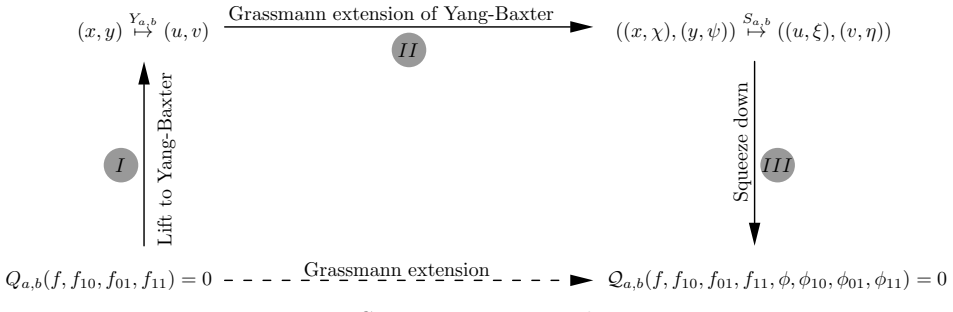
The load-bearing machinery is the Grassmann extension scheme, built around an augmented Lax matrix (a matrix whose refactorisation problem encodes the equations; existence of such a matrix is a working definition of integrability). The scheme runs in three steps: (I) lift a quad-graph equation to a parametric Yang-Baxter map via its symmetries; (II) augment the Lax matrix to $4\times 4$ block form, adding odd variables while preserving the bosonic limit and the superdeterminant (the graded determinant defined on such block matrices); (III) squeeze the extended map back to a lattice system using its symmetries. The augmented Lax matrix $L_a(x,\chi)$ in (17) is the central object that carries the extension, and the matrix refactorisation problem with it produces the extended Yang-Baxter map. For the 3D-consistency proof itself, the key identity is the function $A(a_{100},a_{010},a_{001},b_{100},b_{010},b_{001}) = (a_{001}-a_{010})(b_{001}-b_{100}) - (a_{001}-a_{100})(b_{001}-b_{010})$, whose invariance under simultaneous cyclic permutations makes the three cube routes for the '111' values coincide.
What would settle it
Perform the three-route cube computation of Appendix B for initial data satisfying the $f=0$ relations, e.g. $q_{100}=q_{010}$, $r_{100}\neq r_{010}$, and nonzero odd $\theta$'s with $\theta^2=0$; if the three answers for $(p_{111},q_{111},r_{111},\theta_{111})$ do not coincide, Theorem 4.0.3 is false. Repeat with $p_{100}+q\,q_{100}-r$ set to a nonzero constant to test whether the $f=0$ sector is essential.
Extended reading notes
Core claim
The paper works with a $\mathbb{Z}_2$-graded algebra whose even variables commute and whose odd variables anticommute. It constructs a twelve-dimensional Grassmann-extended Yang-Baxter map (Theorem 3.3.2) that reduces to the known eight-dimensional Yang-Baxter lift of the lattice Boussinesq system when the odd variables vanish, inherits the four invariants of that map, and adds two anti-invariants. Squeezing this map down, using the symmetry $y_2=x_3$, yields the Grassmann lattice Boussinesq system (29) with a $4\times 4$ Lax representation and with conservation laws. The main integrability statement is Theorem 4.0.3: in the further reduction where $\tau$ is set to zero but $\theta$ remains, the system (42) has the 3D-consistency property—the three routes around the elementary cube for computing $(p_{111},q_{111},r_{111},\theta_{111})$ agree. The proof is explicit: the three routes are computed in Appendix B and shown to coincide using the cyclic invariance of the auxiliary function $A$. The paper does not claim 3D consistency for the full system (40), because the quantity $\tau_{11}$ is missing from it.
Load-bearing premise
The 3D-consistency result is proved only after imposing the restriction $f=0$, i.e. $p_{10}+q\,q_{10}-r=0$, which is the choice $C(n+m)=0$ for the integration constant in the conservation law; if that constant is allowed to be nonzero, the paper does not establish 3D consistency, and the property may fail outside this sector.
Editorial extensions
If this is right
- Because system (42) is 3D consistent, it admits a Bäcklund transformation; the paper writes it explicitly by identifying $(p_{001},q_{001},r_{001},\theta_{001})$ with a new solution $(u,v,w,\varphi)$.
- The Grassmann-extended Yang-Baxter map (25)-(26) satisfies the parametric Yang-Baxter equation, so the mechanism that generates solutions of the lattice system from seed solutions carries over to this noncommutative setting.
- The bosonic limits of all constructed objects recover the commutative lattice Boussinesq system, its Lax matrix, and its Yang-Baxter lift, so the scheme is a genuine extension rather than a replacement.
- The Grassmann lattice Boussinesq system (29) has a Lax representation and conservation laws, so integrability in the Lax sense holds for the noncommutative system before any 3D-consistency restriction is imposed.
Reading between the lines
- Editorial inference: the proof leaves open whether the full system (29), or system (40) with $\tau_{11}$ restored by some completion, is 3D consistent; the explicit three-route computation could be rerun on such a completed system to test this directly.
- Editorial inference: the cyclic-invariance identity used in Lemma 4.0.4 is independent of the Boussinesq structure, so the same three-route check should apply to other Grassmann-extended quad-graph systems whose cube values are rational functions of this form.
- Editorial inference: if the $f=0$ restriction is truly necessary, the meaningful notion of noncommutative integrability may be consistency on a constrained sector rather than on the whole extended system; that would shift how future Grassmann extensions are judged.
- Editorial inference: the asymmetric treatment of the two odd variables ($\tau$ is removed, $\theta$ survives) suggests that consistent Grassmann reductions may single out a preferred fermionic direction, and testing which odd variables can be retained could become a design principle for noncommutative integrable lattices.
Signed reviews
Editorial analysis
A structured set of objections, weighed in public.
Referee Report
Summary. The paper proposes a scheme for constructing Grassmann (anticommuting) extensions of Yang-Baxter maps and associated lattice systems. It applies this scheme to a lattice Boussinesq system, obtaining a twelve-dimensional Grassmann extended Yang-Baxter map (25)-(26) with invariants and anti-invariants, and a Grassmann extended Boussinesq lattice system (29) with Lax representation and conservation laws. Under a restriction f=0, the author derives a reduced system (40) and, after taking the bosonic limit in the odd variable τ, the system (42) for even variables p,q,r and an odd variable θ. Theorem 4.0.3 claims that this system has the 3D-consistency property; the proof in Appendix B computes the three possible values of the '111' vertex and compares them using Lemma 4.0.4.
Significance. If the 3D-consistency claim holds as stated, the paper would provide a nontrivial example showing that Grassmann extensions of integrable lattice systems can retain the 3D-consistency property, in contrast to the potential KdV example in the author's earlier work. The explicit Yang-Baxter map, its Lax representation, and the invariants/anti-invariants are useful concrete data. The Yang-Baxter verification in Appendix A is a direct matrix computation, which is a strength of the paper. However, the central 3D-consistency proof has a scoping problem that must be addressed before the main claim can be accepted.
major comments (2)
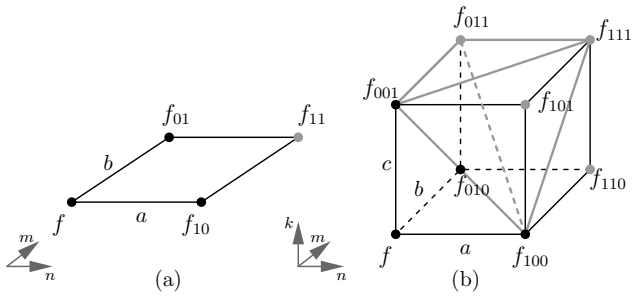
- [Section 4, Eqs. (38)-(39); Appendix B, Eqs. (64c), (65c), (66c)] Theorem 4.0.3 states that system (42) has the 3D-consistency property, but the proof in Appendix B is carried out only after imposing the additional relations (39), namely p10+qq10-r=0 and p01+qq01-r=0. In the cube computation these appear as p001=p100+q(q100-q001), p010=p100+q(q100-q010), and the analogous relation used before (64c) and (65c). These relations do not follow from system (42) alone: system (42) is an explicit formula determining the fourth vertex of a quadrilateral from three arbitrary initial values, so a generic cube initial datum for (42) violates them. Thus the three routes to '111' are compared only on the submanifold of initial data satisfying (39), not for the system as stated. The theorem needs either an explicit hypothesis that the initial data satisfy (39), or a genuinely generic consistency proof.
- [Appendix B, Eq. (66d)] The expression for θ111 in route C is written as A(θ010, θ001, q010, θ100, q001, q100). Lemma 4.0.4 takes arguments (a100, a010, a001, b100, b010, b001), so the correct expression should be A(θ010, θ001, θ100, q010, q001, q100). As printed, the lemma does not directly apply to the third route, and the claimed equality of the θ components is not demonstrated. Please correct the argument order and re-check the derivation.
minor comments (5)
- [Appendix B, Eq. (63)] The formula for r011 in the left-face equation contains an unexplained '+p' term. Consistency with the general form (42c) suggests that this term should be omitted; if it is intentional, its origin should be explained.
- [Section 3.2, Proposition 3.2.1] The Yang-Baxter property of the eight-dimensional map (14)-(15) is asserted by 'straightforward substitution' with no details. Given the size of the map, an explicit verification or a supplementary file would improve reproducibility.
- [Eq. (19)] The condition is stated as sdet(La)^2 = det(La) = a - λ, but no computation is shown. It would be helpful to clarify whether the square is intentional and to include the superdeterminant calculation.
- [Remark 4.0.2] The phrase 'bosonic limit of system of system (40)' contains a duplicated 'of system'; please correct this typo.
- [Section 5] In the Bäcklund transformation list, the equation 'φ10(v - q10) + θ10 - φ' is incomplete; it should end with '= 0'. The analogous equation for the second line should also be checked.
Circularity Check
No significant circularity: the Yang-Baxter and 3D-consistency claims are checked by direct computation, with the f=0 restriction a scope/correctness concern rather than a circular reduction.
full rationale
The paper's central claims are constructive and verified in-line. The Grassmann-extended Yang-Baxter map (25)-(26) is shown to satisfy the Yang-Baxter equation by a direct matrix-trifactorisation argument in Appendix A, and Theorem 4.0.3's 3D-consistency is checked by computing (p111,q111,r111,theta111) by the three cube paths in Appendix B. The scheme in Section 2.4 is explicitly based on the author's earlier work [15], but that is a disclosed methodological antecedent: the new map, its Lax/superdeterminant conditions (18)-(19), and the squeezed systems (29) and (42) are obtained by explicit computation in this paper, not by citing [15] as a black box. The conservation-law restriction C(n+m)=0 leading to Eq. (39) is a genuine limitation: the proof of Theorem 4.0.3 uses (39) to impose relations such as p001=p100+q(q100-q001) and p010=p100+q(q100-q010) on cube initial data that are not part of the stated system (42), so 3D consistency is established only on a constrained submanifold of initial data. This is a correctness/scope gap, not a circular definition or a fitted prediction, and the apparent typo in Eq. (66d) is likewise a proof defect rather than a circular step. Because the derivation does not define its target quantity in terms of its inputs, fit any parameter to data, or import a uniqueness theorem from the author's own papers, no circular step is recorded.
Assumptions & free parameters
assumptions (5)
- standard math Odd Grassmann variables anticommute and each squares to zero; even variables commute with everything.
- standard math The superdeterminant of a block matrix M = [[P,Π],[Λ,L]] is sdet(M) = det(P-ΠL^{-1}Λ)det(L^{-1}).
- domain assumption A matrix refactorization problem of the form La(u)Lb(v)=Lb(y)La(x) defines a Yang-Baxter map if the corresponding trifactorization is unique (theorem from [17,30]).
- domain assumption The Grassmann extension scheme of [15] produces an integrable noncommutative system when applied to a Yang-Baxter map with Lax matrix.
- ad hoc to paper The integration constant C(n+m) in f=C(n+m) arising from Eq. (38) is set to zero.
invented entities (1)
-
Grassmann variables τ, θ (and χ, ξ, η, ψ in the Yang-Baxter map)
Cite this review
Pith. "Pith review of On the $3D$ consistency of a Grassmann extended lattice Boussinesq system." pith.science (2026). https://pith.science/paper/LFHHN42M
@misc{pith2026190800565,
  author       = {Pith},
  title        = {Pith review of: On the $3D$ consistency of a Grassmann extended lattice Boussinesq system},
  year         = {2026},
  howpublished = {\url{https://pith.science/paper/LFHHN42M}},
  note         = {Machine review of arXiv:1908.00565}
}
abstract
In this paper, we formulate a "Grassmann extension" scheme for constructing noncommutative (Grassmann) extensions of Yang-Baxter maps together with their associated systems of P$\Delta$Es, based on the ideas presented in \cite{Sokor-Kouloukas}. Using this scheme, we first construct a Grassmann extension of a Yang-Baxter map which constitutes a lift of a lattice Boussinesq system. The Grassmann-extended Yang-Baxter map can be squeezed down to a novel, integrable, Grassmann lattice Boussinesq system, and we derive its $3D$-consistent limit. We show that some systems retain their $3D$-consistency property in their Grassmann extension.
Figures
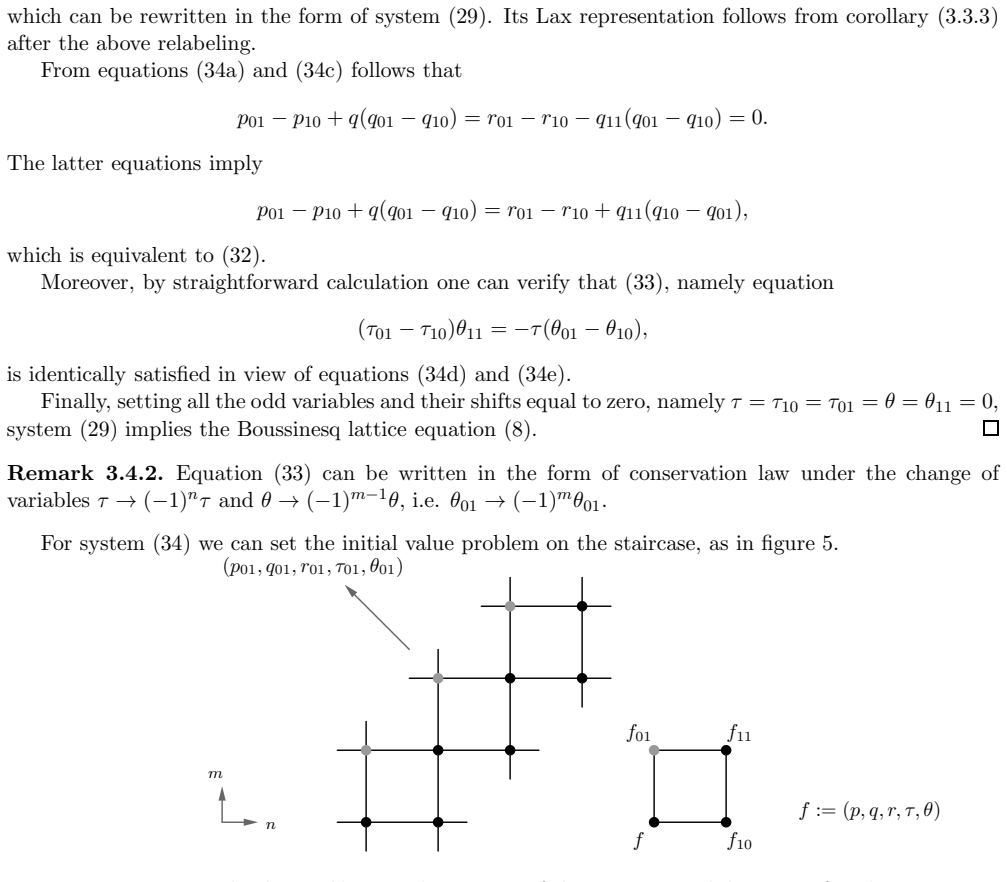
Figures from the paper (2 more)
Forward citations
Cited by 1 Pith paper
-
Integrable multi-component difference systems of equations
Two new families of integrable multi-component difference systems in bond variables are constructed, with Lax pairs, Yang-Baxter maps, and reductions to the ABS quad-equations.
Reference graph
Works this paper leans on
-
[1]
Adler V, Bobenko A, and Suris Y 2004 Geometry of Yang-Baxter maps: pencils of conics and quadrirational mappings Comm. Anal. Geom. 12 967–1007. 21
work page 2004
-
[2]
Atkinson J, Hietarinta J and Nijhoff F 2007 Seed and soliton solutions for Adler’s lattice equation J. Phys. A: Math. Theor. 40 F1–F8
work page 2007
-
[3]
Berezin F 1987 Intoduction to superanalysis Reidel Publishing Co. Dordrecht 9
work page 1987
-
[4]
Bobenko A and Suris Y 2002 Integrable systems on quad-graphs Int. Math. Res. Notices 11 573–611
work page 2002
-
[5]
Bridgman T, Hereman W, Quispel G.R.W., van der Kamp P 2013 Symbolic Computation of Lax Pairs of Partial Difference Equations using Consistenc y Around the Cube Found. Comput. Math. 13517–544
work page 2013
-
[6]
Caudrelier V, Cramp ´ e N, Zhang C 2014 Integrable Boundary for Quad-Graph Systems: Three- Dimensional Boundary Consistency SIGMA 014 (24 pp)
work page 2014
-
[7]
Chaichian M and Kulish P 1978 On the method of inverse scattering problem and B¨ acklu nd transformations for supersymmetric equations Phys. Lett. B 78413–416
work page 1978
-
[8]
Dimakis A and M ¨uller-Hoissen F 2005 An algebraic scheme associated with the non- commutative KP hierarchy and some of its extensions J. Phys. A 385453–5505
work page 2005
Show all 33 references
-
[9]
Grahovski G, Konstantinou-Rizos S and Mikhailov A 2016 Grassmann extensions of Yang- Baxter maps J. Phys. A 49 145202
2016
-
[10]
Grahovski G and Mikhailov A 2013 Integrable discretisations for a class of nonlinear Sc r¨ odinger equations on Grassmann algebras Phys. Lett. A 377 3254–3259
2013
-
[11]
Grisaru M and Penati S 2003 An integrable noncommutative version of the sine-Gord on system Nucl. Phys. B 655 250–276
2003
-
[12]
Hamanaka M and Toda 2003 Towards noncommutative integrable systems Phys. Lett. A 316 77–83
2003
-
[13]
Hietarinta J, Joshi N, Nijhoff F 2016 Discrete Systems and Integrability Cambridge texts in applied mathematics Cambridge University Press
2016
-
[14]
Kassotakis P and Nieszporski M 2012 On non-multiaffine consistent-around-the-cube lattic e equations Phys. Lett. A 376 3135–3140
2012
-
[15]
Konstantinou-Rizos S and Kouloukas T 2018 A noncommutative discrete potential KdV lift J. Math. Phys. 59 063506
2018
-
[16]
Konstantinou-Rizos S and Mikhailov A 2016 Anticommutative extension of the Adler map J. Phys. A: Math. Theor. 49 30LT03
2016
-
[17]
Kouloukas T and Papageorgiou V 2011 Poisson Yang-Baxter maps with binomial Lax matrices J. Math. Phys. 52 073502
2011
-
[18]
Lechtenfeld OO, Mazzanti L, Penati S, Popov A and Tamassia L 2005 Integrable non- commutative sine-Gordon model Nucl. Phys. B 705 477–503. 22
2005
-
[19]
Mao H and Liu Q P 2018 B¨ acklund-Darboux transformations and discretizations of N = 2 a = −2 supersymmetric KdV equation Phys. Lett. A 381 253–258
2018
-
[20]
Nonlinear Math
Mao H and Liu Q P 2018 Supersymmetric Sawada-Kotera equation: B¨ acklund-Darboux transfor- mations and applications J. Nonlinear Math. Phy. 25 375–386
2018
-
[21]
G., Capel H
Nijhoff F W, Papageorgiou V. G., Capel H. W. and Quispel G. R. W. 1992 The lattice Gel’fand-Dikii hierarchy Inverse Probl. 8(4) 597
1992
-
[22]
Nijhoff F and W alker A 2001 The discrete and continuous Painlev´ e VI hierarchy andthe Garnier systems Glasgow Math. J. 43 109–123
2001
-
[23]
Nijhoff F 2002 Lax pair for the Adler (lattice Krichever-Novikov) sys tem Phys. Lett. A 297 49–58
2002
-
[24]
Olver P and Sokolov V 1998 Non-abelian integrable systems of the derivative nonl inear Schr¨ odinger typeInverse Problems 14 L5–L8
1998
-
[25]
Papageorgiou V G and Tongas A 2009 Yang-Baxter maps associated to elliptic curves arXiv:0906.3258v1
2009 arXiv
-
[26]
Papageorgiou V and Tongas A 2007 Yang–Baxter maps and multi-field integrable lattice eq ua- tions J. Phys. A: Math. Theor. 40 12677
2007
-
[27]
Papageorgiou V, Tongas A and Veselov A 2006 Yang–Baxter maps and symmetries of inte- grable equations on quad-graphs J. Math. Phys. 47, 083502
2006
-
[28]
Nonlinear Math
Suris Y and Veselov A 2003 Lax matrices for Yang-Baxter maps J. Nonlinear Math. Phys. 10 223–230
2003
-
[29]
Compatible lattice and con- tinuum structures Glasgow Math
Tongas A and Nijhoff F 2005 The Boussinesq integrable system. Compatible lattice and con- tinuum structures Glasgow Math. J. 47 205–219
2005
-
[30]
Veselov A 2003 Yang-Baxter maps and integrable dynamics Phys. Lett. A 314 no. 3 214–221
2003
-
[31]
Xue L L, Levi D and Liu Q-P 2013 Supersymmetric KdV equation: Darboux transformation and discrete systems J. Phys. A: Math. Theor. (FTC) 46 502001
2013
-
[32]
Xue L L and Liu Q P 2014 B¨ acklund–Darboux transformations and discretizations of super KdV equation SIGMA 10 paper 045
2014
-
[33]
Xue L L and Liu Q P 2015 A supersymmetric AKNS problem and its Darboux-B¨ acklu nd trans- formations and discrete systems Stud. Appl. Math. 135 35–62. 23
2015
Reviewed August 14, 2026 · model on record in the stance chip above.
Discussion (0). Continue with ORCID to comment.