REVIEW 3 major objections 5 minor 52 references
exoALMA II: Data Calibration and Imaging Pipeline
T0 review · 3 major / 5 minor · reviewed 2026-08-16 · deepseek-v4-flash
Pith's one-line read The exoALMA calibration and imaging pipeline produces data clean enough to reveal faint deviations from Keplerian rotation that may mark embedded planets in protoplanetary disks.
desk verdict A careful, openly documented calibration/imaging pipeline for a major ALMA program; the core claim about kinematic fidelity rests on companion-paper tests not reported here, but the work is real and worth refereeing. read the letter →
The pith
A machine-rendered reading of the paper's core claim, the machinery that carries it, and where it could break.
The reading
What carries the argument
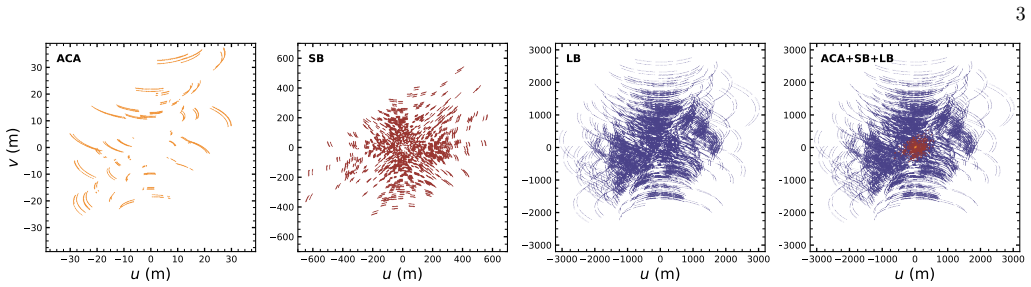
The load-bearing mechanism is the ordered calibration pipeline itself, centered on self-calibration using the target as its own model. Phase-only self-calibration on individual execution blocks corrects decorrelation; a uv-plane alignment routine shifts datasets by minimizing the weighted difference of gridded visibilities where uv coverage overlaps; flux alignment then rescales blocks that differ by more than four percent; and group-level phase then amplitude-and-phase self-calibration progressively concatenates ACA, short-baseline, and long-baseline data. On the imaging side, the key device is the iterative masking CLEAN procedure in which the CLEAN model is convolved with a wide Gaussian and thresholded to build a mask from the channel's own morphology, avoiding any Keplerian assumption that would hide the very signal being searched for. The 6-sigma threshold used to build models for phase self-calibration and the 1-sigma threshold for amplitude self-calibration determine how much real source structure is allowed into the gain solutions.
What would settle it
Take a disk observed by the program, inject a synthetic non-Keplerian perturbation of known amplitude and location into the calibrated visibilities, run the full pipeline end to end, and compare the recovered perturbation to the input; if self-calibration or CLEAN masking removes or shifts the feature, the claim that the data are artifact-free at the target sensitivity fails.
Extended reading notes
Core claim
The central claim is that the exoALMA self-calibration and imaging pipeline, described step by step here, yields measurement sets and image cubes in which faint deviations from Keplerian motion in protoplanetary disks can be confidently assessed as real. The pipeline first phase-self-calibrates each execution block separately, aligns blocks to a common phase center by minimizing weighted differences of gridded visibilities over overlapping uv cells, rescales fluxes when offsets exceed four percent, and then iteratively self-calibrates combined ACA, short-baseline, and long-baseline data before a final amplitude-and-phase round. Line images are CLEANed with masks derived from each channel's own emission morphology rather than from an assumed Keplerian model, so real non-Keplerian features are not masked out. The authors state that the resulting datasets are of sufficiently high quality to search for faint deviations from Keplerian rotation, with a companion non-CLEAN imaging study checking that the features are not artifacts of the deconvolution method.
Load-bearing premise
The gain solutions are computed from a model built by deconvolving the target's own emission, and the argument only works if that model contains none of the faint non-Keplerian motions being searched for; otherwise self-calibration would absorb the real signal into the antenna gains.
Editorial extensions
If this is right
- Released measurement sets and image cubes can be used to search for embedded planets and other non-Keplerian dynamical features without redoing the calibration.
- Kinematic deviations reported in companion analyses of these data can be treated as real; the pipeline's imaging choices also flag where caution is needed, such as low-SNR CS emission.
- The order-of-operations findings provide a template for future ALMA large programs combining ACA, short, and long baselines at Band 7.
- The public release of calibration scripts and quality-assurance figures allows other teams to reproduce or modify every step of the reduction.
Reading between the lines
- A natural stress test not run in this paper would inject a synthetic non-Keplerian kink into the visibilities of a cleanly Keplerian disk and check that the pipeline recovers it without distortion; that would directly test whether self-calibration absorbs real signal.
- The separation of spatial alignment from flux scaling, motivated by phase decoherence, suggests that future surveys should diagnose decorrelation before deciding the order of alignment and self-calibration steps.
- Because the fiducial imaging was optimized for kinematic analysis, other science goals such as accurate total flux measurements of point sources in extended emission will need different weighting or post-processing; the released measurement sets permit that.
- The caution about non-Gaussian PSFs and the epsilon metric recorded in image headers gives later users a quantitative handle on where flux measurements are unreliable.
Signed reviews
Editorial analysis
A structured set of objections, weighed in public.
Referee Report
Summary. This paper presents the calibration and imaging pipeline developed for the exoALMA Large Program, which observed 15 protoplanetary disks in Band 7 with ALMA in three molecular lines (12CO, 13CO, CS). The pipeline includes pseudo-continuum construction, per-execution phase self-calibration, uv-plane spatial alignment of execution blocks, flux rescaling, group-level phase and amplitude self-calibration, production of fiducial measurement sets, and continuum and line imaging using Briggs weighting and an iterative CLEAN masking procedure. The manuscript reports quantitative improvements in signal-to-noise ratio, corrections of phase decoherence, and alignment demonstrations, and it releases the calibrated measurement sets, images, and scripts. The central claim is that the resulting data are of sufficiently high quality to search for faint deviations from Keplerian rotation in protoplanetary disks.
Significance. If the claim holds, the released exoALMA measurement sets and image cubes become a community resource for kinematic planet searches and disk dynamics studies. The paper makes several concrete methodological contributions: an uv-plane alignment method for disks without central peaks (Section 3.3), a decoherence-correction workflow with visible improvement in amplitude-versus-baseline and waterfall diagnostics (Figures 6-8), and a non-Keplerian masking strategy for imaging (Section 4.4). Strengths include the public release of scripts and data products, machine-checkable provenance via HISTORY and exoALMA header keywords, and quantitative SNR improvements (e.g., >300% in Section 3.5.2). The main weakness is that the central fidelity claim is deferred to validation that is described but not reported in this manuscript.
major comments (3)
- [Section 4.4 and Section 5] The central claim that the data are 'of sufficiently high quality to look for faint deviations from Keplerian rotation' is not supported within this manuscript by quantitative validation. The iterative masking procedure (shallow CLEAN to 7×RMSinit, mask formed by convolving the shallow model with a 0.5-0.7 arcsec Gaussian, then deep CLEAN inside the mask to 3×RMSfin) can create spurious channel-to-channel structure if noise or sidelobe peaks inside the mask exceed the cleaning threshold, and it can leave real faint emission outside the mask in the residual image. The paper mentions 'empirical end-to-end testing' (Section 4.1) and defers to Zawadzki & Czekala (2025), but that reference is listed as 'TBD' and no false-positive rates, recovery fractions, or null-injection statistics are reported here. A null-injection or recovery test on representative channels should be reported in this paper, or the summary claim should be tempered to what the presented tests actually establish.
- [Table 2] The continuum images show several cases where the achieved RMS is substantially above the theoretical RMS: DM Tau (17.1 to 26.6 uJy/beam), RXJ1615.3-3255 (11.7 to 19.1 uJy/beam), RXJ1604.3-2130 (16.1 to 23.0 uJy/beam), and V4046 Sgr (14.8 to 19.7 uJy/beam). Since these continuum images are used for alignment and self-calibration and are themselves science products, the excess noise and its likely origin (residual decoherence, weighting choices, or calibration errors) should be discussed. Without an explanation, the reader cannot assess whether the excess propagates to the line cubes or affects the reliability of kinematic measurements made from those images.
- [Section 3.5.3] The amplitude and phase self-calibration at the group level uses a CLEAN model of the target itself, cleaned down to 1 sigma for the amplitude step. Because this model is derived from the same source whose structure the exoALMA program aims to measure, real continuum asymmetries or point-source features could in principle be absorbed into the gain solutions and then applied to all spectral windows, including the line data. The paper does not directly test whether the amplitude self-calibration removes real source structure. A concrete test would be to compare line cubes and continuum images made with and without the amplitude self-calibration step, or with bright continuum features masked from the model, and to report the differences in image morphology and flux.
minor comments (5)
- [Section 4.1] There is a typo in 'an number of different image conditioning or post-processing methods' that should read 'a number of different image conditioning or post-processing methods'.
- [Section 3.2] The phrase 'reduced by a cosifactor' should read 'reduced by a cos i factor' for clarity.
- [References] Several companion papers are cited with 'ApJL, TBD' (Pinte 2025; Izquierdo et al. 2025; Zawadzki & Czekala 2025; Teague et al. 2025). Since the central claim of this paper leans on Zawadzki & Czekala (2025), the reference should be complete or the validation should be included here before acceptance.
- [Section 4.4] The definition of the 'exoALMA' header keyword is clear, but it would help to state explicitly that the recorded quantities include the mask smoothing kernel FWHM and the cleaning thresholds, since these are the parameters most relevant to reproducing the images.
- [Section 3.4] The 4% flux-offset threshold is motivated only as 'empirically found not to affect the resulting image'; a brief statement of what test was performed to determine this threshold would improve reproducibility.
Circularity Check
No significant circularity: the exoALMA calibration and imaging pipeline does not fit a parameter and then rename it as a prediction; its self-calibration is applied to pseudo-continuum with line channels excluded, and the deferred RML cross-check is an independent reconstruction path rather than a circular self-citation.
full rationale
This paper is a data-processing methods paper rather than a derivation of a physical result from fitted parameters, so the usual circularity patterns (predictions forced by fits) do not apply. The central claim in Section 5 ('Our procedures ... have provided datasets that are of sufficiently high quality to look for faint deviations from Keplerian rotation') is a data-quality conclusion supported by the described pipeline choices. The self-calibration in Sections 3.2-3.5 uses the target itself as a gain model, but it is explicitly performed on pseudo-continuum measurement sets with the line channels flagged (Section 3.1), and the resulting gain solutions are applied to the line data afterward (Section 3.6). Non-Keplerian line kinematics are therefore not in the gain-solution model, so the line cubes are not forced to reproduce the model by construction. The line-imaging mask in Section 4.4 is deliberately morphology-based rather than Keplerian, which may carry an imaging-bias risk but does not constitute a circular derivation: the mask is not equivalent to the targeted non-Keplerian deviations, and the paper does not fit any parameter to a subset of the kinematic data and then 'predict' that same quantity. The external validation by Zawadzki & Czekala (2025) is cited as an independent RML-based check of feature recovery; although it is a companion paper with overlapping authors and its results are not reproduced in this manuscript (a real omitted-support caveat), RML imaging is an independent reconstruction algorithm applied to the same calibrated visibilities and does not take the CLEAN-derived feature list as an input. The omission of the companion's quantitative results weakens the support for the strongest claim but is not an instance of a derivation reducing to its own inputs. No self-definitional equation, fitted prediction, imported uniqueness theorem, or renamed known result was found.
Assumptions & free parameters
free parameters (5)
- Briggs robust parameter =
-0.5 (fiducial), -2 to +2 tested
- Flux rescale threshold =
4%
- CLEAN thresholds =
6 sigma for phase-round models, 1 sigma for amplitude-round models, final products at 6/5/4/3 times RMSfin
- Gain solution intervals =
EB-long, 360s, 120s, 60s, 30s, 18s depending on round
- Mask smoothing kernel FWHM =
0.5 to 0.7 arcsec
assumptions (6)
- domain assumption ALMA pipeline-calibrated visibilities have an absolute flux scale accurate to within about 4% in Band 7.
- domain assumption CLEAN deconvolution with the chosen masks recovers the true sky brightness distribution at the scales of interest.
- domain assumption Source inclination and position angle from the literature are accurate enough for deprojected visibility amplitude comparisons.
- standard math The gridded visibility minimization for alignment has a unique global minimum over the searched phase shifts.
- domain assumption A single global phase shift per execution block is sufficient to align it to the reference frame.
- domain assumption Phase decoherence is antenna-based and can be corrected by redundant baseline self-calibration.
Cite this review
Pith. "Pith review of exoALMA II: Data Calibration and Imaging Pipeline." pith.science (2026). https://pith.science/paper/LGHYIC72
@misc{pith2026250419870,
  author       = {Pith},
  title        = {Pith review of: exoALMA II: Data Calibration and Imaging Pipeline},
  year         = {2026},
  howpublished = {\url{https://pith.science/paper/LGHYIC72}},
  note         = {Machine review of arXiv:2504.19870}
}
abstract
The exoALMA Large Program was designed to search for subtle kinematic deviations from Keplerian motion, indicative of embedded planets, in high angular and spectral resolution Band 7 observations of $^{12}$CO, $^{13}$CO and CS emission from protoplanetary disks. This paper summarizes the calibration and imaging pipelines used by the exoALMA collaboration. With sources ranging in diameter from 2.4" to 13.8" when probed by $^{12}$CO, multiple antennae configurations were required to maximally recover all spatial information (including the ACA for 7 sources). Combining these datasets warranted particular care in their alignment during calibration and prior to imaging, so as not to introduce spurious features that might resemble the kinematic deviations being investigated. Phase decoherence was found in several datasets, which was corrected by an iterative self-calibration procedure, and we explored the effects of the order of operations of spatial alignment, flux scaling, and self-calibration. A number of different imaging sets were produced for the continuum and line emission, employing an iterative masking procedure that minimizes bias due to non-Keplerian motions in the disk.
Figures


Figures from the paper (7 more)


Reference graph
Works this paper leans on
-
[1]
, " * write output.state after.block = add.period write newline
ENTRY address archivePrefix author booktitle chapter doi edition editor eprint howpublished institution journal key month number organization pages publisher school series title misctitle type volume year version url label extra.label sort.label short.list INTEGERS output.state before.all mid.sentence after.sentence after.block FUNCTION init.state.consts ...
-
[2]
write newline
" write newline "" before.all 'output.state := FUNCTION format.url url empty "" new.block "" url * "" * if FUNCTION format.eprint eprint empty "" archivePrefix empty "" archivePrefix "arXiv" = new.block " " eprint * " " * new.block " " eprint * " " * if if if FUNCTION format.doi doi empty "" " " doi * " " * if FUNCTION format.pid doi empty eprint empty ur...
-
[3]
- [1] #1 = = ^ ^ ^ .\!\!^ d .\!\!^ h .\!\!^ m .\!\!^ s .\!\!^ @mss
thebibliography [1] 20pt to REFERENCES 6pt =0pt -12pt 10pt plus 3pt =0pt =0pt =1pt plus 1pt =0pt =0pt -12pt =13pt plus 1pt =20pt =13pt plus 1pt \@M =10000 =-1.0em =0pt =0pt 0pt =0pt =1.0em @enumiv\@empty 10000 10000 `\.\@m \@noitemerr \@latex@warning Empty `thebibliography' environment \@ifnextchar \@reference \@latexerr Missing key on reference command E...
2021
-
[4]
ALMA Partnership , Fomalont , E. B., Vlahakis , C., et al. 2015, , 808, L1, 10.1088/2041-8205/808/1/L1
-
[5]
Andrews , S. M. 2020, , 58, 483, 10.1146/annurev-astro-031220-010302
-
[6]
Andrews , S. M., Wilner , D. J., Zhu , Z., et al. 2016, , 820, L40, 10.3847/2041-8205/820/2/L40
-
[7]
Andrews , S. M., Huang , J., P \'e rez , L. M., et al. 2018, , 869, L41, 10.3847/2041-8213/aaf741
-
[8]
Astropy Collaboration , Robitaille , T. P., Tollerud , E. J., et al. 2013, , 558, A33, 10.1051/0004-6361/201322068
Show all 52 references
-
[9]
M., Sip o cz , B
Astropy Collaboration , Price-Whelan , A. M., Sip o cz , B. M., et al. 2018, , 156, 123, 10.3847/1538-3881/aabc4f
2018 doi
-
[10]
M., Lim , P
Astropy Collaboration , Price-Whelan , A. M., Lim , P. L., et al. 2022, , 935, 167, 10.3847/1538-4357/ac7c74
2022 doi
-
[11]
2023, in Astronomical Society of the Pacific Conference Series, Vol
Bae , J., Isella , A., Zhu , Z., et al. 2023, in Astronomical Society of the Pacific Conference Series, Vol. 534, Protostars and Planets VII, ed. S. Inutsuka , Y. Aikawa , T. Muto , K. Tomida , & M. Tamura , 423, 10.48550/arXiv.2210.13314
-
[12]
2021, , 653, A113, 10.1051/0004-6361/202140535
Barraza-Alfaro , M., Flock , M., Marino , S., & P \'e rez , S. 2021, , 653, A113, 10.1051/0004-6361/202140535
2021 doi
-
[13]
2021, , 916, L2, 10.3847/2041-8213/ac0f83
Benisty , M., Bae , J., Facchini , S., et al. 2021, , 916, L2, 10.3847/2041-8213/ac0f83
2021 doi
-
[14]
2023, in Astronomical Society of the Pacific Conference Series, Vol
Benisty , M., Dominik , C., Follette , K., et al. 2023, in Astronomical Society of the Pacific Conference Series, Vol. 534, Protostars and Planets VII, ed. S. Inutsuka , Y. Aikawa , T. Muto , K. Tomida , & M. Tamura , 605, 10.48550/arXiv.2203.09991
-
[15]
2021, ALMA Cycle 8 2021 Proposer’s Guide, ALMA Doc
Braatz , J. 2021, ALMA Cycle 8 2021 Proposer’s Guide, ALMA Doc. 8.2 v1.0
2021
- [16]
-
[17]
2022, , 134, 114501, 10.1088/1538-3873/ac9642
CASA Team , Bean , B., Bhatnagar , S., et al. 2022, , 134, 114501, 10.1088/1538-3873/ac9642
2022 doi
-
[18]
2022, , 513, 5790, 10.1093/mnras/stac1285
Casassus , S., & C \'a rcamo , M. 2022, , 513, 5790, 10.1093/mnras/stac1285
2022 doi
-
[19]
2023, ALMA Cycle 10 Technical Handbook, 10.5281/zenodo.7822943
Cortes, P., Vlahakis, C., Hales, A., et al. 2023, ALMA Cycle 10 Technical Handbook, 10.5281/zenodo.7822943
2023 doi
-
[20]
M., & Testi , L
Curone , P., Facchini , S., Andrews , S. M., & Testi , L. 2025, , TBD
2025
-
[21]
A., Teague , R., et al
Czekala , I., Loomis , R. A., Teague , R., et al. 2021, , 257, 2, 10.3847/1538-4365/ac1430
2021 doi
- [22]
-
[23]
2020, , 639, A121, 10.1051/0004-6361/202038027
Facchini , S., Benisty , M., Bae , J., et al. 2020, , 639, A121, 10.1051/0004-6361/202038027
2020 doi
-
[24]
W., Lang , D., & Goodman , J
Foreman-Mackey , D., Hogg , D. W., Lang , D., & Goodman , J. 2013, , 125, 306, 10.1086/670067
2013 doi
-
[25]
2019, The Journal of Open Source Software, 4, 1864, 10.21105/joss.01864
Foreman-Mackey , D., Farr , W., Sinha , M., et al. 2019, The Journal of Open Source Software, 4, 1864, 10.21105/joss.01864
2019 doi
-
[26]
R., & Harsono , D
Francis , L., Johnstone , D., Herczeg , G., Hunter , T. R., & Harsono , D. 2020, , 160, 270, 10.3847/1538-3881/abbe1a
2020 doi
-
[27]
2020, , 904, 148, 10.3847/1538-4357/abac17
Hall , C., Dong , R., Teague , R., et al. 2020, , 904, 148, 10.3847/1538-4357/abac17
2020 doi
-
[28]
R., Millman, K
Harris, C. R., Millman, K. J., van der Walt, S. J., et al. 2020, Nature, 585, 357, 10.1038/s41586-020-2649-2
2020 doi
-
[29]
Hunter, J. D. 2007, Computing in Science & Engineering, 9, 90, 10.1109/MCSE.2007.55
2007 doi
-
[30]
R., Petry , D., Barkats , D., Corder , S., & Indebetouw , R
Hunter , T. R., Petry , D., Barkats , D., Corder , S., & Indebetouw , R. 2023 a , analysisUtils , 2.6, Zenodo, 10.5281/zenodo.7502160
2023 doi
-
[31]
R., Indebetouw , R., Brogan , C
Hunter , T. R., Indebetouw , R., Brogan , C. L., et al. 2023 b , , 135, 074501, 10.1088/1538-3873/ace216
2023 doi
-
[32]
F., Stadler , J., Bae , J., et al
Izquierdo , A. F., Stadler , J., Bae , J., et al. 2025, , TBD
2025
-
[33]
Jorsater , S., & van Moorsel , G. A. 1995, , 110, 2037, 10.1086/117668
1995 doi
-
[34]
A., Tsutsumi , T., Brogan , C
Kepley , A. A., Tsutsumi , T., Brogan , C. L., et al. 2020, , 132, 024505, 10.1088/1538-3873/ab5e14
2020 doi
-
[35]
2016, in Positioning and Power in Academic Publishing: Players, Agents and Agendas, ed
Kluyver, T., Ragan-Kelley, B., P \'e rez, F., et al. 2016, in Positioning and Power in Academic Publishing: Players, Agents and Agendas, ed. F. Loizides & B. Scmidt (IOS Press), 87--90. https://eprints.soton.ac.uk/403913/
2016
-
[36]
2015, in Proceedings of the 2015 2nd International Workshop on High-Performance and Parallel Programming (HP2P 2015) (New York, NY, USA: ACM), 10.1145/2832953.2832955
Lam, S., Pitrou, A., & Seibert, S. 2015, in Proceedings of the 2015 2nd International Workshop on High-Performance and Parallel Programming (HP2P 2015) (New York, NY, USA: ACM), 10.1145/2832953.2832955
2015
-
[37]
K., Schinnerer , E., Hughes , A., et al
Leroy , A. K., Schinnerer , E., Hughes , A., et al. 2021 a , , 257, 43, 10.3847/1538-4365/ac17f3
2021 doi
-
[38]
K., Hughes , A., Liu , D., et al
Leroy , A. K., Hughes , A., Liu , D., et al. 2021 b , , 255, 19, 10.3847/1538-4365/abec80
2021 doi
-
[39]
A., \"O berg , K
Loomis , R. A., \"O berg , K. I., Andrews , S. M., et al. 2018, , 155, 182, 10.3847/1538-3881/aab604
2018 doi
-
[40]
I., Facchini , S., & Anderson , D
\"O berg , K. I., Facchini , S., & Anderson , D. E. 2023, , 61, 287, 10.1146/annurev-astro-022823-040820
2023 doi
-
[41]
I., Guzm \'a n , V
\"O berg , K. I., Guzm \'a n , V. V., Walsh , C., et al. 2021, , 257, 1, 10.3847/1538-4365/ac1432
2021 doi
-
[42]
2025, , TBD
Pinte , C. 2025, , TBD
2025
-
[43]
2023, in Astronomical Society of the Pacific Conference Series, Vol
Pinte , C., Teague , R., Flaherty , K., et al. 2023, in Astronomical Society of the Pacific Conference Series, Vol. 534, Protostars and Planets VII, ed. S. Inutsuka , Y. Aikawa , T. Muto , K. Tomida , & M. Tamura , 645, 10.48550/arXiv.2203.09528
-
[44]
J., M \'e nard , F., et al
Pinte , C., Price , D. J., M \'e nard , F., et al. 2018, , 860, L13, 10.3847/2041-8213/aac6dc
2018 doi
- [45]
-
[46]
2024, , 633, 58, 10.1038/s41586-024-07877-0
Speedie , J., Dong , R., Hall , C., et al. 2024, , 633, 58, 10.1038/s41586-024-07877-0
2024 doi
-
[47]
2019, The Journal of Open Source Software, 4, 1220, 10.21105/joss.01220
Teague, R. 2019, The Journal of Open Source Software, 4, 1220, 10.21105/joss.01220
2019 doi
-
[48]
A., Birnstiel , T., & Foreman-Mackey , D
Teague , R., Bae , J., Bergin , E. A., Birnstiel , T., & Foreman-Mackey , D. 2018, , 860, L12, 10.3847/2041-8213/aac6d7
2018 doi
-
[49]
2025, , TBD
Teague , R., Benisty , M., Facchini , S., Fukagawa , M., & Pinte , C. 2025, , TBD
2025
-
[50]
E., et al
Virtanen , P., Gommers , R., Oliphant , T. E., et al. 2020, Nature Methods, 17, 261, https://doi.org/10.1038/s41592-019-0686-2
2020 doi
-
[51]
Yoshida , C. T. 2025, , TBD
2025
-
[52]
2025, , TBD
Zawadzki , B., & Czekala , I. 2025, , TBD
2025
Reviewed August 16, 2026 · model on record in the stance chip above.
Discussion (0). Continue with ORCID to comment.