REVIEW 4 major objections 4 minor 1 cited by
Wigner Phase-Space Densities of Nuclear Clusters and Hypernuclei
T0 review · 4 major / 4 minor · reviewed 2026-08-05 · deepseek-v4-flash
Pith's one-line read This paper derives Wigner phase-space densities for light nuclear clusters and hypernuclei, from the deuteron to ${}^5_{\Lambda\Lambda}\mathrm{He}$, by solving the few-body Schrödinger equation with realistic potentials, so that coalescence
desk verdict New Wigner densities for hypernuclei, but the binding-energy validation fails against its own Table I — worth fixing, not citing yet. read the letter →
The pith
A machine-rendered reading of the paper's core claim, the machinery that carries it, and where it could break.
The reading
What carries the argument
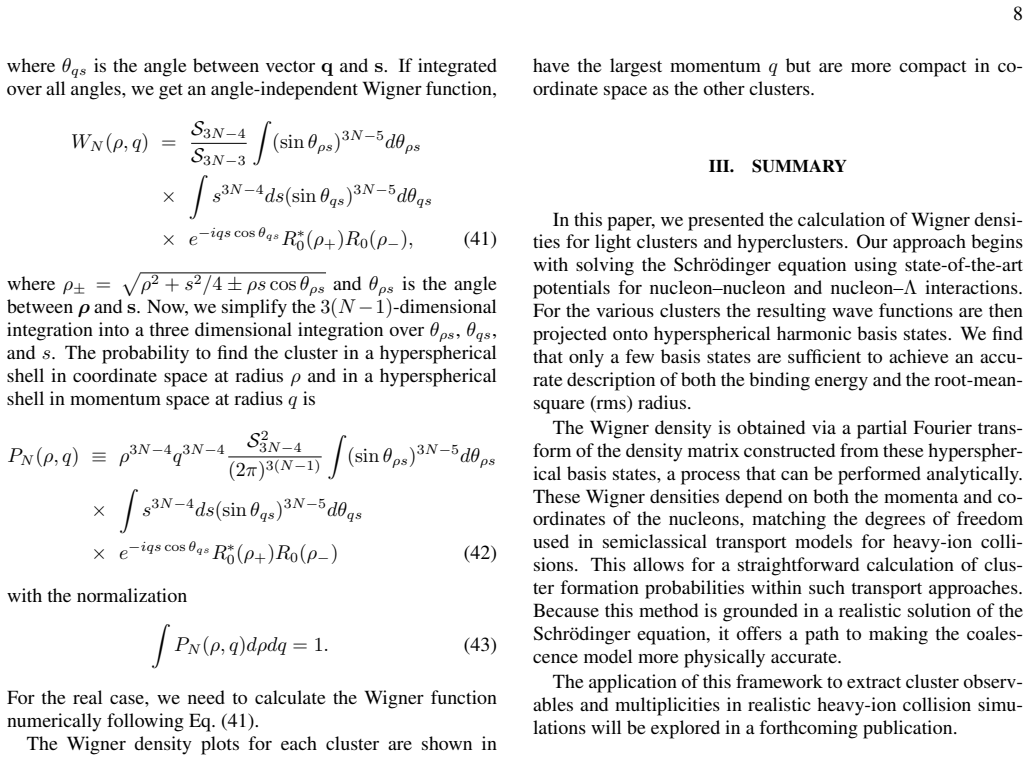
The load-bearing object is the Wigner density $W_N$ built from a hyperspherical-harmonics solution of the few-body Schrödinger equation. The relative wave function $\Phi(\rho,\Omega)=\sum_\kappa R_\kappa(\rho)Y_\kappa(\Omega)$ is expanded in hyperspherical harmonics $Y_\kappa$, eigenstates of the hyperangular-momentum operator; because higher-$\kappa$ components are small, the Wigner transform can be evaluated using the $K=0$ component alone, leaving a reduced density $P_N(\rho,q)$ in just two variables. This is the bridge between the ab initio wavefunction and the coalescence calculation: the Gaussian Wigner function emerges as the special case of a harmonic-oscillator interaction, while $P
What would settle it
Run a coalescence or transport simulation with these Wigner densities and compare the predicted multiplicities and momentum spectra of $d$, $t$, ${}^3\mathrm{He}$, ${}^4\mathrm{He}$, and ${}^3_\Lambda\mathrm{H}$ with published heavy-ion collision data; a systematic mismatch concentrated at large relative momentum $q$ would falsify the claim that these densities are the realistic input for coalescence. Alternatively, recompute ${}^4\mathrm{He}$ with a full spin-dependent Hamiltonian plus three-body forces and a larger $K$; the paper's Table I already shows a binding energy near 8 MeV instead of
Extended reading notes
Core claim
The paper's central claim is that a realistic Wigner density can be built for each cluster directly from the solution of the $N$-body Schrödinger equation, and that this density is the right input for coalescence calculations. Working with the Argonne v18 nucleon–nucleon potential and the Usmani nucleon–$\Lambda$ potential, the authors solve Eq. (13) in a hyperspherical-harmonic basis, keeping only low hyperspherical partial waves (for example, $K\le 4$ for the S-wave of four-body systems and $K\le 2$ for five-body systems). The dominant $K=0$ hyperspherical component is then inserted into the Wigner transform, which reduces to a three-dimensional integral over the hyperradius $\rho$ and the
Load-bearing premise
Section II A assumes that a spin-averaged two-body potential with no three-body forces, solved in a hyperspherical basis truncated at $K\le 4$ for four-body S-waves and $K\le 2$ for five-body systems, gives ground-state wave functions accurate enough for the claimed binding energies and radii; Table I shows the consequence, with ${}^4\mathrm{He}$ binding near 8 MeV rather than 28 MeV and the hypertriton essentially unbound, so the entire claimed accuracy rests on this premise
Editorial extensions
If this is right
- Coalescence models can drop the fitted Gaussian width and use a computed Wigner density for each cluster, removing a free parameter per species.
- The densities are expressed in relative hyperspherical coordinates and momenta, so they can be sampled directly by semiclassical transport codes at freeze-out.
- Hypernuclei such as ${}^3_\Lambda\mathrm{H}$ and ${}^5_\Lambda\mathrm{He}$ get phase-space distributions built from the realistic nucleon–$\Lambda$ force rather than rescaled nucleonic Gaussians, which matters for strangeness-sector yields.
- For ${}^5_{\Lambda\Lambda}\mathrm{He}$, a double-strange hypernucleus not yet confirmed experimentally, the calculation provides a ready-made Wigner density to use once the state is produced or measured.
Reading between the lines
- Beyond the paper: a sharp test is to implement the tabulated $P_N(\rho,q)$ in a transport-plus-coalescence code and compare predicted yield ratios such as $t/{}^3\mathrm{He}$, ${}^4\mathrm{He}/d$, and ${}^3_\Lambda\mathrm{H}/d$ with published heavy-ion data; because the method claims no free parameters, agreement or disagreement is a direct verdict on the density.
- The published reduced density is angle-averaged; directional information is lost, so application to anisotropic freeze-out in non-central collisions may require returning to the full $6(N-1)$-dimensional Wigner function before averaging.
- The same pipeline would immediately produce updated densities if the spin-averaged potentials or the $K$ truncation are improved; the most sensitive region is the large-momentum tail, where the Gaussian and realistic densities already differ.
Editorial analysis
A structured set of objections, weighed in public.
Referee Report
Summary. The manuscript solves the nonrelativistic few-body Schrödinger equation for light clusters and hypernuclei, from d to 5ΛΛHe, using the Argonne v18 nucleon-nucleon potential and the Usmani nucleon-Lambda potential. The relative wave function is expanded in hyperspherical harmonics, and an angle-averaged Wigner density is constructed from the dominant κ=0 component. The paper's stated aim is to provide realistic phase-space densities that can replace Gaussian ansätze in coalescence models for heavy-ion collisions, and it claims that experimental binding energies and rms radii are well reproduced.
Significance. The formal construction of Wigner densities from hyperspherical-harmonics wave functions, Eqs. (36)-(42), is a useful and potentially valuable contribution. The calculation has a genuine non-circularity: the potentials are fitted to scattering data, not to the cluster masses and radii that are used as benchmarks. If the wave functions were accurate, the resulting Wigner densities would indeed be a clear improvement over Gaussian approximations. However, the central validation claim is quantitatively contradicted by the paper's own Table I, and the Wigner densities are therefore not currently a reliable input for coalescence calculations.
major comments (4)
- [Table I; Sec. II A] The abstract and summary state that binding energies are 'well reproduced,' but Table I contradicts this. Using the constituent masses quoted in Sec. II A (m_p=0.938, m_n=0.939, m_Λ=1.116 GeV) with Eq. (19), the theoretical masses imply B.E.(4He)=3.754-3.746≈8 MeV versus the experimental 28.3 MeV; B.E.(3H)=2.816-2.813≈3 MeV versus 8.48 MeV; and B.E.(3ΛH)=2.993-2.993≈0 versus 2.36 MeV. For 5ΛHe the 'experimental' mass 4.731 GeV lies about 112 MeV below the α+Λ threshold (4.843 GeV), which is physically impossible, while the theoretical 4.847 GeV is unbound with respect to the same threshold. The wave functions therefore fail the benchmark that the paper itself sets, and the Wigner densities in Fig. 3 inherit this error.
- [Sec. II A (basis truncation)] The HH basis is truncated at K≤4 for A=3,4 and K≤2 for A=5, and the NN and ΛN potentials are spin-averaged. No convergence study is presented. The underbinding visible in Table I (about 20 MeV for 4He and about 5 MeV for 3H) is far larger than the precision implied by the abstract. A K-convergence study and an estimate of the effect of the omitted spin-dependent terms are necessary before these wave functions can be described as realistic. Without such a test, the phase-space extent of the Wigner densities is not reliable.
- [Sec. II B, Eqs. (37)-(42)] The Wigner transform is applied only to the κ=0 hyperradial component R0(ρ); all other hyperspherical components are discarded. Figure 2 shows substantial higher-κ contributions for several systems, notably 5ΛHe. The statement that the κ=0 component 'dominates' is not quantified. The authors should show the relative contribution of κ>0 components to ⟨ρ²⟩ and to the momentum distribution, or demonstrate that the reduced Wigner density PN(ρ,q) is a faithful representation of the full wave function.
- [Table I; abstract] The abstract also claims that experimental rms radii are reproduced, but Table I lists only theoretical rms values and no experimental radii are given. Without a comparison to measured or accepted radii, this part of the central claim is unsupported. Please provide the experimental values used and their references.
minor comments (4)
- [Fig. 2] The figure caption and panel labels do not clearly distinguish 3H from 3ΛH, nor 4ΛH from 4ΛHe. In particular the panel labeled '3H' in Fig. 2 is presumably the hypertriton, while the same symbol is also the standard notation for triton. Please use unique labels.
- [Eq. (13)] The symbol K is used both for the grand angular quantum number KN and for the effective constant K≡3(3N²-10N+8)/4. This is confusing; please rename one of the two.
- [Sec. II A; Acknowledgements] Typos: 'discussions ith' should be 'discussions with'; 'not founded' should be 'not found' (appears twice). Please proofread the text.
- [References] The experimental masses quoted for hypernuclei, especially 5ΛHe, should be cross-checked against the cited literature. The value 4.731 GeV in Table I is inconsistent with the binding energy quoted in the text.
Circularity Check
No circularity: cluster binding energies/radii are genuine postdictions from scattering-fitted potentials, despite numerical discrepancies.
full rationale
The calculation chain is self-contained. The two-body potentials (Argonne v18 for NN, Usmani for N-Lambda) are external inputs fixed by scattering data, as stated: 'The parameters of these forms are determined by fitting the N-N elastic scattering data' (Sec. II A). The bound-state masses and rms radii are then obtained by solving Eq. (13)/(17)/(19), and the Wigner densities by Eqs. (40)-(42); none of the target observables (binding energies, rms radii, or phase-space widths) is used as an input or fitted parameter. The self-citations [31,33,47-51,66] supply standard HH basis functions, Raynal-Revai coefficients, the inverse-power solution method, and harmonic-oscillator Wigner formulas; they do not import the paper's conclusions. The spin-average, no-three-body-force, and HH truncation assumptions are explicit approximations (Sec. II A). They are numerically inadequate for the abstract's 'well reproduced' claim--Table I gives Mtheo(4He)=3.746 GeV vs Mexp=3.727 GeV (B.E. ~8 vs 28.3 MeV), Mtheo(3LambdaH)=2.993 GeV vs 2.991 GeV (essentially unbound vs 2.36 MeV), and the listed 5LambdaHe experimental mass 4.7315 GeV lies ~108 MeV below the alpha+Lambda threshold--but an inaccurate approximation is not circular. The benchmark comparison is external and the discrepancy is a correctness risk, not a tautology.
Assumptions & free parameters
assumptions (4)
- domain assumption The interaction is the sum of two-body potentials; genuine three-body forces are neglected.
- domain assumption Spin-dependent potentials are neglected; a spin-averaged potential is used for all pairs.
- ad hoc to paper The hyperspherical-harmonics basis is truncated at moderate K (e.g., K <= 4 for S-wave of 3- and 4-body, K <= 2 for 5-body), and this truncation is assumed to give accurate ground states.
- ad hoc to paper The kappa=0 (hyper-radial ground) component dominates the wave function, so the full Wigner function can be reduced to an angle-averaged function of hyperradius and hypermomentum.
Cite this review
Pith. "Pith review of Wigner Phase-Space Densities of Nuclear Clusters and Hypernuclei." pith.science (2026). https://pith.science/paper/LGV5537R
@misc{pith2026250805814,
  author       = {Pith},
  title        = {Pith review of: Wigner Phase-Space Densities of Nuclear Clusters and Hypernuclei},
  year         = {2026},
  howpublished = {\url{https://pith.science/paper/LGV5537R}},
  note         = {Machine review of arXiv:2508.05814}
}
abstract
We solve the Schr\"odinger equation for few-body systems to obtain the wave function for light nuclear clusters and hypernuclei from d to $\rm ^5_{\Lambda\Lambda}He$ employing realistic nucleon-nucleon and nucleon-$\Lambda$ potentials. We project the solution to the hyperspherical harmonic basis states to obtain the corresponding density matrices and the Wigner densities. The experimental root mean square (rms) radii and binding energies of the different clusters are well reproduced. The Wigner densities obtained will allow to improve the present coalescence approaches to identify clusters, created in heavy-ion collisions.
Figures


Figures from the paper (1 more)
Forward citations
Cited by 1 Pith paper
-
From hyperon--nucleon interactions to deuteron--hyperon femtoscopy
Folded HAL-QCD potentials yield no dY bound states but a large dΛ scattering length and strong low-k correlation enhancement, with feed-down from Σ and Ξ clearly reshaping the observed dΛ signal.
Reference graph
Works this paper leans on
-
[1]
J. Schaffner-Bielich, Nucl. Phys. A 804, 309 (2008), arXiv:0801.3791 [astro-ph]
arXiv 2008
-
[2]
J. M. Lattimer and M. Prakash, Phys. Rept. 621, 127 (2016), arXiv:1512.07820 [astro-ph.SR]
arXiv 2016
-
[3]
M. Abdulhamid et al. (STAR), Phys. Rev. C 110, 054911 (2024), arXiv:2311.11020 [nucl-ex]
arXiv 2024
-
[4]
M. Abdallah et al. (STAR), Phys. Rev. Lett. 128, 202301 (2022), arXiv:2110.09513 [nucl-ex]
arXiv 2022
-
[5]
First measurement of A = 4 (anti)hypernuclei at the LHC
S. Acharya et al. (ALICE), Phys. Rev. Lett.134, 162301 (2025), arXiv:2410.17769 [nucl-ex]
work page Pith review arXiv 2025
-
[6]
S. Acharya et al. (ALICE), Phys. Rev. Lett.131, 102302 (2023), arXiv:2209.07360 [nucl-ex]
arXiv 2023
-
[7]
S. Acharya et al. (ALICE), Phys. Lett. B 860, 139066 (2025), arXiv:2405.19839 [nucl-ex]
work page Pith review arXiv 2025
-
[8]
D. Oliinychenko, L.-G. Pang, H. Elfner, and V . Koch (SMASH), Phys. Rev. C 99, 044907 (2019), arXiv:1809.03071 [hep-ph]
arXiv 2019
Show all 69 references
-
[9]
Oliinychenko, C
D. Oliinychenko, C. Shen, and V . Koch (SMASH), Phys. Rev. C 103, 034913 (2021), arXiv:2009.01915 [hep-ph]
2021 arXiv
-
[10]
Aichelin, Phys
J. Aichelin, Phys. Rept. 202, 233 (1991)
1991
-
[11]
Aichelin, E
J. Aichelin, E. Bratkovskaya, A. Le F `evre, V . Kireyeu, V . Kolesnikov, Y . Leifels, V . V oronyuk, and G. Coci, Phys. Rev. C 101, 044905 (2020), arXiv:1907.03860 [nucl-th]
2020 arXiv
-
[12]
Gl ¨aßel, V
S. Gl ¨aßel, V . Kireyeu, V . V oronyuk, J. Aichelin, C. Blume, E. Bratkovskaya, G. Coci, V . Kolesnikov, and M. Winn, Phys. Rev. C 105, 014908 (2022), arXiv:2106.14839 [nucl-th]
2022 arXiv
-
[13]
G. Coci, S. Gl ¨aßel, V . Kireyeu, J. Aichelin, C. Blume, E. Bratkovskaya, V . Kolesnikov, and V . V oronyuk, Phys. Rev. C 108, 014902 (2023), arXiv:2303.02279 [nucl-th]
2023 arXiv
-
[14]
Kireyeu, V
V . Kireyeu, V . V oronyuk, M. Winn, S. Gl ¨aßel, J. Aichelin, C. Blume, E. Bratkovskaya, G. Coci, and J. Zhao, (2024), arXiv:2411.04969 [nucl-th]. 9
2024 arXiv
-
[15]
Andronic, P
A. Andronic, P. Braun-Munzinger, J. Stachel, and H. Stocker, Phys. Lett. B 697, 203 (2011), arXiv:1010.2995 [nucl-th]
2011 arXiv
-
[16]
Steinheimer, K
J. Steinheimer, K. Gudima, A. Botvina, I. Mishustin, M. Ble- icher, and H. Stocker, Phys. Lett. B 714, 85 (2012), arXiv:1203.2547 [nucl-th]
2012 arXiv
-
[17]
Sombun, K
S. Sombun, K. Tomuang, A. Limphirat, P. Hillmann, C. Herold, J. Steinheimer, Y . Yan, and M. Bleicher, Phys. Rev. C 99, 014901 (2019), arXiv:1805.11509 [nucl-th]
2019 arXiv
-
[18]
H. Liu, D. Zhang, S. He, K.-j. Sun, N. Yu, and X. Luo, Phys. Lett. B 805, 135452 (2020), [Erratum: Phys.Lett.B 829, 137132 (2022)], arXiv:1909.09304 [nucl-th]
2020 arXiv
-
[19]
Kireyeu, J
V . Kireyeu, J. Steinheimer, J. Aichelin, M. Bleicher, and E. Bratkovskaya, Phys. Rev. C 105, 044909 (2022), arXiv:2201.13374 [nucl-th]
2022 arXiv
-
[20]
Reichert, M
T. Reichert, M. Omana Kuttan, A. Kittiratpattana, N. Buyuk- cizmeci, A. Botvina, J. Steinheimer, and M. Bleicher, (2025), arXiv:2504.17389 [nucl-th]
2025 arXiv
-
[21]
Scheibl and U
R. Scheibl and U. W. Heinz, Phys. Rev. C 59, 1585 (1999), arXiv:nucl-th/9809092
1999 arXiv
-
[22]
L. Zhu, C. M. Ko, and X. Yin, Phys. Rev. C 92, 064911 (2015), arXiv:1510.03568 [nucl-th]
2015 arXiv
-
[23]
Aichelin and E
J. Aichelin and E. A. Remler, Phys. Rev. C 35, 1291 (1987)
1987
-
[24]
Sun and C
K.-J. Sun and C. M. Ko, Phys. Rev. C 103, 064909 (2021), arXiv:2005.00182 [nucl-th]
2021 arXiv
-
[25]
R.-Q. Wang, J. Song, M.-Y . Wu, H.-T. Xue, and F.-L. Shao, (2025), arXiv:2504.13640 [nucl-th]
2025 arXiv
-
[26]
Wang, Y .-H
R.-Q. Wang, Y .-H. Li, J. Song, and F.-L. Shao, Phys. Rev. C 109, 034907 (2024), arXiv:2309.16296 [nucl-th]
2024 arXiv
-
[27]
D.-N. Liu, C. M. Ko, Y .-G. Ma, F. Mazzaschi, M. Puccio, Q.-Y . Shou, K.-J. Sun, and Y .-Z. Wang, Phys. Lett. B 855, 138855 (2024), arXiv:2404.02701 [nucl-th]
2024 arXiv
-
[28]
Lin, Y .-J
Q.-R. Lin, Y .-J. Huang, L.-G. Pang, X.-F. Luo, and X.-N. Wang, (2025), arXiv:2503.01128 [hep-ph]
2025 arXiv
-
[29]
Bellini, K
F. Bellini, K. Blum, A. P. Kalweit, and M. Puccio, Phys. Rev. C 103, 014907 (2021), arXiv:2007.01750 [nucl-th]
2021 arXiv
-
[30]
Mahlein, L
M. Mahlein, L. Barioglio, F. Bellini, L. Fabbietti, C. Pinto, B. Singh, and S. Tripathy, Eur. Phys. J. C 83, 804 (2023), arXiv:2302.12696 [hep-ex]
2023 arXiv
-
[31]
Barnea, W
N. Barnea, W. Leidemann, and G. Orlandini, Phys. Rev. C 61, 054001 (2000), arXiv:nucl-th/9910062
2000 arXiv
-
[32]
L. E. Marcucci, J. Dohet-Eraly, L. Girlanda, A. Gnech, A. Kievsky, and M. Viviani, Front. in Phys. 8, 69 (2020), arXiv:1912.09751 [nucl-th]
2020 arXiv
-
[33]
J. Zhao, S. Shi, and P. Zhuang, Phys. Rev. D 102, 114001 (2020), arXiv:2009.10319 [hep-ph]
2020 arXiv
-
[34]
Kohn, Phys
W. Kohn, Phys. Rev. 74, 1763 (1948)
1948
-
[35]
Demkov and N
I. Demkov and N. Kemmer, (No Title) (1963)
1963
-
[36]
Kamimura, Phys
M. Kamimura, Phys. Rev. A 38, 621 (1988)
1988
-
[37]
L. D. Faddeev, Sov. Phys. JETP 12, 1014 (1961)
1961
-
[38]
Gl ¨ockle, The quantum mechanical few-body problem (Springer Science & Business Media, 2012)
W. Gl ¨ockle, The quantum mechanical few-body problem (Springer Science & Business Media, 2012)
2012
-
[39]
Leidemann and G
W. Leidemann and G. Orlandini, Prog. Part. Nucl. Phys.68, 158 (2013), arXiv:1204.4617 [nucl-th]
2013 arXiv
-
[40]
Ekstr ¨om, C
A. Ekstr ¨om, C. Forss ´en, G. Hagen, G. R. Jansen, W. Jiang, and T. Papenbrock, Front. Phys. 11, 1129094 (2023), arXiv:2212.11064 [nucl-th]
2023 arXiv
-
[41]
Papenbrock (2024) arXiv:2410.00843 [nucl-th]
T. Papenbrock (2024) arXiv:2410.00843 [nucl-th]
2024 arXiv
-
[42]
Wirth, D
R. Wirth, D. Gazda, P. Navr´atil, A. Calci, J. Langhammer, and R. Roth, Phys. Rev. Lett.113, 192502 (2014), arXiv:1403.3067 [nucl-th]
2014 arXiv
-
[43]
Wirth and R
R. Wirth and R. Roth, Phys. Lett. B 779, 336 (2018), arXiv:1710.04880 [nucl-th]
2018 arXiv
-
[44]
H. Le, J. Haidenbauer, U.-G. Meißner, and A. Nogga, Eur. Phys. J. A 56, 301 (2020), arXiv:2008.11565 [nucl-th]
2020 arXiv
-
[45]
H. Le, J. Haidenbauer, U.-G. Meißner, and A. Nogga, Phys. Rev. C 107, 024002 (2023), arXiv:2210.03387 [nucl-th]
2023 arXiv
-
[46]
H. Le, J. Haidenbauer, U.-G. Meißner, and A. Nogga, Phys. Rev. Lett. 134, 072502 (2025), arXiv:2409.18577 [nucl-th]
2025 arXiv
-
[47]
Barnea, J
N. Barnea, J. Vijande, and A. Valcarce, Phys. Rev. D 73, 054004 (2006), arXiv:hep-ph/0604010
2006 arXiv
-
[48]
Zhao and S
J. Zhao and S. Shi, Phys. Rev. C 109, 024901 (2024), arXiv:2311.04594 [nucl-th]
2024 arXiv
-
[49]
Zhao and P
J. Zhao and P. Zhuang, Few Body Syst. 58, 100 (2017)
2017
-
[50]
Raynal and J
J. Raynal and J. Revai, Nuovo Cim. A 68, 612 (1970)
1970
-
[51]
Zhao and S
J. Zhao and S. Shi, Comput. Phys. Commun. 303, 109284 (2024), arXiv:2403.02747 [physics.comp-ph]
2024 arXiv
-
[52]
Navas et al
S. Navas et al. (Particle Data Group), Phys. Rev. D110, 030001 (2024)
2024
-
[53]
Lamia, M
L. Lamia, M. La Cognata, C. Spitaleri, B. Irgaziev, and R. G. Pizzone, Phys. Rev. C 85, 025805 (2012)
2012
-
[54]
Yukawa, Proc
H. Yukawa, Proc. Phys. Math. Soc. Jap. 17, 48 (1935)
1935
-
[55]
R. A. Bryan and B. L. Scott, Phys. Rev. 135, B434 (1964)
1964
-
[56]
Lacombe, B
M. Lacombe, B. Loiseau, J. M. Richard, R. Vinh Mau, J. Cote, P. Pires, and R. De Tourreil, Phys. Rev. C 21, 861 (1980)
1980
-
[57]
R. B. Wiringa, V . G. J. Stoks, and R. Schiavilla, Phys. Rev. C 51, 38 (1995), arXiv:nucl-th/9408016
1995 arXiv
-
[58]
R. V . Reid, Jr., Annals Phys.50, 411 (1968)
1968
-
[59]
V . G. J. Stoks, R. A. M. Klomp, C. P. F. Terheggen, and J. J. de Swart, Phys. Rev. C49, 2950 (1994), arXiv:nucl-th/9406039
1994 arXiv
-
[60]
M. M. Nagels, T. A. Rijken, and Y . Yamamoto, Phys. Rev. C 99, 044002 (2019), arXiv:1408.4825 [nucl-th]
2019 arXiv
-
[61]
A. R. Bodmer, Q. N. Usmani, and J. Carlson, Phys. Rev. C 29, 684 (1984)
1984
-
[62]
Otsuki, Progress of Theoretical Physics Supplement 42, 39 (1968), https://academic.oup.com/ptps/article- pdf/doi/10.1143/PTPS.42.39/5346731/42-39.pdf
S. Otsuki, Progress of Theoretical Physics Supplement 42, 39 (1968), https://academic.oup.com/ptps/article- pdf/doi/10.1143/PTPS.42.39/5346731/42-39.pdf
1968 doi
-
[63]
I. J. McGee, Phys. Rev. 158, 1500 (1967)
1967
-
[64]
T. A. Armstrong et al. (E864), Phys. Rev. C70, 024902 (2004), arXiv:nucl-ex/0211010
2004 arXiv
-
[65]
Nemura, Y
H. Nemura, Y . Suzuki, Y . Fujiwara, and C. Nakamoto, Prog. Theor. Phys. 103, 929 (2000), arXiv:nucl-th/9912065
2000 arXiv
-
[66]
J. Zhao, P. B. Gossiaux, T. Song, E. Bratkovskaya, and J. Aichelin, EPJ Web Conf. 296, 09014 (2024), arXiv:2312.11349 [hep-ph]
2024 arXiv
-
[67]
L.-W. Chen, C. M. Ko, and B.-A. Li, Nucl. Phys. A 729, 809 (2003), arXiv:nucl-th/0306032
2003 arXiv
-
[68]
Sun and L.-W
K.-J. Sun and L.-W. Chen, Phys. Lett. B 751, 272 (2015), arXiv:1509.05302 [nucl-th]
2015 arXiv
-
[69]
L. K. Liu, C. L. Hu, X. H. He, S. S. Shi, and G. N. Xie, Phys. Lett. B 855, 138853 (2024), arXiv:2404.13582 [nucl-th]
2024 arXiv
Reviewed August 5, 2026 · model on record in the stance chip above.
Discussion (0). Sign in to comment.