Periodic orbits as probes of charged loop quantum gravity black holes through gravitational waves
Pith reviewed 2026-06-27 09:19 UTC · model grok-4.3
The pith
Gravitational waves from periodic orbits around charged loop quantum gravity black holes exceed the sensitivity of planned space-based detectors.
A machine-rendered reading of the paper's core claim, the machinery that carries it, and where it could break.
Core claim
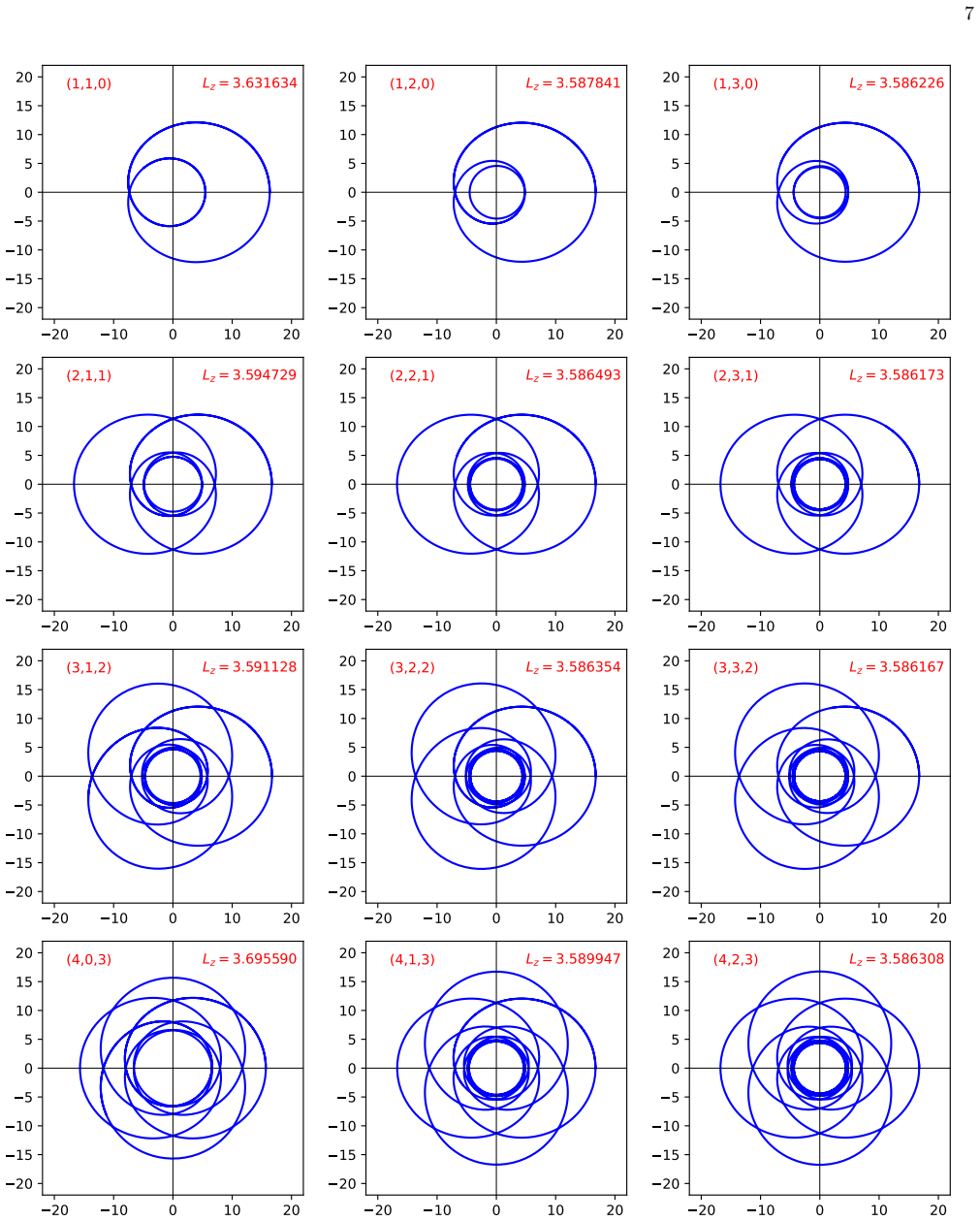
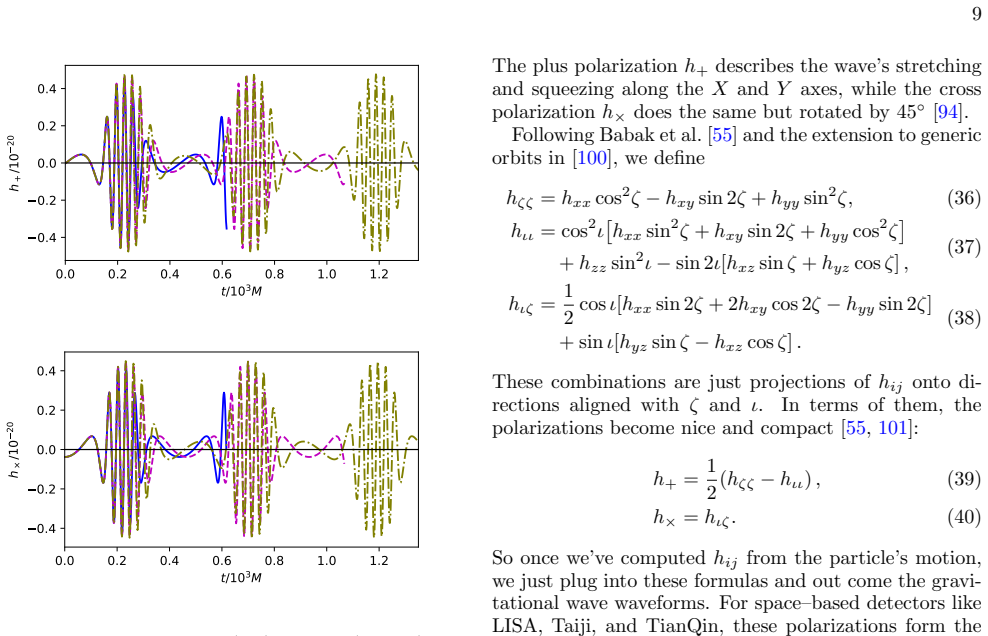
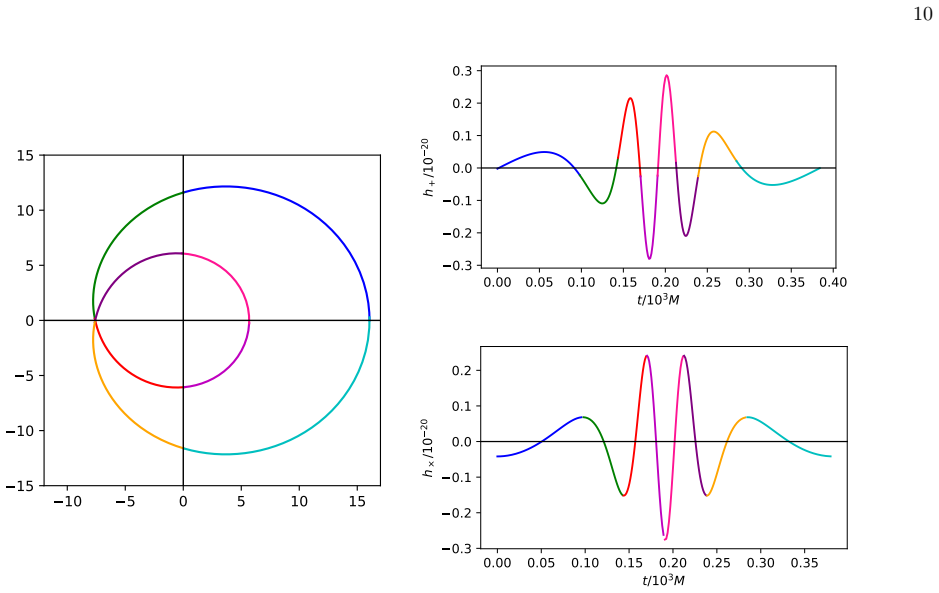
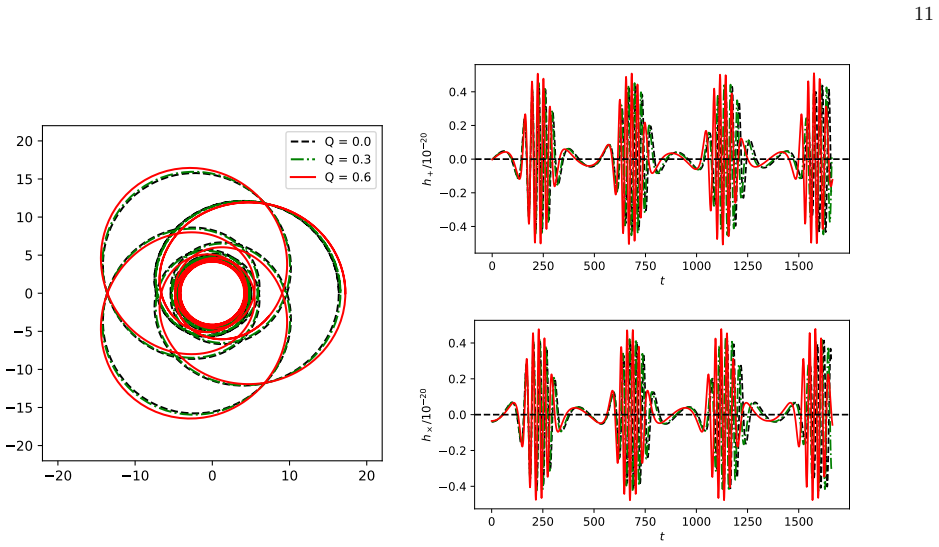
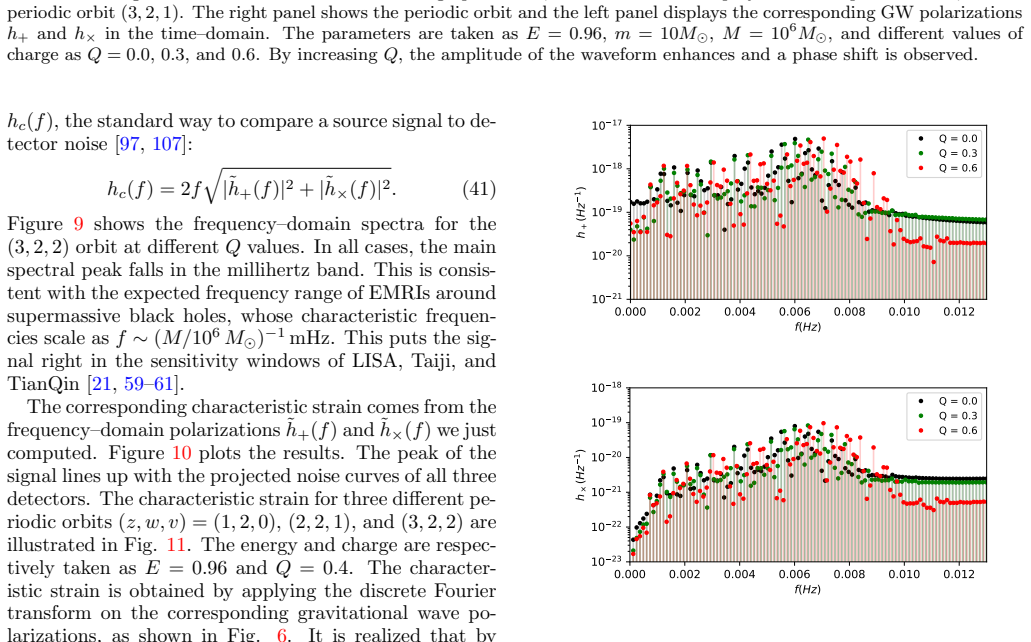
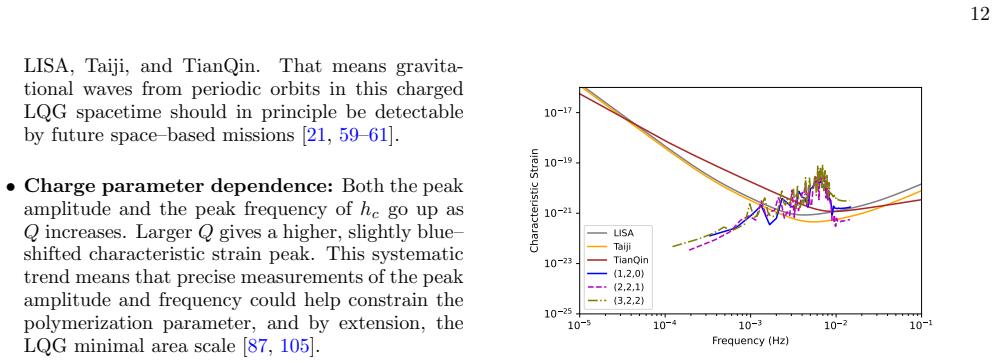
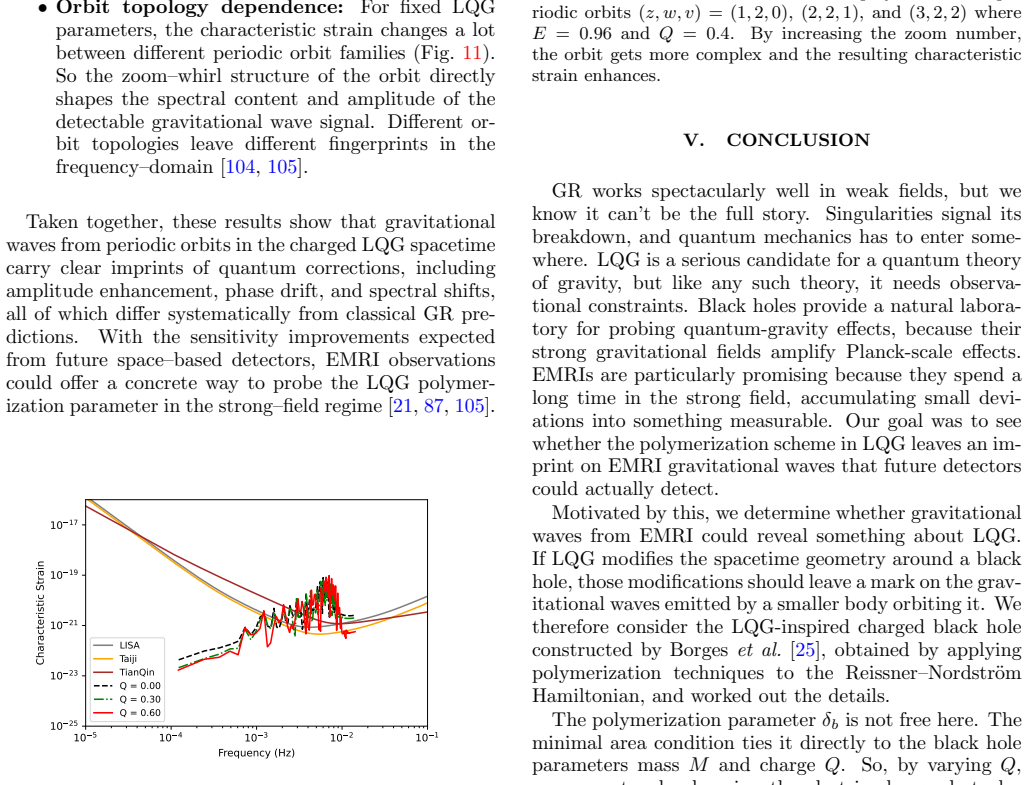
In the spacetime of a charged LQG black hole with polymerization parameter fixed by the area-gap condition, the effective potential admits innermost stable circular orbits and marginally bound orbits. Periodic orbits are labeled by integers (z, w, v) according to the rational ratio of azimuthal to radial frequencies, and the gravitational waveforms they produce in the quadrupole approximation display a zoom-whirl structure whose amplitude and phase vary with the charge parameter Q and the LQG correction. The resulting characteristic strains lie in the millihertz band and surpass the projected sensitivities of LISA, Taiji, and TianQin for all examined values of Q.
What carries the argument
The zoom-whirl taxonomy of periodic orbits, defined by the triple (z, w, v) and the frequency ratio q = ω_φ / ω_r - 1, which determines the topology and the shape of the emitted gravitational waveform.
If this is right
- The polarization waveforms in time and frequency domain depend on the LQG parameter.
- Characteristic strain peaks in millihertz for all Q.
- Future observations can constrain the LQG polymerization parameter in strong-field regime.
- Orbit topology shapes the waveform morphology.
Where Pith is reading between the lines
- This approach could be extended to spinning LQG black holes to see if the constraints improve.
- Comparison with waveforms from other modified gravity theories might allow distinguishing LQG effects.
- Detection would provide a direct test of the area-gap condition in curved spacetime.
Load-bearing premise
The quadrupole approximation is sufficient to capture the leading gravitational-wave emission from these extreme-mass-ratio inspirals, and the polymerization parameter is fixed solely by the area-gap condition without additional model dependence.
What would settle it
A precise measurement of the characteristic strain from an EMRI around a black hole with known charge that falls below the projected LISA sensitivity curve or shows no dependence on the expected LQG corrections would falsify the claim that these signals can constrain the polymerization parameter.
Figures
read the original abstract
Gravitational waves from extreme-mass-ratio inspirals (EMRI) provide a direct probe of the strong-field geometry of black holes. Motivated by this, we study the motion of test particles and the resulting gravitational wave emission in the spacetime of a charged black hole inspired by loop quantum gravity (LQG), where the classical singularity is replaced by a smooth transition surface arising from the LQG polymerization, in which its radius is set by the LQG area gap condition. As a result, the polymerization parameter $\delta_b$ is uniquely determined by the mass $M$ and charge parameter $Q$, so that all cases examined in this work contain LQG correction. By constructing the effective potential, the innermost stable circular orbit (ISCO) and the marginally bound orbit (MBO) are determined. Periodic orbits are classified using the Levin-Perez-Giz zoom-whirl taxonomy, showing how the orbit topology shapes the waveform, so that each closed trajectory is labeled by the triple integer $(z, w, v)$ and located through the rational frequency ratio $q = \omega_\phi/\omega_r - 1$. Within the quadrupole approximation, the gravitational waveforms for an EMRIs are estimated, and the resulting polarizations are obtained in the time-domain and frequency-domain. The resulting polarizations in the time-domain exhibit a zoom-whirl morphology, with the waveform amplitude and phase dependent on the LQG parameter. The characteristic strain peaks in the millihertz band for all values of the charge parameter $Q$, and they exceed the projected sensitivities of LISA, Taiji, and TianQin, suggesting that future observations could place meaningful constraints on the LQG polymerization parameter in the strong-field regime.
Editorial analysis
A structured set of objections, weighed in public.
Referee Report
Summary. The paper studies test-particle motion in the spacetime of charged LQG black holes with the polymerization parameter δ_b fixed uniquely by the area-gap condition in terms of M and Q. It constructs the effective potential to locate the ISCO and MBO, classifies periodic orbits via the Levin-Perez-Giz (z,w,v) zoom-whirl taxonomy using the rational frequency ratio q = ω_φ/ω_r − 1, generates time- and frequency-domain waveforms in the quadrupole approximation, and reports that the characteristic strain peaks in the millihertz band and exceeds the projected sensitivities of LISA, Taiji and TianQin for all values of Q, thereby suggesting that future observations could constrain the LQG parameter.
Significance. If the radiation modeling step is validated, the work supplies a parameter-free (given M and Q) set of waveform predictions for periodic orbits in an LQG-inspired geometry that could be confronted with space-based detector data. The unique fixing of δ_b by the area-gap condition without additional fitting parameters is a clear strength that avoids circularity in the model.
major comments (2)
- [Abstract] Abstract: the claim that characteristic strains exceed LISA/Taiji/TianQin sensitivities (and thereby constrain δ_b) is obtained from waveforms computed via the quadrupole formula applied to geodesic motion in the effective LQG metric. No error estimate, convergence test, or comparison against a Teukolsky-like calculation in the modified background is supplied to show that LQG curvature corrections leave the leading radiation amplitude and far-zone propagation unchanged at the quoted level. This assumption is load-bearing for the detectability conclusion.
- [Abstract] Abstract: the frequency ratio q = ω_φ/ω_r − 1 is asserted to label the (z,w,v) orbits and to produce the claimed zoom-whirl morphology, yet no explicit verification is given that this relation continues to hold once the LQG effective potential (rather than the classical one) is used to define the frequencies.
Simulated Author's Rebuttal
We thank the referee for their careful reading and constructive comments on our manuscript. We address each major comment below and outline the revisions we will make.
read point-by-point responses
-
Referee: [Abstract] Abstract: the claim that characteristic strains exceed LISA/Taiji/TianQin sensitivities (and thereby constrain δ_b) is obtained from waveforms computed via the quadrupole formula applied to geodesic motion in the effective LQG metric. No error estimate, convergence test, or comparison against a Teukolsky-like calculation in the modified background is supplied to show that LQG curvature corrections leave the leading radiation amplitude and far-zone propagation unchanged at the quoted level. This assumption is load-bearing for the detectability conclusion.
Authors: We acknowledge that the waveforms rely on the quadrupole approximation applied to geodesics in the effective LQG metric, without a full Teukolsky-style perturbation analysis or explicit error estimates for curvature corrections. This is a standard leading-order approach in EMRI studies of modified spacetimes when higher-order calculations are not yet available. The LQG corrections enter through the background metric, and the detectability estimates are intended as indicative for the millihertz band. In the revised manuscript we will add an explicit discussion of this limitation, including a statement that the conclusions on detector sensitivity are preliminary and would benefit from future waveform modeling beyond the quadrupole formula. revision: partial
-
Referee: [Abstract] Abstract: the frequency ratio q = ω_φ/ω_r − 1 is asserted to label the (z,w,v) orbits and to produce the claimed zoom-whirl morphology, yet no explicit verification is given that this relation continues to hold once the LQG effective potential (rather than the classical one) is used to define the frequencies.
Authors: The frequencies ω_φ and ω_r are obtained by integrating the geodesic equations using the effective potential derived from the LQG metric. The rational ratio q is then applied exactly as in the classical Levin-Perez-Giz taxonomy to identify closed orbits. Because the frequencies are computed directly from the LQG potential, the relation holds by construction for the periodic orbits we classify. We will add a clarifying sentence in the revised text (near the definition of q) stating that the taxonomy is applied to frequencies extracted from the modified potential, together with a brief note confirming consistency with the zoom-whirl morphology observed in the waveforms. revision: yes
Circularity Check
No significant circularity detected
full rationale
The paper fixes the LQG polymerization parameter δ_b uniquely via the area-gap condition from M and Q (abstract), then computes geodesics, periodic orbits via Levin-Perez-Giz taxonomy, and GW polarizations via the quadrupole formula applied to those orbits. No parameters are fitted to the target strain data and renamed as predictions; the detectability claim follows directly from the model metric and standard radiation formula without self-definition or self-citation load-bearing steps. The derivation chain is self-contained against external benchmarks.
Axiom & Free-Parameter Ledger
axioms (2)
- domain assumption The LQG polymerization replaces the classical singularity with a transition surface whose radius is set by the area-gap condition, uniquely determining δ_b from M and Q.
- domain assumption The quadrupole approximation suffices for the leading gravitational-wave emission from extreme-mass-ratio inspirals.
Forward citations
Cited by 1 Pith paper
-
Gravitational Wave Signatures from Periodic Orbits around a Non--commutative Schwarzschild Black Hole
Non-commutative corrections move periodic orbits inward, lower the energy needed for a given orbit shape, and generate gravitational waves with phase shifts plus higher amplitude; a bound Θ/M² < 0.014 is extracted fro...
Reference graph
Works this paper leans on
-
[1]
zoom–whirl
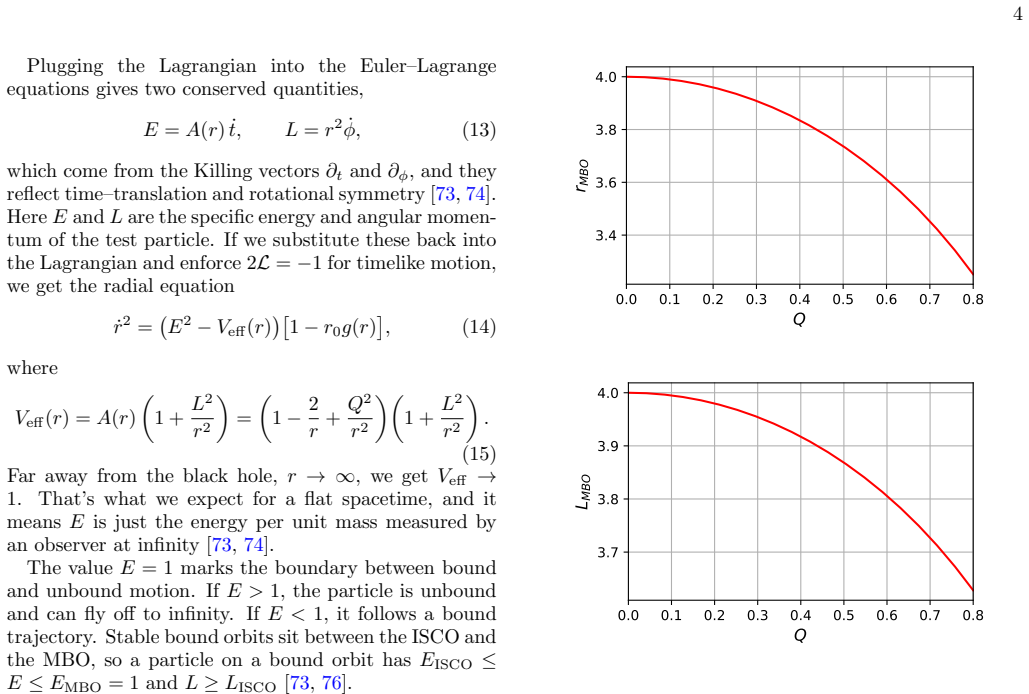
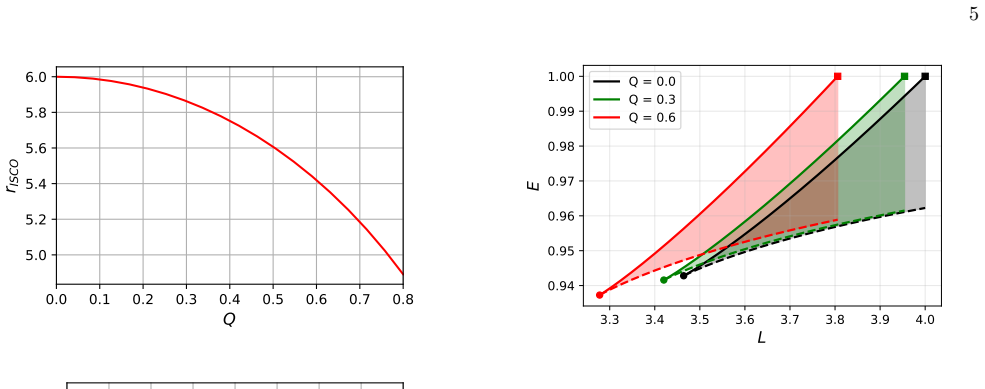
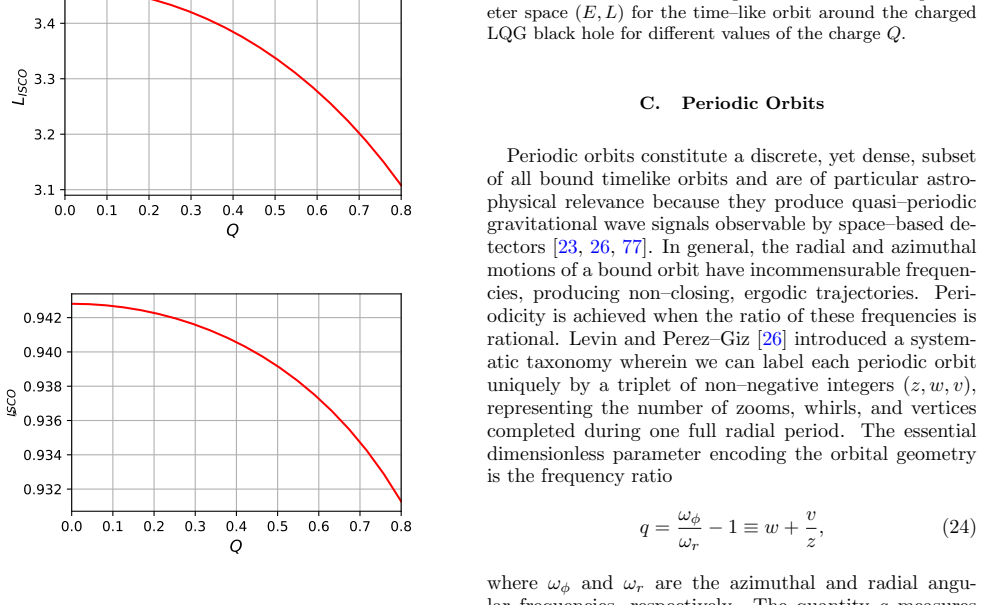
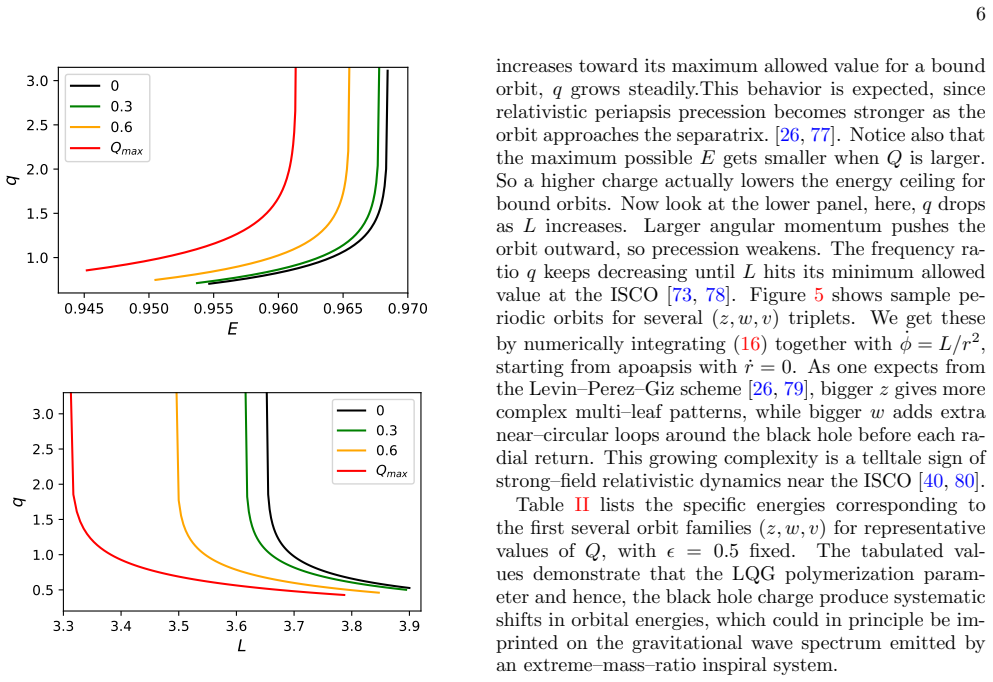
That’s what we expect for a flat spacetime, and it meansEis just the energy per unit mass measured by an observer at infinity [73, 74]. The valueE= 1 marks the boundary between bound and unbound motion. IfE >1, the particle is unbound and can fly off to infinity. IfE <1, it follows a bound trajectory. Stable bound orbits sit between the ISCO and the MBO, ...
-
[2]
B. P. Abbottet al.(LIGO Scientific, Virgo), Phys. Rev. Lett.116, 061102 (2016), arXiv:1602.03837 [gr-qc]
Pith/arXiv arXiv 2016
-
[3]
B. P. Abbottet al.(LIGO Scientific, Virgo), Phys. Rev. D93, 122003 (2016), arXiv:1602.03839 [gr-qc]
Pith/arXiv arXiv 2016
-
[4]
B. P. Abbottet al.(LIGO Scientific, Virgo), Phys. Rev. Lett.116, 241102 (2016), arXiv:1602.03840 [gr-qc]
Pith/arXiv arXiv 2016
-
[5]
B. P. Abbottet al.(LIGO Scientific, Virgo), Phys. Rev. Lett.116, 131103 (2016), arXiv:1602.03838 [gr-qc]
Pith/arXiv arXiv 2016
- [6]
-
[7]
Thiemann, Int
T. Thiemann, Int. J. Mod. Phys. A23, 1113 (2008). 14
2008
-
[8]
C. Rovelli, Class. Quant. Grav.32, 124005 (2015), arXiv:1506.00927 [gr-qc]
Pith/arXiv arXiv 2015
-
[9]
L. Modesto, Int. J. Theor. Phys.49, 1649 (2010), arXiv:0811.2196 [gr-qc]
Pith/arXiv arXiv 2010
-
[10]
A. Ashtekar, J. Olmedo, and P. Singh, Phys. Rev. Lett. 121, 241301 (2018), arXiv:1806.00648 [gr-qc]
Pith/arXiv arXiv 2018
-
[11]
A. Ashtekar, J. Olmedo, and P. Singh, Class. Quant. Grav.37, 205017 (2020), arXiv:2001.08833 [gr-qc]
arXiv 2020
-
[12]
L. Modesto, J. W. Moffat, and P. Nicolini, Phys. Lett. B695, 397 (2011), arXiv:1010.0680 [gr-qc]
Pith/arXiv arXiv 2011
-
[13]
A. Corichi and P. Singh, Class. Quant. Grav.33, 055006 (2016), arXiv:1506.08015 [gr-qc]
Pith/arXiv arXiv 2016
-
[14]
A. Ashtekar, J. Olmedo, and P. Singh, Phys. Rev. D 98, 126003 (2018), arXiv:1806.02406 [gr-qc]
Pith/arXiv arXiv 2018
-
[15]
N. Bodendorfer, F. M. Mele, and J. M¨ unch, Class. Quant. Grav.38, 095002 (2021), arXiv:1912.00774 [gr- qc]
arXiv 2021
-
[16]
N. Bodendorfer, F. M. Mele, and J. M¨ unch, Phys. Lett. B819, 136390 (2021), arXiv:1911.12646 [gr-qc]
arXiv 2021
-
[17]
B. Elizaga Navascu´ es, A. Garc´ ıa-Quismondo, and G. A. Mena Marug´ an, Phys. Rev. D106, 043531 (2022), arXiv:2208.00425 [gr-qc]
arXiv 2022
-
[18]
B. Elizaga Navascu´ es, A. Garc´ ıa-Quismondo, and G. A. Mena Marug´ an, Phys. Rev. D106, 063516 (2022), arXiv:2207.04677 [gr-qc]
arXiv 2022
-
[19]
A. Alonso-Bardaji, D. Brizuela, and R. Vera, Phys. Rev. D106, 024035 (2022), arXiv:2205.02098 [gr-qc]
arXiv 2022
-
[20]
A. Alonso-Bardaji, D. Brizuela, and R. Vera, Phys. Lett. B829, 137075 (2022), arXiv:2112.12110 [gr-qc]
arXiv 2022
-
[21]
Z. S. Moreira, H. C. D. Lima Junior, L. C. B. Crispino, and C. A. R. Herdeiro, Phys. Rev. D107, 104016 (2023), arXiv:2302.14722 [gr-qc]
arXiv 2023
-
[22]
P. A. Seoaneet al.(LISA), Living Rev. Rel.26, 2 (2023), arXiv:2203.06016 [gr-qc]
Pith/arXiv arXiv 2023
-
[23]
S. Babak, J. Gair, A. Sesana, E. Barausse, C. F. Sop- uerta, C. P. L. Berry, E. Berti, P. Amaro-Seoane, A. Pe- titeau, and A. Klein, Phys. Rev. D95, 103012 (2017), arXiv:1703.09722 [gr-qc]
Pith/arXiv arXiv 2017
-
[24]
L. Barack and C. Cutler, Phys. Rev. D69, 082005 (2004), arXiv:gr-qc/0310125
Pith/arXiv arXiv 2004
-
[25]
J. R. Gair, M. Vallisneri, S. L. Larson, and J. G. Baker, Living Rev. Rel.16, 7 (2013), arXiv:1212.5575 [gr-qc]
Pith/arXiv arXiv 2013
-
[26]
H. A. Borges, I. P. R. Baranov, F. C. Sobrinho, and S. Carneiro, Class. Quant. Grav.41, 05LT01 (2024), arXiv:2310.01560 [gr-qc]
arXiv 2024
-
[27]
J. Levin and G. Perez-Giz, Phys. Rev. D77, 103005 (2008), arXiv:0802.0459 [gr-qc]
Pith/arXiv arXiv 2008
-
[28]
J. Levin, Class. Quant. Grav.26, 235010 (2009), arXiv:0907.5195 [gr-qc]
Pith/arXiv arXiv 2009
-
[29]
J. Levin and B. Grossman, Phys. Rev. D79, 043016 (2009), arXiv:0809.3838 [gr-qc]
Pith/arXiv arXiv 2009
-
[30]
P. Bambhaniya, D. N. Solanki, D. Dey, A. B. Joshi, P. S. Joshi, and V. Patel, Eur. Phys. J. C81, 205 (2021), arXiv:2007.12086 [gr-qc]
arXiv 2021
-
[31]
P. Rana and A. Mangalam, Class. Quant. Grav.36, 045009 (2019), arXiv:1901.02730 [gr-qc]
Pith/arXiv arXiv 2019
-
[32]
V. Misra and J. Levin, Phys. Rev. D82, 083001 (2010), arXiv:1007.2699 [gr-qc]
Pith/arXiv arXiv 2010
-
[33]
Lin and X.-M
H.-Y. Lin and X.-M. Deng, Eur. Phys. J. C83, 311 (2023)
2023
-
[34]
C. Liu, C. Ding, and J. Jing, Commun. Theor. Phys. 71, 1461 (2019), arXiv:1804.05883 [gr-qc]
arXiv 2019
-
[35]
G. Z. Babar, A. Z. Babar, and Y.-K. Lim, Phys. Rev. D96, 084052 (2017), arXiv:1710.09581 [gr-qc]
Pith/arXiv arXiv 2017
-
[36]
Yao and X
J.-T. Yao and X. Li, Phys. Rev. D108, 084067 (2023)
2023
-
[37]
Lin and X.-M
H.-Y. Lin and X.-M. Deng, Universe8, 278 (2022)
2022
-
[38]
C. Gong, T. Zhu, R. Niu, Q. Wu, J.-L. Cui, X. Zhang, W. Zhao, and A. Wang, Phys. Rev. D105, 044034 (2022), arXiv:2112.06446 [gr-qc]
arXiv 2022
-
[39]
Z. C. S. Chan and Y.-K. Lim, Gen. Rel. Grav.57, 35 (2025), arXiv:2502.03082 [gr-qc]
arXiv 2025
-
[40]
R. Wang, F. Gao, and H. Chen, Annals Phys.447, 169167 (2022)
2022
-
[41]
S. Haroon and T. Zhu, Phys. Rev. D112, 044046 (2025), arXiv:2502.09171 [gr-qc]
arXiv 2025
-
[42]
Z.-Y. Tu, T. Zhu, and A. Wang, Phys. Rev. D108, 024035 (2023), arXiv:2304.14160 [gr-qc]
arXiv 2023
-
[43]
Zhou and Y
T.-Y. Zhou and Y. Xie, Eur. Phys. J. C80, 1070 (2020)
2020
-
[44]
M. Alloqulov, S. Shaymatov, B. Ahmedov, and T. Zhu, (2025), arXiv:2508.05245 [gr-qc]
arXiv 2025
-
[45]
Z.-L. Wei, J. Zhang, Y. Xie, and P.-L. Yin, Eur. Phys. J. C85, 698 (2025)
2025
-
[46]
C.-H. Wang, Y.-P. Zhang, T. Zhu, and S.-W. Wei, (2025), arXiv:2508.20558 [gr-qc]
arXiv 2025
-
[47]
S. Yang, Y.-P. Zhang, T. Zhu, L. Zhao, and Y.-X. Liu, JCAP01, 091 (2025), arXiv:2407.00283 [gr-qc]
arXiv 2025
-
[48]
L. Zhao, M. Tang, and Z. Xu, Eur. Phys. J. C85, 36 (2025), arXiv:2411.01979 [gr-qc]
arXiv 2025
-
[49]
Jiang, M
H. Jiang, M. Alloqulov, Q. Wu, S. Shaymatov, and T. Zhu, Phys. Dark Univ.46, 101627 (2024)
2024
-
[50]
M. Alloqulov, T. Xamidov, S. Shaymatov, and B. Ahmedov, Eur. Phys. J. C85, 798 (2025), arXiv:2504.05236 [gr-qc]
arXiv 2025
-
[51]
S. Zare, T. Zhu, L. M. Nieto, S. Lu, and H. Hassan- abadi, (2025), arXiv:2510.05166 [gr-qc]
arXiv 2025
-
[52]
H. Gong, S. Long, X.-J. Wang, Z. Xia, J.-P. Wu, and Q. Pan, (2025), arXiv:2509.23318 [gr-qc]
Pith/arXiv arXiv 2025
- [53]
-
[54]
W. Deng, S. Long, Q. Tan, and J. Jing, (2025), arXiv:2510.24468 [gr-qc]
arXiv 2025
-
[55]
A. Kumar, A. Mohammadi, and S. G. Ghosh, (2026), arXiv:2605.07187 [gr-qc]
Pith/arXiv arXiv 2026
- [56]
-
[57]
J. R. Gair and K. Glampedakis, Phys. Rev. D73, 064037 (2006), arXiv:gr-qc/0510129
Pith/arXiv arXiv 2006
-
[58]
X. Qiao, Z.-W. Xia, Q. Pan, H. Guo, W.-L. Qian, and J. Jing, JCAP03, 006 (2025), arXiv:2408.10022 [gr-qc]
arXiv 2025
-
[59]
S. Yang, Y.-P. Zhang, L. Zhao, and Y.-X. Liu, Eur. Phys. J. C86, 35 (2026), arXiv:2509.24835 [gr-qc]
arXiv 2026
-
[60]
Amaro-Seoaneet al.(LISA), (2017), arXiv:1702.00786 [astro-ph.IM]
P. Amaro-Seoaneet al.(LISA), (2017), arXiv:1702.00786 [astro-ph.IM]
Pith/arXiv arXiv 2017
-
[61]
Hu and Y.-L
W.-R. Hu and Y.-L. Wu, Natl. Sci. Rev.4, 685 (2017)
2017
-
[62]
J. Luoet al.(TianQin), Class. Quant. Grav.33, 035010 (2016), arXiv:1512.02076 [astro-ph.IM]
Pith/arXiv arXiv 2016
-
[63]
G. Immirzi, Nucl. Phys. B Proc. Suppl.57, 65 (1997), arXiv:gr-qc/9701052
Pith/arXiv arXiv 1997
-
[64]
K. A. Meissner, Class. Quant. Grav.21, 5245 (2004), arXiv:gr-qc/0407052
Pith/arXiv arXiv 2004
-
[65]
A. Ghosh and P. Mitra, Phys. Rev. D71, 027502 (2005), arXiv:gr-qc/0401070
Pith/arXiv arXiv 2005
- [66]
-
[67]
R. Tibrewala, Class. Quant. Grav.29, 235012 (2012), arXiv:1207.2585 [gr-qc]. 15
Pith/arXiv arXiv 2012
-
[68]
R. Gambini, E. M. Capurro, and J. Pullin, Phys. Rev. D91, 084006 (2015), arXiv:1412.6055 [gr-qc]
Pith/arXiv arXiv 2015
-
[69]
R. Gambini, F. Ben´ ıtez, and J. Pullin, Universe8, 526 (2022), arXiv:2102.09501 [gr-qc]
arXiv 2022
-
[70]
I. P. R. Baranov, H. A. Borges, F. C. Sobrinho, and S. Carneiro, Class. Quant. Grav.42, 085012 (2025), arXiv:2407.21076 [gr-qc]
arXiv 2025
-
[71]
C. Pigozzo, F. S. Bacelar, and S. Carneiro, Class. Quant. Grav.38, 045001 (2021), arXiv:2001.03440 [gr- qc]
arXiv 2021
-
[72]
N. Bodendorfer, F. M. Mele, and J. M¨ unch, Class. Quant. Grav.36, 195015 (2019), arXiv:1902.04542 [gr- qc]
arXiv 2019
- [73]
-
[74]
Chandrasekhar,The mathematical theory of black holes(1985)
S. Chandrasekhar,The mathematical theory of black holes(1985)
1985
-
[75]
R. M. Wald,General Relativity(Chicago Univ. Pr., Chicago, USA, 1984)
1984
-
[76]
C. W. Misner, K. S. Thorne, and J. A. Wheeler,Grav- itation(W. H. Freeman, San Francisco, 1973)
1973
- [77]
-
[78]
K. Glampedakis, S. A. Hughes, and D. Kennefick, Phys. Rev. D66, 064005 (2002), arXiv:gr-qc/0205033
Pith/arXiv arXiv 2002
-
[79]
J. M. Bardeen, W. H. Press, and S. A. Teukolsky, As- trophys. J.178, 347 (1972)
1972
-
[80]
R. Grossman and J. Levin, Phys. Rev. D79, 043017 (2009), arXiv:0811.3798 [gr-qc]
Pith/arXiv arXiv 2009
discussion (0)
Sign in with ORCID, Apple, or X to comment. Anyone can read and Pith papers without signing in.