REVIEW 4 major objections 6 minor 35 references
MEETING DELEGATE: Benchmarking LLMs on Attending Meetings on Our Behalf
T0 review · 4 major / 6 minor · reviewed 2026-08-09 · deepseek-v4-flash
Pith's one-line read LLM meeting delegates produce a relevant point in about 60% of responses, with model-specific engagement styles and a sharp drop under transcription noise.
desk verdict The benchmark idea and taxonomy are genuinely new, but the headline 60% recall is not trustworthy until the authors confirm that dataset construction does not leak future utterances into the delegate prompt. read the letter →
The pith
A machine-rendered reading of the paper's core claim, the machinery that carries it, and where it could break.
The reading
What carries the argument
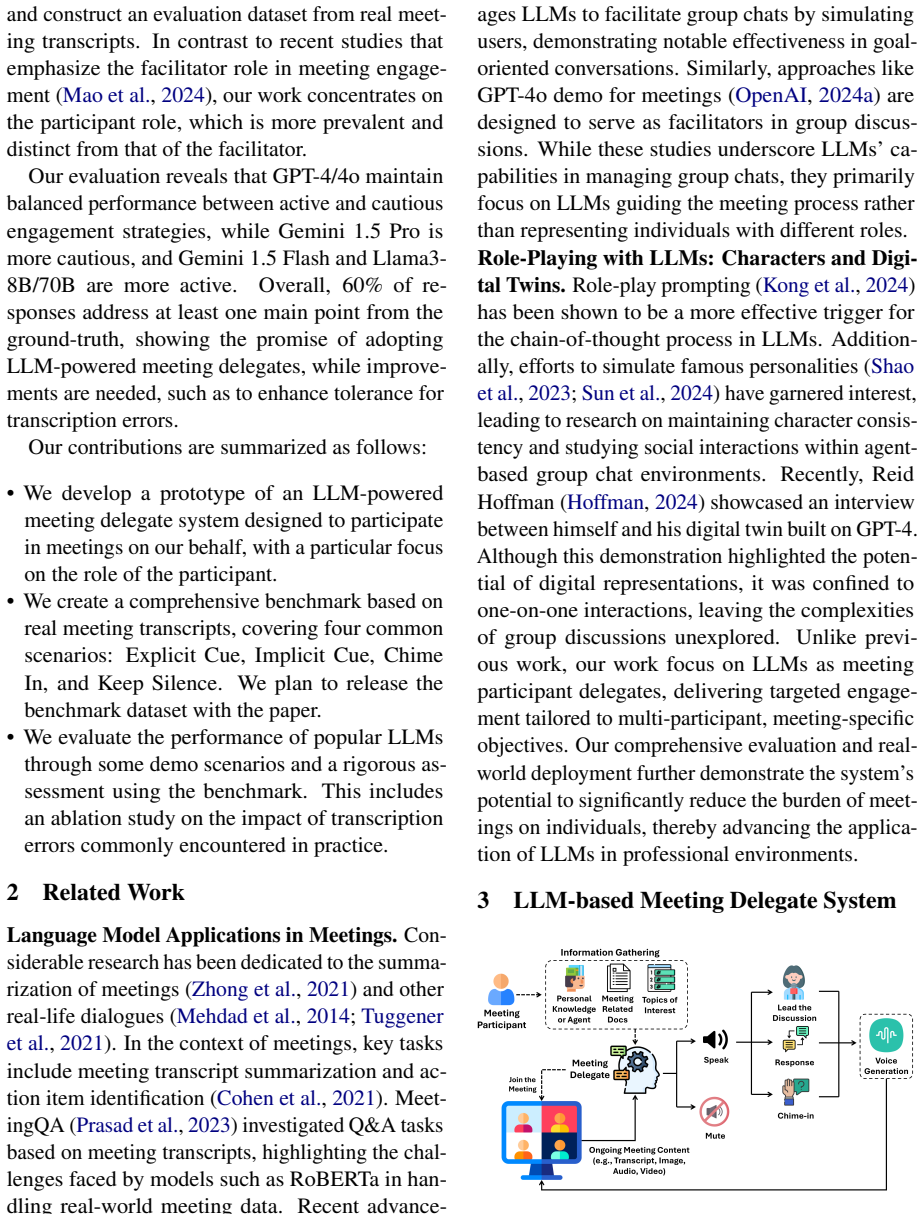
The load-bearing object is the snapshot-based benchmark itself: a test case is a truncated meeting transcript ending at one participant's utterance, paired with that participant's intents and shareable background information, and a ground-truth response assembled from the real subsequent utterances. Three derived datasets give the benchmark its power: the Matched Dataset (846 cases, categorized as Explicit Cue, Implicit Cue, or Chime In), the Mismatched Dataset (294 cases where the delegate should stay silent), and the Noisy Name Dataset (122 cases with phonetically confusable names). The evaluation pipeline then computes response/silence rates, loose and strict recall against ground-truth points, and an attribution score that traces each generated point to the expected response, input context, previous transcript, or hallucination.
What would settle it
Re-run the benchmark construction using only the transcript prefix up to the snapshot for intent extraction, then repeat the response-rate and recall evaluation; if the ~60% loose recall drops substantially, the reported performance is inflated by future-context leakage.
Extended reading notes
Core claim
The paper's central claim is that LLMs can act as viable meeting participants at a prototype level: across seven models, roughly 60% of responses contain at least one main point from the ground-truth response, with hallucination staying near 5%. The behavioral taxonomy shows GPT-4 and GPT-4o keep response rate and silence rate both between 0.7 and 0.8, Gemini 1.5 Pro is the most cautious (silence rate near 0.9), and Gemini 1.5 Flash plus Llama3-8B/70B are more active, speaking too often in situations where they should stay silent. Attribution analysis finds that only about 40–50% of generated points come from the expected response, roughly 30% come from other provided context, and transcription errors that mangle participant names cause response rates to fall by up to 26 percentage points (e.g., GPT-4o from 94.3% to 68.0% on explicit cues).
Load-bearing premise
The benchmark assumes the intents and shareable information given to the delegate at each snapshot come only from what was said before that moment, but the paper's extraction method uses a sliding window over the whole transcript, so future content could leak into the model's input.
Editorial extensions
If this is right
- The 60% loose-recall rate provides a baseline: any future meeting-delegate system could be compared directly against this benchmark, making progress measurable.
- The correlation between general model capability and meeting-delegate performance suggests that as LLMs improve, meeting delegation will improve without task-specific fine-tuning.
- The minimal performance impact observed when removing <Context> conditions implies that users may not need to pre-specify disclosure rules; intent alone might be enough for a Phase I delegate.
- The sharp drop on the Noisy Name Dataset indicates that robust name recognition under speech-to-text errors is a concrete bottleneck that targeted fine-tuning or multi-modal input should address.
Reading between the lines
- A natural extension is to use the benchmark to tune an engagement-calibration parameter, letting organizations choose a delegate that favors caution for sensitive meetings or activity for brainstorming sessions.
- The benchmark's snapshot construction, if released, could serve as a reusable testbed for 'participant role' modeling, complementing existing facilitator-focused group-chat benchmarks.
- The good performance without explicit context conditions hints that a simpler user interface—where the user only lists topics and facts, without 'when to share' rules—could already work in practice, which is a testable design decision for a real deployment.
Editorial analysis
A structured set of objections, weighed in public.
Referee Report
Summary. This paper proposes a prototype LLM-powered meeting delegate system and a benchmark built from real ELITR meeting transcripts. Test cases are constructed as transcript snapshots: an LLM is prompted with a de-identified user's intents and shareable background information plus the meeting transcript up to the snapshot, and its generated response is compared against a ground-truth response extracted from subsequent utterances in the original meeting. The authors evaluate seven LLMs on response/silence rates, loose and strict recall, and attribution, and report that GPT-4 and GPT-4o maintain a balanced engagement strategy, Gemini 1.5 Pro is cautious, and Gemini 1.5 Flash and Llama3 models are more active, with about 60% loose recall overall. Additional ablations study the effect of speaker-name transcription noise and the removal of <Context> pairs from the background information.
Significance. The paper addresses a timely and underexplored task: using LLMs as meeting participants rather than facilitators or summarizers. Its strengths are the use of real multi-party meeting transcripts, the concrete prototype and deployment discussion, the four engagement categories, the Noisy Name Dataset, and the unusually transparent prompt documentation in the appendix. If the evaluation were causally sound, the behavioral taxonomy (balanced vs. cautious vs. active models) and the headline 60% loose-recall figure would be a useful reference for practitioners building meeting-delegate systems. However, the quantitative claims currently rest on a dataset-construction procedure that can leak future utterances into the model input, and the GPT-4-based evaluation loop is validated on only 30 manually checked cases. The significance is therefore conditional on correcting the temporal-causality flaw and re-reporting the main results.
major comments (4)
- [Section 4.1, Figure 8, Table 21] The dataset construction is not causal with respect to the snapshot. Section 4.1 says that intents and shareable information are obtained by 'progressively' analyzing each participant's utterances with a sliding window, and Figure 8 shows that the Input Context Information is extracted from the participant's utterances in the Original Transcript. The prompt in Table 21 updates a summary of the participant's utterances across the whole transcript and never restricts the update to the portion of the transcript before the snapshot's timestamp. Because a ground-truth response is defined from 'several subsequent utterances' (Section 4.1), the delegate's prompt at a snapshot can include the exact content that later appears as the ground truth. For instance, Table 24's extracted 'provided information' for PERSON6 contains the statement about calculating word error rate that is also the ground-truth response in the worked example. This contamination inflates Response Rate on the Matched Dataset, loose and strict Recall, and the Expected Response attribution, and it affects every evaluated model. The authors should rebuild the dataset so that, for a snapshot after utterance t, only utterances with id <= t are used to derive the participant's intents and shareable information, and they should report the main results before and after this correction.
- [Section 4.2, Table 19, Figure 7] The Attribution metric cannot distinguish between answering from the live meeting and copying from the provided background. The attribution prompt in Table 19 assigns a point to the Expected Response category when it matches the StandardResponse, irrespective of whether the same content also appears in the ContextInfo. Given the leakage described above, a delegate that simply reproduces a sentence from the Intents or Background receives credit for 'Expected Response' even though it did not need to process the meeting transcript. Thus the observed 40-50% Expected Response rates in Figure 7 and Table 8 do not substantiate the claim that LLMs respond to given cues in real time. The authors should either re-run attribution with causally restricted context or report attribution separately for cases where the ground-truth content is and is not present in the input context.
- [Section 5, Table 6, Figure 6] The cross-model comparison is contaminated by the same leakage and the effect may not be uniform across models. More capable models are likely to exploit the background information in the prompt more effectively than weaker models, so the reported ranking ('GPT-4o highest, GPT-4 next') and the active/cautious taxonomy in Figure 4 could reflect how well each model copies from leaked context rather than how well it attends to the meeting. After fixing the temporal split, the authors should verify whether the 60% loose-recall headline and the model ordering persist; the Response/Silence trade-off in Figure 4 should also be re-plotted on the corrected dataset.
- [Section 4.2 and Section 4.1] The human validation is too thin for the load it carries. The entire pipeline—intent extraction (Table 21), test-case extraction (Table 27), ground-truth construction, recall scoring (Table 17), and attribution (Table 19)—is GPT-4-based, with GPT-4 among the evaluated models. Only 30 randomly sampled cases are manually validated for the Recall and Attribution tasks, and no inter-annotator agreement or per-category breakdown is given. Manual verification of the extracted test cases is mentioned in Section 4.1, but the number of verified cases and the agreement level are not reported. The authors should add a larger human-evaluated held-out set, report agreement per metric and per model family, and ideally include a non-GPT judge to estimate judge-model bias.
minor comments (6)
- [Section 5, Figure 4] The text says GPT-4 and GPT-4o have Response/Silence Rates 'between 0.7 and 0.8', but Table 2 gives GPT-4 a Matched response rate of 68.9%; please align the text with the exact values or define the intended range.
- [Section 5, Correlation Analysis] The statement that 'no significant relationships' were observed is not backed by any test statistic; report correlation coefficients (e.g., Spearman's rho) with confidence intervals or p-values.
- [Section 4.1] The claim that 'the extracted cases are manually verified by two authors' does not state how many cases were verified or the level of agreement; add these details.
- [Appendix B, Tables 7 and 9] Several table captions say 'due to limited statistics' without giving the per-model and per-category sample sizes after intersection; add the exact case counts so readers can assess the stability of the intersection results.
- [Data Availability] The paper repeatedly states 'we plan to release the benchmark dataset' but provides no URL, license, or release timeline; an availability statement would help readers evaluate the benchmark's reproducibility.
- [Table 14] There is a typo in the instruction 'determine whether you are can speak'; also, the guideline 'You MUST NOT repeat what <Person Name> has said' is ambiguous when <Person Name>'s earlier utterances are part of the current transcript and should be clarified.
Circularity Check
Ground-truth response is baked into the delegate's shareable information, so the 60% loose recall is partly a copy-from-input measure.
-
self definitional
[Section 4.1 (Dataset Construction); Appendix Table 21 (context-information extraction prompt)]
"we first employ GPT-4 to progressively analyze each participant’s utterances by taking a “sliding window” on the original meeting transcript. This is to capture their meeting intents and the information that they can share during the meeting, serving as the critical input to the Meeting Engagement module for response generation. ... The ground-truth response is determined by considering several subsequent utterances."
The snapshot's live meeting context is temporally truncated ('use the preceding transcript as the ongoing meeting context'), but the <Intents>/<Background> supplied to the delegate are extracted by sliding over the whole original transcript, progressively summarizing each participant's utterances. That summary includes the same subsequent utterances from which the ground-truth response is later defined. Table 21 explicitly instructs the extractor to preserve the participant's original utterances as 'provided information.' Thus, for a snapshot, the model is given the answer text inside its input context; 'loose recall' then largely measures whether the generated response borrows a phrase from the provided information.
full rationale
The paper does not rely on self-citation; the cited LLM-annotation support (Gilardi et al.) and the manual validation of 30 samples are external or author-performed checks that do not establish causal isolation. The central circularity is in benchmark construction: the delegate's shareable information is extracted from the whole meeting transcript, while the ground-truth response is defined from subsequent utterances of the same participant. The manual validation only checks the GPT-4 judge's semantic-comparison accuracy; it does not check whether the ground truth leaked into the prompt. Consequently, the abstract's 60% loose-recall claim and the balanced-versus-cautious taxonomy, which rest on Response Rate and Recall, are not established by the current construction. This is a construction-level circularity rather than a mathematical derivation reducing exactly to its inputs, so a score of 6 is appropriate rather than 8 or 10.
Assumptions & free parameters
assumptions (4)
- domain assumption The actual subsequent utterances of the original participant are the correct delegate responses.
- domain assumption GPT-4-based extraction and evaluation is accurate enough to measure recall and attribution.
- domain assumption The extracted intents and background information do not include utterances after the snapshot.
- domain assumption ELITR Minuting Corpus transcripts are representative of real workplace meetings.
Cite this review
Pith. "Pith review of MEETING DELEGATE: Benchmarking LLMs on Attending Meetings on Our Behalf." pith.science (2026). https://pith.science/paper/LIIDGUQT
@misc{pith2026250204376,
  author       = {Pith},
  title        = {Pith review of: MEETING DELEGATE: Benchmarking LLMs on Attending Meetings on Our Behalf},
  year         = {2026},
  howpublished = {\url{https://pith.science/paper/LIIDGUQT}},
  note         = {Machine review of arXiv:2502.04376}
}
read the original abstract
In contemporary workplaces, meetings are essential for exchanging ideas and ensuring team alignment but often face challenges such as time consumption, scheduling conflicts, and inefficient participation. Recent advancements in Large Language Models (LLMs) have demonstrated their strong capabilities in natural language generation and reasoning, prompting the question: can LLMs effectively delegate participants in meetings? To explore this, we develop a prototype LLM-powered meeting delegate system and create a comprehensive benchmark using real meeting transcripts. Our evaluation reveals that GPT-4/4o maintain balanced performance between active and cautious engagement strategies. In contrast, Gemini 1.5 Pro tends to be more cautious, while Gemini 1.5 Flash and Llama3-8B/70B display more active tendencies. Overall, about 60\% of responses address at least one key point from the ground-truth. However, improvements are needed to reduce irrelevant or repetitive content and enhance tolerance for transcription errors commonly found in real-world settings. Additionally, we implement the system in practical settings and collect real-world feedback from demos. Our findings underscore the potential and challenges of utilizing LLMs as meeting delegates, offering valuable insights into their practical application for alleviating the burden of meetings.
Figures


Figures from the paper (5 more)


Reference graph
Works this paper leans on
-
[1]
Usman Anwar, Abulhair Saparov, Javier Rando, Daniel Paleka, Miles Turpin, Peter Hase, Ekdeep Singh Lubana, Erik Jenner, Stephen Casper, Oliver Sourbut, Benjamin L. Edelman, Zhaowei Zhang, Mario Günther, Anton Korinek, Jose Hernandez-Orallo, Lewis Hammond, Eric Bigelow, Alexander Pan, Lauro Langosco, Tomasz Korbak, Heidi Zhang, Ruiqi Zhong, Seán Ó hÉigeart...
arXiv 2024
-
[2]
Sumit Asthana, Sagih Hilleli, Pengcheng He, and Aaron Halfaker. 2023. https://arxiv.org/abs/2307.15793 Summaries, highlights, and action items: Design, implementation and evaluation of an llm-powered meeting recap system . Preprint, arXiv:2307.15793
arXiv 2023
-
[3]
Bender, Timnit Gebru, Angelina McMillan-Major, and Shmargaret Shmitchell
Emily M. Bender, Timnit Gebru, Angelina McMillan-Major, and Shmargaret Shmitchell. 2021. https://doi.org/10.1145/3442188.3445922 On the dangers of stochastic parrots: Can language models be too big? In Proceedings of the 2021 ACM Conference on Fairness, Accountability, and Transparency, FAccT '21, page 610–623, New York, NY, USA. Association for Computing...
-
[4]
Cerebrium . 2024. https://fastvoiceagent.cerebrium.ai/ Fast voice agent . Accessed: 2024-09-19
work page 2024
-
[5]
Amir Cohen, Amir Kantor, Sagi Hilleli, and Eyal Kolman. 2021. https://doi.org/10.18653/v1/2021.findings-acl.253 Automatic rephrasing of transcripts-based action items . In Findings of the Association for Computational Linguistics: ACL-IJCNLP 2021, pages 2862--2873, Online. Association for Computational Linguistics
-
[6]
Fabrizio Gilardi, Meysam Alizadeh, and Maël Kubli. 2023. https://doi.org/10.1073/pnas.2305016120 Chatgpt outperforms crowd workers for text-annotation tasks . Proceedings of the National Academy of Sciences, 120(30):e2305016120
-
[7]
Google. 2024 a . https://arxiv.org/abs/2403.05530 Gemini 1.5: Unlocking multimodal understanding across millions of tokens of context . Preprint, arXiv:2403.05530
arXiv 2024
-
[8]
Google. 2024 b . https://deepmind.google/technologies/gemini/ Gemini models . Accessed: 2024-09-18
work page 2024
Show all 35 references
-
[9]
Reid Hoffman. 2024. https://www.youtube.com/watch?v=rgD2gmwCS10 Reid hoffman meets his ai twin - full . Accessed: 2024-09-18
2024
-
[10]
Enkelejda Kasneci, Kathrin Sessler, Stefan Küchemann, Maria Bannert, Daryna Dementieva, Frank Fischer, Urs Gasser, Georg Groh, Stephan Günnemann, Eyke Hüllermeier, Stephan Krusche, Gitta Kutyniok, Tilman Michaeli, Claudia Nerdel, Jürgen Pfeffer, Oleksandra Poquet, Michael Sail...
2023
-
[11]
Kirk, Bertie Vidgen, Paul R \"o ttger, et al
Hannah R. Kirk, Bertie Vidgen, Paul R \"o ttger, et al. 2024. https://doi.org/10.1038/s42256-024-00820-y The benefits, risks and bounds of personalizing the alignment of large language models to individuals . Nature Machine Intelligence, 6:383--392
2024 doi
-
[12]
Aobo Kong, Shiwan Zhao, Hao Chen, Qicheng Li, Yong Qin, Ruiqi Sun, Xin Zhou, Enzhi Wang, and Xiaohang Dong. 2024. https://aclanthology.org/2024.naacl-long.228 Better zero-shot reasoning with role-play prompting . In Proceedings of the 2024 Conference of the North American Chap...
2024
-
[13]
Danielle Kost. 2020. https://hbswk.hbs.edu/item/you-re-right-you-are-working-longer-and-attending-more-meetings You're right! you are working longer and attending more meetings . Accessed: 2024-09-18
2020
-
[14]
Manqing Mao, Paishun Ting, Yijian Xiang, Mingyang Xu, Julia Chen, and Jianzhe Lin. 2024. https://arxiv.org/abs/2401.04883 Multi-user chat assistant (muca): a framework using llms to facilitate group conversations . Preprint, arXiv:2401.04883
2024 arXiv
-
[15]
Yashar Mehdad, Giuseppe Carenini, and Raymond T. Ng. 2014. https://doi.org/10.3115/v1/P14-1115 Abstractive summarization of spoken and written conversations based on phrasal queries . In Proceedings of the 52nd Annual Meeting of the Association for Computational Linguistics (V...
2014 doi
-
[16]
Meta. 2024. https://llama.meta.com/ Meta llama . Accessed: 2024-09-18
2024
-
[17]
Marino Mugayar-Baldocchi, Bill Schaninger, and Kartik Sharma. 2021. https://www.mckinsey.com/capabilities/people-and-organizational-performance/our-insights/the-organization-blog/the-future-of-the-workplace-embracing-change-and-fostering-connectivity The future of the workplac...
2021
-
[18]
Anna Nedoluzhko, Muskaan Singh, Marie Hled \'i kov \'a , Tirthankar Ghosal, and Ondrej Bojar. 2022. https://api.semanticscholar.org/CorpusID:250157963 Elitr minuting corpus: A novel dataset for automatic minuting from multi-party meetings in english and czech . In Internationa...
2022
-
[19]
OpenAI. 2023. https://arxiv.org/abs/2303.08774 Gpt-4 technical report . Preprint, arXiv:2303.08774
2023 arXiv
-
[20]
OpenAI. 2024 a . https://openai.com/index/hello-gpt-4o/ Hello gpt-4o . Accessed: 2024-09-18
2024
-
[21]
OpenAI. 2024 b . https://openai.com/index/introducing-the-realtime-api/ Introducing the realtime api . Accessed: 2024-10-15
2024
-
[22]
OpenAI. 2024 c . https://platform.openai.com/docs/models Models . Accessed: 2024-09-18
2024
-
[23]
Long Ouyang, Jeffrey Wu, Xu Jiang, Diogo Almeida, Carroll Wainwright, Pamela Mishkin, Chong Zhang, Sandhini Agarwal, Katarina Slama, Alex Ray, John Schulman, Jacob Hilton, Fraser Kelton, Luke Miller, Maddie Simens, Amanda Askell, Peter Welinder, Paul F Christiano, Jan Leike, a...
2022
-
[24]
Perlow, Constance Noonan Hadley, and Eunice Eun
Leslie A. Perlow, Constance Noonan Hadley, and Eunice Eun. 2017. https://hbr.org/2017/07/stop-the-meeting-madness Stop the meeting madness . Accessed: 2024-09-18
2017
-
[25]
Archiki Prasad, Trung Bui, Seunghyun Yoon, Hanieh Deilamsalehy, Franck Dernoncourt, and Mohit Bansal. 2023. https://doi.org/10.18653/v1/2023.acl-long.837 M eeting QA : Extractive question-answering on meeting transcripts . In Proceedings of the 61st Annual Meeting of the Assoc...
2023 doi
-
[26]
Zengyi Qin, Wenliang Zhao, Xumin Yu, and Xin Sun. 2023. https://arxiv.org/abs/2312.01479 Openvoice: Versatile instant voice cloning . Preprint, arXiv:2312.01479
2023 arXiv
-
[27]
Yunfan Shao, Linyang Li, Junqi Dai, and Xipeng Qiu. 2023. https://aclanthology.org/2023.emnlp-main.814 Character- LLM : A trainable agent for role-playing . In Proceedings of the 2023 Conference on Empirical Methods in Natural Language Processing, pages 13153--13187, Singapore...
2023
-
[28]
Jared Spataro. 2020. https://www.microsoft.com/en-us/microsoft-365/blog/2020/04/09/remote-work-trend-report-meetings/ Remote work trend report: meetings . Accessed: 2024-09-18
2020
-
[29]
Fung, Hou Pong Chan, ChengXiang Zhai, and Heng Ji
Chenkai Sun, Ke Yang, Revanth Gangi Reddy, Yi R. Fung, Hou Pong Chan, ChengXiang Zhai, and Heng Ji. 2024. https://arxiv.org/abs/2402.11060 Persona-db: Efficient large language model personalization for response prediction with collaborative data refinement . Preprint, arXiv:2402.11060
2024 arXiv
-
[30]
Don Tuggener, Margot Mieskes, Jan Deriu, and Mark Cieliebak. 2021. https://doi.org/10.18653/v1/2021.newsum-1.12 Are we summarizing the right way? a survey of dialogue summarization data sets . In Proceedings of the Third Workshop on New Frontiers in Summarization, pages 107--1...
2021 doi
-
[31]
Dickerson
Angelina Wang, Jamie Morgenstern, and John P. Dickerson. 2024. https://arxiv.org/abs/2402.01908 Large language models should not replace human participants because they can misportray and flatten identity groups . Preprint, arXiv:2402.01908
2024 arXiv
-
[32]
Biwei Yan, Kun Li, Minghui Xu, Yueyan Dong, Yue Zhang, Zhaochun Ren, and Xiuzhen Cheng. 2024. https://arxiv.org/abs/2403.05156 On protecting the data privacy of large language models (llms): A survey . Preprint, arXiv:2403.05156
2024 arXiv
-
[33]
Ming Zhong, Da Yin, Tao Yu, Ahmad Zaidi, Mutethia Mutuma, Rahul Jha, Ahmed Hassan Awadallah, Asli Celikyilmaz, Yang Liu, Xipeng Qiu, and Dragomir Radev. 2021. https://doi.org/10.18653/v1/2021.naacl-main.472 QMS um: A new benchmark for query-based multi-domain meeting summariza...
2021 doi
-
[34]
online" 'onlinestring :=
ENTRY address archivePrefix author booktitle chapter edition editor eid eprint eprinttype howpublished institution journal key month note number organization pages publisher school series title type volume year doi pubmed url lastchecked label extra.label sort.label short.list...
-
[35]
write newline
" write newline "" before.all 'output.state := FUNCTION n.dashify 't := "" t empty not t #1 #1 substring "-" = t #1 #2 substring "--" = not "--" * t #2 global.max substring 't := t #1 #1 substring "-" = "-" * t #2 global.max substring 't := while if t #1 #1 substring * t #2 gl...
Reviewed August 9, 2026 · model on record in the stance chip above.
Discussion (0). Continue with ORCID to comment.