REVIEW 3 major objections 5 minor 17 references
Coriolis terms in Skyrmion Quantization
T0 review · 3 major / 5 minor · reviewed 2026-08-14 · deepseek-v4-flash
Pith's one-line read Quantized Skyrmions with vibration-rotation Coriolis coupling reproduce 11 of 12 helium-4 states below 30 MeV
desk verdict New formalism, impressive fit, but the Skyrme-model claim is not yet earned. read the letter →
The pith
A machine-rendered reading of the paper's core claim, the machinery that carries it, and where it could break.
The reading
What carries the argument
The load-bearing object is the gauge field $A_i$ that appears in the metric of the restricted configuration space $\mathcal{C}\simeq SU(2)\times SU(2)\times \mathbb{R}^N$ when rotations and isorotations are treated as the fibres of a principal bundle over shape space; its curvature measures the obstruction to separating zero modes from vibrations. In the quantum Hamiltonian it produces minimal-coupling terms $(p_i-\mathcal{L}\cdot A_i)$ and the Coriolis operators $-\eta\,\mathcal{L}\cdot J_s$ together with $J_s^2$ corrections. Jahn's rule, a symmetry-counting condition from molecular physics, determines $A_i$ up to one or two constants per mode, fitted here as $\eta_-$, $\eta_+$, $\eta_L$ and $\eta_K$. The analysis also introduces the vibrational angular momentum operators $J_s$, $J_t$, $J_s^L$ and $J_s^K$ that generate rotations within the degenerate vibrational spaces, and the metric is approximated near equilibrium as flat ($\delta_{ij}$) with a constant moment of inertia tensor $\Lambda_0$.
What would settle it
Compute the Coriolis coefficient $\eta_K$ directly from explicit vibrating $B=7$ Skyrmion fields: the proposed mechanism for the lithium-7 ground state fails if it is not close to 0.5, and a search for the predicted $0^+$ state in helium-4 near 23.4 MeV would confirm or rule out the $B=4$ fit.
Extended reading notes
Core claim
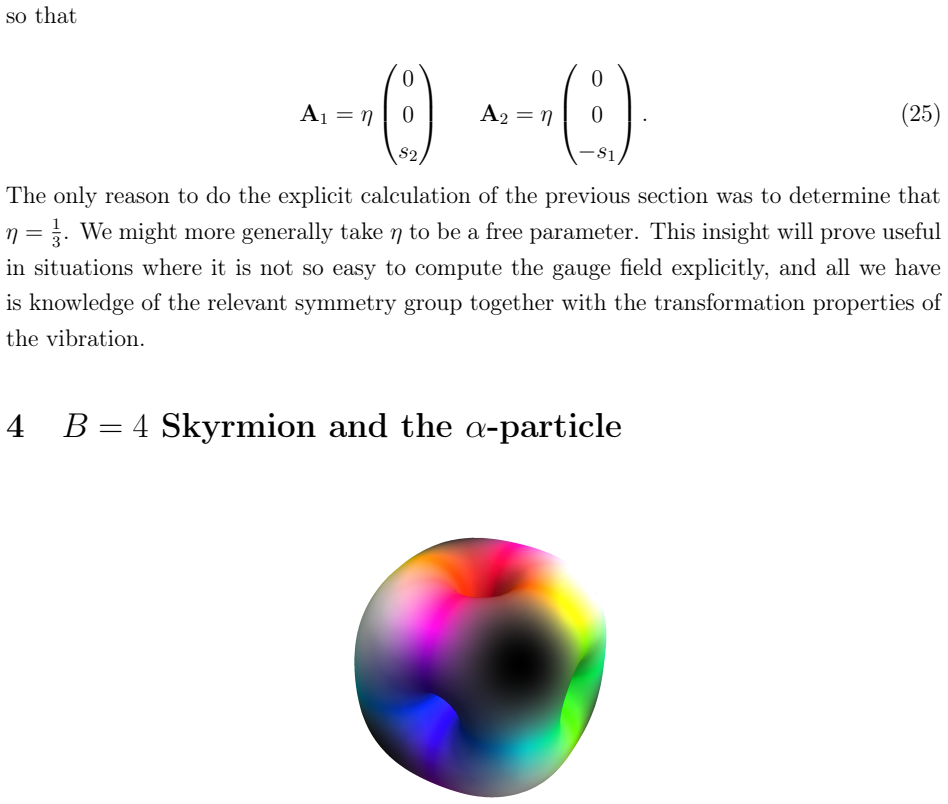
The paper's central claim is that a quantized Skyrmion that vibrates while rotating and isorotating must retain the interaction between the vibrational modes and the zero modes---the molecular-physics analogue of Coriolis coupling---and that including this interaction makes the Skyrme model reproduce the low-lying spectra of light nuclei in detail. For the $B=4$ cube, the helium-4 states below 30 MeV are identified with one- and two-phonon excitations of the $F_2^-$ and $F_2^+$ vibrations, with an $A_2^-$ mode contributing near 28 MeV; a six-parameter fit reproduces 11 of the 12 experimental states with correct spin and parity and predicts a $0^+$ state at 23.4 MeV. For the $B=7$ dodecahedron, an isospin Coriolis term splits the one-phonon $H_5^g$ isospin-1/2 band and, for a coupling coefficient $\eta_K$ near 0.5, lowers the spin-3/2 state enough to give the observed ground state of lithium-7/beryllium-7. The formalism is presented as a general framework for any soliton whose low-energy dynamics contains both zero modes and shape modes.
Load-bearing premise
The calculation assumes that the low-energy dynamics is captured by a handful of harmonic normal modes with a constant moment of inertia tensor and leading-order Coriolis corrections, even for two-phonon states up to 30 MeV, and for the $B=7$ case that the isospin Coriolis coefficient $\eta_K$ is a constant near 0.5; if anharmonic or higher-order terms matter in this range, the computed spectrum would not represent the Skyrme model.
Editorial extensions
If this is right
- The helium-4 spectrum below 30 MeV, apart from one $0^-$ state at 28.6 MeV, is accounted for by one vibrating cube with six parameters, so the Skyrme model no longer needs a separate explanation for the low-spin excitations between 20 and 30 MeV.
- A new $0^+$ state of helium-4 is predicted at 23.4 MeV, where current data have no level, so a dedicated search could confirm or eliminate the fitted spectrum.
- The lithium-7/beryllium-7 ground state loses its rotational-band puzzle: the low spin 3/2 is produced by isospin Coriolis splitting of the one-phonon $H_5^g$ band with $\eta_K\approx 0.5$.
- Because isospin moments of inertia scale as $B$ while spin moments scale as $B^{5/3}$, isospin Coriolis corrections become more important for heavier Skyrmions, affecting many odd-$B$ nuclei.
- The principal-bundle quantization with Coriolis coupling is not restricted to the Skyrme model and applies to any soliton system with zero modes and vibrational modes.
Reading between the lines
- A testable extension the paper leaves implicit: computing the transition form factor of the 20.2 MeV $0^+$ state would distinguish its two-phonon $F_2^-$ assignment from a breathing-mode interpretation.
- The same symmetry-counting machinery could be applied to other soliton systems, such as vortices, monopoles, or domain walls, where zero-mode/vibration coupling is usually dropped.
- The fitted frequency ordering reverses the harmonic ordering of the $B=4$ modes (the $E^+$ breakup mode is pushed above the $F_2$ modes), suggesting anharmonic corrections to the potential are needed before the model is fully predictive.
- For large $B$ the paper's scaling argument implies that odd-$B$ Skyrmion spectra should systematically include isospin Coriolis terms; a numerical calculation of $\eta_K$ from explicit vibrating fields would turn the $B=7$ suggestion into a quantitative prediction.
Signed reviews
Editorial analysis
A structured set of objections, weighed in public.
Referee Report
Summary. This paper develops a quantization formalism for Skyrmions that includes the interaction between vibrational modes and zero modes (rotations and isorotations), in analogy with Coriolis couplings in molecular physics. The author constructs a principal-bundle description of the restricted configuration space, derives the quantum Hamiltonian including the gauge-field coupling, and applies it to the B=4 and B=7 Skyrmions. For B=4, the model treats three vibrational modes (F2-, F2+, A2-) with fitted frequencies and Coriolis parameters, and the resulting spectrum is compared to the experimental helium-4 states below 30 MeV; the paper claims to reproduce 11 of 12 states with correct spin and parity and to predict an additional 0+ state at 23.4 MeV. For B=7, the author shows that an isospin Coriolis term with a constant of order 0.5 can lower the one-phonon 3/2 state relative to the 5/2 and 7/2 states, improving the comparison to the lithium-7/beryllium-7 doublet. The paper also gives a fully worked point-particle example (equilateral triangle) that illustrates the derivation and the use of Jahn's rule to determine the form of the gauge field.
Significance. If the formalism were combined with field-theoretically computed parameters, it would represent a significant step beyond rigid-body quantization of Skyrmions, opening a systematic way to include vibration-rotation and vibration-isospin couplings. The principal-bundle formulation and the generalization of Jahn's rule to isorotations are clean and likely to be useful for future work in the Skyrme model and other soliton systems. The explicit equilateral-triangle example, the character-theoretic derivations, and the table of computed states are valuable. However, the quantitative claims as stated are stronger than what the paper supports: the B=4 comparison is a six-parameter fit to the experimental spectrum, not a test of the Skyrme model, and the fitted frequencies are not the Skyrme-model frequencies. The B=7 result is conditional on an uncomputed Coriolis parameter. These limitations do not invalidate the formalism, but they require a substantial reframing of the paper's conclusions.
major comments (3)
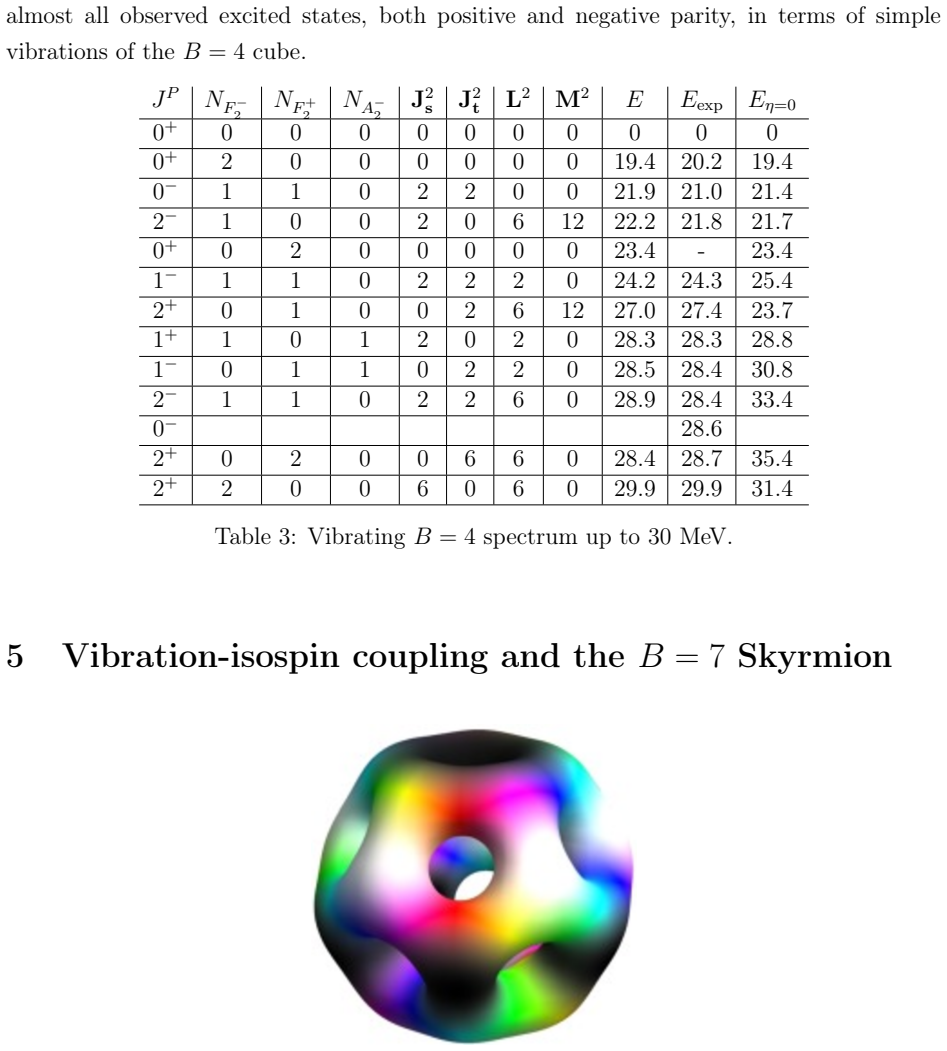
- [Section 4, Eq. (40) and Table 1] The fitted vibrational frequencies in Eq. (40) are not the frequencies of the B=4 Skyrmion. Table 1 lists the four lowest modes with frequencies 0.46 (E+), 0.48 (F2+), 0.52 (A2-), and 0.62 (F2-), so F2- is the stiffest of the four; Eq. (40) instead makes hbar*omega_F2- = 9.7 MeV the softest of the three included modes, with hbar*omega_F2+ = 11.7 MeV and hbar*omega_A2- = 15.1 MeV. The paper's discussion of the E+ discrepancy does not address this reversal of the F2- mode relative to F2+ and A2-. Since the frequencies and the Coriolis parameters eta+ and eta- are free parameters fitted to the helium-4 spectrum, the agreement shown in Table 3 is a fit-quality statement rather than a prediction of the Skyrme model. The claim in Section 4 that "With these 6 parameters we are able to describe 11 of the 12 experimentally observed Helium-4 states below 30 MeV" should be rephrased to make clear that this is a phenomenological fit, and the paper should explain what, if anything, the fit tells us about the Skyrme model itself.
- [Section 4, Eqs. (27) and (37)] The Hamiltonian (37) is derived under a leading-order 1/omega expansion in which the shape-space metric is approximated as flat (delta_ij) and the inertia tensor is approximated by its equilibrium value Lambda0. This approximation is uncontrolled for the two-phonon states that are central to the comparison. With the fitted parameters in Eq. (40), a two-phonon F2- excitation at 19.4 MeV has mean squared vibrational amplitude <s^2> ~ (n+1/2)/omega ~ 0.26 (with hbar=1 and hbar*omega = 9.7 MeV), and the neglected s-dependence of Lambda and the potential gives corrections of order s^2 times the rotational energy (~12 MeV for L=2 with hbar^2/I = 4 MeV), i.e., several MeV. These corrections are comparable to the claimed Coriolis shifts (e.g., 3.3 MeV for the lowest 2+ state), so the quantitative spectrum in Table 3 is not reliably predicted by the truncated Hamiltonian. The authors should estimate the next-order corrections or explicitly restrict the claims to the one-phonon sector.
- [Section 5, Eq. (46) and Table 4] The B=7 result depends on the isospin Coriolis parameter eta_K, which is not computed from the Skyrme model but chosen to reproduce the experimental ratio of energy differences. The symmetry analysis in Eq. (45) determines the gauge field only up to two undetermined constants eta_L and eta_K, and the paper then selects eta_K ~ 0.5 to match the observed E(7/2)-E(3/2) over E(5/2)-E(3/2) ratio of about 1.4. As stated in Section 6, "It would be interesting to calculate eta_K explicitly from the Skyrme model and compare to this value." Consequently, the B=7 discussion is a consistency check of the proposed mechanism, not a quantitative prediction of the Skyrme model. The abstract and conclusions should be modified to state this distinction clearly.
minor comments (5)
- [Section 4, Table 3] Table 3 is difficult to read as typeset: the experimental state "0- 28.6" appears on a line between theoretical rows, making it easy to miscount the states. Please reformat the table so that the experimental states and theoretical states are clearly separated, with column headers identifying each quantity.
- [Section 3, after Eq. (22)] The statement that the V2 term contributes only an additive constant to leading order is correct for the equilateral triangle, but the same reasoning is used later to drop V2 from the B=4 Hamiltonian (37). A sentence noting that this is the same leading-order truncation and not an exact result would help the reader understand the scope of the approximation.
- [Section 4, first paragraph] The sentence "The lowest four vibrational modes [2, 5] of the B=4 Oh-symmetric Skyrmion are listed in Table 1" cites two references; please verify that both references indeed report all four modes and their frequencies, as the table appears to draw the numerical values from reference [2].
- [Section 5, Eqs. (47)-(48)] The operators J_L^s and J_K^s are called vibrational angular momentum operators, but no explanation is given for why they satisfy angular momentum commutation relations. A brief remark that they generate the spin(5) symmetry of the five-dimensional harmonic oscillator would be helpful.
- [Throughout] There are a number of typographical errors: "preceeding" in Section 4, "Frequences" in the Table 1 caption, and "isospin0" in Section 4. These should be corrected in revision.
Circularity Check
The headline helium-4 match is a six-parameter fit, and the B=7 ratio is reproduced by choosing eta_K~0.5; both are fitted inputs presented as explanatory/predictive outputs.
-
fitted input called prediction
[Section 4, Eqs. (37)-(40) and Table 3, text after Eq. (40)]
"Calculating the resulting spectrum, and then fitting the frequencies, Coriolis parameters η+/− and moment of inertia Λ of the B = 4 to nuclear data, we obtain the best fit (in a least-squares sense) for the values ... With these 6 parameters we are able to describe 11 of the 12 experimentally observed Helium-4 states below 30 MeV complete with the correct spin and parity assignments, and we predict one further 0+ state at 23.4 MeV."
The six parameters—ℏωF−2, ℏωF+2, ℏωA−2, η+, η−, and ℏ2/I—are fitted to the helium-4 spectrum below 30 MeV. The subsequent claim to 'describe 11 of 12' states is therefore a measure of the quality of that fit, not an independent prediction from the Skyrme model. The genuinely new 0+ at 23.4 MeV is not fitted to an observed state, so it is a conditional prediction of the fitted Hamiltonian; however, the paper's central quantitative agreement is a fit-quality statement by its own description.
-
fitted input called prediction
[Section 5, B=7 rotational-band ratio comparison; Section 6 conclusions]
"which reproduces the experimental ratio of 1.4 for a Coriolis parameter of ηK≈ 25/4 ΛK/ΛL ∼ 0.5. It would be interesting to calculate ηK explicitly from the Skyrme model and compare to this value."
The B=7 mechanism is made to work by choosing ηK so that the calculated level ratio equals the experimental 1.4. No field-theory computation of ηK is supplied; the paper explicitly defers that calculation. Thus the 'explanation' of the low 3/2 ground state is contingent on a parameter adjusted to reproduce the very ratio it is invoked to explain. This is a fitted-input explanation rather than an independent prediction, although the paper is candid that ηK is not calculated.
full rationale
The paper's general Coriolis formalism is not circular: it adapts a standard principal-bundle construction and applies Jahn's rule from molecular physics, and those steps do not reduce to the paper's own conclusions. The circularity is concentrated in the quantitative applications. For B=4, the frequencies, Coriolis parameters, and moment of inertia are explicitly fitted to nuclear data, so the 11/12 agreement is a post-fit description rather than a parameter-free prediction. The one unobserved predicted state at 23.4 MeV follows from the fitted Hamiltonian and is not itself fitted, giving the B=4 application partial predictive content. For B=7, the ratio that is 'explained' is reproduced by choosing ηK≈0.5, with the paper itself acknowledging that ηK has not been calculated from the Skyrme model. These are fitted inputs used as explanatory outputs, warranting a score of 6 rather than a higher score, because the paper openly labels the parameters as fitted and identifies the Coriolis coefficients as quantities to be computed in future work.
Assumptions & free parameters
free parameters (8)
- omega_F2- =
9.7 MeV (hbar*omega_F2-)
- omega_F2+ =
11.7 MeV (hbar*omega_F2+)
- omega_A2- =
15.1 MeV (hbar*omega_A2-)
- I =
hbar^2/I = 4 MeV
- eta+ =
0.71
- eta- =
0.13
- eta_K =
~0.5
- eta_L
assumptions (6)
- domain assumption The Skyrme Lagrangian (Eq. 2) defines the classical field theory and the induced metric on the restricted configuration space.
- domain assumption The restricted configuration space is a principal SU(2)xSU(2) bundle, and the metric takes the form of Eq. (27) with constant moment of inertia and flat normal-mode blocks.
- domain assumption The low-lying dynamics is captured by a harmonic potential and the leading-order expansion in 1/omega, neglecting higher-order terms and anharmonicities.
- domain assumption The Finkelstein-Rubinstein constraints select physical states by requiring trivial transformation under the rotational subgroup of the symmetry group.
- domain assumption The normal mode frequencies and irreps of the B=4 and B=7 Skyrmions are correctly taken from [2], [5], and [10].
- standard math Jahn's rule and the symmetry group determine the gauge field Ai up to a small number of constants, which are then treated as free parameters.
Cite this review
Pith. "Pith review of Coriolis terms in Skyrmion Quantization." pith.science (2026). https://pith.science/paper/LIJ7SV5I
@misc{pith2026190803414,
  author       = {Pith},
  title        = {Pith review of: Coriolis terms in Skyrmion Quantization},
  year         = {2026},
  howpublished = {\url{https://pith.science/paper/LIJ7SV5I}},
  note         = {Machine review of arXiv:1908.03414}
}
read the original abstract
We consider the problem of quantizing a Skyrmion which is allowed to vibrate, rotate and isorotate. Previous approaches have neglected the interactions between vibrations and zero modes (analogous to so-called Coriolis terms in the molecular physics literature). A new formalism incorporating these interactions is introduced, inspired by a principal bundle approach to deformable-body dynamics. We quantize the B=4 and B=7 Skyrmions and compare the results to observed nuclear properties of Helium-4 and the Lithium-7/Beryllium-7 isospin doublet.
Figures
Reference graph
Works this paper leans on
-
[1]
Gaugefieldsintheseparationofrotationsandinternal motions in the n-body problem,
R.G.LittlejohnandM.Reinsch, “Gaugefieldsintheseparationofrotationsandinternal motions in the n-body problem,” Rev. Mod. Phys 69 (1997) 213
work page 1997
-
[2]
Vibrational modes of Skyrmions,
S. B. Gudnason and C. Halcrow, “Vibrational modes of Skyrmions,” Phys. Rev. D 98 (2018) 125010. 22
work page 2018
-
[3]
An alpha particle model for Carbon-12,
J. I. Rawlinson, “An alpha particle model for Carbon-12,” Nucl. Phys. A 975 (2018) 122
work page 2018
-
[4]
Dynamicalα−cluster model of16O,
C. J. Halcrow, C. King and N. S. Manton, “Dynamicalα−cluster model of16O,” Phys. Rev. C 95 (2017) 031303
work page 2017
-
[5]
Normal Modes of theB = 4 Skyrme Soliton,
C. Barnes, K. Baskerville and N. Turok, “Normal Modes of theB = 4 Skyrme Soliton,” Phys. Rev. Lett 79 (1997) 367-370
work page 1997
-
[6]
Inelastic electron scattering from the alpha particle,
R. F. Frosch et al., “Inelastic electron scattering from the alpha particle,” Phys. Lett 19 (1965) 155
work page 1965
-
[7]
Collective Nuclear “Breathing Mode
C. Werntz and H. Uberall, “Collective Nuclear “Breathing Mode” Model with Applica- tion to Helium-4 Monopole State,” Phys. Rev. 149 (1966) 762
work page 1966
-
[8]
Is the first excited state of theα−particle a breathing mode?,
S. Bacca et al., “Is the first excited state of theα−particle a breathing mode?,” Phys. Rev. C 91 (2015) 024303
work page 2015
Show all 17 references
-
[9]
Nuclear Spectroscopy in theα−particle,
A. de-Shalit and J. D. Walecka, “Nuclear Spectroscopy in theα−particle,” Phys. Rev. 147 (1966) 763
1966
-
[10]
Vibrational spectrum of the B = 7 Skyrme soliton,
W. K. Baskerville, “Vibrational spectrum of the B = 7 Skyrme soliton,” hepth/9906063 (1999)
1999
-
[11]
Vibrational quantisation of theB = 7 Skyrmion,
C. J. Halcrow, “Vibrational quantisation of theB = 7 Skyrmion,” Nucl. Phys. B 904 (2016) 106-123
2016
-
[12]
Skyrmions - beyond rigid body quantisation,
C. J. Halcrow, “Skyrmions - beyond rigid body quantisation,” Doctoral thesis, Cam- bridge University (2017)
2017
-
[13]
Light nuclei as quantized Skyrmions,
O.V. Manko, N.S. Manton and S.W. Wood, “Light nuclei as quantized Skyrmions,” Phys. Rev. C 76 (2007) 055203
2007
-
[14]
Note on Coriolis Coupling Terms in Polyatomic Molecules,
H. A. Jahn, “Note on Coriolis Coupling Terms in Polyatomic Molecules,” Phys. Rev. 56 (1939) 680
1939
-
[15]
TUNL Nuclear Data Evaluation Project, Energy Levels of Light Nuclei, A=3-20, www.tunl.duke.edu/nucldata
-
[16]
Character tables for chemically important point groups, symmetry.jacobs-university.de. 23
-
[17]
Quantized Skyrmions from SU(4) weight diagrams,
C. J. Halcrow, N. S. Manton, and J. I. Rawlinson, “Quantized Skyrmions from SU(4) weight diagrams,” Phys. Rev. C 97 (2018) 034307. 24
2018
Reviewed August 14, 2026 · model on record in the stance chip above.
Discussion (0). Continue with ORCID to comment.