REVIEW 3 major objections 5 minor 23 references
Dynamic Modeling and Efficient Data-Driven Optimal Control for Micro Autonomous Surface Vehicles
T0 review · 3 major / 5 minor · reviewed 2026-08-04 · deepseek-v4-flash
Pith's one-line read This paper claims that a weak-form online learner updating a physics-driven model cuts a centimeter-scale surface vehicle's average tracking error by 75% even when payloads and disturbances change.
desk verdict A coherent weak-form learning + TPBVP control combination for micro-ASVs, but the ground-truth coefficient table is internally inconsistent with the stated physics, which undercuts the headline simulation numbers. read the letter →
The pith
A machine-rendered reading of the paper's core claim, the machinery that carries it, and where it could break.
The reading
What carries the argument
The load-bearing mechanism is weak-form identification of the dynamics coefficients. The right-hand side of each acceleration equation is written as a linear combination of known basis functions: surge velocity and the four thrust forces multiplied by sin θ or cos θ, yielding nine unknown coefficients per translation row and five for the yaw row. For each compact-support test function, the paper integrates the product of the basis-library term and the test function, moves the derivative onto the test function by integration by parts, and solves the resulting least-squares problem for the coefficient vector. This removes the need to differentiate noisy position or velocity data and lets the m
What would settle it
Run the same controller on the physical 85 mm MicroASV in a water tank, add a known 2 kg payload mid-run, and compare the tracking error of the nominal model with the weak-form learning controller; if the error drop does not approach the simulated 75% because the true hydrodynamics do not match the hemisphere/linear-drag basis, the central claim fails.
Extended reading notes
Core claim
On the paper's own terms, the central discovery is that the coefficients of a physics-driven MicroASV model can be extracted online from a short moving window of states and control inputs, and those coefficients are enough to make an optimal controller substantially more accurate. The learning step treats each acceleration component as a linear combination of known basis functions—surge velocity and thrust forces multiplied by sine or cosine of the heading—so the only unknowns are coefficients tied to added mass, drag, and thrust allocation. Multiplying by compactly supported test functions and integrating by parts converts the identification into a least-squares problem on measured trajecto
Load-bearing premise
The simulator's ground truth is generated by the same physics model—hemisphere added mass and linear drag—that defines the learning basis, so if real hydrodynamics fall outside this model class, the learned coefficients and the reported error reductions may not transfer to hardware.
Editorial extensions
If this is right
- A sudden 2 kg payload change on an 85 mm, 0.25 kg boat can be absorbed by online re-identification: average tracking error drops by 75.1% on a sine path and 71.4% on a spiral relative to the nominal controller.
- The same controller improves disturbance response, cutting overshoot by 23.5% and convergence time by 35.7% after a 0.5 s force-couple disturbance.
- When the nominal model is wrong in both payload and effective radius, online identification still cuts mean tracking error by 75%, showing robustness to model inaccuracy.
- Because each one-second optimization cycle solves in about 0.05 s on a laptop CPU, the approach is computationally light enough for small onboard computers, and the authors argue a dedicated solver could push it toward STM32-class microcontrollers.
- The weak-form learning also provides a practical route to online model updates without numerical differentiation of state estimates, which is important for small robots with noisy onboard sensing.
Reading between the lines
- The paper leaves implicit that the method is online calibration of a known model class rather than discovery of unmodeled physics: the basis contains exactly the hemisphere added-mass and linear-drag terms, so a real hull with quadratic or other nonlinear drag would need additional basis functions.
- The yaw coefficient vector differed noticeably from ground truth, yet control quality was unaffected; this suggests the thruster configuration creates symmetries that make total moment insensitive to individual coefficient errors, which would help hardware robustness.
- A natural, untested extension is sharing learned coefficients across a swarm operating in the same water, since all vehicles share the same basis functions; one vehicle's identification could initialize or update its neighbors' models.
Editorial analysis
A structured set of objections, weighed in public.
Referee Report
Summary. The paper develops a physics-driven dynamics model for a centimeter-scale over-actuated MicroASV using Lagrange's equations, with added mass approximated by a hemisphere and drag modeled as linear damping. It then proposes an online dynamics-learning algorithm based on a weak formulation, and couples the learned model with a finite-horizon LQR-type optimal controller formulated as a two-point boundary value problem (TPBVP). Simulation studies on sine and spiral tracking, with payload shifts, model inaccuracy, and external disturbances, report large reductions in tracking error (e.g., 75.1% average and 70.7% maximum error in the sine task).
Significance. The weak-form identification strategy and the efficient TPBVP-based controller are reasonable and potentially useful for small, low-cost ASVs. The paper is clearly written and the algorithmic pipeline is plausible. However, the numerical validation currently rests on a simulator whose reported ground-truth coefficients are internally inconsistent with the stated physics model, and the validation is entirely in-class (the simulator uses the same model class as the learning basis). These issues must be resolved before the performance claims can be considered substantiated.
major comments (3)
- [Section IV-B, Eq. (44) vs. Eqs. (14)-(15)] The reported 'ground-truth coefficients' in Eq. (44) cannot be obtained from the stated parameters and Eq. (15). With m = 0.25 + 0.2 = 0.45 kg, R_eff = 0.08 m, and rho = 1000 kg/m^3, Eq. (14) gives M_eff = 0.45 + 1000*(4/3)*pi*(0.08)^3 ≈ 2.59 kg. Therefore any coefficient multiplying F_i*sin(theta) or F_i*cos(theta) in g1 has magnitude at most 1/2.59 ≈ 0.386, yet Eq. (44) reports 0.5638. Likewise, D_x = mu*4*pi*R_eff ≈ 0.001 N*s/m, so the drag coefficient should be about -0.00039, not -0.4. The learned coefficients in Eq. (43) also exceed the same bound. This indicates that the simulator generating Figs. 4-8 is not the model described by the stated parameters, or that Eq. (44) is erroneous. The central numerical claims are therefore not reproducible from the manuscript as written.
- [Section III-C, Eq. (29)] The claim that the optimization problem in Eq. (29) is convex is false. The dynamics constraint f(x,u) contains sin(theta) and products of states and control inputs, making the feasible set nonconvex. A quadratic positive-definite cost makes the objective convex for a fixed constraint, but not the constrained problem. The calculus-of-variations derivation in Eqs. (31)-(37) yields necessary conditions for a local extremum, not a global minimum. Please remove the convexity/global-minimum statement and describe the TPBVP solution as a stationary/local solution.
- [Section IV-C/D] The validation is entirely in-class: the simulator's ground truth is Eq. (15), which is exactly the model class used to define the learning basis. The reported error reductions are therefore a self-consistency check of the identifier, not evidence of transfer to real hydrodynamics. The paper should include out-of-class tests (e.g., nonlinear drag, non-diagonal added mass, wave-induced forces, or hardware experiments) before claiming robustness in realistic conditions, and should report identification error relative to the true coefficients.
minor comments (5)
- [Throughout] The text contains numerous typos: 'samll', 'historal', 'specifially', 'deriavtives', 'stead-state', 'w is are', and inconsistent use of 'real-time' vs. 'real time'. The manuscript would benefit from a careful proofread.
- [Section III-B, Eq. (27)] The text says timesteps need not be constant, but Eq. (27) writes a single scalar Delta_t. Please clarify the trapezoidal discretization for nonuniform sampling.
- [Section III-C, Eq. (34)] The first integrand has a misplaced delta_x: it should read (lambda_dot^T + lambda^T df/dx + (x-xd)^T Q) delta_x. The transposes and parentheses should also be normalized for clarity.
- [Section IV-C vs. IV-D] In IV-C the simulation adds a 2 kg payload at t=30 s after an initial 0.2 kg payload, while IV-D varies the total payload from 0 to 2 kg. Please state explicitly whether the 2 kg is added on top of the 0.2 kg payload or is the total payload, as the experiment descriptions are ambiguous.
- [Section IV-B] The discrepancy between the learned w3 and the reported w_true3 is dismissed by a symmetry argument that is not quantified. If the controller's heading dynamics matter for tracking, please provide a more rigorous explanation or show the resulting closed-loop effect.
Circularity Check
No circular derivation; the learning/control pipeline is internally consistent, though the validation is in-class and Eq. (44) appears internally inconsistent with Eq. (15).
full rationale
The paper's derivation chain is not circular. The physics-driven model (Eq. 15) is used to define the basis functions for the weak-form learning algorithm, and the simulator uses the same Eq. (15) to generate ground-truth data. This makes the identification experiment an in-class self-consistency check rather than an external validation, but it does not make the reported tracking improvements equivalent to the inputs by construction. The improvement arises because the nominal model is deliberately wrong (payload and R_eff mismatches) and the learned model corrects those errors; that is the intended adaptive-control mechanism, not a fitted parameter renamed as a prediction. The TPBVP optimal-control derivation is a standard variational calculation and does not assume the result. The only self-citation is reference [22] for the MicroASV prototype, which is not load-bearing for the model, learning, or control claims. A separate correctness concern is that the reported ground-truth coefficients in Eq. (44) appear inconsistent with the stated parameters and Eq. (15) (e.g., the magnitude 0.5638 exceeds 1/M_eff ≈ 0.386, and the -0.4 coefficient for X_dot is orders of magnitude larger than D_x/M_eff), but this is an internal-consistency/reproducibility issue, not circularity. Overall, no circular step meets the evidentiary standard; the main limitation is transferability to real hydrodynamics, which the paper itself defers to future hardware work.
Assumptions & free parameters
free parameters (5)
- R_eff (effective radius) =
0.08 m
- I_Gzz (moment of inertia) =
0.0045 kg m^2
- beta (thruster angle) =
not specified numerically
- Q, R, Q_f (cost weights) =
not specified
- Learning period and controller horizon =
30 s, 1 s
assumptions (5)
- domain assumption Three unconstrained generalized coordinates (X_G, Y_G, theta) fully describe the motion; heave, roll, pitch are neglected.
- ad hoc to paper Added mass and drag are modeled by a hemisphere approximation with diagonal matrices (Eqs. 9 and 12).
- domain assumption Drag is linear in velocity at low speeds.
- domain assumption The learned basis functions (Xdot, Fi sin theta, Fi cos theta) are sufficient to span the true dynamics.
- ad hoc to paper The optimization problem is convex because the cost is quadratic with positive definite weights.
Cite this review
Pith. "Pith review of Dynamic Modeling and Efficient Data-Driven Optimal Control for Micro Autonomous Surface Vehicles." pith.science (2026). https://pith.science/paper/LIKDX7BQ
@misc{pith2026250906882,
  author       = {Pith},
  title        = {Pith review of: Dynamic Modeling and Efficient Data-Driven Optimal Control for Micro Autonomous Surface Vehicles},
  year         = {2026},
  howpublished = {\url{https://pith.science/paper/LIKDX7BQ}},
  note         = {Machine review of arXiv:2509.06882}
}
read the original abstract
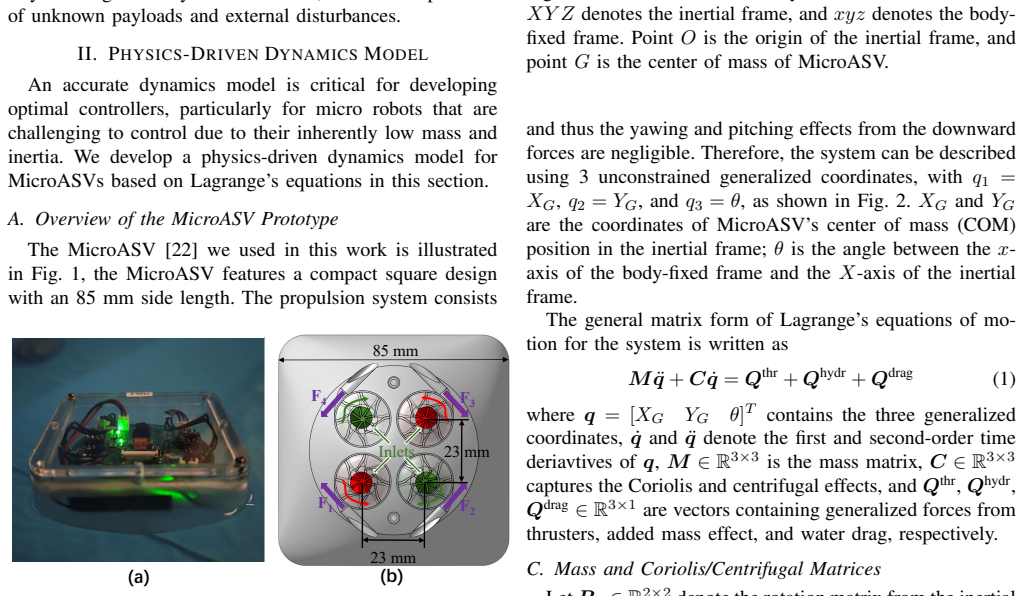
Micro Autonomous Surface Vehicles (MicroASVs) offer significant potential for operations in confined or shallow waters and swarm robotics applications. However, achieving precise and robust control at such small scales remains highly challenging, mainly due to the complexity of modeling nonlinear hydrodynamic forces and the increased sensitivity to self-motion effects and environmental disturbances, including waves and boundary effects in confined spaces. This paper presents a physics-driven dynamics model for an over-actuated MicroASV and introduces a data-driven optimal control framework that leverages a weak formulation-based online model learning method. Our approach continuously refines the physics-driven model in real time, enabling adaptive control that adjusts to changing system parameters. Simulation results demonstrate that the proposed method substantially enhances trajectory tracking accuracy and robustness, even under unknown payloads and external disturbances. These findings highlight the potential of data-driven online learning-based optimal control to improve MicroASV performance, paving the way for more reliable and precise autonomous surface vehicle operations.
Figures


Figures from the paper (5 more)


Reference graph
Works this paper leans on
-
[1]
Underwater gliders for ocean research,
D. L. Rudnick, R. E. Davis, C. C. Eriksen, D. M. Fratantoni, and M. J. Perry, “Underwater gliders for ocean research,”Marine Technology Society Journal, vol. 38, no. 2, pp. 73–84, 2004
work page 2004
-
[2]
Cooperative uav swarms for maritime surveillance,
F. Schill, P. U. Lima, and D. Jung, “Cooperative uav swarms for maritime surveillance,”Autonomous Robots, vol. 32, no. 3, pp. 409– 433, 2017
work page 2017
-
[3]
Towards centimeter-scale underwater mobile robots: An architecture for capableµauvs,
P. Spino and D. Rus, “Towards centimeter-scale underwater mobile robots: An architecture for capableµauvs,” in2024 IEEE International Conference on Robotics and Automation (ICRA). IEEE, 2024, pp. 1484–1490
work page 2024
-
[4]
Review of floating object manipulation by autonomous multi-vessel systems,
Z. Du, R. R. Negenborn, and V . Reppa, “Review of floating object manipulation by autonomous multi-vessel systems,”Annual Reviews in Control, vol. 55, pp. 255–278, 2023
work page 2023
-
[5]
Distributed motion control for multiple connected surface vessels,
W. Wang, Z. Wang, L. Mateos, K. W. Huang, M. Schwager, C. Ratti, and D. Rus, “Distributed motion control for multiple connected surface vessels,” in2020 IEEE/RSJ International Conference on Intelligent Robots and Systems (IROS). IEEE, 2020, pp. 11 658–11 665
work page 2020
-
[6]
Automated self-assembly of large maritime structures by a team of robotic boats,
J. Paulos, N. Eckenstein, T. Tosun, J. Seo, J. Davey, J. Greco, V . Kumar, and M. Yim, “Automated self-assembly of large maritime structures by a team of robotic boats,”IEEE Transactions on Automa- tion Science and Engineering, vol. 12, no. 3, pp. 958–968, 2015
work page 2015
-
[7]
Self-assembly of a swarm of autonomous boats into floating structures,
I. O’hara, J. Paulos, J. Davey, N. Eckenstein, N. Doshi, T. Tosun, J. Greco, J. Seo, M. Turpin, V . Kumaret al., “Self-assembly of a swarm of autonomous boats into floating structures,” in2014 IEEE International Conference on Robotics and Automation (ICRA). IEEE, 2014, pp. 1234–1240
work page 2014
-
[8]
Self- reconfiguration of modular underwater robots using an energy heuris- tic,
L. Furno, M. Blanke, R. Galeazzi, and D. J. Christensen, “Self- reconfiguration of modular underwater robots using an energy heuris- tic,” in2017 IEEE/RSJ International Conference on Intelligent Robots and Systems (IROS). IEEE, 2017, pp. 6277–6284
work page 2017
Show all 23 references
-
[9]
Control ofµ-autonomous surface vehicle using sliding mode control,
Y . Kawamura, J. Tahara, T. Kato, S. Baba, and M. Koike, “Control ofµ-autonomous surface vehicle using sliding mode control,”Sensors and materials, vol. 31, no. 12, pp. 4231–4245, 2019
2019
-
[10]
Development of small autonomous surface vehicle implementing position control system using sliding mode control,
Y . Kawamura, J. Tahara, T. Kato, S. Fujii, S. Baba, and M. Koike, “Development of small autonomous surface vehicle implementing position control system using sliding mode control,”Sens Mater, vol. 33, no. 3, pp. 883–895, 2021
2021
-
[11]
Nonlinear modeling for a water-jet propulsion usv: An experimental study,
J. Han, J. Xiong, Y . He, F. Gu, and D. Li, “Nonlinear modeling for a water-jet propulsion usv: An experimental study,”IEEE Transactions on Industrial Electronics, vol. 64, no. 4, pp. 3348–3358, 2016
2016
-
[12]
Identification of a control oriented nonlinear dynamic usv model,
K. R. Muske, H. Ashrafiuon, G. Haas, R. McCloskey, and T. Flynn, “Identification of a control oriented nonlinear dynamic usv model,” in 2008 American Control Conference. IEEE, 2008, pp. 562–567
2008
-
[13]
Design and experiments with a low- cost single-motor modular aquatic robot,
G. Knizhnik and M. Yim, “Design and experiments with a low- cost single-motor modular aquatic robot,” in2020 17th International Conference on Ubiquitous Robots (UR). IEEE, 2020, pp. 233–240
2020
-
[14]
Collective control for arbitrary configurations of docked mod- boats,
——, “Collective control for arbitrary configurations of docked mod- boats,”arXiv preprint arXiv:2209.04000, 2022
2022 arXiv
-
[15]
Adaptive nonlinear model predictive control for autonomous surface vessels with largely varying payload,
W. Wang, N. Hagemann, C. Ratti, and D. Rus, “Adaptive nonlinear model predictive control for autonomous surface vessels with largely varying payload,” in2021 IEEE International Conference on robotics and automation (ICRA). IEEE, 2021, pp. 7337–7343
2021
-
[16]
Robust model predictive control with control barrier func- tions for autonomous surface vessels,
W. Wang, W. Xiao, A. Gonzalez-Garcia, J. Swevers, C. Ratti, and D. Rus, “Robust model predictive control with control barrier func- tions for autonomous surface vessels,” in2024 IEEE International Conference on Robotics and Automation (ICRA). IEEE, 2024, pp. 6089–6095
2024
-
[17]
Design, modeling, and nonlinear model predic- tive tracking control of a novel autonomous surface vehicle,
W. Wang, L. A. Mateos, S. Park, P. Leoni, B. Gheneti, F. Duarte, C. Ratti, and D. Rus, “Design, modeling, and nonlinear model predic- tive tracking control of a novel autonomous surface vehicle,” in2018 IEEE International Conference on Robotics and Automation (ICRA). IEEE, 201...
2018
-
[18]
Design and realization of lqr course keeping control for small unmanned surface vehicle,
P. Feng, J. Wu, X. Yang, W. Zhang, and H. Guo, “Design and realization of lqr course keeping control for small unmanned surface vehicle,” in2021 China Automation Congress (CAC). IEEE, 2021, pp. 6640–6645
2021
-
[19]
Direct estimation of parameters in ode models using wendy: Weak-form estimation of nonlinear dynamics,
D. M. Bortz, D. A. Messenger, and V . Dukic, “Direct estimation of parameters in ode models using wendy: Weak-form estimation of nonlinear dynamics,”Bulletin of Mathematical Biology, vol. 85, no. 11, p. 110, 2023
2023
-
[20]
Weak sindy: Galerkin-based data- driven model selection,
D. A. Messenger and D. M. Bortz, “Weak sindy: Galerkin-based data- driven model selection,”Multiscale Modeling & Simulation, vol. 19, no. 3, pp. 1474–1497, 2021
2021
-
[21]
J. J. Bramburger,Data-Driven Methods for Dynamic Systems. SIAM, 2024
2024
-
[22]
Microasv: An affordable 3d- printed centimetre-scale autonomous surface vehicle,
K. Macauley, Z. Chen, and W. Wang, “Microasv: An affordable 3d- printed centimetre-scale autonomous surface vehicle,” in2025 IEEE International Conference on Robotics and Automation, 2025, accepted
2025
-
[23]
The weak form is stronger than you think,
D. A. Messenger, A. Tran, V . Dukic, and D. M. Bortz, “The weak form is stronger than you think,”arXiv preprint arXiv:2409.06751, 2024
2024 arXiv
Reviewed August 4, 2026 · model on record in the stance chip above.
Discussion (0). Continue with ORCID to comment.