REVIEW 4 major objections 4 minor 27 references
ELMZip: Onboard Satellite Image Compression via Extreme Learning Machines for Efficient Downlink
T0 review · 4 major / 4 minor · reviewed 2026-08-10 · deepseek-v4-flash
Pith's one-line read ELMZip compresses multispectral satellite images with a convex least-squares fit, beating backprop-trained neural baselines on all six test scenes while using roughly a tenth of the electrical energy.
desk verdict Practical idea with a load-bearing untested assumption; the empirical case is missing bitrate and codec comparisons, but the math is sound and it deserves revision. read the letter →
The pith
A machine-rendered reading of the paper's core claim, the machinery that carries it, and where it could break.
The reading
What carries the argument
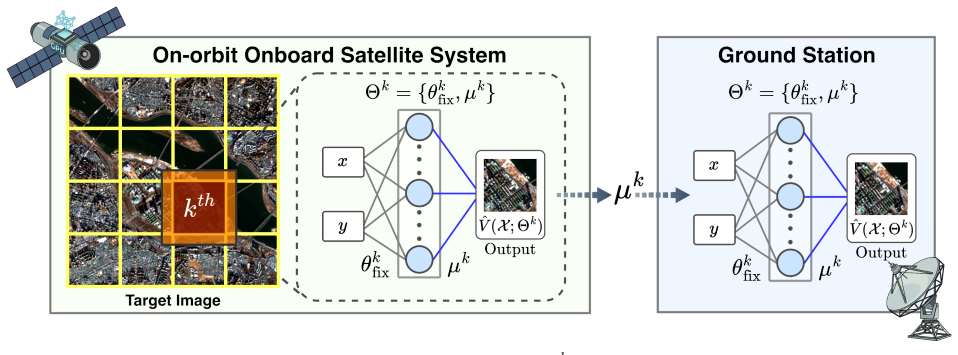
The carrying object is the domain-decomposed extreme learning machine with sine activations. The spatial domain is split into overlapping subdomains, each with a local ELM $\phi_k$ whose hidden matrix $H_k = \omega_k(X)\,\sigma(W^k_{\text{fix}} X + b^k_{\text{fix}})$ is built from fixed random input weights. The output weights come from the normal equations $\hat{\mu}_k = (H_k^\top H_k)^{-1} H_k^\top V^{\text{gt}}_k$, a strictly convex least-squares problem. Smooth window functions $\omega_k$ form a partition of unity, blending local reconstructions into the global image. Because the random input parameters are shared and deterministic, only the output weights must be downlinked.
What would settle it
Run the encoder on the satellite's software stack and the decoder on a different software stack using the same seed, transmitting only the output weights; if the reconstructed image diverges from the onboard fit, the shared-feature premise fails.
Extended reading notes
Core claim
The central claim is that per-image compression of multispectral satellite imagery can be done with an extreme learning machine: a single hidden layer with fixed random sine weights, decomposed into overlapping spatial subdomains, whose only trainable parameters are the output weights. Because those weights solve a linear least-squares problem, fitting is analytic and convex, requiring no backpropagation. The protocol is asymmetric: the satellite and ground station share the fixed random input layer, so the satellite transmits only the output weights, which are far smaller than a full network. The paper reports this setup reconstructs all six Level-0 and Level-1C Sentinel-2 test scenes with the highest PSNR and SSIM among the compared methods, including SIREN, WIRE, Fourier-feature networks, and GaussNet, despite those baselines being allotted roughly ten times more energy.
Load-bearing premise
The method assumes the ground station can reproduce exactly the same random feature values the satellite generated from a shared seed, including identical rounding in the computer arithmetic; otherwise the transmitted output weights will not decode to the intended image.
Editorial extensions
If this is right
- Onboard fitting becomes a linear solve per subdomain, fast enough for a short orbital pass.
- Downlink payload shrinks to the quantized output weights, not the full network, so ground stations can reconstruct a preview before full data arrives.
- The same fixed features and output weights can be evaluated at arbitrary pixel coordinates, giving resolution-free reconstruction without retraining.
- Because the objective is convex, the fit is deterministic and depends on no optimizer hyperparameters.
- Reported gains are largest on complex urban scenes, where over-smoothing is otherwise worst.
Reading between the lines
- If the shared-feature reproduction holds, the asymmetric protocol could generalize to hyperspectral or SAR data by treating extra bands as extra output channels.
- The paper's comparison grants INR baselines about 10x more energy, so a fixed-energy comparison with matched parameter budgets would be a sharper test of the margin.
- A portability failure between the satellite's and ground station's software stacks would make the transmitted weights useless; this is directly testable by cross-environment decoding.
- The convex formulation invites rate-distortion tuning: subdomain count, hidden width, and quantization could be chosen by optimization instead of hand-tuning.
Editorial analysis
A structured set of objections, weighed in public.
Referee Report
Summary. ELMZip proposes an extreme-learning-machine approach to onboard compression of multispectral satellite images. The image is spatially decomposed into overlapping subdomains, each fitted by a single hidden-layer network with fixed random input weights; only the output weights are solved via normal equations and transmitted, while the input weights are pre-shared as a fixed initialization between the satellite and the ground station. Experiments on six Sentinel-2 scenes report PSNR/SSIM for ELMZip and several INR baselines, and the paper claims approximately 10x lower fitting energy for ELMZip. The central least-squares derivation in Eqs. (4)-(5) is straightforward and the qualitative results are promising, but the compression and energy claims are not yet supported by the reported measurements.
Significance. The method is a clean application of ELM/random-feature regression to neural image compression, and the closed-form solve (Eqs. 4-5) is a genuine advantage over backpropagation-based INRs for onboard use. The idea of sharing deterministic random features between encoder and decoder is elegant and, if made robust, could yield a real asymmetric transmission protocol. The paper's main strength is that it avoids circularity: the decoder is a direct evaluation of the fitted model, not a retrained network, and the authors position the work against a concrete operational constraint. However, the current evidence is incomplete: no coded bitrate, no quantization details, no energy measurements, and no test of the shared-initialization reproducibility on which the protocol depends. The potential significance is high if these gaps are filled.
major comments (4)
- [III-A and Eq. (5)] The asymmetric protocol rests on the assumption that the ground station can reproduce the satellite's hidden feature matrix H_k bit-exactly from the shared deterministic initialization. Because the transmitted mu_k solves min ||H_k mu - V_gt|| using the satellite's H_k, any floating-point, RNG, or library difference on the ground changes the feature matrix and invalidates the least-squares solution; no checksum or redundancy is transmitted to detect this. The paper asserts determinism in Section III-A but reports no verification on distinct PyTorch/CUDA/CPU stacks, and the normal-equation solve in Eq. (5) is especially sensitive to conditioning. This is load-bearing: the claimed compression gain over full-network INR transmission depends on transmitting only mu_k. Please add an end-to-end test across hardware/software stacks, or modify the protocol to send enough metadata to reconstruct H_k robustly.
- [IV-A (experimental setup)] The paper never reports an actual bitrate. It states that all methods are constrained to 'at least approximately 10x reduction in payload' and to 'quantized payload settings', but gives no number of hidden units, no number of subdomains, no quantization bits per weight, and no total coded size per image. As a result, the central claim of 'significant compression efficiency' in the abstract is not empirically quantifiable: Table II reports only PSNR/SSIM, not rate-distortion. Please provide full bit budgets, including all side information such as subdomain boundaries, window parameters, and any normalization constants, and report PSNR/SSIM versus bits per pixel, ideally with rate-distortion curves.
- [IV (energy comparison)] The 'approximately 10x less electrical energy' claim is not backed by measurements. No energy meter readings, power traces, or per-method energy numbers are reported; the statement that INR baselines consume about 10x more energy to reach their reported performance is asserted in the setup and repeated in the results. Since the abstract and discussion foreground low energy as a main advantage, please report measured energy, e.g., Jetson Nano power draw and wall-clock time during fitting, for each method and for ELMZip, with error bars if available.
- [IV-B (comparison set)] There is no comparison with standard codecs, despite the introduction motivating the work by the limitations of CCSDS 123 and JPEG. A rate-distortion comparison with JPEG2000 or CCSDS 123.0-B-2 at matched bitrates is necessary for a compression paper, otherwise the reader cannot tell whether ELMZip is competitive with deployed baselines. Also, because the INR baselines are evaluated under unequal energy budgets and no matched bitrate is reported, Table II alone is insufficient to support the conclusion that ELMZip provides a better fidelity/rate trade-off.
minor comments (4)
- [Fig. 4] The figure caption labels the top row as 'Antuco (L0, B8)' and the bottom row as 'Cairo (L1C, B3)', but the Sentinel-2 spectral bands B8 and B3 are never defined; please specify which bands are shown.
- [Table I] The coordinate column contains awkward spacing, and 'V olcano' appears with a line-break-induced space; please format this table with standard degree/minute symbols and consistent spacing.
- [References] Reference [4] contains the typo 'F orward' in the title; please correct it.
- [Abstract] The term 'resolution-free' is used in the abstract but no experiment demonstrates reconstruction at resolutions different from the training resolution; please either add such an experiment or qualify the claim.
Circularity Check
No significant circularity: ELMZip's reconstruction is a direct evaluation of the fitted least-squares output weights, and no load-bearing claim reduces to the paper's own inputs by construction.
full rationale
The derivation chain is self-contained. The satellite fits output weights by solving the normal equations (Eq. 5) for the hidden activation matrix H_k (Eq. 4), transmits only mu_k, and the ground station evaluates V_hat as the partition-of-unity combination of local ELM outputs (Eq. 3). Reconstruction fidelity is a direct evaluation of this fit, not a generalization prediction, so the reported quality is not equivalent to an input by construction; the compression gain is structurally produced by transmitting mu_k only. Self-cited references [7], [14], [18], and [20] appear as background or downstream-use citations, and none supplies a load-bearing premise; no uniqueness theorem or ansatz is imported from the authors' prior work. The material fragility is Section III-A's premise that the shared fixed parameters are deterministic: 'By sharing the fixed parameters θ_fix between the satellite and the ground station, these parameters become deterministic and do not need to be transmitted.' This requires bit-exact reproducibility of H_k across different software/hardware stacks, which the paper does not verify; that is a robustness and verification gap, not a circularity, because mu_k is genuinely fitted to the satellite-side H_k and the ground-station reconstruction is not used to define the fitting objective. Likewise, the roughly 10x energy claim in Section IV-B is reported qualitatively without an energy table, but that is an evidentiary gap rather than a circular reduction.
Assumptions & free parameters
free parameters (5)
- Number of subdomains K =
not stated
- Hidden layer width per subdomain =
not stated
- Window function overlap parameters =
not stated
- Quantization bits per output weight =
not stated
- Random initialization seed and generator =
not stated
assumptions (4)
- domain assumption Random input weights drawn from a continuous distribution can be fixed, and only output weights need to be learned (ELM theory).
- standard math The domain decomposition windows form a partition of unity (sum omega_k = 1).
- domain assumption The normal equations are solvable and well-conditioned for each subdomain.
- domain assumption The ground station can exactly reproduce the random features theta_fix from the shared initialization.
Cite this review
Pith. "Pith review of ELMZip: Onboard Satellite Image Compression via Extreme Learning Machines for Efficient Downlink." pith.science (2026). https://pith.science/paper/LIT7WXVL
@misc{pith2026260806942,
  author       = {Pith},
  title        = {Pith review of: ELMZip: Onboard Satellite Image Compression via Extreme Learning Machines for Efficient Downlink},
  year         = {2026},
  howpublished = {\url{https://pith.science/paper/LIT7WXVL}},
  note         = {Machine review of arXiv:2608.06942}
}
read the original abstract
The acquisition of multispectral imagery via small satellites (e.g., CubeSats) presents significant data downlink challenges due to high data volumes and restricted communication windows. While onboard image compression is critical to address this bottleneck, traditional methods often struggle to adapt to the nonlinear statistics of multi-band, multi-resolution data. To overcome these limitations, we propose ELMZip, a novel framework based on Extreme Learning Machines (ELM) and domain decomposition strategies for efficient, resolution-free onboard neural representation. ELMZip formulates the fitting process as a convex least-squares problem using random-feature single-layer networks, thereby eliminating the need for computationally expensive backpropagation. By adopting an asymmetric transmission protocol that sends only the compact output weights, the proposed method significantly reduces the downlink payload. Unlike previous neural representation approaches that rely on iterative optimization and require transmitting full network parameters, ELMZip achieves significant compression efficiency while maintaining high reconstruction fidelity. This capability enables immediate image reconstruction for analysis, allowing resource-constrained platforms to maximize data return and advancing real-time AI-powered Earth observation.
Figures


Figures from the paper (1 more)

Reference graph
Works this paper leans on
-
[1]
M. Hern ´andez-Cabronero, A. B. Kiely, M. Klimesh, I. Blanes, J. Ligo, E. Magli, and J. Serra-Sagrista, “The ccsds 123.0- b-2 “low-complexity lossless and near-lossless multispectral and hyperspectral image compression” standard: A comprehen- sive review,”IEEE Geoscience and Remote Sensing Magazine, vol. 9, no. 4, pp. 102–119, 2021
work page 2021
-
[2]
The jpeg still picture compression standard,
G. K. Wallace, “The jpeg still picture compression standard,” Communications of the ACM, vol. 34, no. 4, pp. 30–44, 1992
1992
-
[3]
A survey on optimized implementation of deep learning models on the nvidia jetson platform,
S. Mittal, “A survey on optimized implementation of deep learning models on the nvidia jetson platform,”Journal of Systems Architecture, vol. 97, pp. 428–442, 2019
work page 2019
-
[4]
Nvidia jetson agx orin series,
L. S. Karumbunathan, “Nvidia jetson agx orin series,”A Giant Leap F orward for Robotics and Edge AI Applications. Technical Brief, 2022
work page 2022
-
[5]
Satellite identi- fication imaging for small satellites using nvidia,
N. Buonaiuto, M. Louie, J. Aarestad, R. Mital, D. Mateik, R. Sivilli, A. Bhopale, C. Kief, and B. Zufelt, “Satellite identi- fication imaging for small satellites using nvidia,” 2017
work page 2017
-
[6]
Theϕ-sat-1 mission: The first on-board deep neural network demonstrator for satellite earth observation,
G. Giuffrida, L. Fanucci, G. Meoni, M. Bati ˇc, L. Buckley, A. Dunne, C. Van Dijk, M. Esposito, J. Hefele, N. Vercruyssen et al., “Theϕ-sat-1 mission: The first on-board deep neural network demonstrator for satellite earth observation,”IEEE Transactions on Geoscience and Remote Sensing, vol. 60, pp. 1–14, 2021
2021
-
[7]
Neural Functions for Learning Periodic Signal
W. Cho, M. Jo, K. Lee, and N. Park, “Neural functions for learning periodic signal,”arXiv preprint arXiv:2506.09526, 2025
work page Pith review arXiv 2025
-
[8]
Z. Chen, Y . Chen, J. Liu, X. Xu, V . Goel, Z. Wang, H. Shi, and X. Wang, “Videoinr: Learning video implicit neural representa- tion for continuous space-time super-resolution,” inProceedings of the IEEE/CVF Conference on Computer Vision and Pattern Recognition, 2022, pp. 2047–2057
work page 2022
Show all 27 references
-
[9]
Implicit neural representations with periodic activation functions,
V . Sitzmann, J. Martel, A. Bergman, D. Lindell, and G. Wet- zstein, “Implicit neural representations with periodic activation functions,”Advances in neural information processing systems, vol. 33, pp. 7462–7473, 2020
2020
-
[10]
Wire: Wavelet implicit neural representations,
V . Saragadam, D. LeJeune, J. Tan, G. Balakrishnan, A. Veer- araghavan, and R. G. Baraniuk, “Wire: Wavelet implicit neural representations,” inProceedings of the IEEE/CVF Conference on Computer Vision and Pattern Recognition, 2023, pp. 18 507– 18 516
2023
-
[11]
Elm- fbpinn: efficient finite-basis physics-informed neural networks,
S. Anderson, V . Dolean, B. Moseley, and J. Pestana, “Elm- fbpinn: efficient finite-basis physics-informed neural networks,” arXiv preprint arXiv:2409.01949, 2024
2024 arXiv
-
[12]
Local feature filtering for scalable and well-conditioned domain-decomposed random feature methods,
J. W. van Beek, V . Dolean, and B. Moseley, “Local feature filtering for scalable and well-conditioned domain-decomposed random feature methods,”Computer Methods in Applied Me- chanics and Engineering, vol. 449, p. 118583, 2026
2026
-
[13]
Extreme learning machine: theory and applications,
G.-B. Huang, Q.-Y . Zhu, and C.-K. Siew, “Extreme learning machine: theory and applications,”Neurocomputing, vol. 70, no. 1-3, pp. 489–501, 2006
2006
-
[14]
Fourier- modulated implicit neural representation for multispectral satel- lite image compression,
W. Cho, S. A. Immanuel, J. Heo, and D. Kwon, “Fourier- modulated implicit neural representation for multispectral satel- lite image compression,”arXiv preprint arXiv:2506.01234, 2025
2025 arXiv
-
[15]
Global spatial and temporal distribution of vegetation fire as determined from satellite observations,
E. Dwyer, S. Pinnock, J.-M. Gr ´egoire, and J. Pereira, “Global spatial and temporal distribution of vegetation fire as determined from satellite observations,”International Journal of Remote Sensing, vol. 21, no. 6-7, pp. 1289–1302, 2000
2000
-
[16]
Detecting aquatic vegetation changes in taihu lake, china using multi-temporal satellite imagery,
R. Ma, H. Duan, X. Gu, and S. Zhang, “Detecting aquatic vegetation changes in taihu lake, china using multi-temporal satellite imagery,”Sensors, vol. 8, no. 6, pp. 3988–4005, 2008
2008
-
[17]
Recent advances in urban expansion monitoring through deep learning-based semantic change detection techniques from satellite imagery,
K. Basavaraju, N. Sravyaet al., “Recent advances in urban expansion monitoring through deep learning-based semantic change detection techniques from satellite imagery,” in2024 IEEE Space, Aerospace and Defence Conference (SPACE). IEEE, 2024, pp. 169–173
2024
-
[18]
Tackling few- shot segmentation in remote sensing via inpainting diffusion model,
S. A. Immanuel, W. Cho, J. Heo, and D. Kwon, “Tackling few- shot segmentation in remote sensing via inpainting diffusion model,”arXiv preprint arXiv:2503.03785, 2025
2025 arXiv
-
[19]
Implicit neural representations for image compression,
Y . Str ¨umpler, J. Postels, R. Yang, L. V . Gool, and F. Tombari, “Implicit neural representations for image compression,” in ECCV, 2022
2022
-
[20]
Pdefuncta: Spectrally-aware neural representation for pde solution modeling,
M. Jo, W. Cho, U. B. Mudiyanselage, S. Lee, N. Park, and K. Lee, “Pdefuncta: Spectrally-aware neural representation for pde solution modeling,”arXiv preprint arXiv:2506.12790, 2025
2025 arXiv
-
[21]
Fourier features let networks learn high frequency functions in low dimensional domains,
M. Tancik, P. Srinivasan, B. Mildenhall, S. Fridovich-Keil, N. Raghavan, U. Singhal, R. Ramamoorthi, J. Barron, and R. Ng, “Fourier features let networks learn high frequency functions in low dimensional domains,”Advances in neural information processing systems, vol. 33, pp. ...
2020
-
[22]
Finer: Flexible spectral-bias tuning in implicit neural representation by variable-periodic activation functions,
Z. Liu, H. Zhu, Q. Zhang, J. Fu, W. Deng, Z. Ma, Y . Guo, and X. Cao, “Finer: Flexible spectral-bias tuning in implicit neural representation by variable-periodic activation functions,” inProceedings of the IEEE/CVF Conference on Computer Vision and Pattern Recognition, 2024, ...
2024
-
[23]
Fast training of sinu- soidal neural fields via scaling initialization,
T. Yeom, S. Lee, and J. Lee, “Fast training of sinu- soidal neural fields via scaling initialization,”arXiv preprint arXiv:2410.04779, 2024
2024
-
[24]
On the spectral bias of neural networks,
N. Rahaman, A. Baratin, D. Arpit, F. Draxler, M. Lin, F. Ham- precht, Y . Bengio, and A. Courville, “On the spectral bias of neural networks,” inInternational conference on machine learning. PMLR, 2019, pp. 5301–5310
2019
-
[25]
Finite basis physics-informed neural networks (fbpinns): a scalable domain decomposition approach for solving differential equations,
B. Moseley, A. Markham, and T. Nissen-Meyer, “Finite basis physics-informed neural networks (fbpinns): a scalable domain decomposition approach for solving differential equations,”Ad- vances in Computational Mathematics, vol. 49, no. 4, p. 62, 2023
2023
-
[26]
Unlocking the use of raw multispectral earth observation imagery for onboard artificial intelligence,
G. Meoni, R. Del Prete, F. Serva, A. De Beusscher, O. Colin, and N. Long ´ep´e, “Unlocking the use of raw multispectral earth observation imagery for onboard artificial intelligence,”IEEE Journal of Selected Topics in Applied Earth Observations and Remote Sensing, vol. 17, pp....
2024
-
[27]
Beyond periodicity: Towards a unifying framework for activations in coordinate-mlps,
S. Ramasinghe and S. Lucey, “Beyond periodicity: Towards a unifying framework for activations in coordinate-mlps,” in European Conference on Computer Vision. Springer, 2022, pp. 142–158
2022
Reviewed August 10, 2026 · model on record in the stance chip above.
Discussion (0). Continue with ORCID to comment.