Weak decay of the positronium ion
Pith reviewed 2026-06-25 21:10 UTC · model grok-4.3
The pith
The weak decay branching ratio of the positronium ion is comparable to that of ortho-positronium.
A machine-rendered reading of the paper's core claim, the machinery that carries it, and where it could break.
Core claim
By treating the three-body decay Ps⁻ → e⁻ ν_μ ν̄_μ as the effective two-body transition Ps⁻ → e⁻ Z*(→ ν_μ ν̄_μ), the decay rate is calculated explicitly for all spin configurations and agrees with the standard spin-summation formalism of quantum field theory, resulting in a branching ratio comparable to o-Ps → γ ν ν̄.
What carries the argument
The effective two-body transition Ps⁻ → e⁻ Z*(→ ν_μ ν̄_μ) obtained by replacing the photon with a virtual Z boson in the radiative decay channel.
Load-bearing premise
The three-body decay can be treated as an effective two-body transition Ps⁻ → e⁻ Z*(→ ν_μ ν̄_μ).
What would settle it
A precise measurement of the branching ratio for Ps⁻ → e⁻ ν_μ ν̄_μ that deviates substantially from the value obtained for the ortho-positronium weak decay would challenge the result.
Figures
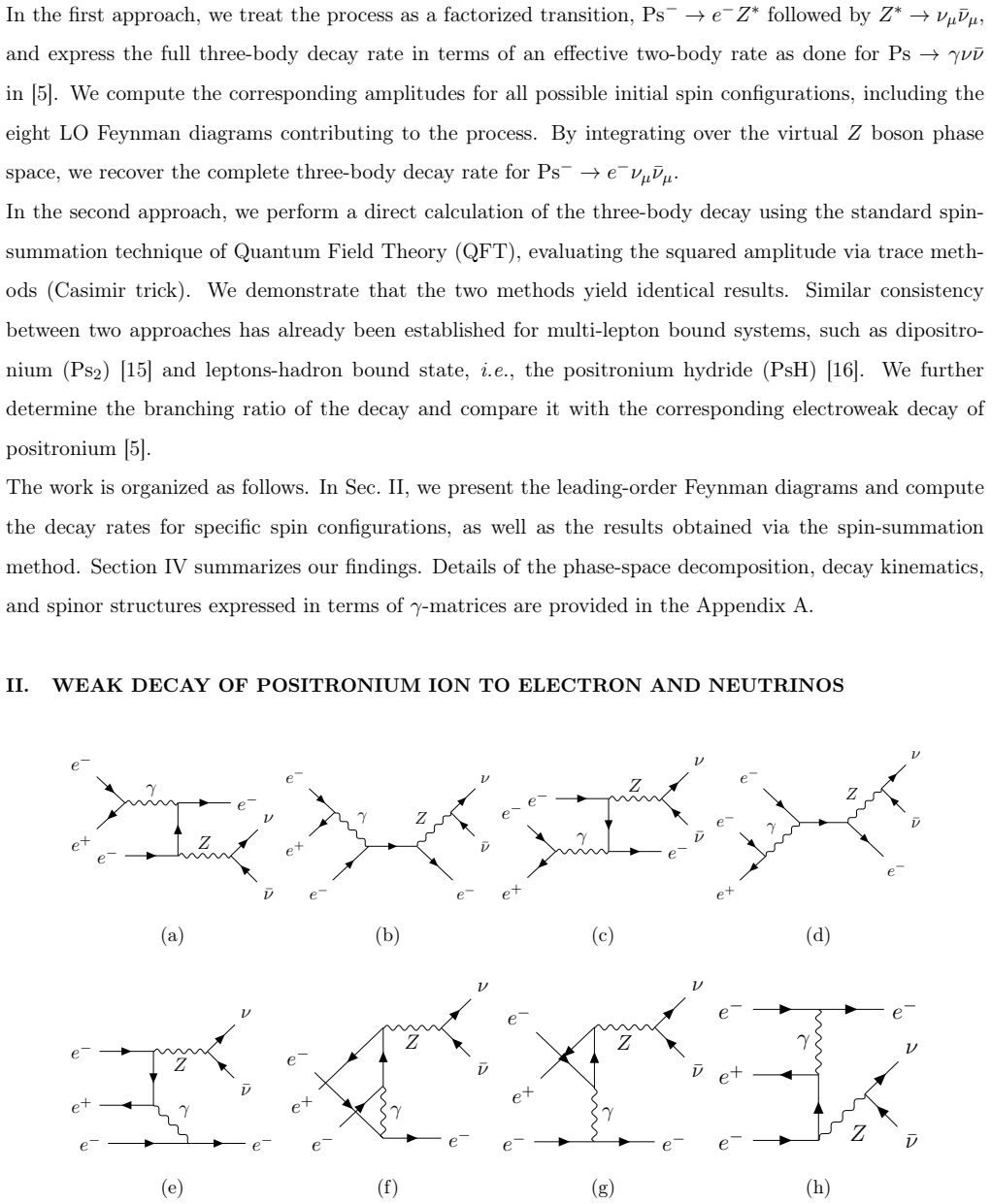
read the original abstract
The positronium ion ($\mathrm{Ps}^-$), a coulombic three-body bound state of two electrons and a positron, predominantly decays via electron-positron annihilation into electromagnetic final states. While its radiative decay channels have been extensively studied, much less attention has been given to weak processes in this system. In this work, we investigate the rare decay $\mathrm{Ps}^- \to e^- \nu_\mu \bar{\nu}_\mu$, obtained by replacing the photon in $\mathrm{Ps}^- \to e^- \gamma$ with a virtual $Z$ boson. Treating the three-body process as an effective two-body transition, $\mathrm{Ps}^- \to e^- Z^*\left(\to \nu_\mu\bar{\nu}_\mu\right)$, we compute the decay rate by explicitly evaluating all spin configurations of the initial bound state and final particles. The result agrees with that obtained using the standard spin-summation formalism of quantum field theory. We find that the branching ratio is comparable to that of the weak decay of ortho-positronium, $\mathrm{o\text{-}Ps} \to \gamma \nu \bar{\nu}$.
Editorial analysis
A structured set of objections, weighed in public.
Referee Report
Summary. The paper investigates the rare weak decay Ps⁻ → e⁻ ν_μ ν̄_μ of the positronium ion by replacing the photon in the radiative decay with a virtual Z boson. It treats the three-body process as an effective two-body transition Ps⁻ → e⁻ Z*(→ ν_μ ν̄_μ), computes the rate by explicitly evaluating all spin configurations, reports agreement with the standard spin-summation formalism of QFT, and finds the branching ratio comparable to that of o-Ps → γ ν ν̄.
Significance. If the central approximation holds, the work supplies a new result for a rare weak channel in a three-body Coulomb bound state, extending studies of weak decays beyond two-body positronium systems. The explicit enumeration of spin states and cross-check against the standard formalism are strengths that would support the numerical claim if the reduction is justified.
major comments (1)
- [method of effective two-body transition (as described following the abstract)] The effective two-body reduction Ps⁻ → e⁻ Z*(→ ν_μ ν̄_μ) is load-bearing for the branching-ratio result. The manuscript must supply a detailed derivation showing how the spectator electron factors out of the matrix element, how the three-body Coulomb wave function is inserted into the two-body annihilation operator, and whether overlap corrections from indistinguishability or off-shell Z kinematics are included; without this, any systematic error propagates directly into the quoted rate.
Simulated Author's Rebuttal
We thank the referee for the careful reading of our manuscript and for the constructive major comment. We appreciate the positive assessment of our explicit spin enumeration and its agreement with the standard QFT spin-summation formalism. We address the single major comment below.
read point-by-point responses
-
Referee: [method of effective two-body transition (as described following the abstract)] The effective two-body reduction Ps⁻ → e⁻ Z*(→ ν_μ ν̄_μ) is load-bearing for the branching-ratio result. The manuscript must supply a detailed derivation showing how the spectator electron factors out of the matrix element, how the three-body Coulomb wave function is inserted into the two-body annihilation operator, and whether overlap corrections from indistinguishability or off-shell Z kinematics are included; without this, any systematic error propagates directly into the quoted rate.
Authors: We agree that the effective two-body reduction is central to the result and that the current manuscript provides only a brief statement of the approximation without a full derivation. In the revised version we will add a dedicated subsection (or appendix) that derives the reduction explicitly. This will include: (i) the construction of the matrix element by projecting the three-body Coulomb wave function onto the positron-electron annihilation operator while treating the second electron as a spectator whose wave-function factor is integrated separately; (ii) the explicit insertion of the three-body bound-state wave function into the two-body operator; and (iii) a discussion of possible corrections arising from electron indistinguishability (via antisymmetrization of the initial state) and from the off-shell kinematics of the virtual Z. We will also quantify the expected size of these corrections under the kinematic conditions of the decay. These additions will be made without altering the numerical result already reported. revision: yes
Circularity Check
No circularity: derivation uses explicit spin summation on effective two-body ansatz without reducing to fitted inputs or self-citations
full rationale
The provided abstract and description show a direct computation of the decay rate via explicit evaluation of all spin configurations for the effective two-body transition Ps⁻ → e⁻ Z*, with the result stated to agree with standard QFT spin-summation formalism. No parameters are fitted to data and then relabeled as predictions, no self-citations are invoked as load-bearing uniqueness theorems, and no ansatz is smuggled via prior work. The three-body to two-body reduction is presented as an explicit modeling choice whose validity can be assessed externally; it does not collapse by construction to the input assumptions. This is the common case of a self-contained calculation against external benchmarks.
Axiom & Free-Parameter Ledger
axioms (1)
- standard math Standard quantum field theory formalism for weak decays and spin summation in bound states
Reference graph
Works this paper leans on
-
[1]
Therefore, the total spin of the system can be eitherJ= 1 2 orJ= 3
-
[2]
Using the standard Clebsch–Gordan coefficients, the initial state - labeled by total angular momentumJand its magnetic projectionm j - can be decomposed in terms of the final particle 5 spin states [24]. mj Incoming Outgoing Amplitude 1 2 e− e+ e− Z ∗ e− ↑ ↑ ↓ +1 ↓ e3√Ee+m(aℓ √ E2e −m2(5Ee−9m)+vℓ(5Ee−11m)(Ee−m)) 4m3/2(Ee−m)2 ↓ ↑ ↑ +1 ↓ − e3√Ee+m(aℓ √ E2e ...
-
[3]
Basedontheaforementionedconsiderations, togetherwiththespinorcombinationsdefinedinAppendixB1, we compute the scattering amplitudes for all possible spin configurations
However, the amplitudes formj =± 3 2 vanish, so that only the spin-singlet electron-pair configuration contributes. Basedontheaforementionedconsiderations, togetherwiththespinorcombinationsdefinedinAppendixB1, we compute the scattering amplitudes for all possible spin configurations. In particular, we consider the electron pair in both spin-singlet and sp...
-
[4]
The authors have reviewed and edited the output and take full responsibility for the content of this work
During the preparation of this study, the authors used ChatGPT 5.2 (free version) for the purposes of language editing and to correct grammatical mistakes. The authors have reviewed and edited the output and take full responsibility for the content of this work. Appendix A: Phase space TheNbody phase space can be written as: dϕN(pµ;k 1, ....kN) = (2π)4δ4(...
-
[5]
We can write the unity in terms of an integral as 1 = ˆ d3q (2π)32Eq dq2 2π (2π)4δ4(q−k 1 −k 2).(A.3) Hereq=k 1 +k 2 is the four momentum of the virtualZboson
Decomposition of three-body phase space The three body phase space can be written as, ˆ dϕ3(P;k 1, k2, k3) = ˆ 3Y i=1 d3ki (2π)32Ei (2π)4δ4(P−k 1 −k 2 −k 3).(A.2) WhereP=p 1 +p 2 +p 3 is the total initial momentum. We can write the unity in terms of an integral as 1 = ˆ d3q (2π)32Eq dq2 2π (2π)4δ4(q−k 1 −k 2).(A.3) Hereq=k 1 +k 2 is the four momentum of t...
-
[6]
Factorization of three body decay rate forPs− →e −νµ¯νµ The Feynman graphs relevant to the decayPs− →eν µ¯νµ are drawn in Figure 1a. For any of these diagrams, the LO amplitude is of the form M= 2GF J ν∗Xν√ 2πα ,(A.7) where Xν = (¯v(p2)ieγµu(p1)) 1 q2γ ¯u(k3)ieγµ i( /qe +m) q2e −m 2 ieγν(vℓ −a ℓγ5) ,(A.8) and J ν∗(k1, k2) = (¯u(k1)γν(1−γ 5)v(k2)),(A.9) is...
-
[7]
Combination of spinors Using the definition of Dirac spinors [25], we can write them for the spin-up and -down outgoing electron. In terms of theγmatrices, we used the following form in our calculation [14, 27]: u↑ (p) ¯u↑ (k3) = p 2m(Ee +m) 4 1 +γ 0 γ5 +γ 3 γ5 − |⃗k3| Ee +m ! ,(B.4) u↓ (p) ¯u↑ (k3) =− p 2m(Ee +m) 4 1 +γ 0 |⃗k3| Ee +m +γ 5 ! γ1 −iγ 2 ,(B....
-
[8]
R. D. Peccei,Discrete and Global Symmetries in Particle Physics, inBroken Symmetries, Springer, Berlin (2008), pp. 1–50
2008
-
[9]
Czarnecki,Positronium Properties, Acta Phys
A. Czarnecki,Positronium Properties, Acta Phys. Polon. B30, 3837 (1999) [arXiv:hep-ph/9911455]
Pith/arXiv arXiv 1999
-
[10]
Sen and Z
A. Sen and Z. K. Silagadze,Two-photon decay of P-wave positronium: A tutorial, Can. J. Phys.97, 693 (2019)
2019
-
[11]
Ore and J
A. Ore and J. L. Powell,Three-Photon Annihilation of an Electron-Positron Pair, Phys. Rev.75, 1696 (1949)
1949
-
[12]
A. Pokraka and A. Czarnecki,Positronium Decay into a Photon and Neutrinos, Phys. Rev. D94, 113012 (2016) [arXiv:1611.07645 [hep-ph]]. 12
Pith/arXiv arXiv 2016
-
[13]
J. Perez-Rios and S. T. Love,Effective Single Photon Decay Mode of Positronium Decay via Electroweak Inter- actions, arXiv:1508.01144 [physics.atom-ph]
-
[14]
A. P. Mills,Observation of the Positronium Negative Ion, Phys. Rev. Lett.46, 717 (1981)
1981
-
[15]
Nagashima, T
Y. Nagashima, T. Hakodate, A. Miyamoto and K. Michishio,Efficient emission of positronium negative ions from Cs deposited W(100) surfaces, New J. Phys.10, 123029 (2008)
2008
-
[16]
Nagashima,Experiments on positronium negative ions, Phys
Y. Nagashima,Experiments on positronium negative ions, Phys. Rept.545, 95 (2014)
2014
-
[17]
Fermi and G
E. Fermi and G. E. Uhlenbeck,On the Recombination of Electrons and Positrons, Phys. Rev.44, 510 (1933)
1933
-
[18]
Y. K. Ho,Positron annihilation in the positronium negative ion, J. Phys. B16, 1503 (1983)
1983
-
[19]
M. C. Chu and V. Ponisch,Calculation of the one-photon decay rate of the polyelectronP++−, Phys. Rev. C 33, 2222 (1986)
1986
-
[20]
S. I. Kryuchkov,On the one-photon annihilation of the Ps− ion, J. Phys. B27, L61 (1994)
1994
-
[21]
M. J. Aslam, W. Chen, A. Czarnecki, S. R. Mir and M. Mubasher,Rare decays of the positronium ion and molecule,Ps − →e −γandPs 2 →e +e−γ, γγ, e +e−, Phys. Rev. A104, 052803 (2021) [arXiv:2108.06785 [hep- ph]]
arXiv 2021
-
[22]
S. Z. Munir, M. Mubasher and M. J. Aslam,Revisiting the radiative and non-radiative decays of di-positronium (Ps2), EPL141, 44003 (2023)
2023
-
[23]
Masood, S
I. Masood, S. Z. Munir and M. J. Aslam,Contribution of various spin configurations to the radiationless decay of PsH, Phys. Rev. A109, 032820 (2024)
2024
-
[24]
A. M. Frolov,Highly accurate evaluation of the singular properties for the positronium and hydrogen negative ions, J. Phys. A40, 6175 (2007)
2007
-
[25]
Blinov and A
N. Blinov and A. Czarnecki,Binding energy of the positronium negative ion via dimensional scaling, Phys. Rev. A85, 012522 (2012)
2012
-
[26]
W. J. Marciano,Fermi constants and new physics, Phys. Rev. D60, 093006 (1999)
1999
-
[27]
Hahn,Generating Feynman diagrams and amplitudes with FeynArts 3, Comput
T. Hahn,Generating Feynman diagrams and amplitudes with FeynArts 3, Comput. Phys. Commun.140, 418 (2001)
2001
-
[28]
Shtabovenko,FeynCalc 9, J
V. Shtabovenko,FeynCalc 9, J. Phys. Conf. Ser.762, 012064 (2016)
2016
-
[29]
Czarnecki and W
A. Czarnecki and W. J. Marciano,Electrons are not ambidextrous, Nature435, 437 (2005)
2005
-
[30]
A. K. Bhatia and R. J. Drachman,New calculation of the properties of the positronium ion, Phys. Rev. A28, 2523 (1983)
1983
-
[31]
Navaset al.[Particle Data Group],Review of Particle Physics, Phys
S. Navaset al.[Particle Data Group],Review of Particle Physics, Phys. Rev. D110, 030001 (2024)
2024
-
[32]
M. E. Peskin and D. V. Schroeder,An Introduction to Quantum Field Theory, Addison-Wesley, Reading, MA, 1995
1995
-
[33]
Bernreuther and O
W. Bernreuther and O. Nachtmann,Weak Interaction Effects in Positronium, Z. Phys. C11, 235 (1981)
1981
-
[34]
M. J. Aslam, W. Chen, A. Czarnecki, M. Mubasher and C. Stephens,Positronium hydride decay into proton, electron, and one or zero photons, Phys. Rev. A107, 062816 (2023). 13
2023
discussion (0)
Sign in with ORCID, Apple, or X to comment. Anyone can read and Pith papers without signing in.