Determinants of Phase-Separation Propensities, Material States, and Material Properties of Biomolecular Condensates
Pith reviewed 2026-06-29 09:37 UTC · model grok-4.3
The pith
Phase-separation thresholds for biomolecules track excess chemical potential set by interaction strength and valency, with material states hinging on whether spinodal decomposition runs to completion.
A machine-rendered reading of the paper's core claim, the machinery that carries it, and where it could break.
Core claim
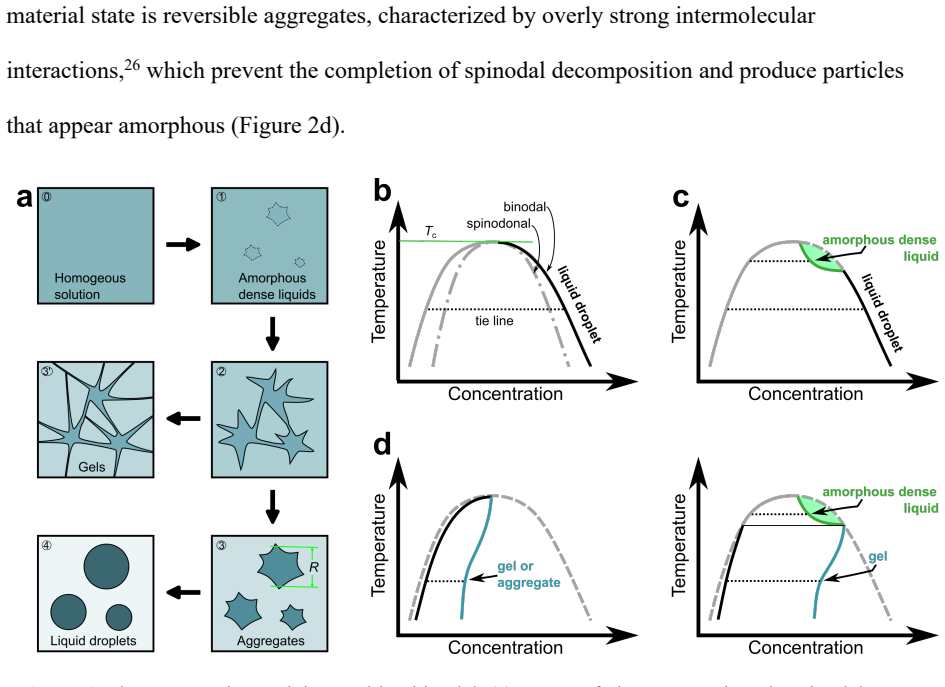
The saturation concentration for phase separation equals the point at which the excess chemical potential in the dense phase balances the dilute-phase value, with the excess term governed by interaction strength and valency. Liquid droplets form by complete phase separation while amorphous liquids, aggregates, and gels arise when spinodal decomposition terminates prematurely owing to overly weak, overly strong, or directional interactions; gels in particular advance by directional tip growth whereas aggregates advance by interior addition that maximizes valency. The mean lifetime of intermolecular bonds determines the stress relaxation time that governs viscoelasticity, shear-dependent flow,
What carries the argument
Excess chemical potential in the dense phase (tied to interaction strength and valency) for separation thresholds; premature termination of spinodal decomposition (modulated by interaction weakness, strength, or directionality) for material states; stress relaxation time set by mean intermolecular bond lifetime for viscoelastic and viscous properties.
If this is right
- Stronger or higher-valency interactions lower the concentration needed for phase separation.
- Directional interactions favor gels through tip growth rather than uniform droplet formation.
- Reversible aggregates form when molecules add at interior sites to maximize contacts instead of directional extension.
- Longer bond lifetimes raise the relaxation time and thereby increase viscosity while enabling shear thickening or thinning.
- Different condensates display orders-of-magnitude viscosity differences because their bond lifetimes differ.
Where Pith is reading between the lines
- The frameworks suggest that cells could tune condensate material state by modulating interaction directionality or lifetime without changing overall concentration.
- Synthetic design of condensates with prescribed flow properties would follow from choosing bond lifetimes and valencies to set the relaxation time.
- The distinction between tip-driven gels and valency-driven aggregates points to separate regulatory mechanisms that could be tested by altering interaction geometry in model systems.
- If premature arrest is the dominant route to solid-like states, then mutations that alter interaction range or strength should shift the boundary between liquid and arrested states in a predictable way.
Load-bearing premise
Non-liquid states arise specifically because spinodal decomposition stops early due to interaction details rather than from equilibrium thermodynamics or other kinetic routes.
What would settle it
Direct imaging or scattering data showing a gel or aggregate forming under interaction conditions where spinodal decomposition should reach full completion, or a liquid droplet forming when interactions are predicted to cause arrest.
Figures
read the original abstract
Phase separation of various materials has been studied for one and a half centuries. In the last two decades, phase separation of proteins and nucleic acids has received enormous attention, due its relevance to cellular functions. However, many of the observations on the resulting biomolecular condensates lack a theoretical underpinning. The first goal of this Account is to put forward theoretical frameworks for the phase-separation propensities, material states, and material properties of biomolecular condensates. Using these frameworks, I rationalize mechanistic interpretations from our recent experimental and computational studies, and synthesize these studies with prior literature to draw new conclusions. For phase-separation propensities, I relate the threshold (or saturation) concentration to the excess chemical potential in the dense phase, which in turn depends on intermolecular interaction strength and valency. For material states, I posit that liquid droplets form via complete phase separation, whereas amorphous dense liquids, reversible aggregates, and gels arise from premature termination of spinodal decomposition, due to overly weak or overly strong interactions or directional interactions. In particular, gels and aggregates are different forms of dynamically arrested states, with gels driven by tip growth via directional interactions whereas aggregates driven by monomer addition at interior sites to maximize valency. For material properties, I highlight the crucial roles of the stress relaxation time, which is determined by the mean lifetime of intermolecular bonds in a condensate. This relaxation time dictates how the condensate manifests viscoelasticity, including shear thickening and shear thinning, and accounts for the wide variation in zero-shear viscosity among different condensates.
Editorial analysis
A structured set of objections, weighed in public.
Referee Report
Summary. This Account proposes theoretical frameworks for phase-separation propensities, material states, and material properties of biomolecular condensates. It relates the threshold (saturation) concentration to the excess chemical potential in the dense phase, which depends on intermolecular interaction strength and valency. Liquid droplets are said to form via complete phase separation, whereas amorphous dense liquids, reversible aggregates, and gels arise from premature termination of spinodal decomposition due to overly weak, overly strong, or directional interactions (with gels via tip growth and aggregates via interior monomer addition to maximize valency). Material properties are linked to the stress relaxation time set by the mean lifetime of intermolecular bonds, which governs viscoelasticity (including shear thickening/thinning) and viscosity variation. The frameworks are used to rationalize the author's recent experimental and computational studies and to synthesize them with prior literature.
Significance. If the frameworks hold, they could offer a unifying conceptual synthesis connecting molecular-scale interaction parameters to condensate behaviors and properties, aiding interpretation of cellular functions and material design. The paper explicitly integrates multiple studies into new conclusions, providing a broad perspective that may guide future work if the posited relations receive quantitative support.
major comments (1)
- [Framework for material states] In the framework for material states: the claim that amorphous dense liquids, reversible aggregates, and gels arise specifically from premature termination of spinodal decomposition (due to weak/strong/directional interactions) rather than equilibrium thermodynamic outcomes (e.g., equilibrium gels via percolation or directional bonding) is presented without a derivation, quantitative conditions, or explicit comparison that rules out the alternatives. This distinction is load-bearing for the central classification of material states.
minor comments (1)
- The text would benefit from explicit definitions or standard references for key quantities such as 'excess chemical potential in the dense phase' and 'mean lifetime of intermolecular bonds' to improve accessibility for readers outside the immediate subfield.
Simulated Author's Rebuttal
We thank the referee for their constructive feedback on our manuscript. We address the major comment below.
read point-by-point responses
-
Referee: In the framework for material states: the claim that amorphous dense liquids, reversible aggregates, and gels arise specifically from premature termination of spinodal decomposition (due to weak/strong/directional interactions) rather than equilibrium thermodynamic outcomes (e.g., equilibrium gels via percolation or directional bonding) is presented without a derivation, quantitative conditions, or explicit comparison that rules out the alternatives. This distinction is load-bearing for the central classification of material states.
Authors: The manuscript is an Account proposing conceptual frameworks to synthesize our recent studies with the literature rather than deriving them from first principles. The posited distinction between complete phase separation and premature termination of spinodal decomposition is based on kinetic arguments and observations from our experimental and computational work. We agree that the Account does not include a quantitative derivation, explicit conditions, or direct comparison ruling out equilibrium alternatives such as percolation-driven gels. In the revised version we will add a paragraph in the material-states section that acknowledges these alternatives, references relevant percolation and directional-bonding literature, and clarifies the rationale for emphasizing the kinetic mechanism in the systems we discuss. revision: yes
Circularity Check
No significant circularity: frameworks presented as independent posits applied to own data
full rationale
The paper explicitly puts forward theoretical frameworks via statements such as 'I relate the threshold concentration to the excess chemical potential' and 'I posit that liquid droplets form via complete phase separation, whereas ... arise from premature termination of spinodal decomposition'. These are introduced as the author's frameworks rather than derived from or reduced to the mentioned 'our recent experimental and computational studies'. The studies are described as the objects being rationalized by the frameworks, not as the source or justification of the frameworks themselves. No equations, fitted parameters, or self-citation chains are exhibited that would make any claimed prediction equivalent to its inputs by construction. Self-mention of own work occurs only in the application step and does not load-bear the central premises.
Axiom & Free-Parameter Ledger
free parameters (3)
- intermolecular interaction strength
- valency
- mean lifetime of intermolecular bonds
axioms (1)
- domain assumption Phase separation proceeds via spinodal decomposition whose termination is controlled by interaction strength and directionality.
Reference graph
Works this paper leans on
-
[1]
dense liquid
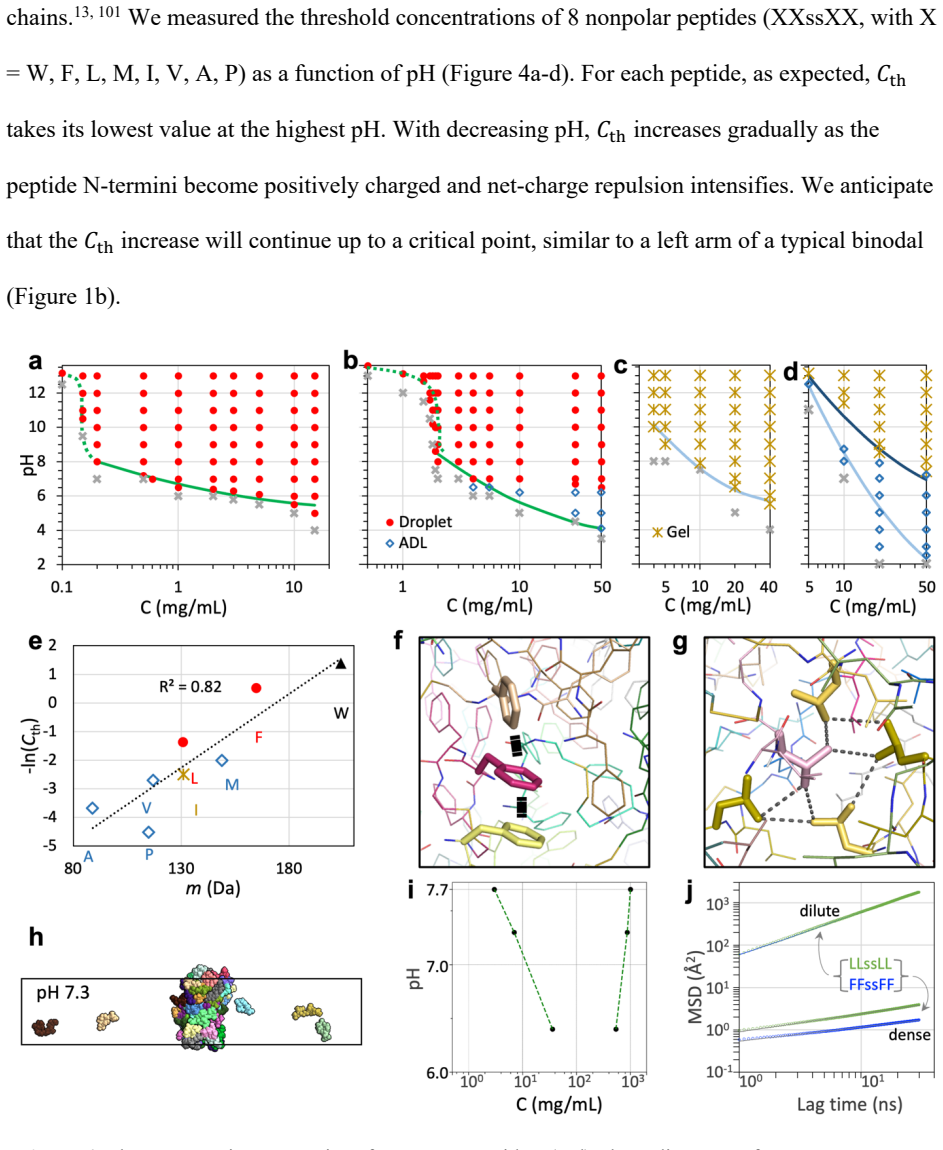
DETERMINANTS OF MATERIAL STATES In addition to the threshold concentrations of XXssXX peptides, Figure 4a-d also displays the material states formed under various combinations of peptide concentration (𝐶) and pH.13 FFssFF (Figure 4a) formed liquid droplets in all 𝐶–pH combinations tested; the same was true for LLssLL (Figures 4b and 2a) and MMssMM, except...
2024
-
[2]
"4𝐼2𝜋𝑘*𝑇𝑑4 [7b] 26 where 𝑑 is the hard-core diameter of the particles, 𝑔(𝑟) is the radial distribution function, 𝜙
and their dynamics at a wide-range of spatial and temporal scales, molecular-level interpretations of these properties should be seen as tentative. 4.1. Why Do Biomolecular Condensates Have Similar Surface Tensions? Surface tension is a fundamental property of all liquids, including biomolecular condensates in the liquid-droplet state. Indeed, the spheric...
2024
-
[3]
CONCLUDING REMARKS Based on our studies over the past decade, I have presented here theoretical frameworks for the phase-separation propensities, material states, and material properties, which have largely been missing in the biomolecular condensate literature. Using these frameworks, I have rationalized mechanistic interpretations from our recent experi...
1988
-
[4]
A.; Ren, J.; Svergun, D.; Chen, A.; Yang, P.; Zeng, A
(25) Nie, J.; Zhang, X.; Hu, Z.; Wang, W.; Schroer, M. A.; Ren, J.; Svergun, D.; Chen, A.; Yang, P.; Zeng, A. P. A globular protein exhibits rare phase behavior and forms chemically regulated orthogonal condensates in cells. Nat Commun 2025, 16,
2025
-
[5]
W.; Holehouse, A
43 (26) Martin, E. W.; Holehouse, A. S.; Peran, I.; Farag, M.; Incicco, J. J.; Bremer, A.; Grace, C. R.; Soranno, A.; Pappu, R. V .; Mittag, T. Valence and Patterning of Aromatic Residues Determine the Phase Behavior of Prion-Like Domains. Science 2020, 367, 694-699. (27) Tombs, M. P.; Newsom, B. G.; Wilding, P. Protein solubility: Phase separation in ara...
2020
-
[6]
(53) Huggins, M. L. Solutions of Long Chain Compounds. J Chem Phys 1941, 9, 440-440. (54) Flory, P. J. Thermodynamics of High Polymer Solutions. J Chem Phys 1942, 10, 51-61. 46 (55) Gibbs, J. W. On the Equilibrium of Heterogeneous Substances. Trans Conn Acad Arts Sci 1876; 1878, 3, 108–248; 343–524. (56) Mazarakos, K.; Zhou, H. X. Multiphase organization ...
1941
-
[7]
N.; Mathur, P.; Stavrakis, S.; deMello, A
(68) Makasewicz, K.; Schneider, T. N.; Mathur, P.; Stavrakis, S.; deMello, A. J.; Arosio, P. Formation of multicompartment structures through aging of protein-RNA condensates. Biophys J 2025, 124, 115-124. (69) Qin, S.; Zhou, H. X. A Fixed-V olume Variant of Gibbs-Ensemble Monte Carlo Yields Significant Speedup in Binodal Calculation. arXiv 2025, 2512.188...
-
[8]
S.; Weinhardt, V .; Kovacs, D.; Van Lindt, J.; Larabell, C.; Van Den Bosch, L.; Das, R.; Tompa, P
(74) Boeynaems, S.; Holehouse, A. S.; Weinhardt, V .; Kovacs, D.; Van Lindt, J.; Larabell, C.; Van Den Bosch, L.; Das, R.; Tompa, P. S.; Pappu, R. V .; et al. Spontaneous Driving Forces Give Rise to Protein-RNA Condensates with Coexisting Phases and Complex Material Properties. Proc. Natl. Acad. Sci. USA 2019, 116, 7889-7898. (75) Espinosa, J. R.; Joseph,...
2019
-
[9]
Improved Predictions of Phase Behaviour of Intrinsically Disordered Proteins by Tuning the Interaction Range
(82) Tesei, G.; Lindorff-Larsen, K. Improved Predictions of Phase Behaviour of Intrinsically Disordered Proteins by Tuning the Interaction Range. Open Res. Eur. 2023, 2,
2023
-
[10]
(83) An, Y .; Webb, M. A.; Jacobs, W. M. Active Learning of the Thermodynamics-Dynamics Trade-off in Protein Condensates. Sci. Adv. 2024, 10, eadj2448. (84) MacAinsh, M.; Dey, S.; Zhou, H. X. Direct and indirect salt effects on homotypic phase separation. eLife 2024, 13, RP100282. (85) Zhang, Y .; Li, S.; Gong, X.; Chen, J. Toward Accurate Simulation of C...
-
[11]
(91) Kota, D.; Zhou, H. X. Macromolecular Regulation of the Material Properties of Biomolecular Condensates. J Phys Chem Lett 2022, 5285-5290. (92) Qin, S.; Zhou, H. X. Calculation of Second Virial Coefficients of Atomistic Proteins Using Fast Fourier Transform. J Phys Chem B 2019, 123, 8203-8215. (93) Ahn, S. H.; Qin, S.; Zhang, J. Z.; McCammon, J. A.; Z...
2022
-
[12]
ATP Biphasically Modulates LLPS of TDP-43 PLD by Specifically Binding Arginine Residues
(98) Dang, M.; Lim, L.; Kang, J.; Song, J. ATP Biphasically Modulates LLPS of TDP-43 PLD by Specifically Binding Arginine Residues. Commun. Biol. 2021, 4,
2021
-
[13]
51 (99) Toyama, Y .; Rangadurai, A. K.; Forman-Kay, J. D.; Kay, L. E. Mapping the Per-Residue Surface Electrostatic Potential of CAPRIN1 along Its Phase-Separation Trajectory. Proc. Natl. Acad. Sci. USA 2022, 119, e2210492119. (100) Kota, D.; Prasad, R.; Zhou, H. X. Adenosine Triphosphate Mediates Phase Separation of Disordered Basic Proteins by Bridging ...
-
[14]
W.; Thomasen, F
(137) Martin, E. W.; Thomasen, F. E.; Milkovic, N. M.; Cuneo, M. J.; Grace, C. R.; Nourse, A.; Lindorff-Larsen, K.; Mittag, T. Interplay of folded domains and the disordered low-complexity domain in mediating hnRNPA1 phase separation. Nucleic Acids Res 2021, 49, 2931-2945. (138) Otis, J. B.; Sharpe, S. Sequence Context and Complex Hofmeister Salt Interact...
2021
-
[15]
(151) Zhou, H. X. Viscoelasticity of Biomolecular Condensates Conforms to the Jeffreys Model. J. Chem. Phys. 2021, 154, 041103. (152) Cox, W. P.; Merz, E. H. Correlation of dynamic and steady flow viscosities. J Polym Sci 1958, 28, 619-622. (153) Cross, M. M. Rheology of non-Newtonian fluids: A new flow equation for pseudoplastic systems. J Colloid Sci 19...
2021
-
[16]
Macromolecules 1998, 31, 1386-1397
Linear Dynamics. Macromolecules 1998, 31, 1386-1397. 58 (160) Shen, Z.; Jia, B.; Xu, Y .; Wessén, J.; Pal, T.; Chan, H. S.; Du, S.; Zhang, M. Biological Condensates Form Percolated Networks with Molecular Motion Properties Distinctly Different from Dilute Solutions. eLife 2023, 12, e81907. (161) Grimm, M.; Jeney, S.; Franosch, T. Brownian motion in a Maxw...
1998
discussion (0)
Sign in with ORCID, Apple, or X to comment. Anyone can read and Pith papers without signing in.