REVIEW 4 major objections 5 minor 10 references
A spatially varying differential equation for multi-patch pandemic propagation
T0 review · 4 major / 5 minor · reviewed 2026-08-09 · deepseek-v4-flash
Pith's one-line read The paper derives a spatially varying SIR model by taking the continuum limit of discrete interacting patches and recasts it as a nonlinear heat conduction equation whose temperature vector captures susceptible and infected populations.
desk verdict The central PDE in Eq. (7) is not derived from the discrete model; the infected equation has the wrong structure, so the paper's main claim is unsupported. read the letter →
The pith
A machine-rendered reading of the paper's core claim, the machinery that carries it, and where it could break.
The reading
What carries the argument
The key machinery is the discrete-to-continuum mapping of the patch interactions. The paper assumes the infection rate at patch x is proportional to the infected populations of that patch and its two immediate neighbors, which converts the neighbor sum into a finite-difference second derivative plus a local term, giving the diffusion operator in the susceptible equation. The corresponding term in the infected equation is introduced 'by extension', assuming symmetric coupling. The system is then cast in matrix form with logarithmic time derivatives, which is what makes it look like a heat equation with a skew-symmetric thermal conductivity tensor and a constant generation term.
What would settle it
Simulate an epidemic on a lattice with a transmission kernel that includes long-range jumps rather than only nearest neighbors, and check whether the resulting spread still obeys Eq. 7; if it does not, the continuum derivation is specific to additive nearest-neighbor coupling rather than a general spatial SIR limit.
Extended reading notes
Core claim
The central claim is that the continuum limit of a one-dimensional chain of SIR patches yields ds/dt = -D s d2f/dx2 - A s f and df/dt = f(D d2s/dx2 + A s - beta), with the diffusion constant D = A' N_x and the recovery parameter beta = B'/(A' N_x). By taking logarithmic derivatives and assembling the variables into a vector T = (s, f), the paper rewrites the system as d ln T/dt = K d2T/dx2 + G, where K is the skew-symmetric matrix [[0, -D], [D, 0]] and G = (0, -D beta). This is a nonlinear heat equation, nonlinear because the left-hand side carries the logarithm of the temperature vector while the right-hand side carries the vector itself. The paper presents this as a derivation of the diffusion mechanism from the underlying patch dynamics rather than as an imposed term.
Load-bearing premise
The whole derivation hinges on the assumption that infection at a patch is driven by the sum of infected people in that patch and its two immediate neighbors, and that the same diffusion coupling applies to susceptibles by symmetry; if real spread is not additive in this nearest-neighbor way, the diffusion equation does not follow.
Editorial extensions
If this is right
- If the derivation holds, the diffusion term in spatial SIR models is not a free parameter but is fixed by the local population, patch spacing, and infection rate: D = A' N_x.
- The equivalence to a nonlinear heat equation means that heat-conduction intuition, such as smoothing, wave propagation, and boundary effects, can be applied to epidemic spread.
- The nonlinearity from the logarithmic left side implies that superposition fails: the sum of two outbreak solutions is not itself a solution, so control measures for separate outbreaks cannot be treated independently.
- The recovered fraction R can be recovered from S and I by population conservation, giving a complete spatial picture of the epidemic.
- The derived relation between D and the SIR parameters provides a way to infer spatial spread parameters from observed susceptible and infected profiles.
Reading between the lines
- An extension of the derivation to asymmetric neighbor coupling, such as directed migration, would break the skew-symmetric structure of K and likely produce a different cross-diffusion matrix, so the heat-equation analogy is specific to symmetric nearest-neighbor interactions.
- The sign of the D d2s/dx2 term in the infected equation could lead to nonmonotone or pattern-forming behavior when the susceptible profile is nonconvex, a dynamical regime the paper does not explore.
- A natural testable extension is to fit the model to empirical spatiotemporal outbreak data and check whether a single position-dependent diffusion constant can reproduce the observed spread of both susceptible and infected populations.
- Generalizing the derivation to two spatial dimensions would replace the scalar D with a tensor, and the predicted dependence of that tensor on patch geometry could be compared against geographic spread data.
Editorial analysis
A structured set of objections, weighed in public.
Referee Report
Summary. The manuscript proposes a continuum multi-patch SIR model by taking a nearest-neighbor finite-difference expansion of discrete interacting patches and then rewriting the resulting system as a nonlinear heat-conduction equation. It claims that the diffusion constant appearing in the continuum equations can be related to the patch infection rate and local population size, and that the dynamics reduces to a heat-flow analogy with a two-component temperature vector.
Significance. If the derivation were valid, the proposed bridge between discrete multi-patch epidemic models and continuum diffusion-style equations would be a useful contribution, and the paper's finite-difference step in Eq. (5) is a coherent expansion of nearest-neighbor interactions. The manuscript also correctly notes that the heat-conduction analogy is nonlinear because the left-hand side involves logarithms while the right-hand side does not. However, the central claim is not established: the infected equation is introduced by assertion rather than derived, and the heat-conduction rewriting is produced by choosing K and G to match the previous equations. The paper contains no data, no code, and no reproducible numerical details, so the contribution as presented does not meet the standard for publication.
major comments (4)
- [C, Eqs. (4)-(7)] Equation (4) is a statement about dSx/dt only; it says nothing about the time evolution of Ix. The second line of Eq. (7) is introduced with the phrase "By extension" and is not derived from the discrete model. If one completes the discrete model symmetrically as dIx/dt = Ax Sx (I_{x-Δx} + Ix + I_{x+Δx}) - Bx Ix, the same finite-difference expansion used for Eq. (5) gives dI/dt = A S (3I + Δx² d²I/dx²) - B I, whose diffusion term is proportional to S d²I/dx², not to f d²s/dx² as in Eq. (7). The claimed continuum limit therefore has the wrong structure for the infected equation unless an independent migration term is added, and no such term is derived.
- [C, Eqs. (5)-(8)] The passage from Eq. (5) to Eq. (7) silently changes the reaction coefficient: Eq. (5) has -3AxSxIx while Eq. (7) has -Asf, and Eq. (8) defines D and beta in terms of A' and Nx without specifying how A in Eq. (7) relates to Ax, A'x, or Nx. The recovery equation dR/dt = BI is also absent from Eq. (7), so the manuscript does not actually close the SIR system in its spatial form.
- [D, Eq. (11)] The reduction from Eq. (7) to Eq. (11) drops the reaction terms with the statement that one considers deviations from the long-term single-patch solutions f→0 and s→s*. No small parameter or error estimate is provided. In the f equation the dropped term after taking the logarithmic derivative is As, not As f as the text says; near the long-time state this term can be comparable to or larger than D d²s/dx² depending on the spatial profile, so the reduction is not a controlled approximation.
- [D, Eqs. (12)-(14)] The heat-conduction rewriting is not a derivation. Equation (12) is produced by choosing K = [[0,-D],[D,0]] and G = (0,-Dβ) so that the right-hand side formally matches Eq. (11), while the left-hand side contains d ln T/dt rather than dT/dt. Equation (13) therefore does not have the form of the heat equation, and the stated nonlinearity is a consequence of this mismatch, not a physical property of the epidemic model.
minor comments (5)
- [C, Eq. (5)] The notation A'_x is introduced as Ax Δx², but the relationship between A'_x and the A appearing in Eq. (7) is never defined; please add a sentence clarifying this.
- [B] The definition β = B/(ANp) is confusing because Np is described as a population while s and f are normalized fractions; please define all symbols explicitly in one place.
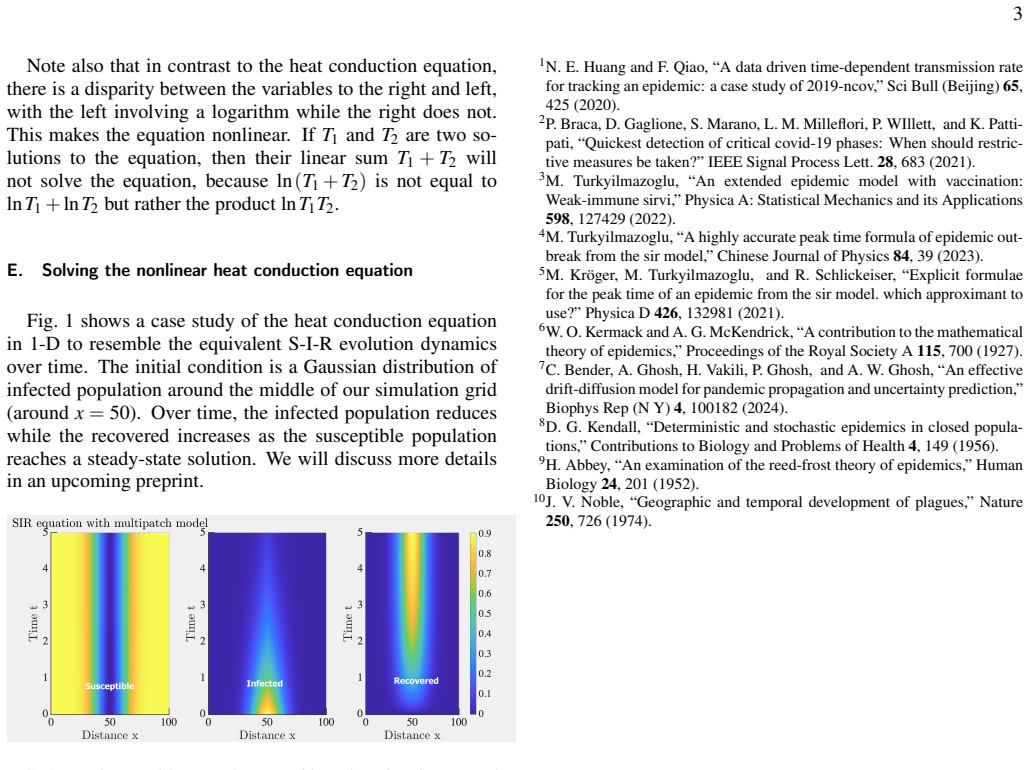
- [E, Fig. 1] The text says that details will appear in an upcoming preprint, so the figure cannot be reproduced; specify the initial conditions, parameter values, and numerical method, or remove the figure.
- [Abstract and Eq. (14)] The abstract states that the temperature vector captures infected and recovered populations, but Eq. (14) defines T = (s, f), i.e. susceptible and infected fractions; recovered population R is not part of the vector.
- [Page 2] The word "resemebles" is a typo for "resembles".
Circularity Check
One definitional rewriting (heat-conduction form), not a fitted prediction; the discrete-to-continuum step is underived but not circular.
-
self definitional
[Section D, Eqs. (11)-(14)]
"To resemble the conventional heat conduction equation, we rewrite the equations in matrix form as ... (12) which can be written to resemble the heat conduction equation as d ln ¯T/dt = ¯K d2 ¯T/dx2 + ¯G (13) where the temperature vector, thermal conductance tensor, and generation vector are respectively ¯T = (s f), ¯K = (0 −D; D 0), ¯G = (0 −Dβ) (14)."
The heat-conduction form is not derived from SIR dynamics; K and G are defined to be the coefficient matrix and constant vector already displayed in Eq. (12), after the ±Asf terms were dropped in Eq. (11). Equation (13) therefore holds by construction: it is Eq. (12) relabeled as T, K, G. The abstract's claim that the population dynamics 'can be reinterpreted as a nonlinear heat flow equation' is a notational restatement, not a new result. The analogy is made to fit by choosing the tensor and generation vector, so this step reduces to definition.
full rationale
We find no fitted parameter disguised as a prediction and no load-bearing self-citation. The central discrete-to-continuum step (Eqs. 4-7) is a derivation attempt: Eq. (5) follows from Eq. (4) via the finite-difference formula, and Eq. (8) defines D and beta as the continuum-limit coefficients. However, the infected equation in Eq. (7) is asserted 'By extension' rather than derived from Eq. (4); that is an unsupported jump or correctness gap, but it is not circular because Eq. (7) is not equivalent to the input Eq. (4) by construction. The only genuine circular-by-construction item is the thermal rewriting in Eqs. (13)-(14), where K and G are chosen to reproduce Eq. (12), making the 'resemblance' definitional. This is a partial circularity in the paper's presentation, but it does not infect the SIR diffusion equation itself, so the overall score is moderate rather than high.
Assumptions & free parameters
free parameters (1)
- Diffusion constant D =
D = A' N_x = A Delta x^2 N_x (defined, not fitted)
assumptions (5)
- domain assumption Standard SIR compartment assumptions: homogeneous mixing within a patch, mass-action incidence, constant total population S+I+R=N, and constant parameters A,B in the single-patch baseline.
- domain assumption The continuum limit of discrete interacting patches is represented by nearest-neighbor finite differences, so that I_x + I_x+Delta x + I_x-Delta x equals Delta x^2 d2I/dx2 + 3I_x as Delta x approaches zero.
- ad hoc to paper By symmetry, the infected fraction satisfies an equation containing D d2s/dx2 even though Eq. (4) only models S_x responding to neighboring I values.
- ad hoc to paper The A s f reaction terms can be dropped when considering deviations from the long-term single-patch solution (f tends to 0, s tends to s*).
- ad hoc to paper The matrix K=[[0,-D],[D,0]] and vector G=(0,-D beta) define a heat-conduction analogy despite the left-hand side being d ln T/dt rather than dT/dt.
invented entities (1)
-
Temperature vector T=(s,f) and thermal conductance tensor K=[[0,-D],[D,0]]
Cite this review
Pith. "Pith review of A spatially varying differential equation for multi-patch pandemic propagation." pith.science (2026). https://pith.science/paper/LKXSKCUY
@misc{pith2026250200454,
  author       = {Pith},
  title        = {Pith review of: A spatially varying differential equation for multi-patch pandemic propagation},
  year         = {2026},
  howpublished = {\url{https://pith.science/paper/LKXSKCUY}},
  note         = {Machine review of arXiv:2502.00454}
}
read the original abstract
We develop an extension of the Susceptible-Infected-Recovery (SIR) model to account for spatial variations in population as well as infection and recovery parameters. The equations are derived by taking the continuum limit of discrete interacting patches, and results in a diffusion equation with some nonlinear terms. The resulting population dynamics can be reinterpreted as a nonlinear heat flow equation where the temperature vector captures both infected and recovered populations across multiple patches.
Figures
Reference graph
Works this paper leans on
-
[1]
author author N. E. \ Huang \ and\ author F. Qiao ,\ title title A data driven time-dependent transmission rate for tracking an epidemic: a case study of 2019-ncov , \ @noop journal journal Sci Bull (Beijing) \ volume 65 ,\ pages 425 ( year 2020 ) NoStop
work page 2019
-
[2]
author author P. Braca , author D. Gaglione , author S. Marano , author L. M. \ Milleflori , author P. WIllett , \ and\ author K. Pattipati ,\ title title Quickest detection of critical covid-19 phases: When should restrictive measures be taken? \ @noop journal journal IEEE Signal Process Lett. \ volume 28 ,\ pages 683 ( year 2021 ) NoStop
work page 2021
-
[3]
author author M. Turkyilmazoglu ,\ title title An extended epidemic model with vaccination: Weak-immune sirvi , \ @noop journal journal Physica A: Statistical Mechanics and its Applications \ volume 598 ,\ pages 127429 ( year 2022 ) NoStop
work page 2022
-
[4]
author author M. Turkyilmazoglu ,\ title title A highly accurate peak time formula of epidemic outbreak from the sir model , \ @noop journal journal Chinese Journal of Physics \ volume 84 ,\ pages 39 ( year 2023 ) NoStop
work page 2023
-
[5]
author author M. Kr \"o ger , author M. Turkyilmazoglu , \ and\ author R. Schlickeiser ,\ title title Explicit formulae for the peak time of an epidemic from the sir model. which approximant to use? \ @noop journal journal Physica D \ volume 426 ,\ pages 132981 ( year 2021 ) NoStop
work page 2021
-
[6]
author author W. O. \ Kermack \ and\ author A. G. \ McKendrick ,\ title title A contribution to the mathematical theory of epidemics , \ @noop journal journal Proceedings of the Royal Society A \ volume 115 ,\ pages 700 ( year 1927 ) NoStop
work page 1927
-
[7]
author author C. Bender , author A. Ghosh , author H. Vakili , author P. Ghosh , \ and\ author A. W. \ Ghosh ,\ title title An effective drift-diffusion model for pandemic propagation and uncertainty prediction , \ @noop journal journal Biophys Rep (N Y) \ volume 4 ,\ pages 100182 ( year 2024 ) NoStop
work page 2024
-
[8]
author author D. G. \ Kendall ,\ title title Deterministic and stochastic epidemics in closed populations , \ @noop journal journal Contributions to Biology and Problems of Health \ volume 4 ,\ pages 149 ( year 1956 ) NoStop
work page 1956
Show all 10 references
-
[9]
Abbey ,\ title title An examination of the reed-frost theory of epidemics , \ @noop journal journal Human Biology \ volume 24 ,\ pages 201 ( year 1952 ) NoStop
author author H. Abbey ,\ title title An examination of the reed-frost theory of epidemics , \ @noop journal journal Human Biology \ volume 24 ,\ pages 201 ( year 1952 ) NoStop
1952
-
[10]
author author J. V. \ Noble ,\ title title Geographic and temporal development of plagues , \ @noop journal journal Nature \ volume 250 ,\ pages 726 ( year 1974 ) NoStop
1974
Reviewed August 9, 2026 · model on record in the stance chip above.
Discussion (0). Continue with ORCID to comment.