REVIEW 2 major objections 4 minor 32 references
Financial Numerical Prediction and Allocation as Token Generation
T0 review · 2 major / 4 minor · reviewed 2026-08-11 · deepseek-v4-flash
Pith's one-line read The paper argues that a causal language model can emit both multi-step return forecasts and constrained portfolio weights through a single head-free token interface.
desk verdict A transparent, honestly framed feasibility study of a head-free token interface for financial forecasting and allocation, but the headline Sharpe gains rest on single-seed runs and an unquantified news-summarizer leakage channel, so the numbers should not be taken at face value. read the letter →
The pith
A machine-rendered reading of the paper's core claim, the machinery that carries it, and where it could break.
The reading
What carries the argument
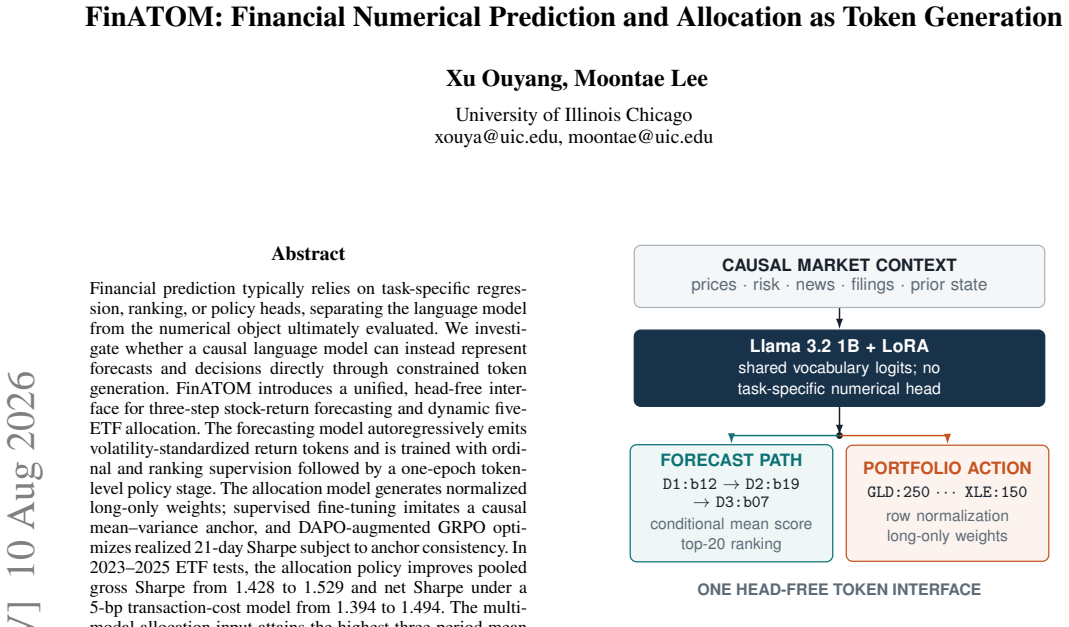
The central object is the head-free token interface: forecast bins and allocation grid values are added vocabulary items scored by the tied LM readout, with no regression, policy, value, or reward head. Two training mechanisms carry the argument: (i) a causal mean-variance teacher that solves a 20-day-window long-only optimization with a turnover penalty, shrinkage toward equal weight, and 50-unit quantization, producing SFT targets that contain no future information; and (ii) a DAPO-augmented GRPO stage that samples legal allocation sequences, rewards their future 21-day Sharpe minus an $\ell^1$ anchor-consistency penalty, and applies token-level clipped group-relative advantages. For forecasting, 41 train-only quantile bins with conditional-mean centers plus an ordinal and same-date ranking loss define the supervised contract, and a one-epoch token-PPO stage refines it.
What would settle it
Recompute the 2023 allocation Sharpe and the 2023 stock returns using a base model and a news summarizer whose training sets provably end before January 2023, keeping the pipeline otherwise identical. If those gains disappear, or if the original models can recite test-period prices or news they were not trained on, the causal-validity premise fails.
Extended reading notes
Core claim
The paper's central claim is that a causal language model can emit both multi-step return forecasts and constrained portfolio allocations through one head-free token interface. For allocation, the model generates five long-only ETF weights as normalized token expectations; a strictly causal mean-variance teacher supplies supervised targets, and a DAPO-augmented GRPO stage optimizes realized 21-day Sharpe subject to anchor consistency. For forecasting, the model autoregressively emits D1-D3 volatility-standardized return buckets whose conditional means form a cross-sectional ranking score. The evaluation is deliberately framed as feasibility: the allocation policy improves pooled gross Sharpe from 1.428 to 1.529 and net Sharpe from 1.394 to 1.494 with turnover rising only 5.6 basis points per day, while the forecasting policy adds a small increment over its SFT initialization. The paper does not claim dominance over head-based systems and separates within-protocol evidence from contextual comparison with the published FinTexTS baseline.
Load-bearing premise
The out-of-sample numbers assume that neither the pretrained Llama 3.2 base model nor the DeepSeek-V4 news summarizer secretly knows the test-period market outcomes, even though the 2023 tests overlap the base model's pretraining cutoff and the summarizer was trained after all test periods.
Editorial extensions
If this is right
- Allocation policy optimization improves pooled gross Sharpe from 1.428 to 1.529 and net Sharpe from 1.394 to 1.494, with daily one-way turnover rising only about 5.6 basis points.
- The same interface handles both ordered multi-step forecasts and jointly constrained portfolio weights, so a task-specific numerical head is not required for either contract.
- Time-series context is the stable standalone signal, while news contributes most in 2025, suggesting the multimodal advantage is regime-dependent rather than uniform.
- The policy can exceed its causal teacher in some periods, as in 2024 (1.564 vs. 1.407), while trailing it pooled (1.529 vs. 1.540), indicating outcome-based refinement rather than pure imitation.
- Broader asset universes, longer post-cutoff evaluation periods, repeated seeds, and matched head-based baselines are the stated next steps needed to test generality.
Reading between the lines
- A natural extension is to test whether the same grammar-plus-normalization interface enforces other constrained financial outputs, such as risk budgets, target volatility, or hedging ratios, without retraining the architecture.
- The 2025 news advantage could be tested by re-summarizing the daily news with a model whose training predates the test periods; if the 2025 gap shrinks, part of that gain is summarizer hindsight rather than learned forecasting.
- The anchor-consistency penalty coefficient of 8 is a fixed constant; a sensitivity sweep around it would show whether the policy gain is robust or contingent on that one design choice.
- Because the causal-validity risk is concentrated in the 2023 allocation test and the 2023 stock test, a post-cutoff replication with a base model and summarizer trained strictly before the test window would cleanly separate learned forecasting from memorization.
Editorial analysis
A structured set of objections, weighed in public.
Referee Report
Summary. FinATOM studies whether a causal language model can emit financial forecasts and allocations directly through constrained token generation, without a task-specific regression or policy head. The forecasting contract autoregressively outputs volatility-standardized D1–D3 return bins and is trained with ordinal and ranking supervision plus a one-epoch policy stage; the allocation contract emits five normalized long-only ETF weights, is first fine-tuned to imitate a causal mean–variance anchor, and is then refined by DAPO-augmented GRPO against realized 21-day Sharpe with an anchor-consistency penalty. In 2023–2025 ETF tests the policy raises pooled gross Sharpe from 1.428 to 1.529 and net Sharpe from 1.394 to 1.494 under 5-bp costs, and the multimodal input has its clearest advantage in 2025. On FinTexTS the SFT and policy strategies achieve 73.52%/2.68 and 73.72%/2.69 cumulative-return/Sharpe. The paper frames the contribution as feasibility of the head-free interface, not superiority over head-based systems.
Significance. The paper is carefully framed and unusually honest about its limits: the causal mean–variance teacher is explicitly separated from future returns, the path-dependent anchor is recomputed sequentially within each experiment, and the discussion and supplementary material identify the base-model cutoff, single-seed scope, and missing significance tests. If the headline results hold, the work would be a useful demonstration that one tied-vocabulary token interface can support two different numerical contracts and that outcome-based RL can refine an imitated allocation without a separate policy head. The reported effect sizes, however, are not yet trustworthy as evidence of a learned edge because the strongest multimodal result sits exactly on an unquantified news-summarizer hindsight channel and all Sharpe improvements come from single runs. The contribution is therefore plausible and potentially useful, but the central empirical claim needs additional robustness evidence before it can be regarded as established.
major comments (2)
- [Section 4, Table 4; Section 6 and Supplementary Q15] The news channel is summarized by DeepSeek-V4, whose training postdates every test period, and the single ablation that removes news also removes any legitimate news signal, so the +0.190 2025 gap between news+time-series and time-series-only cannot distinguish genuine macro-news information from retroactive summarization. Because the 2025 multimodal contribution is the paper's 'clearest advantage' and is part of the pooled policy result, this is a load-bearing threat to the central feasibility claim. The paper should report a re-summarized ablation using a summarizer trained before the test periods, or equivalently bound the channel by comparing policies trained without news on 2025 and showing the pooled gain survives.
- [Section 5, Tables 2 and 3] The headline pooled Sharpe improvement of 1.428 to 1.529 (gross) and 1.394 to 1.494 (net) is based on a single random seed and a single walk-forward run per setting, with no confidence intervals or significance tests. The SFT and policy strategies produce paired daily return series on identical dates, so the paper should report a paired Sharpe-difference test (e.g., Jobson–Korkie with Memmel correction or a Ledoit–Wolf bootstrap) and, ideally, repeated seeds. Without this, the observed differences in 2024 and 2025—and the sharp 2025 news gap—could be within single-run noise; the paper's own Q11 concedes this, but the consequence for the main quantitative claim is not mitigated.
minor comments (4)
- [Figure 3 caption] The caption says 'no completed forecasting policy-stage result is claimed,' which is confusing because the abstract and Section 5 report the FinATOM Policy result; please clarify that this refers to a fuller DAPO-style pipeline rather than the evaluated one-epoch policy stage.
- [Table 3] The 'Net 5 bp' column is empty for the Causal target and Equal weight rows; please either compute the same net values or state explicitly why the calculation is unavailable for those reference rows.
- [Section 4, Portfolio allocation] The statement that the final 20 training dates are excluded because they lack a fully contained future reward window should clarify that this exclusion concerns the policy-stage reward computation, since the SFT target itself does not require future data.
- [Supplementary Q19] The deployment setup conditions on the previous anchor state rather than the model's own previous allocation; this is an important qualification for deployability and should be stated in the main text, not only in the supplementary material.
Circularity Check
No circular derivation: allocation targets are causal, policy rewards use future returns only during training, and the reported test periods are out-of-sample; no load-bearing self-citation chain appears.
full rationale
The paper's derivation chain is self-contained rather than circular. For allocation, the SFT teacher in Eqs. (2)-(3) is a deterministic mean-variance solution computed from the visible 20-day window (R_t, mu_t, Sigma_t) and the previous anchor state; future returns never enter the prompt or the target. The policy reward in Eq. (5) uses realized 21-day Sharpe on returns t+1 through t+21, but this is applied only during training on each chronological training split, whereas the reported pooled and per-year Sharpe values are computed on the held-out 2023, 2024, and 2025 test periods. The anchor-consistency penalty does not make the result circular: it is a regularizer toward a causal reference, and the evaluation metric is realized Sharpe, not closeness to the anchor. Indeed, the paper's own Table 3 shows that the policy gain is not forced: in 2023 the policy Sharpe is unchanged at 1.404, and in 2024 the policy exceeds its own teacher (1.564 vs. 1.407), demonstrating that the optimization is not merely reproducing a fitted target. For forecasting, the SFT targets in Eq. (8) are realized one-day returns standardized by trailing volatility, with ordinal and ranking losses; the model is then evaluated out-of-sample on 2023 top-20 ranking, and the policy stage adds only a modest refinement. Training a model on realized targets and evaluating on a future split is standard supervised learning, not circularity. The main admitted risk, that the DeepSeek-V4 news summarizer was trained after all test periods, is a data-leakage and causal-validity limitation (acknowledged in Section 6 and Supplementary Q15), not a definitional or self-citation circularity; the time-series-only ablation removes the entire news channel, and the paper explicitly confines the potential hindsight inflation to the 2025 news contribution. No load-bearing self-citation or imported uniqueness theorem was found; FinTexTS is cited as an external dataset, and the controlled SFT-vs-policy comparison does not depend on that citation. The paper does not rename a known result as a new derivation, and its claims are explicitly feasibility-level rather than superiority claims.
Assumptions & free parameters
free parameters (8)
- anchor return weight =
0.05
- anchor turnover penalty =
0.05
- shrinkage factor =
0.85
- quantization grid =
50 units
- anchor penalty coefficient =
8
- advantage standard-deviation floor =
0.65
- policy clipping bounds =
[0.80, 1.28]
- forecast reward component weights =
0.40, 0.25, 0.05, 0.25, 0.05
assumptions (5)
- domain assumption A 20-day-window mean-variance optimizer is a reliable causal allocation teacher.
- domain assumption The 21-day realized Sharpe ratio is a stable enough reward signal for policy optimization.
- domain assumption The Llama 3.2 base model and DeepSeek-V4 summarizer do not encode test-period market outcomes.
- domain assumption The five selected ETFs span distinct macro exposures.
- domain assumption A 5-bp per-unit one-way transaction cost model is a reasonable approximation.
Cite this review
Pith. "Pith review of Financial Numerical Prediction and Allocation as Token Generation." pith.science (2026). https://pith.science/paper/LLASL6GN
@misc{pith2026260809880,
  author       = {Pith},
  title        = {Pith review of: Financial Numerical Prediction and Allocation as Token Generation},
  year         = {2026},
  howpublished = {\url{https://pith.science/paper/LLASL6GN}},
  note         = {Machine review of arXiv:2608.09880}
}
read the original abstract
Financial prediction typically relies on task-specific regression, ranking, or policy heads, separating the language model from the numerical object ultimately evaluated. We investigate whether a causal language model can instead represent forecasts and decisions directly through constrained token generation. FinATOM introduces a unified, head-free interface for three-step stock-return forecasting and dynamic five-ETF allocation. The forecasting model autoregressively emits volatility-standardized return tokens and is trained with ordinal and ranking supervision followed by a one-epoch token-level policy stage. The allocation model generates normalized long-only weights; supervised fine-tuning imitates a causal mean--variance anchor, and DAPO-augmented GRPO optimizes realized 21-day Sharpe subject to anchor consistency. In 2023--2025 ETF tests, the allocation policy improves pooled gross Sharpe from 1.428 to 1.529 and net Sharpe under a 5-bp transaction-cost model from 1.394 to 1.494. The multimodal allocation input attains the highest three-period mean Sharpe of 1.540, with its clearest advantage in 2025. On FinTexTS, the SFT and policy strategies achieve 73.52\%/2.68 and 73.72\%/2.69 cumulative-return/Sharpe, respectively. These results support the feasibility of direct language-model token generation for financial numerical prediction and decision-making, while motivating broader tests across assets, regimes, and random seeds.
Figures


Figures from the paper (1 more)

Reference graph
Works this paper leans on
-
[1]
The Journal of Finance , volume =
Markowitz, Harry , title =. The Journal of Finance , volume =. 1952 , doi =
1952
-
[2]
The Review of Financial Studies , volume =
DeMiguel, Victor and Garlappi, Lorenzo and Uppal, Raman , title =. The Review of Financial Studies , volume =. 2009 , doi =
work page 2009
- [3]
-
[4]
and Shen, Yelong and Wallis, Phillip and Allen-Zhu, Zeyuan and Li, Yuanzhi and Wang, Shean and Wang, Lu and Chen, Weizhu , title =
Hu, Edward J. and Shen, Yelong and Wallis, Phillip and Allen-Zhu, Zeyuan and Li, Yuanzhi and Wang, Shean and Wang, Lu and Chen, Weizhu , title =. International Conference on Learning Representations , year =
-
[5]
arXiv preprint arXiv:2407.21783 , year =
Dubey, Abhimanyu and others , title =. arXiv preprint arXiv:2407.21783 , year =
-
[6]
Advances in Neural Information Processing Systems , volume =
Gruver, Nate and Finzi, Marc and Qiu, Shikai and Wilson, Andrew Gordon , title =. Advances in Neural Information Processing Systems , volume =
-
[7]
Advances in Neural Information Processing Systems , volume =
Zhou, Tian and Niu, Peisong and Wang, Xue and Sun, Liang and Jin, Rong , title =. Advances in Neural Information Processing Systems , volume =
-
[8]
Jin, Ming and Wang, Shiyu and Ma, Lintao and Chu, Zhixuan and Zhang, James Y. and Shi, Xiaoming and Chen, Pin-Yu and Liang, Yuxuan and Li, Yuan-Fang and Pan, Shirui and Wen, Qingsong , title =. International Conference on Learning Representations , year =
Show all 32 references
-
[9]
and Sinthong, Phanwadee and Kalagnanam, Jayant , title =
Nie, Yuqi and Nguyen, Nam H. and Sinthong, Phanwadee and Kalagnanam, Jayant , title =. International Conference on Learning Representations , year =
-
[10]
International Conference on Learning Representations , year =
Liu, Yong and Hu, Tengge and Zhang, Haoran and Wu, Haixu and Wang, Shiyu and Ma, Lintao and Long, Mingsheng , title =. International Conference on Learning Representations , year =
-
[11]
and Gupta, Vinayak and Althoff, Tim and Hartvigsen, Thomas , title =
Tan, Mingtian and Merrill, Mike A. and Gupta, Vinayak and Althoff, Tim and Hartvigsen, Thomas , title =. Advances in Neural Information Processing Systems , volume =
-
[12]
Langer, Patrick and Kaar, Thomas and Rosenblattl, Max and Xu, Maxwell A. and Chow, Winnie and Maritsch, Martin and Verma, Aradhana and Han, Brian and Kim, Daniel Seung and Chubb, Henry and Ceresnak, Scott and Zahedivash, Aydin and Sandhu, Alexander Tarlochan Singh and Rodrigue...
-
[13]
and Sharma, Megha and Cui, Jiaming and Wen, Qingsong and Zhang, Chao and Prakash, B
Liu, Haoxin and Xu, Shangqing and Zhao, Zhiyuan and Kong, Lingkai and Kamarthi, Harshavardhan and Sasanur, Aditya B. and Sharma, Megha and Cui, Jiaming and Wen, Qingsong and Zhang, Chao and Prakash, B. Aditya , title =. Advances in Neural Information Processing Systems: Datase...
-
[14]
Proceedings of the 30th ACM SIGKDD Conference on Knowledge Discovery and Data Mining , pages =
Dong, Zihan and Fan, Xinyu and Peng, Zhiyuan , title =. Proceedings of the 30th ACM SIGKDD Conference on Knowledge Discovery and Data Mining , pages =. 2024 , doi =
2024
-
[15]
Proceedings of the 32nd ACM SIGKDD Conference on Knowledge Discovery and Data Mining , year =
Lee, Jaehoon and Park, Suhwan and Lim, Taeyoon and Lee, Seunghan and Seo, Jun and Kang, Dongwan and Choi, Hwanil and Kim, Minjae and Yoo, Sungdong and Lee, Soonyoung and Lee, Yongjae and Ahn, Wonbin , title =. Proceedings of the 32nd ACM SIGKDD Conference on Knowledge Discover...
-
[16]
Advances in Neural Information Processing Systems: Datasets and Benchmarks Track , volume =
Xie, Qianqian and Han, Weiguang and Chen, Zhengyu and Xiang, Ruoyu and Zhang, Xiao and He, Yueru and Xiao, Mengxi and Li, Dong and Dai, Yongfu and Feng, Duanyu and others , title =. Advances in Neural Information Processing Systems: Datasets and Benchmarks Track , volume =
-
[17]
Proceedings of the AAAI Conference on Artificial Intelligence , volume =
Li, Tong and Liu, Zhaoyang and Shen, Yanyan and Wang, Xue and Chen, Haokun and Huang, Sen , title =. Proceedings of the AAAI Conference on Artificial Intelligence , volume =. 2024 , doi =
2024
-
[18]
arXiv preprint arXiv:2304.07619 , year =
Lopez-Lira, Alejandro and Tang, Yuehua , title =. arXiv preprint arXiv:2304.07619 , year =
-
[19]
arXiv preprint arXiv:2407.17866 , year =
Kim, Alex and Muhn, Maximilian and Nikolaev, Valeri , title =. arXiv preprint arXiv:2407.17866 , year =
-
[20]
and Hinton, Geoffrey , title =
Chen, Ting and Saxena, Saurabh and Li, Lala and Fleet, David J. and Hinton, Geoffrey , title =. International Conference on Learning Representations , year =
-
[21]
Proceedings of the IEEE/CVF Conference on Computer Vision and Pattern Recognition , pages =
Jiang, Qing and Huo, Junan and Chen, Xingyu and Xiong, Yuda and Zeng, Zhaoyang and Chen, Yihao and Ren, Tianhe and Yu, Junzhi and Zhang, Lei , title =. Proceedings of the IEEE/CVF Conference on Computer Vision and Pattern Recognition , pages =
-
[22]
Shao, Zhihong and Wang, Peiyi and Zhu, Qihao and Xu, Runxin and Song, Junxiao and Bi, Xiao and Zhang, Haowei and Zhang, Mingchuan and Li, Y. K. and Wu, Y. and Guo, Daya , title =. arXiv preprint arXiv:2402.03300 , year =
-
[23]
arXiv preprint arXiv:1707.06347 , year =
Schulman, John and Wolski, Filip and Dhariwal, Prafulla and Radford, Alec and Klimov, Oleg , title =. arXiv preprint arXiv:1707.06347 , year =
-
[24]
Proceedings of the AAAI Conference on Artificial Intelligence , volume =
Zeng, Ailing and Chen, Muxi and Zhang, Lei and Xu, Qiang , title =. Proceedings of the AAAI Conference on Artificial Intelligence , volume =
-
[25]
and Kaiser, Lukasz and Polosukhin, Illia , title =
Vaswani, Ashish and Shazeer, Noam and Parmar, Niki and Uszkoreit, Jakob and Jones, Llion and Gomez, Aidan N. and Kaiser, Lukasz and Polosukhin, Illia , title =. Advances in Neural Information Processing Systems , volume =
-
[26]
Koa, Kelvin J. L. and Ma, Yunshan and Ng, Ritchie and Chua, Tat-Seng , title =. Proceedings of the ACM Web Conference 2024 , pages =. 2024 , doi =
2024
-
[27]
arXiv preprint arXiv:2508.09191 , year =
Tao, Ming and others , title =. arXiv preprint arXiv:2508.09191 , year =
-
[28]
arXiv preprint arXiv:2508.02739 , year =
Shi, Yuxuan and others , title =. arXiv preprint arXiv:2508.02739 , year =
-
[29]
Llama 3.2 Model Card , year =
-
[30]
arXiv preprint arXiv:2503.14476 , year =
Yu, Qiying and Zhang, Zheng and Zhu, Ruofei and Yuan, Yufeng and Zuo, Xiaochen and Yue, Yu and others , title =. arXiv preprint arXiv:2503.14476 , year =
-
[31]
arXiv preprint arXiv:2505.06408 , year =
Zha, Ruijian and Liu, Bojun , title =. arXiv preprint arXiv:2505.06408 , year =
-
[32]
2026 , howpublished =
2026
Reviewed August 11, 2026 · model on record in the stance chip above.
Discussion (0). Continue with ORCID to comment.