REVIEW 3 major objections 4 minor 6 references
Real-Time Multilingual Sign Language Processing
T0 review · 3 major / 4 minor · reviewed 2026-08-11 · deepseek-v4-flash
Pith's one-line read This thesis argues that SignWriting should be the universal written intermediary for sign-language processing.
desk verdict A useful compilation of open-source SLP infrastructure with a SignWriting-pivot thesis that the author's own results don't yet establish end-to-end. read the letter →
The pith
A machine-rendered reading of the paper's core claim, the machinery that carries it, and where it could break.
The reading
What carries the argument
The load-bearing object is SignWriting, a two-dimensional pictographic notation that encodes handshapes, palm orientation, location, movement, and non-manual markers as discrete graphemes. The thesis treats it as the "Notation" node in a graph whose other nodes are video, pose, gloss, and text; every translation or production task is a directed edge between nodes. The proposal is that the best paths never jump directly between video and text but pass through Notation, so that SignWriting functions as a universal token vocabulary for signed languages. The supporting machinery includes a pose-based segmentation model using BIO tagging and optical flow, an automatic transcription step, and a notation-to-pose animation step, with libraries and datasets that let each edge be trained and evaluated separately.
What would settle it
Run the full pipeline, video to pose to SignWriting to text, on a continuous corpus with gold SignWriting annotations and compare translation quality and notation accuracy against a gloss-based pipeline on the same data. If the SignWriting transcription step reproduces less than most gold symbols, or if the SignWriting route underperforms the gloss route on the same test set, the central claim that SignWriting is the right pivot would be refuted.
Extended reading notes
Core claim
The central discovery the author is trying to establish is that a written phonetic lexical representation, specifically SignWriting, can serve as the pivot node between the visual-gestural modality of signed languages and text-based NLP, the same way audio transcription sits between speech and language processing. Glosses fail because they are linear, language-specific, and unstandardized; SignWriting is two-dimensional, captures the simultaneity of hands, face, and body, and is shared across sign languages. The thesis builds a full stack around this idea: pose extraction, sign and phrase segmentation, automatic transcription, translation from SignWriting to spoken text, production from text through SignWriting to pose, and a real-time translation application. Its empirical evaluations are presented as evidence that the transcription-based paradigm yields faster, more targeted, and more accurate translation across languages than gloss-based approaches. The author states this as a paradigm for the field: keep computer-vision tasks language-agnostic and NLP tasks notation-based, with SignWriting as the crossing point.
Load-bearing premise
The pivot stands or falls on automatic transcription: SignWriting can only serve as the intermediate representation if video can be turned into accurate SignWriting notation, and the thesis's own earlier study concludes that current pose estimators lose critical information when hands touch each other or the face.
Editorial extensions
If this is right
- Sign-to-text translation decomposes into video-to-SignWriting and SignWriting-to-text, so each component can be improved and evaluated independently.
- Because SignWriting is not tied to any one sign language, models trained on one language's notation can transfer to others, reducing the need for language-specific glossing.
- The clean split between computer-vision edges and NLP edges means progress on hand-pose estimation and progress on text translation no longer block each other.
- Real-time applications such as videoconferencing sign-language detection and live translation become feasible with lightweight pose inputs and a discrete notation stream.
- Resources built around SignWriting, including datasets, transcription tools, and animation models, compound across languages instead of fragmenting per language.
Reading between the lines
- If automatic transcription ever reaches the accuracy of human annotation, SignWriting tokens could let large pretrained text models be adapted to signed languages with minimal paired video data, an advantage the thesis states only implicitly.
- A direct test of the pivot would be a three-way comparison on the same corpus: gloss-pivot translation, SignWriting-pivot translation, and end-to-end video translation; the thesis's claims predict the SignWriting route wins on data efficiency, not necessarily on peak BLEU.
- The thesis's own negative result on pose expressiveness suggests the pivot's weakest link is upstream, not downstream: better 3D hand-pose estimation under hand-hand and hand-face occlusion would likely improve transcription more than any change in the translation models.
- The same pivot idea could extend beyond sign languages to co-speech gesture and action segmentation, where a discrete notation layer would give text-based models access to continuous movement.
Editorial analysis
A structured set of objections, weighed in public.
Referee Report
Summary. The thesis proposes SignWriting, a written phonetic notation for signed languages, as a universal intermediate representation (pivot) for sign language processing. It argues that gloss-based systems are language-specific and miss the multidimensional nature of signing, and that a SignWriting pivot enables modular, multilingual, and real-time translation and production. The manuscript presents open-source infrastructure (pose-format, sign-language-datasets, a 3D hand benchmark), component studies for activity detection, isolated recognition, gloss translation, segmentation, transcription, translation, and production, and a demonstration application. The thesis-level claim is that adopting SignWriting as an intermediary stage is vital for progress in the field.
Significance. If fully validated, the pivot idea would be practically valuable: a discrete, language-independent notation could decompose sign language processing into computer-vision and NLP stages, enable low-resource multilingual work, and support real-time applications. The manuscript's strengths include genuinely reusable open-source libraries, reproducible training commands, repeated trials with error bars, and candid failure-case analyses in the component studies. The significance is currently limited, however, because the central claim is not tested end-to-end against a gloss-based pipeline, and the thesis's own component results contain negative findings on exactly the pose-based hand information that SignWriting encodes.
major comments (3)
- [Section 5.2.6 and Section 6.1.5] The load-bearing premise of the transcription pivot is that SignWriting can be produced automatically from raw video with sufficient accuracy. The thesis's own Section 5.2.6 concludes that pose-estimation tools "are not immediately applicable for the use in sign language recognition -- the current representations are not sufficiently expressive," and Section 6.1.5 reports that 3D hand normalization, a key component for extracting handshapes, is a "negative result" caused by poor depth-estimation quality. Since SignWriting encodes precisely the handshapes, orientations, and interactions that these results show pose estimation misses, the transcription step in Section 6.2 needs either a dedicated accuracy evaluation on a SignWriting-labeled benchmark or an explicit acknowledgment that this step is the current bottleneck. Without this, the central claim in Section 1.2 is not supported.
- [Chapter 6 and Section 7.1] The thesis argues that SignWriting is "vital" as an intermediary "for any subsequent tasks," but it does not report an end-to-end comparison of the full SignWriting pivot (video-to-SignWriting-to-text and text-to-SignWriting-to-video) against the gloss-based baseline on the same data. Section 7.1 provides an open-source gloss-based baseline for spoken-to-signed translation, but the SignWriting-based production path in Sections 7.2 and 7.3 is not compared with that baseline under controlled conditions. The empirical support therefore shows that the components work in isolation, not that the pivot outperforms or even matches the gloss pipeline. This missing comparison is the main gap between the data and the thesis-level claim.
- [Section 6.1.5, Table 6.1] The component evidence for the pivot is mixed in ways the manuscript should address more directly. Adding 3D hand normalization (E4/E4s) does not improve over the corresponding models without it on most sign and phrase metrics, and the E5 autoregressive variant is markedly worse than E1s. The discussion attributes the hand-normalization result to depth-estimation quality and notes an implementation bug in E5 (each LSTM layer has half the parameters). These confounds should be stated prominently, because they undercut the claim that the current pose-based representations can feed the SignWriting transcription stage reliably.
minor comments (4)
- [Abstract and Chapter 4] The abstract uses "SignWiring" once where "SignWriting" is meant; the same typo appears in the Chapter 4 overview.
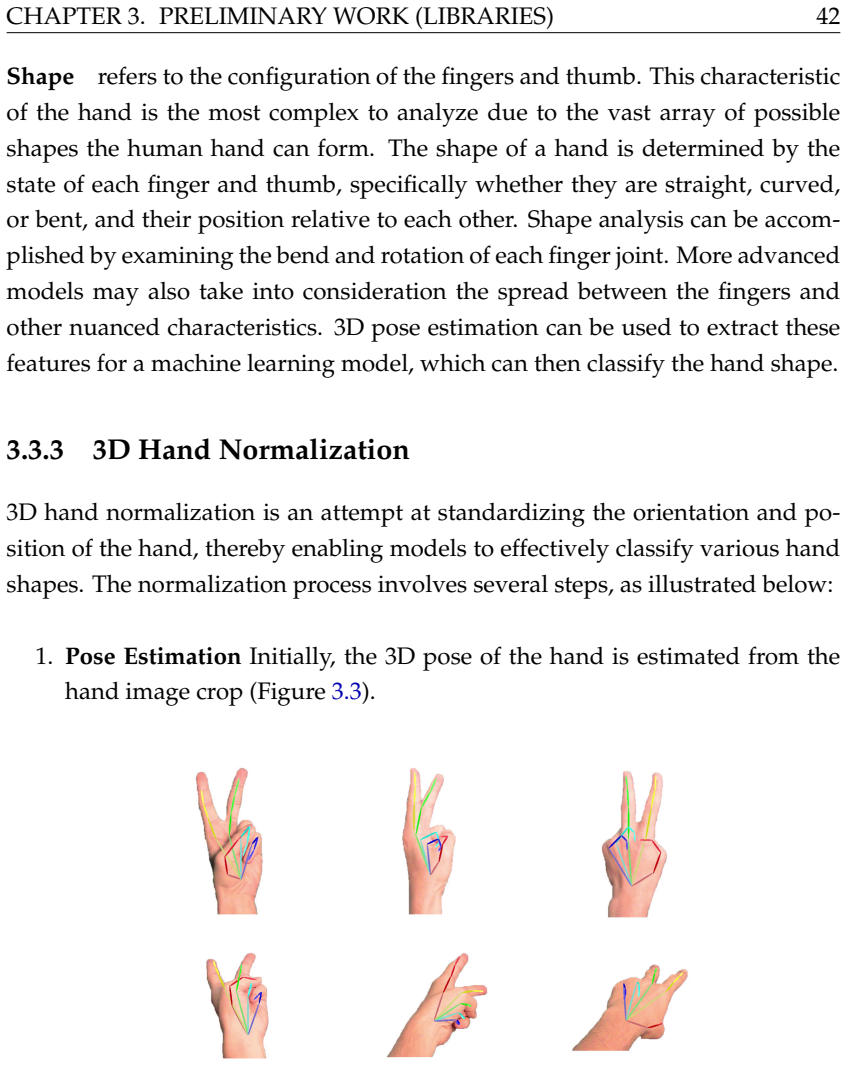
- [Section 3.3] The 3D hand benchmark is built from images of one adult white man's hand; the thesis should state this demographic limitation explicitly when drawing conclusions about pose-estimation consistency for sign language handshapes.
- [Section 6.1.5] The E5 result is confounded by the parameter-halving implementation bug noted in the text; the conclusion that autoregressive connections do not help should be labeled tentative rather than presented as a clean negative result.
- [Section 3.2] The code comment contains a typo: "videoss" appears in the sentence "we also want to load the videos resized to 256 x256 as tensors at 12 frames-per-second, and also load MediaPipe Holistic poses for each of the videoss."
Circularity Check
No circular derivation: the SignWriting-pivot claim is a design hypothesis supported by independent benchmarks, not a fitted input or self-citation chain.
full rationale
I find no circular step in the claimed derivation. The core proposal is a design hypothesis: adopt SignWriting as an intermediate notation between video and text. The thesis does not define SignWriting in terms of the downstream translation results, nor does it fit a parameter and then re-report that fit as a prediction. Section 5.2 reports an empirical evaluation of pose-based recognition and concludes that pose representations are 'not sufficiently expressive' — a negative result that limits the pivot's feasibility but does not make the argument circular. Section 6.1.5 similarly calls 3D hand normalization a 'negative result' caused by poor depth estimation; again, this is an honest limitation rather than a circular reuse of outputs as inputs. The translation and production chapters rely on previously published joint work (SignBank+, Jiang et al. 2023a, Arkushin et al. 2023); those are external benchmarks with independent test sets, not citations that merely restate the thesis's conclusion. The strongest circularity-adjacent concern is that the thesis's evidence for the paradigm comes substantially from the author's own prior papers, but self-citation is not circularity unless the cited result itself assumes the target claim. Here the cited papers provide empirical evaluations of SignWriting-based translation and Ham2Pose production; they do not assume the 'vitality' of the pivot. The absence of an end-to-end video-to-SignWriting-to-text comparison against a gloss baseline is a missing-evidence problem, not a by-construction equivalence. Accordingly, the appropriate finding is no significant circularity.
Assumptions & free parameters
free parameters (4)
- Segmentation decoder thresholds =
threshold_b=60, threshold_o=40-60 for signs; threshold_b=90, threshold_o=90 for phrases
- Augmentation hyperparameters =
p=0.2 token drop, d=4 max permutation distance
- LSTM hidden size and depth =
256 hidden units, 4 layers
- Hand normalization scale =
middle-finger metacarpal length set to 200
assumptions (3)
- domain assumption SignWriting is a faithful, language-independent representation of signed languages.
- domain assumption Pose sequences retain enough information for downstream transcription.
- domain assumption Gold gloss and phrase annotations in the DGS Corpus can serve as ground truth for sign and phrase boundaries.
Cite this review
Pith. "Pith review of Real-Time Multilingual Sign Language Processing." pith.science (2026). https://pith.science/paper/LLCYBS2J
@misc{pith2026241201991,
  author       = {Pith},
  title        = {Pith review of: Real-Time Multilingual Sign Language Processing},
  year         = {2026},
  howpublished = {\url{https://pith.science/paper/LLCYBS2J}},
  note         = {Machine review of arXiv:2412.01991}
}
read the original abstract
Sign Language Processing (SLP) is an interdisciplinary field comprised of Natural Language Processing (NLP) and Computer Vision. It is focused on the computational understanding, translation, and production of signed languages. Traditional approaches have often been constrained by the use of gloss-based systems that are both language-specific and inadequate for capturing the multidimensional nature of sign language. These limitations have hindered the development of technology capable of processing signed languages effectively. This thesis aims to revolutionize the field of SLP by proposing a simple paradigm that can bridge this existing technological gap. We propose the use of SignWiring, a universal sign language transcription notation system, to serve as an intermediary link between the visual-gestural modality of signed languages and text-based linguistic representations. We contribute foundational libraries and resources to the SLP community, thereby setting the stage for a more in-depth exploration of the tasks of sign language translation and production. These tasks encompass the translation of sign language from video to spoken language text and vice versa. Through empirical evaluations, we establish the efficacy of our transcription method as a pivot for enabling faster, more targeted research, that can lead to more natural and accurate translations across a range of languages. The universal nature of our transcription-based paradigm also paves the way for real-time, multilingual applications in SLP, thereby offering a more inclusive and accessible approach to language technology. This is a significant step toward universal accessibility, enabling a wider reach of AI-driven language technologies to include the deaf and hard-of-hearing community.
Figures


Figures from the paper (32 more)




Reference graph
Works this paper leans on
-
[1301]
Addressing the Blind Spots in Spoken Language Processing
URL https://aclanthology.org/P19-1301. Patrick Littell, David R. Mortensen, Ke Lin, Katherine Kairis, Carlisle Turner, and Lori Levin. URIEL and lang2vec: Representing languages as typological, geographical, and phylogenetic vectors. In Proceedings of the 15th Conference of the European Chapter of the Association for Computational Linguistics: Volume 2, S...
work page Pith review arXiv 2017
-
[2017]
URL https://aclantho logy.org/P17-4012
Association for Computational Linguistics. URL https://aclantho logy.org/P17-4012. Sang-Ki Ko, Chang Jo Kim, Hyedong Jung, and Choongsang Cho. Neural sign language translation based on human keypoint estimation. Applied Sciences, 9(13):2683, 2019. Reiner Konrad, Thomas Hanke, Gabriele Langer, Susanne K ¨onig, Lutz K ¨onig, Rie Nishio, and Anja Regen. Publ...
work page 2019
-
[2020]
Sockeye: A Toolkit for Neural Machine Translation
European Language Resources Association (ELRA). ISBN 979-10-95546- 54-2. URL https://www.aclweb.org/anthology/2020.signlang-1 .14. Saad Hassan, Matthew Seita, Larwan Berke, Yingli Tian, Elaine Gale, Sooyeon Lee, and Matt Huenerfauth. ASL-Homework-RGBD dataset: An annotated dataset of 45 fluent and non-fluent signers performing American Sign Lan- guage hom...
work page Pith review arXiv 2020
-
[2023]
Zed Sevcikova Sehyr, Naomi Caselli, Ariel M Cohen-Goldberg, and Karen Em- morey
Accessed on: Monday 2 nd December, 2024. Zed Sevcikova Sehyr, Naomi Caselli, Ariel M Cohen-Goldberg, and Karen Em- morey. The ASL-LEX 2.0 project: A database of lexical and phonological prop- erties for 2,723 signs in american sign language.The Journal of Deaf Studies and Deaf Education, 26(2):263–277, 2021. Prem Selvaraj, Gokul Nc, Pratyush Kumar, and Mi...
arXiv 2003
-
[2826]
URLhttp://dx.doi.org/10.21437/Interspeech.2020-2826. Ofir Press and Lior Wolf. Using the output embedding to improve language models. In Proceedings of the 15th Conference of the European Chapter of the As- sociation for Computational Linguistics: Volume 2, Short Papers , pages 157–163, Valencia, Spain, April 2017. Association for Computational Linguistic...
arXiv 2020
-
[3084]
Necati Cihan Camg ¨oz, Simon Hadfield, Oscar Koller, Hermann Ney, and Richard Bowden
IEEE, 2017. Necati Cihan Camg ¨oz, Simon Hadfield, Oscar Koller, Hermann Ney, and Richard Bowden. Neural sign language translation. In Proceedings of the IEEE Conference on Computer Vision and Pattern Recognition, pages 7784–7793, 2018. Necati Cihan Camg ¨oz, Oscar Koller, Simon Hadfield, and Richard Bowden. Multi-channel transformers for multi-articulato...
arXiv 2017
Reviewed August 11, 2026 · model on record in the stance chip above.
Discussion (0). Continue with ORCID to comment.