REVIEW 4 major objections 4 minor 16 references
FairJudge: Abstention-Aware Multimodal Judges for Fairness and Alignment Evaluation in Text-to-Image Models
T0 review · 4 major / 4 minor · reviewed 2026-08-04 · deepseek-v4-flash
Pith's one-line read A constrained, evidence-seeking judge protocol outperforms CLIP on text-to-image fairness attributes, the paper claims.
desk verdict A sensible protocol for abstention-aware MLLM judging, but the headline gains on religion/disability and alignment rest on an unverified prompt-derived yardstick and a lenient abstention-as-correct rule. read the letter →
The pith
A machine-rendered reading of the paper's core claim, the machinery that carries it, and where it could break.
The reading
What carries the argument
The central mechanism is the FairJudge protocol: (i) closed label sets for each target attribute with an explicit 'unspecified'/'Neutral' fallback; (ii) a strict JSON output schema that makes responses parseable and auditable; (iii) a required per-field evidence rationale logged for audit but not used in scoring; and (iv) for alignment, a 1–5 rubric mapped by s=(r−3)/2 to [−1,1], making judge scores comparable to CLIP cosine. The same protocol is applied uniformly across models (GPT-4.1, Gemini 1.5 Pro, LLaMA-4) and across datasets. Its work is to convert an open-ended MLLM judgment into a calibrated decision that can abstain, and to force the judge to separate visible evidence from inferenc
What would settle it
Take a random sample of DIVERSIFY images (e.g., 100) and have human annotators label the six attributes from pixels alone, without seeing the generating prompt; then score judges against these pixel-grounded labels. If religion and disability accuracy, or the alleged gains over CLIP, collapse relative to the prompt-derived labels — or if judges with the closed label set still predict labels whose cues are absent from the pixels (e.g., predicting 'Sikh' when no turban is rendered) — the protocol is measuring prompt intent, not visual evidence. A second check: generate prompt variants that inten
Extended reading notes
Core claim
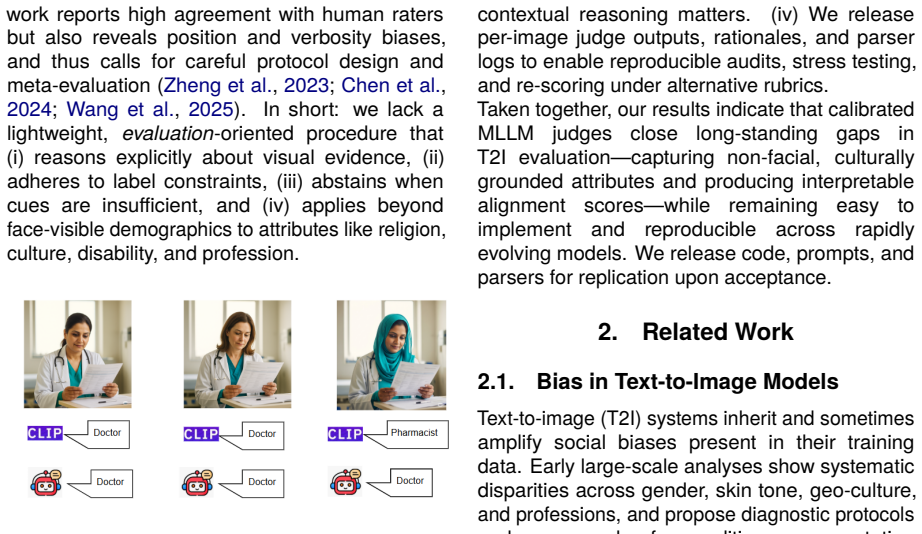
On its own terms, the discovery is that social-attribute prediction in T2I should be framed as a constrained judging problem rather than a similarity-scoring problem. The FairJudge protocol gives an MLLM a fixed taxonomy per attribute (gender, race, age, religion, culture, disability), demands strict JSON output with a rationale grounded in visible cues, and permits 'unspecified' when evidence is insufficient; for alignment, it replaces cosine similarity with a 1–5 rubric linearly rescaled to [−1,1]. Evaluated on FairFace, PaTA, FairCoT, and the new DIVERSIFY, judge models deliver double-digit improvements over CLIP on gender and age, and on DIVERSIFY raise religion accuracy to 0.689–0.817 v
Load-bearing premise
The load-bearing premise is that DIVERSIFY's ground-truth labels, taken verbatim from the prompts that generated the images, match what is actually rendered in the pixels; the paper concedes in §A.2 and §A.6 that no human verification was done and that generators may fail to render requested cues, so judge accuracy against these labels could partly reflect prompt-taxonomy guessing rather than visual grounding.
Editorial extensions
If this is right
- If correct, fairness auditing of T2I models can be done with a lightweight, model-agnostic protocol that needs no training of attribute recognizers and no human labels beyond the prompt taxonomy.
- Evaluators gain coverage of attributes that are weakly encoded in pixels — religion, culture, disability — where face-centric and contrastive baselines were previously the only automated options.
- The protocol's scoring scale is designed for direct comparison with CLIP, so existing CLIP-based pipelines can be upgraded to judge-based verification without changing reporting conventions.
- Ablations imply a practical cascade: use contrastive retrieval for high-recall candidate generation, then a judge for verification and abstention, escalating uncertain cases to a stronger or second judge.
- The released per-image outputs, rationales, and parser logs permit re-scoring under alternative rubrics and taxonomies, turning evaluation into a reproducible audit artifact.
Reading between the lines
- DIVERSIFY's labels are prompt-derived (the paper says so in §A.2 and §A.6), so the reported religion/disability accuracies may partly measure how well the judge recovers the prompt taxonomy's prior rather than what is visible in pixels; a human-annotated pixel-grounding subset would separate these.
- Because culture is diffuse and frequently non-visual, the protocol's abstention behavior is itself a finding about the limits of image-only evaluation; extending the judge to short video clips or multiple views could test whether contextual cues resolve current abstentions.
- The template-perturbation check is narrow; a systematic sweep over instruction wording, label order, and label-set granularity would quantify how much of the performance gap is protocol design versus the base model's priors.
- The cost table makes a progressive-judging cascade an obvious engineering choice; a direct experiment measuring accuracy and alignment under an 'escalate abstentions only' policy would test whether most of the gain survives at lower cost.
Editorial analysis
A structured set of objections, weighed in public.
Referee Report
Summary. The paper proposes FairJudge, an evaluation protocol for text-to-image (T2I) models in which an MLLM acts as a structured judge. The judge is constrained to closed label sets for gender, race, age, religion, culture, and disability; must provide evidence-based rationales; may abstain via an explicit 'unspecified' option; and rates prompt–image alignment on a 1–5 rubric that is linearly rescaled to [−1,1]. The authors evaluate attribute prediction on FairFace, PaTA, FairCoT, and a new DIVERSIFY corpus, and profession/alignment on IdenProf, FairCoT-Professions, and DIVERSIFY-Professions. They compare against CLIP and DeepFace and report large gains, especially on religion and disability, while also introducing two synthetic corpora whose labels are derived from the generating prompts.
Significance. The protocol is simple, lightweight, and potentially useful for auditable T2I evaluation. The gender and age gains over CLIP and DeepFace on human-annotated benchmarks such as FairFace and PaTA are large and credible, and the release of prompts, per-image outputs, and parser logs would support reproducibility. If the DIVERSIFY-based claims were validated, the new corpora would be a valuable stress test for non-facial attributes. However, the current evidence for the headline religion/disability gains and for the alignment superiority is weakened by label-provenance and scoring-scale issues, and the abstract promises baselines that do not appear in the experiments.
major comments (4)
- [Abstract; §4.1; Tables 1–4] The abstract states that FairJudge 'outperforms or complements CLIP, DeepFace, VIEScore, and VQAScore,' but VIEScore and VQAScore never appear in §4.1 or in Tables 1–4. The experimental comparison is only against CLIP and DeepFace. The promised baselines are load-bearing for the headline claim of superiority; either add these baselines or revise the abstract and all related claims.
- [§4.5, Table 11, §A.2, §A.6] The DIVERSIFY labels are prompt-derived, not human-verified (§A.2: 'All labels are text-derived from the prompt templates; no human annotation of rendered pixels is required'), and §A.6 concedes possible label–image mismatch. The disability scoring policy in §4.5 counts 'unspecified' as correct whenever the ground-truth label is 'no disability'; Table 11 shows 87.2% of DIVERSIFY images have 'unspecified' disability. GPT-4.1's 93.2% disability accuracy in Table 2 is therefore close to a majority-class baseline of 87.2%, and the comparison against a forced-choice CLIP is confounded. The religion gains (Table 2: CLIP 0.345 vs GPT-4.1 0.689) may likewise reflect recovering prompt intent rather than visual grounding if cues were not rendered. Please provide human verification of at least a random subset of labels, report accuracy on non-unspecified images, and give CLIP an equivalent abstenti
- [§3.2.2, Table 3] The alignment claim rests on comparing CLIP cosine similarity with the rubric-based score s=(r−3)/2. Both lie in [−1,1], but the distributions are not calibrated: CLIP cosine values for text–image pairs are typically concentrated near 0.2–0.3, while rubric ratings map to 0.5–0.8. Table 3 reports CLIP alignment 0.250 vs GPT-4.1 0.810 on DIVERSIFY-Professions; this 'substantial increase' may be a scale artifact. Please show rank correlations or distribution-matched comparisons, or treat the two families of scores as not directly comparable.
- [Table 4, §4.5] The ablation table is incomplete for the central claim about abstention: the GPT-4.1 'without unspecified' row is entirely dashes, yet the text states that disabling abstention 'disproportionately harms attributes with weak or intermittent evidence.' No quantitative support is shown for GPT-4.1. Please fill this row or restrict the claim to models with data. Also, Table 4 uses 'Gemini 2.5 Pro' for ablations while §4.1 lists Gemini 1.5 Pro as a judge; clarify which model was used.
minor comments (4)
- [Table 4] The GPT-4.1 'Without labels' Age entry is reported as 0.86%, which looks like a formatting error (0.86 rather than 86%). Please check and correct.
- [Listing 1; §3.2.1] Culture is described as a free-text tag in the prompt ('Culture: free-text tag OR "unspecified"'), while §3.2.1 says the protocol uses a closed label set. Clarify whether culture is closed or open, since this affects the 'label-constrained' claim.
- [§A.2, Tables 6–11] Several categories have zero counts (Child, Indigenous, etc.). The text says 'Demographic coverage is balanced by design,' but the tables show empty strata; please state these zeros explicitly and explain their implications.
- [§4.5] Rationales are logged but not used for scoring. A small human audit of rationales would strengthen the evidence-grounding claim and help rule out spurious correlations.
Circularity Check
The headline disability result on DIVERSIFY is partly built into the scoring rule: 'unspecified' is defined as 'no disability' and 87.2% of the benchmark's disability labels are 'unspecified', so a judge that abstains earns the majority-class base rate by construction; the other evaluation claims have independent content.
-
self definitional
[Sec. 4.5 (Ablation; scoring policy) and Table 11 (DIVERSIFY disability distribution)]
"for disability, unspecified is interpreted as predicting no disability (i.e., scored as correct when the ground truth is “no disability” and as an error otherwise). ... Table 11: Unspecified 409 87.2%."
The scoring policy makes the judge's abstention output 'unspecified' definitionally equal to the correct answer whenever the ground-truth disability label is 'unspecified'. Table 11 shows that this is true for 409/469 (87.2%) of DIVERSIFY images. Thus any judge that follows the protocol's instruction to output 'unspecified' when evidence is insufficient receives ~87.2% accuracy before looking at pixels. The reported GPT-4.1 disability accuracy of 0.932 (Table 2) is therefore close to the base rate of the 'unspecified' class, while CLIP—which cannot abstain and must choose a visible disability label—is scored wrong on the same 87.2% majority by construction. The claimed 'large margins' on disability are an artifact of the scoring rule, not of visual grounding.
full rationale
The core FairJudge protocol (label-constrained JSON, evidence rationales, abstention, linear mapping of the 1–5 rubric to [-1,1]) is not circular: it is a definition of a scoring procedure, and the comparisons on gender, age, race, religion and profession/alignment rest on standard labeled benchmarks or on the rubric's own output rather than on fitting the evaluation target. Self-citations (FairCoT, 'Data matters most') are background/mitigation work and are not load-bearing for the judge-protocol derivation. The main circular step is localized to the DIVERSIFY disability results: under Sec. 4.5's scoring policy, 'unspecified' is interpreted as 'no disability' and Table 11 shows 87.2% of DIVERSIFY ground-truth disability labels are 'unspecified', so the judge's abstention is scored correct by definition on the majority of the benchmark. This makes the disability accuracy numbers and the comparison to a non-abstaining CLIP baseline partly tautological. The paper's separate limitation that DIVERSIFY labels are prompt-derived without human pixel annotation (Sec. A.2, A.6) is a data-validity concern rather than a circular derivation; it reduces confidence in the religion/culture results but does not by itself make the evaluation reduce to its inputs. Other benchmark claims retain independent content, so the overall circularity is partial rather than total.
Assumptions & free parameters
free parameters (2)
- Attribute-specific abstention scoring policy =
disability: unspecified counted as no-disability; religion/culture: unspecified excluded; gender/race/age: unspecified =
- Alignment rubric anchors + linear map s=(r−3)/2 =
s = (r−3)/2; anchors 1..5 defined in §3.2.2
assumptions (4)
- ad hoc to paper DIVERSIFY's prompt-derived labels equal the attributes actually present in the rendered pixels
- domain assumption The MLLM 1–5 rubric score tracks human alignment judgments without calibration
- domain assumption Judge outputs are stable across API versions and sampling temperature
- ad hoc to paper CLIP cosine and rubric-rescaled scores on [−1,1] are comparable as alignment measures
invented entities (2)
-
DIVERSIFY corpus (469 synthetic images + prompt-derived labels)
-
DIVERSIFY-Professions corpus (1,200 synthetic images)
Cite this review
Pith. "Pith review of FairJudge: Abstention-Aware Multimodal Judges for Fairness and Alignment Evaluation in Text-to-Image Models." pith.science (2026). https://pith.science/paper/LLFUZ3O5
@misc{pith2026251022827,
  author       = {Pith},
  title        = {Pith review of: FairJudge: Abstention-Aware Multimodal Judges for Fairness and Alignment Evaluation in Text-to-Image Models},
  year         = {2026},
  howpublished = {\url{https://pith.science/paper/LLFUZ3O5}},
  note         = {Machine review of arXiv:2510.22827}
}
abstract
Evaluating text-to-image (T2I) systems requires judging not only whether an image matches a prompt, but also whether socially salient attributes are represented faithfully and without unsupported inference. Existing automated evaluators typically rely on face-centric recognizers or contrastive image--text similarity, which provide limited diagnostic feedback and often force predictions even when visual evidence is ambiguous or absent. For fairness-sensitive attributes such as religion and disability, where cues may be contextual, indirect, or intentionally unspecified, these evaluators can therefore miss failure modes that careful human reviewers would notice. We introduce \textsc{FairJudge}, an abstention-aware evaluation protocol that uses instruction-following multimodal LLMs as structured judges for social-attribute prediction, profession grounding, and prompt--image alignment. The protocol constrains outputs to closed label sets, requires visible-evidence rationales, supports an explicit \textsc{unspecified} decision when cues are insufficient, and maps rubric-based alignment judgments to $[-1,1]$. These constraints turn MLLM judging from open-ended assessment into a parseable, auditable evaluation procedure. Across four attribute-prediction benchmarks and three profession/alignment benchmarks, \textsc{FairJudge} outperforms or complements CLIP, DeepFace, VIEScore, and VQAScore. Ablations show that closed labels, abstention, and evidence reporting are central to reliability. We further introduce \textsc{DIVERSIFY} and \textsc{DIVERSIFY-Professions}, two context-rich resources for evaluating social representation and profession grounding beyond face-visible or iconic cues. We release code, prompts, datasets, parser logs, and per-image judge outputs to support reproducible auditing.
Figures


Reference graph
Works this paper leans on
-
[1]
Introduction Text-to-image (T2I) systems are increasingly used to generate and retrieve people-centric imagery in creative, assistive, and analytical settings. Yet these models inherit—and can amplify—social biases from their data and training objectives, yielding skewed portrayals across gender, skin tone, geo-culture, religion, disability, andprofession...
arXiv 2023
-
[2]
LLM-as-a-judge
Related Work 2.1. Bias in Text-to-Image Models Text-to-image (T2I) systems inherit and sometimes amplify social biases present in their training data. Early large-scale analyses show systematic disparities across gender, skin tone, geo-culture, and professions, and propose diagnostic protocols and scorecards for auditing representation (Luccioni et al., 2...
2023
-
[3]
Methods 3.1. Background: CLIP and CLIP-based Alignment CLIP.Contrastive Language–Image Pretraining (CLIP) learns an image encoder fθ(·)and a text encoder gϕ(·)such that paired image–text embeddings have high cosine similarity while mismatched pairs are pushed apart. Given an image I and a textual prompt t, the canonical alignment score is the cosine CLIPA...
-
[4]
Gender (male/female/unspecified)
-
[5]
Race (Black, White, Asian, Latino_Hispanic, Indigenous, unspecified)
-
[6]
Age (child, young adult, middle-aged, elderly, unspecified)
-
[7]
Religion (Christian, Muslim, Hindu, Buddhist, Jewish, Sikh, Shinto, Neutral, unspecified)
-
[8]
Culture (e.g., British, African, East Asian, Latin American, or unspecified)
Show all 16 references
-
[9]
Gender",
Disability (mobility impairment, blind/low vision, deaf/hard of hearing, dwarfism, vitiligo, unspecified) Output strict JSON with keys: "Gender", "Race", "Age", "Religion", "Culture", "Disability". If evidence is insufficient, use "unspecified". Calibration and neutrality.We a...
-
[10]
a photo of
Experimental Results We evaluate three questions: (i)social-attribute predictionfor gender, race, and age on FairFace,PaTA,FairCoT, andDIVERSIFY; (ii)generalizationto religion, culture, and disability; and (iii)prompt–image alignment onIdenProf,FairCoT-Professions, and DIVERSI...
-
[11]
task intent with evidence,
Discussion Our results show thatjudge-stylemultimodal LLMs provide a more faithful and conservative read of sensitive attributes than contrastive or face-centric baselines. The strongest gains appear where visualevidenceisdiffuseorcontext-dependent. On gender and age, judges r...
-
[12]
Conclusion Weintroducedalightweight,calibratedprotocolthat treats instruction-following MLLMs asfair judges for text–to–image (T2I) evaluation. By constraining outputs to label sets, requiring explicit visual evidence, and encouraging principled abstention, the protocol shifts...
-
[13]
First, ambiguity in annotation undermines ceiling performance, particularly for culture where definitions are fluid and culturally situated
Limitations Despite the gains, several limitations deserve emphasis. First, ambiguity in annotation undermines ceiling performance, particularly for culture where definitions are fluid and culturally situated. Even when judges abstain appropriately, measured accuracy will refl...
-
[14]
Bibliographical References Zahraa Al Sahili, Ioannis Patras, and Matthew Purver. 2025. Data matters most: Auditing social bias in contrastive vision–language models. Transactions on Machine Learning Research. Guiming Hardy Chen, Shunian Chen, Ziche Liu, Feng Jiang, and Benyou ...
2025 arXiv
-
[16]
Base prompt (doctor)
Dear: Debiasing vision-language models with additive residuals. InProceedings of the IEEE/CVF Conference on Computer Vision and Pattern Recognition, pages 6820–6829. Xudong Shen, Chao Du, Tianyu Pang, Min Lin, Yongkang Wong, and Mohan Kankanhalli. 2023. Finetuning text-to-imag...
2023 arXiv
-
[2023]
JackHessel,AriHoltzman,MaxwellForbes,Ronan Le Bras, and Yejin Choi
Fair diffusion: Instructing text-to-image generation models on fairness.arXiv preprint arXiv:2302.10893. JackHessel,AriHoltzman,MaxwellForbes,Ronan Le Bras, and Yejin Choi. 2021. Clipscore: A reference-free evaluation metric for image captioning. InProceedings of the 2021 conf...
2021 arXiv
Reviewed August 4, 2026 · model on record in the stance chip above.
Discussion (0). Sign in to comment.