REVIEW 4 major objections 6 minor 15 references
Uncheatable Machine Learning Inference
T0 review · 4 major / 6 minor · reviewed 2026-08-14 · deepseek-v4-flash
Pith's one-line read The paper proposes client-side tests that give probabilistic evidence of whether an ML-as-a-service provider is cheating.
desk verdict A clear taxonomy of MLaaS cheating and a menu of plausible countermeasures, but every method is an untested sketch and the steganography pillar rests on an explicit, unsupported assumption. read the letter →
The pith
A machine-rendered reading of the paper's core claim, the machinery that carries it, and where it could break.
The reading
What carries the argument
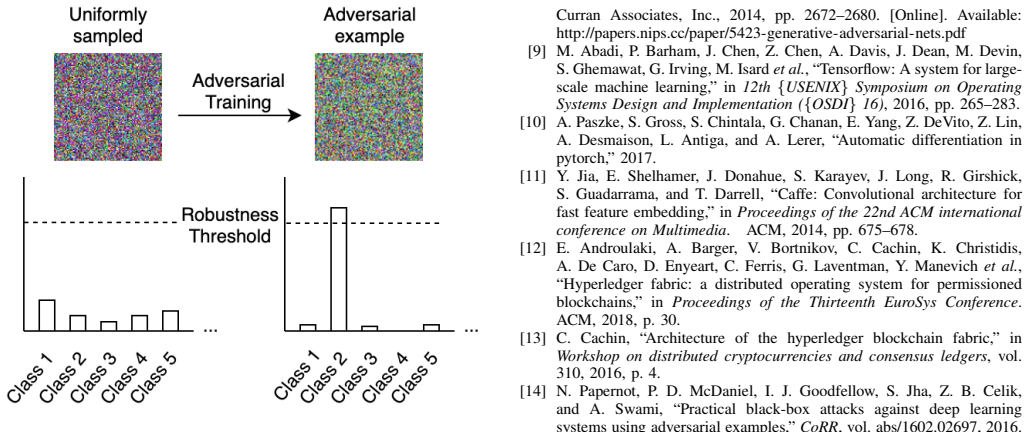
The central mechanism is the steganographic probe: an input image into which a secret message is embedded by a prep network and a hiding network, such that only the supplier's trained reveal/classifier model can decode it, while a cheaper substitute model would not. The paper also uses two secondary mechanisms: seeding, which makes model initialization and stochastic training reproducible so that identical outputs are comparable, and an adversarial query-counting procedure that measures robustness as the average number of black-box inputs needed to cross a per-class probability threshold. These mechanisms carry the verification arguments because each gives the client a comparison the cheating provider cannot easily fake.
What would settle it
Train an off-the-shelf classifier on a large set of normal inputs and the supplier-released container images, then test whether it can flag containers as anomalous; if such a cheap discriminator succeeds, the steganographic audit's central premise is false.
Extended reading notes
Core claim
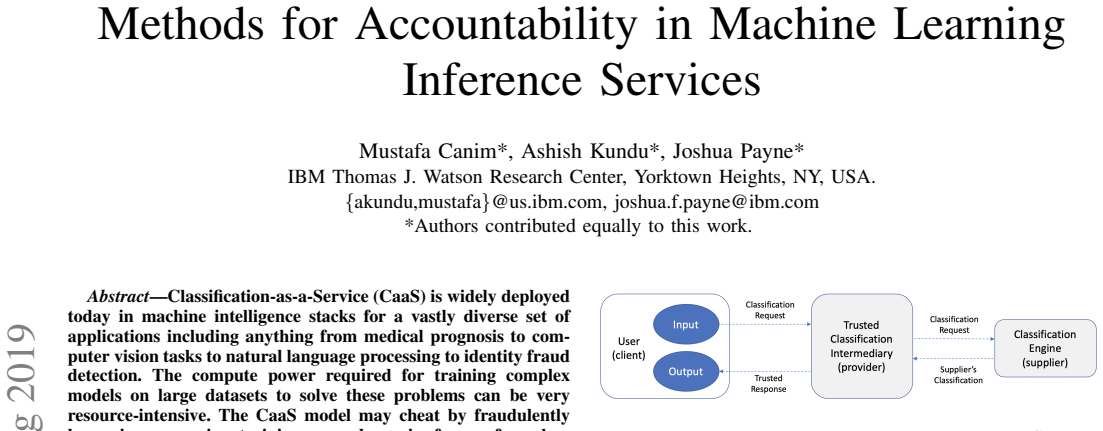
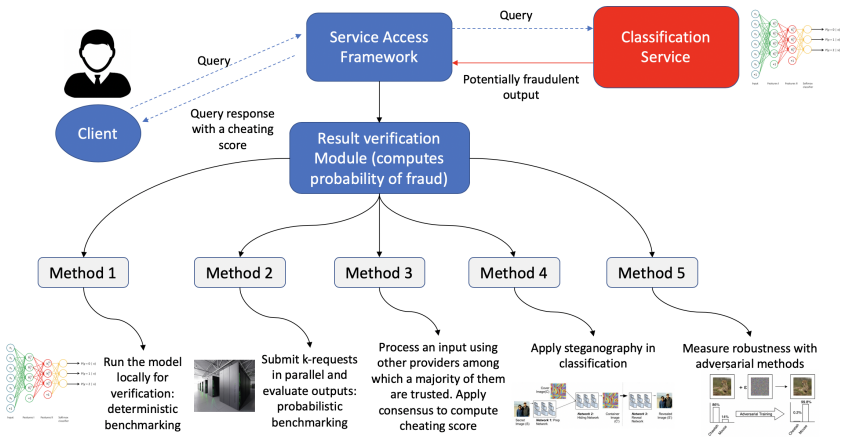
The paper's central claim is that a client can, with high probability, determine whether an intermediary provider is substituting a cheaper model for the promised supplier's model, and can also benchmark an untrusted supplier's accuracy and robustness claims. For the trusted-supplier case it proposes steganographic probes generated by networks released by the supplier; when answers to probes are mostly correct, the provider is probably honest, and when they are mostly wrong, it is probably cheating. It also proposes deterministic verification by seeding, probabilistic accuracy comparison on identical inputs, and verification of supplier-generated metaresults such as explanations. For the untrusted-supplier case it proposes an adversarial procedure that measures how many black-box queries are needed to push inputs past a robustness threshold, giving a verifiable robustness score per class. The final component is a permissioned-blockchain QoS auditor in which oracles compute the model, reach consensus on its performance, and reward majority voters with tokens.
Load-bearing premise
The entire audit rests on the assumption that a cheating provider cannot build a cheaper model that recognizes the hidden-message inputs while still handling normal inputs well, a premise the paper states but does not test.
Editorial extensions
If this is right
- If the steganographic probe method works, a client can run a series of probe and non-probe queries and get a statistically meaningful probability that the intermediary is or is not calling the claimed supplier.
- If seeding is available, a single mismatched input-output pair between the provider and a directly queried, identically seeded supplier is enough to declare the provider fraudulent; all identical pairs certify it.
- In the blackbox case, accuracy on k identical labeled inputs gives a confidence interval, so the client can trade query budget for certainty about cheating.
- For an untrusted supplier, the published adversarial robustness score gives clients a quantitative, class-by-class QoS measure that can be written into an SLA.
Reading between the lines
- Beyond the paper: the same probe logic could be turned into a continuous, automated audit, with a client or regulator randomly injecting steganographic probes into live traffic and aggregating results over time to catch providers that occasionally degrade service.
- The paper's weakest point is also its most testable: one could attempt to train a cheap discriminator on released container images and probe outputs, and if that discriminator separates probes from normal inputs, the whole steganographic audit collapses.
- The oracle-based blockchain auditor, if it works, is a general pattern: any service whose output can be recomputed by independent parties could be audited by the same token-incentivized consensus, not just classification models.
Signed reviews
Editorial analysis
A structured set of objections, weighed in public.
Referee Report
Summary. The paper addresses the problem of detecting fraudulent machine-learning-as-a-service (MLaaS) providers who claim to use a trusted supplier's model but actually use cheaper, lower-quality models. It proposes five methods: deep steganography based probes, deterministic seeding-based benchmarking, probabilistic accuracy benchmarking, verification via metaresults, black-box robustness benchmarking, and a permissioned blockchain-based auditor. The paper gives a high-level description of these methods but contains no equations beyond a loss function definition, no proofs, no algorithmic details, and no experimental evaluation. The conclusion asserts that clients will be able to determine a probability of provider cheating, but no such probability is formally derived.
Significance. If the proposed methods worked as described, the paper would make a useful contribution to MLaaS accountability, especially the idea of using steganographic probes and a distributed auditor for SLA verification. The paper identifies a real and increasingly relevant problem, and it gives credit to prior work. However, the lack of formal security analysis and empirical validation means that the significance is currently only potential. The paper's strengths are its clear problem statement and the breadth of proposed directions; its weaknesses are that each method rests on unverified assumptions and the deterministic benchmarking claim is incorrect in realistic settings.
major comments (4)
- [IV-A2] The claim that 'if any pair is not identical, we can say that P is fraudulent' is false in any realistic deployment. Seeded pseudorandom number generators make training reproducible only when the entire software and hardware stack is identical; inference itself can be nondeterministic due to floating-point non-associativity, GPU kernel scheduling, and batched execution. A faithful P that truly forwards queries to S can therefore produce outputs that differ from C's locally recomputed outputs, causing the test to falsely accuse an honest provider. The authors should restrict the claim to a tightly controlled execution environment and account for the remaining nondeterminism.
- [IV-A1] The security of the deep steganography audit rests entirely on the explicit assumption that a cheaper model that is not Mt and that can discriminate between inputs of the message class and object class is not viable. Because the protocol releases the prep and hiding networks to C, a cheating provider P can also obtain them and generate its own stego/non-stego training pairs. If P can train any binary classifier that distinguishes containers from ordinary inputs, P can simply return the message class for detected probes and pass the audit without ever querying S. The paper offers no argument, experimental evidence, or reference supporting the claimed infeasibility, so this load-bearing step is unsupported. The authors either need to provide a formal hardness assumption or an empirical evaluation against an actual steganalyzer.
- [IV-A3] The probabilistic benchmarking method is not specified enough to support the paper's conclusion that a client can 'determine a probability of whether a MLaaS provider is cheating.' The text states that differences in accuracy may be evaluated 'with variance in mind, which is controlled by k' but does not define a test statistic, a significance level, a confidence interval, or a rule for declaring fraud. 'Mostly correct' and 'mostly incorrect' are not quantitative thresholds. The authors should provide a concrete hypothesis test, a formula for the required sample size k given a minimum detectable accuracy gap, and a bound on the false-positive rate.
- [IV-C] The proposed robustness metric is not well-defined and therefore is not reproducible or measurable as stated. The phrase 'gradient of convergence to a certain robustness threshold' and the 'average number of input queries the adversarial model needs to make ... before we reach a certain classification probability' depend on unspecified algorithmic choices (query budget, step size, initialization, threshold) and on a uniform sampling distribution over the image space, which is not a well-defined probability measure. Moreover, the objective function introduced in this section does not follow from the minimax game that precedes it; the notation and derivation need to be corrected. A precise definition and a stability analysis are required before this can serve as a benchmark.
minor comments (6)
- [General] The paper presents several proposals but never states their limitations or the conditions under which they fail; adding a 'Limitations' section would improve the clarity and honesty of the presentation.
- [IV-A2] The phrase 'with high probability' is used without specifying the probability or the source of uncertainty; it should be made precise or removed.
- [IV-A4] The assumption that metaresults cannot be forged without access to Mt is stated but never tied to a concrete cryptographic mechanism, such as digital signatures or a tamper-proof attestation protocol.
- [IV-B] The description of the permissioned blockchain is too high-level; the claim that oracles are trusted or mutually untrusting and therefore will not collude is a strong assumption that needs justification, and the consensus and token mechanics are left unspecified.
- [IV-C] The manuscript contains several typos and unclear passages, for example 'we are n concerned only with a dynamic generator model' in Section IV-C and the mislabeled 'Figure 3' and 'section III' in Section IV.
- [Title] The title 'Uncheatable Machine Learning Inference' overstates the results: the proposed methods only reduce the probability of cheating under specific assumptions and do not make cheating impossible.
Circularity Check
No circularity: the paper is a design proposal whose protocols are definitions rather than derived predictions; the flagged steganography assumption is an unsupported correctness premise, not a circular reduction.
full rationale
The manuscript proposes accountability protocols for MLaaS and contains no quantitative derivation in which an output quantity is fitted and then re-predicted as a result. The probabilistic benchmarking method (Section IV-A3) defines a comparison protocol: C queries P and S with identical inputs and compares accuracy; this is a statistical testing procedure, not an equation that reduces to its own input. The deterministic seeding method (Section IV-A2) defines fraud as non-identical outputs given the same seed; that is an explicitly stated definitional test, and it is not disguised as an empirical prediction. The robustness metric (Section IV-C) is introduced as a definition: the number of adversarial queries needed to reach a robustness threshold, optionally passed through a sigmoid. Defining a metric is not circular derivation, even though the metric is described in terms of the adversarial model used to measure it. The one passage that must be flagged explicitly is in Section IV-A1 (Deep Steganography): 'In describing this procedure, we've assumed that generating a cheaper model that is not Mt and that can discriminate between inputs of the message class and object class is not viable.' This is a load-bearing security assumption for the steganographic audit, and the paper offers no experimental or theoretical support for it. If a cheating provider can train any discriminator between steganographic and ordinary inputs, the proposed test fails. However, the assumption is not a circular step: the paper does not fit a parameter to the test outcome and then claim that parameter as a predicted cheating probability. Under the hard rules, unsupported assumptions are correctness risks, not circularity. There are no self-citations that carry the argument, no uniqueness theorem imported from the authors' prior work, and no renamed empirical pattern presented as a new result. Accordingly, the circularity score is 0.
Assumptions & free parameters
free parameters (3)
- beta (steganography loss weight)
- robustness threshold
- k (number of probe samples)
assumptions (6)
- domain assumption Deep steganography can hide a message inside a cover so that the container is visually similar and the message is extractable only by the trained reveal network.
- ad hoc to paper A fraudulent provider cannot train a cheaper model that identifies steganographic objects.
- domain assumption Seeded training is deterministic and reproduces identical model outputs across environments.
- domain assumption Blockchain oracles are trusted and/or mutually untrusting and will not collude.
- domain assumption The blackbox model Mt is differentiable, so adversarial gradients can be computed via queries.
- ad hoc to paper Metaresults (explanations or QA keys) cannot be forged without access to Mt.
Cite this review
Pith. "Pith review of Uncheatable Machine Learning Inference." pith.science (2026). https://pith.science/paper/LLXS6UCI
@misc{pith2026190803270,
  author       = {Pith},
  title        = {Pith review of: Uncheatable Machine Learning Inference},
  year         = {2026},
  howpublished = {\url{https://pith.science/paper/LLXS6UCI}},
  note         = {Machine review of arXiv:1908.03270}
}
abstract
Classification-as-a-Service (CaaS) is widely deployed today in machine intelligence stacks for a vastly diverse set of applications including anything from medical prognosis to computer vision tasks to natural language processing to identity fraud detection. The computing power required for training complex models on large datasets to perform inference to solve these problems can be very resource-intensive. A CaaS provider may cheat a customer by fraudulently bypassing expensive training procedures in favor of weaker, less computationally-intensive algorithms which yield results of reduced quality. Given a classification service supplier $S$, intermediary CaaS provider $P$ claiming to use $S$ as a classification backend, and customer $C$, our work addresses the following questions: (i) how can $P$'s claim to be using $S$ be verified by $C$? (ii) how might $S$ make performance guarantees that may be verified by $C$? and (iii) how might one design a decentralized system that incentivizes service proofing and accountability? To this end, we propose a variety of methods for $C$ to evaluate the service claims made by $P$ using probabilistic performance metrics, instance seeding, and steganography. We also propose a method of measuring the robustness of a model using a blackbox adversarial procedure, which may then be used as a benchmark or comparison to a claim made by $S$. Finally, we propose the design of a smart contract-based decentralized system that incentivizes service accountability to serve as a trusted Quality of Service (QoS) auditor.
Figures

Figures from the paper (3 more)


Reference graph
Works this paper leans on
-
[1]
BERT: pre-training of deep bidirectional transformers for language understanding,
J. Devlin, M. Chang, K. Lee, and K. Toutanova, “BERT: pre-training of deep bidirectional transformers for language understanding,” CoRR, vol. abs/1810.04805, 2018. [Online]. Available: http://arxiv.org/abs/ 1810.04805
arXiv 2018
-
[2]
Cloud computingthe business perspective,
S. Marston, Z. Li, S. Bandyopadhyay, J. Zhang, and A. Ghalsasi, “Cloud computingthe business perspective,” Decision support systems , vol. 51, no. 1, pp. 176–189, 2011
work page 2011
-
[3]
Web service level agreement (wsla) language specification,
H. Ludwig, A. Keller, A. Dan, R. P. King, and R. Franck, “Web service level agreement (wsla) language specification,” Ibm corporation , pp. 815–824, 2003
work page 2003
-
[4]
Hiding images in plain sight: Deep steganography,
S. Baluja, “Hiding images in plain sight: Deep steganography,” in Advances in Neural Information Processing Systems 30 , I. Guyon, U. V . Luxburg, S. Bengio, H. Wallach, R. Fergus, S. Vishwanathan, and R. Garnett, Eds. Curran Associates, Inc., 2017, pp. 2069–2079. [Online]. Available: http://papers.nips.cc/paper/ 6802-hiding-images-in-plain-sight-deep-ste...
work page 2017
-
[5]
An overview of image steganography
T. Morkel, J. H. Eloff, and M. S. Olivier, “An overview of image steganography.” in ISSA, 2005, pp. 1–11
work page 2005
-
[6]
Reducing the dimensionality of data with neural networks,
G. E. Hinton and R. R. Salakhutdinov, “Reducing the dimensionality of data with neural networks,” science, vol. 313, no. 5786, pp. 504–507, 2006
2006
-
[7]
Explainable artificial intelligence (xai),
D. Gunning, “Explainable artificial intelligence (xai),” Defense Ad- vanced Research Projects Agency (DARPA), nd Web , vol. 2, 2017
work page 2017
-
[8]
I. Goodfellow, J. Pouget-Abadie, M. Mirza, B. Xu, D. Warde-Farley, S. Ozair, A. Courville, and Y . Bengio, “Generative adversarial nets,” in Advances in Neural Information Processing Systems 27 , Z. Ghahramani, M. Welling, C. Cortes, N. D. Lawrence, and K. Q. Weinberger, Eds. Curran Associates, Inc., 2014, pp. 2672–2680. [Online]. Available: http://papers...
work page 2014
Show all 15 references
-
[9]
Tensorflow: A system for large- scale machine learning,
M. Abadi, P. Barham, J. Chen, Z. Chen, A. Davis, J. Dean, M. Devin, S. Ghemawat, G. Irving, M. Isard et al., “Tensorflow: A system for large- scale machine learning,” in 12th {USENIX} Symposium on Operating Systems Design and Implementation ( {OSDI} 16), 2016, pp. 265–283
2016
-
[10]
Automatic differentiation in pytorch,
A. Paszke, S. Gross, S. Chintala, G. Chanan, E. Yang, Z. DeVito, Z. Lin, A. Desmaison, L. Antiga, and A. Lerer, “Automatic differentiation in pytorch,” 2017
2017
-
[11]
Caffe: Convolutional architecture for fast feature embedding,
Y . Jia, E. Shelhamer, J. Donahue, S. Karayev, J. Long, R. Girshick, S. Guadarrama, and T. Darrell, “Caffe: Convolutional architecture for fast feature embedding,” in Proceedings of the 22nd ACM international conference on Multimedia . ACM, 2014, pp. 675–678
2014
-
[12]
Hyperledger fabric: a distributed operating system for permissioned blockchains,
E. Androulaki, A. Barger, V . Bortnikov, C. Cachin, K. Christidis, A. De Caro, D. Enyeart, C. Ferris, G. Laventman, Y . Manevich et al. , “Hyperledger fabric: a distributed operating system for permissioned blockchains,” in Proceedings of the Thirteenth EuroSys Conference . AC...
2018
-
[13]
Architecture of the hyperledger blockchain fabric,
C. Cachin, “Architecture of the hyperledger blockchain fabric,” in Workshop on distributed cryptocurrencies and consensus ledgers , vol. 310, 2016, p. 4
2016
-
[14]
Practical black-box attacks against deep learning systems using adversarial examples,
N. Papernot, P. D. McDaniel, I. J. Goodfellow, S. Jha, Z. B. Celik, and A. Swami, “Practical black-box attacks against deep learning systems using adversarial examples,” CoRR, vol. abs/1602.02697, 2016. [Online]. Available: http://arxiv.org/abs/1602.02697
2016 arXiv
-
[15]
Adversarial examples in the physical world,
A. Kurakin, I. J. Goodfellow, and S. Bengio, “Adversarial examples in the physical world,” CoRR, vol. abs/1607.02533, 2016. [Online]. Available: http://arxiv.org/abs/1607.02533
2016 arXiv
Reviewed August 14, 2026 · model on record in the stance chip above.
Discussion (0). Continue with ORCID to comment.