REVIEW 33 references
Self-Supervised Traversability Learning with Online Prototype Adaptation for Off-Road Autonomous Driving
T0 review · reviewed 2026-08-16 · deepseek-v4-flash
Pith's one-line read A self-supervised, BEV-based traversability classifier with online prototype updates outperforms prior self-supervised methods on off-road datasets and runs in real time.
desk verdict Plausible new self-supervised traversability pipeline with real field validation, but the headline performance comparison is not fair as run. read the letter →
The pith
A machine-rendered reading of the paper's core claim, the machinery that carries it, and where it could break.
The reading
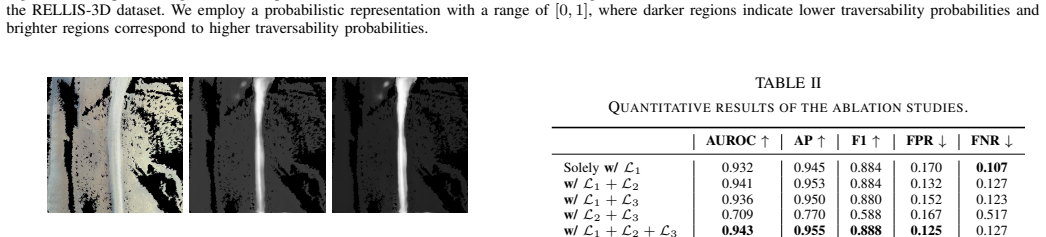
The learning system turns each small patch of the top-down map into a feature vector, then uses a contrastive loss to pull vectors of safe areas together and push vectors of unsafe areas apart. It also clusters the feature vectors into prototypes, or representative examples, at several levels of detail. This gives the network a compact set of safe and unsafe reference points. At run time, a second mechanism updates those reference points online: as the vehicle drives, it compares new terrain to the prototypes it has built from its recent path, and if the terrain is sufficiently different it creates a new prototype. The final output is a cost map in which each cell has a number between 0 and 1, representing how similar that cell is to terrain the vehicle has already driven on successfully.
The experiments compare the method with two earlier self-supervised methods on the RELLIS-3D public dataset and on a new 30.88 km dataset. The reported numbers are favorable, but the comparisons are not fully convincing: one baseline is reported with AUROC below 0.5 (worse than random), which is not explained, and no error bars are given. The authors also admit a key assumption: the vehicle must always be driving within traversable areas for the self-labels to be correct.
Extended reading notes
Core claim
The paper's central claim, as stated in the abstract and Section IV-D, is that the proposed self-supervised traversability learning method with BEV input, automatic labeling from trajectory and LiDAR obstacle detection, and online prototype adaptation 'significantly outperforms recent approaches' on both public (RELLIS-3D) and self-collected off-road datasets, and that the resulting cost maps are compatible with downstream motion planning, validated by a 5.5 km autonomous driving run at 10 Hz on an NVIDIA L4.
Load-bearing premise
The method assumes that regions traversed by the vehicle are safe and that similarity to recently traversed terrain is a valid traversability measure. This enters in the self-supervised label generation (Section III-B), where vehicle trajectory points are labeled positive, and in the online prototype queue (Section III-D), where the cost of every cell is its cosine similarity to the prototypes of previously driven areas. The conclusion admits this: 'the current work assumes that the vehicle always drives within the traversable area.' If the vehicle's recent path contains unsafe or unrepresentative terrain, or if the LiDAR obstacle detector misses hazards, the prototype queue and the cost map are corrupted.
Signed reviews
Editorial analysis
A structured set of objections, weighed in public.
Assumptions & free parameters
free parameters (7)
- temperature tau =
0.05
- loss weight lambda =
min(1, epoch/60)
- momentum m =
0.99
- similarity threshold alpha =
0.9
- cluster centers K =
{50, 100, 500}
- noise scale sigma =
not specified
- binary decision threshold tau* =
varies per dataset
assumptions (4)
- domain assumption Traversed vehicle trajectories are safe and traversable.
- domain assumption LiDAR obstacle detection [30] reliably identifies non-traversable regions.
- domain assumption Odometry and calibration are accurate enough for BEV fusion and labeling.
- standard math Standard ML and clustering assumptions hold (i.i.d. splits, K-Means convergence, CRP online clustering).
Cite this review
Pith. "Pith review of Self-Supervised Traversability Learning with Online Prototype Adaptation for Off-Road Autonomous Driving." pith.science (2026). https://pith.science/paper/LMAFO6JR
@misc{pith2026250412109,
  author       = {Pith},
  title        = {Pith review of: Self-Supervised Traversability Learning with Online Prototype Adaptation for Off-Road Autonomous Driving},
  year         = {2026},
  howpublished = {\url{https://pith.science/paper/LMAFO6JR}},
  note         = {Machine review of arXiv:2504.12109}
}
read the original abstract
Achieving reliable and safe autonomous driving in off-road environments requires accurate and efficient terrain traversability analysis. However, this task faces several challenges, including the scarcity of large-scale datasets tailored for off-road scenarios, the high cost and potential errors of manual annotation, the stringent real-time requirements of motion planning, and the limited computational power of onboard units. To address these challenges, this paper proposes a novel traversability learning method that leverages self-supervised learning, eliminating the need for manual annotation. For the first time, a Birds-Eye View (BEV) representation is used as input, reducing computational burden and improving adaptability to downstream motion planning. During vehicle operation, the proposed method conducts online analysis of traversed regions and dynamically updates prototypes to adaptively assess the traversability of the current environment, effectively handling dynamic scene changes. We evaluate our approach against state-of-the-art benchmarks on both public datasets and our own dataset, covering diverse seasons and geographical locations. Experimental results demonstrate that our method significantly outperforms recent approaches. Additionally, real-world vehicle experiments show that our method operates at 10 Hz, meeting real-time requirements, while a 5.5 km autonomous driving experiment further validates the generated traversability cost maps compatibility with downstream motion planning.
Figures


Figures from the paper (4 more)



Reference graph
Works this paper leans on
-
[8]
Ufo: Uncertainty-aware lidar-image fusion for off-road semantic terrain map estimation,
O. Kim, J. Seo, S. Ahn, and C. H. Kim, “Ufo: Uncertainty-aware lidar-image fusion for off-road semantic terrain map estimation,” arXiv preprint arXiv:2403.02642, 2024
arXiv 2024
-
[1]
Scene parsing through ade20k dataset,
B. Zhou, H. Zhao, X. Puig, S. Fidler, A. Barriuso, and A. Tor- ralba, “Scene parsing through ade20k dataset,” in Proceedings of the IEEE/CVF conference on computer vision and pattern recognition, 2017, pp. 633–641
work page 2017
-
[2]
Bdd100k: A diverse driving dataset for heterogeneous multitask learning,
F. Yu, H. Chen, X. Wang, W. Xian, Y . Chen, F. Liu, V . Madhavan, and T. Darrell, “Bdd100k: A diverse driving dataset for heterogeneous multitask learning,” in Proceedings of the IEEE/CVF conference on computer vision and pattern recognition , 2020, pp. 2636–2645
2020
-
[3]
Adaptive multi-lane detection based on robust instance segmentation for intelligent vehicles,
Y . Sun, J. Li, X. Xu, and Y . Shi, “Adaptive multi-lane detection based on robust instance segmentation for intelligent vehicles,”IEEE Transactions on Intelligent Vehicles, vol. 8, no. 1, pp. 888–899, 2022
work page 2022
-
[4]
V-strong: Visual self-supervised traversability learning for off-road navigation,
S. Jung, J. Lee, X. Meng, B. Boots, and A. Lambert, “V-strong: Visual self-supervised traversability learning for off-road navigation,” in 2024 IEEE International Conference on Robotics and Automation (ICRA) . IEEE, 2024, pp. 1766–1773
2024
-
[5]
Rellis-3d dataset: Data, benchmarks and analysis,
P. Jiang, P. Osteen, M. Wigness, and S. Saripalli, “Rellis-3d dataset: Data, benchmarks and analysis,” in 2021 IEEE International Conference on Robotics and Automation (ICRA) . IEEE, 2021, pp. 1110–1116
work page 2021
-
[6]
M. Sivaprakasam, P. Maheshwari, M. G. Castro, S. Triest, M. Nye, S. Willits, A. Saba, W. Wang, and S. Scherer, “Tartandrive 2.0: More modalities and better infrastructure to further self-supervised learning research in off-road driving tasks,” arXiv preprint arXiv:2402.01913 , 2024
arXiv 2024
-
[7]
The goose dataset for perception in unstructured environments,
P. Mortimer, R. Hagmanns, M. Granero, T. Luettel, J. Petereit, and H.-J. Wuensche, “The goose dataset for perception in unstructured environments,” in 2024 IEEE International Conference on Robotics and Automation (ICRA). IEEE, 2024, pp. 14 838–14 844
work page 2024
Show all 33 references
-
[9]
Contrastive label disambiguation for self-supervised terrain traversability learning in off-road environments,
H. Xue, X. Hu, R. Xie, H. Fu, L. Xiao, Y . Nie, and B. Dai, “Contrastive label disambiguation for self-supervised terrain traversability learning in off-road environments,” arXiv preprint arXiv:2307.02871 , 2023
2023 arXiv
-
[10]
Imost: Incre- mental memory mechanism with online self-supervision for continual traversability learning,
K. Ma, Z. Sun, C. Xiong, Q. Zhu, K. Wang, and L. Pei, “Imost: Incre- mental memory mechanism with online self-supervision for continual traversability learning,” arXiv preprint arXiv:2409.14070 , 2024
2024 arXiv
-
[11]
Sterling: Self-supervised terrain representation learning from uncon- strained robot experience,
H. Karnan, E. Yang, D. Farkash, G. Warnell, J. Biswas, and P. Stone, “Sterling: Self-supervised terrain representation learning from uncon- strained robot experience,” in7th Annual Conference on Robot Learning, 2023
2023
-
[12]
Terrain traversability prediction through self- supervised learning and unsupervised domain adaptation on synthetic data,
G. Vecchio, S. Palazzo, D. C. Guastella, D. Giordano, G. Muscato, and C. Spampinato, “Terrain traversability prediction through self- supervised learning and unsupervised domain adaptation on synthetic data,” Autonomous Robots, vol. 48, no. 2, p. 4, 2024
2024
-
[13]
Wayfast: Navigation with predictive traversability in the field,
M. V . Gasparino, A. N. Sivakumar, Y . Liu, A. E. Velasquez, V . A. Higuti, J. Rogers, H. Tran, and G. Chowdhary, “Wayfast: Navigation with predictive traversability in the field,” IEEE Robotics and Automation Letters, vol. 7, no. 4, pp. 10 651–10 658, 2022
2022
-
[14]
Terrainnet: Visual modeling of complex terrain for high-speed, off-road navigation,
X. Meng, N. Hatch, A. Lambert, A. Li, N. Wagener, M. Schmittle, J. Lee, W. Yuan, Z. Chen, S. Deng et al., “Terrainnet: Visual modeling of complex terrain for high-speed, off-road navigation,” arXiv preprint arXiv:2303.15771, 2023
2023 arXiv
-
[15]
Learning off-road terrain traversability with self-supervisions only,
J. Seo, S. Sim, and I. Shim, “Learning off-road terrain traversability with self-supervisions only,” IEEE Robotics and Automation Letters , vol. 8, no. 8, pp. 4617–4624, 2023
2023
-
[16]
How does it feel? self-supervised costmap learning for off-road vehicle traversability,
M. G. Castro, S. Triest, W. Wang, J. M. Gregory, F. Sanchez, J. G. Rogers, and S. Scherer, “How does it feel? self-supervised costmap learning for off-road vehicle traversability,” in 2023 IEEE International Conference on Robotics and Automation (ICRA). IEEE, 2023, pp. 931– 938
2023
-
[17]
Self-supervised traversability prediction by learning to reconstruct safe terrain,
R. Schmid, D. Atha, F. Schöller, S. Dey, S. Fakoorian, K. Otsu, B. Ridge, M. Bjelonic, L. Wellhausen, M. Hutter et al., “Self-supervised traversability prediction by learning to reconstruct safe terrain,” in 2022 IEEE/RSJ International Conference on Intelligent Robots and Syst...
2022
-
[18]
Fuzzy based traversabil- ity analysis for a mobile robot on rough terrain,
Y . Tanaka, Y . Ji, A. Yamashita, and H. Asama, “Fuzzy based traversabil- ity analysis for a mobile robot on rough terrain,” in 2015 IEEE International Conference on Robotics and Automation (ICRA) . IEEE, 2015, pp. 3965–3970
2015
-
[19]
Rough terrain motion planning for actively reconfigurable mobile robots,
M. Brunner, “Rough terrain motion planning for actively reconfigurable mobile robots,” Ph.D. dissertation, Dissertation, RWTH Aachen Univer- sity, 2015, 2015
2015
-
[20]
Navigation planning for legged robots in challenging terrain,
M. Wermelinger, P. Fankhauser, R. Diethelm, P. Krüsi, R. Siegwart, and M. Hutter, “Navigation planning for legged robots in challenging terrain,” in 2016 IEEE/RSJ International Conference on Intelligent Robots and Systems (IROS) . IEEE, 2016, pp. 1184–1189
2016
-
[21]
Probabilistic traversability map generation using 3d-lidar and camera,
J. Sock, J. Kim, J. Min, and K. Kwak, “Probabilistic traversability map generation using 3d-lidar and camera,” in 2016 IEEE International Conference on Robotics and Automation (ICRA) . IEEE, 2016, pp. 5631–5637
2016
-
[22]
Fast terrain classification using variable-length representation for autonomous nav- igation,
A. Angelova, L. Matthies, D. Helmick, and P. Perona, “Fast terrain classification using variable-length representation for autonomous nav- igation,” in 2007 IEEE Conference on Computer Vision and Pattern Recognition. IEEE, 2007, pp. 1–8
2007
-
[23]
A survey on terrain traversability analysis for autonomous ground vehicles: Methods, sensors, and challenges
P. V . Borges, T. Peynot, S. Liang, B. Arain, M. Wildie, M. Minareci, S. Lichman, G. Samvedi, I. Sa, N. Hudson et al. , “A survey on terrain traversability analysis for autonomous ground vehicles: Methods, sensors, and challenges.” Field Robotics, vol. 2, no. 1, pp. 1567–1627, 2022
2022
-
[24]
Terrain segmentation and roughness estimation using rgb data: Path planning application on the centauro robot,
V . Suryamurthy, V . S. Raghavan, A. Laurenzi, N. G. Tsagarakis, and D. Kanoulas, “Terrain segmentation and roughness estimation using rgb data: Path planning application on the centauro robot,” in 2019 IEEE- RAS 19th International Conference on Humanoid Robots (Humanoids) . I...
2019
-
[25]
Ga-nav: Efficient terrain segmentation for robot navigation in unstructured outdoor environments,
T. Guan, D. Kothandaraman, R. Chandra, A. J. Sathyamoorthy, K. Weer- akoon, and D. Manocha, “Ga-nav: Efficient terrain segmentation for robot navigation in unstructured outdoor environments,” IEEE Robotics and Automation Letters , vol. 7, no. 3, pp. 8138–8145, 2022
2022
-
[26]
Passable area detection in off-road environments based on improved pspnet,
C. Sun, P.-S. Ge, T. Zhang, and Q.-Y . Xiang, “Passable area detection in off-road environments based on improved pspnet,” in 2023 4th International Conference on Computer Vision, Image and Deep Learning (CVIDL). IEEE, 2023, pp. 687–692
2023
-
[27]
Autonomous driving in unstructured environ- ments: How far have we come?
C. Min, S. Si, X. Wang, H. Xue, W. Jiang, Y . Liu, J. Wang, Q. Zhu, Q. Zhu, L. Luo et al. , “Autonomous driving in unstructured environ- ments: How far have we come?” arXiv preprint arXiv:2410.07701, 2024
2024
-
[28]
Where should i walk? predicting terrain properties from images via self-supervised learning,
L. Wellhausen, A. Dosovitskiy, R. Ranftl, K. Walas, C. Cadena, and M. Hutter, “Where should i walk? predicting terrain properties from images via self-supervised learning,” IEEE Robotics and Automation Letters, vol. 4, no. 2, pp. 1509–1516, 2019
2019
-
[29]
Memorizing normality to detect anomaly: Memory- augmented deep autoencoder for unsupervised anomaly detection,
D. Gong, L. Liu, V . Le, B. Saha, M. R. Mansour, S. Venkatesh, and A. v. d. Hengel, “Memorizing normality to detect anomaly: Memory- augmented deep autoencoder for unsupervised anomaly detection,” in Proceedings of the IEEE/CVF international conference on computer vision, 2019...
2019
-
[30]
Traversability analysis for autonomous driving in complex environment: A lidar-based terrain modeling approach,
H. Xue, H. Fu, L. Xiao, Y . Fan, D. Zhao, and B. Dai, “Traversability analysis for autonomous driving in complex environment: A lidar-based terrain modeling approach,” JOURNAL OF FIELD ROBOTICS , pp. 1779–1803, 2023
2023
-
[31]
Learning representation for clustering via prototype scattering and positive sampling,
Z. Huang, J. Chen, J. Zhang, and H. Shan, “Learning representation for clustering via prototype scattering and positive sampling,” IEEE Transactions on Pattern Analysis and Machine Intelligence , vol. 45, no. 6, pp. 7509–7524, 2022
2022
-
[32]
Prototypical contrastive learning of unsupervised representations (2020),
J. Li, P. Zhou, C. Xiong, and S. C. Hoi, “Prototypical contrastive learning of unsupervised representations (2020),” in Proceedings of the Ninth International Conference on Learning Representations: ICLR, 2021, pp. 4–8
2020
-
[33]
Pico: Contrastive label disambiguation for partial label learning,
H. Wang, R. Xiao, Y . Li, L. Feng, G. Niu, G. Chen, and J. Zhao, “Pico: Contrastive label disambiguation for partial label learning,” in International conference on learning representations , 2022
2022
Reviewed August 16, 2026 · model on record in the stance chip above.
Discussion (0). Continue with ORCID to comment.