REVIEW 4 major objections 6 minor 61 references
OcRFDet: Object-Centric Radiance Fields for Multi-View 3D Object Detection in Autonomous Driving
T0 review · 4 major / 6 minor · reviewed 2026-08-06 · deepseek-v4-flash
Pith's one-line read Radiance fields improve multi-view 3D detection only when they render foreground objects, and the opacity they produce sharpens bird's-eye-view features.
desk verdict Solid engineering contribution: object-centric rendering as an auxiliary task is a sensible, well-ablated idea, and the ablation-baseline mismatch the stress-test flags is a presentation issue, not a confound, because the ablation uses a shorter training schedule. read the letter →
The pith
A machine-rendered reading of the paper's core claim, the machinery that carries it, and where it could break.
The reading
What carries the argument
Two modules carry the argument. OcRF is a hybrid generalizable radiance field: MLPs decode the detector's 3D voxel features into 3D Gaussian attributes (position, scale, rotation, opacity, color) and NeRF attributes (density, color weight); one randomly chosen view is rendered via Gaussian splatting and degenerate volume rendering, and the RGB and depth losses are masked to the 2D projections of 3D ground-truth boxes. HOA fuses the 3DGS and NeRF opacity fields with cross-attention, slices the fused opacity into height groups, and learns parallel attention maps that weight BEV features, plus a BEV mask auxiliary loss. The rendering branch is used only during training and removed at inference.
What would settle it
Corrupt the 3D box annotations used to build the rendering masks, such as shrinking every box by 20% in the training set, and retrain; if the reported mAP gain over the baseline does not shrink, then foreground-mask fidelity is not what drives the improvement.
Extended reading notes
Core claim
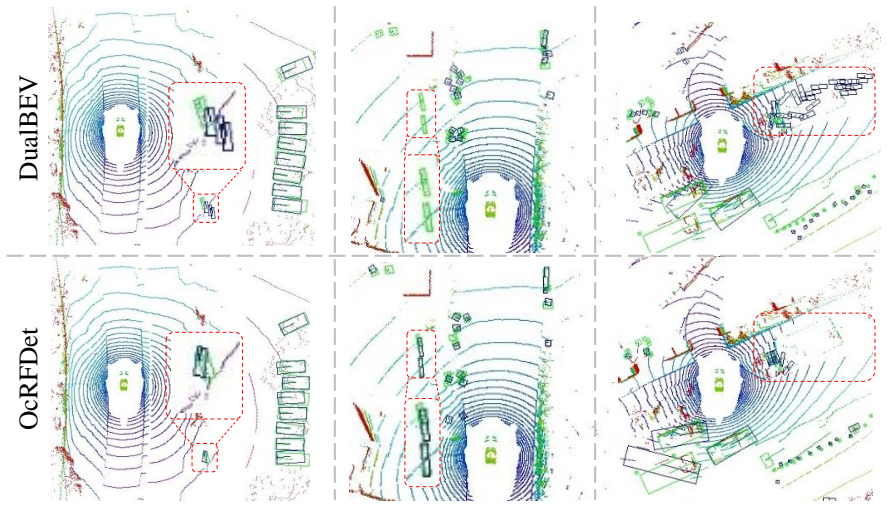
The central claim is that the optimization goal of the rendering branch determines whether radiance fields help detection: optimizing the entire scene degrades performance (33.8% mAP vs. 34.1% baseline), while optimizing foreground objects improves it (34.7% mAP), and a scene warm-up plus object-centric optimization does best (35.0% mAP). The authors attribute this to background responses being irrelevant noise for detection. On the nuScenes test benchmark, OcRFDet reports 57.2% mAP and 64.8% NDS, exceeding the DualBEV baseline by 2.0 mAP and 1.1 NDS.
Load-bearing premise
The method assumes the 2D masks projected from 3D box annotations mark exactly the foreground objects that matter, so incomplete or noisy labels can suppress unlabeled objects or amplify background features.
Editorial extensions
If this is right
- Foreground-only rendering supervision improves 3D voxel features: adding OcRF to the baseline raises mAP by 0.9 and NDS by 1.6 in the 20-epoch ablation.
- Opacity-based height-aware attention improves BEV features on top of OcRF by another 0.5 mAP and 0.3 NDS.
- The gains transfer: OcRFDet improves a query-based detector and holds on Waymo, different backbones, near/middle/far ranges, and small objects.
- Rendering only at training keeps inference cost near the baseline; the two modules add about 18.9 ms latency in the ablation setting.
- On nuScenes test, the method reports 57.2% mAP and 64.8% NDS, above prior published numbers.
Reading between the lines
- A testable extension is to replace the box-projected rendering masks with pseudo-masks from a 2D segmentation model and see whether the gains persist or grow; this would separate the value of object-centric masking from the value of precise box annotations.
- Because the rendering branch is removed at inference, the method is effectively a training-time regularizer, so the same object-centric rendering loss could plausibly be applied to teacher-student distillation or semi-supervised settings.
- HOA's height-slicing idea could transfer to other BEV tasks with strong height priors, such as occupancy prediction or drivable-area segmentation, where per-height attention would emphasize the relevant layers.
- The paper's own limitation section implies the method is inherently closed-set: unlabeled foreground objects such as traffic lights tend to be suppressed, so prompt-based or open-vocabulary masks are a natural next step beyond the paper's scope.
Editorial analysis
A structured set of objections, weighed in public.
Referee Report
Summary. This manuscript proposes OcRFDet, a multi-view 3D object detector built on DualBEV with two new modules. The OcRF module uses a hybrid generalizable 3D-GS/NeRF branch that decodes voxel features into radiance-field attributes and renders a randomly selected viewpoint, with RGB and depth losses restricted to 2D masks projected from 3D boxes; the rendering branch is intended only for training. The HOA module fuses 3D-GS and NeRF opacity fields via cross-attention and applies height-sliced, multi-scale attention to refine BEV features, together with a BEV mask auxiliary loss. Experiments on nuScenes validation and test are reported, with the claim of 57.2 mAP/64.8 NDS on the test benchmark and consistent gains over DualBEV and BEVFormer baselines.
Significance. If the reported gains are reproducible, the paper makes a useful contribution: it reframes radiance-field supervision as object-centric for detection rather than scene-centric, shows a hybrid 3D-GS/NeRF voxel decoder can be coupled to a detection head without per-scene optimization, and demonstrates transfer to a query-based baseline (BEVFormer) and to Waymo. The writing is mostly clear and the ablation set is broad, including rendering view selection, depth rendering, and optimization goal. The principal weakness is that the central attribution of the gains rests on a 20-epoch ablation whose baseline (34.1/40.3) does not match the 60-epoch SOTA-comparison baseline (35.2/42.5), so the magnitude of the claimed contribution at the main evaluation protocol is not yet established. The code-release statement and the explicit limitation discussion are strengths.
major comments (4)
- [§4.3, Tables 1 and 4] The ablation baseline is not on the same protocol as the main comparison. Table 4 reports a Baseline of 34.1 mAP / 40.3 NDS with a 20-epoch training strategy, while Table 1 lists DualBEV at 35.2 mAP / 42.5 NDS for the same one-frame ResNet-50 256×704 configuration, and the supplementary states a 60-epoch schedule for the validation set. The paper should provide ablations under the exact same schedule and implementation as the SOTA comparisons, including a re-trained DualBEV baseline in the authors' own framework, and report the resulting gains for OcRF and HOA; without this, the claimed +1.4/+1.9 pp gains are not tied to the protocol in which the headline numbers are reported.
- [§3.2.2, §3.3.1, Fig. 3] The inference story is underspecified. The text states that 'the whole rendering process is not involved during inference', yet HOA consumes the opacity fields o_gs and o_nerf that are produced by the Gaussian and NeRF MLPs from voxel features. The latency numbers in Table 4 also show a 16.43 ms cost for OcRF and 2.47 ms for HOA, implying some radiance-field computation remains at inference. Please specify exactly which submodules are executed at test time, how the opacity fields are obtained if the rendering branch is removed, and what the latency breakdown includes.
- [§3.3.2, Eq. (10)] The BEV mask prediction branch is not defined. The target mask for the BCE/Dice loss is never specified: its resolution, how it is derived from 3D boxes, and its coordinate frame are all omitted, and Table 17 shows this loss contributes to the final gain. Without a precise definition of L_mask, the full loss in Eq. (1) is not reproducible.
- [§4.3, Tables 4, 9, 16 and §8] The ablation evidence has no statistical grounding. The individual components add 0.3–0.5 pp mAP, and the HOA gain varies from +0.1 to +1.6 across the two scenes in Table 16, yet all results are reported on the validation set with single runs and no variance. Please report multiple seeds (and ideally a significance measure) for the key ablation rows, and avoid selecting hyperparameters such as k=4 in Table 9 from validation results without quantifying the difference to k=6.
minor comments (6)
- [§4.2, Table 1] The text says the two-frame OcRFDet achieves '50.4% NDS', but Table 1 lists 50.9; correct the discrepancy.
- [§4.2, Table 2] The same paragraph says the test NDS gain over DualBEV is 1.1 pp, but 64.8 − 63.4 = 1.4; correct the arithmetic.
- [Table 5] The sentence 'using a single radiance field leads to a drop in detection performance' is misleading: each single field is above the Table 4 baseline, and the drop is relative to the hybrid field; please rephrase.
- [§1 Contribution] The claim of being 'the first to apply radiance fields to multi-view 3D object detection in autonomous driving' should be qualified; the paper itself cites NeRF-Det [52] for radiance-field-based multi-view 3D detection, so the scope of the novelty claim needs to be stated more precisely.
- [Supplementary Sec. 10] The annotation-dependence limitation is important and should be stated in the main text rather than only in the supplement, since it directly affects the object-centric masking design and open-set applicability.
- [Table 13] For the SwinTransformer-Base row, mAAE worsens from 0.312 to 0.418 while mAP and NDS improve; please comment on this attribute-error trade-off.
Circularity Check
No circular derivation: the radiance-field branch and opacity attention are auxiliary supervised tasks, and the detection head is evaluated against external nuScenes benchmarks.
full rationale
OcRFDet's derivation chain is not circular. The rendering loss (Eqs. 4-7) supervises predicted RGB and depth against ground-truth images and depth, masked by projected 3D boxes, and the opacity field used by HOA is an intermediate geometric prediction from voxel features, not the detection target. The detection loss is independent, and the final detection predictions are evaluated on nuScenes, an external benchmark, so the method is self-contained. The object-centric masks are derived from annotations, which is standard auxiliary supervision rather than an equivalence between inputs and predictions; the paper's own limitation section (Sec. 10) explicitly acknowledges annotation-dependence as a constraint. The ablation baseline in Table 4 is trained with a 20-epoch scheme while the main validation table reports the same DualBEV baseline under a 60-epoch scheme, but this is a benchmarking-consistency detail and does not reduce any prediction to its inputs. No self-citation chain, definitional equivalence, or renamed-known-result substitution appears in the core argument.
Assumptions & free parameters
free parameters (3)
- α and β fusion weights =
learnable, α + β = 1
- k number of height slices =
k = 4
- loss weights λmse, λssim, λl1, λbce, λdice =
10, 1, 1, 10, 10
assumptions (3)
- ad hoc to paper Rendering only the foreground mask areas forces the radiance field to improve 3D features for detection.
- domain assumption The opacity field produced by the radiance field is a meaningful foreground/geometry signal in BEV space.
- domain assumption Depth maps from the renderer are accurate enough to provide useful supervision.
invented entities (2)
-
OcRF, object-centric radiance field hybrid of 3DGS and NeRF
-
HOA, height-aware opacity-based attention
Cite this review
Pith. "Pith review of OcRFDet: Object-Centric Radiance Fields for Multi-View 3D Object Detection in Autonomous Driving." pith.science (2026). https://pith.science/paper/LN7A7Z4L
@misc{pith2026250623565,
  author       = {Pith},
  title        = {Pith review of: OcRFDet: Object-Centric Radiance Fields for Multi-View 3D Object Detection in Autonomous Driving},
  year         = {2026},
  howpublished = {\url{https://pith.science/paper/LN7A7Z4L}},
  note         = {Machine review of arXiv:2506.23565}
}
abstract
Current multi-view 3D object detection methods typically transfer 2D features into 3D space using depth estimation or 3D position encoder, but in a fully data-driven and implicit manner, which limits the detection performance. Inspired by the success of radiance fields on 3D reconstruction, we assume they can be used to enhance the detector's ability of 3D geometry estimation. However, we observe a decline in detection performance, when we directly use them for 3D rendering as an auxiliary task. From our analysis, we find the performance drop is caused by the strong responses on the background when rendering the whole scene. To address this problem, we propose object-centric radiance fields, focusing on modeling foreground objects while discarding background noises. Specifically, we employ Object-centric Radiance Fields (OcRF) to enhance 3D voxel features via an auxiliary task of rendering foreground objects. We further use opacity - the side-product of rendering- to enhance the 2D foreground BEV features via Height-aware Opacity-based Attention (HOA), where attention maps at different height levels are generated separately via multiple networks in parallel. Extensive experiments on the nuScenes validation and test datasets demonstrate that our OcRFDet achieves superior performance, outperforming previous state-of-the-art methods with 57.2$\%$ mAP and 64.8$\%$ NDS on the nuScenes test benchmark. Code will be available at https://github.com/Mingqj/OcRFDet.
Figures



Figures from the paper (6 more)


Reference graph
Works this paper leans on
-
[1]
nuscenes: A multi- modal dataset for autonomous driving
Holger Caesar, Varun Bankiti, Alex H Lang, Sourabh V ora, Venice Erin Liong, Qiang Xu, Anush Krishnan, Yu Pan, Gi- 12 ancarlo Baldan, and Oscar Beijbom. nuscenes: A multi- modal dataset for autonomous driving. In CVPR, 2020. 2, 5
work page 2020
-
[2]
Objectfusion: Multi-modal 3d object detection with object-centric fusion
Qi Cai, Yingwei Pan, Ting Yao, Chong-Wah Ngo, and Tao Mei. Objectfusion: Multi-modal 3d object detection with object-centric fusion. In ICCV, 2023. 10
work page 2023
-
[3]
Gaussianbev: 3d gaussian representation meets percep- tion models for bev segmentation
Florian Chabot, Nicolas Granger, and Guillaume Lapouge. Gaussianbev: 3d gaussian representation meets percep- tion models for bev segmentation. arXiv preprint arXiv:2407.14108, 2024. 1, 3, 4
arXiv 2024
-
[4]
Recurrentbev: a long-term temporal fusion framework for multi-view 3d detection
Ming Chang, Xishan Zhang, Rui Zhang, Zhipeng Zhao, Guanhua He, and Shaoli Liu. Recurrentbev: a long-term temporal fusion framework for multi-view 3d detection. In ECCV, 2024. 6
work page 2024
-
[5]
Learning high- resolution vector representation from multi-camera images for 3d object detection
Zhili Chen, Shuangjie Xu, Maosheng Ye, Zian Qian, Xi- aoyi Zou, Dit-Yan Yeung, and Qifeng Chen. Learning high- resolution vector representation from multi-camera images for 3d object detection. In ECCV, 2024. 10, 11
work page 2024
-
[6]
Bev-san: Accurate bev 3d object detection via slice attention networks
Xiaowei Chi, Jiaming Liu, Ming Lu, Rongyu Zhang, Zhao- qing Wang, Yandong Guo, and Shanghang Zhang. Bev-san: Accurate bev 3d object detection via slice attention networks. In CVPR, 2023. 2, 5
work page 2023
-
[7]
Depth-regularized optimization for 3d gaussian splatting in few-shot images
Jaeyoung Chung, Jeongtaek Oh, and Kyoung Mu Lee. Depth-regularized optimization for 3d gaussian splatting in few-shot images. In CVPR, 2024. 4
work page 2024
-
[8]
MMDetection3D: Open- MMLab next-generation platform for general 3D object detection
MMDetection3D Contributors. MMDetection3D: Open- MMLab next-generation platform for general 3D object detection. https://github.com/open- mmlab/ mmdetection3d, 2020. 10
work page 2020
Show all 61 references
-
[9]
Exploring recurrent long-term temporal fusion for multi-view 3d perception
Chunrui Han, Jinrong Yang, Jianjian Sun, Zheng Ge, Run- pei Dong, Hongyu Zhou, Weixin Mao, Yuang Peng, and Xi- angyu Zhang. Exploring recurrent long-term temporal fusion for multi-view 3d perception. IEEE RA-L, 2024. 6
2024
-
[10]
Deep residual learning for image recognition
Kaiming He, Xiangyu Zhang, Shaoqing Ren, and Jian Sun. Deep residual learning for image recognition. In CVPR,
-
[11]
Open: Object-wise position embedding for multi-view 3d object de- tection
Jinghua Hou, Tong Wang, Xiaoqing Ye, Zhe Liu, Shi Gong, Xiao Tan, Errui Ding, Jingdong Wang, and Xiang Bai. Open: Object-wise position embedding for multi-view 3d object de- tection. In ECCV, 2024. 3, 6
2024
-
[12]
Bevdet4d: Exploit tempo- ral cues in multi-camera 3d object detection
Junjie Huang and Guan Huang. Bevdet4d: Exploit tempo- ral cues in multi-camera 3d object detection. arXiv preprint arXiv:2203.17054, 2022. 6
2022 arXiv
-
[13]
Bevdet: High-performance multi-camera 3d object de- tection in bird-eye-view
Junjie Huang, Guan Huang, Zheng Zhu, Yun Ye, and Dalong Du. Bevdet: High-performance multi-camera 3d object de- tection in bird-eye-view. arXiv preprint arXiv:2112.11790,
-
[14]
Gaussianformer: Scene as gaussians for vision-based 3d semantic occupancy prediction
Yuanhui Huang, Wenzhao Zheng, Yunpeng Zhang, Jie Zhou, and Jiwen Lu. Gaussianformer: Scene as gaussians for vision-based 3d semantic occupancy prediction. arXiv preprint arXiv:2405.17429, 2024. 1, 3
2024 arXiv
-
[15]
Enhanc- ing 3d object detection with 2d detection-guided query an- chors
Haoxuanye Ji, Pengpeng Liang, and Erkang Cheng. Enhanc- ing 3d object detection with 2d detection-guided query an- chors. In CVPR, 2024. 2, 6
2024
-
[16]
3d gaussian splatting for real-time radiance field rendering
Bernhard Kerbl, Georgios Kopanas, Thomas Leimk ¨uhler, and George Drettakis. 3d gaussian splatting for real-time radiance field rendering. ACM Trans. Graph., 2023. 1
2023
-
[17]
Adam: A method for stochastic optimization
Diederik P Kingma and Jimmy Ba. Adam: A method for stochastic optimization. arXiv preprint arXiv:1412.6980 ,
-
[18]
Seabird: Segmentation in bird’s view with dice loss improves monocular 3d detection of large objects
Abhinav Kumar, Yuliang Guo, Xinyu Huang, Liu Ren, and Xiaoming Liu. Seabird: Segmentation in bird’s view with dice loss improves monocular 3d detection of large objects. In CVPR, 2024. 5
2024
-
[19]
Delving into the devils of bird’s- eye-view perception: A review, evaluation and recipe
Hongyang Li, Chonghao Sima, Jifeng Dai, Wenhai Wang, Lewei Lu, Huijie Wang, Jia Zeng, Zhiqi Li, Jiazhi Yang, Hanming Deng, et al. Delving into the devils of bird’s- eye-view perception: A review, evaluation and recipe. IEEE TPAMI, 2023. 10
2023
-
[20]
Dualbev: Cnn is all you need in view transformation
Peidong Li, Wancheng Shen, Qihao Huang, and Dixiao Cui. Dualbev: Cnn is all you need in view transformation. In ECCV, 2024. 2, 6, 10, 11
2024
-
[21]
Bevstereo: Enhancing depth estimation in multi-view 3d object detection with temporal stereo
Yinhao Li, Han Bao, Zheng Ge, Jinrong Yang, Jianjian Sun, and Zeming Li. Bevstereo: Enhancing depth estimation in multi-view 3d object detection with temporal stereo. In AAAI, 2023. 6
2023
-
[22]
Bevdepth: Acquisition of reliable depth for multi-view 3d object detec- tion
Yinhao Li, Zheng Ge, Guanyi Yu, Jinrong Yang, Zengran Wang, Yukang Shi, Jianjian Sun, and Zeming Li. Bevdepth: Acquisition of reliable depth for multi-view 3d object detec- tion. In AAAI, 2023. 2, 3, 6
2023
-
[23]
Bevformer: Learning bird’s-eye-view representation from multi-camera images via spatiotemporal transformers
Zhiqi Li, Wenhai Wang, Hongyang Li, Enze Xie, Chong- hao Sima, Tong Lu, Yu Qiao, and Jifeng Dai. Bevformer: Learning bird’s-eye-view representation from multi-camera images via spatiotemporal transformers. In ECCV, 2022. 2, 6, 7, 11
2022
-
[24]
Fb-bev: Bev representa- tion from forward-backward view transformations
Zhiqi Li, Zhiding Yu, Wenhai Wang, Anima Anandkumar, Tong Lu, and Jose M Alvarez. Fb-bev: Bev representa- tion from forward-backward view transformations. In ICCV,
-
[25]
Bevnext: Reviving dense bev frameworks for 3d object de- tection
Zhenxin Li, Shiyi Lan, Jose M Alvarez, and Zuxuan Wu. Bevnext: Reviving dense bev frameworks for 3d object de- tection. In CVPR, 2024. 2, 6
2024
-
[26]
Feature pyramid networks for object detection
Tsung-Yi Lin, Piotr Doll ´ar, Ross Girshick, Kaiming He, Bharath Hariharan, and Serge Belongie. Feature pyramid networks for object detection. In CVPR, 2017. 6
2017
-
[27]
Sparse4d: Multi-view 3d object detec- tion with sparse spatial-temporal fusion
Xuewu Lin, Tianwei Lin, Zixiang Pei, Lichao Huang, and Zhizhong Su. Sparse4d: Multi-view 3d object detec- tion with sparse spatial-temporal fusion. arXiv preprint arXiv:2211.10581, 2022. 2, 6
2022 arXiv
-
[28]
Ray denoising: Depth-aware hard negative sampling for multi- view 3d object detection
Feng Liu, Tengteng Huang, Qianjing Zhang, Haotian Yao, Chi Zhang, Fang Wan, Qixiang Ye, and Yanzhao Zhou. Ray denoising: Depth-aware hard negative sampling for multi- view 3d object detection. In ECCV, 2024. 3, 6
2024
-
[29]
Sparsebev: High-performance sparse 3d object detec- tion from multi-camera videos
Haisong Liu, Yao Teng, Tao Lu, Haiguang Wang, and Limin Wang. Sparsebev: High-performance sparse 3d object detec- tion from multi-camera videos. In ICCV, 2023. 2, 6
2023
-
[30]
Fast generalizable gaussian splatting reconstruction from multi-view stereo
Tianqi Liu, Guangcong Wang, Shoukang Hu, Liao Shen, Xinyi Ye, Yuhang Zang, Zhiguo Cao, Wei Li, and Ziwei Liu. Fast generalizable gaussian splatting reconstruction from multi-view stereo. In ECCV, 2024. 3
2024
-
[31]
Multi-view atten- tive contextualization for multi-view 3d object detection
Xianpeng Liu, Ce Zheng, Ming Qian, Nan Xue, Chen Chen, Zhebin Zhang, Chen Li, and Tianfu Wu. Multi-view atten- tive contextualization for multi-view 3d object detection. In CVPR, 2024. 10, 11 13
2024
-
[32]
Swin transformer: Hierarchical vision transformer using shifted windows
Ze Liu, Yutong Lin, Yue Cao, Han Hu, Yixuan Wei, Zheng Zhang, Stephen Lin, and Baining Guo. Swin transformer: Hierarchical vision transformer using shifted windows. In ICCV, 2021. 10
2021
-
[33]
A convnet for the 2020s
Zhuang Liu, Hanzi Mao, Chao-Yuan Wu, Christoph Feicht- enhofer, Trevor Darrell, and Saining Xie. A convnet for the 2020s. In CVPR, 2022. 6
2022
-
[34]
Nerf in the wild: Neural radiance fields for uncon- strained photo collections
Ricardo Martin-Brualla, Noha Radwan, Mehdi SM Sajjadi, Jonathan T Barron, Alexey Dosovitskiy, and Daniel Duck- worth. Nerf in the wild: Neural radiance fields for uncon- strained photo collections. In CVPR, 2021. 1
2021
-
[35]
Nerf: Representing scenes as neural radiance fields for view syn- thesis
Ben Mildenhall, Pratul P Srinivasan, Matthew Tancik, Jonathan T Barron, Ravi Ramamoorthi, and Ren Ng. Nerf: Representing scenes as neural radiance fields for view syn- thesis. Communications of the ACM, 2021. 1
2021
-
[36]
V-net: Fully convolutional neural networks for volumetric medical image segmentation
Fausto Milletari, Nassir Navab, and Seyed-Ahmad Ahmadi. V-net: Fully convolutional neural networks for volumetric medical image segmentation. In 3DV, 2016. 5
2016
-
[37]
Uniocc: Unifying vision-centric 3d oc- cupancy prediction with geometric and semantic rendering
Mingjie Pan, Li Liu, Jiaming Liu, Peixiang Huang, Lon- glong Wang, Shanghang Zhang, Shaoqing Xu, Zhiyi Lai, and Kuiyuan Yang. Uniocc: Unifying vision-centric 3d oc- cupancy prediction with geometric and semantic rendering. arXiv preprint arXiv:2306.09117, 2023. 1, 3
2023 arXiv
-
[38]
Renderocc: Vision-centric 3d occupancy prediction with 2d rendering supervision
Mingjie Pan, Jiaming Liu, Renrui Zhang, Peixiang Huang, Xiaoqi Li, Hongwei Xie, Bing Wang, Li Liu, and Shanghang Zhang. Renderocc: Vision-centric 3d occupancy prediction with 2d rendering supervision. In ICRA, 2024. 1, 3, 4
2024
-
[39]
Is pseudo-lidar needed for monocular 3d object detection? In ICCV, 2021
Dennis Park, Rares Ambrus, Vitor Guizilini, Jie Li, and Adrien Gaidon. Is pseudo-lidar needed for monocular 3d object detection? In ICCV, 2021. 6
2021
-
[40]
Time will tell: New outlooks and a baseline for temporal multi- view 3d object detection
Jinhyung Park, Chenfeng Xu, Shijia Yang, Kurt Keutzer, Kris M Kitani, Masayoshi Tomizuka, and Wei Zhan. Time will tell: New outlooks and a baseline for temporal multi- view 3d object detection. In ICLR, 2022. 6
2022
-
[41]
Pytorch: An imperative style, high-performance deep learning library
Adam Paszke, Sam Gross, Francisco Massa, Adam Lerer, James Bradbury, Gregory Chanan, Trevor Killeen, Zeming Lin, Natalia Gimelshein, Luca Antiga, et al. Pytorch: An imperative style, high-performance deep learning library. In NeurIPS, 2019. 10
2019
-
[42]
Lift, splat, shoot: Encoding images from arbitrary camera rigs by implicitly unprojecting to 3d
Jonah Philion and Sanja Fidler. Lift, splat, shoot: Encoding images from arbitrary camera rigs by implicitly unprojecting to 3d. In ECCV, 2020. 2
2020
-
[43]
Scalability in perception for autonomous driving: Waymo open dataset
Pei Sun, Henrik Kretzschmar, Xerxes Dotiwalla, Aurelien Chouard, Vijaysai Patnaik, Paul Tsui, James Guo, Yin Zhou, Yuning Chai, Benjamin Caine, et al. Scalability in perception for autonomous driving: Waymo open dataset. In CVPR,
-
[44]
Block-nerf: Scalable large scene neural view synthesis
Matthew Tancik, Vincent Casser, Xinchen Yan, Sabeek Prad- han, Ben Mildenhall, Pratul P Srinivasan, Jonathan T Barron, and Henrik Kretzschmar. Block-nerf: Scalable large scene neural view synthesis. In CVPR, 2022. 1
2022
-
[45]
Exploring object-centric temporal modeling for efficient multi-view 3d object detection
Shihao Wang, Yingfei Liu, Tiancai Wang, Ying Li, and Xi- angyu Zhang. Exploring object-centric temporal modeling for efficient multi-view 3d object detection. In ICCV, 2023. 6
2023
-
[46]
Fcos3d: Fully convolutional one-stage monocular 3d object detection
Tai Wang, Xinge Zhu, Jiangmiao Pang, and Dahua Lin. Fcos3d: Fully convolutional one-stage monocular 3d object detection. In ICCV, 2021. 6
2021
-
[47]
Detr3d: 3d object detection from multi-view images via 3d-to-2d queries
Yue Wang, Vitor Campagnolo Guizilini, Tianyuan Zhang, Yilun Wang, Hang Zhao, and Justin Solomon. Detr3d: 3d object detection from multi-view images via 3d-to-2d queries. In RL, 2022. 2
2022
-
[48]
Image quality assessment: from error visibility to structural similarity
Zhou Wang, Alan C Bovik, Hamid R Sheikh, and Eero P Simoncelli. Image quality assessment: from error visibility to structural similarity. IEEE TIP, 2004. 4
2004
-
[49]
Mapnerf: Incorporating map priors into neural ra- diance fields for driving view simulation
Chenming Wu, Jiadai Sun, Zhelun Shen, and Liangjun Zhang. Mapnerf: Incorporating map priors into neural ra- diance fields for driving view simulation. In IROS, 2023. 1
2023
-
[50]
4d gaussian splatting for real-time dynamic scene rendering
Guanjun Wu, Taoran Yi, Jiemin Fang, Lingxi Xie, Xiaopeng Zhang, Wei Wei, Wenyu Liu, Qi Tian, and Xinggang Wang. 4d gaussian splatting for real-time dynamic scene rendering. In CVPR, 2024. 6
2024
-
[51]
Heightformer: Explicit height modeling without extra data for camera-only 3d object detection in bird’s eye view
Yiming Wu, Ruixiang Li, Zequn Qin, Xinhai Zhao, and Xi Li. Heightformer: Explicit height modeling without extra data for camera-only 3d object detection in bird’s eye view. IEEE TIP, 2024. 2, 5
2024
-
[52]
Nerf-det: Learning geometry-aware volu- metric representation for multi-view 3d object detection
Chenfeng Xu, Bichen Wu, Ji Hou, Sam Tsai, Ruilong Li, Jialiang Wang, Wei Zhan, Zijian He, Peter Vajda, Kurt Keutzer, et al. Nerf-det: Learning geometry-aware volu- metric representation for multi-view 3d object detection. In ICCV, 2023. 3
2023
-
[53]
Street gaussians for modeling dynamic ur- ban scenes
Yunzhi Yan, Haotong Lin, Chenxu Zhou, Weijie Wang, Haiyang Sun, Kun Zhan, Xianpeng Lang, Xiaowei Zhou, and Sida Peng. Street gaussians for modeling dynamic ur- ban scenes. arXiv preprint arXiv:2401.01339, 2024. 1
2024 arXiv
-
[54]
Bevformer v2: Adapting modern image backbones to bird’s-eye-view recognition via perspective su- pervision
Chenyu Yang, Yuntao Chen, Hao Tian, Chenxin Tao, Xizhou Zhu, Zhaoxiang Zhang, Gao Huang, Hongyang Li, Yu Qiao, Lewei Lu, et al. Bevformer v2: Adapting modern image backbones to bird’s-eye-view recognition via perspective su- pervision. In CVPR, 2023. 2
2023
-
[55]
Emernerf: Emergent spatial-temporal scene decomposition via self-supervision
Jiawei Yang, Boris Ivanovic, Or Litany, Xinshuo Weng, Se- ung Wook Kim, Boyi Li, Tong Che, Danfei Xu, Sanja Fidler, Marco Pavone, et al. Emernerf: Emergent spatial-temporal scene decomposition via self-supervision. arXiv preprint arXiv:2311.02077, 2023. 1
2023 arXiv
-
[56]
Center- based 3d object detection and tracking
Tianwei Yin, Xingyi Zhou, and Philipp Krahenbuhl. Center- based 3d object detection and tracking. In CVPR, 2021. 3
2021
-
[57]
Sa-bev: Generating semantic-aware bird’s-eye-view feature for multi-view 3d object detection
Jinqing Zhang, Yanan Zhang, Qingjie Liu, and Yunhong Wang. Sa-bev: Generating semantic-aware bird’s-eye-view feature for multi-view 3d object detection. In ICCV, 2023. 2, 6
2023
-
[58]
Nerf-lidar: Generating realistic lidar point clouds with neural radiance fields
Junge Zhang, Feihu Zhang, Shaochen Kuang, and Li Zhang. Nerf-lidar: Generating realistic lidar point clouds with neural radiance fields. In AAAI, 2024. 1
2024
-
[59]
Hybridocc: Nerf enhanced transformer-based multi-camera 3d occupancy prediction
Xiao Zhao, Bo Chen, Mingyang Sun, Dingkang Yang, Youx- ing Wang, Xukun Zhang, Mingcheng Li, Dongliang Kou, Xiaoyi Wei, and Lihua Zhang. Hybridocc: Nerf enhanced transformer-based multi-camera 3d occupancy prediction. IEEE RA-L, 2024. 1, 3
2024
-
[60]
Hugs: Holistic urban 3d scene understanding via gaus- sian splatting
Hongyu Zhou, Jiahao Shao, Lu Xu, Dongfeng Bai, Weichao Qiu, Bingbing Liu, Yue Wang, Andreas Geiger, and Yiyi Liao. Hugs: Holistic urban 3d scene understanding via gaus- sian splatting. In CVPR, 2024. 1
2024
-
[61]
Drivinggaussian: 14 Composite gaussian splatting for surrounding dynamic au- tonomous driving scenes
Xiaoyu Zhou, Zhiwei Lin, Xiaojun Shan, Yongtao Wang, Deqing Sun, and Ming-Hsuan Yang. Drivinggaussian: 14 Composite gaussian splatting for surrounding dynamic au- tonomous driving scenes. In CVPR, 2024. 1 15
2024
Reviewed August 6, 2026 · model on record in the stance chip above.
Discussion (0). Sign in to comment.