REVIEW 3 major objections 6 minor 1 references
Time-Reversal Symmetry-Protected Coherent Control of Ultracold Molecular Collisions
T0 review · 3 major / 6 minor · reviewed 2026-08-11 · deepseek-v4-flash
Pith's one-line read Time-reversal symmetry forces all final partial waves to share one control phase, so ultracold molecular cross sections can be switched exactly from zero to maximum.
desk verdict Time-reversal symmetry gives a clean, parameter-free mechanism for synchronizing partial waves in ultracold coherent control; the paper is solid, with an overreaching abstract and minor reproducibility gaps. read the letter →
The pith
A machine-rendered reading of the paper's core claim, the machinery that carries it, and where it could break.
The reading
What carries the argument
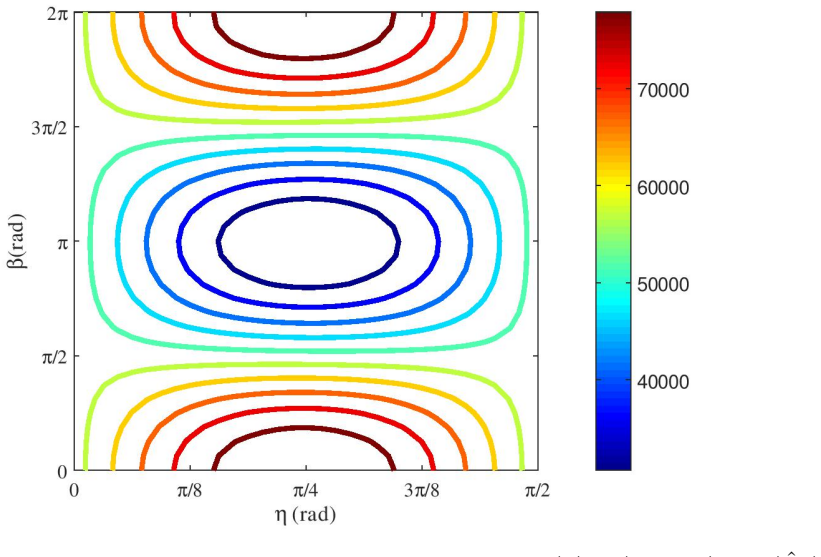
The load-bearing object is the time-reversal relation between scattering-matrix elements, Eq. (4): $S_{m,-m,0,0\to f,\ell',0} = p\, S_{-m,m,0,0\to f,\ell',0}$, with $p = \pm 1$ the parity of the initial two-molecule state. This relation converts the partial-wave sum in the integral cross section into a common factor $|\cos\eta + p\,\sin\eta\, e^{i\beta}|^2$ multiplying the sum of squared $S$-matrix elements, so that partial-wave scrambling is bypassed rather than overcome. The supporting pieces are the entangled time-reversal superposition of Eq. (3) and the choice of a final state invariant under time reversal, such as the $|g_0,g_0\rangle$ rotational state, which together force the constraint to hold for every final partial wave $\ell'$.
What would settle it
Compute or measure the ratio $R_{\ell'} = S_{m,-m,0,0\to f,\ell',0}/S_{-m,m,0,0\to f,\ell',0}$ for the final state $|g_0,g_0\rangle$ in coupled-channel calculations at several ultracold energies: the protection requires $|R_{\ell'}| = 1$ for every $\ell'$ with the same argument $p$. A more direct experiment would scan $\beta$ in a trap at low field and check that the integral cross section to $|g_0,g_0\rangle$ touches zero and reaches the predicted maximum for a narrow energy distribution; any residual offset or a $\beta$ shift between partial waves would disprove the symmetry protection.
Extended reading notes
Core claim
The paper's central discovery is a symmetry-protected locking of the coherent-control landscape across partial waves. For the entangled time-reversal superposition $|\Psi_{\text{sup}}\rangle = \cos\eta\, |j_A,m\rangle|j_B,-m\rangle + \sin\eta\, e^{i\beta} |j_A,-m\rangle|j_B,m\rangle$ and a final state $|f\rangle$ with $\hat{T}|f\rangle = |f\rangle$, the $S$-matrix obeys $S_{m,-m,0,0\to f,\ell',0} = p\, S_{-m,m,0,0\to f,\ell',0}$, where $p = \pm 1$ is the parity of the initial state. Because parity conservation forces $\ell'$ to stay on a fixed parity ladder, every final partial wave carries the same controllable factor $|\cos\eta + p\,\sin\eta\, e^{i\beta}|^2$. Consequently the integral cross section can be reduced exactly to zero and maximized with the same $\beta$ for all partial waves, independent of the interaction potential's shape or the complexity of the short-range dynamics; the optimal mixing angle is $\eta = \pi/4$, and the optimal phase is $\beta = 0$ or $\pi$ according to $p$. In coupled-channel calculations for $^{17}\text{O}_2$--$^{17}\text{O}_2$, the time-reversal-invariant final state $|g_0,g_0\rangle$ shows complete control from $1.9\times10^{-4}\,\text{Å}^2$ to $23175\,\text{Å}^2$, whereas the non-invariant state $|g_0,g_{+1}\rangle$ shows only partial control.
Load-bearing premise
Everything rests on exact time-reversal symmetry of the collision Hamiltonian and on preparing precisely the entangled time-reversal superposition; if a magnetic field is present, or if satellite terms are populated, the common $S$-matrix phase relation (4) is broken and complete destructive interference disappears.
Editorial extensions
If this is right
- Any ultracold inelastic or reactive collision into a $J = 0,\ M = 0$ product state can be switched from zero cross section to maximum by tuning $\beta$ of a time-reversal superposition, regardless of short-range resonance density or anisotropy.
- Because the optimal parameters are energy independent within the ultracold regime, a narrow thermal distribution of collision energies does not wash out the control.
- Magnetic fields break the protection, so coherent-control experiments must be performed at low fields; at finite field the complete destructive interference is lost.
- Complete control requires the entangled time-reversal superposition; non-entangled superpositions retain satellite terms and can only achieve partial control, as in the $1352\text{--}7142\,\text{Å}^2$ range shown for $|g_0,g_0\rangle$.
- In crossed molecular beams above the ultracold regime, time-reversal symmetry still synchronizes all final partial waves of the same parity, and with identical bosons the combined permutation and time-reversal symmetries produce complete control at any temperature; isotropic trap/gas samples lose this synchronization under orientation averaging.
Reading between the lines
- A natural extension is to chaotic ultracold reactions such as KRb $+$ KRb $\to$ K$_2 +$ Rb$_2$: the same symmetry argument predicts complete control over ground-state product populations, so observing such control would confirm that the protection is independent of dynamical complexity.
- Because Eq. (4) is exact under time-reversal invariance, any deviation in a state-to-state experiment---a nonzero minimum cross section, or an optimal $\beta$ that shifts between partial waves---would directly signal either a stray magnetic field or imperfect entangled-state preparation, giving an in-situ diagnostic.
- The parity-selective suppression in crossed beams (even versus odd partial waves) could act as a partial-wave filter, letting experiments isolate specific partial-wave contributions and probe symmetry-dependent short-range dynamics.
- The satellite-term analysis implies that single-molecule superpositions without entanglement will generally not reach complete control in exothermic ultracold scattering, redirecting experimental effort toward entangled molecular pair preparation.
Signed reviews
Editorial analysis
A structured set of objections, weighed in public.
Referee Report
Summary. The manuscript argues that time-reversal symmetry can protect coherent control of ultracold bimolecular collisions against partial wave scrambling. For an entangled initial superposition of two channel states related by time reversal (Eq. 3) and a time-reversal-invariant final state, the S-matrix relation (4) is used to factor the state-to-state integral cross section (6) into a single control factor common to all final partial waves. This makes complete destructive interference and maximum control reachable with the same phase β for every partial wave, independent of the short-range dynamics. The authors support the result with coupled-channel calculations for O2-O2 scattering at 1 μK, showing synchronized control landscapes for ℓ'=0,2,4 and a control range of over nine orders of magnitude for the |g0,g0⟩ final state, and they extend the analysis to crossed-beam versus trap geometries at 100 mK. They also discuss the role of partial-wave parity and permutation symmetry for identical bosonic molecules.
Significance. The result, if correct, is significant: it identifies a symmetry-based mechanism that removes a known obstacle to coherent control of complex molecular collisions and yields a parameter-free prediction of complete control for time-reversal-invariant final states. The algebraic step from Eq. (4) to Eq. (6) is clean and the numerical demonstration is compelling, especially the synchronized partial-wave control landscapes. The paper also makes a falsifiable prediction for chaotic collisions, which is valuable even if not directly tested. The main caveat is that the load-bearing symmetry relation is cited from a textbook rather than derived or directly verified in the numerical data.
major comments (3)
- [Main text, Eq. (4)] The central factorization in Eq. (6) rests on the relation S_{m,-m,0,0→f,ℓ',0}=p S_{-m,m,0,0→f,ℓ',0} with a single phase p for every final partial wave ℓ'. This relation is only cited to Ref. 42 and is not derived for the symmetrized two-molecule channel states defined in Eq. (7) that are used in the coupled-channel calculation. The text appeals to parity conservation to argue that p is independent of ℓ', but the time-reversal phase convention, the treatment of the identical-particle symmetrization, and the role of the final partial wave are not specified. Please give an explicit derivation of Eq. (4) (and of the analogous Eq. (13) for nonzero initial ℓ) in the basis of Eq. (7), stating the phase convention and showing that the ℓ'-dependence reduces to a constant for the parity-allowed ℓ'.
- [Fig. 2 and coupled-channel results] The numerical evidence for Eq. (4) is indirect: the synchronized control landscapes in Fig. 2(a) are consistent with the relation but do not exclude small ℓ'-dependent phase deviations that would degrade the predicted complete control. Please add a direct numerical check, for example by reporting the complex ratio S_{m,-m,0,0→f,ℓ',0}/S_{-m,m,0,0→f,ℓ',0} for each ℓ' contributing to the cross section at 1 μK for the |g0,g0⟩ final state, together with its deviation from p. If the ratio is p to the numerical precision of the calculation, the central theorem is verified; if there are deviations, the factorization in Eq. (6) and the 'complete control' claim need to be revisited.
- [Abstract and Conclusion] The headline claim that time-reversal-invariant final states 'can always be optimally controlled' is broader than the conditions demonstrated in the paper. The proof requires an entangled time-reversal superposition of the form (3), a time-reversal-invariant final state, and the absence of magnetic fields (noted in the text), while the beyond-ultracold any-temperature statement also requires identical bosonic molecules and a crossed-beam geometry. The non-entangled superposition of Eqs. (9)-(11) does not achieve complete destructive interference, as shown in Fig. 1(b). Please qualify the abstract and conclusion to state these conditions explicitly.
minor comments (6)
- [Eqs. (1)-(3), notation] The superscripts in m1A, m2B, etc. are typeset inconsistently (for example, m1A and m2A in Eq. (2)), making it hard to distinguish state labels from exponents; please use a consistent notation such as m_A^{(1)} and m_B^{(2)} throughout.
- [Page 6, after Eq. (6)] The text 'This imples that the control is protected' contains a typo: 'imples' should be 'implies'.
- [Reference 36] Reference 36 is incomplete: 'Nature 1–6' lacks the volume and article number; please update it.
- [Fig. 2 caption] The labels 'd0-wave' and 'g0-wave' are nonstandard; please specify 'd-wave with m_ℓ=0' and 'g-wave with m_ℓ=0' or use the standard spectroscopic notation for partial waves.
- [Fig. 1(a) and text near it] The numerical minimum of the cross section in Fig. 1(a) is 1.9×10^-4 Ų, not exactly zero; the text calls this 'complete destructive interference,' which is strictly true only in the ideal limit of the symmetry relation. Please add a sentence noting that the residual value reflects the numerical accuracy of the calculation.
- [Supplementary Information, Eq. (3)] In the sentence introducing the supplementary control landscapes, 'other interesting features than the protection against partial wave scrambling' should be rephrased, for instance as 'other interesting features, in addition to the protection against partial wave scrambling'.
Circularity Check
No significant circularity: the central control result follows algebraically from a standard time-reversal symmetry relation, with no fitted parameters and no load-bearing self-citation.
full rationale
The paper's central derivation is self-contained in the sense required by the circularity analysis. Equation (6) follows from Eq. (5) by substituting the time-reversal constraint Eq. (4), which is attributed to a standard scattering theory textbook (Taylor, Ref. 42), not to the authors' own prior work. The key step is a symmetry relation among S-matrix elements, not a fitted or empirically calibrated input. The optimal control parameters (eta = pi/4, beta = 0 or pi) are derived algebraically from the factored term |cos(eta) + p sin(eta)e^{i beta}|^2, which is common to all final partial waves because of Eq. (4). No parameter is extracted from the coupled-channel numerics and then renamed a prediction; the coupled-channel calculations are illustrations of the predicted control landscapes rather than sources of the symmetry constraint. The self-citations in the paper (Refs. 3, 4, 7, 45, 46) are used for background, for the coupled-channel methodology, and for prior demonstrations of coherent control; none of them is invoked to justify the load-bearing time-reversal relation. The paper itself explicitly identifies the limitations of the assumption, e.g., that magnetic fields break the protection, and those caveats further indicate that the derivation is not circularly insulated from physical conditions. The skeptic's concern that Eq. (4) is not re-derived from the symmetrized coupled-channel states is a verification or correctness question, not evidence that the paper's claim reduces to its own input by construction. Therefore the appropriate circularity score is 0.
Assumptions & free parameters
assumptions (5)
- standard math Time-reversal symmetry imposes the S-matrix relation (Eq. 4): S_{m,-m,0,0->f,l',0} = p S_{-m,m,0,0->f,l',0}.
- domain assumption Parity is conserved during collisions in the absence of an external electric field.
- domain assumption The initial superposition is entangled (Eq. 3) and the final state is time-reversal invariant (T|f>=|f>).
- domain assumption No magnetic field is present, so time-reversal symmetry is unbroken.
- domain assumption The O2-O2 coupled-channel results use the interaction potential and methodology from prior work.
Cite this review
Pith. "Pith review of Time-Reversal Symmetry-Protected Coherent Control of Ultracold Molecular Collisions." pith.science (2026). https://pith.science/paper/LNC23FAM
@misc{pith2026241214425,
  author       = {Pith},
  title        = {Pith review of: Time-Reversal Symmetry-Protected Coherent Control of Ultracold Molecular Collisions},
  year         = {2026},
  howpublished = {\url{https://pith.science/paper/LNC23FAM}},
  note         = {Machine review of arXiv:2412.14425}
}
abstract
Coherent control of atomic and molecular scattering relies on the preparation of colliding particles in superpositions of internal states, establishing interfering pathways that can be used to tune the outcome of a scattering process. However, incoherent addition of different partial wave contributions to the integral cross sections (partial wave scrambling), commonly encountered in systems with complex collisional dynamics, poses a significant challenge, often limiting control. This work demonstrates that time-reversal symmetry can overcome these limitations by constraining the relative phases of S-matrix elements, thereby protecting coherent control against partial wave scrambling, even for collisions mediated by highly anisotropic interactions. Using the example of ultracold O$_2$-O$_2$ scattering, we show that coherent control is robust against short-range dynamical complexity. Furthermore, the time-reversal symmetry also protects the control against a distribution of collisional energy. These findings show that ultracold scattering into the final states that are time-reversal-invariant, such as the J = 0, M = 0 rotational state, can always be optimally controlled by using time-reversal-invariant initial superpositions. Beyond the ultracold regime, we observe significant differences in the controllability of crossed-molecular beam vs. trap experiments with the former being easier to control, emphasizing the cooperative role of time-reversal and permutation symmetries in maintaining control at any temperature. These results open new avenues for the coherent control of complex inelastic collisions and chemical reactions both in and outside of the ultracold regime.
Figures


Figures from the paper (3 more)


Reference graph
Works this paper leans on
-
[1]
(1) Devolder, A.; Tscherbul, T. V.; Brumer, P. Interference is in the eye of the beholder: Applica- tion to the coherent control of collisional processes.J. Chem. Phys. 2024, 160, 174304. 5
work page 2024
Reviewed August 11, 2026 · model on record in the stance chip above.
Discussion (0). Continue with ORCID to comment.