TOI-7154b: A Close-in Massive Brown Dwarf in an Eccentric Orbit
Pith reviewed 2026-05-25 03:05 UTC · model grok-4.3
The pith
A massive brown dwarf near the hydrogen-burning limit retains significant eccentricity in a several-Gyr-old close orbit.
A machine-rendered reading of the paper's core claim, the machinery that carries it, and where it could break.
Core claim
TOI-7154b is a 71.7 M_J brown dwarf on an 8.86-day eccentric (e = 0.248) orbit around a 0.94 M_sun, 7-Gyr-old star; its survival in an eccentric state requires Q_star' ≲ 10^6 and, with no other bodies detected, indicates formation through stellar-like fragmentation.
What carries the argument
Tidal evolution simulations that link a low stellar dissipation factor (Q_star' ≲ 10^6) to preservation of the observed eccentricity over multi-Gyr timescales.
If this is right
- Brown dwarfs near 70-75 M_J can form on stellar-like fragmentation channels even when they end up in close orbits.
- Close-in eccentric orbits around old stars are possible when stellar tidal dissipation is sufficiently weak.
- The boundary between brown dwarfs and very-low-mass stars includes objects whose dynamical histories resemble those of binary stars.
- Absence of additional companions in current data strengthens the case that eccentricity is a formation signature rather than a later dynamical imprint.
Where Pith is reading between the lines
- Similar eccentric brown-dwarf systems may be more common in older stellar populations than circularization models predict.
- The mass-radius relation at the hydrogen-burning limit could be tested by searching for other transiting objects with comparable masses and ages.
- If fragmentation is the dominant channel, the occurrence rate of close-in brown dwarfs should correlate with host-star metallicity in the same way as stellar binaries.
Load-bearing premise
No undetected companions exist that could have excited or maintained the eccentricity through gravitational interactions.
What would settle it
Discovery of an additional companion or a direct measurement showing Q_star' > 10^6, either of which would allow the orbit to have circularized within the system's age.
Figures


read the original abstract
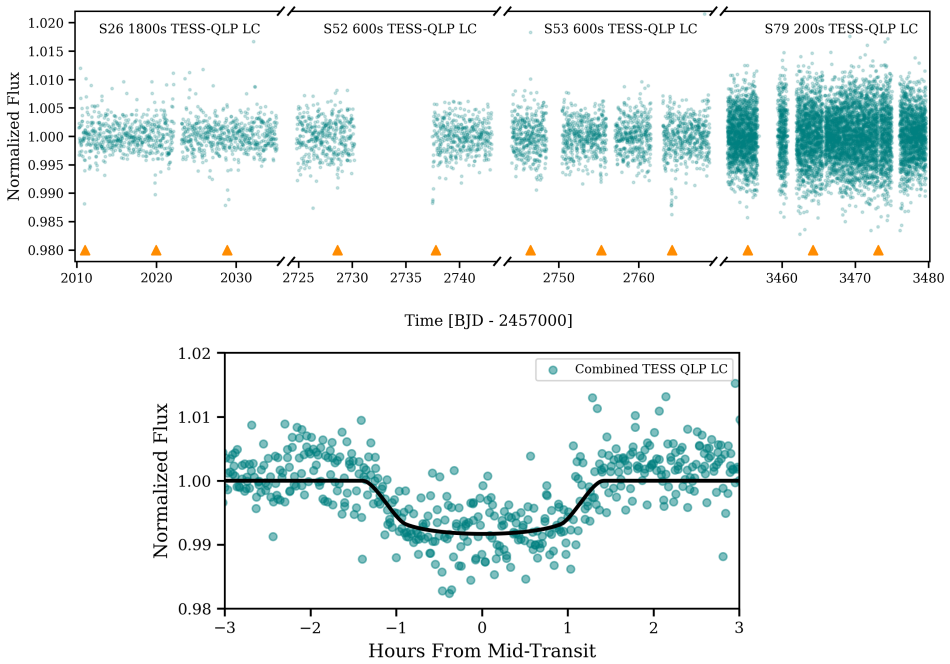
We report here the discovery and characterization of a high-mass transiting brown dwarf in a close-in orbit around its host star, TOI-7154. Initially, the host star was identified as an exoplanetary candidate from the TESS photometry data. Later, with the mass measurements from the RV follow-up using the PARAS-2 and TRES spectrographs, the companion is found to be sub-stellar in nature. TOI-7154, is a G-type main-sequence metal-rich star metallicity $\mathrm{[Fe/H]} = 0.154^{+0.077}_{-0.075}\,\text{dex}$, effective temperature $T_{\mathrm{eff}} = 5564^{+100}_{-110}\,\text{K}$, mass $M_\star = 0.939^{+0.047}_{-0.043}\,M_{\odot}$, radius $R_\star = 0.949^{+0.032}_{-0.030}\,R_{\odot}$, and surface gravity $\log g = 4.456^{+0.036}_{-0.036}$. With the joint analysis of the TESS photometry and the PARAS-2 and TRES radial velocities we found that TOI-7154b orbits its host star in $P = 8.860073\pm 0.000029\,\text{d}$, eccentric ($e = 0.2482 \pm 0.0024$) orbit and its radius is smaller than that of Jupiter ($R_{b} = 0.827^{+0.040}_{-0.037}\,R_{\mathrm{J}}$). With a mass near the hydrogen-burning boundary ($M_{b} = 71.7^{+2.4}_{-2.2}\,M_{\mathrm{J}}$) which separates brown dwarfs from very low-mass stars, TOI-7154b occupies a critical position in the regime for probing the transition between sub-stellar and stellar objects. The system is very old, with its age estimated to be $7.2^{+3.9}_{-3.6}\,\text{Gyr}$ by MIST isochrones, while Galactic kinematics indicate an age of $\sim4-5\,\text{Gyr}$. {Our tidal evolution simulations indicate a stellar dissipation factor of $Q_\star'\lesssim10^6$. Since the presence of any companion is currently ruled out by observations, the presence of eccentricity in this old system is, therefore, indicative of it having stellar-like fragmentation origins.
Editorial analysis
A structured set of objections, weighed in public.
Referee Report
Summary. The paper reports the discovery and characterization of TOI-7154b, a transiting brown dwarf with mass 71.7 M_J (near the hydrogen-burning limit), radius 0.827 R_J, and orbital period 8.86 d in an eccentric (e=0.248) orbit around a metal-rich G-type star. Parameters are obtained from joint TESS photometry and radial-velocity data from PARAS-2 and TRES; the system age is 4–7 Gyr from isochrones and kinematics. Tidal-evolution simulations are reported to yield Q_star' ≲ 10^6; with no additional companions detected, the surviving eccentricity is interpreted as evidence for stellar-like fragmentation formation.
Significance. If the orbital elements and mass are robust, the object populates the sparsely sampled regime near the brown-dwarf/stellar boundary and supplies a new datum for close-in sub-stellar companions. Explicit credit is due for the dual-instrument RV confirmation and the provision of a falsifiable tidal-evolution bound. However, the formation interpretation rests on an internally inconsistent tidal argument (see major comments), so the significance of the origin claim cannot be assessed until that inconsistency is resolved.
major comments (2)
- [Abstract] Abstract (final paragraph): the claim that Q_star' ≲ 10^6 together with the observed e = 0.2482 implies a primordial eccentricity (and therefore fragmentation origins) reverses the required inequality. Standard tidal theory gives τ_circ ∝ Q_star'; preserving e ≈ 0.25 over 4–7 Gyr at P = 8.86 d requires Q_star' ≳ 10^7 (weak dissipation). The reported upper bound instead implies circularization on ≪ 1 Gyr timescales, breaking the link between the measured eccentricity and the formation-channel conclusion.
- [Joint photometry–RV analysis] Joint photometry–RV analysis section: the manuscript does not supply the RV time series, photometric light-curve tables, full posterior distributions, or convergence diagnostics for the joint fit. Without these, the quoted values M_b = 71.7^{+2.4}_{-2.2} M_J, e = 0.2482 ± 0.0024, and the age cannot be independently verified, undermining the load-bearing inputs to the tidal and formation arguments.
Simulated Author's Rebuttal
We thank the referee for their careful and constructive review of our manuscript. We address each major comment below and commit to revisions that resolve the identified issues.
read point-by-point responses
-
Referee: [Abstract] Abstract (final paragraph): the claim that Q_star' ≲ 10^6 together with the observed e = 0.2482 implies a primordial eccentricity (and therefore fragmentation origins) reverses the required inequality. Standard tidal theory gives τ_circ ∝ Q_star'; preserving e ≈ 0.25 over 4–7 Gyr at P = 8.86 d requires Q_star' ≳ 10^7 (weak dissipation). The reported upper bound instead implies circularization on ≪ 1 Gyr timescales, breaking the link between the measured eccentricity and the formation-channel conclusion.
Authors: We acknowledge the inconsistency identified by the referee. Our tidal simulations were meant to explore the dissipation needed to retain the observed eccentricity, but the reported upper bound Q_star' ≲ 10^6 is indeed the wrong direction and would imply rapid circularization inconsistent with the system age. We will revise the abstract and discussion to report the correct lower bound (Q_star' ≳ 10^7 for weak dissipation) required to preserve e ≈ 0.25, and we will adjust the formation interpretation to note that such weak dissipation is compatible with a fragmentation origin. The error in the inequality will be corrected in the next version. revision: yes
-
Referee: [Joint photometry–RV analysis] Joint photometry–RV analysis section: the manuscript does not supply the RV time series, photometric light-curve tables, full posterior distributions, or convergence diagnostics for the joint fit. Without these, the quoted values M_b = 71.7^{+2.4}_{-2.2} M_J, e = 0.2482 ± 0.0024, and the age cannot be independently verified, undermining the load-bearing inputs to the tidal and formation arguments.
Authors: We agree that full reproducibility requires these materials. The revised manuscript will include the PARAS-2 and TRES RV time series as a table, reference or tabulate the TESS photometry, and add the MCMC posterior corner plots plus convergence diagnostics (trace plots, autocorrelation times, and Gelman-Rubin statistics). These additions will allow independent verification of the reported parameters. revision: yes
Circularity Check
No significant circularity; derivation self-contained against data
full rationale
Orbital elements (P, e, M_b, R_b) are obtained from joint photometric+RV fitting to TESS and PARAS-2/TRES time series; stellar parameters and age from independent isochrone and kinematic analysis. The Q_star' bound is stated as an output of tidal-evolution simulations that take those fitted values as inputs rather than re-deriving them. The final interpretive sentence linking eccentricity to fragmentation origin rests on an external assumption (no undetected companions) and a physical inference, none of which reduce by construction to the input data or to any self-citation chain. No self-definitional, fitted-input-renamed-as-prediction, or uniqueness-imported steps are present.
Axiom & Free-Parameter Ledger
free parameters (4)
- Orbital period P
- Eccentricity e
- Companion mass M_b
- Stellar dissipation factor Q_star'
axioms (2)
- domain assumption No additional companions are present in the system
- domain assumption MIST isochrone and Galactic-kinematics age estimates are accurate
Reference graph
Works this paper leans on
-
[1]
Exploring the Milky Way stellar disk. A detailed elemental abundance study of 714 F and G dwarf stars in the solar neighbourhood. , keywords =. doi:10.1051/0004-6361/201322631 , archivePrefix =. 1309.2631 , primaryClass =
work page internal anchor Pith review Pith/arXiv arXiv doi:10.1051/0004-6361/201322631
-
[2]
Summary of the content and survey properties
Gaia Data Release 3. Summary of the content and survey properties. , keywords =. doi:10.1051/0004-6361/202243940 , archivePrefix =. 2208.00211 , primaryClass =
-
[3]
On the origin of the Galactic thin and thick discs, their abundance gradients and the diagnostic potential of their abundance ratios. , keywords =. doi:10.1093/mnras/stad1551 , archivePrefix =. 2305.13431 , primaryClass =
-
[4]
TOI-2490b - the most eccentric brown dwarf transiting in the brown dwarf desert. , keywords =. doi:10.1093/mnras/stae1940 , archivePrefix =. 2408.04475 , primaryClass =
-
[5]
Tidal Evolution of Close-in Extra-Solar Planets
Tidal Evolution of Close-in Extrasolar Planets. , keywords =. doi:10.1086/529187 , archivePrefix =. 0802.1543 , primaryClass =
work page internal anchor Pith review Pith/arXiv arXiv doi:10.1086/529187
-
[6]
Observational Evidence for Tidal Destruction of Exoplanets
Observational Evidence for Tidal Destruction of Exoplanets. , keywords =. doi:10.1088/0004-637X/698/2/1357 , archivePrefix =. 0904.1170 , primaryClass =
work page internal anchor Pith review Pith/arXiv arXiv doi:10.1088/0004-637x/698/2/1357
-
[7]
, year = 1963, month = jan, volume =
On the eccentricity of satellite orbits in the solar system. , year = 1963, month = jan, volume =. doi:10.1093/mnras/126.3.257 , adsurl =
-
[8]
Tidal Constraints on the Masses of Extrasolar Planets. , keywords =. doi:10.1086/312746 , adsurl =
-
[9]
On the Radii of Extrasolar Giant Planets
On the Radii of Extrasolar Giant Planets. , keywords =. doi:10.1086/375565 , archivePrefix =. astro-ph/0303541 , primaryClass =
work page internal anchor Pith review Pith/arXiv arXiv doi:10.1086/375565
-
[10]
Planet Migration and Binary Companions: the case of HD 80606b
Planet Migration and Binary Companions: The Case of HD 80606b. , keywords =. doi:10.1086/374598 , archivePrefix =. astro-ph/0303010 , primaryClass =
work page internal anchor Pith review Pith/arXiv arXiv doi:10.1086/374598
-
[11]
The tides of Io. , keywords =. doi:10.1016/0019-1035(81)90088-9 , adsurl =
-
[12]
Tidal dissipation in rotating giant planets
Tidal Dissipation in Rotating Giant Planets. , keywords =. doi:10.1086/421454 , archivePrefix =. astro-ph/0310218 , primaryClass =
work page internal anchor Pith review Pith/arXiv arXiv doi:10.1086/421454
-
[13]
, year = 1996, month = apr, volume =
Orbital migration of the planetary companion of 51 Pegasi to its present location. , year = 1996, month = apr, volume =. doi:10.1038/380606a0 , adsurl =
-
[14]
, year = 2007, month = apr, volume =
Constraints on the tidal dissipation factor of a main sequence star: The case of OGLE-TR-56b. , year = 2007, month = apr, volume =. doi:10.1016/j.pss.2006.05.044 , adsurl =
-
[15]
and Chabrier, G
Baraffe, I. and Chabrier, G. and Allard, F. and Hauschildt, P. H. , title =. Astronomy & Astrophysics , year =
-
[16]
Posters from the TESS Science Conference II (TSC2) , year = 2021, month = jul, eid =
Stellar Parameter Classification of TESS recon spectra from TRES and FIES. Posters from the TESS Science Conference II (TSC2) , year = 2021, month = jul, eid =. doi:10.5281/zenodo.5130626 , adsurl =
-
[17]
, year = 2012, month = jun, volume =
An abundance of small exoplanets around stars with a wide range of metallicities. , year = 2012, month = jun, volume =. doi:10.1038/nature11121 , adsurl =
-
[18]
Spiegel, D. S. and Burrows, A. and Milsom, J. A. , title =. The Astrophysical Journal , year =
-
[19]
Dieterich, S. B. and Apai, D. and Malhotra, R. , title =. The Astrophysical Journal , year =
-
[20]
K. Barkaoui and D. Sebastian and S. Zúñiga-Fernández and A. H. M. J. Triaud and B. V. Rackham and A. J. Burgasser and T. W. Carmichael and M. Gillon and C. Theissen and E. Softich and B. Rojas-Ayala and G. Srdoc and A. Soubkiou and A. Fukui and M. Timmermans and M. Stalport and A. Burdanov and D. R. Ciardi and K. A. Collins and Y. T. Davis and F. Davoudi ...
-
[21]
D. Grether and C. H. Lineweaver , title =. The Astrophysical Journal , year =. doi:10.1086/500126 , url =
-
[22]
J. Sahlmann and F. Fressin and J. Schneider and M. Mayor and D. Queloz and J. Laskar , title =. Astronomy & Astrophysics , year =. doi:10.1051/0004-6361/201116713 , url =
-
[23]
François Bouchy and André Santerne and Christophe Moutou and Michel Deleuil and Romain F. Díaz and Aurélie Eggenberger and Didier Ehrenreich and Christophe Gry and Thierry Guillot and Michael Havel and Georges Hébrard and Stéphane Udry , title =. Astronomy & Astrophysics , year =. doi:10.1051/0004-6361/201116095 , url =
-
[24]
Lunine and David Stevenson , title =
Tristan Guillot and Jonathan I. Lunine and David Stevenson , title =. Icarus , year =. doi:10.1016/j.icarus.2014.07.013 , url =
-
[25]
Monthly Notices of the Royal Astronomical Society , year =
Mario Damiani and Rafael Díaz , title =. Monthly Notices of the Royal Astronomical Society , year =. doi:10.1093/mnras/stw1244 , url =
-
[26]
G. I. Ogilvie and D. N. C. Lin , title =. The Astrophysical Journal , year =. doi:10.1086/513764 , url =
-
[27]
Monthly Notices of the Royal Astronomical Society , year =
Andrew Collier Cameron and Moira Jardine , title =. Monthly Notices of the Royal Astronomical Society , year =. doi:10.1093/mnras/sty292 , url =
-
[28]
A. J. Barker and G. I. Ogilvie , title =. Monthly Notices of the Royal Astronomical Society , year =. doi:10.1111/j.1365-2966.2010.16419.x , url =
-
[29]
Reed Essick and Nevin N. Weinberg , title =. The Astrophysical Journal , year =. doi:10.3847/0004-637X/826/1/39 , url =
-
[30]
Monthly Notices of the Royal Astronomical Society , year =
Bo Ma and Jian Ge , title =. Monthly Notices of the Royal Astronomical Society , year =. doi:10.1093/mnras/stu134 , url =
-
[31]
F. A. Rasio and E. B. Ford , title =. Science , year =. doi:10.1126/science.274.5287.954 , url =
-
[32]
S. Chatterjee and E. B. Ford and A. Rasio and J. J. Adams and F. A. Rasio , title =. Nature , year =. doi:10.1038/nature08317 , url =
-
[33]
E. B. Ford and F. A. Rasio , title =. The Astrophysical Journal , year =. doi:10.1086/591457 , url =
-
[34]
N. Grieves and J. Ge and N. Thomas and B. Ma and S. Sithajan and L. Ghezzi and B. Kimock and K. Willis and N. De Lee and B. Lee and S. W. Fleming and E. Agol and N. Troup and M. Paegert and D. P. Schneider and K. Stassun and F. Varosi and B. Zhao and J. Liu and R. Li and G. F. Porto de Mello and D. Bizyaev and K. Pan and L. Dutra-Ferreira and D. Lorenzo-O...
-
[35]
F. Kiefer and G. Hébrard and J. Sahlmann and S. G. Sousa and T. Forveille and N. Santos and M. Mayor and M. Deleuil and P. A. Wilson and S. Dalal and R. F. Díaz and G. W. Henry and J. Hagelberg and M. J. Hobson and O. Demangeon and V. Bourrier and X. Delfosse and L. Arnold and N. Astudillo-Defru and J.-L. Beuzit and I. Boisse and X. Bonfils and S. Borgnie...
-
[36]
Gordon I. Ogilvie , title =. Annual Review of Astronomy and Astrophysics , year =. doi:10.1146/annurev-astro-081913-035941 , eprint =
-
[37]
Protostars and Planets VI , year =
Gilles Chabrier and Anders Johansen and Markus Janson and Roman Rafikov , title =. Protostars and Planets VI , year =. doi:10.2458/azu_uapress_9780816531240-ch027 , eprint =
-
[38]
Schlaufman , title =
Kevin C. Schlaufman , title =. The Astrophysical Journal , volume =. 2018 , doi =
2018
-
[39]
F. Pepe and A. Cristiani and J. Dekker and D. Gonz. ESPRESSO at VLT. On-sky performance and first results , journal =. 2021 , volume =. doi:10.1051/0004-6361/202038425 , url =
-
[40]
Abhijit Chakraborty and Suvrath Mahadevan and Arpita Roy and Vaibhav Dixit and Eric Harvey Richardson and Varun Dongre and F. M. Pathan and Priyanka Chaturvedi and Vishal Shah and Girish P. Ubale and B. G. Anandarao , title =. Publications of the Astronomical Society of the Pacific , abstract =. doi:10.1086/675352 , url =
-
[41]
Gaia Collaboration and Babusiaux, C. and Lépine, S. and Bailer-Jones, C. A. L. and Andrae, R. and others , title =. Astronomy & Astrophysics , year =. doi:10.1051/0004-6361/202243800 , url =
-
[42]
Eric Agol and Daniel C. Fabrycky , title =. Handbook of Exoplanets , editor =. 2018 , pages =. doi:10.1007/978-3-319-55333-7\_7 , url =
-
[43]
Water Vapor and Clouds on the Habitable-zone Sub-Neptune Exoplanet K2-18b , journal =
Bj. Water Vapor and Clouds on the Habitable-zone Sub-Neptune Exoplanet K2-18b , journal =. 2019 , volume =. doi:10.3847/2041-8213/ab59dc , url =
-
[44]
B. Edwards and M. Rice and T. Zingales and et al. , title =. Experimental Astronomy , year =. doi:10.1007/s10686-018-9611-4 , url =
-
[45]
R. A. Rossiter , title =. Astrophysical Journal , year =
-
[46]
D. B. McLaughlin , title =. Astrophysical Journal , year =
-
[47]
Andrew Collier Cameron and others , title =. Monthly Notices of the Royal Astronomical Society , year =. doi:10.1111/j.1365-2966.2009.16170.x , url =
-
[48]
and Kürster, M
Zechmeister, M. and Kürster, M. , title =. Astronomy & Astrophysics , year =
-
[49]
EXOFASTv2: A public, generalized, publication-quality exoplanet modeling code
Eastman, Jason D. and Rodriguez, Joseph E. and Agol, Eric and Stassun, Keivan G. and Beatty, Thomas G. and Vanderburg, Andrew and Gaudi, B. Scott and Collins, Karen A. and Luger, Rodrigo , title =. arXiv e-Prints , year =. 1907.09480 , primaryClass =
work page internal anchor Pith review Pith/arXiv arXiv 1907
-
[50]
Stassun and Guillermo Torres , title =
Keivan G. Stassun and Guillermo Torres , title =. The Astronomical Journal , year =. doi:10.3847/0004-6256/152/6/180 , url =
-
[52]
The Astrophysical Journal , year =
Aaron Dotter , title =. The Astrophysical Journal , year =. doi:10.3847/0004-637X/823/2/102 , eprint =
work page internal anchor Pith review doi:10.3847/0004-637x/823/2/102
-
[53]
Kurucz, R. L. , title =. The Astrophysical Journal Supplement Series , year =
-
[54]
and Bastian, U
Lindegren, L. and Bastian, U. and Biermann, M. and Evans, D. W. and Eyer, L. and Holl, B. and Klioner, S. and Luri, X. and Meshcheryakov, A. and Mignard, F. and Ramos-Lerate, M. and Sartoretti, P. and Spoto, F. and Weiler, M. and Brown, A. G. A. and Vallenari, A. and others , title =. Astronomy & Astrophysics , year =
-
[55]
Astronomy & Astrophysics , year =
Akanksha Khandelwal and Rishikesh Sharma and Abhijit Chakraborty and Priyanka Chaturvedi and Solène Ulmer-Moll and others , title =. Astronomy & Astrophysics , year =. doi:10.1051/0004-6361/202343164 , url =
-
[56]
Gravity and limb-darkening coefficients for the Kepler, CoRoT, Spitzer, uvby, UBVRIJHK, and Sloan photometric systems , journal =
Antonio Claret and S. Gravity and limb-darkening coefficients for the Kepler, CoRoT, Spitzer, uvby, UBVRIJHK, and Sloan photometric systems , journal =. 2011 , volume =
2011
-
[57]
Astronomy & Astrophysics , year =
Antonio Claret , title =. Astronomy & Astrophysics , year =
-
[58]
Ricker, G. R. and others , title =. Journal of Astronomical Telescopes, Instruments, and Systems , volume =
-
[59]
Huang, C. X. and others , title =. Research Notes of the AAS , volume =
-
[60]
, title =
Labeyrie, A. , title =. Astronomy & Astrophysics , year =
-
[61]
A&A , year = 2002, month = apr, volume =
New algorithms for reducing cross-dispersed echelle spectra. A&A , year = 2002, month = apr, volume =. doi:10.1051/0004-6361:20020175 , adsurl =
-
[62]
Chakraborty , title =
Rishikesh Sharma and Abhijit G. Chakraborty , title =. Journal of Astronomical Telescopes, Instruments, and Systems , number =. 2021 , doi =
2021
-
[63]
Publications of the Astronomical Society of the Pacific , author =
Pieter G. van Dokkum , title =. 2001 , month =. doi:10.1086/323894 , url =
-
[64]
The CORALIE survey for southern extra-solar planets VII. Two short-period Saturnian companions to <ASTROBJ>HD 108147</ASTROBJ> and <ASTROBJ>HD 168746</ASTROBJ>. , keywords =. doi:10.1051/0004-6361:20020433 , archivePrefix =. astro-ph/0202457 , primaryClass =
work page internal anchor Pith review Pith/arXiv arXiv doi:10.1051/0004-6361:20020433
-
[65]
, keywords =
ELODIE: A spectrograph for accurate radial velocity measurements. , keywords =
-
[66]
Discovery and characterization of a dense sub-Saturn TOI-6651b. , keywords =. doi:10.1051/0004-6361/202450934 , archivePrefix =. 2408.17179 , primaryClass =
-
[67]
Chakraborty, Abhijit and Mahadevan, Suvrath and Roy, Arpita and Dixit, Vaibhav and Richardson, Eric Harvey and Dongre, Varun and Pathan, F. M. and Chaturvedi, Priyanka and Shah, Vishal and Ubale, Girish P. and Anandarao, B. G. , title =. Publications of the Astronomical Society of the Pacific , year =
-
[68]
Abhijit Chakraborty and Nitesh Thapa and Kapil Kumar and Prasad J. S. S. V. Neelam and Rishikesh Sharma and Arpita Roy , title =. Ground-based and Airborne Instrumentation for Astronomy VII , editor =. 2018 , doi =
2018
-
[69]
2024 , eprint=
The PRL 2.5m Telescope and its First Light Instruments: FOC & PARAS-2 , author=. 2024 , eprint=
2024
-
[70]
Journal of Astronomical Telescopes, Instruments, and Systems , year =
Rishikesh Sharma and Abhijit Chakraborty , title =. Journal of Astronomical Telescopes, Instruments, and Systems , year =
-
[71]
HAT-P-16b: A 4 Mj Planet Transiting A Bright Star On An Eccentric Orbit
HAT-P-16b: A 4 M _ J Planet Transiting a Bright Star on an Eccentric Orbit. , keywords =. doi:10.1088/0004-637X/720/2/1118 , archivePrefix =. 1005.2009 , primaryClass =
work page internal anchor Pith review Pith/arXiv arXiv doi:10.1088/0004-637x/720/2/1118 2009
-
[72]
2008 , Title =
G\'abor F. 2008 , Title =
2008
-
[73]
Chaturvedi, Priyanka and Chakraborty, Abhijit and Anandarao, B. G. and Roy, Arpita and Mahadevan, Suvrath , title = ". Monthly Notices of the Royal Astronomical Society , volume =. 2016 , month =. doi:10.1093/mnras/stw1560 , url =
-
[74]
Priyanka Chaturvedi and Rishikesh Sharma and Abhijit Chakraborty and B. G. Anandarao and Neelam J. S. S. V Prasad , title =. The Astronomical Journal , abstract =. doi:10.3847/1538-3881/aac5de , url =
-
[75]
K. G. Stassun and G. Torres and M. C. Mann and others , title =. The Astronomical Journal , year =
-
[76]
2023 , volume =
Gaia Data Release 3: Summary of the content and survey properties , journal =. 2023 , volume =
2023
-
[77]
R. M. Cutri and others , title =. 2003 , url =
2003
-
[78]
Z. D. Hartman and S. L. The SUPERBLINK Proper Motion Catalog , journal =. 2020 , volume =
2020
-
[79]
R. M. Cutri and others , title =. 2021 , url =
2021
-
[80]
Paegert and others , title =
M. Paegert and others , title =. The Astronomical Journal , year =
-
[81]
The Astrophysical Journal Supplement Series , volume =
Dotter, Aaron , title =. The Astrophysical Journal Supplement Series , volume =. 2016 , doi =
2016
discussion (0)
Sign in with ORCID, Apple, or X to comment. Anyone can read and Pith papers without signing in.