REVIEW 4 major objections 6 minor 72 references
Depth Gives a False Sense of Privacy: LLM Internal States Inversion
T0 review · 4 major / 6 minor · reviewed 2026-08-06 · deepseek-v4-flash
Pith's one-line read LLM internal states, long treated as irreversible, can be inverted to recover near-verbatim user prompts — including a 4,112-token medical consultation recovered with 86.88 F1 token matching.
desk verdict Solid evidence that LLM internal states leak prompt content, with genuinely new optimization tricks, but the 'nearly perfect' headline is a cherry-picked operating point and the attack's practical robustness to noise is not established. read the letter →
The pith
A machine-rendered reading of the paper's core claim, the machinery that carries it, and where it could break.
The reading
What carries the argument
The load-bearing mechanism is a two-phase inversion pipeline: first reconstruct the input embedding whose forward pass would produce the observed internal states, then decode tokens by choosing, for each position, the dictionary token whose embedding is most cosine-similar to the recovered embedding. For deep layers, Token Basis Selection (TBS) replaces direct embedding optimization with optimization over coefficients of an orthogonal basis (typically derived from an SVD of the input embedding matrix), which shrinks the search space and bounds gradient magnitude so the loss does not explode. A distribution-matching penalty keeps recovered embeddings in-distribution, and a generation-based variant treats inversion as translation by projecting internal states into an encoder-decoder model's embedding space. These pieces together are what let the attack scale from BERT-style models with around a dozen layers to modern LLMs with 32 or 80 layers.
What would settle it
Measure the TBS attack on hidden states that have been rounded to an 8-bit fixed-point representation before reaching the adversary; if token-level F1 falls from the reported 86.88 to near chance, the near-perfect inversion result depends on pristine, high-precision internal states rather than on an intrinsic property of the states themselves.
Extended reading notes
Core claim
On the paper's own terms, the discovery is that an adversary who observes the internal states at a chosen layer can reconstruct the original prompt almost exactly, in order and with preserved semantics, rather than merely inferring attributes about it. The enabling insight is that strong inversion is possible if the attack first recovers a plausible input embedding and only then selects tokens: Embedding Recovery does this directly for shallow layers, while Token Basis Selection expresses the candidate embedding as a learned combination of an orthogonal basis of the input embedding matrix, which stabilizes gradients and lets deep layers be inverted too. The same strategy transfers to black-box settings when the victim model is derived from a known base model, and a separate generation-based inversion model, trained on surrogate data with a projection module aligning internal states to an encoder, handles closed-sourced models. The paper reports this across six models, short and long prompts, medical and coding domains, and shows that the broad privacy conclusion holds up to the middle layer of a 70B model.
Load-bearing premise
The near-perfect inversion numbers rest on the adversary observing the internal states exactly as computed by the deployed model, with no added noise, rounding, or defensive perturbation; the paper's own defense experiments show that even mild differential privacy noise severely degrades the optimization attack.
Editorial extensions
If this is right
- Collaborative inference cannot promise data locality as privacy: any party holding the rest of the layers can, in principle, reconstruct the user's prompt rather than only consuming it for inference.
- Safety auditors that legitimately inspect internal states become high-value targets; an honest auditor's access is indistinguishable from an inversion adversary's access.
- Inversion quality persists across model scales—from 7B to 70B—so choosing a larger model does not by itself restore confidentiality of prompts.
- Domain-specialized models, such as a coding-tuned model, leak more than general-purpose counterparts, so fine-tuning on sensitive domains raises rather than lowers inversion risk.
- No tested defense—quantization, dropout, noisy embeddings, or differential privacy—blocks inversion while keeping model utility intact; the paper therefore frames the problem as needing architectural changes or confidential computing rather than output perturbation alone.
Reading between the lines
- Beyond the paper: if real serving stacks quantize or round activations, the headline TBS numbers may overstate real-world risk; testing the attack on fixed-point hidden states is a direct next experiment.
- Beyond the paper: the paper's architectural hypothesis—that uniform layer width prevents information loss and thereby aids inversion—implies a cheap falsifiable test: train a small transformer with decreasing hidden width and measure whether the same attack loses fidelity.
- Beyond the paper: the generation-based attack's success hinges on surrogate data resembling the victim's domain; a defender could therefore focus on domain separation or on making internal states task-specific rather than on adding noise.
- Beyond the paper: the two-phase embedding-recovery recipe is not obviously limited to internal states and may transfer to other shared artifacts such as KV caches or per-layer gradients, where hidden values are also exposed.
Editorial analysis
A structured set of objections, weighed in public.
Referee Report
Summary. The paper studies whether the internal states (ISs) of modern LLMs can be inverted to recover the original user prompt. It proposes two white-box optimization attacks (Embedding Recovery for shallow layers and Token Basis Selection for deep layers), a black-box extension that first identifies and replicates a derived model, and a generation-based attack that trains an encoder-decoder with a projection module to translate ISs back into text. The evaluation covers six LLMs on short and long medical and coding prompts, claims up to 86.88 F1 / 95.19 semantic similarity for a 4,112-token medical prompt from the middle layer of Llama-3-8B-Instruct, and tests quantization, dropout, noisy input embeddings, and DP as defenses. The authors conclude that input inversion from ISs is practical and that existing defenses do not fully mitigate it.
Significance. The privacy question addressed is timely and the attack surface (ISs exposed by collaborative inference and auditing) is well chosen. The paper is among the first to scale inversion to long prompts and large models (up to 70B), and it provides an extensive comparison across six models and multiple baselines. The commitment to release code, pretrained inversion models, and logs is valuable for reproducibility. If the evaluation were more conservative—notably with a validation protocol and without test-set hyperparameter selection—the results would still support a meaningful claim: middle-layer ISs leak substantial token-level and semantic content under white-box access, and generation-based inversion transfers across similar distributions. As written, the headline 'nearly perfect' claim overstates what the evidence shows.
major comments (4)
- [Section 5.2.2 / Figure 7 / Figure 9 / Table 4] The long-context evaluation uses only the 25 longest prompts from each dataset, and the reported operating points are selected by sweeping learning rate, distance metric, and basis on these same test prompts. Table 4 shows that the same TBS attack on Mentalhealth ranges from 78.53 F1 (unbiased basis, µ=5e-4, λ=0) to 94.99 F1 (SVD basis, µ=5e-4, λ=0), so the headline numbers are an optimized envelope rather than a representative or predictive operating point. A separate validation split or a pre-registered configuration is needed before the abstract's general claim can be accepted.
- [Abstract / Figures 21–23 / Section 5.2.2] The abstract's 'nearly perfect' claim for the 4,112-token prompt is not traceable to the reported averages: Section 5.2.2 gives Aimedical averages of 98.12 CS and 96.7 F1, while the abstract quotes 86.88 F1 / 95.19 CS. If the latter is a single-example result, the paper should say so explicitly. In addition, the displayed inversion in Figures 21–23 contains numerous inserted non-English and special tokens (e.g., 'тися', 'ıldığı', '神马收录', '<|begin_of_text|>') and repeated words, which is difficult to reconcile with 'nearly perfectly inverted'; reporting per-example token precision/recall would clarify what the F1 score actually means here.
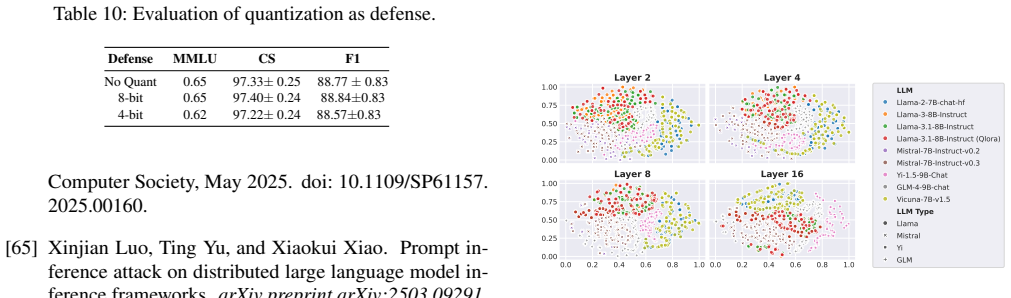
- [Section 5.4 / Section 7 (Limitation)] The defense evaluation tests only the generation-based attack, while the abstract's strongest result is produced by the optimization-based TBS attack. The paper's own Limitation section states that TBS 'cannot recover meaningful inputs even under the highest ε we tested because of noise sensitivity,' so the conclusion that the four defenses 'cannot perfectly prevent ISs inversion' is not established for the attack that carries the headline claim. The authors should evaluate TBS under the same defenses or explicitly scope the defense conclusion to the generation-based attack.
- [Section 4.2 / Appendix A] TBS's optimization assumes that the true input embeddings are representable in the arctan-bounded basis; no proof or validation of this assumption is provided, and the strong dataset-dependent sensitivity in Table 4 suggests the feasible set may be misspecified for some inputs. The assumption should be stated explicitly and tested, e.g., by measuring whether the converged loss can reach the value expected when a representable target is available.
minor comments (6)
- [Section 5.4] The section says 'four practical defenses including DP, pruning, quantization, dropout and noisy input embedding,' which lists five defenses and never evaluates pruning; please correct the enumeration.
- [Section 4.3] The Bayesian perspective is simply Bayes' theorem applied to the inversion objective and does not explain the design choices; it can be shortened or removed without affecting the method.
- [Figure 8] The color-highlighted missed tokens are not legible in grayscale; consider adding underlining or textual markers.
- [Section 5.2.2] 'unbridle the maximum sequence to 4,096' should read 'set the maximum sequence length to 4,096'.
- [Table 1] The symbols '#' and the checkmark/cross convention are not defined in the caption; please add a legend.
- [Section 5.2.1] The attack settings paragraph describes Llama-3 layer indices, but Table 3 reports results on Llama-2; clarify which settings apply to which model.
Circularity Check
No circularity: the inversion attacks are empirical optimizations and supervised fits, with results measured against held-out inputs.
full rationale
I find no load-bearing circular step. The optimization-based attacks (ER/TBS) minimize a distance between inverted and observed internal states, but the reported F1 and semantic-similarity numbers are evaluated against held-out ground-truth prompts (Table 3, Figures 8-9, 21-23), so the target text is not used to construct the output. The generation-based attack trains a T5 inversion model on surrogate data (NoRobots/Instruction-2M) and is evaluated on separate test data (Tables 7-9), which is standard supervised learning rather than a circular prediction. The 'Bayesian perspective' (Eq. 6) is a straightforward restatement of Bayes' rule and is not used to derive any quantity that is then reported as a prediction. Self-citations such as [14], [60], and [68] appear only in contextual related-work or speculative mitigation discussion and are not load-bearing for the paper's central claims. The paper's own Limitation section acknowledges hyperparameter and noise sensitivity, which is a robustness/correctness concern rather than evidence of circularity.
Assumptions & free parameters
free parameters (6)
- Learning rate µ =
1e-4 to 1e-3
- Penalty weight λ =
0 or 1e-3
- Distance metric =
MSE or COS
- Basis type =
Unbiased or SVD
- α in ϕz =
5/π
- Max sequence length (generation) =
128-1024
assumptions (4)
- standard math Transformer layers are differentiable and gradients can be backpropagated through them
- domain assumption The adversary knows the exact layer index l and tokenizer of the target model
- ad hoc to paper The true input embeddings lie within the bounded range representable by the arctan parametrization in TBS
- domain assumption The adversary has access to a surrogate dataset with distribution similar to the victim's queries for black-box attacks
Cite this review
Pith. "Pith review of Depth Gives a False Sense of Privacy: LLM Internal States Inversion." pith.science (2026). https://pith.science/paper/LP5EZC6K
@misc{pith2026250716372,
  author       = {Pith},
  title        = {Pith review of: Depth Gives a False Sense of Privacy: LLM Internal States Inversion},
  year         = {2026},
  howpublished = {\url{https://pith.science/paper/LP5EZC6K}},
  note         = {Machine review of arXiv:2507.16372}
}
read the original abstract
Large Language Models (LLMs) are increasingly integrated into daily routines, yet they raise significant privacy and safety concerns. Recent research proposes collaborative inference, which outsources the early-layer inference to ensure data locality, and introduces model safety auditing based on inner neuron patterns. Both techniques expose the LLM's Internal States (ISs), which are traditionally considered irreversible to inputs due to optimization challenges and the highly abstract representations in deep layers. In this work, we challenge this assumption by proposing four inversion attacks that significantly improve the semantic similarity and token matching rate of inverted inputs. Specifically, we first develop two white-box optimization-based attacks tailored for low-depth and high-depth ISs. These attacks avoid local minima convergence, a limitation observed in prior work, through a two-phase inversion process. Then, we extend our optimization attack under more practical black-box weight access by leveraging the transferability between the source and the derived LLMs. Additionally, we introduce a generation-based attack that treats inversion as a translation task, employing an inversion model to reconstruct inputs. Extensive evaluation of short and long prompts from medical consulting and coding assistance datasets and 6 LLMs validates the effectiveness of our inversion attacks. Notably, a 4,112-token long medical consulting prompt can be nearly perfectly inverted with 86.88 F1 token matching from the middle layer of Llama-3 model. Finally, we evaluate four practical defenses that we found cannot perfectly prevent ISs inversion and draw conclusions for future mitigation design.
Figures


Figures from the paper (19 more)







Reference graph
Works this paper leans on
-
[1]
X fact checks elon musk after he blasts apple-openai partnership as ‘creepy’ privacy nightmare
Robert Hart. X fact checks elon musk after he blasts apple-openai partnership as ‘creepy’ privacy nightmare. https://www.forbes.com/sites/roberthart/2024/06/11/x- fact-checks-elon-musk-after-he-blasts-apple-openai- partnership-as-creepy-privacy-nightmare/, 2024
work page 2024
-
[2]
Abhimanyu Dubey, Abhinav Jauhri, Abhinav Pandey, Abhishek Kadian, Ahmad Al-Dahle, Aiesha Letman, Akhil Mathur, Alan Schelten, Amy Yang, Angela Fan, et al. The llama 3 herd of models. arXiv preprint arXiv:2407.21783, 2024
arXiv 2024
-
[3]
Splitlora: A split parameter-efficient fine- tuning framework for large language models
Zheng Lin, Xuanjie Hu, Yuxin Zhang, Zhe Chen, Zihan Fang, Xianhao Chen, Ang Li, Praneeth Vepakomma, and Yue Gao. Splitlora: A split parameter-efficient fine- tuning framework for large language models. arXiv preprint arXiv:2407.00952, 2024
arXiv 2024
-
[4]
Helix: Dis- tributed serving of large language models via max-flow on heterogeneous gpus
Yixuan Mei, Yonghao Zhuang, Xupeng Miao, Juncheng Yang, Zhihao Jia, and Rashmi Vinayak. Helix: Dis- tributed serving of large language models via max-flow on heterogeneous gpus. In Proceedings of Interna- tional Conference on Architectural Support for Program- ming Languages and Operating Systems, ASPLOS 2025 , 2025
work page 2025
-
[5]
Edgeshard: Efficient llm inference via collaborative edge computing
Mingjin Zhang, Jiannong Cao, Xiaoming Shen, and Zeyang Cui. Edgeshard: Efficient llm inference via collaborative edge computing. arXiv preprint arXiv:2405.14371, 2024
arXiv 2024
-
[6]
Fact sheet: President biden issues executive order on safe, secure, and trustworthy artificial intelligence. https://www.whitehouse.gov/briefing-room/statements- releases/2023/10/30/fact-sheet-president-biden-issues- executive-order-on-safe-secure-and-trustworthy- artificial-intelligence/, 2023. 15
work page 2023
-
[7]
The internal state of an LLM knows when it‘s lying
Amos Azaria and Tom Mitchell. The internal state of an LLM knows when it‘s lying. In Findings of the As- sociation for Computational Linguistics: EMNLP 2023 , pages 967–976, December 2023. doi: 10.18653/v1/2023. findings-emnlp.68
doi:10.18653/v1/2023 2023
-
[8]
INSIDE: LLMs’ internal states retain the power of hallucination detection
Chao Chen, Kai Liu, Ze Chen, Yi Gu, Yue Wu, Mingyuan Tao, Zhihang Fu, and Jieping Ye. INSIDE: LLMs’ internal states retain the power of hallucination detection. In The Twelfth International Conference on Learning Representations, 2024
work page 2024
Show all 72 references
-
[9]
Unsupervised real-time hallucination detection based on the internal states of large language models
Weihang Su, Changyue Wang, Qingyao Ai, Yiran Hu, Zhijing Wu, Yujia Zhou, and Yiqun Liu. Unsupervised real-time hallucination detection based on the internal states of large language models. In Findings of the Asso- ciation for Computational Linguistics ACL 2024 , pages 14379–1...
2024
- [10]
-
[11]
Physics of language models: Part 2.1, grade-school math and the hidden reasoning process
Tian Ye, Zicheng Xu, Yuanzhi Li, and Zeyuan Allen- Zhu. Physics of language models: Part 2.1, grade-school math and the hidden reasoning process. arXiv preprint arXiv:2407.20311, 2024
2024 arXiv
-
[12]
Safety layers of aligned large language models: The key to llm security
Shen Li, Liuyi Yao, Lan Zhang, and Yaliang Li. Safety layers of aligned large language models: The key to llm security. arXiv preprint arXiv:2408.17003, 2024
2024 arXiv
-
[13]
Analyzing and editing inner mechanisms of backdoored language 353 models
M Lamparth and A Reuel. Analyzing and editing inner mechanisms of backdoored language 353 models. In The 2024 ACM Conference on Fairness, Accountability, and Transparency (F AccT), page 354, 2024
2024
-
[14]
The philosopher’s stone: Trojaning plugins of large language models
Tian Dong, Minhui Xue, Guoxing Chen, Rayne Holland, Yan Meng, Shaofeng Li, Zhen Liu, and Haojin Zhu. The philosopher’s stone: Trojaning plugins of large language models. In Network and Distributed System Security Symposium, NDSS 2025. The Internet Society, 2025
2025
-
[15]
Rep- resentation engineering: A top-down approach to ai transparency
Andy Zou, Long Phan, Sarah Chen, James Campbell, Phillip Guo, Richard Ren, Alexander Pan, Xuwang Yin, Mantas Mazeika, Ann-Kathrin Dombrowski, et al. Rep- resentation engineering: A top-down approach to ai transparency. arXiv preprint arXiv:2310.01405, 2023
-
[16]
Discovering latent knowledge in language models without supervision
Collin Burns, Haotian Ye, Dan Klein, and Jacob Stein- hardt. Discovering latent knowledge in language models without supervision. In The Eleventh International Con- ference on Learning Representations, 2023
2023
-
[17]
States hidden in hidden states: Llms emerge dis- crete state representations implicitly
Junhao Chen, Shengding Hu, Zhiyuan Liu, and Maosong Sun. States hidden in hidden states: Llms emerge dis- crete state representations implicitly. arXiv preprint arXiv:2407.11421, 2024
2024 arXiv
-
[18]
Informa- tion leakage in embedding models
Congzheng Song and Ananth Raghunathan. Informa- tion leakage in embedding models. In Proceedings of the 2020 ACM SIGSAC conference on computer and communications security, pages 377–390, 2020
2020
-
[19]
Text embeddings reveal (almost) as much as text
John Morris, V olodymyr Kuleshov, Vitaly Shmatikov, and Alexander Rush. Text embeddings reveal (almost) as much as text. In Proceedings of the 2023 Con- ference on Empirical Methods in Natural Language Processing, pages 12448–12460, Singapore, December
2023
-
[20]
Morris, and Vitaly Shmatikov
Collin Zhang, John X. Morris, and Vitaly Shmatikov. Extracting prompts by inverting LLM outputs. In Pro- ceedings of the 2024 Conference on Empirical Methods in Natural Language Processing, EMNLP 2024 , pages 14753–14777. Association for Computational Linguis- tics, 2024
2024
-
[21]
Deep learning and the information bottleneck principle
Naftali Tishby and Noga Zaslavsky. Deep learning and the information bottleneck principle. In 2015 IEEE Information Theory Workshop (ITW), pages 1–5, 2015. doi: 10.1109/ITW.2015.7133169
2015
-
[22]
Privacy risks of general-purpose language models
Xudong Pan, Mi Zhang, Shouling Ji, and Min Yang. Privacy risks of general-purpose language models. In 2020 IEEE Symposium on Security and Privacy (SP) , pages 1314–1331, 2020. doi: 10.1109/SP40000.2020. 00095
2020
-
[23]
Sentence embedding leaks more information than you expect: Generative embedding inversion attack to recover the whole sentence
Haoran Li, Mingshi Xu, and Yangqiu Song. Sentence embedding leaks more information than you expect: Generative embedding inversion attack to recover the whole sentence. arXiv preprint arXiv:2305.03010, 2023
2023 arXiv
-
[24]
Language model inversion
John Xavier Morris, Wenting Zhao, Justin T Chiu, Vitaly Shmatikov, and Alexander M Rush. Language model inversion. In The Twelfth International Conference on Learning Representations, 2024
2024
-
[25]
TAG: gradient attack on transformer-based lan- guage models
Jieren Deng, Yijue Wang, Ji Li, Chenghong Wang, Chao Shang, Hang Liu, Sanguthevar Rajasekaran, and Caiwen Ding. TAG: gradient attack on transformer-based lan- guage models. In Findings of the Association for Com- putational Linguistics: EMNLP 2021, pages 3600–3610,
2021
-
[26]
Uncovering gradient inversion risks in prac- tical language model training
Xinguo Feng, Zhongkui Ma, Zihan Wang, Eu Joe Chegne, Mengyao Ma, Alsharif Abuadbba, and Guang- dong Bai. Uncovering gradient inversion risks in prac- tical language model training. In Proceedings of the 16 2024 on ACM SIGSAC Conference on Computer and Communications Security, ...
2024
-
[27]
Unveiling the vulnerability of private fine-tuning in split-based frameworks for large language models: A bidirectionally enhanced attack
Guanzhong Chen, Zhenghan Qin, Mingxin Yang, Yajie Zhou, Tao Fan, Tianyu Du, and Zenglin Xu. Unveiling the vulnerability of private fine-tuning in split-based frameworks for large language models: A bidirectionally enhanced attack. In Proceedings of the 2024 on ACM SIGSAC Confe...
2024
-
[28]
How alignment and jail- break work: Explain LLM safety through intermediate hidden states
Zhenhong Zhou, Haiyang Yu, Xinghua Zhang, Rongwu Xu, Fei Huang, and Yongbin Li. How alignment and jail- break work: Explain LLM safety through intermediate hidden states. In Findings of the Association for Compu- tational Linguistics: EMNLP 2024 , pages 2461–2488, November 202...
2024 doi
-
[29]
Enterprise privacy at openai - does ope- nai review my business data? https://openai.com/ enterprise-privacy/, 2024
OpenAI. Enterprise privacy at openai - does ope- nai review my business data? https://openai.com/ enterprise-privacy/, 2024
2024
-
[30]
Petals: Collaborative inference and fine-tuning of large mod- els
Alexander Borzunov, Dmitry Baranchuk, Tim Dettmers, Maksim Riabinin, Younes Belkada, Artem Chu- machenko, Pavel Samygin, and Colin Raffel. Petals: Collaborative inference and fine-tuning of large mod- els. In Proceedings of the 61st Annual Meeting of the Association for Comput...
2023 doi
-
[31]
Shad- ownet: A secure and efficient on-device model inference system for convolutional neural networks
Zhichuang Sun, Ruimin Sun, Changming Liu, Am- rita Roy Chowdhury, Long Lu, and Somesh Jha. Shad- ownet: A secure and efficient on-device model inference system for convolutional neural networks. In2023 IEEE Symposium on Security and Privacy (SP) , pages 1596– 1612, 2023. doi: ...
2023
-
[32]
Zhang, C
Z. Zhang, C. Gong, Y . Cai, Y . Yuan, B. Liu, D. Li, Y . Guo, and X. Chen. No privacy left outside: On the (in-)security of tee-shielded dnn partition for on-device ml. In 2024 IEEE Symposium on Security and Privacy (SP), pages 55–55, may 2024
2024
-
[33]
Large dual encoders are generalizable retrievers
Jianmo Ni, Chen Qu, Jing Lu, Zhuyun Dai, Gus- tavo Hernández Ábrego, Ji Ma, Vincent Y Zhao, Yi Luan, Keith B Hall, Ming-Wei Chang, et al. Large dual encoders are generalizable retrievers. arXiv preprint arXiv:2112.07899, 2021
2021 arXiv
-
[34]
Mingyu Jin, Qinkai Yu, Jingyuan Huang, Qingcheng Zeng, Zhenting Wang, Wenyue Hua, Haiyan Zhao, Kai Mei, Yanda Meng, Kaize Ding, Fan Yang, Mengnan Du, and Yongfeng Zhang. Exploring concept depth: How large language models acquire knowledge at different layers? In Proceedings of...
2025
-
[35]
Authorship attribution in the era of llms: Problems, methodologies, and challenges
Baixiang Huang, Canyu Chen, and Kai Shu. Authorship attribution in the era of llms: Problems, methodologies, and challenges. arXiv preprint arXiv:2408.08946, 2024
2024 arXiv
-
[36]
LLM internal states reveal hallucination risk faced with a query
Ziwei Ji, Delong Chen, Etsuko Ishii, Samuel Cahyawi- jaya, Yejin Bang, Bryan Wilie, and Pascale Fung. LLM internal states reveal hallucination risk faced with a query. In Proceedings of the 7th BlackboxNLP Work- shop: Analyzing and Interpreting Neural Networks for NLP, pages 8...
-
[37]
Get my drift? catching llm task drift with activation deltas
Sahar Abdelnabi, Aideen Fay, Giovanni Cherubin, Ahmed Salem, Mario Fritz, and Andrew Paverd. Get my drift? catching llm task drift with activation deltas. In SaTML, 2025
2025
-
[38]
Minxin Du, Xiang Yue, Sherman S. M. Chow, Tian- hao Wang, Chenyu Huang, and Huan Sun. Dp-forward: Fine-tuning and inference on language models with dif- ferential privacy in forward pass. In Proceedings of the 2023 ACM SIGSAC Conference on Computer and Communications Security,...
2023
-
[39]
Dataset condensation with distribution matching
Bo Zhao and Hakan Bilen. Dataset condensation with distribution matching. In Proceedings of the IEEE/CVF Winter Conference on Applications of Computer Vision. 2023, 2023
2023
-
[40]
Binyuan Hui, Jian Yang, Zeyu Cui, Jiaxi Yang, Dayiheng Liu, Lei Zhang, Tianyu Liu, Jiajun Zhang, Bowen Yu, Keming Lu, et al. Qwen2. 5-coder technical report. arXiv preprint arXiv:2409.12186, 2024
2024 arXiv
-
[41]
Bio-medical: A high- performance biomedical language model
ContactDoctor. Bio-medical: A high- performance biomedical language model. https://huggingface.co/ContactDoctor/Bio-Medical- Llama-3-8B, 2024
2024
-
[42]
Introducing llama 3.1: Our most capable mod- els to date
Meta AI. Introducing llama 3.1: Our most capable mod- els to date. https://ai.meta.com/blog/meta-llama-3-1/, 2024
2024
-
[43]
C-pack: Packaged resources to advance general chinese embedding, 2023
Shitao Xiao, Zheng Liu, Peitian Zhang, and Niklas Muennighoff. C-pack: Packaged resources to advance general chinese embedding, 2023
2023
- [44]
-
[45]
Massive text em- bedding benchmark (mteb) leaderboard
MTEB Leaderboard. Massive text em- bedding benchmark (mteb) leaderboard. https://huggingface.co/spaces/mteb/leaderboard, 2024
2024
-
[46]
Decoupled weight decay regularization
Ilya Loshchilov and Frank Hutter. Decoupled weight decay regularization. In International Conference on Learning Representations, 2019
2019
-
[47]
Oliphant, Matt Haberland, Tyler Reddy, David Cournapeau, Evgeni Burovski, Pearu Peterson, Warren Weckesser, Jonathan Bright, Stéfan J
Pauli Virtanen, Ralf Gommers, Travis E. Oliphant, Matt Haberland, Tyler Reddy, David Cournapeau, Evgeni Burovski, Pearu Peterson, Warren Weckesser, Jonathan Bright, Stéfan J. van der Walt, Matthew Brett, Joshua Wilson, K. Jarrod Millman, Nikolay Mayorov, Andrew R. J. Nelson, E...
2020
-
[48]
Ai medical dataset,
Ruslan Magana Vsevolodovna. Ai medical dataset,
-
[49]
mental_health_counseling_conversations (revision 9015341), 2024
Amod. mental_health_counseling_conversations (revision 9015341), 2024. URL https: //huggingface.co/datasets/Amod/mental_ health_counseling_conversations
2024
-
[50]
Wizardcoder: Empowering code large language models with evol-instruct, 2023
Ziyang Luo, Can Xu, Pu Zhao, Qingfeng Sun, Xiubo Geng, Wenxiang Hu, Chongyang Tao, Jing Ma, Qingwei Lin, and Daxin Jiang. Wizardcoder: Empowering code large language models with evol-instruct, 2023
2023
-
[51]
Measuring coding challenge competence with apps
Dan Hendrycks, Steven Basart, Saurav Kadavath, Man- tas Mazeika, Akul Arora, Ethan Guo, Collin Burns, Samir Puranik, Horace He, Dawn Song, and Jacob Stein- hardt. Measuring coding challenge competence with apps. NeurIPS, 2021
2021
-
[52]
URL https://github.com/ruslanmv/ ai-medical-chatbot
-
[53]
The magical effect of the bias term: Rope + bias = better length extrapolation
Jianlin Su. The magical effect of the bias term: Rope + bias = better length extrapolation. https://spaces. ac.cn/archives/9577, 2023
2023
-
[54]
Rush, and Thomas Wolf
Nazneen Rajani, Lewis Tunstall, Edward Beeching, Nathan Lambert, Alexander M. Rush, and Thomas Wolf. No robots. https://huggingface.co/datasets/ HuggingFaceH4/no_robots, 2023
2023
-
[55]
QLoRA: Efficient finetuning of quan- tized LLMs
Tim Dettmers, Artidoro Pagnoni, Ari Holtzman, and Luke Zettlemoyer. QLoRA: Efficient finetuning of quan- tized LLMs. In Thirty-seventh Conference on Neural Information Processing Systems (NeurIPS), 2023
2023
-
[56]
Big code models leaderboard
bigcode. Big code models leaderboard. https://huggingface.co/spaces/bigcode/bigcode- models-leaderboard, 2025
2025
-
[57]
Measuring massive multitask language understanding
Dan Hendrycks, Collin Burns, Steven Basart, Andy Zou, Mantas Mazeika, Dawn Song, and Jacob Steinhardt. Measuring massive multitask language understanding. In ICLR, 2021
2021
-
[58]
GAN you see me? enhanced data reconstruction attacks against split infer- ence
Ziang Li, Mengda Yang, Yaxin Liu, Juan Wang, Hongxin Hu, Wenzhe Yi, and Xiaoyang Xu. GAN you see me? enhanced data reconstruction attacks against split infer- ence. In Advances in Neural Information Processing Systems 36: Annual Conference on Neural Information Processing Syst...
2023
-
[59]
Unveiling the vulnerability of private fine-tuning in split-based frameworks for large language models: A bidirection- ally enhanced attack
Guanzhong Chen, Zhenhan Qin, Mingxin Yang, Yajie Zhou, Tao Fan, Tianyu Du, and Zenglin Xu. Unveiling the vulnerability of private fine-tuning in split-based frameworks for large language models: A bidirection- ally enhanced attack. In Proceedings of the 2024 ACM SIGSAC Confere...
2024
-
[60]
Exploring the limits of transfer learning with a unified text-to-text transformer
Colin Raffel, Noam Shazeer, Adam Roberts, Katherine Lee, Sharan Narang, Michael Matena, Yanqi Zhou, Wei Li, and Peter J Liu. Exploring the limits of transfer learning with a unified text-to-text transformer. Journal of machine learning research, 21(140):1–67, 2020
2020
-
[61]
Input reconstruction attack against verti- cal federated large language models
Fei Zheng. Input reconstruction attack against verti- cal federated large language models. arXiv preprint arXiv:2311.07585, 2023
2023 arXiv
-
[62]
A first look at efficient and secure on-device llm inference against kv leakage, 2024
Huan Yang, Deyu Zhang, Yudong Zhao, Yuanchun Li, and Yunxin Liu. A first look at efficient and secure on-device llm inference against kv leakage, 2024
2024
-
[63]
I know what you asked: Prompt leakage via kv-cache sharing in multi- tenant llm serving
Guanlong Wu, Zheng Zhang, Weili Wang, Jianyu Niu, Yao Zhang, Ye Wu, and Yinqian Zhang. I know what you asked: Prompt leakage via kv-cache sharing in multi- tenant llm serving. In Network and Distributed System Security Symposium, NDSS 2025 . The Internet Society, 2025
2025
-
[64]
Learn what you want to unlearn: Unlearning inver- sion attacks against machine unlearning
Hongsheng Hu, Shuo Wang, Tian Dong, and Minhui Xue. Learn what you want to unlearn: Unlearning inver- sion attacks against machine unlearning. In 2024 IEEE Symposium on Security and Privacy (SP) , pages 3257– 3275, may 2024. doi: 10.1109/SP54263.2024.00248
2024
-
[65]
Prompt in- ference attack on distributed large language model in- ference frameworks
Xinjian Luo, Ting Yu, and Xiaokui Xiao. Prompt in- ference attack on distributed large language model in- ference frameworks. arXiv preprint arXiv:2503.09291, 2025
2025 arXiv
-
[66]
Strengthening vm isolation with in- tegrity protection and more
AMD Sev-Snp. Strengthening vm isolation with in- tegrity protection and more. White Paper , January, 53: 1450–1465, 2020
2020
-
[67]
Confidential Compute on NVIDIA Hopper H100
Rob Nertney. Confidential Compute on NVIDIA Hopper H100. https://images.nvidia.cn/ aem-dam/en-zz/Solutions/data-center/ HCC-Whitepaper-v1.0.pdf, 2023
2023
-
[68]
Prompt Inversion Attack against Collaborative Inference of Large Language Models
Wenjie Qu, Yuguang Zhou, Yongji Wu, Tingsong Xiao, Binhang Yuan, Yiming Li, and Jiaheng Zhang. Prompt Inversion Attack against Collaborative Inference of Large Language Models . In 2025 IEEE Symposium on Security and Privacy (SP) , pages 1602–1619. IEEE 18 Table 10: Evaluation...
2025
-
[72]
Seeing is not always believing: The space of harmless perturbations
Lu Chen, Shaofeng Li, Benhao Huang, Fan Yang, Zheng Li, Jie Li, and Yuan Luo. Seeing is not always believing: The space of harmless perturbations. arXiv preprint arXiv:2402.02095, 2024. A Additional Results Visualization of Internal States. We applies the t-SNE onto the ISs of...
2024 arXiv
-
[2021]
doi: 10.18653/V1/2021.FINDINGS-EMNLP.305
2021 doi
-
[2023]
doi: 10.18653/v1/2023.emnlp-main.765
Association for Computational Linguistics. doi: 10.18653/v1/2023.emnlp-main.765
2023 doi
-
[2024]
doi: 10.18653/v1/2024.blackboxnlp-1.6
Association for Computational Linguistics. doi: 10.18653/v1/2024.blackboxnlp-1.6
2024 doi
Reviewed August 6, 2026 · model on record in the stance chip above.
Discussion (0). Sign in to comment.