Orbit Refinement of WASP-18 b and Evidence Against the Existence of WASP-18 c
Pith reviewed 2026-06-28 12:26 UTC · model grok-4.3
The pith
Refined ephemeris for WASP-18 b shows no consistent transit or radial velocity signals for a second planet.
A machine-rendered reading of the paper's core claim, the machinery that carries it, and where it could break.
Core claim
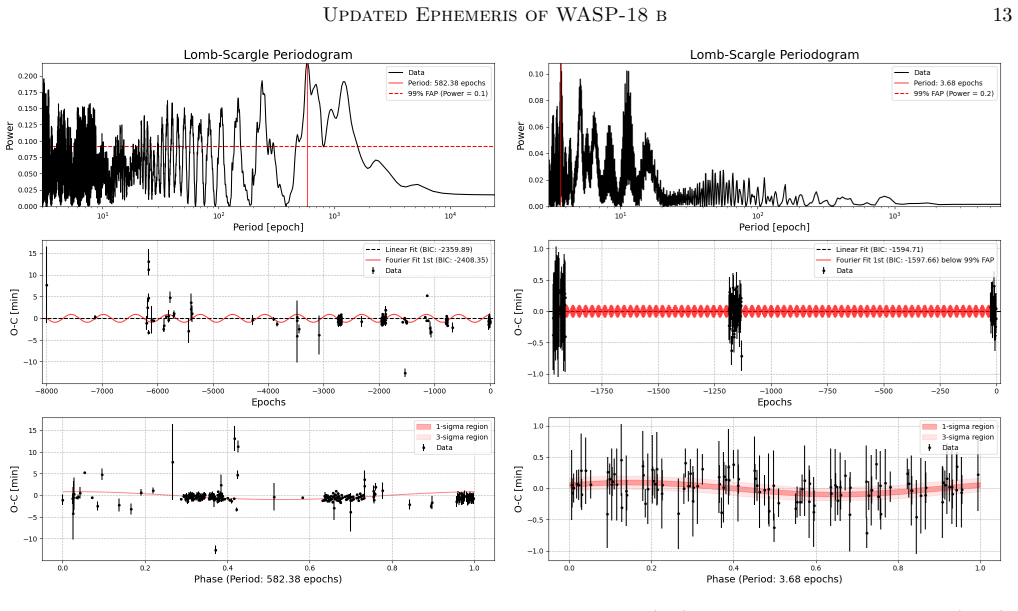
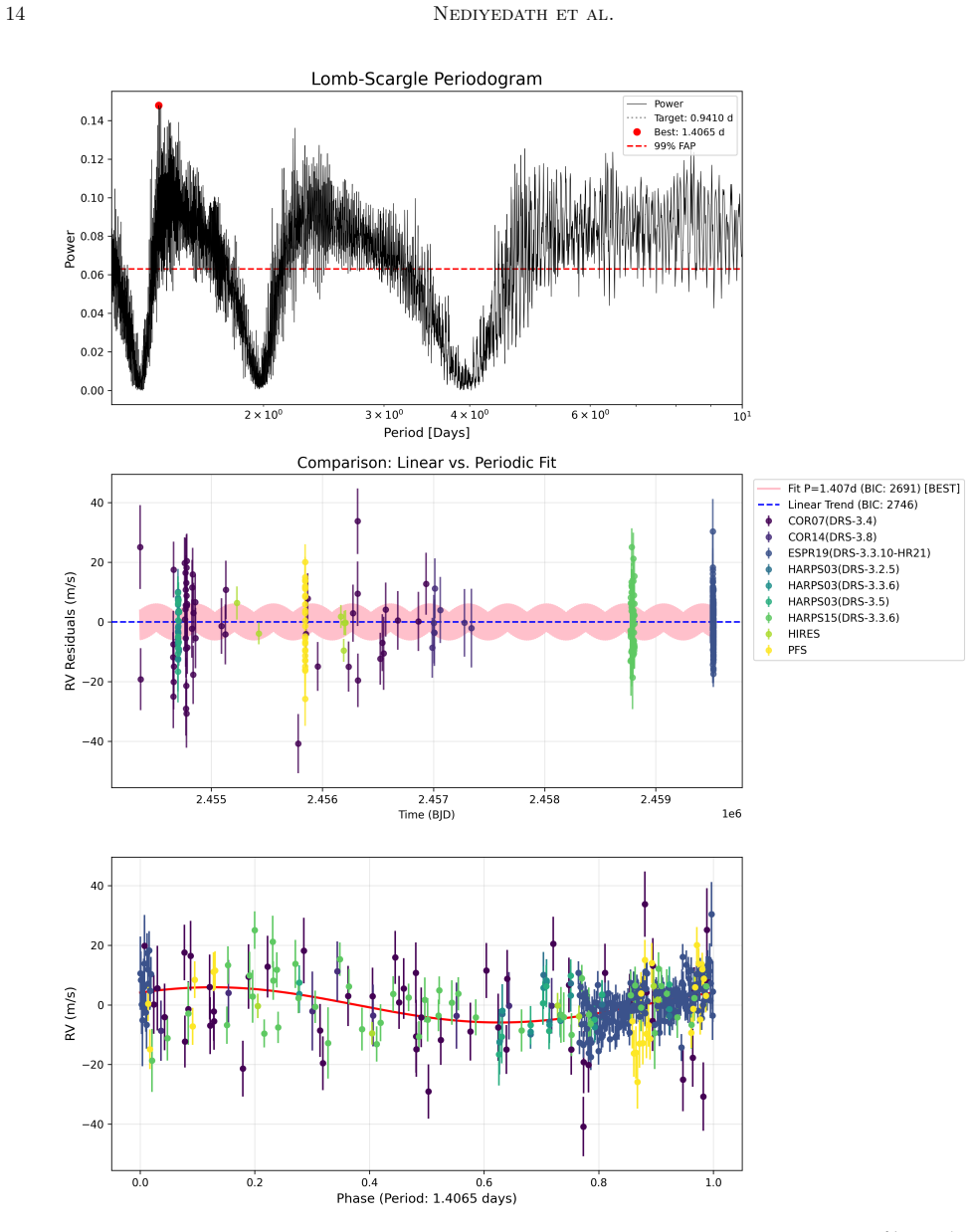
Using the combined transit and radial-velocity data sets, the authors derive a new linear ephemeris for WASP-18 b and find that the most significant periodicities identified in either data type fail to appear consistently in the other; they therefore conclude that the previously proposed companion WASP-18 c does not produce detectable, dynamically relevant signals and is likely spurious.
What carries the argument
A high-precision linear ephemeris fitted to 205 transits, cross-checked against periodic signals extracted from 449 radial-velocity points, with consistency between the two data types required before any second planet is accepted.
If this is right
- The updated ephemeris can be used to schedule observations through at least 2030 with sub-three-second timing uncertainty.
- Claims of additional planets in hot-Jupiter systems should be tested for consistency across independent transit-timing and radial-velocity data sets.
- The WASP-18 system is consistent with a single-planet architecture on the timescales probed by the current observations.
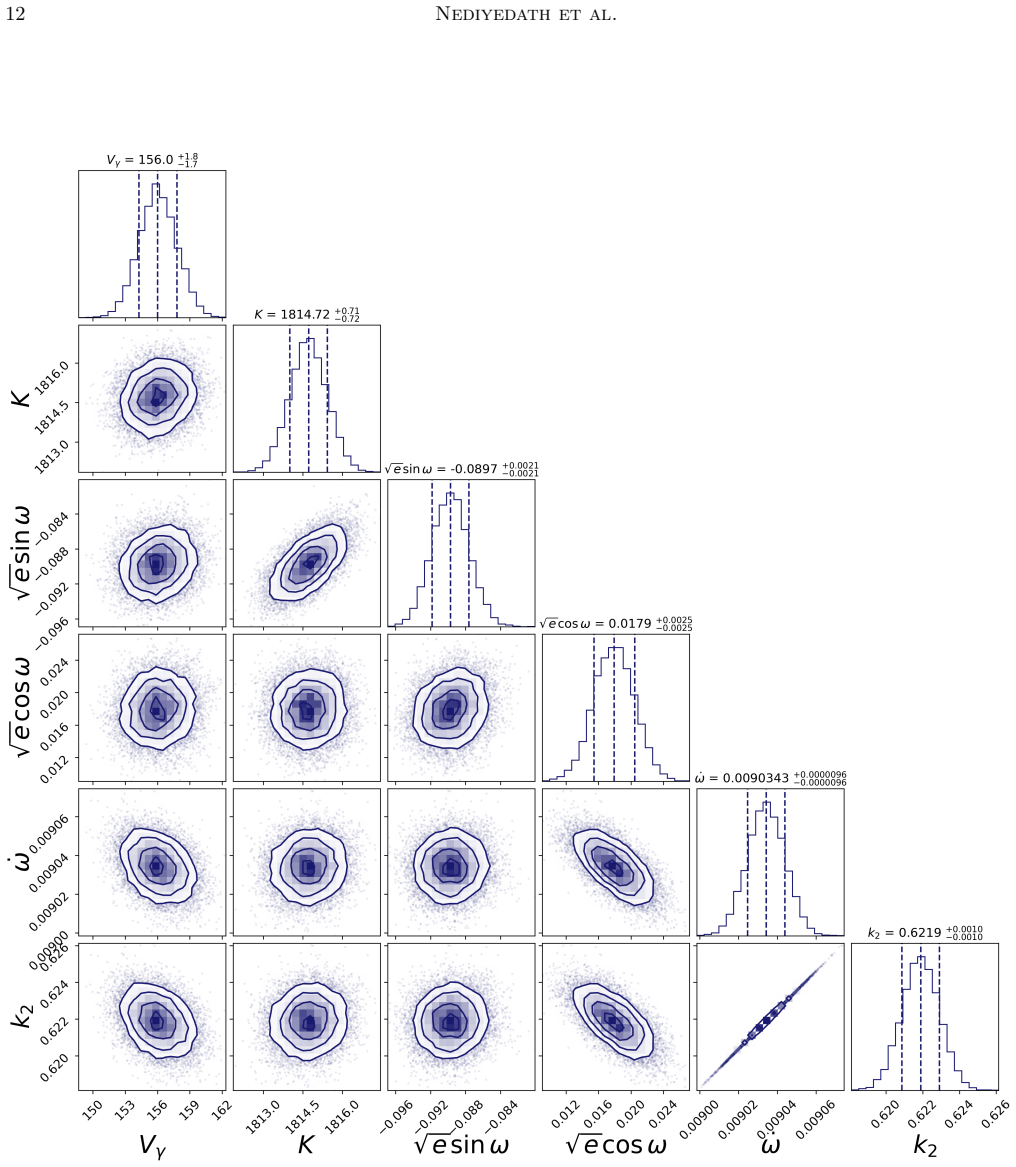
- The derived Love number k2 = 0.62199 +/- 0.0011 provides a constraint on the internal structure of WASP-18 b.
Where Pith is reading between the lines
- Similar single-method detections of additional companions around other hot Jupiters may also be spurious when subjected to multi-technique consistency tests.
- Future space-based photometry or high-precision radial-velocity campaigns can treat the published ephemeris as a reliable zero-point for searching smaller TTV signals.
- The absence of a second planet reduces the dynamical complexity that would otherwise need to be modeled when interpreting the planet's inflated radius or tidal evolution.
Load-bearing premise
That any real, dynamically relevant second planet would produce detectable and consistent periodic signals in both transit-timing and radial-velocity data when observations from multiple instruments are combined.
What would settle it
New transit-timing or radial-velocity observations that reveal the same periodicity in both data types at the period previously claimed for WASP-18 c.
Figures
read the original abstract
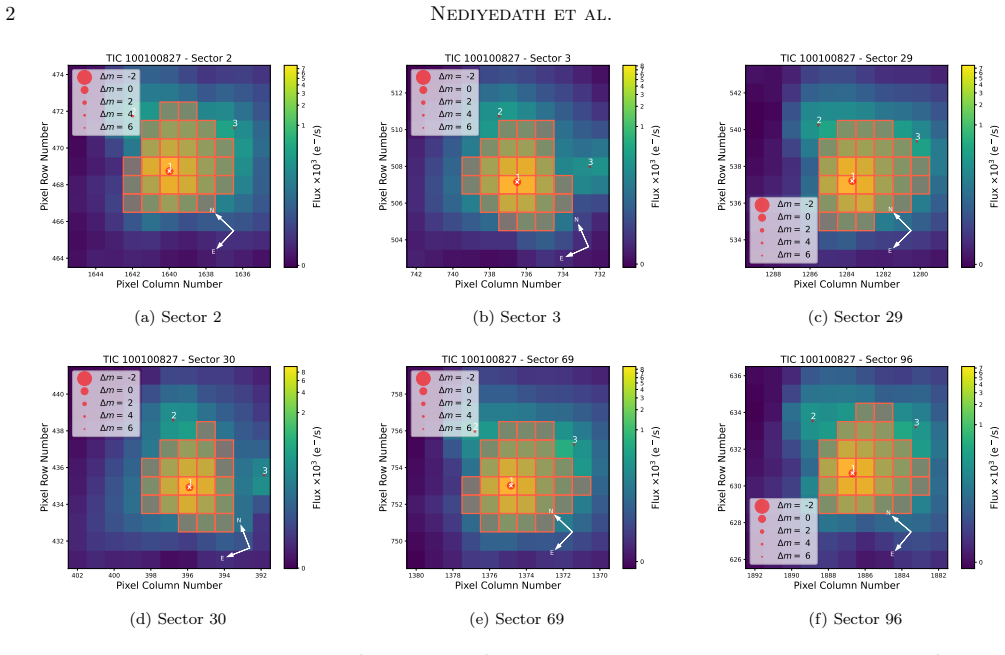
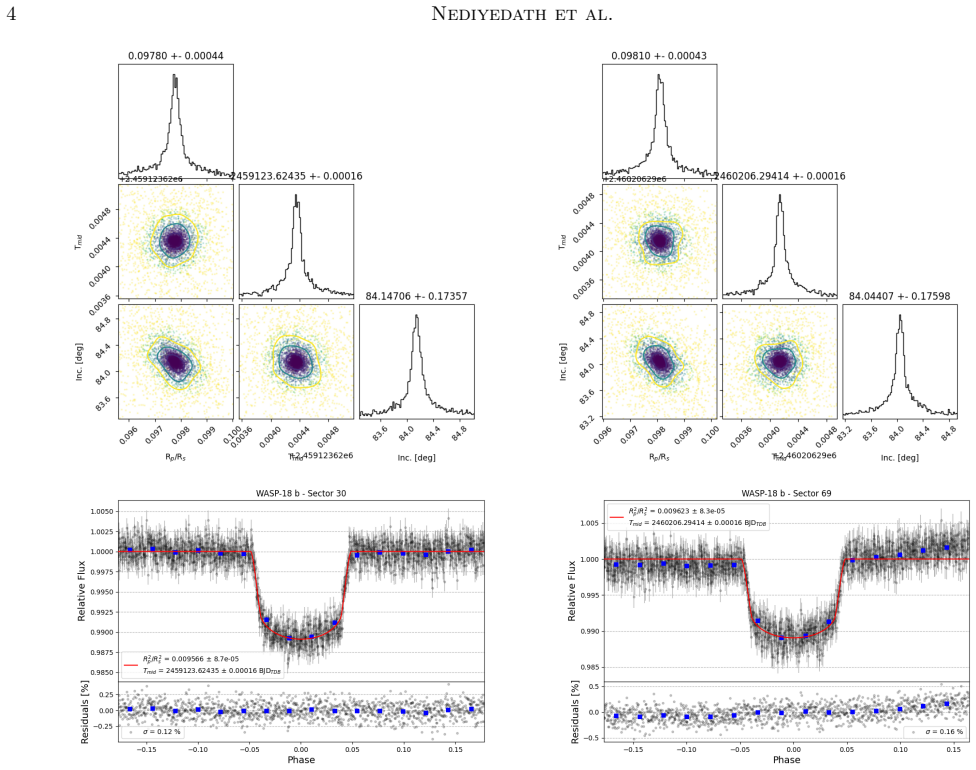
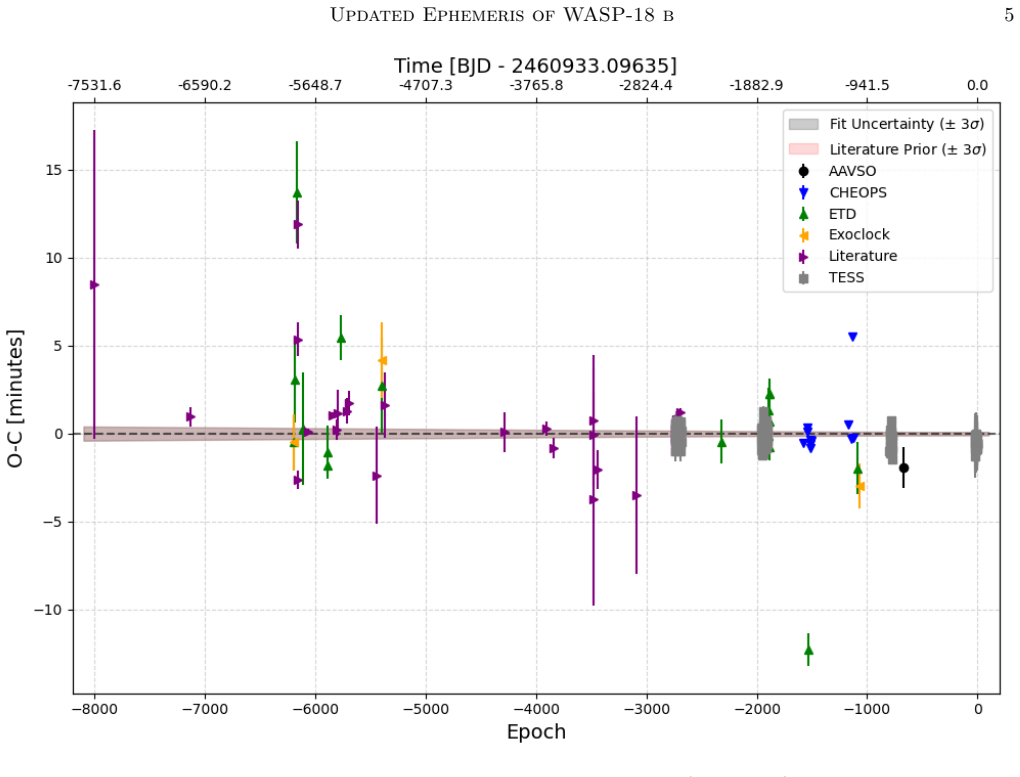
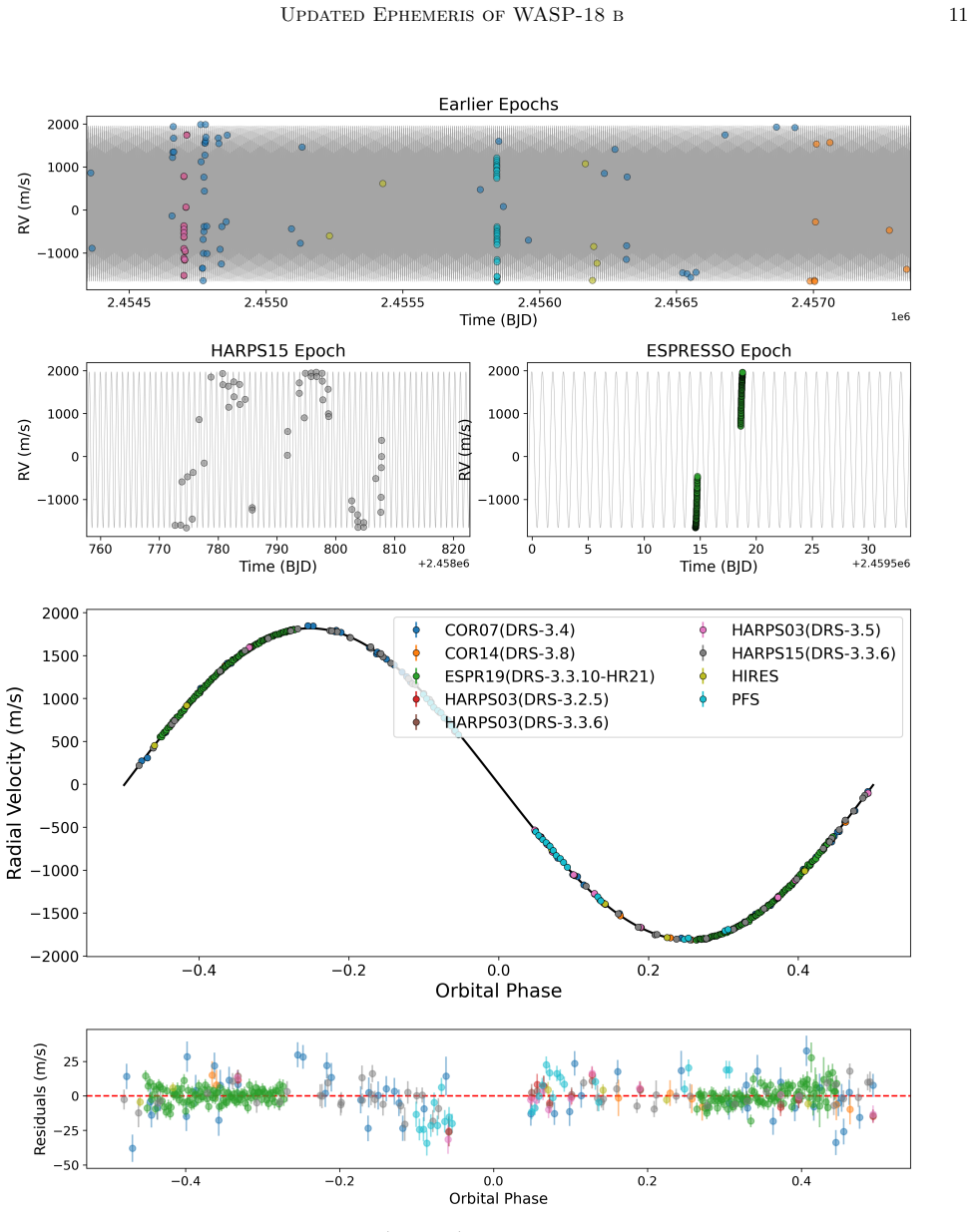
We present an updated transit ephemeris for the exoplanet WASP-18 b and critically examine the existence of a proposed second planet, WASP-18 c. Using 205 transit light curves from TESS, CHEOPS, Exoplanet Watch, Exoplanet Transit Database and previous literature, we derive a refined mid-transit time of 2460933.096346 +/- 0.000022 BJD_TDB and an orbital period of 0.94145252 +/- 1.1 x 10^-8 days for WASP-18 b. Our forward-propagated ephemeris to January 1, 2030, shows a timing uncertainty of 2.41 seconds. This high-precision refinement serves as a robust baseline to test for Transit Timing Variations (TTVs), ensuring that any reported deviations are not artifacts of an insufficiently constrained orbital period. In addition, we analyze 449 radial velocity (RV) measurements from the CORALIE, HARPS, PFS, HIRES and ESPRESSO spectrographs to search for signatures of WASP-18 c, a previously proposed additional planetary companion, and also estimated the k2 love number as 0.62199 +/- 0.0011. However, we do not find significant variations in either transit timing or RV data that support the presence of WASP-18 c. Moreover, the most significantly identified periodicities are not consistently measured across the transit or RV datasets, strongly arguing against the existence of a dynamically relevant second planet in the system. Our results indicate that the claimed WASP-18 c signal is likely spurious in nature. Overall, this work enhances our understanding of the WASP-18 system and provides a valuable resource for future observational campaigns with the refinement of the b planet orbit and falsified status of the previously defined c planet.
Editorial analysis
A structured set of objections, weighed in public.
Referee Report
Summary. The manuscript reports a refined ephemeris for WASP-18 b derived from 205 transit light curves compiled from TESS, CHEOPS, Exoplanet Watch, Exoplanet Transit Database, and literature sources, giving a mid-transit time of 2460933.096346 ± 0.000022 BJD_TDB and orbital period of 0.94145252 ± 1.1×10^{-8} days, with a propagated timing uncertainty of 2.41 s to 2030. It further analyzes 449 radial-velocity measurements from CORALIE, HARPS, PFS, HIRES, and ESPRESSO, estimates the Love number k2 = 0.62199 ± 0.0011, and concludes that no consistent periodic signals appear in either the transit-timing or RV datasets that would support the previously proposed companion WASP-18 c; the claimed signal is therefore judged spurious.
Significance. If the non-detection is robust, the work supplies a high-precision ephemeris that will be directly useful for scheduling future transit observations and for testing dynamical models of the WASP-18 system. The multi-instrument consistency check on periodicities adds a concrete falsification test for an additional planet and illustrates the value of combining large transit and RV archives when assessing candidate companions.
minor comments (3)
- The abstract states that periodicities were identified but does not specify the periodogram algorithm, normalization, or false-alarm-probability threshold used; a brief methods paragraph describing these choices would strengthen the non-detection claim.
- The quoted period uncertainty (1.1 x 10^-8) mixes decimal and scientific notation; adopt consistent scientific notation throughout the manuscript and tables.
- The forward-propagated ephemeris uncertainty of 2.41 s is quoted without stating whether it includes only the linear term or also higher-order contributions from period derivatives; a short derivation or reference to the propagation formula would clarify this.
Simulated Author's Rebuttal
We thank the referee for their positive assessment of our manuscript, including the recognition of the utility of the refined ephemeris and the value of the combined TTV and RV analysis in testing the WASP-18 c candidate. The recommendation for minor revision is noted. No specific major comments were raised in the report.
Circularity Check
No significant circularity identified
full rationale
The paper's derivation consists of standard least-squares fitting of an ephemeris to 205 external transit light curves from TESS, CHEOPS and other listed instruments, followed by a periodogram search on 449 RVs from five independent spectrographs. Neither the refined mid-transit time/period nor the non-detection of WASP-18 c reduces to any quantity defined by the authors' prior work; both are direct statistical outputs from the input observations. The k2 Love-number estimate is likewise a fitted parameter. No self-citations, ansatzes, or uniqueness theorems are invoked as load-bearing steps in the provided text, so the chain remains self-contained against external data.
Axiom & Free-Parameter Ledger
free parameters (3)
- mid-transit time =
2460933.096346 BJD_TDB
- orbital period =
0.94145252 days
- k2 love number =
0.62199
axioms (1)
- domain assumption Heterogeneous transit and RV datasets from different instruments can be jointly analyzed without dominant unmodeled systematics that would mask or mimic planetary signals.
Reference graph
Works this paper leans on
-
[1]
N., Johnson, J
Albrecht, S., Winn, J. N., Johnson, J. A., et al. 2012, The Astrophysical Journal, 757, 18
2012
-
[2]
Aller, A., Lillo-Box, J., Jones, D., Miranda, L. F., & Barcel´ o Forteza, S. 2020, A&A, 635, A128, doi: 10.1051/0004-6361/201937118 Astropy Collaboration, Robitaille, T. P., Tollerud, E. J., et al. 2013, A&A, 558, A33, doi: 10.1051/0004-6361/201322068 Astropy Collaboration, Price-Whelan, A. M., Sip˝ ocz, B. M., et al. 2018, AJ, 156, 123, doi: 10.3847/1538...
-
[3]
2009, Astronomy & Astrophysics, 506, 411
Auvergne, M., Bodin, P., Boisnard, L., et al. 2009, Astronomy & Astrophysics, 506, 411
2009
-
[4]
2004, Publications of the Astronomical Society of the Pacific, 116, 266
Bakos, G., Noyes, R., Kov´ acs, G., et al. 2004, Publications of the Astronomical Society of the Pacific, 116, 266
2004
-
[5]
Experimental Astronomy , keywords =
Benz, W., Broeg, C., Fortier, A., et al. 2021, Experimental Astronomy, 51, 109, doi: 10.1007/s10686-020-09679-4 Blaˇ zek, M., Kab´ ath, P., Piette, A. A. A., et al. 2022, MNRAS, 513, 3444, doi: 10.1093/mnras/stac992
-
[6]
Borucki, W. J. 2016, Reports on Progress in Physics, 79, 036901
2016
-
[7]
Borucki, W. J., Koch, D., Basri, G., et al. 2010, Science, 327, 977, doi: 10.1126/science.1185402
-
[8]
Bouma, L. G., Winn, J. N., Baxter, C., et al. 2019, AJ, 157, 217, doi: 10.3847/1538-3881/ab189f
-
[9]
Brogi, M., Emeka-Okafor, V., Line, M. R., et al. 2023, The Astronomical Journal, 165, 91, doi: 10.3847/1538-3881/acaf5c
-
[10]
2016, Astrophysics Source Code Library, ascl
Buchner, J. 2016, Astrophysics Source Code Library, ascl
2016
-
[11]
Changeat, Q., Edwards, B., Al-Refaie, A. F., et al. 2022, The Astrophysical Journal Supplement Series, 260, 3, doi: 10.3847/1538-4365/ac5cc2 Cort´ es-Zuleta, P., Rojo, P., Wang, S., et al. 2020, Astronomy & Astrophysics, 636, A98
-
[12]
2023, Nature, 620, 292
Coulombe, L.-P., Benneke, B., Challener, R., et al. 2023, Nature, 620, 292
2023
-
[13]
2019, Astronomy & Astrophysics, 623, A45
Csizmadia, S., Hellard, H., & Smith, A. 2019, Astronomy & Astrophysics, 623, A45
2019
-
[14]
Deline, A., Cubillos, P. E., Carone, L., et al. 2025, Dark skies of the slightly eccentric WASP-18 b from its optical-to-infrared dayside emission. https://arxiv.org/abs/2505.01544
arXiv 2025
-
[15]
2016, Astronomy & Astrophysics, 590, A134
Delisle, J.-B., S´ egransan, D., Buchschacher, N., & Alesina, F. 2016, Astronomy & Astrophysics, 590, A134
2016
-
[16]
Foreman-Mackey, D., Hogg, D. W., Lang, D., & Goodman, J. 2013, PASP, 125, 306, doi: 10.1086/670067 Gaia Collaboration, Vallenari, A., Brown, A. G. A., et al. 2023, A&A, 674, A1, doi: 10.1051/0004-6361/202243940
-
[17]
2019, in UV/Optical/IR Space Telescopes and Instruments: Innovative Technologies and Concepts
Warfield, K. 2019, in UV/Optical/IR Space Telescopes and Instruments: Innovative Technologies and Concepts
2019
-
[18]
S., Seager, S., Mennesson, B., et al
Gaudi, B. S., Seager, S., Mennesson, B., et al. 2020, arXiv preprint arXiv:2001.06683
arXiv 2020
-
[19]
M., Brasseur, C., et al
Ginsburg, A., Sip˝ ocz, B. M., Brasseur, C., et al. 2019, The Astronomical Journal, 157, 98
2019
-
[20]
R., Millman, K
Harris, C. R., Millman, K. J., Van Der Walt, S. J., et al. 2020, Nature, 585, 357
2020
-
[21]
C., et al
Hellier, C., Anderson, D., Cameron, A. C., et al. 2009, Nature, 460, 1098
2009
-
[22]
J., Mulders, G
Hippke, M., David, T. J., Mulders, G. D., & Heller, R. 2019, The Astronomical Journal, 158, 143
2019
-
[23]
2007, Matplotlib 0.90
Hunter, J., & Dale, D. 2007, Matplotlib 0.90. 0 user’s guide, 487
2007
-
[24]
M., Twicken, J
Jenkins, J. M., Twicken, J. D., McCauliff, S., et al. 2016, in Software and Cyberinfrastructure for Astronomy IV, Vol. 9913, SPIE, 1232–1251
2016
-
[25]
A., Fulton, B
Knutson, H. A., Fulton, B. J., Montet, B. T., et al. 2014, The Astrophysical Journal, 785, 126
2014
-
[26]
2023, The Astrophysical Journal Supplement Series, 265, 4
Kokori, A., Tsiaras, A., Edwards, B., et al. 2023, The Astrophysical Journal Supplement Series, 265, 4
2023
-
[27]
Lanza, A. F., & Breton, S. N. 2024, A&A, 687, A187, doi: 10.1051/0004-6361/202348279 Lightkurve Collaboration, Cardoso, J. V. d. M., Hedges, C., et al. 2018, Lightkurve: Kepler and TESS time series analysis in Python, Astrophysics Source Code Library. http://ascl.net/1812.013
-
[28]
Lomb, N. R. 1976, Astrophysics and space science, 39, 447
1976
-
[29]
2020, Acta Astronomica, 70, 1–18, doi: 10.32023/0001-5237/70.1.1
Maciejewski, G., Knutson, H., Howard, A., et al. 2020, Acta Astronomica, 70, 1–18, doi: 10.32023/0001-5237/70.1.1
-
[30]
2013, Monthly Notices of the Royal Astronomical Society, 428, 2645
Maxted, P., Anderson, D., Doyle, A., et al. 2013, Monthly Notices of the Royal Astronomical Society, 428, 2645
2013
-
[31]
S., Fowler, M
Nediyedath, A. S., Fowler, M. J., Norris, A., et al. 2023, Journal of the American Association of Variable Star Observers (JAAVSO), 51, 243
2023
-
[32]
Nymeyer, S., Harrington, J., Hardy, R. A., et al. 2011, The Astrophysical Journal, 742, 35, doi: 10.1088/0004-637X/742/1/35
-
[33]
Patra, K. C., Winn, J. N., Holman, M. J., et al. 2017, AJ, 154, 4, doi: 10.3847/1538-3881/aa6d75 —. 2020, AJ, 159, 150, doi: 10.3847/1538-3881/ab7374
-
[34]
Pearson, K. A. 2019, The Astronomical Journal, 158, 243
2019
-
[35]
A., Beichman, C., Fulton, B
Pearson, K. A., Beichman, C., Fulton, B. J., et al. 2022, The Astronomical Journal, 164, 178
2022
-
[36]
2000, in Optical and IR telescope instrumentation and detectors, Vol
Pepe, F., Mayor, M., Delabre, B., et al. 2000, in Optical and IR telescope instrumentation and detectors, Vol. 4008, SPIE, 582–592 Updated Ephemeris of W ASP-18 b17
2000
-
[37]
Pepe, F., Cristiani, S., Rebolo, R., et al. 2021, A&A, 645, A96, doi: 10.1051/0004-6361/202038306
-
[38]
A., Cristiani, S., Rebolo Lopez, R., et al
Pepe, F. A., Cristiani, S., Rebolo Lopez, R., et al. 2010, in Society of Photo-Optical Instrumentation Engineers (SPIE) Conference Series, Vol. 7735, Ground-based and Airborne Instrumentation for Astronomy III, ed. I. S
2010
-
[39]
McLean, S. K. Ramsay, & H. Takami, 77350F, doi: 10.1117/12.857122
-
[40]
Ca II H&K time series for the HARPS radial velocity database
Perdelwitz, V., Trifonov, T., Teklu, J. T., Sreenivas, K. R., & Tal-Or, L. 2024, A&A, 683, A125, doi: 10.1051/0004-6361/202348263
-
[41]
Pillitteri, I., Colombo, S., Micela, G., & Wolk, S. J. 2023, A&A, 673, A61, doi: 10.1051/0004-6361/202245467 Poddan` y, S., Br´ at, L., & Pejcha, O. 2010, New Astronomy, 15, 297
-
[42]
L., Skillen, I., Cameron, A
Pollacco, D. L., Skillen, I., Cameron, A. C., et al. 2006, Publications of the Astronomical Society of the Pacific, 118, 1407
2006
-
[43]
2001, The
Queloz, D., Mayor, M., Udry, S., et al. 2001, The
2001
-
[44]
Messenger, No. 105, p. 1-7 (September 2001), 105, 1
2001
-
[45]
R., Winn, J
Ricker, G. R., Winn, J. N., Vanderspek, R., et al. 2015, Journal of Astronomical Telescopes, Instruments, and Systems, 1, 014003 Ros´ ario, N. M., Barros, S. C. C., Demangeon, O. D. S., &
2015
-
[46]
Santos, N. C. 2022, A&A, 668, A114, doi: 10.1051/0004-6361/202244513
-
[47]
Scargle, J. D. 1982, Astrophysical Journal, Part 1, vol. 263, Dec. 15, 1982, p. 835-853., 263, 835
1982
-
[48]
X., et al
Shporer, A., Wong, I., Huang, C. X., et al. 2019, The Astronomical Journal, 157, 178
2019
-
[49]
C., Dominik, M., et al
Southworth, J., Hinse, T. C., Dominik, M., et al. 2009, The Astrophysical Journal, 707, 167
2009
-
[50]
G., Oelkers, R
Stassun, K. G., Oelkers, R. J., Pepper, J., et al. 2018, The Astronomical Journal, 156, 102
2018
-
[51]
2026, ApJS, 282, 37, doi: 10.3847/1538-4365/ae2a29 TESS Team
Sun, Q. 2026, ApJS, 282, 37, doi: 10.3847/1538-4365/ae2a29 TESS Team. 2021a, TESS Light Curves - All Sectors, STScI/MAST, doi: 10.17909/T9-NMC8-F686 —. 2021b, TESS Target Pixel Files - All Sectors, STScI/MAST, doi: 10.17909/T9-YK4W-ZC73
-
[52]
Triaud, A. H. M. J., Collier Cameron, A., Queloz, D., et al. 2010, A&A, 524, A25, doi: 10.1051/0004-6361/201014525
-
[53]
2016, Astrophysics Source Code Library, ascl
Tsiaras, A., Waldmann, I., Rocchetto, M., et al. 2016, Astrophysics Source Code Library, ascl
2016
-
[54]
E., et al
Virtanen, P., Gommers, R., Oliphant, T. E., et al. 2020, Nature methods, 17, 261
2020
-
[55]
Wilkins, A. N., Delrez, L., Barker, A. J., et al. 2017, The Astrophysical Journal Letters, 836, L24, doi: 10.3847/2041-8213/aa5d9f
-
[56]
2023, Astronomy & Astrophysics, 672, A107
Yan, F., Nortmann, L., Reiners, A., et al. 2023, Astronomy & Astrophysics, 672, A107
2023
-
[57]
Yee, S. W., Winn, J. N., Knutson, H. A., et al. 2020, ApJL, 888, L5, doi: 10.3847/2041-8213/ab5c16
-
[58]
T., Pearson, K
Zellem, R. T., Pearson, K. A., Blaser, E., et al. 2020, Publications of the Astronomical Society of the Pacific, 132, 054401
2020
discussion (0)
Sign in with ORCID, Apple, or X to comment. Anyone can read and Pith papers without signing in.