REVIEW 4 major objections 5 minor 51 references
Medalyze: Lightweight Medical Report Summarization Application Using FLAN-T5-Large
T0 review · 4 major / 5 minor · reviewed 2026-08-15 · deepseek-v4-flash
Pith's one-line read Medalyze claims that a 780M-parameter fine-tuned FLAN-T5-Large summarizes structured medical passages more faithfully than GPT-4, and ships that capability as a locally deployable web and mobile app.
desk verdict The M-Passage claim of beating GPT-4 likely rests on a test set drawn from the training pool; without a properly held-out split, the paper's central result is not established. read the letter →
The pith
A machine-rendered reading of the paper's core claim, the machinery that carries it, and where it could break.
The reading
What carries the argument
The named central object is FLAN-T5-Large, a roughly 780-million-parameter text-to-text transformer with a 512-token context window, chosen because its sequence-to-sequence design fits summarization. Its fine-tuned variants, M-Passage, M-Conversation, and M-Question, are the actual engines of the system. The argument is carried by the fine-tuning step: exposure to medical passages teaches the model to compress technical text while retaining key terms and meaning, which the paper calls the reason for the high semantic-overlap scores. The evaluation machinery is the four-metric battery of BLEU, ROUGE-L, BERTScore, and SpaCy similarity, each measuring a different level of overlap with human-written reference summaries.
What would settle it
Inspect the deployed pipeline's tokenized input lengths on the reported test samples: if any long M-Conversation input is truncated to 512 tokens before generation while GPT-4 received the full conversation, the comparison is not on equal terms. A second check is to hash the training and test inputs to detect overlap between fine-tuning and evaluation samples.
Extended reading notes
Core claim
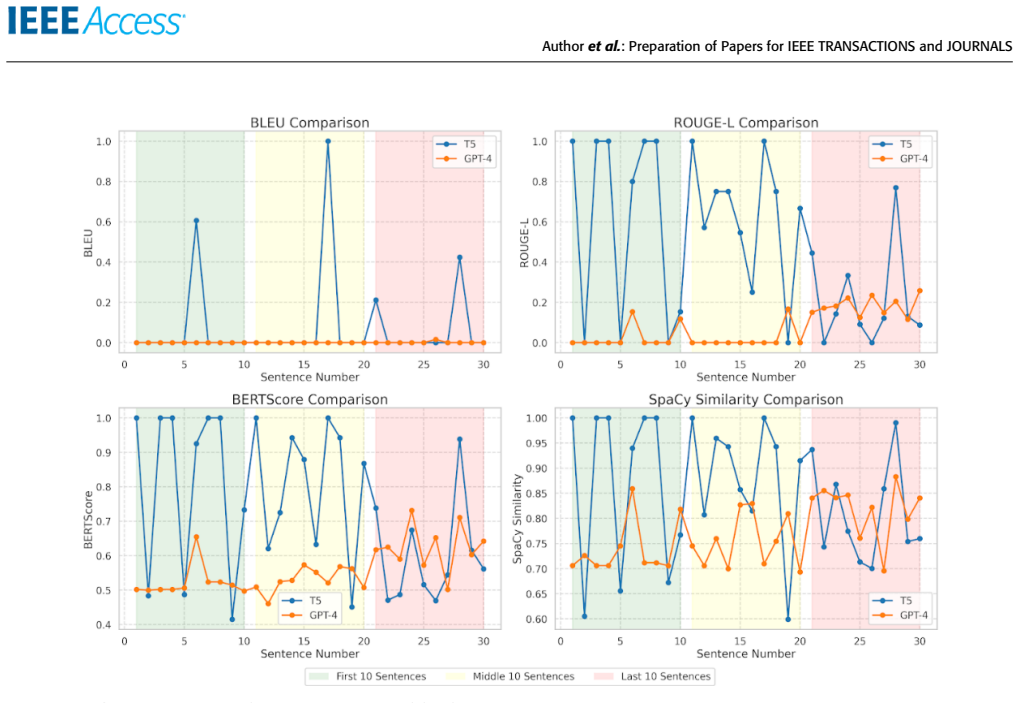
The discovery, stated on the paper's terms, is that a 780-million-parameter FLAN-T5-Large model fine-tuned on medical passages can outperform GPT-4 in summarizing structured medical reports. On the M-Passage task it reaches BLEU 0.0982 versus 0.0032, ROUGE-L 0.3728 versus 0.0644, BERTScore 0.6533 versus 0.5453, and SpaCy similarity 0.8413 versus 0.7810. The paper interprets these gaps as evidence that domain specialization plus a sequence-to-sequence architecture can beat scale for this class of task. For the two auxiliary tasks the comparison is not uniformly favorable: GPT-4 scores higher on question extraction and on BERTScore for conversations, while the fine-tuned model keeps a slight edge on lexical and SpaCy measures there.
Load-bearing premise
The central comparison assumes that the fine-tuned models saw the same complete input text GPT-4 saw and that the test samples were not part of fine-tuning, since the paper does not describe how FLAN-T5-Large's 512-token input limit was handled for conversations up to 3,050 words.
Editorial extensions
If this is right
- If the M-Passage result is correct, structured medical reports can be summarized by a 780M-parameter local model with closer alignment to human references than a frontier general-purpose model.
- Because Medalyze runs locally and stores summaries in its own database, patient text does not have to be sent to an external cloud service, which supports privacy-preserving use in healthcare.
- The same fine-tuning recipe produces working models for extracting health issues from dialogues and identifying the main question in a passage, with task-specific trade-offs the paper reports.
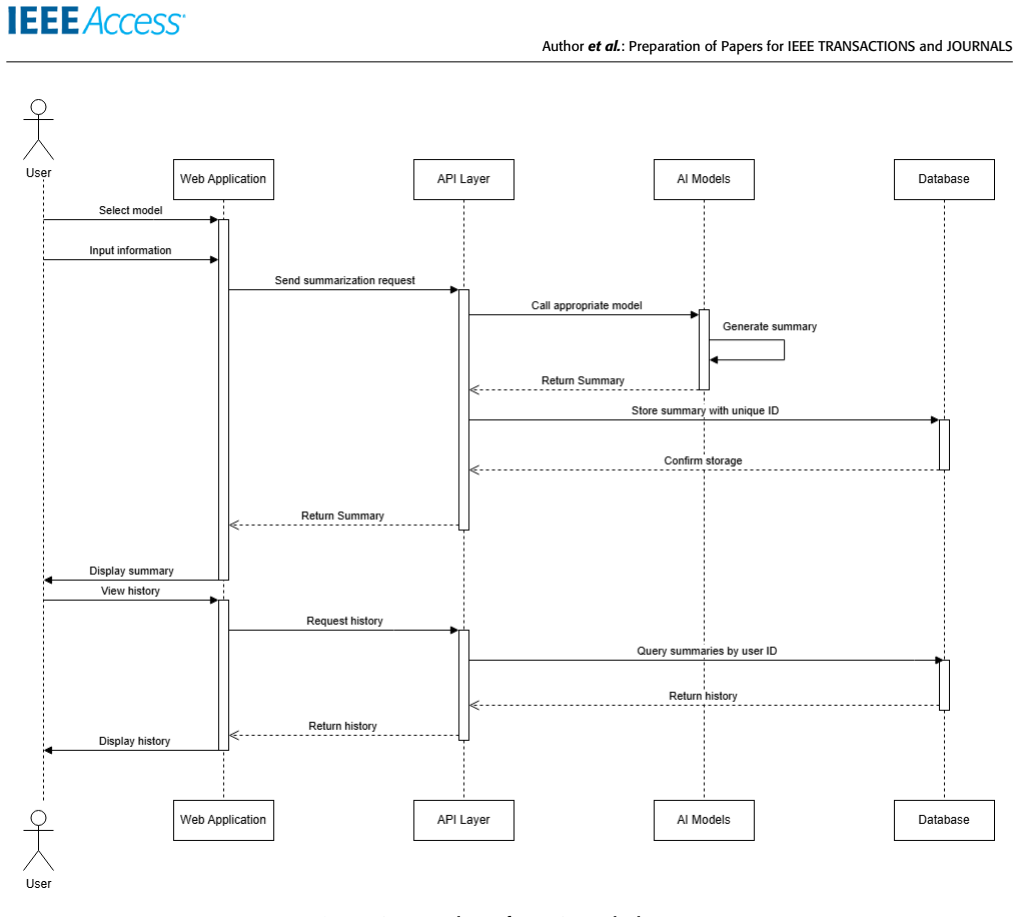
- The deployment architecture, with API endpoints, web and mobile front ends, and a single-node database, makes real-time summarization available to non-specialist users.
- Medalyze is explicitly a comprehension aid rather than a diagnostic tool, so its summaries are positioned as support for clinical decisions, not as medical advice.
Reading between the lines
- The clearest reading of the results is a division of labor: small domain-tuned models may be preferable for formal, terminology-dense texts, while larger autoregressive models remain stronger at extracting and rewording open-ended questions; a hybrid system could route each input type to the better model.
- A necessary engineering step the paper leaves implicit is handling FLAN-T5-Large's 512-token limit for long conversations; testing chunk-and-summarize or hierarchical pipelines would show whether M-Conversation's scores hold on full dialogues.
- Because all four metrics reward overlap with reference text rather than clinical factuality, an expert review of generated summaries for factual errors and hallucinated findings would be a stronger test than any of the reported scores.
- Fine-tuning on each institution's own report templates is a plausible cheap improvement: domain-tuned summarization should track the format and terminology of the texts it will actually receive.
Signed reviews
Editorial analysis
A structured set of objections, weighed in public.
Referee Report
Summary. The paper describes Medalyze, an application built around three fine-tuned FLAN-T5-Large models for (1) summarizing structured medical passages, (2) extracting health issues from patient-doctor conversations, and (3) identifying the central question in a medical text. The authors also present a web/mobile platform with a Flask API and YugabyteDB storage, and they compare their models against GPT-4 on BLEU, ROUGE-L, BERTScore, and SpaCy Similarity. The abstract claims superior performance over GPT-4 in domain-specific tasks, citing the experimental evaluation.
Significance. If validated, the headline result—that a 780M-parameter fine-tuned model beats GPT-4 on domain-specific medical summarization—would be practically significant for lightweight, privacy-preserving deployment. The paper also demonstrates a full application pipeline, which is a useful engineering contribution. The authors should be credited for using an external benchmark (the Stanford dataset [38]) and a strong baseline (GPT-4), and for releasing no code or split, which limits reproducibility. However, the central comparative claim is not supported by the evidence as presented: the evaluation appears to use test items derived from the training pool, the abstract overstates results that the paper's own tables contradict, and the handling of long conversations beyond the model's context window is unexplained. These issues are load-bearing for the paper's main contribution.
major comments (4)
- [Section IX-B, Table 7] The paper states that 'the test dataset is derived from the original training dataset' (Section IX-B), and Section V describes the Stanford resource as 'the dataset used for training the models.' This implies the M-Passage test items in Table 7 come from the same pool used for fine-tuning. If so, the reported BLEU 0.0982, ROUGE-L 0.3728, BERTScore 0.6533, and SpaCy 0.8413 could reflect memorization rather than generalization, invalidating the comparison with GPT-4. The authors must specify an explicit train/test split (e.g., disjoint subsets of the Stanford data), report the number of test samples, and ideally release the split or code. Without a held-out test set, the central claim of superiority over GPT-4 is not established.
- [Abstract, Section IX-C] The abstract claims 'superior summarization performance over GPT-4 in domain-specific tasks,' but Tables 8 and 9 show GPT-4 outperforming M-Question on all metrics (e.g., BLEU 0.0911 vs. 0.0084, ROUGE-L 0.2564 vs. 0.1938, BERTScore 0.6524 vs. 0.5552) and M-Conversation on BERTScore (0.5428 vs. 0.4707). The paper itself acknowledges in Section IX-C-3 that 'GPT-4 performance is superior across all metrics' for M-Question. The abstract therefore overstates the findings; the data support superiority only on the M-Passage task, and even that is contingent on the unresolved train/test overlap issue. The abstract must be revised to reflect the evidence.
- [Section VII-B-2, Section IX-C-4, Table 5] The M-Conversation model is evaluated on long inputs of 2992 to 3050 words (Section VII-B-2), while Table 5 lists FLAN-T5-Large's context window as 512 tokens. The paper never describes how such long inputs are handled: whether they are truncated, chunked, or processed with a sliding window. If inputs are truncated, the model sees only a prefix of the conversation, so its outputs cannot be meaningfully compared with GPT-4's full-context outputs; if they are not truncated, the model cannot process them at all given its context limit. The authors must report the exact input processing procedure and discuss its effect on the conversational summarization results.
- [Section VII-B, Section IX-B] The evaluation reports average scores over the test samples with no error bars, confidence intervals, significance tests, or even the number of samples per task. The per-sample figures (Figs. 7–9) show considerable fluctuation, yet no statistical analysis is provided. For the headline M-Passage comparison, at minimum the authors should report the test set size, the variance across samples, and bootstrap confidence intervals for each metric, so the reader can assess whether the reported differences are actually robust.
minor comments (5)
- [Section VI] The subsection heading 'Fine-turning process' contains a typo; it should be 'Fine-tuning process'.
- [Section VII] The metric descriptions use 'the original text' ambiguously; the comparisons are against the human-written reference summary, not the original input text.
- [Table 6] The BLEU score for the GPT-4 Conversation row is reported as 0.0000; clarify whether this is exactly zero or rounded from a small nonzero value.
- [Section VI] The phrase 'due to it's lightweight' uses 'it's' incorrectly; it should be 'its'.
- [References] References [40] and [43] appear to be the same paper (Van Veen et al.); duplicate entries should be consolidated.
Circularity Check
No circularity: the headline comparison is an external benchmark evaluation against GPT-4, with no fitted-input-as-prediction or load-bearing self-citation; the possible train/test overlap is a validity concern, not a circularity.
full rationale
Medalyze's claimed superiority over GPT-4 rests on Table 7, which compares BLEU, ROUGE-L, BERTScore, and SpaCy similarity of a fine-tuned FLAN-T5-Large against GPT-4 using the Stanford clinical summarization benchmark [38]. The fine-tuned model is trained on the benchmark dataset, but the reported scores are computed from generated outputs and human-written reference summaries using standard external metrics; no equation in the paper is fitted to those scores, and no parameter is defined in terms of the result it is used to predict. The selection of FLAN-T5-Large is motivated by an external study [38], not by a self-citation chain, and no uniqueness theorem or prior work by the same authors is invoked to force the design. The one visible concern is that Section IX-B says 'the test dataset is derived from the original training dataset' without documenting a disjoint held-out split; if that means the same examples were used in fine-tuning, the comparison would be weakened as evidence of generalization. That is a data-leakage or validity issue, however, not circular reasoning: the scores are not forced by construction, and the GPT-4 baseline is independent of Medalyze's fitted parameters. Therefore no circular step is identified.
Assumptions & free parameters
free parameters (4)
- learning_rate =
1e-5
- batch_size =
2
- gradient_accumulation_steps =
2
- weight_decay =
0.01
assumptions (4)
- domain assumption The Stanford [38] dataset's human-written targets are valid medical ground truth.
- domain assumption The test subset used for evaluation is held out from fine-tuning.
- ad hoc to paper FLAN-T5-Large receives the full input despite a 512-token context.
- domain assumption Automatic NLG metrics are adequate proxies for medical summary quality.
Cite this review
Pith. "Pith review of Medalyze: Lightweight Medical Report Summarization Application Using FLAN-T5-Large." pith.science (2026). https://pith.science/paper/LPYH5HUU
@misc{pith2026250517059,
  author       = {Pith},
  title        = {Pith review of: Medalyze: Lightweight Medical Report Summarization Application Using FLAN-T5-Large},
  year         = {2026},
  howpublished = {\url{https://pith.science/paper/LPYH5HUU}},
  note         = {Machine review of arXiv:2505.17059}
}
read the original abstract
Understanding medical texts presents significant challenges due to complex terminology and context-specific language. This paper introduces Medalyze, an AI-powered application designed to enhance the comprehension of medical texts using three specialized FLAN-T5-Large models. These models are fine-tuned for (1) summarizing medical reports, (2) extracting health issues from patient-doctor conversations, and (3) identifying the key question in a passage. Medalyze is deployed across a web and mobile platform with real-time inference, leveraging scalable API and YugabyteDB. Experimental evaluations demonstrate the system's superior summarization performance over GPT-4 in domain-specific tasks, based on metrics like BLEU, ROUGE-L, BERTScore, and SpaCy Similarity. Medalyze provides a practical, privacy-preserving, and lightweight solution for improving information accessibility in healthcare.
Figures


Figures from the paper (5 more)




Reference graph
Works this paper leans on
-
[38]
Aali, Aet al.,‘‘A dataset and benchmark for hospital course summarization with adapted large language models,’’Journal of the American Medical Informatics Association., vol. 32, pp. 470–479, 2025
work page 2025
-
[1]
R. Roushan, H. Mishra, L. Y adav, S. Koppula, N. Tiwari and K. S. Nataraj, ‘‘Optimizing Speech Recognition for Medical Transcription: Fine-Tuning Whisper and Developing a Web Application,’’ in2024 IEEE Conference on Engineering Informatics (ICEI) ,Melbourne, Australia, 2024, pp. 1-6
work page 2024
-
[2]
N. M. Ali, M. Shaheen, M. S. Mabrouk and M. A. Aborizka, ‘‘A Novel Ap- proach of Transcriptomic microRNA Analysis Using Text Mining Meth- ods: An Early Detection of Multiple Sclerosis Disease,’’IEEE Access, vol. 9, pp. 120024-120033, 2021, doi: 10.1109/ACCESS.2021.3109069
arXiv 2021
-
[3]
E. H. Houssein, R. E. Mohamed and A. A. Ali, ‘‘Machine Learning Tech- niques for Biomedical Natural Language Processing: A Comprehensive Review,’’IEEE Access, vol. 9, pp. 140628-140653, 2021, doi: 10.1109/AC- CESS.2021.3119621
arXiv 2021
-
[4]
P . Guleria, ‘‘NLP-based clinical text classification and sentiment analyses of complex medical transcripts using transformer model and machine learning classifiers,’’Neural Computing and Applications., vol. 37, pp. 341–366, 2025
work page 2025
-
[5]
Fareezet al.,‘‘A dataset of simulated patient-physician medical interviews with a focus on respiratory cases,’’Scientific Data., vol. 9, pp. 313, 2022
work page 2022
-
[6]
Loredana Caruccio, Stefano Cirillo, Giuseppe Polese, Giandomenico Soli- mando, Shanmugam Sundaramurthy, Genoveffa Tortora, ‘‘Can ChatGPT provide intelligent diagnoses? A comparative study between predictive models and ChatGPT to define a new medical diagnostic bot,’’Neural Computing and Applications., vol. 235, pp. 121186, 2024
work page 2024
-
[7]
Y anjun Gaoet al.,‘‘DR.BENCH: Diagnostic Reasoning Benchmark for Clinical Natural Language Processing,’’Journal of Biomedical Informatics ., vol. 138, pp. 104286, 2023
work page 2023
Show all 51 references
-
[8]
William Rojas-Carabaliet al.,‘‘Natural Language Processing in medicine and ophthalmology: A review for the 21st-century clinician,’’Asia-Pacific Journal of Ophthalmology., vol. 13, pp. 100084, 2024
2024
-
[9]
Erberk Uslu, E
E. Erberk Uslu, E. Sezer and Z. Anil Guven,, ‘‘NLP-Powered Healthcare Insights: A Comparative Analysis for Multi-Labeling Classification With MIMIC-CXR Dataset,’’IEEE Access., vol. 12, pp. 67314-67324, 2024
2024
-
[10]
Azade Tabaieet al.,‘‘Evaluation of a natural language processing approach to identify diagnostic errors and analysis of safety learning system case review data: retrospective cohort study,’’Journal of Medical Internet Re- search., vol. 26, pp. e50935, 2024
2024
-
[11]
Roushan, H
R. Roushan, H. Mishra, L. Y adav, S. Koppula, N. Tiwari and K. S. Nataraj, ‘‘Automation of the Analysis of Medical Interviews to Improve Diagnoses Using NLP for Medicine,’’ inAsian Conference on Intelligent Information and Database Systems ,Singapore, 2024, pp. 120-131
2024
-
[12]
J.et al.,‘‘Identification of clinical disease trajectories in neurodegenerative disorders with natural language processing,’’Nature medicine., vol
Mekkes, N. J.et al.,‘‘Identification of clinical disease trajectories in neurodegenerative disorders with natural language processing,’’Nature medicine., vol. 30, pp. 1143–1153, 2024
2024
-
[13]
Wang, Zet al.,‘‘Enhancing diagnostic accuracy and efficiency with GPT-4-generated structured reports: a comprehensive study,’’Journal of Medical and Biological Engineering., vol. 44, pp. 144–153, 2024
2024
-
[14]
P . M. Mah, ‘‘Investigating Remote Healthcare Accessibility with AI: Deep Learning and NLP-Based Knowledge Graph for Digitalized Diagnostics,’’ inProceedings of the AAAI Symposium Seriesvol. 4, pp. 284–292, 2024
2024
-
[15]
Song, JinTao and Huang, JunJie and Liu, RuiLi, ‘‘Integrating NLP and LLMs to discover biomarkers and mechanisms in Alzheimer’s disease,’’ SLAS technology., vol. 31, pp. 100257, 2025
2025
-
[16]
A. A. Abdullah, M. M. Hassan and Y . T. Mustafa, ‘‘A Review on Bayesian Deep Learning in Healthcare: Applications and Challenges,’’IEEE Ac- cess,., vol. 10, pp. 36538-36562, 2022
2022
-
[17]
Ahmed, R
A. Ahmed, R. Xi, M. Hou, S. A. Shah and S. Hameed, ‘‘Harnessing Big Data Analytics for Healthcare: A Comprehensive Review of Frameworks, Implications, Applications, and Impacts,’’IEEE Access,., vol. 11, pp. 112891-112928, 2023
2023
-
[18]
S. Sai, A. Gaur, R. Sai, V . Chamola, M. Guizani and J. J. P . C. Rodrigues, ‘‘Generative AI for Transformative Healthcare: A Comprehensive Study of Emerging Models, Applications, Case Studies, and Limitations,’’IEEE Access,., vol. 12, pp. 31078-31106, 2024
2024
-
[19]
P . Bose, S. Roy and P . Ghosh, ‘‘A Comparative NLP-Based Study on the Current Trends and Future Directions in COVID-19 Research,’’IEEE Access,., vol. 9, pp. 78341-78355, 2021
2021
-
[20]
D. K. Murala, S. K. Panda and S. P . Dash, ‘‘MedMetaverse: Medical Care of Chronic Disease Patients and Managing Data Using Artificial Intelligence, Blockchain, and Wearable Devices State-of-the-Art Methodology,’’IEEE Access,., vol. 11, pp. 138954-138985, 2023
2023
-
[21]
Koubaa, W
A. Koubaa, W. Boulila, L. Ghouti, A. Alzahem and S. Latif, ‘‘Exploring ChatGPT Capabilities and Limitations: A Survey,’’IEEE Access,., vol. 11, pp. 118698-118721, 2023
2023
-
[22]
Ullah, S
H. Ullah, S. Manickam, M. Obaidat, S. U. A. Laghari and M. Uddin, ‘‘Exploring the Potential of Metaverse Technology in Healthcare: Applica- tions, Challenges, and Future Directions,’’IEEE Access., vol. 9, pp. 69686- 69707, 2023
2023
-
[23]
Schopow, Nikolas and Osterhoff, Georg and Baur, David, ‘‘Applications of the Natural Language Processing Tool ChatGPT in Clinical Practice: Comparative Study and Augmented Systematic Review,’’JMIR Medical Informatics., vol. 11, pp. e48933, 2023
2023
-
[24]
Lee, V Vienet al.,‘‘Harnessing ChatGPT for thematic analysis: Are we ready?,’’Journal of Medical Internet Research., vol. 26, pp. e54974, 2024
2024
-
[25]
2022–12, 2022
Gilson, Aet al.,‘‘How does ChatGPT perform on the medical licensing exams? The implications of large language models for medical education and knowledge assessment,’’MedRxiv., pp. 2022–12, 2022
2022
-
[26]
Kim, H. W.et al.,‘‘Assessing the performance of ChatGPT’s responses to questions related to epilepsy: a cross-sectional study on natural language processing and medical information retrieval,’’Seizure: European Journal of Epilepsy., vol. 114, pp. 1–8, 2024
2024
-
[27]
Jin, Het al.,‘‘Comparative study of Claude 3.5-Sonnet and human physicians in generating discharge summaries for patients with renal in- sufficiency: assessment of efficiency, accuracy, and quality.,’’Frontiers in Digital Health., vol. 6, pp. 1456911, 2024
2024
-
[28]
Schmidl, Bet al.,‘‘Assessing the use of the novel tool Claude 3 in comparison to ChatGPT 4.0 as an artificial intelligence tool in the diagnosis VOLUME 11, 2023 15 Authoret al.: Preparation of Papers for IEEE TRANSACTIONS and JOURNALS and therapy of primary head and neck cance...
2023
-
[29]
16, 2024
Gupta, Ret al.,‘‘Comparative evaluation of AI models such as ChatGPT 3.5, ChatGPT 4.0, and Google Gemini in neuroradiology diagnostics,’’ Cureus., vol. 16, 2024
2024
-
[30]
21–46, 2024
Pal, Ankit and Sankarasubbu, Malaikannan, ‘‘Gemini goes to med school: exploring the capabilities of multimodal large language models on medical challenge problems & hallucinations,’’Proceedings of the 6th Clinical Natural Language Processing Workshop., pp. 21–46, 2024
2024
-
[31]
Chen, Kun and Xu, Wengui and Li, Xiaofeng ‘‘The potential of Gemini and GPTs for structured report generation based on free-text 18F-FDG PET/CT breast cancer reports,’’Academic Radiology., vol. 32, pp. 624–633, 2025
2025
-
[32]
Het al.,‘‘Comparative analysis of ChatGPT and Gemini (Bard) in medical inquiry: a scoping review,’’Frontiers in Digital Health., vol
Fattah, F. Het al.,‘‘Comparative analysis of ChatGPT and Gemini (Bard) in medical inquiry: a scoping review,’’Frontiers in Digital Health., vol. 7, pp. 1482712, 2025
2025
-
[33]
jfaf034, 2025
Srivastava, Ret al.,‘‘MedPromptExtract (Medical Data Extraction Tool): Anonymization and High-Fidelity Automated Data Extraction Using Natu- ral Language Processing and Prompt Engineering,’’The Journal of Applied Laboratory Medicine., pp. jfaf034, 2025
2025
-
[34]
Wang, Xet al.,‘‘Evaluation of the Performance of Three Large Language Models in Clinical Decision Support: A Comparative Study Based on Actual Cases,’’Journal of Medical Systems., vol. 49, pp. 23, 2025
2025
-
[35]
Ramchandani, Ret al.,‘‘Comparison of ChatGPT-4, Copilot, Bard and Gemini Ultra on an Otolaryngology Question Bank,’’Clinical Otolaryn- gology., 2025
2025
-
[36]
Alsentzer, Eet al.,‘‘Zero-shot interpretable phenotyping of postpartum hemorrhage using large language models,’’NPJ digital medicine., vol. 6, pp. 212, 2023
2023
-
[37]
Fuet al.,‘‘ACER: Clinical concept Annotations for Cancer Events and Relations,’’Journal of the American Medical Informatics Association., vol. 31, pp. 2583–2594, 2024
2024
-
[39]
Y uanet al.,‘‘A continued pretrained llm approach for automatic medical note generation,’’arXiv preprint arXiv:2403.09057, 2024
2024 arXiv
-
[40]
V an V eenet al.,‘‘Adapted large language models can outperform medical experts in clinical text summarization,’’Nature medicine, vol. 30, no. 4, pp. 1134–1142, 2024
2024
-
[41]
Tariq, Aet al.,‘‘Patient centric summarization of radiology findings using large language models,’’medRxiv, 2024
2024
-
[42]
Goodman, Katherine E and Paul, H Yi and Morgan, Daniel J, ‘‘AI- generated clinical summaries require more than accuracy,’’JAMA, vol. 331, no. 8, pp. 637–638, 2024
2024
-
[43]
V an V eenet al., ‘‘Adapted large language models can outperform medical experts in clinical text summarization,’’Nature medicine, vol. 30, no. 4, pp. 1134–1142, Sep. 2024
2024
-
[44]
Irfan, Azmul Asmar and Khatim, Nur Ahmad and Arief, Mansur M, ‘‘Using LLM for Real-Time Transcription and Summarization of Doctor-Patient Interactions into ePuskesmas in Indonesia,’’arXiv preprint arXiv:2409.17054, 2024
2024 arXiv
-
[45]
Tariq, Aet al.,‘‘Patient-centric Summarization of Radiology Findings using Two-step Training of Large Language Models,’’ACM Transactions on Computing for Healthcare, 2024
2024
-
[46]
Zhanget al.,"Closing the gap between open source and commercial large language models for medical evidence summarization,’’J. Lightw. Technol., vol. 7, no. 1, pp. 239, 2024
2024
-
[47]
Castellanos, Aet al.,‘‘A systematic review of large language model (LLM) evaluations in clinical medicine,’’BMC Medical Informatics and Decision Making, vol. 25, no. 1, pp. 117, 2025
2025
-
[48]
Croxford, Eet al.,‘‘Current and future state of evaluation of large language models for medical summarization tasks,’’npj Health Systems, vol. 2, no. 1, pp. 6, 2025
2025
-
[49]
Fraile Navarroet al.,‘‘Expert evaluation of large language models for clinical dialogue summarization,’’Scientific Reports, vol. 15, no. 1, pp. 1195, 2025
2025
-
[50]
VAN-TINH NGUYENreceived the B.S
Chen, Yet al.,‘‘ MedCT: A Clinical Terminology Graph for Generative AI Applications in Healthcare,’’arXiv preprint arXiv:2501.06465, 2025. VAN-TINH NGUYENreceived the B.S. degree in Radio electronics engineering from the Belarusian State University of Informatics and Radioelec...
2025 arXiv
-
[2012]
He is working as an Associate Professor, Director with Institute of System Integration, Le Quy Don Technical University, Hanoi, Vietnam
He has worked as postdoc researcher, visiting scholar at The University of Electro- Communications, Tokyo, Japan, Telecom Paris, France and University of Strathclyde, Glasgow, UK during the period of 2012-2018. He is working as an Associate Professor, Director with Institute o...
2012
Reviewed August 15, 2026 · model on record in the stance chip above.
Discussion (0). Continue with ORCID to comment.