REVIEW 1 major objections 6 minor 81 references
Strain picks ferroaxial domains through cubic coupling
Reviewed by Pith at T0; open to challenge. T0 means a machine referee read the full paper against a public rubric. the ladder, T0–T4 →
T0 review · glm-5.2
2026-07-08 13:10 UTC pith:LQG2KJ7N
load-bearing objection Clean symmetry framework for strain-as-conjugate-field for ferroaxial order, with DFT verification in a trigonal test case. The group-theoretic derivation is parameter-free and the cubic scaling checks out almost perfectly. the 1 major comments →
Piezoaxial coupling for strain-selected ferroaxial domain control
The pith
A machine-rendered reading of the paper's core claim, the machinery that carries it, and where it could break.
Core claim
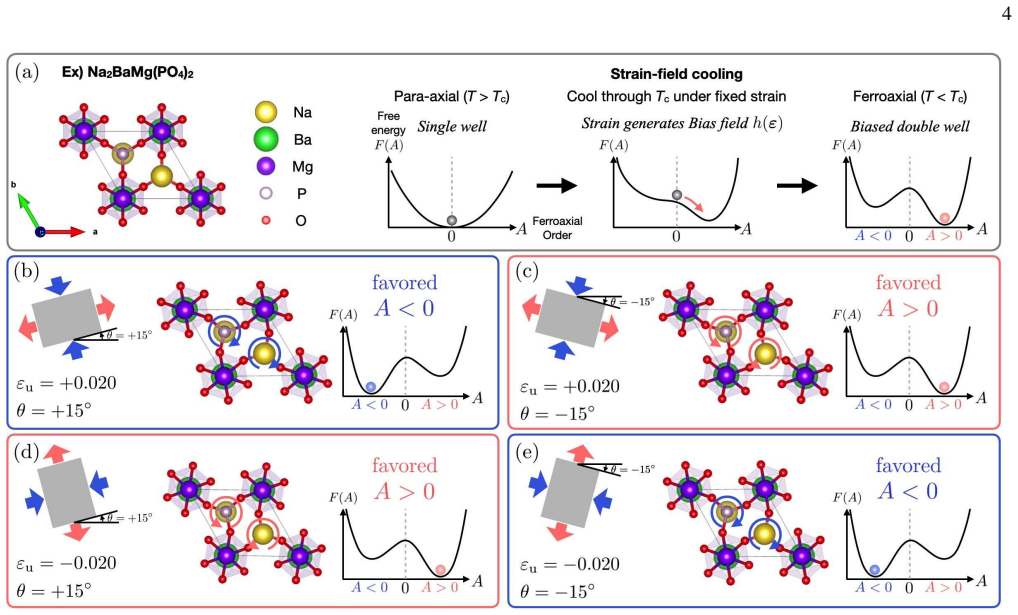
The central object is the piezoaxial coupling, defined as the free-energy term F_A = -h(epsilon) * A, where A is the ferroaxial order parameter and h(epsilon) is a strain-derived axial field whose polynomial form is uniquely fixed by the parent point-group symmetry. The paper proves by construction that such a field always exists for non-pyroaxial point groups and demonstrates, via first-principles calculations on Na2BaMg(PO4)2, that the trigonal cubic invariant h proportional to epsilon_u^3 sin(6 theta) produces a measurable domain energy splitting of approximately 1.58 meV per cell at 2% strain, with the correct sign reversal under both strain-sign flip and 30-degree axis rotation. Fixed-c
What carries the argument
The strain tensor is decomposed into local-frame deviatoric components (eta, xi, zeta, omega, upsilon) and the allowed axial field is found by solving a polynomial covariance condition under all point-group generators. For trigonal symmetry, the leading basal-plane invariant is xi(3*eta^2 - xi^2), which under uniaxial deviatoric strain with amplitude epsilon_u and angle theta reduces to epsilon_u^3 sin(6*theta). First-principles verification uses three complementary methods: clamped-coordinate domain splittings, biased double-well scans along the PO4 rotation coordinate, and fixed-cell relaxations from the para-axial structure.
Load-bearing premise
The Landau free-energy analysis assumes that the domain-odd energy splitting is dominated by the linear conjugate-field term and that higher-order odd-in-A terms (such as strain-cubed or strain-A-cubed couplings) are negligible at the strain magnitudes used, up to 2%. If higher-order terms contribute at these strain levels, the extracted piezoaxial coefficient would mix multiple symmetry invariants.
What would settle it
If the measured domain splitting in Na2BaMg(PO4)2 under strain did not follow the predicted sin(6 theta) angular dependence or the cubic epsilon_u^3 amplitude scaling, or if fixed-strain relaxations from the para-axial state did not select opposite domains for opposite strain signs, the piezoaxial coupling mechanism as formulated would be falsified for this material.
If this is right
- Strain-field cooling through the ferroaxial transition temperature under a fixed in-plane deviatoric strain should select a single ferroaxial domain, analogous to magnetic field cooling for ferromagnets but using purely mechanical strain.
- The symmetry hierarchy in Table II provides a design rule: given a material's parent point group and desired ferroaxial axis, one can look up the lowest-order strain polynomial needed and the required strain geometry without material-specific calculation.
- For finite-wave-vector ferroaxial systems such as charge-density-wave compounds, the strain field couples to an induced uniform axial composite rather than the primary order parameter, extending the framework to electronic ferroaxial states.
- The sign-reversal controls (30-degree rotation or strain-sign flip) provide built-in experimental null tests: a 60-degree rotation should restore the same domain selection, and nodal directions should suppress the bias entirely.
Where Pith is reading between the lines
- The cubic strain scaling for trigonal systems means that the domain bias is a steep function of strain magnitude, so modest increases in applied strain could produce disproportionately larger domain selectivity, but also that very small strains may produce negligible bias, setting a practical threshold for strain-cooling experiments.
- The piezoaxial coefficient kappa extracted from first-principles is material-specific, so the symmetry framework predicts the form of the coupling but not its strength; a survey across the candidate materials in Table III could reveal whether structural ferroaxial compounds systematically yield larger coefficients than electronic ones.
- The framework could be extended to dynamical strain (acoustic waves or surface acoustic waves) as a time-dependent conjugate field, potentially enabling resonant or floquet-type control of ferroaxial domains beyond the static strain-cooling protocol proposed here.
Editorial analysis
A structured set of objections, weighed in public.
Referee Report
Summary. The manuscript formulates a symmetry-based framework for static homogeneous strain as a conjugate field for ferroaxial order. The central result is that strain polynomials transforming in the same irreducible representation as the ferroaxial order parameter can energetically select ferroaxial domains, with the leading polynomial order determined by the parent point group (linear for orthorhombic, quadratic for tetragonal, cubic for trigonal/hexagonal, with a further split for cubic groups). The framework is parameter-free in its symmetry predictions. The trigonal case is verified by first-principles DFT calculations on Na2BaMg(PO4)2, confirming the predicted sin6θ angular dependence and ε_u^3 strain scaling of the domain splitting through three complementary calculations: clamped-coordinate splittings, double-well bias scans, and fixed-strain relaxations from the para-axial structure.
Significance. The paper addresses a well-defined problem: ferroaxial order lacks a universal static conjugate field (unlike ferroelectric or ferromagnetic order), and the question of whether homogeneous strain can fill this role is both timely and physically motivated. The symmetry derivation in Sec. II and the Supplemental Material is systematic and parameter-free: the strain polynomial forms are fixed entirely by point-group representation theory through the covariance condition (Eq. S4/S5), with no fitting to data. The DFT verification tests predictions (sin6θ angular dependence, ε_u^3 scaling) that were derived before the computation, and the cubic scaling is verified over a factor-of-64 range in amplitude with near-perfect consistency (Table IV: ratios 8.02, 27.05, 64.0 vs. ideal 8, 27, 64). The three complementary DFT calculations (clamped splitting, double-well bias, para-axial relaxation) provide mutually consistent evidence. The strain-field-cooling protocol proposed in Fig. 1 and Sec. III.F is a falsifiable experimental prediction with concrete symmetry controls (30° rotation reverses domain selection, 60° restores it, nodal directions suppress bias). The comprehensive point-group tabl
major comments (1)
- §III.F, Eq. (27): The population estimate P_fav/P_unfav ≈ exp[N·κ₀(|ε_u|)/(k_B T)] introduces the correlated nucleus size N as a free parameter, and the chosen values (N=100, 500) are illustrative rather than constrained. While the authors acknowledge this does not replace nucleation theory, the claim that the bias 'can become thermodynamically significant' (end of Sec. III.F) rests entirely on this estimate. The one-cell splittings at |ε_u|=0.020 are 18.4 K (Table IV), which is ~3% of T_c≈540 K. The manuscript would benefit from either (a) providing a physical argument or estimate for N based on correlation lengths or domain-wall energies in Na2BaMg(PO4)2, or (b) more explicitly framing the claim as conditional on the existence of a sufficiently large correlated volume, rather than asserting significance. This is load-bearing because the experimental feasibility of the proposed strain-
minor comments (6)
- §III.F, Eq. (27): The population estimate introduces N as a free parameter with illustrative values (N=100, 500). A physical justification or more cautious framing of the significance claim would strengthen this section.
- Fig. 3: The sixth-order polynomial fits are described as 'guides to the eye,' but the odd-in-φ domain splitting extracted from these fits (panels c,d) is used qualitatively to confirm sign reversal. A brief note on the sensitivity of the extracted odd component to the polynomial order would improve transparency, particularly for the |ε_u|=0.020 case.
- Table II caption: The distinction between the basal subgroup and non-basal subgroup columns could be stated more explicitly in the caption, perhaps with a one-sentence note that these represent the residual symmetry for representative strain tensors, not for the polynomial invariant alone.
- §II.A, Eq. (10): The term O[h(ε)^3] is written schematically. A brief expansion or reference to the Supplemental Material for the explicit form of higher-order corrections would help readers assess the magnitude of these terms relative to the leading -2h(ε)A contribution.
- Table III: The entry for RTe3 uses the notation 'C2h' for the point-group symmetry of the ferroaxial CDW state, with a footnote explaining it is not an ordinary space group. This is somewhat unusual notation; a brief clarification that this denotes the point group of the electronic density-wave pattern would improve readability.
- The Supplemental Material reference [48] reads 'supplemental Material' redundantly at the end of the citation. This appears to be a formatting artifact.
Simulated Author's Rebuttal
The referee raises a single major comment regarding the population estimate in §III.F (Eq. 27), specifically that the correlated nucleus size N is an unconstrained free parameter and that the claim of thermodynamic significance rests on this estimate. We agree this is a fair concern and will revise accordingly.
read point-by-point responses
-
Referee: §III.F, Eq. (27): The population estimate P_fav/P_unfav ≈ exp[N·κ₀(|ε_u|)/(k_B T)] introduces the correlated nucleus size N as a free parameter, and the chosen values (N=100, 500) are illustrative rather than constrained. While the authors acknowledge this does not replace nucleation theory, the claim that the bias 'can become thermodynamically significant' (end of Sec. III.F) rests entirely on this estimate. The one-cell splittings at |ε_u|=0.020 are 18.4 K (Table IV), which is ~3% of T_c≈540 K. The manuscript would benefit from either (a) providing a physical argument or estimate for N based on correlation lengths or domain-wall energies in Na2BaMg(PO4)2, or (b) more explicitly framing the claim as conditional on the existence of a sufficiently large correlated volume, rather than asserting significance.
Authors: We thank the referee for this careful and well-taken comment. We agree that the current presentation does not adequately justify the chosen values of N or sufficiently qualify the claim of thermodynamic significance. We will address this through both suggested routes (a) and (b) in the revised manuscript. revision: partial
Circularity Check
No significant circularity: symmetry derivation is parameter-free; DFT verifies predictions not used as inputs.
full rationale
The paper's central derivation chain is self-contained and not circular. The strain polynomial forms (Table II, Eqs. 16-18) are derived from standard point-group representation theory in the Supplemental Material (§S1-S3), where the covariance condition Eq. (S4) is imposed on monomials of strain and solved as a linear system Eq. (S15) for each point group. No fitted parameters enter the symmetry derivation. The first-principles DFT calculations on Na2BaMg(PO4)2 then independently verify two predictions that were derived before computation: (1) the sin6θ angular dependence of the domain splitting (Fig. 2a, Eq. 23) and (2) the cubic ε_u^3 strain scaling (Fig. 2b, Eq. 24, Table IV). The single fitted parameter κ = 1.9792×10^5 meV/cell is a material-dependent coupling constant extracted from the DFT data, not an input to the symmetry framework. The clamped-coordinate splittings at four strain magnitudes (0.005, 0.010, 0.015, 0.020) show ratios 8.02, 27.05, 64.0 versus ideal cubic ratios 8, 27, 64, providing independent verification rather than a fit renamed as prediction. Self-citations (Refs. 3-6, 21, 23, 27, 32-34, 36-43) concern related ferroaxial physics but are not load-bearing for the core derivation: the polynomial invariance argument stands on its own mathematical content. No step in the derivation chain reduces to its inputs by construction.
Axiom & Free-Parameter Ledger
free parameters (2)
- κ (piezoaxial coupling constant) =
1.9792 × 10^5 meV/cell
- N (correlated nucleus size) =
100-500 primitive cells (assumed range)
axioms (4)
- domain assumption Landau free-energy expansion near Tc is dominated by terms up to sixth order in A, with the domain-odd part dominated by the linear conjugate-field term -h(ε)A.
- domain assumption The ferroaxial order parameter A can be represented by the PO4 rotation angle φ in Na2BaMg(PO4)2.
- domain assumption Homogeneous strain couples to a uniform (Γ-point) ferroaxial order parameter; for finite-q order, it couples to an induced uniform axial composite.
- standard math Point-group representation theory correctly classifies the transformation properties of strain polynomials and axial-vector components.
read the original abstract
We formulate a symmetry-based hierarchy of strain-derived conjugate fields for ferroaxial order, and demonstrate strain-selected ferroaxial domain control using first-principles calculations. Since ferroaxial order is even under both spatial inversion and time reversal, ordinary electric and magnetic fields cannot serve as universal linear conjugate fields. Homogeneous strain, however, can generate symmetry-allowed piezoaxial fields whose leading order is determined by the parent point group and by the chosen ferroaxial-axis component. For basal-plane strain, the leading field is linear in orthorhombic systems, quadratic in tetragonal systems, and cubic in trigonal and hexagonal systems. Cubic parent groups further split into two classes: cubic-I groups, $23$ and $m\bar{3}$, allow linear full-strain fields for selected axes, whereas cubic-II groups, $432$, $\bar{4}3m$, and $m\bar{3}m$, forbid linear fields and require quadratic or cubic strain combinations depending on the selected axis. In trigonal systems, the basal-plane deviatoric strain with signed amplitude $\varepsilon_{\rm u}$ and principal-axis angle $\theta$ gives the single-axis field $h\propto\varepsilon_{\rm u}^3\sin6\theta$. First-principles calculations for the trigonal ferroaxial compound Na$_2$BaMg(PO$_4$)$_2$ verify both the predicted angular dependence and cubic strain scaling of the ferroaxial domain splitting, and fixed-strain atomic relaxations show strain-selected evolution from the para-axial structure. These results establish static homogeneous strain as a symmetry-allowed conjugate field for ferroaxial order and suggest a route to ferroaxial domain control through strain-field cooling.
Figures


Reference graph
Works this paper leans on
-
[1]
defines the sign convention used below: a domain with ℎ( /u1D73A) /u1D434 > 0 is lowered in free energy. The Landau free energy near the ferroaxial transition tem- perature /u1D447c at fixed static homogeneous strain can be written as /u1D439( /u1D434; /u1D73A) = /u1D44E 2 ( /u1D447− /u1D447c) /u1D4342 + /u1D44F 4 /u1D4344 + /u1D450 6 /u1D4346 − ℎ( /u1D73A)...
-
[2]
for [ 110] , and ( [ ¯110]/ √ 2, [ ¯1¯12]/ √ 6, [ 111]/ √ 3) for [ 111] . The basal subgroup is the residual point group for a represe ntative basal-plane strain with nonzero leading basal field , whereas the non-basal subgroup is that for a representative strain involving at least one of /u1D44D, /u1D448, and /u1D449. Here /u1D44B= /u1D700/u1D465 /u1D465−...
-
[3]
(17) This is the same signed-principal-strain convention as Eq.(14)
The two in-plane principal strains are + /u1D700u and − /u1D700u, giving /u1D44B= 2/u1D700u cos 2/u1D703, /u1D44C = 2/u1D700u sin 2/u1D703. (17) This is the same signed-principal-strain convention as Eq.(14). Substituting Eq. (17) into Eq. ( 16), we obtain ℎ( /u1D700u, /u1D703) ∝ /u1D7003 u sin 6/u1D703. (18) Thus the field changes sign either when the ten...
-
[4]
and ( 13), Eq. ( 19) gives exactly Eq. (14). The strained cell L′ and initially strained Cartesian coordi- nates /u1D493′ /u1D456are generated by the affine transformation L′ = L( I + /u1D73A) T, /u1D493′ /u1D456= /u1D493/u1D456( I + /u1D73A) T. (21) Here, the rows of L are the non-strained lattice vectors, and /u1D493/u1D456is the Cartesian row vector of t...
-
[5]
and ( 18). D. Bias of the ferroaxial double well The clamped-coordinate comparison verifies the symmetry of the domain splitting. We next confirm that the same strain- derived field appears as an actual tilt of the ferroaxial doub le- well potential. Figure 3 shows the energy profile as a function of the PO 4 rotation angle /u1D719for | /u1D700u| = 0.020 and ...
- [6]
- [7]
- [8]
- [9]
-
[10]
H. Kusunose and S. Hayami, J. Phys.: Condens. Matter 34, 464002 (2022)
work page 2022
- [11]
-
[12]
W. Jin, E. Drueke, S. Li, A. Admasu, R. Owen, M. Day, K. Sun, S.-W. Cheong, and L. Zhao, Nat. Phys. 16, 42 (2020)
work page 2020
-
[13]
R. Owen, E. Drueke, C. Albunio, A. Kaczmarek, W. Jin, D. Obeysekera, S.-W. Cheong, J. Yang, S. Cundiff, and L. Zhao, Phys. Rev. B 103, 054104 (2021)
work page 2021
-
[14]
T. Hayashida, Y . Uemura, K. Kimura, S. Matsuoka, M. Hag- ihala, S. Hirose, H. Morioka, T. Hasegawa, and T. Kimura, Phys. Rev. Materials 5, 124409 (2021)
work page 2021
-
[15]
Z. Zeng, M. Först, M. Fechner, D. Prabhakaran, P. G. Radaelli , and A. Cavalleri, Science 390, 195 (2025)
work page 2025
-
[16]
S. Yamagishi, T. Hayashida, R. Misawa, K. Kimura, M. Hagihala, T. Murata, S. Hirose, and T. Kimura, Chem. Mater. 35, 747 (2023)
work page 2023
- [17]
-
[18]
Y . Xie, R. Oiwa, and S. Hayami, Phys. Rev. B 113, 205133 (2026)
work page 2026
- [19]
- [20]
- [21]
- [22]
-
[23]
T. Hayashida, Y . Uemura, K. Kimura, S. Matsuoka, D. Morikawa, S. Hirose, K. Tsuda, T. Hasegawa, and T. Kimura, Nat. Commun. 11, 4582 (2020)
work page 2020
-
[24]
H. Y okota, T. Hayashida, D. Kitahara, and T. Kimura, npj Quantum Mater. 7, 106 (2022)
work page 2022
-
[25]
X. Guo, R. Owen, A. Kaczmarek, X. Fang, C. De, Y . Ahn, W. Hu, N. Agarwal, S. H. Sung, R. Hovden, S.-W. Cheong, and L. Zhao, Phys. Rev. B 107, L180102 (2023)
work page 2023
- [26]
-
[27]
C. Silva de Farias, M.-A. Méasson, A. Ferraz, and S. Burdin, Phys. Rev. B 101, 205114 (2020)
work page 2020
- [28]
-
[29]
T. Hasegawa, W. Y oshida, K. Nakamura, N. Ogita, and K. Mat- suhira, J. Phys. Soc. Jpn. 89, 054602 (2020)
work page 2020
- [30]
- [31]
- [32]
- [33]
- [34]
-
[35]
B. Singh, G. McNamara, K.-M. Kim, S. Siddique, S. D. Funni, W. Zhang, X. Luo, P. Sakrikar, E. M. Kenney, R. Singha, S. Alek- seev, S. A. A. Ghorashi, T. J. Hicken, C. Baines, H. Luetkens, Y . Wang, V . M. Plisson, M. Geiwitz, C. A. Occhialini, R. Comin, M. J. Graf, L. Zhao, J. Cano, R. M. Fernandes, J. J. Cha, L. M. Schoop, and K. S. Burch, Nature Physics...
work page 2025
- [36]
-
[37]
H. Watanabe, R. Oiwa, G. Kusuno, T. Satoh, and R. Arita, Phys. Rev. B 112, 115105 (2025)
work page 2025
-
[38]
Y . Suganuma, G. Kusuno, H. Watanabe, R. Oiwa, H. Mori, R. Arita, and T. Satoh, arXiv preprint (2026), arXiv:2603.21756 [cond-mat.mtrl-sci]
-
[39]
H. Watanabe, R. Oiwa, and R. Arita, arXiv preprint (2025), arXiv:2507.09237 [cond-mat.str-el]
-
[40]
E. Day-Roberts, R. M. Fernandes, and T. Birol, Phys. Rev. Lett. 134, 016401 (2025)
work page 2025
- [41]
-
[42]
A. Roy, M. H. D. Guimarães, and J. Sławińska, Phys. Rev. Mater. 6, 045004 (2022)
work page 2022
- [43]
- [44]
- [45]
- [46]
-
[47]
K. Du, D. Jo, X. Xu, F.-T. Huang, M.-H. Lee, M.-W. Chu, K. Wang, D. Vanderbilt, H.-W. Lee, and S.-W. Cheong, Nat. Phys. 22, 61 (2026)
work page 2026
- [48]
- [49]
- [50]
-
[51]
L. D. Barron, Chem. Phys. Lett. 123, 423 (1986)
work page 1986
-
[52]
L. D. Barron, Molecular Light Scattering and Optical Activity , 2nd ed. (Cambridge University Press, Cambridge, U.K., 2004 ) Chap. 1.9.5, p. 39
work page 2004
-
[53]
See supplemental material at [url will be inserted by publis her] for the symmetry derivation of the strain-induced axial fiel ds, the polynomial construction, and the tensor-stabilizer derivation of the strained subgroups, supplemental Material
-
[54]
A. Jain, S. P. Ong, G. Hautier, W. Chen, W. D. Richards, S. Dacek, S. Cholia, D. Gunter, D. Skinner, G. Ceder, and K. A. Persson, APL Materials 1, 011002 (2013)
work page 2013
-
[55]
M. D. Watson, I. Marković, E. A. Morales, P. Le Fèvre, M. Merz, A. A. Haghighirad, and P. D. C. King, Physical Review Research 2, 013236 (2020)
work page 2020
-
[56]
N. Maraytta, P. Nagel, F. Ghorbani, A. Ghiami, S. Pakhira, M. Y e, B. Wehinger, F. Abbruciati, G. Garbarino, M. Le Tacon, S. Schuppler, A.-A. Haghighirad, and M. Merz, Scientific Reports 15, 35019 (2025)
work page 2025
-
[57]
J. Neu, K. Wei, X. He, O. Delaire, R. E. Baumbach, Z. Feng, Y . Fu, Y . Zhang, D. J. Singh, and T. Siegrist, Physical Review B 100, 144102 (2019)
work page 2019
-
[58]
M. Reehuis, C. Ulrich, K. Prokes, S. Mat’as, J. Fu- jioka, S. Miyasaka, Y . Tokura, and B. Keimer, Physical Review B 83, 064404 (2011)
work page 2011
-
[59]
L. Poudel, C. de la Cruz, E. A. Payzant, A. F. May, M. Koehler, V . O. Garlea, A. E. Taylor, D. S. Parker, H. B. Cao, M. A. McGuire, W. Tian, M. Matsuda, H. Jeen, H. N. Lee, T. Hong, S. Calder, H. D. Zhou, M. D. Lumsden, V . Keppens, D. Mandrus, and A. D. Christianson, Physical Review B 92, 214421 (2015)
work page 2015
-
[60]
G. W. Howieson, K. K. Mishra, A. S. Gibbs, R. S. Kati- yar, J. F. Scott, F. D. Morrison, and M. A. Carpenter, Physical Review B 103, 014119 (2021)
work page 2021
-
[61]
C. J. Howard, V . Luca, and K. S. Knight, Journal of Physics: Condensed Matter 14, 377 (2002)
work page 2002
-
[62]
J. L. Garc’ia-Mu noz, J. Rodr’iguez-Carvajal, P. Lacorre, a nd J. B. Torrance, Physical Review B 46, 4414 (1992)
work page 1992
-
[63]
J. A. Alonso, M. J. Mart’inez-Lope, M. T. Casais, J. L. Garc’ia-Mu noz, and M. T. Fern’andez-D’iaz, Physical Review B 64, 094102 (2001)
work page 2001
-
[64]
H. Nishimine, Y . Doi, Y . Hinatsu, and M. Sato, Journal of the Ceramic Society of Japan 115, 577 (2007)
work page 2007
-
[65]
S. Lee, I. N. Ivanov, J. K. Keum, and H. N. Lee, Scientific Reports 6, 19621 (2016)
work page 2016
-
[66]
J. del Valle, C. W. Rischau, A. Korshunov, D. Ambrosi- Jalón, A. Tarazaga Martín-Luengo, I. Y ousef, S. A. Lopez-Paz, S. Neyshtadt-Ronel, R. Singh, A. Rakshit, S. Gariglio, A. Bosak, and Y . Kalcheim, Phys. Rev. B 113, 174114 (2026)
work page 2026
-
[67]
H.-C. zur Loye, S.-J. Kim, R. Macquart, M. D. Smith, Y . Lee, and T. Vogt, Solid State Sciences 11, 608 (2009)
work page 2009
- [68]
-
[69]
R. D. Johnson, L. C. Chapon, D. D. Khalyavin, P. Manuel, P. G. Radaelli, and C. Martin, Phys. Rev. Lett. 108, 067201 (2012)
work page 2012
-
[70]
R. Yuan, L. Duan, X. Du, and Y . Li, Physical Review B 91, 054102 (2015)
work page 2015
-
[71]
S. M. Souliou, Y . Li, X. Du, M. Le Tacon, and A. Bosak, Physical Review B 94, 184309 (2016)
work page 2016
-
[72]
L. Zhou, X. Wang, Z. Liu, X. Y e, J. Zhang, H. Zhao, D. Lu, M. Pi, Z. Pan, X. Zhang, and Y . Long, Journal of Physics: Condensed Matter 35, 254001 (2023)
work page 2023
-
[73]
K. Yamamura, M. Wakeshima, and Y . Hinatsu, Journal of Solid State Chemistry 179, 605 (2006)
work page 2006
-
[74]
H. Ishikawa, D. Hirai, A. Ikeda, M. Gen, T. Yajima, A. Matsuo, Y . H. Matsuda, Z. Hiroi, and K. Kindo, Physical Review B 104, 174422 (2021)
work page 2021
-
[75]
B. J. Kennedy, P. J. Saines, Y . Kubota, C. Mi- nakata, H. Hano, K. Kato, and M. Takata, Materials Research Bulletin 42, 1875 (2007)
work page 2007
-
[76]
H. W. Mayer, D. Reinen, and G. Heger, Journal of Solid State Chemistry 50, 213 (1983)
work page 1983
-
[77]
P. Giannozzi, S. Baroni, N. Bonini, M. Calandra, R. Car, C. Cavazzoni, D. Ceresoli, G. L. Chiarotti, M. Cococ- cioni, I. Dabo, A. Dal Corso, S. de Gironcoli, S. Fab- ris, G. Fratesi, R. Gebauer, U. Gerstmann, C. Gougous- sis, A. Kokalj, M. Lazzeri, L. Martin-Samos, N. Marzari, F. Mauri, R. Mazzarello, S. Paolini, A. Pasquarello, L. Paul atto, C. Sbraccia,...
work page 2009
-
[78]
P. Giannozzi, O. Andreussi, T. Brumme, O. Bunau, M. Buon- giorno Nardelli, M. Calandra, R. Car, C. Cavazzoni, D. Ceresoli, M. Cococcioni, N. Colonna, I. Carnimeo, A. Dal Corso, S. de Gironcoli, P. Delugas, R. A. DiStasio, A. Ferretti, A. Floris, G. Fratesi, G. Fugallo, R. Gebauer, U. Gerstmann, F. Giustin o, T. Gorni, J. Jia, M. Kawamura, H. Ko, A. Kokalj...
work page 2017
-
[79]
J. P. Perdew, A. Ruzsinszky, G. I. Csonka, O. A. Vydrov, G. E. Scuseria, L. A. Constantin, X. Zhou, and K. Burke, Phys. Rev. Lett. 100, 136406 (2008)
work page 2008
-
[80]
D. R. Hamann, Phys. Rev. B 88, 085117 (2013)
work page 2013
discussion (0)
Sign in with ORCID, Apple, or X to comment. Anyone can read and Pith papers without signing in.