REVIEW 4 major objections 3 minor 109 references
Yielding versus random organization: convex absorbing transitions in soft matter
T0 review · 4 major / 3 minor · reviewed 2026-08-02 · deepseek-v4-flash
Pith's one-line read The paper argues that the reversible-irreversible transition in cyclically sheared suspensions and the yielding transition in yield-stress fluids are two realizations of a single absorbing phase transition, evidenced by a shared parametric
desk verdict The master-curve comparison between the RIT and yielding is real and worth refereeing, but the LR-CDP anchor for the α-ROM rests on an effective-transport mapping that is partly circular. read the letter →
The pith
A machine-rendered reading of the paper's core claim, the machinery that carries it, and where it could break.
The reading
What carries the argument
The central device is the parametric exponent plot: instead of plotting critical exponents against the interaction-range exponent α, the paper plots them against the order-parameter exponent β. This removes the model-specific relation between α and the physics, revealing a common master curve. The two theoretical anchors are the LR-CDP field equations, which add fractional long-range transport to the conserved density and activity fields, and the generalized Hebraud-Lequeux model, a mean-field description in which local variables diffuse—normally or anomalously—under self-consistent noise until they cross a threshold, with diffusion coefficient proportional to the mean activity. For the α-RO
What would settle it
A decisive test: in the α-ROM, measure the correlation-length exponent ν⊥ directly (not via hyperscaling) and compute β_LR-CDP(d_f + ν⊥^{-1}); if it disagrees with the measured β beyond error bars in the concave regime, the LR-CDP assignment lacks support. Alternatively, simulate an α-ROM variant in which long-range noise and long-range transport are tuned independently; if the master curve breaks when the noise exponent is varied with transport fixed, the collapse is accidental.
Extended reading notes
Core claim
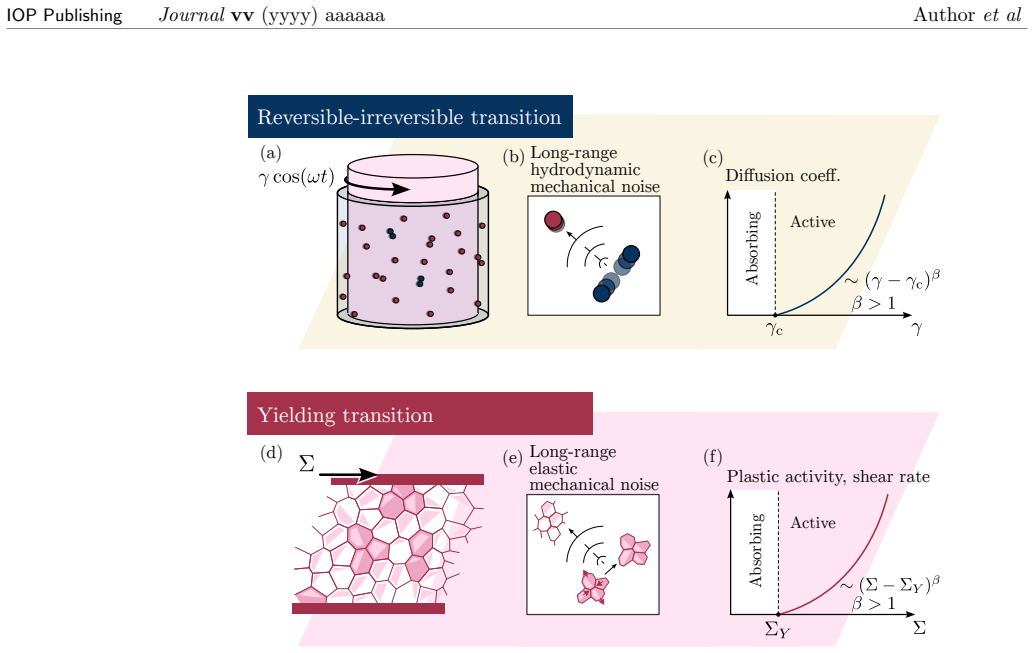
The central claim is that convex absorbing transitions—where the order parameter rises with exponent β > 1, fluctuations vanish, avalanches are non-compact, and hyperuniformity is lost—are not a separate exotic family but the same transition as ordinary concave ones, seen through the wrong parameter. Concretely, the α-ROM (a model of cyclically sheared suspensions with long-range hydrodynamic-like noise) and the α-Picard model (an elastoplastic model of yield-stress fluids with long-range elastic stress redistribution) produce different critical exponents at the same interaction-range exponent α, yet their exponents collapse onto one master curve when plotted as functions of β. The concave l
Load-bearing premise
The load-bearing premise is that an effective transport exponent α' = d_f + ν⊥^{-1}, built from the model's own fractal dimension and correlation-length exponents via a depinning scaling relation that the α-ROM does not actually satisfy, can stand in for the true interaction range when comparing the α-ROM to long-range conserved directed percolation.
Editorial extensions
If this is right
- The reversible-irreversible transition and yielding are unified: for a given β, all measured critical exponents—activity mean and fluctuations, avalanche statistics, and fractal dimensions—match between the two models.
- The crossover between concave and convex transitions, at β = 1, coincides in each model with the crossover from diverging to vanishing fluctuations and from compact to non-compact avalanches, so a single criterion separates the two regimes.
- The concave side of the master curve is accounted for by long-range conserved directed percolation, meaning that the α-ROM behaves as if it had an effective long-range transport exponent even though its actual transport is short-range.
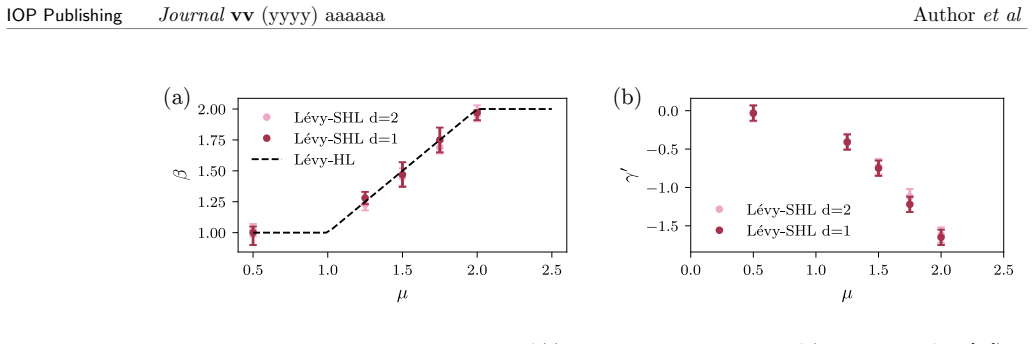
- The convex side is accounted for by the generalized Hebraud-Lequeux model, whose prediction β = μ links the order-parameter exponent to the Lévy exponent of the mediated noise.
- Hyperuniformity is lost for convex transitions: the structure factor of the conserved field develops a non-monotonic low-q behavior in the α-ROM and a vanishing hyperuniformity exponent in the α-Picard model, with zero modes extending the α-dependent regime up to α = 6.
Reading between the lines
- The master-curve collapse invites the conjecture that a coarse-grained mapping connects the two models, analogous to the known mapping between disordered elastic interfaces and sandpiles; if such a mapping exists, it should predict the effective transport exponent rather than fit it.
- A direct experimental test is available: measure the activity exponent β and the fluctuation exponent γ' in a cyclically sheared suspension and in a yield-stress fluid; both should fall on the same parametric curve even though their microscopic interaction ranges are not directly comparable.
- If the Hebraud-Lequeux branch is exact, then any soft-matter system whose activity is created by noise near a threshold—foams, emulsions, granular packs—should fall on the same convex branch, which is testable by measuring the order-parameter exponent and its fluctuations in such systems.
- The paper leaves open whether the zero-mode-dominated class it tentatively calls CDP-0 is real; this could be settled by simulating the α-Picard model at α > 6 and checking whether the hyperuniformity exponent follows the predicted zero-mode behavior rather than the LR-CDP saturation.
Editorial analysis
A structured set of objections, weighed in public.
Referee Report
Summary. The paper compares two minimal models of athermal soft-matter absorbing transitions—the α-ROM for cyclically sheared suspensions and the α-Picard elastoplastic model for yield-stress fluids—by tuning the decay exponent α of their long-range interaction kernels. It documents a continuous evolution of the order-parameter exponent β, the fluctuation exponent γ′, the avalanche exponents, and hyperuniformity as α varies, with a crossover at β=1. Parametric plots of exponents versus β are claimed to reveal a shared master curve for β>0.64, with the concave branch assigned to long-range conserved directed percolation (LR-CDP) and the convex branch assigned to a generalized Hebraud-Lequeux model with Lévy noise. The paper concludes that the reversible-irreversible transition and the yielding transition may be two physical realizations of a common absorbing transition.
Significance. If the master curve and the two-branch assignment are correct, this is a substantial step toward unifying two important classes of driven soft matter; it gives concrete, falsifiable criteria (exponent collapse, hyperuniformity crossover, noise statistics) and identifies candidate universality classes. The model definitions are precise, the numerical protocols are standard, and the authors are unusually explicit about the limitations of their arguments, including the admitted loophole in the effective α′ mapping. The main weakness is that the central quantitative evidence is presented without error bars and with one partially self-consistent mapping, so the significance is real but the support is not yet definitive.
major comments (4)
- [Sec. 4.1, Fig. 8(b)] The identification of the α-ROM with LR-CDP is not independently established. The effective transport exponent α′ is defined through α′=d_f+ν⊥^{-1}, using the depinning tilt-symmetry relation ν⊥^{-1}=α−d_f, which the paper itself states is not satisfied by the α-ROM. Moreover, ν⊥ is not measured directly but obtained from the hyperscaling relation γ′=dν⊥−2β (Eq. 10), i.e. from the same β and γ′ that are later used in the comparison. The agreement between β_LR-CDP(α′) and the measured β in Fig. 8(b) is therefore a self-consistency check of scaling relations, not an independent test of the LR-CDP mapping. The paper acknowledges this loophole in Sec. 5. To support the central claim that the concave regime of the α-ROM belongs to the LR-CDP class, an independent determination of ν⊥ (e.g., finite-size scaling of the correlation length) and a test of statistical tilt symmetry in the α-ROM, or
- [Figs. 2–6, 8–10] Critical exponents are reported without error bars or fitting details. The master-curve collapse in Fig. 6 is the central quantitative result, and Fig. 6 itself shows visible discrepancies for τ, τ′, and τ″ at intermediate β. Without uncertainties on these points and on the LR-CDP/HL comparison curves, the claim of a shared master curve for β>0.64 cannot be distinguished from systematic deviations. Please provide tables or error bars for all exponents, specify fitting ranges and finite-size scaling procedures, and state the statistical uncertainty of the collapse (e.g., scatter around a common parametric curve).
- [Sec. 4.2, Fig. 8(a)] The identification of the convex regime with the generalized Hebraud-Lequeux model depends on the mean-field relation µ=d/α for the Lévy noise exponent. The paper explicitly states that no analytical prediction for µ beyond mean field is available (Sec. 4.2.1). The µ-HL data in Figs. 9 and 8(a) are generated with µ as an input parameter; the link to the α-ROM and α-Picard models is therefore through an unmeasured exponent. Without a direct measurement of p(δξ) in the two models, or a robustness test of the master-curve agreement under alternative µ(α) assignments, the claim that generalized HL 'visits the entire part of the master curve associated with convex transition' is a statement about the HL model rather than about the physical models. This is load-bearing for the unified-description conclusion.
- [Appendix A] The LR-CDP exponents used as the concave-branch anchor are measured in a newly introduced LR-ROM model, but the appendix provides no simulation details: no system size, no lattice/off-lattice specification, no finite-size scaling analysis, no uncertainty estimates, and no explicit fitting procedure for β and γ′. The main text only states that the jump probability decays as ~1/|Δr|^{α′}. Given that these new exponents are central to the LR-CDP identification, their numerical determination should be documented at the same level as the other models, or the figure should be presented as preliminary pending a dedicated study.
minor comments (3)
- [Abstract and Sec. 4] The abstract refers to 'Long-Range Directed Percolation' while the body and the rest of the paper use 'Long-Range Conserved Directed Percolation' (LR-CDP). Please make the terminology consistent.
- [Fig. 7(c)] The linearized-theory prediction line in Fig. 7(c) is described only in the text. Please add the explicit prediction S_σ(q)∼q^{α−4} for 1<α<6 and q^2 for α≥6 to the caption, and indicate where the comparison is expected to fail.
- [Sec. 2.1.2 and Eq. (17)] The symbol A is used both for mean activity and for the prefactor in the noise distribution p(δξ)∼A/|δξ|^{1+µ}. This can be confusing; consider a different symbol for the prefactor.
Circularity Check
Master-curve comparison is independent, but the LR-CDP identification for the α-ROM leans on an effective α′ built from the model's own exponents via relations the model does not satisfy.
-
fitted input called prediction
[Sec. 5 (Discussion), with construction in Sec. 4.1 and Fig. 8(b); uses Eq. (10) hyperscaling]
"This tentative scenario is suggested by the scaling relation ν−1⊥=α−df [67], which although not satisfied in the α-ROM, allows for the definition of an effective value αeff. Once plugged into the long-range CDP class, αeff predicts the correct value of the exponent β (i.e., the one measured in the α-ROM) as long as β≤1."
The effective transport exponent α′ is not measured or derived from the α-ROM's dynamics; it is constructed as α′=d_f+ν⊥^{-1} using the depinning tilt-symmetry relation ν⊥^{-1}=α−d_f, which the paper admits the α-ROM does not satisfy. Moreover ν⊥ is not measured independently: it is obtained through the hyperscaling relation γ′=dν⊥−2β from the same α-ROM β and γ′ that Fig. 8(b) later 'predicts' via β_LR-CDP(α′). The agreement is therefore a self-consistency check on the model's own exponents rather than an independent confirmation of the LR-CDP class. The paper itself concedes a loophole cannot be excluded. If the effective-mapping premise fails, the placement of the α-ROM's concave regime in LR-CDP loses its theoretical anchor; the empirical master-curve collapse survives, but the univers
full rationale
Most of the paper is a direct comparison of measured critical exponents and avalanche statistics of two model families, and the parametric master curve (Fig. 6) is an empirical finding that does not reduce to any fit. The α-Picard data, the α-ROM data, and the new LR-ROM simulations are independent numerical outputs, so using them to test scaling ideas is not circular in itself. The main circularity concern is confined to the LR-CDP assignment for the α-ROM: the effective exponent α′ is assembled from the α-ROM's own d_f and from ν⊥ inferred via hyperscaling from the same β and γ′ that the LR-CDP curve is then used to reproduce, under a scaling relation the paper states is not satisfied. This makes Fig. 8(b) partly a self-consistency test, as the paper itself acknowledges ('a loophole cannot be excluded'). That acknowledged circular step is load-bearing for the universality-class identification but not for the central master-curve comparison, so the overall circularity score is moderate.
Assumptions & free parameters
free parameters (4)
- α (interaction decay exponent)
- Effective transport exponent α' (α_eff) for α-ROM =
varies; defined via α'=d_f+ν⊥^{-1}
- Critical points ϕ_c,α and Σ_Y,α =
model- and α-dependent
- Noise exponent µ in Lévy-Hebraud-Lequeux model =
0<µ<2, varied as input
assumptions (7)
- domain assumption CDP universality class describes short-range APTs with a conserved field; β≈0.64 in 2D, hyperuniform critical state.
- domain assumption Long-range propagator in α-ROM: G(r)=c(1+r²)^{-α} with Gaussian displacements.
- domain assumption Generalized Eshelby propagator with zero modes: G̃^{E,α}_{q_x,q_y}=-b_α q_x² q_y²/|q|^{6-α}.
- ad hoc to paper Mediated noise distribution p(δξ)~A/|δξ|^{1+µ} with µ=d/α for α>d/2.
- domain assumption Hyperscaling γ'=dν⊥-2β and statistical tilt symmetry relation ν⊥^{-1}=α-d_f.
- domain assumption LR-CDP field equations (15)-(16) with fractional derivative transport describe long-range conserved APTs.
- domain assumption Hebraud-Lequeux mean-field self-consistency D=κA for activity-induced diffusion.
Cite this review
Pith. "Pith review of Yielding versus random organization: convex absorbing transitions in soft matter." pith.science (2026). https://pith.science/paper/LRI4YM2K
@misc{pith2026260623914,
  author       = {Pith},
  title        = {Pith review of: Yielding versus random organization: convex absorbing transitions in soft matter},
  year         = {2026},
  howpublished = {\url{https://pith.science/paper/LRI4YM2K}},
  note         = {Machine review of arXiv:2606.23914}
}
abstract
We compare two different soft matter models, a generalized Random Organization Model (ROM) describing the stroboscopic dynamics of cyclically sheared suspensions, and an elastoplastic model describing the mesoscale dynamics of a yield-stress fluid under imposed stress. Both show absorbing phase transitions, sharing a peculiar mechanism: activity induces an internal noise which is transmitted over large distances by long-ranged mediated interactions, either hydrodynamic or elastic, which results in non-local creation of activity. They also both show convex transitions (i.e., the exponent $\beta >1$), in stark contrast with usual absorbing phase transitions, like (Conserved) Directed Percolation, which are concave ($\beta <1$). We further compare the dependence of the critical properties (activity mean value and fluctuations, avalanche statistics, low-wavenumber structure factor) on the decay exponent $\alpha$ of long-range interactions in both models, finding a qualitatively similar scenario. A smooth crossover is observed as a function of $\alpha$ between a concave transition regime for short-range interactions, with diverging fluctuations and compact avalanches, and a convex transition regime, with vanishing fluctuations and non-compact avalanches, for longer-range interactions. Although for a given range exponent $\alpha$, the values of critical exponents for both models differ, a good agreement between the models is found by parametrically plotting the different critical exponents as a function of the exponent $\beta$ of the mean activity. In this parametric representation, the concave regime is consistent with the behavior of the Long-Range Conserved Directed Percolation class, while the convex regime can be accounted for by a mean-field-type scenario with anomalous diffusion close to an absorbing boundary, inspired by the H\'ebraud-Lequeux model for the yielding transition.
Figures


Figures from the paper (7 more)



Reference graph
Works this paper leans on
-
[1]
Nonequilibrium Critical Phenomena and Phase Transitions into Absorbing States.Advances in Physics, 49(7):815–958, November 2000
Haye Hinrichsen. Nonequilibrium Critical Phenomena and Phase Transitions into Absorbing States.Advances in Physics, 49(7):815–958, November 2000
2000
-
[2]
Universal scaling behavior of non-equilibrium phase transitions.International Journal of Modern Physics B, 18(31n32):3977–4118, December 2004
Sven L¨ ubeck. Universal scaling behavior of non-equilibrium phase transitions.International Journal of Modern Physics B, 18(31n32):3977–4118, December 2004
2004
-
[3]
Cambridge University Press, 1 edition, May 1999
Joaquin Marro and Ronald Dickman.Nonequilibrium Phase Transitions in Lattice Models. Cambridge University Press, 1 edition, May 1999
1999
-
[4]
Non-equilibrium phase transitions.Physica A: Statistical Mechanics and its Applications, 369(1):1–28, September 2006
Haye Hinrichsen. Non-equilibrium phase transitions.Physica A: Statistical Mechanics and its Applications, 369(1):1–28, September 2006
2006
-
[5]
Number 1 in Non-Equilibrium Phase Transitions / Malte Henkel; Haye Hinrichsen; Sven L¨ ubeck
Malte Henkel, Haye Hinrichsen, Sven L¨ ubeck, and Malte Henkel.Absorbing Phase Transitions. Number 1 in Non-Equilibrium Phase Transitions / Malte Henkel; Haye Hinrichsen; Sven L¨ ubeck. Springer [u.a.], Dordrecht, 2008. 19 IOP PublishingJournalvv(yyyy) aaaaaa Authoret al
2008
-
[6]
D. J. Pine, J. P. Gollub, J. F. Brady, and A. M. Leshansky. Chaos and threshold for irreversibility in sheared suspensions.Nature, 438(7070):997–1000, December 2005
2005
-
[7]
Laurent Cort´ e, P. M. Chaikin, J. P. Gollub, and D. J. Pine. Random organization in periodically driven systems.Nature Physics, 4(5):420–424, May 2008
2008
-
[8]
Cort´ e, S
L. Cort´ e, S. J. Gerbode, W. Man, and D. J. Pine. Self-Organized Criticality in Sheared Suspensions.Physical Review Letters, 103(24):248301, December 2009
2009
Show all 109 references
-
[9]
Menon and Sriram Ramaswamy
Gautam I. Menon and Sriram Ramaswamy. Universality class of the reversible-irreversible transition in sheared suspensions.Physical Review E, 79(6):061108, June 2009
2009
-
[10]
Hyperuniform Density Fluctuations and Diverging Dynamic Correlations in Periodically Driven Colloidal Suspensions.Physical Review Letters, 114(14):148301, April 2015
Elsen Tjhung and Ludovic Berthier. Hyperuniform Density Fluctuations and Diverging Dynamic Correlations in Periodically Driven Colloidal Suspensions.Physical Review Letters, 114(14):148301, April 2015
2015
-
[11]
Christopher Ness and Michael E. Cates. Absorbing-State Transitions in Granular Materials Close to Jamming.Physical Review Letters, 124(8):088004, February 2020
2020
-
[12]
Cates, and Ludovic Berthier
Leonardo Galliano, Michael E. Cates, and Ludovic Berthier. Two-Dimensional Crystals far from Equilibrium.Physical Review Letters, 131(4):047101, July 2023
2023
-
[13]
Absorbing-state transitions in particulate systems under spatially varying driving.Soft Matter, 21(17):3340–3346, April 2025
Bhanu Prasad Bhowmik and Christopher Ness. Absorbing-state transitions in particulate systems under spatially varying driving.Soft Matter, 21(17):3340–3346, April 2025
2025
-
[14]
Rheology and dynamics of dense particle suspensions in rotary shear flows.Journal of Fluid Mechanics, 1018:A51, September 2025
Naveen Kumar Agrawal, Zhouyang Ge, Martin Trulsson, Outi Tammisola, and Luca Brandt. Rheology and dynamics of dense particle suspensions in rotary shear flows.Journal of Fluid Mechanics, 1018:A51, September 2025
2025
-
[15]
Maire, A
R. Maire, A. Plati, M. Stockinger, E. Trizac, F. Smallenburg, and G. Foffi. Interplay between an absorbing phase transition and synchronization in a driven granular system.Phys. Rev. Lett., 132:238202, Jun 2024
2024
-
[16]
R Maire, A Plati, F Smallenburg, and G Foffi. Dynamical and structural properties of an absorbing phase transition: A case study from granular systems.Journal of Statistical Mechanics: Theory and Experiment, 2025(12):123206, December 2025
2025
-
[17]
Yielding Is an Absorbing Phase Transition with Vanishing Critical Fluctuations.Physical Review Letters, 132(26):268203, June 2024
Tristan Jocteur, Shana Figueiredo, Kirsten Martens, Eric Bertin, and Romain Mari. Yielding Is an Absorbing Phase Transition with Vanishing Critical Fluctuations.Physical Review Letters, 132(26):268203, June 2024
2024
-
[18]
Ferrero, Kirsten Martens, and Jean-Louis Barrat
Alexandre Nicolas, Ezequiel E. Ferrero, Kirsten Martens, and Jean-Louis Barrat. Deformation and flow of amorphous solids: Insights from elastoplastic models.Reviews of Modern Physics, 90(4):045006, December 2018
2018
-
[19]
P. Coussot. Yield stress fluid flows: A review of experimental data.Journal of Non-Newtonian Fluid Mechanics, 211:31–49, September 2014
2014
-
[20]
Denn, Ludovic Berthier, Thibaut Divoux, and S´ ebastien Manneville
Daniel Bonn, Morton M. Denn, Ludovic Berthier, Thibaut Divoux, and S´ ebastien Manneville. Yield stress materials in soft condensed matter.Reviews of Modern Physics, 89(3):035005, August 2017
2017
-
[21]
S. S. Manna. Two-state model of self-organized criticality.Journal of Physics A: Mathematical and General, 24(7):L363, 1991
1991
-
[22]
Driving, conservation, and absorbing states in sandpiles.Physical Review Letters, 81(25):5676, 1998
Alessandro Vespignani, Ronald Dickman, Miguel A Munoz, and Stefano Zapperi. Driving, conservation, and absorbing states in sandpiles.Physical Review Letters, 81(25):5676, 1998
1998
-
[23]
Universality class of absorbing phase transitions with a conserved field.Physical Review Letters, 85(9):1803, 2000
Michela Rossi, Romualdo Pastor-Satorras, and Alessandro Vespignani. Universality class of absorbing phase transitions with a conserved field.Physical Review Letters, 85(9):1803, 2000
2000
-
[24]
Exact mapping of the stochastic field theory for manna sandpiles to interfaces in random media.Physical Review Letters, 114(11):110601, 2015
Pierre Le Doussal and Kay J¨ org Wiese. Exact mapping of the stochastic field theory for manna sandpiles to interfaces in random media.Physical Review Letters, 114(11):110601, 2015
2015
-
[25]
Interface moving through a random background.Physical Review B, 32(1):280–292, July 1985
Joel Koplik and Herbert Levine. Interface moving through a random background.Physical Review B, 32(1):280–292, July 1985. 20 IOP PublishingJournalvv(yyyy) aaaaaa Authoret al
1985
-
[26]
Dynamics of interface depinning in a disordered medium.Journal de Physique II, 2(8):1483–1488, August 1992
Thomas Nattermann, Semjon Stepanow, Lei-Han Tang, and Heiko Leschhorn. Dynamics of interface depinning in a disordered medium.Journal de Physique II, 2(8):1483–1488, August 1992
1992
-
[27]
Onuttom Narayan and Daniel S. Fisher. Threshold critical dynamics of driven interfaces in random media.Physical Review B, 48(10):7030–7042, September 1993
1993
-
[28]
Nonequilibrium dynamics of interfaces and lines.Physics Reports, 301(1):85–112, July 1998
Mehran Kardar. Nonequilibrium dynamics of interfaces and lines.Physics Reports, 301(1):85–112, July 1998
1998
-
[29]
M. J. Alava and K. Bækgaard Lauritsen. Quenched noise and over-active sites in sandpile dynamics.Europhysics Letters, 53(5):563, March 2001
2001
-
[30]
Bonachela, Hugues Chat´ e, Ivan Dornic, and Miguel A
Juan A. Bonachela, Hugues Chat´ e, Ivan Dornic, and Miguel A. Mu˜ noz. Absorbing States and Elastic Interfaces in Random Media: Two Equivalent Descriptions of Self-Organized Criticality.Physical Review Letters, 98(15):155702, April 2007
2007
-
[31]
Royer and Paul M
John R. Royer and Paul M. Chaikin. Precisely cyclic sand: Self-organization of periodically sheared frictional grains.Proceedings of the National Academy of Sciences, 112(1):49–53, January 2015
2015
-
[32]
Weijs, Rapha¨ el Jeanneret, R´ emi Dreyfus, and Denis Bartolo
Joost H. Weijs, Rapha¨ el Jeanneret, R´ emi Dreyfus, and Denis Bartolo. Emergent Hyperuniformity in Periodically Driven Emulsions.Physical Review Letters, 115(10):108301, September 2015
2015
-
[33]
Srimayee Mukherji, Neelima Kandula, A. K. Sood, and Rajesh Ganapathy. Strength of Mechanical Memories is Maximal at the Yield Point of a Soft Glass.Physical Review Letters, 122(15):158001, April 2019
2019
-
[34]
Oscillatory athermal quasistatic deformation of a model glass.Physical Review E, 88(2):020301(R), August 2013
Davide Fiocco, Giuseppe Foffi, and Srikanth Sastry. Oscillatory athermal quasistatic deformation of a model glass.Physical Review E, 88(2):020301(R), August 2013
2013
-
[35]
Memory from coupled instabilities in unfolded crumpled sheets.Proceedings of the National Academy of Sciences, 119(28):e2200028119, July 2022
Dor Shohat, Daniel Hexner, and Yoav Lahini. Memory from coupled instabilities in unfolded crumpled sheets.Proceedings of the National Academy of Sciences, 119(28):e2200028119, July 2022
2022
-
[36]
Connecting the random organization transition and jamming within a unifying model system.Physical Review E, 88(6):062308, December 2013
Lars Milz and Michael Schmiedeberg. Connecting the random organization transition and jamming within a unifying model system.Physical Review E, 88(6):062308, December 2013
2013
-
[38]
Muhittin Mungan and Thomas A. Witten. Cyclic annealing as an iterated random map. Physical Review E, 99(5):052132, May 2019
2019
-
[39]
Networks and Hierarchies: How Amorphous Materials Learn to Remember.Physical Review Letters, 123(17):178002, October 2019
Muhittin Mungan, Srikanth Sastry, Karin Dahmen, and Ido Regev. Networks and Hierarchies: How Amorphous Materials Learn to Remember.Physical Review Letters, 123(17):178002, October 2019
2019
-
[40]
Guerra, Dov Levine, and Paul M
Sam Wilken, Rodrigo E. Guerra, Dov Levine, and Paul M. Chaikin. Random Close Packing as a Dynamical Phase Transition.Physical Review Letters, 127(3):038002, July 2021
2021
-
[41]
Ferrero, Eduardo A
Chen Liu, Ezequiel E. Ferrero, Eduardo A. Jagla, Kirsten Martens, Alberto Rosso, and Laurent Talon. The fate of shear-oscillated amorphous solids.The Journal of Chemical Physics, 156(10):104902, March 2022
2022
-
[42]
Guo, Sam Wilken, Dov Levine, and Paul M
Ashley Z. Guo, Sam Wilken, Dov Levine, and Paul M. Chaikin. Active diffusing crystals in a 2D non-equilibrium system. (arXiv:2512.19277), December 2025
2025
-
[43]
Banding and polarization in driven multistable materials
Sheng Huang and Daniel Hexner. Banding and polarization in driven multistable materials. The Journal of Chemical Physics, 163(21):214504, December 2025
2025
-
[44]
Glass and jamming transitions in a random organization model
Leonardo Galliano and Ludovic Berthier. Glass and jamming transitions in a random organization model. (arXiv:2603.15519), March 2026
2026
-
[45]
Emergent universal long-range structure in random-organizing systems.Nature Communications, 17(1):2346, January 2026
Satyam Anand, Guanming Zhang, and Stefano Martiniani. Emergent universal long-range structure in random-organizing systems.Nature Communications, 17(1):2346, January 2026. 21 IOP PublishingJournalvv(yyyy) aaaaaa Authoret al
2026
-
[46]
Absorbing phase transitions in systems with mediated interactions.Physical Review E, 105(3):L032602, March 2022
Romain Mari, Eric Bertin, and Cesare Nardini. Absorbing phase transitions in systems with mediated interactions.Physical Review E, 105(3):L032602, March 2022
2022
-
[47]
Jocteur, C
T. Jocteur, C. Nardini, E. Bertin, and R. Mari. Random organization criticality with long-range hydrodynamic interactions.Eur. Phys. J. E, 48:59, 2025
2025
-
[48]
Avalanches in the random organization model with long-range interactions.The European Physical Journal E, 49(7):49, June 2026
Tristan Jocteur, Kirsten Martens, Romain Mari, and Eric Bertin. Avalanches in the random organization model with long-range interactions.The European Physical Journal E, 49(7):49, June 2026
2026
-
[49]
Herschel and Ronald Bulkley
Winslow H. Herschel and Ronald Bulkley. Konsistenzmessungen von Gummi-Benzoll¨ osungen. Kolloid-Zeitschrift, 39(4):291–300, August 1926
1926
-
[50]
M Princen and A
H. M Princen and A. D Kiss. Rheology of foams and highly concentrated emulsions: IV. An experimental study of the shear viscosity and yield stress of concentrated emulsions.Journal of Colloid and Interface Science, 128(1):176–187, March 1989
1989
-
[51]
T. G. Mason, J. Bibette, and D. A. Weitz. Yielding and Flow of Monodisperse Emulsions. Journal of Colloid and Interface Science, 179(2):439–448, May 1996
1996
-
[52]
Roberts and Howard A
Geraint P. Roberts and Howard A. Barnes. New measurements of the flow-curves for Carbopol dispersions without slip artefacts.Rheologica Acta, 40(5):499–503, September 2001
2001
-
[53]
M Princen
H. M Princen. Rheology of foams and highly concentrated emulsions: I. Elastic properties and yield stress of a cylindrical model system.Journal of Colloid and Interface Science, 91(1):160–175, January 1983
1983
-
[54]
M. L. Falk and J. S. Langer. Dynamics of viscoplastic deformation in amorphous solids. Physical Review E, 57(6):7192–7205, June 1998
1998
-
[55]
Maloney and Ana¨ el Lema ˆ ıtre
Craig E. Maloney and Ana¨ el Lema ˆ ıtre. Amorphous systems in athermal, quasistatic shear. Physical Review E, 74(1):016118, July 2006
2006
-
[56]
Tanguy, F
A. Tanguy, F. Leonforte, and J. L. Barrat. Plastic response of a 2D Lennard-Jones amorphous solid: Detailed analysis of the local rearrangements at very slow strain rate.The European Physical Journal E, 20(3):355–364, July 2006
2006
-
[57]
Weitz, and Frans Spaepen
Peter Schall, David A. Weitz, and Frans Spaepen. Structural Rearrangements That Govern Flow in Colloidal Glasses.Science, 318(5858):1895–1899, December 2007
2007
-
[58]
Scaling theory for steady-state plastic flows in amorphous solids.Physical Review E, 80(2):026128, August 2009
Edan Lerner and Itamar Procaccia. Scaling theory for steady-state plastic flows in amorphous solids.Physical Review E, 80(2):026128, August 2009
2009
-
[59]
Avalanches, precursors, and finite-size fluctuations in a mesoscopic model of amorphous plasticity
Mehdi Talamali, Viljo Pet¨ aj¨ a, Damien Vandembroucq, and St´ ephane Roux. Avalanches, precursors, and finite-size fluctuations in a mesoscopic model of amorphous plasticity. Physical Review E, 84(1):016115, 2011
2011
-
[60]
Criticality in the Approach to Failure in Amorphous Solids.Physical Review Letters, 115(16):168001, October 2015
Jie Lin, Thomas Gueudr´ e, Alberto Rosso, and Matthieu Wyart. Criticality in the Approach to Failure in Amorphous Solids.Physical Review Letters, 115(16):168001, October 2015
2015
-
[61]
Ferrero, Francesco Puosi, Jean-Louis Barrat, and Kirsten Martens
Chen Liu, Ezequiel E. Ferrero, Francesco Puosi, Jean-Louis Barrat, and Kirsten Martens. Driving Rate Dependence of Avalanche Statistics and Shapes at the Yielding Transition. Physical Review Letters, 116(6):065501, February 2016
2016
-
[62]
Universal features of amorphous plasticity.Nature communications, 8(1):15928, 2017
Zoe Budrikis, David Fernandez Castellanos, Stefan Sandfeld, Michael Zaiser, and Stefano Zapperi. Universal features of amorphous plasticity.Nature communications, 8(1):15928, 2017
2017
-
[63]
E. E. Ferrero and E. A. Jagla. Criticality in elastoplastic models of amorphous solids with stress-dependent yielding rates.Soft Matter, October 2019
2019
-
[64]
Slow flows of yield stress fluids: Complex spatiotemporal behavior within a simple elastoplastic model
Guillemette Picard, Armand Ajdari, Fran¸ cois Lequeux, and Lyd´ eric Bocquet. Slow flows of yield stress fluids: Complex spatiotemporal behavior within a simple elastoplastic model. Physical Review E, 71(1):010501, January 2005
2005
-
[65]
Spontaneous formation of permanent shear bands in a mesoscopic model of flowing disordered matter.Soft Matter, 8(15):4197–4205, March 2012
Kirsten Martens, Lyd´ eric Bocquet, and Jean-Louis Barrat. Spontaneous formation of permanent shear bands in a mesoscopic model of flowing disordered matter.Soft Matter, 8(15):4197–4205, March 2012. 22 IOP PublishingJournalvv(yyyy) aaaaaa Authoret al
2012
-
[66]
Rheology of athermal amorphous solids: Revisiting simplified scenarios and the concept of mechanical noise temperature.EPL (Europhysics Letters), 107(4):44003, August 2014
Alexandre Nicolas, Kirsten Martens, and Jean-Louis Barrat. Rheology of athermal amorphous solids: Revisiting simplified scenarios and the concept of mechanical noise temperature.EPL (Europhysics Letters), 107(4):44003, August 2014
2014
-
[67]
Scaling description of the yielding transition in soft amorphous solids at zero temperature.Proceedings of the National Academy of Sciences, 111(40):14382–14387, October 2014
Jie Lin, Edan Lerner, Alberto Rosso, and Matthieu Wyart. Scaling description of the yielding transition in soft amorphous solids at zero temperature.Proceedings of the National Academy of Sciences, 111(40):14382–14387, October 2014
2014
-
[68]
From depinning transition to plastic yielding of amorphous media: A soft-modes perspective
Botond Tyukodi, Sylvain Patinet, St´ ephane Roux, and Damien Vandembroucq. From depinning transition to plastic yielding of amorphous media: A soft-modes perspective. Physical Review E, 93(6):063005, June 2016
2016
-
[69]
E. E. Ferrero and E. A. Jagla. Elastic Interfaces on Disordered Substrates: From Mean-Field Depinning to Yielding.Physical Review Letters, 123(21):218002, November 2019
2019
-
[70]
Hyperuniformity of Critical Absorbing States.Physical Review Letters, 114(11):110602, March 2015
Daniel Hexner and Dov Levine. Hyperuniformity of Critical Absorbing States.Physical Review Letters, 114(11):110602, March 2015
2015
-
[71]
Hydrodynamics of random-organizing hyperuniform fluids
Qun-Li Lei and Ran Ni. Hydrodynamics of random-organizing hyperuniform fluids. Proceedings of the National Academy of Sciences, 116(46):22983–22989, November 2019
2019
-
[72]
Xiao Ma, Johannes Pausch, and Michael E. Cates. Theory of Hyperuniformity at the Absorbing State Transition. (arXiv:2310.17391), October 2023
2023 arXiv
-
[73]
Xiao Ma, Johannes Pausch, Gunnar Pruessner, and Michael E. Cates. Hyperuniformity at the Absorbing State Transition: Perturbative RG for Random Organization. (arXiv:2507.07793), July 2025
2025 arXiv
-
[74]
Hyperuniformity in the Manna Model, Conserved Directed Percolation and Depinning.Physical Review Letters, 133(6):067103, August 2024
Kay J¨ org Wiese. Hyperuniformity in the Manna Model, Conserved Directed Percolation and Depinning.Physical Review Letters, 133(6):067103, August 2024
2024
-
[76]
Kinetic theory of plastic flow in soft glassy materials.Phys
Lyd´ eric Bocquet, Annie Colin, and Armand Ajdari. Kinetic theory of plastic flow in soft glassy materials.Phys. Rev. Lett., 103:036001, 2009
2009
-
[77]
Hinrichsen and M
H. Hinrichsen and M. Howard. A model for anomalous directed percolation.The European Physical Journal B, 7(4):635–643, February 1999
1999
-
[78]
Ginelli, H
F. Ginelli, H. Hinrichsen, R. Livi, D. Mukamel, and A. Politi. Directed percolation with long-range interactions: Modeling nonequilibrium wetting.Physical Review E, 71(2):026121, February 2005
2005
-
[79]
Ginelli, H
F. Ginelli, H. Hinrichsen, R. Livi, D. Mukamel, and A. Torcini. Contact processes with long range interactions.Journal of Statistical Mechanics: Theory and Experiment, 2006(08):P08008, 2006
2006
-
[80]
Non-equilibrium phase transitions with long-range interactions.Journal of Statistical Mechanics: Theory and Experiment, 2007(07):P07006, July 2007
Haye Hinrichsen. Non-equilibrium phase transitions with long-range interactions.Journal of Statistical Mechanics: Theory and Experiment, 2007(07):P07006, July 2007
2007
-
[81]
Argolo, Yan Quintino, Pedro H
C. Argolo, Yan Quintino, Pedro H. Barros, and M. L. Lyra. Vanishing order-parameter critical fluctuations of an absorbing-state transition driven by long-range interactions. Physical Review E, 87(3):032141, March 2013
2013
-
[82]
Cristina Marchetti
Lee-Wen Chen and M. Cristina Marchetti. Interface motion in random media at finite temperature.Physical Review B, 51(10):6296–6308, March 1995
1995
-
[83]
Bustingorry, A
S. Bustingorry, A. B. Kolton, and T. Giamarchi. Thermal rounding of the depinning transition.Europhysics Letters, 81(2):26005, December 2007
2007
-
[84]
Chaikin, and Dov Levine
Daniel Hexner, Paul M. Chaikin, and Dov Levine. Enhanced hyperuniformity from random reorganization.Proceedings of the National Academy of Sciences, 114(17):4294–4299, April 2017
2017
-
[85]
Ferrero, Laura Foini, Thierry Giamarchi, Alejandro B
Ezequiel E. Ferrero, Laura Foini, Thierry Giamarchi, Alejandro B. Kolton, and Alberto Rosso. Creep Motion of Elastic Interfaces Driven in a Disordered Landscape.Annual Review of Condensed Matter Physics, 12(Volume 12, 2021):111–134, March 2021. 23 IOP PublishingJournalvv(yyyy)...
2021
-
[86]
Korchinski, Dor Shohat, Yoav Lahini, and Matthieu Wyart
Daniel J. Korchinski, Dor Shohat, Yoav Lahini, and Matthieu Wyart. Thermal Avalanches Drive Logarithmic Creep in Disordered Media.Physical Review X, 15(3):031024, July 2025
2025
-
[87]
On the relevance of disorder in athermal amorphous materials under shear.The European Physical Journal E, 38(7):71, July 2015
Elisabeth Agoritsas, Eric Bertin, Kirsten Martens, and Jean-Louis Barrat. On the relevance of disorder in athermal amorphous materials under shear.The European Physical Journal E, 38(7):71, July 2015
2015
-
[88]
Mean-Field Description of Plastic Flow in Amorphous Solids
Jie Lin and Matthieu Wyart. Mean-Field Description of Plastic Flow in Amorphous Solids. Physical Review X, 6(1):011005, January 2016
2016
-
[89]
Microscopic processes controlling the Herschel-Bulkley exponent.Physical Review E, 97(1):012603, January 2018
Jie Lin and Matthieu Wyart. Microscopic processes controlling the Herschel-Bulkley exponent.Physical Review E, 97(1):012603, January 2018
2018
-
[90]
Slow flows of yield stress fluids: complex spatio-temporal behaviour within a simple elasto-plastic model
Guillemette Picard, Armand Ajdari, Francois Lequeux, and Lyderic Bocquet. Slow flows of yield stress fluids: complex spatio-temporal behaviour within a simple elasto-plastic model. Physical Review E, 71:010501(R), 2005
2005
-
[91]
Julian Schrenk and Daan Frenkel
K. Julian Schrenk and Daan Frenkel. Communication: Evidence for non-ergodicity in quiescent states of periodically sheared suspensions.The Journal of Chemical Physics, 143(24):241103, December 2015
2015
-
[92]
Elsen Tjhung and Ludovic Berthier. Criticality and correlated dynamics at the irreversibility transition in periodically driven colloidal suspensions.Journal of Statistical Mechanics: Theory and Experiment, 2016(3):033501, 2016
2016
-
[93]
The determination of the elastic field of an ellipsoidal inclusion, and related problems.Proceedings of the Royal Society of London
John Douglas Eshelby. The determination of the elastic field of an ellipsoidal inclusion, and related problems.Proceedings of the Royal Society of London. Series A. Mathematical and Physical Sciences, 241(1226):376–396, August 1957
1957
-
[94]
Picard, A
G. Picard, A. Ajdari, F. Lequeux, and L. Bocquet. Elastic consequences of a single plastic event: A step towards the microscopic modeling of the flow of yield stress fluids.The European Physical Journal E, 15(4):371–381, December 2004
2004
-
[95]
On the density of shear transformations in amorphous solids.EPL (Europhysics Letters), 105(2):26003, January 2014
Jie Lin, Alaa Saade, Edan Lerner, Alberto Rosso, and Matthieu Wyart. On the density of shear transformations in amorphous solids.EPL (Europhysics Letters), 105(2):26003, January 2014
2014
-
[96]
Fisher, Shang-keng Ma, and B
Michael E. Fisher, Shang-keng Ma, and B. G. Nickel. Critical Exponents for Long-Range Interactions.Physical Review Letters, 29(14):917–920, October 1972
1972
-
[97]
General scaling theory for critical points
ME Fisher. General scaling theory for critical points. In Bengt Lundqvist, Stig Lundqvist, Vera Runnstrom-Reio, and Nobelstiftelsen, editors,Collective Properties of Physical Systems: Proceedings of the Twenty-Fourth Nobel Symposium Held June 12-16, 1973 at Aspen¨ asg ˚ arden,...
1973
-
[98]
Michael E. Fisher. The renormalization group in the theory of critical behavior.Reviews of Modern Physics, 46(4):597–616, October 1974
1974
-
[99]
Critical yielding rheology: From externally deformed glasses to active systems.Soft Matter, 17(43):9944–9949, November 2021
Carlos Villarroel and Gustavo D¨ uring. Critical yielding rheology: From externally deformed glasses to active systems.Soft Matter, 17(43):9944–9949, November 2021
2021
-
[100]
Protocol dependence for avalanches under constant stress in elastoplastic models.Phys
Tristan Jocteur, Eric Bertin, Romain Mari, and Kirsten Martens. Protocol dependence for avalanches under constant stress in elastoplastic models.Phys. Rev. E, 111:024101, Feb 2025
2025
-
[101]
Hyperuniformity of generalized random organization models.Physical Review E, 99(2):022115, February 2019
Zheng Ma and Salvatore Torquato. Hyperuniformity of generalized random organization models.Physical Review E, 99(2):022115, February 2019
2019
-
[102]
Stillinger
Salvatore Torquato and Frank H. Stillinger. Local density fluctuations, hyperuniformity, and order metrics.Physical Review E, 68(4):041113, October 2003
2003
-
[103]
Hyperuniform states of matter.Physics Reports, 745:1–95, June 2018
Salvatore Torquato. Hyperuniform states of matter.Physics Reports, 745:1–95, June 2018
2018
-
[104]
Spatial Clustering of Depinning Avalanches in Presence of Long-Range Interactions.Physical Review Letters, 126(2):025702, January 2021
Cl´ ement Le Priol, Pierre Le Doussal, and Alberto Rosso. Spatial Clustering of Depinning Avalanches in Presence of Long-Range Interactions.Physical Review Letters, 126(2):025702, January 2021. 24 IOP PublishingJournalvv(yyyy) aaaaaa Authoret al
2021
-
[105]
Field theory of directed percolation with long-range spreading.Physical Review E, 78(6):061117, December 2008
Hans-Karl Janssen and Olaf Stenull. Field theory of directed percolation with long-range spreading.Physical Review E, 78(6):061117, December 2008
2008
-
[106]
Kay J¨ org Wiese. Coherent-state path integral versus coarse-grained effective stochastic equation of motion: From reaction diffusion to stochastic sandpiles.Physical Review E, 93(4):042117, April 2016
2016
-
[107]
Theory and experiments for disordered elastic manifolds, depinning, avalanches, and sandpiles.Reports on Progress in Physics, 85(8):086502, April 2022
Kay J¨ org Wiese. Theory and experiments for disordered elastic manifolds, depinning, avalanches, and sandpiles.Reports on Progress in Physics, 85(8):086502, April 2022
2022
-
[108]
H´ ebraud and F
P. H´ ebraud and F. Lequeux. Mode-Coupling Theory for the Pasty Rheology of Soft Glassy Materials.Physical Review Letters, 81(14):2934–2937, October 1998
1998
-
[109]
E. E. Ferrero and E. A. Jagla. Criticality in elastoplastic models of amorphous solids with stress-dependent yielding rates.Soft Matter, 15(44):9041–9055, 2019
2019
-
[110]
Spontaneous instabilities and stick-slip motion in a generalized Hebraud–Lequeux model
Jean-Philippe Bouchaud, Stanislao Gualdi, Marco Tarzia, and Francesco Zamponi. Spontaneous instabilities and stick-slip motion in a generalized Hebraud–Lequeux model. Soft Matter, 12(4):1230–1237, January 2016. Publisher: The Royal Society of Chemistry
2016
-
[111]
Universality class of the reversible-irreversible transition in sheared suspensions.Physical Review E, 79(6):061108, 2009
Gautam I Menon and Sriram Ramaswamy. Universality class of the reversible-irreversible transition in sheared suspensions.Physical Review E, 79(6):061108, 2009. 25
2009
Reviewed August 2, 2026 · model on record in the stance chip above.
Discussion (0). Continue with ORCID to comment.