REVIEW 3 major objections 4 minor 17 references
PBR is designed to be the first instrument to see ultra-high-energy cosmic rays by fluorescence from above, and the first to record optical Cherenkov and radio signals from the same horizontal air showers.
Reviewed by Pith at T0; open to challenge. T0 means a machine referee read the full paper against a public rubric. the ladder, T0–T4 →
PBR is a proposed ultra-long-duration balloon payload combining fluorescence, Cherenkov, and radio detectors to observe ultra-high-energy cosmic rays and neutrinos from suborbital altitude.
T0 review reviewed 2026-08-05 challenge →
load-bearing objection A clear, honest mission-overview paper for the PBR balloon payload, but its central novelty—the first combined optical-radio measurement of high-altitude air showers—is still a design aspiration rather than a demonstrated capability, and the missing coincidence-rate numbers should be addressed before this becomes the canonical reference. the 3 major comments →
POEMMA-Balloon with Radio: An Overview
The pith
A machine-rendered reading of the paper's core claim, the machinery that carries it, and where it could break.
The reading
Core claim
PBR is presented as the first payload that will measure the fluorescence signal of ultra-high-energy cosmic-ray air showers from above the atmosphere (nadir threshold ~1.8 EeV, ~0.2 events/hour), and the first to observe high-altitude horizontal air showers simultaneously in Cherenkov light and 50–550 MHz radio (Cherenkov-camera threshold ~500 TeV, ~60 events/hour). The instrument is a 1.1 m Schmidt telescope with a hybrid focal surface—a 24°×24° fluorescence camera and a 12°×6° Cherenkov camera—plus a beamformed pair of dual-polarized broadband antennas aligned to the same field of view, all tiltable from nadir to 12° above the horizontal. Pointed below the limb, the same cameras search for
What carries the argument
The paper's central mechanism is the tiltable hybrid optical system: a single Schmidt telescope whose focal surface carries two cameras—a 290–430 nm fluorescence camera optimized for faint vertical tracks and a 320–900 nm SiPM Cherenkov camera for fast, bright horizontal tracks—together with a beamformed dual-polarized radio antenna pair aligned on the same axis and triggered by the Cherenkov camera. The tilt range (nadir to 12° above horizontal) is what converts one payload into three experiments: nadir for UHECR fluorescence, above-limb for HAHA optical/radio coincidence, and below-limb for neutrino-induced upward showers. The radio external-trigger scheme is the element that makes simulta
Load-bearing premise
The claimed event rates and neutrino sensitivities rest on Monte Carlo emission models for high-altitude horizontal air showers and on a 20% nighttime duty cycle; those models have not been validated against flight data, so if the shower emission physics or instrument response is mis-modeled, the projected science reach would not hold.
What would settle it
A concrete test: after a clear-sky nadir observation period of ten hours, the fluorescence camera seeing no event above ~2 EeV (expected ~0.2/hour), or the Cherenkov camera recording well under ten HAHA events in its first week at the limb (expected ~60/hour at 500 TeV), would falsify the paper's central rate claims. A sharper early check is whether radio pulses appear only when the Cherenkov camera triggers, as the coincidence design requires.
If this is right
- Fluorescence measurement of UHECRs from above will go from simulation to proven technique, retiring the principal technology risk for the satellite observatory concept.
- The ~60 HAHAs/hour projected at 500 TeV would give the first balloon-based measurement of the cosmic-ray spectrum and composition near the knee using rare, long-track showers that develop above 20 km.
- Coincident optical and radio events provide an independent composition handle: the two emissions respond differently to shower depth and atmospheric density, so joint fits can separate primary mass from hadronic-model uncertainties.
- The 1000-second target-of-opportunity sensitivities are competitive with the best existing limits for transients such as GW170817, so even a single well-timed alert could produce a detection or a meaningful bound.
- The radio self-trigger lets the payload continue HAHA science during daytime, when the optical cameras are off, effectively extending the duty cycle beyond the standard nighttime 20%.
Where Pith is reading between the lines
- The radio dataset is gated by the Cherenkov camera trigger: if real HAHA rates come in lower than the simulated ~60/hour, the radio statistics shrink in lockstep, so the flight's most fragile link may be the Cherenkov-camera rate, not the radio itself.
- A validated geometric energy filter on the Cherenkov camera—estimating energy from the angular spread of the HAHA track—could be exported to other high-altitude or space detectors as a cheap energy proxy where fluorescence profiles are unavailable.
- The same balloon platform, if successful, motivates adapting the radio antennas to orbital altitudes, where the longer path through the atmosphere makes upward-moving neutrino-induced showers more geometrically accessible than from a balloon.
- Since the stated success criterion is technology readiness level 6 rather than a single science detection, the mission can be judged a technical success even if the rare UHECR fluorescence events do not materialize; the HAHA and radio channels are the channels with the largest expected event counts.
Editorial analysis
A structured set of objections, weighed in public.
Referee Report
Summary. The paper presents an overview of the POEMMA-Balloon with Radio (PBR), a NASA super-pressure balloon payload scheduled for launch in spring 2027. PBR carries a Schmidt telescope with a hybrid focal surface (fluorescence camera and Cherenkov camera) plus a two-antenna radio instrument. The stated goals are: (1) first observation of UHECR fluorescence from suborbital altitude, (2) study of high-altitude horizontal air showers (HAHAs) via simultaneous optical Cherenkov and radio detection, and (3) target-of-opportunity searches for very-high-energy neutrinos. Expected performance is reported from simulations: ~0.2 FC events/hr in nadir pointing, ~60 CC HAHA events/hr above 500 TeV, and ToO neutrino sensitivities compared with IceCube, Auger, and ANTARES. The paper is candid that the radio instrument's standalone sensitivity simulations are in progress and that diffuse neutrino sensitivity is limited.
Significance. If the predicted performance is realized, PBR would be the first mission to detect UHECR fluorescence from above and the first to combine optical Cherenkov and radio measurements of high-altitude horizontal air showers. The paper makes concrete, falsifiable predictions from cited simulation frameworks (EUSO-Offline, EASCherSim, nu-SpaceSim) and compares neutrino sensitivities to independent experimental limits, which is a strength. The paper also provides useful technical detail on the payload design and candidly states limitations, such as the expected low sensitivity to diffuse cosmogenic neutrinos. However, the central hybrid optical-radio claim is not yet backed by a quantitative coincidence-rate estimate, and several performance numbers rest on underspecified assumptions. These gaps are fixable in a revision and do not invalidate the design approach.
major comments (3)
- [Sec. 2.2–2.3] The paper's distinctiveness rests on the sentence in Sec. 2.2: 'For the first time, these optical measurements will be combined with coincident radio measurements from the instrument described in Sec. 2.3.' Yet no predicted coincidence rate, radio trigger efficiency, or radio signal-to-noise ratio is given. Sec. 2.3 states that the RI 'primarily operates using an external trigger initiated by CC detections' and that 'simulations to evaluate the RI's standalone sensitivity ... are also in progress.' The HAHA rate of ~60/hr is purely optical; the radio signal from high-altitude horizontal showers is beamed and propagates through a low-density atmosphere, so the detection efficiency per CC-triggered event may be far below unity. Please add a preliminary simulation estimate of the expected number of hybrid optical-radio events, or explicitly reframe this as a design objective rather than an
- [Sec. 2.1] The statement 'Simulations indicate that over 10% of events will be of high quality' is unsupported as written. 'High quality' is defined only as events that allow reconstruction of arrival direction, energy, and potentially composition, with no quantitative thresholds (e.g., angular or energy resolution cuts) and no information on the simulation statistics or systematic uncertainties. This matters because the UHECR science goal and the TRL-6 claim depend on the number of analyzable events, not only the raw trigger rate. Please provide the reconstruction-quality distribution or specify the selection criteria behind the 10% figure.
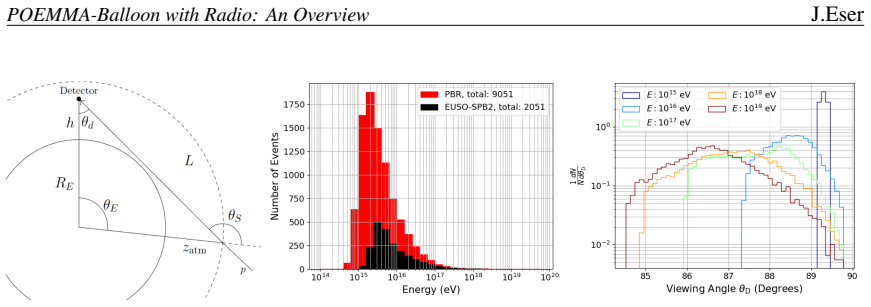
- [Sec. 2.2, Figs. 4–5] The expected-performance numbers rest on assumptions that are partially unstated and internally inconsistent. The HAHA rate is quoted for 'a 20% duty cycle over a 30-day flight' with a 500 TeV threshold, while the mission is described as 'more than 20 days' in Sec. 2 and 'as long as 50 days' in the Abstract. The neutrino sensitivity in the right panel of Fig. 5 assumes a 100-day April 2027 mission, while the left panel refers to an 'April 2023 flight.' Please state one set of baseline flight parameters, report rates per observation hour with explicit exposure, and include the dominant systematic uncertainties from atmospheric, detector-response, and trigger modeling.
minor comments (4)
- [Sec. 2.3] The antenna diameter is given as '60′′', which is easily confused with arcseconds. Please use '60 in' or provide a metric value.
- [Fig. 3] The left panel axis reads 'Number of Events/Hour' but it is not clear whether 'hour' means wall-clock time or live observation time after the 20% duty cycle. Please define the quantity on the axis.
- [References] Reference [10] appears incomplete (the PoS page number is missing), and reference [9] contains a typo: 'Flourescence' should be 'Fluorescence'.
- [Sec. 2.2] The claim that simultaneous radio and optical measurements 'potentially provid[e] an additional handle on primary cosmic-ray composition' would be strengthened by a citation to a quantitative study of composition sensitivity from hybrid radio-optical observations.
Circularity Check
No circular derivation: predictions are forward Monte Carlo results with external benchmarks; self-citations are lineage, not load-bearing.
full rationale
The paper is an instrument overview whose performance figures come from forward Monte Carlo simulations (EUSO-Offline for the fluorescence camera, EASCherSim for HAHA Cherenkov rates, nu-SpaceSim for neutrino ToO sensitivity). These are predictions made with stated assumptions (20% duty cycle, 30-50 day flight, 33 km altitude), not parameters fitted to the claimed sensitivities. The neutrino sensitivities are explicitly compared with independent limits from IceCube, Auger, and ANTARES in Fig. 5, providing an external consistency check. The central novelty claim—first combination of optical Cherenkov and radio measurements of HAHAs—is explicitly qualified as 'potentially providing an additional handle' and the paper states that 'Simulations to evaluate the RI's standalone sensitivity ... are also in progress.' That is an acknowledged missing quantitative support, not a circular step: the hybrid measurement is not asserted to follow from a fitted quantity. Self-citations to EUSO-SPB1, EUSO-SPB2, PUEO, and the collaboration's simulation frameworks document instrument lineage and prior development; they do not smuggle in the target result or forbid alternatives. No equation or definition reduces to its own input, and no uniqueness theorem is imported from the authors' prior work. Therefore, no significant circularity is present.
Axiom & Free-Parameter Ledger
free parameters (7)
- Duty cycle for HAHA rate =
20%
- Flight duration for HAHA and neutrino sensitivities =
30 days (HAHA), 100 days (neutrino map)
- Energy threshold for HAHA detection =
500 TeV
- Energy thresholds for fluorescence camera =
1.8 EeV (nadir), 4 EeV (limb)
- High-quality event fraction =
10%
- BNS merger distance for neutrino event map =
3 Mpc
- ToO observation time =
1000 s
axioms (6)
- domain assumption Air-shower simulation tools (EASCherSim, Corsika-based) accurately model the longitudinal development, Cherenkov light emission, and radio emission of extensive air showers at 33 km altitude.
- domain assumption The fluorescence yield and atmospheric transmission models used in EUSO-Offline are correct for the wavelength range 290-430 nm at the balloon altitude.
- domain assumption Night sky background and the BG3 filter response are modeled correctly in the simulation.
- domain assumption Neutrino cross-sections and Earth-skimming geometry are standard, and the nu-SpaceSim package tracks tau-neutrino regeneration and lepton decay correctly.
- domain assumption Radio emission from air showers is modeled correctly for the 50-550 MHz band and the horizontal geometry.
- domain assumption The balloon will achieve a stable flight longer than 20 days, with nighttime pointing as assumed.
Cite this review
Pith. "Pith review of POEMMA-Balloon with Radio: An Overview." pith.science (2026). https://pith.science/paper/LRNMF4NJ
@misc{pith2026250904302,
  author       = {Pith},
  title        = {Pith review of: POEMMA-Balloon with Radio: An Overview},
  year         = {2026},
  howpublished = {\url{https://pith.science/paper/LRNMF4NJ}},
  note         = {Machine review of arXiv:2509.04302}
}
read the original abstract
The POEMMA-Balloon with Radio (PBR) is an Ultra Long Duration Balloon payload scheduled for launch in Spring 2027 from Wanaka, New Zealand. It will circle over the Southern Ocean for a mission duration as long as 50 days, serving as a precursor to the dual satellite mission, Probe of Extreme Multi-Messenger Astrophysics (POEMMA). The PBR mission represents a significant step towards establishing a space-based multi-messenger observatory. Observations from space will enhance the statistics of the highest-energy cosmic rays and complement ground-based observatories by enabling simultaneous observations of both hemispheres with a single instrument. Additionally, POEMMA will facilitate the measurement of Very-High-Energy Neutrinos (VHENs) following multi-messenger alerts of astrophysical transient events, such as gamma-ray bursts. PBR is an adaptation of the POEMMA mission, featuring three primary science goals: 1. Observe Ultra-High-Energy Cosmic Rays (UHECRs) via the fluorescence technique from suborbital space. 2. Observe horizontal high-altitude air showers (HAHAs) with energies exceeding the cosmic ray knee (E > 3 PeV) using optical and radio detection for the first time. 3. Follow astrophysical event alerts in the search for VHENs. This contribution provides an overview of the PBR payload and discusses the expected performance of its various detectors.
Figures



Reference graph
Works this paper leans on
-
[1]
A. Coleman et al.,Ultra high energy cosmic rays The intersection of the Cosmic and Energy Frontiers, Astropart. Phys. 149(2023) 102819 [2205.05845]
arXiv 2023
-
[2]
POEMMAcollaboration,The POEMMA (Probe of Extreme Multi-Messenger Astrophysics) observatory, JCAP 06(2021) 007 [2012.07945]
Pith/arXiv arXiv 2021
-
[3]
JEM-EUSOcollaboration, From Ground to Space: An Overview of the JEM-EUSO Program for the Study of UHECRs and Astrophysical Neutrinos,PoS ICRC2025(2025) 360
work page 2025
-
[4]
Phys.154(2024) 102891 [2401.06525]
JEM-EUSOcollaboration,EUSO-SPB1 mission and science,Astropart. Phys.154(2024) 102891 [2401.06525]
Pith/arXiv arXiv 2024
-
[5]
JEM-EUSOcollaboration, The Extreme Universe Observatory on a Super-Pressure Balloon II: Mission, Payload, and Flight, 2505.20762
-
[6]
JEM-EUSOcollaboration,TheOpticalandMechanicalDesignofPOEMMABalloonwithRadio ,PoS ICRC2025 (2025) 332
work page 2025
-
[7]
JEM-EUSOcollaboration, EUSO-Offline: A comprehensive simulation and analysis framework,JINST 19 (2024) P01007 [2309.02577]
Pith/arXiv arXiv 2024
-
[8]
Phys.165(2025) 103046 [2406.13673]
JEM-EUSOcollaboration, The EUSO-SPB2 fluorescence telescope for the detection of Ultra-High Energy Cosmic Rays,Astropart. Phys.165(2025) 103046 [2406.13673]
Pith/arXiv arXiv 2025
-
[9]
JEM-EUSOcollaboration, The Flourescence Camera for the PBR mission,PoS ICRC2025(2025) 209
work page 2025
-
[10]
JEM-EUSOcollaboration, The Cherenkov Camera for the PBR mission,PoS ICRC2025(2025)
work page 2025
-
[11]
A.L. Cummings, R. Aloisio and J.F. Krizmanic,Modeling of the Tau and Muon Neutrino-induced Optical Cherenkov Signals from Upward-moving Extensive Air Showers,Phys. Rev. D103 (2021) 043017 [2011.09869]
Pith/arXiv arXiv 2021
-
[12]
A. Cummings, R. Aloisio, J. Eser and J. Krizmanic,Modeling the optical Cherenkov signals by cosmic ray extensive air showers directly observed from suborbital and orbital altitudes,Phys. Rev. D104(2021) 063029 [2105.03255]
Pith/arXiv arXiv 2021
-
[13]
C. Guépin, K. Kotera and F. Oikonomou,High-energy neutrino transients and the future of multi-messenger astronomy,Nature Rev. Phys.4(2022) 697 [2207.12205]
Pith/arXiv arXiv 2022
-
[14]
K. Fang and B.D. Metzger,High-Energy Neutrinos from Millisecond Magnetars formed from the Merger of Binary Neutron Stars,Astrophys. J.849(2017) 153 [1707.04263]
Pith/arXiv arXiv 2017
-
[15]
𝜈SpaceSimcollaboration,𝜈SpaceSim: A Comprehensive Simulation Package for Modeling the Measurement of Cosmic Neutrinos using the Earth as the Neutrino Target and Space-based Detectors,PoS ICRC2025(2025) 1082
work page 2025
-
[16]
T.M. Venters, M.H. Reno, J.F. Krizmanic, L.A. Anchordoqui, C. Guépin and A.V. Olinto,POEMMA’s Target of Opportunity Sensitivity to Cosmic Neutrino Transient Sources, Phys. Rev. D102(2020) 123013 [1906.07209]
Pith/arXiv arXiv 2020
-
[17]
Q. Abarr, P. Allison, J. Ammerman Yebra, J. Alvarez-Muñiz, J. Beatty, D. Besson et al.,The Payload for Ultrahigh Energy Observations (PUEO): a white paper,Journal of Instrumentation16 (2021) P08035. 8 POEMMA-Balloon with Radio: An Overview J.Eser Full Authors list: The JEM-EUSO Collaboration M. Abdullahi𝑒𝑝,𝑒𝑟 M. Abrate𝑒𝑘,𝑒𝑙, J.H. Adams Jr.𝑙𝑑, D. Allard𝑐𝑏,...
work page 2021
This paper was first reviewed by deepseek-v4-flash on August 5, 2026.
discussion (0)
Sign in with ORCID, Apple, or X to comment. Anyone can read and Pith papers without signing in.