REVIEW 5 major objections 6 minor 29 references
IntentionESC: An Intention-Centered Framework for Enhancing Emotional Support in Dialogue Systems
T0 review · 5 major / 6 minor · reviewed 2026-08-07 · deepseek-v4-flash
Pith's one-line read Explicit supporter intention improves emotional support responses in dialogue systems.
desk verdict IntentionESC adds a therapy-grounded intention stage to ESC, but the central causal claim is undercut by derived intention labels and uncontrolled baselines. read the letter →
The pith
A machine-rendered reading of the paper's core claim, the machinery that carries it, and where it could break.
The reading
What carries the argument
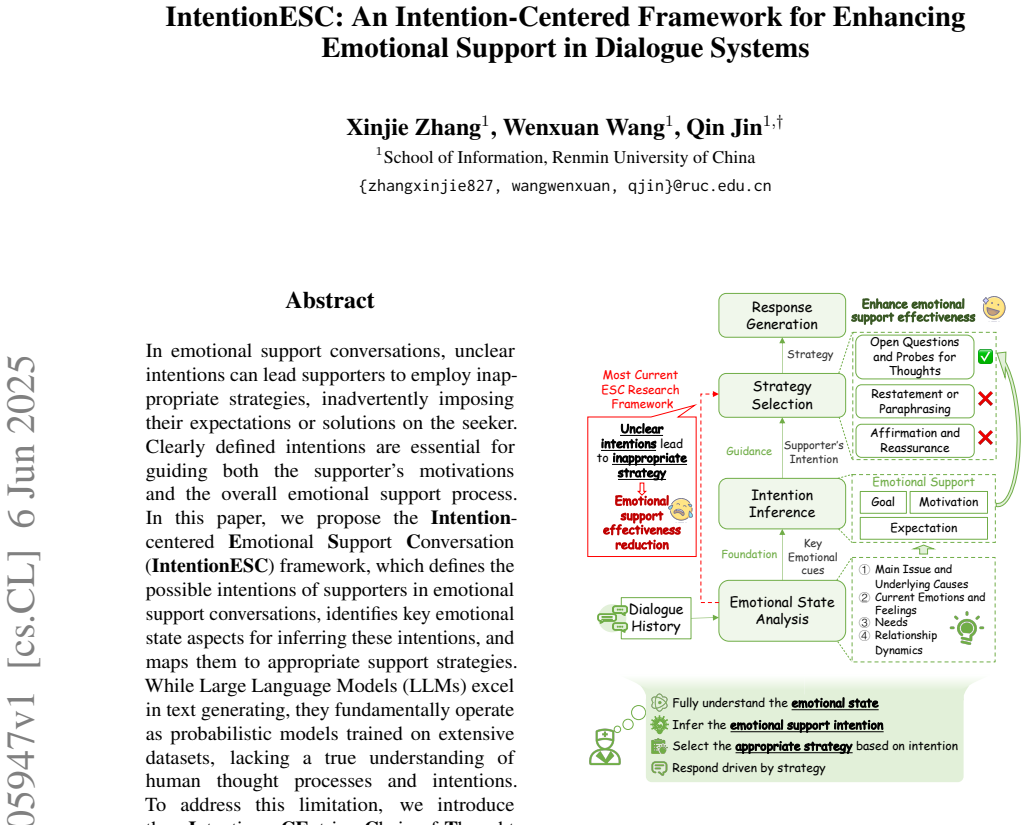
The load-bearing mechanism is the ICECoT reasoning chain together with the intention–strategy mapping from IntentionESC. The mapping connects 12 intentions (e.g., Clarify, Cathart, Insight, Support, Hope, Give information) to the support strategies used in ESConv, such as Open Questions and Probes, Affirmation and Reassurance, and Providing Suggestions. The ICECoT chain makes the reasoning explicit in four steps: emotional state analysis over four aspects, intention inference, strategy selection, and response generation. An automated pipeline built on GPT-4 produces the training chains by refining the original strategy labels and using the intention–strategy mapping to propose intention categories, and the model is trained to reproduce both the chain and the final response.
What would settle it
Run a controlled human evaluation in which the ICECoT model is compared with an identical model whose intention-inference step is replaced by a random intention drawn from the same training distribution, keeping data and generation otherwise unchanged; if scores do not drop significantly, the intention step is not carrying the improvement. A second check is to evaluate ICECoT on emotional support conversations outside ESConv, where the strategy-label distribution that generates the intention annotations is absent.
Extended reading notes
Core claim
On its own terms, the paper's central claim is that intention is the missing link between understanding the seeker's emotional state and selecting an effective support strategy. The authors define a supporter's intention as the goal, motivation, and expectation behind a response, and they derive 12 such intentions from the therapy literature. They claim that when a model first analyzes the seeker's main issue and causes, current emotions, needs, and relationship dynamics, then infers an intention, then picks a strategy, the resulting responses are more effective than responses generated from emotional state or strategy alone. In their experiments, ICECoT trained on ESConv with automatically annotated reasoning chains receives the best human and GPT-4-based scores on all single-response and entire-conversation dimensions compared to BlenderBot, MultiESC, and ESCoT.
Load-bearing premise
The load-bearing premise is that a supporter's intention can be reliably read off from a seeker's emotional state and, in the training data, from the existing strategy labels; if those strategy labels are noisy or the 12 therapy-derived intentions do not fit everyday support conversations, the intention annotations inherit that bias and the reported gains may not transfer.
Editorial extensions
If this is right
- Future emotional support systems can condition generation on an inferred intention instead of only on emotion labels or strategies.
- The four-aspect emotional state checklist provides a reusable annotation scheme for building larger emotional support datasets.
- ICECoT makes the model's reasoning visible, so users and evaluators can check whether the chosen strategy follows from an intention that matches the seeker's state.
- Training on mixed data—full reasoning chains plus direct strategy-response pairs—can compensate for fluency losses that long chains cause, a design choice the paper's ablations support.
Reading between the lines
- The 12-intention taxonomy could be validated as a complete ontology by collecting open-domain support dialogues and checking for intentions that fall outside the list; the paper's own limitation about limited scenarios points in this direction.
- A control condition that replaces the inferred intention with a paraphrase of the selected strategy would reveal whether the intention step adds signal beyond the strategy label, since the annotation pipeline derives intention candidates from strategy annotations.
- The intention-to-strategy mapping could be exposed to users as a control knob, letting a person choose the kind of support they want (e.g., clarifying questions rather than advice) before the model writes a response.
Editorial analysis
A structured set of objections, weighed in public.
Referee Report
Summary. The paper proposes IntentionESC, a framework that defines 12 supporter intentions in emotional support conversations, identifies four emotional-state aspects for inferring them, and maps intentions to support strategies. Building on this, the authors introduce ICECoT, a chain-of-thought mechanism in which a model first analyzes the seeker's emotional state, then infers the supporter's intention, then selects a strategy, and finally generates a response. They describe an automated GPT-4-based annotation pipeline that enriches the ESConv dataset with emotional-state and intention labels, train Llama3.1-8B-Instruct on this data, and evaluate the resulting model against BlenderBot, MultiESC, and ESCoT using a mix of GPT-4 ranking and human annotation on single-response and whole-conversation dimensions. The paper claims that ICECoT outperforms all baselines across all evaluated metrics.
Significance. If the central claim were fully supported, the paper would make a useful contribution: explicitly modeling supporter intentions in emotional support dialogue is a plausible route to more interpretable and effective systems, and the released data, code, and evaluation scheme would be reusable assets for the community. The authors also deserve credit for being transparent about the main limitation of their annotation pipeline, for proposing a new evaluation framework that includes safety and consistency dimensions, and for making their data and code available. However, the current evidence is not yet sufficient to establish the claimed superiority of the intention-centered approach: the main baseline comparison is confounded by different base models, the intention labels are derived from the very strategy annotations they are meant to explain, and the reliability of the human evaluation is low on several key dimensions.
major comments (5)
- [§5.3, Table 1, Appendix C] The headline comparison in Table 1 is confounded by backbone. ICECoT is trained on Llama3.1-8B-Instruct, while ESCoT is the released Llama2-7B-chat model, and BlenderBot and MultiESC are smaller architectures. Because the main claimed advantage over ESCoT may be explained by the newer/larger instruction-tuned base model, the comparison does not isolate the effect of intention modeling. Please add a same-backbone ESCoT run, or an equivalent Llama3.1 baseline without ICECoT, before claiming that ICECoT outperforms prior methods.
- [§4.3, Figure 5, Limitations] The intention labels are not an independent construct. The pipeline first refines ESConv strategy annotations, then generates candidate intentions using the predefined intention–strategy mapping in Figure 2, and then asks GPT-4 to produce a natural-language intention from those candidates. The resulting intention is therefore effectively a paraphrase of a deterministic function of the strategy label that ICECoT is supposed to explain. The Limitations section itself concedes that the pre-existing strategy distribution may bias the intention annotations. To support the central claim, please provide evidence that the learned intention variable carries information beyond the strategy label, for example human intention annotations collected without exposing annotators to the strategy label, or a distributional analysis showing that the emitted intentions are not nearly deterministic given the strategy.
- [§5.3, Table 1] The sentence 'Our ICECoT outperforms other compared methods on all metrics' overstates the results. Only four of the seven dimensions carry a ‡ (p<0.05), and the reported p-values appear to come from a single sign test over all models rather than pairwise tests against each baseline. Please report pairwise p-values against each compared method, apply a multiple-comparison correction if needed, and restrict the superiority claim to the dimensions that are actually significant.
- [§5.4, Table 2, Appendix E] The full ICECoT chain underperforms direct generation on Base Quality, Empathy, Informativeness, and Comforting. The final best system is ICECoT plus an additional 'strategy-and-response-only' training set D_SA, which was introduced after observing this underperformance. As presented, the central claim that ICECoT itself improves emotional support is therefore contingent on a post-hoc repair. Please justify D_SA as a principled component of the method, report whether its introduction was pre-specified, and provide significance tests comparing the final model with the direct-generation setting on each dimension.
- [§5.2, Tables 1 and 2] The inter-annotator agreement is very low for several load-bearing dimensions: in Table 1, Identification κ=0.12 and Comforting κ=0.17; in Table 2, Comforting κ=0.07 and Identification κ=0.21. With agreement at these levels, the ranking data may be too noisy to support fine-grained cross-model conclusions. Please report the number of annotators per item, the adjudication procedure, and consider pooling dimensions or using a more reliable scale, or interpret results with appropriate caution.
minor comments (6)
- [§3.1] There is a typo: 'acomplish' should be 'accomplish'.
- [Figure 2] The strategy numbers under each intention are difficult to decode; please add a legend that explicitly maps the numbers to the strategy list.
- [Tables 1 and 2 captions] The κ values are listed in a single dense line in the captions; please report them per dimension in the table itself so that reliability is transparent and easy to compare.
- [§5.2] The composite 'Base Quality' dimension is formed from Fluency, Coherence, Safety, and Consistency, which are evaluated by GPT-4 ranking, while Empathy and Informativeness are evaluated by human annotators; please clarify exactly how the composite ranking was aggregated (e.g., average ranks, majority vote, or another rule).
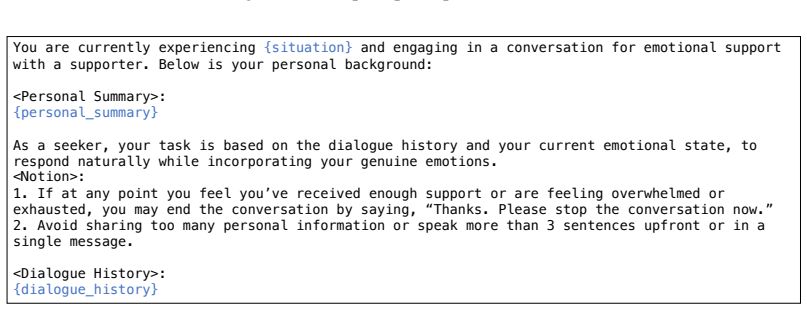
- [Figure 10] The prompt text contains a typo: 'evluation' should be 'evaluation'.
- [§1 and §2] The claim of being 'the first to focus on supporters' intentions' should be softened: related work such as GLHG already models a local intention of the current speaker, so the novelty should be positioned as supporter-intention learning and intention-driven strategy selection rather than intention modeling per se.
Circularity Check
Intention labels in §4.3 are generated from ESConv strategy annotations through the paper's own intention–strategy mapping, so the 'intention inference' training signal is a paraphrase of the strategy labels it is claimed to explain; final human evaluation keeps this at partial rather than full circularity.
-
self definitional
[Section 4.3 (Intention Inference), Figure 5; Limitations]
"(2) Intention Estimation: Using predefined intention-strategy relationships in IntentionESC to estimate possible intentions based on existing strategy annotations; (3) Intention Generation: Producing a final intention annotation for the current response based on dialogue history and candidate intentions."
The 'intention' labels used to train ICECoT are not obtained from an independent source: they are produced from the ESConv strategy annotations via the paper's own predefined intention–strategy mapping, then paraphrased by GPT-4. So the intention-inference stage is trained to reconstruct a deterministic function of the very strategy labels the framework is supposed to explain. The ICECoT gain over baselines can therefore be explained by earlier injection of strategy-conditioned information, not by an independently meaningful intention construct. The paper's Limitation concedes this ('pre-existing distribution of strategy annotations may disproportionately influence the annotation of intentions').
full rationale
The central empirical comparison (Tables 1–2) evaluates ICECoT against baselines on GPT-4 and human-judged response quality, so the headline result is not a pure tautology and keeps the paper from being fully circular. However, the paper's own annotation pipeline generates intention labels from ESConv strategy annotations using the Figure 2 mapping, making 'intention inference' a paraphrase of strategy labels; the ablation varies whether intention tokens are emitted, but all settings share the same strategy-derived training signal. The Limitations explicitly admit this bias. Because the distinct contribution is the intention construct, and that construct is built out of the very strategy labels it is said to guide, the evidence for the causal role of intention is partially circular. No load-bearing self-citation issue was found: ESCoT is a same-group baseline but functions as a comparison system, not as the justification for the framework's core premise. Score 4 reflects one admitted construct-level reduction with independent final evaluation.
Assumptions & free parameters
assumptions (5)
- domain assumption The 12 intentions adapted from Hill and O'Grady transfer to casual emotional support conversations and map sufficiently well to strategies to be learnable.
- domain assumption ESConv strategy annotations are reliable enough to serve as anchors for generating intention labels.
- domain assumption GPT-4 can produce high-quality emotional state, intention, and strategy annotations following the framework prompts.
- domain assumption The lower-rank-mean evaluation with GPT-4 and a few human annotators captures emotional support effectiveness.
- ad hoc to paper Mixed training data D_SA introduced after observing full ICECoT underperformance is a valid fix rather than an overfit to the evaluation.
invented entities (2)
-
Supporter intention as an explicit latent variable in emotional support conversations
-
ICECoT reasoning chain (emotional state to intention to strategy to response)
Cite this review
Pith. "Pith review of IntentionESC: An Intention-Centered Framework for Enhancing Emotional Support in Dialogue Systems." pith.science (2026). https://pith.science/paper/LSPKCI7G
@misc{pith2026250605947,
  author       = {Pith},
  title        = {Pith review of: IntentionESC: An Intention-Centered Framework for Enhancing Emotional Support in Dialogue Systems},
  year         = {2026},
  howpublished = {\url{https://pith.science/paper/LSPKCI7G}},
  note         = {Machine review of arXiv:2506.05947}
}
read the original abstract
In emotional support conversations, unclear intentions can lead supporters to employ inappropriate strategies, inadvertently imposing their expectations or solutions on the seeker. Clearly defined intentions are essential for guiding both the supporter's motivations and the overall emotional support process. In this paper, we propose the Intention-centered Emotional Support Conversation (IntentionESC) framework, which defines the possible intentions of supporters in emotional support conversations, identifies key emotional state aspects for inferring these intentions, and maps them to appropriate support strategies. While Large Language Models (LLMs) excel in text generating, they fundamentally operate as probabilistic models trained on extensive datasets, lacking a true understanding of human thought processes and intentions. To address this limitation, we introduce the Intention Centric Chain-of-Thought (ICECoT) mechanism. ICECoT enables LLMs to mimic human reasoning by analyzing emotional states, inferring intentions, and selecting suitable support strategies, thereby generating more effective emotional support responses. To train the model with ICECoT and integrate expert knowledge, we design an automated annotation pipeline that produces high-quality training data. Furthermore, we develop a comprehensive evaluation scheme to assess emotional support efficacy and conduct extensive experiments to validate our framework. Our data and code are available at https://github.com/43zxj/IntentionESC_ICECoT.
Figures


Figures from the paper (18 more)




Reference graph
Works this paper leans on
-
[1]
online" 'onlinestring :=
ENTRY address archivePrefix author booktitle chapter edition editor eid eprint eprinttype howpublished institution journal key month note number organization pages publisher school series title type volume year doi pubmed url lastchecked label extra.label sort.label short.list INTEGERS output.state before.all mid.sentence after.sentence after.block STRING...
-
[2]
write newline
" write newline "" before.all 'output.state := FUNCTION n.dashify 't := "" t empty not t #1 #1 substring "-" = t #1 #2 substring "--" = not "--" * t #2 global.max substring 't := t #1 #1 substring "-" = "-" * t #2 global.max substring 't := while if t #1 #1 substring * t #2 global.max substring 't := if while FUNCTION word.in bbl.in capitalize " " * FUNCT...
-
[3]
T Albrecht and M Adelman. 1987. Communicating social support: A theoretical perspective. Communicating Social Support. Beverly Hills, CA: Sage, pages 18--39
work page 1987
-
[4]
Brant R Burleson. 2003. Emotional support skills. In Handbook of communication and social interaction skills, pages 569--612. Routledge
work page 2003
-
[5]
Wei Chen, Hengxu Lin, Qun Zhang, Xiaojin Zhang, Xiang Bai, Xuanjing Huang, and Zhongyu Wei. 2024. Cauesc: A causal aware model for emotional support conversation. arXiv preprint arXiv:2401.17755
work page Pith review arXiv 2024
-
[6]
Yi Chen, Rui Wang, Haiyun Jiang, Shuming Shi, and Ruifeng Xu. 2023. Exploring the use of large language models for reference-free text quality evaluation: An empirical study. In Findings of the Association for Computational Linguistics: IJCNLP-AACL 2023 (Findings), pages 361--374
work page 2023
-
[7]
Jiale Cheng, Sahand Sabour, Hao Sun, Zhuang Chen, and Minlie Huang. 2023. Pal: Persona-augmented emotional support conversation generation. In Findings of the Association for Computational Linguistics: ACL 2023, pages 535--554
2023
-
[8]
Yi Cheng, Wenge Liu, Wenjie Li, Jiashuo Wang, Ruihui Zhao, Bang Liu, Xiaodan Liang, and Yefeng Zheng. 2022. Improving multi-turn emotional support dialogue generation with lookahead strategy planning. In Proceedings of the 2022 Conference on Empirical Methods in Natural Language Processing, pages 3014--3026
2022
Show all 29 references
-
[9]
Yi Cheng, Wenge Liu, Jian Wang, Chak Tou Leong, Yi Ouyang, Wenjie Li, Xian Wu, and Yefeng Zheng. 2024. Cooper: Coordinating specialized agents towards a complex dialogue goal. In Proceedings of the AAAI Conference on Artificial Intelligence, volume 38, pages 17853--17861
2024
-
[10]
Carolyn E Cutrona and Daniel W Russell. 1987. The provisions of social relationships and adaptation to stress. Advances in personal relationships, 1(1):37--67
1987
-
[11]
Abhimanyu Dubey, Abhinav Jauhri, Abhinav Pandey, Abhishek Kadian, Ahmad Al-Dahle, Aiesha Letman, Akhil Mathur, Alan Schelten, Amy Yang, Angela Fan, et al. 2024. The llama 3 herd of models. arXiv preprint arXiv:2407.21783
2024 arXiv
-
[12]
Clara E Hill. 2009. Helping skills: Facilitating, exploration, insight, and action. American Psychological Association
2009
-
[13]
Clara E Hill and Kevin E O'Grady. 2001. List of therapist intentions illustrated in a case study and with therapists of varying theoretical orientations. In Meeting of the Society for Psychotherapy Research., Jun, 1983, Sheffield, England; A version of this study was presented...
2001
-
[14]
Zhaopei Huang, Jinming Zhao, and Qin Jin. 2024. Ecr-chain: Advancing generative language models to better emotion-cause reasoners through reasoning chains. arXiv preprint arXiv:2405.10860
2024 arXiv
-
[15]
Shiyang Li, Jianshu Chen, Zhiyu Chen, Xinlu Zhang, Zekun Li, Hong Wang, Jing Qian, Baolin Peng, Yi Mao, Wenhu Chen, et al. 2024. Explanations from large language models make small reasoners better. In 2nd Workshop on Sustainable AI
2024
-
[16]
Chin-Yew Lin. 2004. Rouge: A package for automatic evaluation of summaries. In Text summarization branches out, pages 74--81
2004
-
[17]
Siyang Liu, Chujie Zheng, Orianna Demasi, Sahand Sabour, Yu Li, Zhou Yu, Yong Jiang, and Minlie Huang. 2021. Towards emotional support dialog systems. In Proceedings of the 59th Annual Meeting of the Association for Computational Linguistics and the 11th International Joint Co...
2021
-
[18]
Yinhong Liu, Han Zhou, Zhijiang Guo, Ehsan Shareghi, Ivan Vuli \'c , Anna Korhonen, and Nigel Collier. 2024. Aligning with human judgement: The role of pairwise preference in large language model evaluators. In First Conference on Language Modeling
2024
-
[19]
Kishore Papineni, Salim Roukos, Todd Ward, and Wei-Jing Zhu. 2002. Bleu: a method for automatic evaluation of machine translation. In Proceedings of the 40th annual meeting of the Association for Computational Linguistics, pages 311--318
2002
-
[20]
Wei Peng, Yue Hu, Luxi Xing, Yuqiang Xie, Yajing Sun, and Yunpeng Li. 2022. https://doi.org/10.24963/ijcai.2022/600 Control globally, understand locally: A global-to-local hierarchical graph network for emotional support conversation . In Proceedings of the Thirty-First Intern...
2022 doi
-
[21]
Stephen A Rains, Corey A Pavlich, Bethany Lutovsky, Eric Tsetsi, and Anjali Ashtaputre. 2020. Support seeker expectations, support message quality, and supportive interaction processes and outcomes: The case of the comforting computer program revisited. Journal of Social and P...
2020
-
[22]
Stephen Roller, Emily Dinan, Naman Goyal, Da Ju, Mary Williamson, Yinhan Liu, Jing Xu, Myle Ott, Eric Michael Smith, Y-Lan Boureau, and Jason Weston. 2021. https://doi.org/10.18653/v1/2021.eacl-main.24 Recipes for building an open-domain chatbot . In Proceedings of the 16th Co...
2021 doi
-
[23]
Quan Tu, Yanran Li, Jianwei Cui, Bin Wang, Ji-Rong Wen, and Rui Yan. 2022. Misc: A mixed strategy-aware model integrating comet for emotional support conversation. In Proceedings of the 60th Annual Meeting of the Association for Computational Linguistics (Volume 1: Long Papers...
2022
-
[24]
Lanrui Wang, Jiangnan Li, Chenxu Yang, Zheng Lin, and Weiping Wang. 2023. Enhancing empathetic and emotion support dialogue generation with prophetic commonsense inference. arXiv preprint arXiv:2311.15316
2023 arXiv
-
[25]
Tenggan Zhang, Xinjie Zhang, Jinming Zhao, Li Zhou, and Qin Jin. 2024 a . https://doi.org/10.18653/v1/2024.acl-long.723 ESC o T : Towards interpretable emotional support dialogue systems . In Proceedings of the 62nd Annual Meeting of the Association for Computational Linguisti...
2024 doi
-
[26]
Zaibin Zhang, Yongting Zhang, Lijun Li, Jing Shao, Hongzhi Gao, Yu Qiao, Lijun Wang, Huchuan Lu, and Feng Zhao. 2024 b . Psysafe: A comprehensive framework for psychological-based attack, defense, and evaluation of multi-agent system safety. In Proceedings of the 62nd Annual M...
2024
-
[27]
Weixiang Zhao, Yanyan Zhao, Shilong Wang, and Bing Qin. 2023. Transesc: Smoothing emotional support conversation via turn-level state transition. In Findings of the Association for Computational Linguistics: ACL 2023, pages 6725--6739
2023
-
[28]
Chujie Zheng, Sahand Sabour, Jiaxin Wen, Zheng Zhang, and Minlie Huang. 2023. Augesc: Dialogue augmentation with large language models for emotional support conversation. In Findings of the Association for Computational Linguistics: ACL 2023, pages 1552--1568
2023
-
[29]
Jinfeng Zhou, Zhuang Chen, Bo Wang, and Minlie Huang. 2023. Facilitating multi-turn emotional support conversation with positive emotion elicitation: A reinforcement learning approach. In Proceedings of the 61st Annual Meeting of the Association for Computational Linguistics (...
2023
Reviewed August 7, 2026 · model on record in the stance chip above.
Discussion (0). Sign in to comment.