Bridging the continuum and the kinetic-Boltzmann theories of heat flow through generalized Knudsen numbers
Pith reviewed 2026-06-26 23:52 UTC · model grok-4.3
The pith
A single continuum equation from eigenmode analysis of the phonon Boltzmann equation unifies all heat flow regimes in semiconductors from diffusive to ballistic.
A machine-rendered reading of the paper's core claim, the machinery that carries it, and where it could break.
Core claim
Systematic reduction of the linearized Peierls-Boltzmann equation yields the usual continuum descriptions only for limiting values of the generalized Knudsen numbers; all continuum regimes together with ballistic flow are instead captured by one continuum equation for the temperature field that originates from the eigenmode analysis of the same equation, thereby bridging the continuum and kinetic pictures and exposing previously unidentified features of non-Fourier heat flow.
What carries the argument
The unified continuum equation for the temperature field obtained from eigenmode analysis of the linearized Peierls-Boltzmann equation, with its coefficients set by generalized Knudsen numbers that mark the boundaries between regimes.
If this is right
- The weakly quasiballistic and hydrodynamic regimes are mutually exclusive.
- The velocity of the hydrodynamic second-sound temperature wave depends on heating length, with a specific length that produces the strongest second sound.
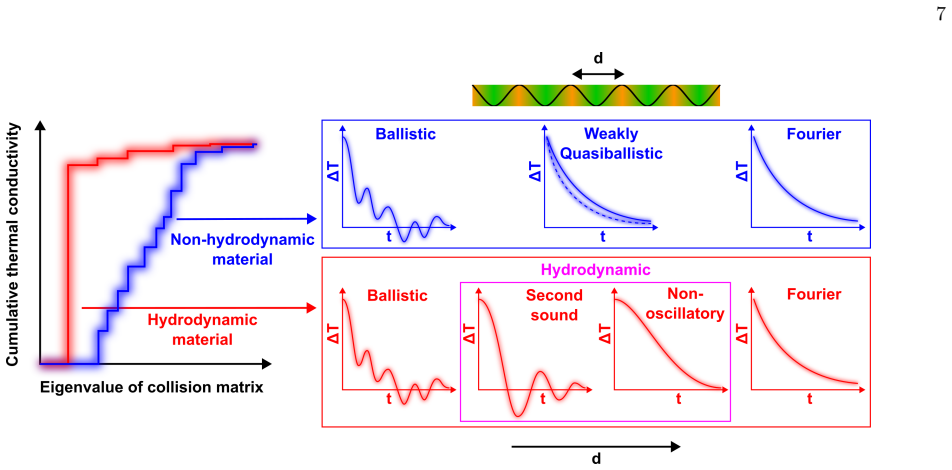
- Frequency-domain temperature responses distinguish hydrodynamic second sound from ballistic heat flow.
- Transient hydrodynamic heat flow carries a previously unrecognized non-oscillatory signature.
Where Pith is reading between the lines
- Varying sample size or modulation frequency in a single material should allow systematic mapping of the transitions between regimes.
- The same eigenmode reduction approach could be tested on other quasiparticle transport problems governed by Boltzmann-type equations.
- The framework supplies concrete targets for time-resolved experiments aimed at isolating the new non-oscillatory hydrodynamic signature.
Load-bearing premise
The eigenmode analysis of the linearized Peierls-Boltzmann equation produces a closed continuum equation whose coefficients remain valid across the full range of generalized Knudsen numbers without additional fitting or truncation.
What would settle it
Direct observation of weakly quasiballistic and hydrodynamic heat flow occurring together in one semiconductor sample, or measured temperature dynamics in any of the twenty-three materials that deviate from the predictions of the single unified equation.
Figures
read the original abstract
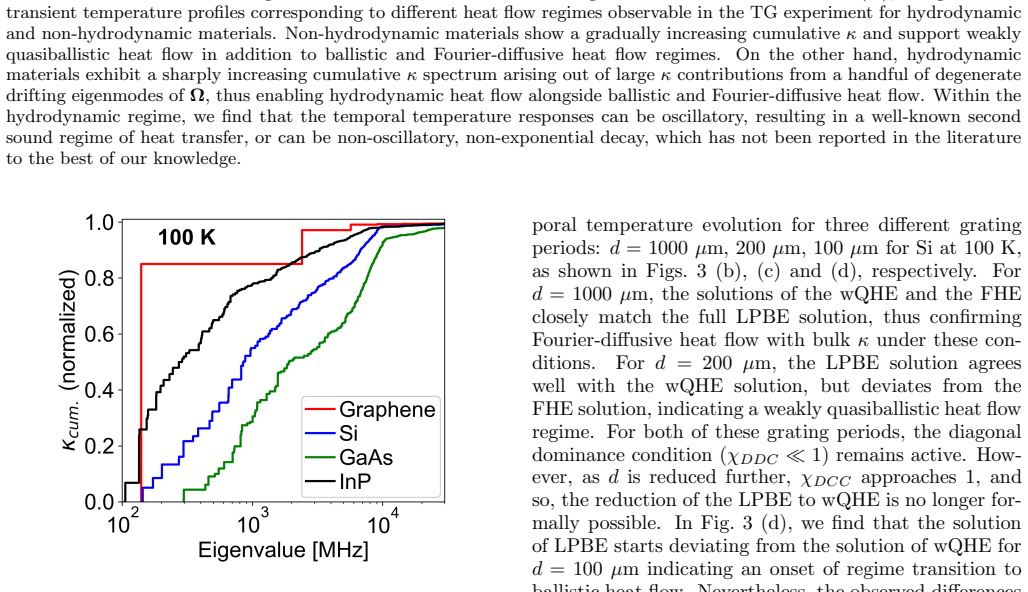
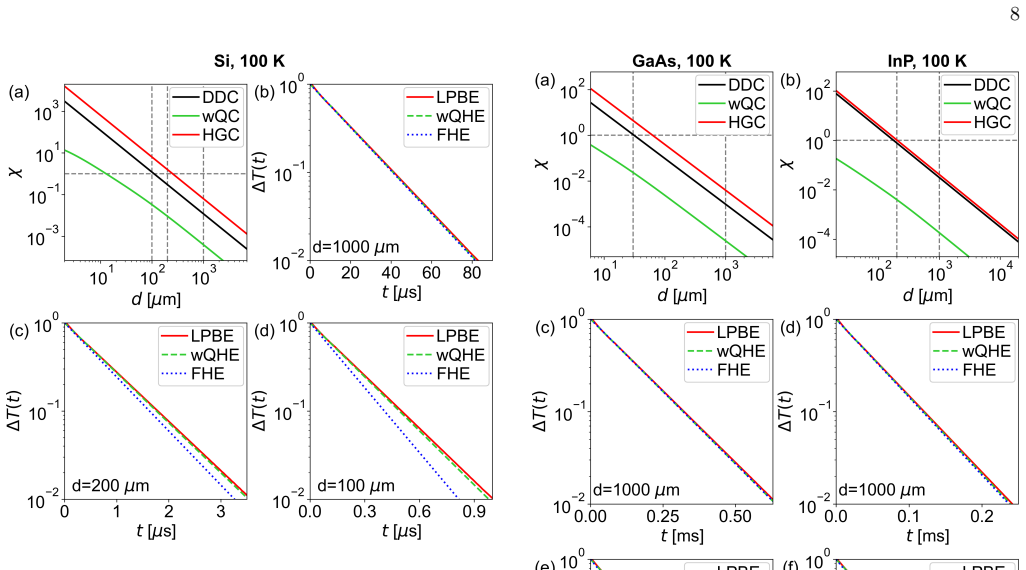
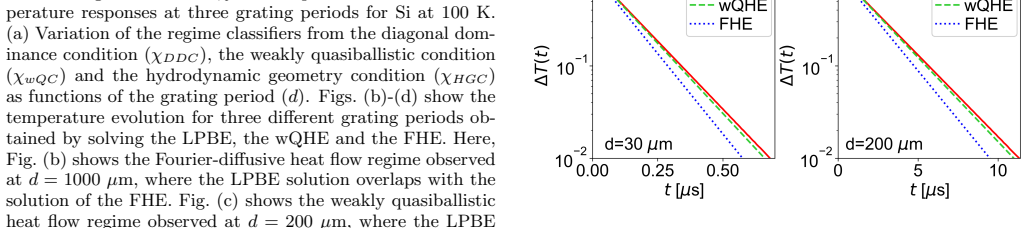
Heat conduction in semiconductor crystals is fundamentally governed by the linearized Peierls-Boltzmann equation (LPBE) for phonon transport, that arises out of a kinetic theory for phonon quasiparticles. Yet, continuum theories such as the Fourier's heat diffusion, weakly quasiballistic and hydrodynamic heat equations are often used to explain the experimental observations of heat flow in these materials. Here, we show that a systematic reduction of the LPBE into such equivalent continuum descriptions are possible only for the limiting values of a set of generalized Knudsen numbers. We further show that all of these continuum heat flow regimes, along with the ballistic heat flow, can be described by a single continuum equation for the temperature field that originates from the eigenmode analysis of the LPBE, thus offering a unified picture of all possible heat flow regimes in semiconducting crystals. Using quantitative examples on twenty three technologically important semiconductors, we show that several previously-unidentified features of the non-Fourier heat flow regimes emerge from this generalized Knudsen number framework such as (1) the mutual exclusivity of the weakly quasiballistic and the hydrodynamic heat flow regimes, (2) length-dependent velocity of the hydrodynamic second sound temperature wave and a characteristic heating length for the strongest hydrodynamic second sound, (3) characteristic frequency-domain temperature response distinguishing the hydrodynamic second sound from the ballistic heat flow regime and, (4) a new non-oscillatory signature of transient hydrodynamic heat flow. Our work formally bridges the continuum and the particulate descriptions of heat flow, and provides insights into the important signatures of temperature dynamics in each of these heat flow regimes, that will aid in their unambiguous experimental observations in the future.
Editorial analysis
A structured set of objections, weighed in public.
Referee Report
Summary. The manuscript claims that systematic reductions of the linearized Peierls-Boltzmann equation (LPBE) to standard continuum heat-flow models (Fourier, weakly quasiballistic, hydrodynamic) are possible only at limiting values of a set of generalized Knudsen numbers. It further asserts that a single continuum PDE for the temperature field, obtained via eigenmode analysis of the LPBE, unifies all these regimes together with the ballistic limit. Quantitative illustrations on 23 semiconductors are used to extract previously unidentified signatures, including mutual exclusivity of the weakly quasiballistic and hydrodynamic regimes, length-dependent second-sound velocity, and distinct frequency-domain responses.
Significance. If the eigenmode-derived equation can be shown to remain closed and accurate without Kn-dependent truncation or refitting, the work would supply a concrete bridge between the kinetic LPBE and continuum descriptions, together with falsifiable experimental signatures. The breadth of the material survey is a positive feature.
major comments (2)
- [Abstract] Abstract: the central claim that the eigenmode analysis directly supplies one closed continuum PDE whose coefficients remain valid and exact across the entire range of generalized Knudsen numbers (including the ballistic limit) is asserted without an explicit derivation or error bound showing that the projection avoids the Kn-dependent truncation that normally appears in finite-mode or moment closures of the Boltzmann equation.
- [Results on 23 materials] Section on quantitative examples (23 semiconductors): the reported new features (mutual exclusivity, length-dependent second-sound velocity, characteristic heating length, frequency-domain distinctions) are presented without error bars, without direct numerical comparison to solutions of the full LPBE, and without a statement of the number of retained eigenmodes, so it is impossible to judge whether the unified equation reproduces the LPBE outside the limiting-Kn regimes for which the reductions are known to be valid.
minor comments (1)
- [Theory] The definition and explicit construction of the generalized Knudsen numbers should be collected in a single early section or table rather than introduced piecemeal.
Simulated Author's Rebuttal
We thank the referee for their careful reading and constructive comments on our manuscript. We address each major comment below, indicating the revisions we plan to make to strengthen the presentation of the eigenmode reduction and its validation.
read point-by-point responses
-
Referee: [Abstract] Abstract: the central claim that the eigenmode analysis directly supplies one closed continuum PDE whose coefficients remain valid and exact across the entire range of generalized Knudsen numbers (including the ballistic limit) is asserted without an explicit derivation or error bound showing that the projection avoids the Kn-dependent truncation that normally appears in finite-mode or moment closures of the Boltzmann equation.
Authors: The eigenmode projection is derived in the main text by expanding the LPBE solution in the eigenbasis of the collision operator, retaining only the temperature mode (the slowest-decaying eigenmode) while higher modes are orthogonal and decay exponentially faster. The resulting PDE for temperature is closed by construction, with coefficients determined solely by material properties (eigenvalues and matrix elements) and independent of Kn. To address the request for explicitness, we will add a dedicated subsection in the revised manuscript that spells out the projection operator, derives the closed PDE step by step, and supplies an error bound based on the spectral gap to the next eigenmode. This will clarify why no Kn-dependent truncation arises. revision: yes
-
Referee: [Results on 23 materials] Section on quantitative examples (23 semiconductors): the reported new features (mutual exclusivity, length-dependent second-sound velocity, characteristic heating length, frequency-domain distinctions) are presented without error bars, without direct numerical comparison to solutions of the full LPBE, and without a statement of the number of retained eigenmodes, so it is impossible to judge whether the unified equation reproduces the LPBE outside the limiting-Kn regimes for which the reductions are known to be valid.
Authors: We agree that the quantitative section would benefit from additional documentation. The unified equation retains exactly one eigenmode (the temperature mode), as described in the methods. In the revision we will (i) explicitly state the number of retained eigenmodes, (ii) add error bars to all plotted quantities, and (iii) include direct numerical comparisons of the unified PDE against full LPBE solutions for a representative subset of the 23 materials across a range of Kn values. The new signatures are analytic consequences of the single-mode equation and therefore hold within its validity; the added comparisons will confirm reproduction of the LPBE outside the known limiting regimes. revision: yes
Circularity Check
No circularity: derivation proceeds from LPBE eigenmode analysis to a single continuum PDE without reduction to fitted inputs or self-citations.
full rationale
The paper's central claim is that eigenmode analysis of the linearized Peierls-Boltzmann equation directly yields one closed continuum equation for the temperature field whose coefficients are valid across all generalized Knudsen numbers, including the ballistic limit. The abstract and provided excerpts describe this as a systematic reduction valid for limiting Kn values, with the unified equation then used to identify new features in 23 materials. No step reduces a prediction to a fit of the same data, renames a known result, or relies on a load-bearing self-citation whose content is unverified. The derivation chain is presented as originating from the LPBE spectral analysis itself rather than from any ansatz or truncation that is defined circularly in terms of the target continuum equation. This is the normal case of an independent first-principles reduction.
Axiom & Free-Parameter Ledger
axioms (1)
- domain assumption The eigenmodes of the LPBE form a complete basis that yields a closed continuum temperature equation valid for arbitrary generalized Knudsen numbers.
Reference graph
Works this paper leans on
-
[1]
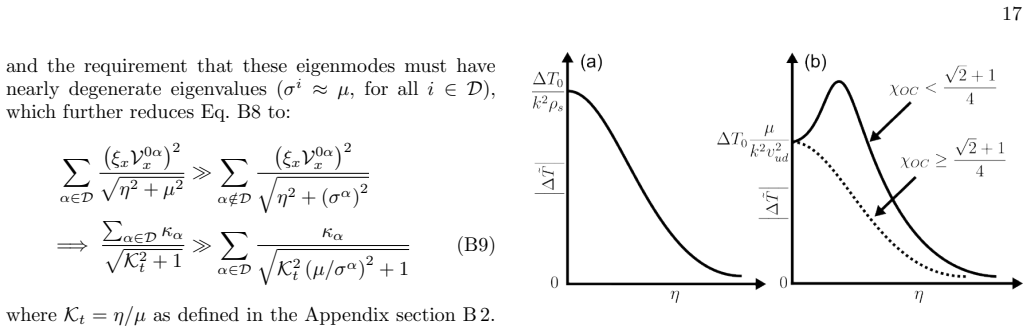
WhenD >0, the term within the square brackets of Eq. 24 evolves in time as an oscillatory func- tion, while forD≤0, it ceases to show any os- cillatory behavior, and we obtain a monotonically decaying response, as discussed later in this sub- section. Thus, thenecessary(but not sufficient) condition for the HHE [Eq. 21] to admit a damped oscillatory tempe...
-
[2]
ThoughD >0 (or equivalently,χ OC <1) ensures that the terms within the square brackets in Eq. 24 are oscillatory, these oscillations are visible only when the oscillation frequency is significantly more than the decay rate of the background exponen- tial (µ/2); otherwise the background exponential suppresses the oscillatory component of the tem- poral tem...
-
[3]
From Fig
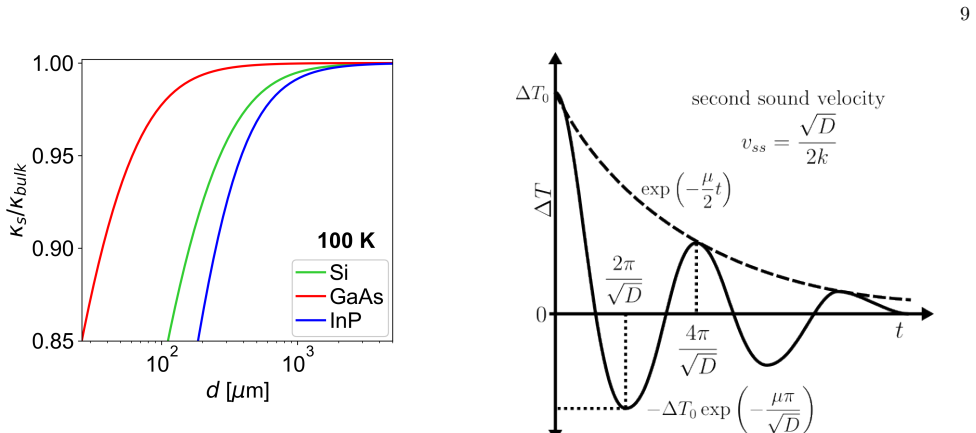
In the second sound regime, the velocity of the advective temperature wave is proportional to the ratio of the grating period to the time between adjacent positive peaks in the temporal tempera- ture response. From Fig. 6, this velocity, which is the second sound velocity (v ss), is given by vss = √ D/2k, and the depth of the first dip is given by ∆T 0 ex...
-
[4]
This new non-oscillatory feature of hydrodynamic heat flow regime has not been re- ported in the literature to the best of our knowl- edge
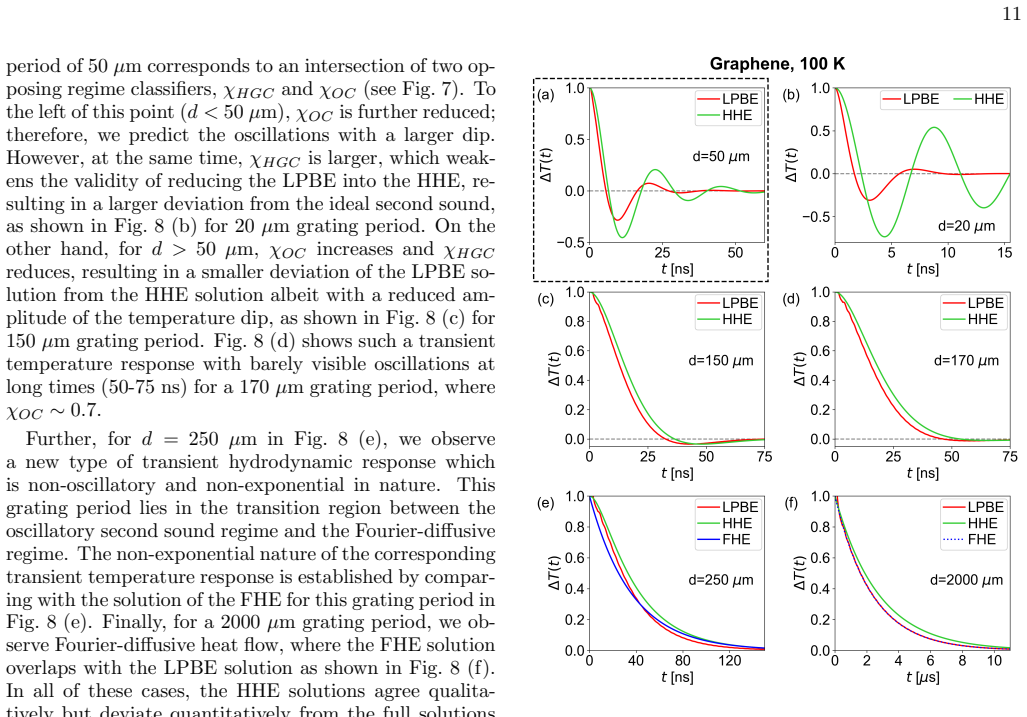
ForD≤0 (orχ OC ≥1), the temperature evolves as a non-oscillatory, non-exponential (therefore not weakly quasiballistic), monotonically decreasing function oftgiven by: ∆T(x, t) = ∆T 0e−ikxe−µt/2u(t) × " µ√ D′ sinh √ D′ 2 t ! + cosh √ D′ 2 t !# (27) whereD ′ =−D. This new non-oscillatory feature of hydrodynamic heat flow regime has not been re- ported in t...
-
[5]
27 reduces to an exponential solution as in the Fourier-diffusive regime, with temporal decay ratev 2 udk2/µ(see Ap- pendix D)
For long grating periods (k→0), Eq. 27 reduces to an exponential solution as in the Fourier-diffusive regime, with temporal decay ratev 2 udk2/µ(see Ap- pendix D). Sincev 2 ud/µis the thermal diffusivity from the eigenmodes ofΩbelonging to the spe- cial setDin hydrodynamic materials introduced earlier, Eq. 27 reduces exactly to the solution of FHE, with t...
-
[6]
where,R(Γ γγ d ) is the real part of Γ γγ d
Diagonal dominance condition (DDC) As discussed in section III, for the diagonal dominance ofΓwe require max β,γ̸=β Γβγ od r Γ−1 d ββ Γ−1 d γγ ≪ 1, where: Γβγ d = " −iη+σ β + X ¯α>0 ξxV β¯α x 2 σ ¯α−iη # ∆βγ (B1a) Γβγ od = X ¯α>0 ξxV β¯α x ξxV ¯α(γ̸=β) x σ ¯α−iη .(B1b) To arrive at the properties of the eigenmodes ofΩ and the Fourier variables (η, ξ x) th...
-
[7]
1 +P ¯β>0 ξxV α¯β x 2 σασ ¯β #2 = X α>0 ξ2 x[V0α] 2 σα σα 1 +P ¯β>0 (ξxV α¯β x ) 2 (σ ¯β) 2
Weakly quasiballistic condition (wQC) To obtain the wQC, we start from the intermediate heat equation (IHE, Eq. 14), which is rewritten by split- tingΓ d into its real and imaginary parts as: −i η+ X α>0 ξxV0α x 2 I I2 +R 2 ! ∆ ˜T + X α>0 ξxV0α x 2 R I2 +R 2 ∆ ˜T= ˜h0 ζ (B3) where,RandIare the real and imaginary parts of Γ αα d respectively, given by: R=σ...
-
[8]
µ√ D′ sinh √ D′ 2 t ! + cosh √ D′ 2 t !# (D1) ≈∆T 0e−ikxe−µt/2u(t) ×
Hydrodynamic geometry and material conditions (HGC and HMC) As discussed in Ref [12], to reduce the IHE [Eq. 14] to the HHE [Eq. 3], the diagonal part of theΓmatrix must be reduced as: Γ αα d ≈ −iη+σ α. To obtain this reduction, we consider the real (R) and imaginary (I) components of Γ αα d , as defined in Section B 2, which fol- low the following inequa...
2022
-
[9]
J. A. Johnson, A. A. Maznev, J. Cuffe, J. K. Eliason, A. J. Minnich, T. Kehoe, C. M. S. Torres, G. Chen, and K. A. Nelson, Direct measurement of room-temperature 19 nondiffusive thermal transport over micron distances in a silicon membrane, Physical Review Letters110, 025901 (2013)
2013
-
[10]
N. K. Ravichandran, H. Zhang, and A. J. Minnich, Spec- trally Resolved Specular Reflections of Thermal Phonons from Atomically Rough Surfaces, Physical Review X8, 041004 (2018)
2018
-
[11]
Maire, R
J. Maire, R. Anufriev, and M. Nomura, Ballistic thermal transport in silicon nanowires, Scientific Reports7, 41794 (2017)
2017
-
[12]
T. F. McNelly, S. J. Rogers, D. J. Channin, R. J. Rollef- son, W. M. Goubau, G. E. Schmidt, J. A. Krumhansl, and R. O. Pohl, Heat pulses in NaF: onset of second sound, Physical Review Letters24, 100 (1970)
1970
-
[13]
H. E. Jackson, C. T. Walker, and T. F. McNelly, Second sound in NaF, Physical Review Letters25, 26 (1970)
1970
-
[14]
H. E. Jackson and C. T. Walker, Thermal conductivity, second sound, and phonon-phonon interactions in NaF, Physical Review B3, 1428 (1971)
1971
-
[15]
Huberman, R
S. Huberman, R. A. Duncan, K. Chen, B. Song, V. Chiloyan, Z. Ding, A. A. Maznev, G. Chen, and K. A. Nelson, Observation of second sound in graphite at tem- peratures above 100 K, Science364, 375 (2019)
2019
-
[16]
Z. Ding, K. Chen, B. Song, J. Shin, A. A. Maznev, K. A. Nelson, and G. Chen, Observation of second sound in graphite over 200 K, Nature Communications13, 285 (2022)
2022
-
[17]
Huang, R
X. Huang, R. Anufriev, L. Jalabert, K. Watanabe, T. Taniguchi, Y. Guo, Y. Ni, S. Volz, and M. Nomura, A graphite thermal Tesla valve driven by hydrodynamic phonon transport, Nature634, 1086 (2024)
2024
-
[18]
Z. Xie, Y. Zhang, X. Huang, Z. Ding, J. Wei, D. Dong, K. Cao, T. Lai, K. Watanabe, T. Taniguchi, X. Qian, M. Nomura, and K. Chen, Room-temperature second sound in isotopically pure graphite, Nature Communi- cations 10.1038/s41467-026-70807-3 (2026)
-
[19]
A. J. Minnich, G. Chen, S. Mansoor, and B. S. Yilbas, Quasiballistic heat transfer studied using the frequency- dependent Boltzmann transport equation, Physical Re- view B84, 235207 (2011)
2011
-
[20]
R. J. Hardy, Phonon Boltzmann equation and second sound in solids, Physical Review B2, 1193 (1970)
1970
-
[21]
Beardo, M
A. Beardo, M. L´ opez-Su´ arez, L. A. P´ erez, L. Sendra, M. I. Alonso, C. Melis, J. Bafaluy, J. Camacho, L. Colombo, R. Rurali, F. X. Alvarez, and J. S. Reparaz, Observation of second sound in a rapidly varying temper- ature field in Ge, Science Advances7, eabg4677 (2021)
2021
-
[22]
A. J. Minnich, J. A. Johnson, A. J. Schmidt, K. Es- farjani, M. S. Dresselhaus, K. A. Nelson, and G. Chen, Thermal Conductivity Spectroscopy Technique to Mea- sure Phonon Mean Free Paths, Physical Review Letters 107, 095901 (2011)
2011
-
[23]
W. Jeon, Y. Pei, X. Li, L. Lindsay, S. Lee, and R. Chen, Grain Boundary-Limited Thermal Transport in Sus- pended Thin Graphite across an Unexplored Thickness Regime, Nano Letters25, 14074 (2025)
2025
-
[24]
N. K. Ravichandran and D. Broido, Unified first- principles theory of thermal properties of insulators, Physical Review B98, 085205 (2018)
2018
-
[25]
Cepellotti and N
A. Cepellotti and N. Marzari, Thermal transport in crys- tals as a kinetic theory of relaxons, Physical Review X6, 041013 (2016)
2016
-
[26]
Hua and L
C. Hua and L. Lindsay, Space-time dependent thermal conductivity in nonlocal thermal transport, Physical Re- view B102, 104310 (2020)
2020
-
[27]
N. Malviya and N. K. Ravichandran, Efficient calculation of phonon dynamics through a low-rank solution of the Boltzmann equation (2025), arXiv:2502.00337
arXiv 2025
-
[28]
A. J. Minnich, Phonon heat conduction in layered anisotropic crystals, Physical Review B91, 085206 (2015)
2015
-
[29]
Hua and A
C. Hua and A. J. Minnich, Transport regimes in quasi- ballistic heat conduction, Physical Review B89, 094302 (2014)
2014
-
[30]
N. K. Ravichandran and A. J. Minnich, Role of thermaliz- ing and nonthermalizing walls in phonon heat conduction along thin films, Physical Review B93, 035314 (2016)
2016
-
[31]
Malviya and N
N. Malviya and N. K. Ravichandran, Failure of the Call- away description of heat flow in boron arsenide and boron antimonide driven by phonon scattering selection rules, Physical Review B108, 155201 (2023)
2023
-
[32]
R. A. Guyer and J. A. Krumhansl, Solution of the lin- earized phonon boltzmann equation, Physical Review 148, 766 (1966)
1966
-
[33]
N. K. Ravichandran, Elasticity reshapes heat flow in graphene (2026), arXiv:2604.03910 [cond-mat]
Pith/arXiv arXiv 2026
-
[34]
L. P. Pitaevskii and E. M. Lifshitz,Physical kinetics: vol- ume 10(Butterworth-Heinemann, 2012)
2012
-
[35]
A. V. Inyushkin, A. N. Taldenkov, V. G. Ralchenko, A. P. Bolshakov, A. V. Koliadin, and A. N. Katrusha, Thermal conductivity of high purity synthetic single crystal dia- monds, Physical Review B97, 144305 (2018)
2018
-
[36]
A. V. Inyushkin, V. G. Ralchenko, A. P. Bolshakov, A. A. Khomich, D. A. Chernodubov, A. N. Taldenkov, V. V. Saraykin, and S. Y. Kilin, Thermal conductivity of chem- ical vapor deposition diamond enriched with 13C isotope, Journal of Applied Physics137, 125109 (2025)
2025
-
[37]
J. S. Kang, M. Li, H. Wu, H. Nguyen, and Y. Hu, Ex- perimental observation of high thermal conductivity in boron arsenide, Science361, 575 (2018)
2018
-
[38]
S. Li, Q. Zheng, Y. Lv, X. Liu, X. Wang, P. Y. Huang, D. G. Cahill, and B. Lv, High thermal conductivity in cubic boron arsenide crystals, Science361, 579 (2018)
2018
-
[39]
F. Tian, B. Song, X. Chen, N. K. Ravichandran, Y. Lv, K. Chen, S. Sullivan, J. Kim, Y. Zhou, T.-H. Liu, M. Goni, Z. Ding, J. Sun, G. A. G. Udalamatta Gamage, H. Sun, H. Ziyaee, S. Huyan, L. Deng, J. Zhou, A. J. Schmidt, S. Chen, C.-W. Chu, P. Y. Huang, D. Broido, L. Shi, G. Chen, and Z. Ren, Unusual high thermal con- ductivity in boron arsenide bulk cryst...
2018
-
[40]
K. Chen, B. Song, N. K. Ravichandran, Q. Zheng, X. Chen, H. Lee, H. Sun, S. Li, G. A. G. Udala- matta Gamage, F. Tian, Z. Ding, Q. Song, A. Rai, H. Wu, P. Koirala, A. J. Schmidt, K. Watanabe, B. Lv, Z. Ren, L. Shi, D. G. Cahill, T. Taniguchi, D. Broido, and G. Chen, Ultrahigh thermal conductivity in isotope- enriched cubic boron nitride, Science367, 555 (2020)
2020
-
[41]
Y. Zhu, A. L. N. Kondusamy, K. Chen, P. Koirala, H. Wu, M. S. Patel, E. R. Glaser, S. White, J. C. Culbertson, J. L. Lyons, N. K. Ravichandran, M. Ze- tati, X. Wang, R. Addou, R. M. Wallace, S. Hou, S. Vaziri, X. Bao, D. Broido, G. Chen, and B. Lv, Vapor- Flux Growth of c-BP Single Crystals With Concurrently High Electrical Resistivity and Isotope-Enhance...
2026
-
[42]
N. Malviya and N. K. Ravichandran, Indicators for phonon hydrodynamics from first principles predictions of thermal conductivity (2026), arXiv:2605.17947 [cond- mat.mtrl-sci]
Pith/arXiv arXiv 2026
-
[43]
Z. Ding, J. Zhou, B. Song, M. Li, T.-H. Liu, and G. Chen, Umklapp scattering is not necessarily resistive, Physical Review B98, 180302 (2018)
2018
-
[44]
Zhang, S
C. Zhang, S. Huberman, and L. Wu, On the emergence of heat waves in the transient thermal grating geometry, Journal of Applied Physics132, 085103 (2022)
2022
-
[45]
Lee and X
S. Lee and X. Li, Hydrodynamic phonon transport: past, present and prospects, inNanoscale Energy Transport: Emerging phenomena, methods and applications(IOP Publishing, 2020)
2020
-
[46]
Chaput, Direct Solution to the Linearized Phonon Boltzmann Equation, Physical Review Letters110, 265506 (2013)
L. Chaput, Direct Solution to the Linearized Phonon Boltzmann Equation, Physical Review Letters110, 265506 (2013)
2013
-
[47]
Kefayati, P
A. Kefayati, P. B. Allen, and V. Perebeinos, Nonlocal thermal transport modeling using the thermal distribu- tor, Physical Review B105, 235402 (2022)
2022
-
[48]
N. K. Ravichandran and D. Broido, Phonon-phonon in- teractions in strongly bonded solids: selection rules and higher-order processes, Physical Review X10, 021063 (2020)
2020
-
[49]
N. K. Ravichandran, Low bending rigidity and large Young’s modulus drive strong flexural phonon renormalization in two-dimensional monolayers (2026), arXiv:2603.16717 [cond-mat]
arXiv 2026
-
[50]
Tur-Prats, Z
J. Tur-Prats, Z. Han, A. Beardo, X. Ruan, and F. X. Alvarez, High-Order Anharmonicities Shape Phonon Hy- drodynamic Effects in Graphene, Nano Letters25, 11203 (2025)
2025
-
[51]
X. Li, Z. Han, X. Ruan, and L. Shi, Effects of four- phonon scattering on phonon hydrodynamics in mono- layer graphene, Physical Review B112, L100302 (2025)
2025
discussion (0)
Sign in with ORCID, Apple, or X to comment. Anyone can read and Pith papers without signing in.