REVIEW 7 minor 2 cited by
Anomaly-free symmetries with obstructions to gauging and onsiteability
T0 review · 0 major / 7 minor · reviewed 2026-08-06 · deepseek-v4-flash
Pith's one-line read This paper constructs finite-group symmetries of 2D lattice systems that cannot be made on-site or coupled to gauge fields, yet are anomaly-free in the standard sense.
desk verdict A solid, explicit counterexample to the lore that non-onsiteable 2D symmetries must be anomalous, with a useful index and a couple of fixable soft spots. read the letter →
The pith
A machine-rendered reading of the paper's core claim, the machinery that carries it, and where it could break.
The reading
What carries the argument
The central object is the $H^2(G,\mathbb{Q}_+)$ onsiteability index. For a symmetry $\{U_g\}$ written as a finite-depth quantum circuit and a restriction $U_{g,A}$ to a large disk $A$, the paper forms $\Omega_{g,h}=U_{g,A}U_{h,A}U^{-1}_{gh,A}$, a unitary supported near the boundary; its GNVW index—the positive rational number measuring how many degrees of freedom a one-dimensional quantum cellular automaton shifts across a cut—defines a cocycle $\omega(g,h)\in\mathbb{Q}_+$. The cohomology class $[\omega]$ is invariant under the choice of restriction. The GNVW index is load-bearing because it completely classifies one-dimensional quantum cellular automata up to finite-depth circuits and ancillas, so the boundary shift's index cannot be undone by local redefinitions.
What would settle it
Search for a one-dimensional quantum cellular automaton with GNVW index 1 that is not equivalent to a finite-depth circuit even after adding ancillas; the classification used here says none exists, and finding one would remove the ground on which the onsiteability obstruction stands. Alternatively, produce a 2D symmetry whose cocycle is a nontrivial element of $H^2(G,\mathbb{Q}_+)$ but that can be explicitly conjugated to an on-site symmetry, which would refute the paper's claim that the index obstructs onsiteability.
Extended reading notes
Core claim
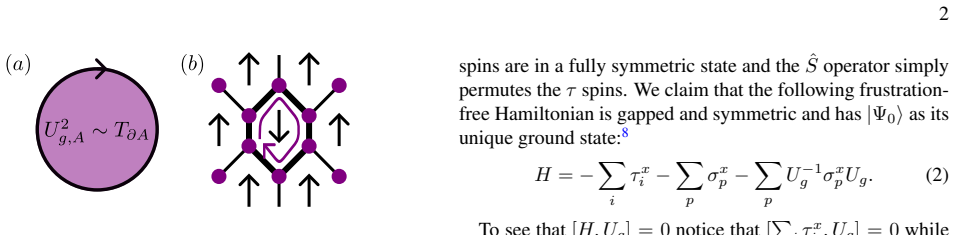
On its own terms, the paper's central discovery is a family of 2D $G$-symmetries, one for every finite group $G$ and every cohomology class $[\omega]\in H^2(G,\mathbb{Q}_+)$, that are anomaly-free but not onsiteable and not gaugeable. The basic example is a $\mathbb{Z}_2$ symmetry on the honeycomb lattice: $U_g = \hat{S}[\{\sigma^z_p\}] \prod_p \sigma^x_p$, where $\hat{S}$ translates vertex qubits along the domain walls of the plaquette configuration. Restricting $U_g$ to a disk and squaring yields an odd translation along the disk boundary, an operation whose GNVW index is $2$; this boundary shift cannot be removed by any choice of restriction or by conjugation, so the symmetry is not a finite-depth-conjugated on-site symmetry. The same symmetry has a commuting-projector parent Hamiltonian with a unique product ground state, so it is anomaly-free in the strongest sense. The paper proves that a nontrivial index obstructs background gauging, that this index is realized for every element of $H^2(G,\mathbb{Q}_+)$, and that dynamical gaugeability is equivalent to onsiteability, giving additional examples including a Clifford-circuit $\mathbb{Z}_4$ symmetry of the toric code that permutes the $e$ and $m$ anyons.
Load-bearing premise
The argument's load-bearing premise is the completeness of the GNVW index for one-dimensional quantum cellular automata: every 1D QCA is equivalent, up to finite-depth circuits and ancillas, to a translation with a rational index, and two QCAs are equivalent exactly when their indices agree, so a boundary shift with index 2 cannot be undone by local redefinitions.
Editorial extensions
If this is right
- Every 2D symmetry that is a finite-depth quantum circuit carries a well-defined invariant $[\omega]\in H^2(G,\mathbb{Q}_+)$; a nontrivial class obstructs onsiteability and also background and dynamical gauging.
- Anomaly-free is strictly weaker than onsiteable in two dimensions: the constructed symmetries admit symmetric gapped Hamiltonians with unique invertible ground states, yet cannot be disentangled to on-site operators.
- The obstruction is not preserved under renormalization-group flow, so it can disappear in a low-energy subspace even though it was present in the original lattice model.
- The paper realizes every class $[\omega]\in H^2(G,\mathbb{Q}_+)$ by an explicit 2D symmetry for any finite group $G$, and gives additional examples including a $\mathbb{Z}_4$ symmetry of the toric code that permutes $e$ and $m$ anyons and fermionic Gaussian symmetries.
Reading between the lines
- The construction suggests that the $H^2$ index is a kinematic, lattice-level obstruction invisible to anomaly inflow and to low-energy topological field theory, since it is not RG-stable; this invites a systematic search for similar cohomology-valued obstructions in higher dimensions by decorating lower-dimensional junctions with QCAs, as the paper itself anticipates.
- Because the index is defined through the GNVW classification of 1D QCAs, any future refinement or exception to that classification would directly change which symmetries are obstructed; the paper's conclusion is therefore tied to the completeness of that classification.
- The fermionic Gaussian examples indicate that analogous obstructions occur for locally generated symmetries with algebraic tails and connect the index to Chern numbers, even though those symmetries are not strictly finite-depth circuits; formalizing the index for locally generated unitaries is a natural next step.
- At a practical level, the boundary index of $U_{g,A}^n$ is a finite-size probe: a numerical or experimental measurement of the shift of operators across a cut could certify non-onsiteability of a symmetry without needing to solve for its anomalies.
Editorial analysis
A structured set of objections, weighed in public.
Referee Report
Summary. This paper addresses the question whether every non-onsiteable two-dimensional internal symmetry is necessarily anomalous. The main construction is a Z2 symmetry on a honeycomb lattice, defined by U_g = Ŝ[{σ^z}]∏_p σ^x_p, where Ŝ translates τ-qubits along the domain walls of the σ^z configuration. The authors prove that U_g is an FDQC, that the frustration-free Hamiltonian H = -∑_i τ^x_i -∑_p σ^x_p -∑_p U^{-1}_g σ^x_p U_g is gapped with |Ψ0⟩ = ⊗ |σ^x=+1, τ^x=+1⟩ as its unique ground state, and that the boundary operator U^2_{g,A} has GNVW index 2, giving a nontrivial element [ω]∈H^2(Z2,Q+). They show that a nontrivial [ω] obstructs both onsiteability and background gauging, and in the Supplemental Material they generalize the construction to arbitrary finite G and cocycle [ω]∈H^2(G,Q+) via a bulk-boundary map from 3D G-symmetric QCAs. Additional examples include a Z4 toric-code symmetry and fermionic Gaussian symmetries.
Significance. The Z2 example is a clean and explicit counterexample to the lore that an obstruction to gauging or onsiteability implies an anomaly. The argument is self-contained and uses the established GNVW classification of 1D QCAs as an external input rather than adjusting definitions to fit the conclusion; the gap and uniqueness proof for the parent Hamiltonian is complete. The general H^2(G,Q+) index is a natural and computable invariant, and the SM construction realizing every cohomology class is a substantial classification step. The main caveat is that the index is defined for FDQC symmetries; whether it extends to all QCA symmetries in 2D is left as a plausible but unproven assumption, so the characterization in the abstract should be read with that caveat.
minor comments (7)
- [SM V] The Z4 toric-code symmetry is introduced as 'anomaly-free,' but no symmetric gapped Hamiltonian with a unique invertible ground state is provided; the toric-code Hamiltonian itself has a topologically degenerate ground-state space and therefore does not satisfy the paper's own anomaly-free definition. Please either supply such a parent Hamiltonian or explicitly label this example as one whose anomaly-free status is not established.
- [SM VI.A] The fermionic Gaussian symmetries are not strictly locality-preserving QCAs, and the paper states that the index definition does not directly apply; the non-onsiteability conclusion therefore rests on an assumed extension of the H^2(G,Q+) formalism to locally generated symmetries. This conditional status should be stated prominently when these examples are summarized.
- [Obstruction to background gauging] After Eqs. (11) and (12), the claim that Ω_{g,h} is an FDQC needs one more step: from U_{g,A}V1U_{h,A}U^{-1}_{gh,A} ∝ V2 one should insert U_{g,A}^{-1}U_{g,A} and use that conjugation of an FDQC by a QCA is again an FDQC. Writing this out would remove the only non-obvious step in an otherwise clear argument.
- [H^2(G,Q+) onsiteability index] The sentence 'Likewise, the same is true for any onsiteable symmetry' is terse, since onsiteability allows conjugation by an arbitrary QCA rather than an FDQC. A short justification, or an explicit restriction of the claim to FDQC disentanglers, would make the obstruction statement precise.
- [SM III.C, Eq. (32)] In the definition of the modified Gauss law operators, the right-hand side contains indices s'_k and s_k that are not defined; the intent appears to be a map from site configurations to link configurations, but as written the equation is difficult to parse and should be corrected.
- [SM I] For readers not familiar with the GNVW machinery, it would help to state that for commuting subalgebras the overlap η(X,Y) is the square root of the dimension of the intersection algebra; this makes the index value 2 for a single-site translation immediately transparent.
- [Introduction, footnote 9] The abstract and introduction characterize all of the constructed symmetries by the H^2(G,Q+) index, but the index is defined only for FDQC symmetries and the equality with all QCA symmetries in 2D is presented as plausible rather than proven. This caveat should appear wherever the classification statement is made.
Circularity Check
No significant circularity: the central Z2 counterexample and H^2(G,Q+) index are derived from the independent GNVW classification; only minor non-load-bearing self-citations appear.
full rationale
The central derivation chain is self-contained. The Z2 symmetry Ug (Eq. 1) is shown anomaly-free by an explicit symmetric, frustration-free Hamiltonian (Eq. 2), with gap and uniqueness proven by reducing to the sigma^x sector; this part does not use the H^2 index. Non-onsiteability follows from the boundary square U^2_{g,A} being an odd shift, and the external input is the GNVW classification of 1D QCAs (Ref. [1]), an established theorem used as stated: alternative restrictions differ by boundary 1D QCAs whose indices contribute only even shifts. The H^2(G,Q+) index (Eqs. 5-6) is defined from the GNVW index of Omega_{g,h}; nontriviality for the example is computed, not assumed. The background-gauging obstruction is proved by contrapositive from the defining properties of background gaugeability, and dynamical gaugeability is reduced to background gaugeability in SM III B by an explicit Gauss-law construction; neither step assumes the conclusion. The only self-reliance is minor and non-load-bearing: the supplementary proposition that dynamical gaugeability is equivalent to onsiteability (SM III C) invokes a construction from Ref. [6] (arXiv:2503.09717), co-authored by one of the present authors, and the general all-cocycle construction cites the bulk-boundary map [18,19] with a co-authored component. These do not support the core counterexample: the central obstruction to dynamical gauging is already implied by the background-gauging proof, and the general construction is verified explicitly in the SM. The toric-code and fermionic examples are supplementary and flagged as incomplete, so they carry no circularity burden. Overall, no prediction reduces to a fit, no definition is circular, and no load-bearing argument reduces to a self-citation chain.
Assumptions & free parameters
assumptions (4)
- standard math The GNVW index completely classifies 1D quantum cellular automata (Gross, Nesme, Vogts, Werner).
- standard math For any FDQC symmetry, restrictions to a disk exist, and any two restrictions differ by a 1D QCA near the boundary.
- domain assumption The Hilbert spaces are finite-dimensional local tensor products and symmetries are strict QCAs.
- ad hoc to paper For finite G in 2D, every QCA symmetry is plausibly an FDQC, so the index applies to all QCA symmetries.
Cite this review
Pith. "Pith review of Anomaly-free symmetries with obstructions to gauging and onsiteability." pith.science (2026). https://pith.science/paper/LVOSSVDJ
@misc{pith2026250721267,
  author       = {Pith},
  title        = {Pith review of: Anomaly-free symmetries with obstructions to gauging and onsiteability},
  year         = {2026},
  howpublished = {\url{https://pith.science/paper/LVOSSVDJ}},
  note         = {Machine review of arXiv:2507.21267}
}
abstract
We present counterexamples to the lore that symmetries that cannot be gauged or made on-site are necessarily anomalous. Specifically, we construct unitary, internal symmetries of two-dimensional lattice models that cannot be consistently coupled to background or dynamical gauge fields or disentangled to a tensor product of on-site operators. These symmetries are nevertheless anomaly-free in the sense that they admit symmetric, gapped Hamiltonians with unique, invertible ground states. We show that symmetries of this kind are characterized by an index $[\omega]\in H^2(G,\mathbb{Q}_+)$, where $\mathbb{Q}_+$ is the multiplicative group of rational numbers labeling one-dimensional quantum cellular automata.
Figures


Figures from the paper (9 more)


Forward citations
Cited by 2 Pith papers
-
Exactly Solvable 1+1d Chiral Lattice Gauge Theories
Anomaly-free chiral U(1) gauge theories in 1+1 dimensions can be written as quadratic, exactly solvable lattice Hamiltonians, with the 34-50 model as an explicit example.
-
Trading Mathematical for Physical Simplicity: Bialgebraic Structures in Matrix Product Operator Symmetries
MPO symmetries are governed by pre-bialgebras; the anomalous Z2 symmetry of the XX model yields a non-semisimple representation category and new mixed-state fixed points.
Reference graph
Works this paper leans on
-
[1]
discussed earlier. First we choose a re- striction Ug,A of the symmetry operator Ug to a disk A: Ug,A = ˆS[{˜σz p}] ∏ p∈A σx p ˜σz p = { σz p, if p ∈ A 1, otherwise . (8) This is a valid restriction because Ug,A is a QCA that acts like Ug in the interior of region A and acts as the identity operator outside of A. Next, we compute Ωg,g . Using ( 8) we have...
-
[2]
To see that ω is in fact a nontrivial cocycle, note that the quantity ω(g, 1)ω(g, g) transforms as ω(g, 1)ω(g, g) → ω(g, 1)ω(g, g)α(g)2 under a shift by a coboundary ( 4). It fol- lows that, for any trivial cocycle, ω(g, 1)ω(g, g) is the square of a rational number. Since our cocycle has ω(g, 1)ω(g, g) = 2, it is nontrivial. Obstruction to (background) ga...
-
[3]
Here, we use ‘ ∝’ to denote equality up to a phase
If g′ i = gi except for i ∈ R for some subset R ⊂ Λ, then U{g′ i} ∝ W U{gi} for some unitary W supported within a finite distance of R. Here, we use ‘ ∝’ to denote equality up to a phase. This defi- nition deserves a few comments:
-
[4]
where α(g) = Ind( Vg,∂A ). We conclude that the equivalence class [ω] ∈ H 2(G, Q+) is a well-defined quantity insensitive to the particular choice of restriction. FIG. 2. (a) Action of Ωg,g for a typical {σz p} configuration. Here A is the shaded region and the grey arrows show the upward orientation of ˜σz p for p /∈ A ( 8). The two blue arrows show the tr...
-
[5]
If gi = g for all i, then U{gi=g} ∝ Ug
-
[6]
If g′ i = gih for all i, then U{g′ i} ∝ U{gi}Uh
-
[7]
To motivate this definition, we note that the U{gi} opera- tors provide a canonical way to couple an arbitrary local sym- metric Hamiltonian H to a flat 10 spatial background gauge field. Let {gij} be a background gauge field – that is, an as- signment of group elements to links ⟨ij⟩ with the identifica- tion gij = g−1 ji . Suppose that gij is “flat”, that is, ...
-
[8]
Generalized Symmetries in Quantum Field Theory
An important special case of U{gi} is when gi = g for i in some subset R ⊂ Λ and gi = 1 outside of R. In this case we will denote U{gi} by Ug,R. It follows from properties ( 1) and (3) that Ug,R is a restriction of Ug to R. We now derive the claimed obstruction to background gaugeability. More precisely, we establish the contrapositive: we show that a bac...
work page 2025
Show all 65 references
-
[9]
Gross, V
D. Gross, V . Nesme, H. V ogts, and R. F. Werner, Communica- tions in Mathematical Physics 310, 419 (2012)
2012
-
[10]
C. G. Callan Jr and J. A. Harvey, Nuclear Physics B 250, 427 (1985)
1985
-
[11]
Chen, Z.-X
X. Chen, Z.-X. Liu, and X.-G. Wen, Phys. Rev. B 84, 235141 (2011)
2011
-
[13]
Chen, Z.-C
X. Chen, Z.-C. Gu, Z.-X. Liu, and X.-G. Wen, Phys. Rev. B 87, 155114 (2013)
2013
-
[14]
Vishwanath and T
A. Vishwanath and T. Senthil, Phys. Rev. X 3, 011016 (2013)
2013
-
[15]
D. V . Else and C. Nayak, Phys. Rev. B 90, 235137 (2014) , arXiv:1409.5436 [cond-mat.str-el]
2014 arXiv
- [16]
- [17]
-
[19]
See supplemental materials for details
-
[20]
’t Hooft, NA TO Sci
G. ’t Hooft, NA TO Sci. Ser. B59, 135 (1980)
1980
- [21]
-
[22]
Kapustin and R
A. Kapustin and R. Thorngren, Phys. Rev. Lett. 112, 231602 (2014), arXiv:1403.0617 [hep-th]
2014 arXiv
- [23]
-
[24]
Seifnashri, SciPost Physics 16, 098 (2024)
S. Seifnashri, SciPost Physics 16, 098 (2024)
2024
-
[25]
Freedman and M
M. Freedman and M. B. Hastings, Commun. Math. Phys. 376, 1171 (2020), arXiv:1902.10285 [quant-ph]
2020 arXiv
-
[26]
A. C. Potter and T. Morimoto, Phys. Rev. B 95, 155126 (2017)
2017
-
[30]
Y .-T. Tu, D. M. Long, and D. V . Else, (2025)
2025
-
[31]
Kapustin, (2025), arXiv:2505.04719 [math-ph]
A. Kapustin, (2025), arXiv:2505.04719 [math-ph]
2025 arXiv
-
[32]
Anomaly-free symmetries with obstructions to gauging and onsiteability
K. Kawagoe and W. Shirley, (2025), arXiv:2507.07430 [cond- mat.str-el]. Supplemental Material “Anomaly-free symmetries with obstructions to gauging and onsiteability” Wilbur Shirley, 1 Carolyn Zhang, 2 Wenjie Ji, 3 and Michael Levin 1 1Leinweber Institute for Theoretical Physi...
2025 arXiv
-
[33]
Modified Gauss’s law operators 8
-
[34]
equivalent
Symmetry disentangler 8 IV . 2DG-symmetry with general index [ω] ∈H 2(G, Q+) 9 A. Map from 3D G-QCAs to 2D G-symmetries 10 B. A class of nontrivial 3D G-symmetric QCA 10 C. Derivation of the 2D G-symmetry 11 D. Example: G = Z2 13 E. Onsiteability index calculation 14 F. Trivia...
-
[35]
If gi =g for alli, thenU{gi=g} ∝Ug
-
[36]
If g′ i =gih for alli, thenU{g′ i} ∝U{gi}Uh
-
[37]
We now show that dynamical gaugeability implies background gaugeability
If g′ i =gi except fori ∈R for some subset R ⊂ Λ, then U{g′ i} ∝WU {gi} for some unitary W supported within a finite distance ofR. We now show that dynamical gaugeability implies background gaugeability. That is, we show that if there exists a set of Gauss law operators {Gg,i} ...
-
[38]
as U{gi} = (∏ i∈Λ1 Z{gj },i ) · · · (∏ i∈Λn Z{gj },i ) , (24) whereZ{gj },i is a unitary operator acting on Hmatter, defined by Z{gj },i ≡ ⟨{gij = 1}| ˜V{gj },i |{gij = 1}⟩. (25) Finally, notice that the region of support of Z{gj },i is contained within that of Ggi,i so in part...
-
[39]
symmetry disentangler
Modified Gauss’s law operators We will establish onsiteability by constructing an explicit “symmetry disentangler” – a QCA that maps {Ug} to an on-site symmetry, via conjugation, after tensoring with an on-site representation of the symmetry on ancillas. This disentangler acts ...
-
[40]
bulk-boundary correspondence
Symmetry disentangler We are now ready to construct our symmetry disentangler. More specifically, we will construct an FDQC W, acting on H′, that transformsUg ⊗ Lg into the on-site symmetry 1 ⊗ Lg: W †(Ug ⊗ Lg)W ∝ 1 ⊗ Lg. (35) We define W by specifying its matrix elements: ⟨{s′ ...
-
[42]
In the 2D honeycomb lattice system, the G-spin on each plaquette is simply a qubit, where the |1⟩ state is identified with |↑⟩ and the |g⟩ state with |↓⟩
Hence ν(1,g, 1) = ν(g, 1,g ) = 1 , andν = 0 for all other sets of arguments. In the 2D honeycomb lattice system, the G-spin on each plaquette is simply a qubit, where the |1⟩ state is identified with |↑⟩ and the |g⟩ state with |↓⟩. Within the bulk of each edge, the 2D symmetry ...
-
[43]
quasi-diagonal
Recall that for any Pauli string P , the unitary U =eiπP/ 4 is a Clifford gate with the following action on a generic Pauli string Q: UQU † = { Q if [P,Q ] = 0 iPQ if {P,Q } = 0. (69) This fact can be used to deduce the action of Ug on local operators, as shown in Fig. 7. It i...
-
[45]
We do this by constructing an explicit gapped, symmetric Hamil- tonian with a product state as its unique ground state
is anomaly-free. We do this by constructing an explicit gapped, symmetric Hamil- tonian with a product state as its unique ground state. In particular, consider the Hamiltonian H =∑ jc† jcj, which is simply the total particle number. Clearly [H,U g] = 0 . Also, H is gapped and...
-
[46]
flow” F(u) of the single particle unitary matrix ujk associated withU : Ind(U ) = 2 F (u). (77) Here the matrix ujk is defined by U †cjU = ∑ jkujkck, while the “flow
is anomaly-free according to the definition given in the main text. At the same time, the Zn symmetry (73) is non-onsiteable if the Chern number 2ν(P ) is not divisible by n. To see this, let us restrictUg to a half-plane A, defining Ug,A =e2πi/n ∑ jk PA,jk c† j ck, (74) 18 wher...
-
[48]
Gross, V
D. Gross, V . Nesme, H. V ogts, and R. F. Werner, Communications in Mathematical Physics 310, 419 (2012)
2012
-
[49]
H. C. Po, L. Fidkowski, T. Morimoto, A. C. Potter, and A. Vishwanath, Phys. Rev. X 6, 041070 (2016)
2016
-
[50]
If we define an FDQC in terms of layers with gates that have disjoint support, then we must split each of the above six layers into two layers each
Technically, the gates in each layer described here overlap but mutually commute. If we define an FDQC in terms of layers with gates that have disjoint support, then we must split each of the above six layers into two layers each
-
[51]
J. B. Kogut, Rev. Mod. Phys. 51, 659 (1979)
1979
-
[52]
In particular,n is finite
Here, n scales like the number of lattice sites contained in the region of support of the Gg,i operators. In particular,n is finite
- [53]
-
[54]
Zhang, Phys
C. Zhang, Phys. Rev. B 107, 235104 (2023)
2023
-
[55]
is a valid expression, it is not immediately clear that Ug acts on a strictly 2D subsystem. To see this, note that ˆT [{g ˜νij}]† ˆT [{˜νij}] acts trivially on all qubits lying on dual lattice edges ij ∈ ∆X 2 , ∆N 2 (with the possible exception of the νmax qubits at the southe...
-
[56]
Gaiotto and T
D. Gaiotto and T. Johnson-Freyd, JHEP 05, 007 (2019) , arXiv:1712.07950 [hep-th]
2019 arXiv
-
[57]
Barkeshli, Y .-A
M. Barkeshli, Y .-A. Chen, S.-J. Huang, R. Kobayashi, N. Tantivasadakarn, and G. Zhu, SciPost Phys. 14, 065 (2023), arXiv:2208.07367 [cond-mat.str-el]
2023 arXiv
-
[58]
H. C. Po, L. Fidkowski, A. Vishwanath, and A. C. Potter, Phys. Rev. B 96, 245116 (2017)
2017
-
[59]
[ 12] also considered slower decay, but in this work we will assume that the off-diagonal matrix elements decays superpolynomially
Ref. [ 12] also considered slower decay, but in this work we will assume that the off-diagonal matrix elements decays superpolynomially
-
[60]
Kitaev, Annals of Physics 321, 2 (2006)
A. Kitaev, Annals of Physics 321, 2 (2006)
2006
-
[61]
L. Chen, T. Mazaheri, A. Seidel, and X. Tang, Journal of Physics A: Mathematical and Theoretical 47, 152001 (2014). 20
2014
-
[62]
Fidkowski, H
L. Fidkowski, H. C. Po, A. C. Potter, and A. Vishwanath, Phys. Rev. B 99, 085115 (2019)
2019
-
[63]
We expect that a similar argument applies in the case where the unitary U is not strictly locality preserving and has superpolynomially decaying tails
-
[64]
M. S. Rudner, N. H. Lindner, E. Berg, and M. Levin, Phys. Rev. X 3, 031005 (2013)
2013
-
[65]
Zhang and M
C. Zhang and M. Levin, Phys. Rev. X 13, 031038 (2023)
2023
-
[66]
S. Ryu, J. E. Moore, and A. W. W. Ludwig, Phys. Rev. B 85, 045104 (2012)
2012
-
[67]
Qi, New Journal of Physics 15, 065002 (2013)
X.-L. Qi, New Journal of Physics 15, 065002 (2013)
2013
-
[68]
Y ao and S
H. Y ao and S. Ryu, Phys. Rev. B 88, 064507 (2013)
2013
-
[69]
Gu and M
Z.-C. Gu and M. Levin, Phys. Rev. B 89, 201113 (2014), arXiv:1304.4569 [cond-mat.str-el]
2014 arXiv
-
[70]
Tarantino and L
N. Tarantino and L. Fidkowski, Phys. Rev. B 94, 115115 (2016), arXiv:1604.02145 [cond-mat.str-el]
2016 arXiv
-
[71]
( 72) and find that Θ = 2 , which is not a fourth power of a rational number or √ 2, or their combinations
and Eq. ( 72) and find that Θ = 2 , which is not a fourth power of a rational number or √ 2, or their combinations. Thus, the Z4 symmetry carries an index given by a non-trivial element in H 2(Z4, Q+[ √ 2]), where Q+[ √ 2] = { q · √ 2 n |q ∈ Q+,n ∈ Z } . We believe thatUg is eq...
- [72]
-
[73]
We now show that the Zn symmetry (
is locally generated since we can choose H = −∑ jkPjkc† jck. We now show that the Zn symmetry (
Reviewed August 6, 2026 · model on record in the stance chip above.
Discussion (0). Sign in to comment.