REVIEW 3 major objections 4 minor 2 cited by
SynergyAmodal: Deocclude Anything with Text Control
T0 review · 3 major / 4 minor · reviewed 2026-08-16 · deepseek-v4-flash
Pith's one-line read The paper claims that a 16K-image co-synthesized dataset of modal-to-amodal pairs can train a single text-conditioned diffusion model that deoccludes arbitrary objects in open-world images.
desk verdict Useful data-plus-model package; trust the SOTA numbers only after artifacts are out and the pseudo-label loop is sanity-checked against human annotation. read the letter →
The pith
A machine-rendered reading of the paper's core claim, the machinery that carries it, and where it could break.
The reading
What carries the argument
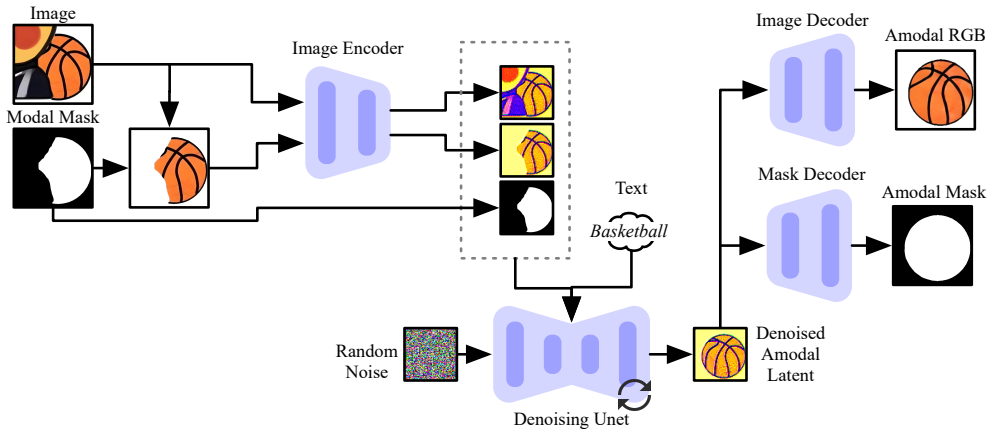
The load-bearing mechanism is the co-synthesis pipeline built on an order-aware self-supervised partial completion model. The partial model removes occluders one at a time in a learned order, using occlusion order annotations, and is trained so that newly synthesized occluders never cover an existing occluder, avoiding the dual-occlusion ambiguity that corrupted the SSSD baseline; this model produces initial deocclusion results. Those results are then filtered by human experts, refined by Stable Diffusion 3 at multiple noise strengths, selected again by humans, and annotated by ZIM for fine masks and InternVL for captions to yield SynergyAmodal16K. The final DeoccAnything model is a latent diffusion inpainting network that takes the visible image, the modal mask, an optional text prompt, and the full image as a conditioning signal, with a two-stage global-to-local inference strategy that sharpens high-resolution outputs. The order-aware training and the human-in-the-loop co-synthesis are what the claims of diversity, plausibility, and fidelity rest on.
What would settle it
Compute the mIoU of DeoccAnything using exactly one generated sample per instance instead of the best of eight; if single-sample mIoU on COCOA drops to within a point of SSSD's score, the reported advantage comes from sampling selection, not from the synthesized dataset. Independently, retrain the full completion model on the same 16K pairs without the human filtering and Stable Diffusion 3 refinement, using raw pseudo-labels, and check whether zero-shot mIoU and FID fall; if they do not, the co-synthesis stage is not the cause of the gains.
Extended reading notes
Core claim
SynergyAmodal establishes that a tripartite data-human-model collaboration can synthesize an amodal dataset whose quality is high enough to train a full completion diffusion model that performs zero-shot amodal completion and supports open-world text control. The argument has three linked steps: an order-aware self-supervised partial completion model trained on EntitySeg provides plausible initial deocclusions; a filter-refine-select-annotate pipeline, using Stable Diffusion 3 refinement and ZIM and InternVL annotations, turns those outputs into 16K high-quality modal-to-amodal training pairs; and the full completion model, a Stable Diffusion 2 Inpainting architecture with an extra full-image condition and text conditioning, outperforms prior methods on COCOA and BSDSA on both mask mIoU and FID. The paper claims this demonstrates both zero-shot generalization and textual controllability for open-world amodal completion.
Load-bearing premise
The whole training rests on the assumption that the pseudo-labels produced by filtering, refining, and annotating the self-supervised model's outputs are accurate and unbiased amodal ground truth, so the model's good test scores reflect true amodal understanding rather than the same diffusion priors that generated its training data.
Editorial extensions
If this is right
- The released SynergyAmodal16K dataset and DeoccAnything model provide a reusable resource, so other amodal, segmentation, or image-editing methods can be trained or evaluated on the same pairs.
- The order-aware self-supervised learning recipe can be applied to any modal segmentation dataset, resolving the dual-occlusion ambiguity that limited prior self-supervised deocclusion.
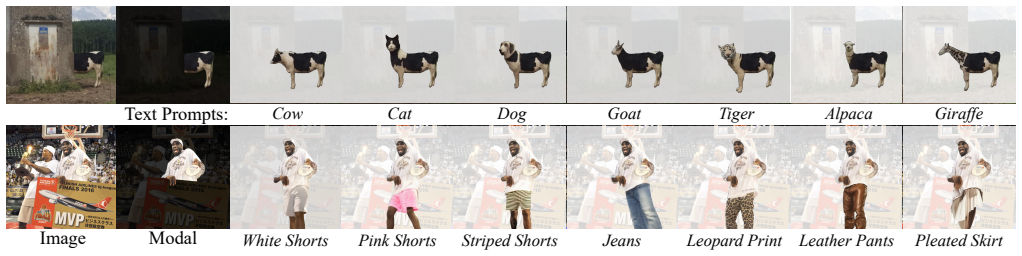
- Because the full model conditions on text, users can control the amodal content for occluded regions, such as the species of an occluded animal or the clothing of a person, a capability prior amodal completion methods did not offer.
- Combining the model with SAM enables point-prompted deocclusion, and plugging its RGBA output into image-to-3D pipelines produces complete 3D geometry from occluded single views.
- The two-stage global-to-local inference improves output sharpness for large inputs and can be adopted by other latent diffusion inpainting models.
Reading between the lines
- If the central claim holds, the bottleneck for further scaling is human screening, since about 200 annotator-hours produced only 16K pairs, so the natural next step is automating plausibility filtering with a learned reward model rather than adding more annotators.
- The evaluation protocol of reporting best-of-8 samples for generative methods favors methods that produce diverse candidates, so reporting single-sample mIoU would measure the model's average competence instead of its best guess, and future comparisons should include it.
- The text-conditioning channel implies a new test for amodal completion: whether the completed appearance is semantically consistent with the prompt, which could be quantified by measuring how often generated contents match the caption semantics.
- The same data-human-model loop could transfer to video amodal completion, where temporal occlusion order provides a natural supervision signal analogous to the static occlusion order used here.
Signed reviews
Editorial analysis
A structured set of objections, weighed in public.
Referee Report
Summary. The paper proposes SynergyAmodal, a framework for co-synthesizing a large-scale amodal completion dataset (SynergyAmodal16K, about 16K pairs) from in-the-wild images via a three-stage pipeline: (1) an order-aware self-supervised partial completion model trained on EntitySeg with synthetically added occluders; (2) a data-human-model co-synthesis stage in which the partial model's deocclusion outputs are filtered and selected by human experts, refined with Stable Diffusion 3, and annotated by ZIM and InternVL; and (3) a full text-conditioned diffusion completion model trained on the synthesized pseudo-labels. The paper reports state-of-the-art mIoU and FID on COCOA and BSDSA, demonstrates textual controllability qualitatively, and releases code, dataset, and models.
Significance. The paper addresses a practical bottleneck in amodal completion, and the 'data-human-model' co-synthesis idea is timely and potentially impactful. The external evaluation on human-annotated COCOA and BSDSA masks is an appropriate way to test generalization, and the proposed order-grounded self-supervised algorithm is a concrete improvement over the SSSD dual-occlusion ambiguity. The promise to release code, dataset, and models is valuable for the community. However, the significance of the reported results is currently limited by insufficient validation of the synthesized pseudo-labels and by an evaluation protocol that favors the proposed stochastic generative method.
major comments (3)
- [Section 3.3] The amodal masks of SynergyAmodal16K are generated by ZIM from Stable Diffusion 3-refined outputs of the partial completion model, and the human annotators filter and select candidates but do not independently verify the fine-grained amodal masks; Appendix D provides only example images and aggregate statistics, with no subset IoU or inter-annotator agreement against human-annotated amodal masks. Because the full completion model is trained directly on these pseudo-labels, the claim that SynergyAmodal16K is 'high-quality' and capable of training a state-of-the-art deocclusion model is not yet substantiated, and the risk of self-training on the diffusion prior's bias remains open. Please add a quantitative validation of the pseudo-labels (e.g., mask IoU on a human-re-annotated random subset) or an ablation showing that a model trained on a small human-verified subset performs comparably.
- [Section 4.2, Table 1 and Fig. 5] The evaluation protocol uses best-of-8 oracle selection for Pix2Gestalt and Ours while SDAmodal and SSSD are evaluated as deterministic methods, which biases the comparison in favor of the stochastic generative methods; the assertion that Ours already outperforms SDAmodal with two or four variations refers to Fig. 5, but Fig. 5 lacks error bars or significance tests and the underlying numbers are not reported, so the claim cannot be checked from the manuscript. Please report mean and standard deviation across seeds or bootstrap confidence intervals, apply a common selection rule to all methods (e.g., best-of-k for every stochastic baseline, or average over samples), and provide significance tests for the headline mIoU differences.
- [Section 4.2 FID paragraph] The manuscript does not specify whether FID is computed on the best-of-8 outputs selected for mIoU, on all generated samples, or on a single random sample, and the reference set of 'real unoccluded instances in the dataset' is not defined (which images, how many, what resolution and cropping). This makes the reported FID differences difficult to interpret, especially because FID is sensitive to the number and preprocessing of samples; please specify the complete FID computation (feature extractor, number of samples, preprocessing) and apply it identically to all methods.
minor comments (4)
- [Section 4.2] The statement that SDAmodal is directly trained on the COCOA dataset appears only after Fig. 5 and is absent from Table 1's caption, so readers may misinterpret the COCOA comparison as a fair zero-shot evaluation; please move this caveat to the main text or table caption.
- [Section 3.3] The heading 'Pesudo Data Co-Synthesis' contains a typo; it should be 'Pseudo Data Co-Synthesis'.
- [Section 4.6] The limitations section discusses text and shadows but does not mention the potential bias introduced by the pseudo-label generation process; a brief discussion of the dataset-validity limitation would be appropriate.
- [Section 4.4] Textual controllability is only demonstrated qualitatively (Fig. 8); adding a quantitative measure (e.g., CLIP similarity between prompt and output, or a small user study) would strengthen the claim of text-driven control.
Circularity Check
No circularity found: external human-annotated benchmarks and disclosed evaluation protocol make the central claim independent of the pseudo-label training targets.
full rationale
The derivation chain is self-contained with respect to the central performance claim. The full completion model f_theta is trained with loss L_f_theta on pairs synthesized by the co-synthesis pipeline, but the reported mIoU and FID numbers are measured on COCOA and BSDSA, which are expert-annotated datasets not used to construct SynergyAmodal16K or to train f_theta; hence the benchmark scores are not equal by construction to any training target. The pseudo-label generation procedure (partial model proposal, Stable Diffusion 3 refinement, human selection, ZIM mask annotation) is an empirical data-construction procedure rather than a definitional reduction: no equation in Section 3.3 sets the evaluation quantity equal to the training signal. The best-of-8 evaluation protocol is explicitly disclosed and also applies to the Pix2Gestalt baseline; it can inflate reported mIoU but does not make the prediction equivalent to the input. No load-bearing self-citation or imported uniqueness theorem appears: prior work (SSSD, Pix2Gestalt) is used as a baseline or starting point, not to justify the central claim. The lack of independent validation of SynergyAmodal16K pseudo-labels is a dataset-validity concern, not a circularity, because the final evaluation is external and human-annotated. Therefore the paper receives a circularity score of 0.
Assumptions & free parameters
free parameters (4)
- SD3 refinement noise strengths =
{0.5, 0.75, 1.0}
- Bernoulli parameter p for deoccluded mask sampling =
0.5
- Number of sampled variations for evaluation =
8
- Global-to-local inference noise strength =
not stated
assumptions (3)
- domain assumption Iterative single-occluder decomposition is valid for amodal completion.
- domain assumption External pretrained models are reliable priors for the target distribution.
- ad hoc to paper Human-filtered, SD3-refined outputs are valid amodal ground truth.
Cite this review
Pith. "Pith review of SynergyAmodal: Deocclude Anything with Text Control." pith.science (2026). https://pith.science/paper/LVXAD2AI
@misc{pith2026250419506,
  author       = {Pith},
  title        = {Pith review of: SynergyAmodal: Deocclude Anything with Text Control},
  year         = {2026},
  howpublished = {\url{https://pith.science/paper/LVXAD2AI}},
  note         = {Machine review of arXiv:2504.19506}
}
read the original abstract
Image deocclusion (or amodal completion) aims to recover the invisible regions (\ie, shape and appearance) of occluded instances in images. Despite recent advances, the scarcity of high-quality data that balances diversity, plausibility, and fidelity remains a major obstacle. To address this challenge, we identify three critical elements: leveraging in-the-wild image data for diversity, incorporating human expertise for plausibility, and utilizing generative priors for fidelity. We propose SynergyAmodal, a novel framework for co-synthesizing in-the-wild amodal datasets with comprehensive shape and appearance annotations, which integrates these elements through a tripartite data-human-model collaboration. First, we design an occlusion-grounded self-supervised learning algorithm to harness the diversity of in-the-wild image data, fine-tuning an inpainting diffusion model into a partial completion diffusion model. Second, we establish a co-synthesis pipeline to iteratively filter, refine, select, and annotate the initial deocclusion results of the partial completion diffusion model, ensuring plausibility and fidelity through human expert guidance and prior model constraints. This pipeline generates a high-quality paired amodal dataset with extensive category and scale diversity, comprising approximately 16K pairs. Finally, we train a full completion diffusion model on the synthesized dataset, incorporating text prompts as conditioning signals. Extensive experiments demonstrate the effectiveness of our framework in achieving zero-shot generalization and textual controllability. Our code, dataset, and models will be made publicly available at https://github.com/imlixinyang/SynergyAmodal.
Figures


Figures from the paper (17 more)






Forward citations
Cited by 2 Pith papers
-
Generate Aligned Anomaly: Region-Guided Few-Shot Anomaly Image-Mask Pair Synthesis for Industrial Inspection
GAA synthesizes aligned anomaly image-mask pairs from few examples using decomposed concept embeddings and region-guided masks, improving downstream anomaly localization and classification on MVTec AD and LOCO.
-
DeOcc-1-to-3: 3D De-Occlusion from a Single Image via Self-Supervised Multi-View Diffusion
A self-supervised fine-tuned multi-view diffusion model produces six consistent de-occluded views from one occluded image, improving downstream 3D reconstruction over two-stage baselines.
Reference graph
Works this paper leans on
-
[1]
Jiayang Ao, Yanbei Jiang, Qiuhong Ke, and Krista A Ehinger. 2024. Open- World Amodal Appearance Completion. ArXiv preprint abs/2411.13019 (2024). https://arxiv.org/abs/2411.13019
work page Pith review arXiv 2024
-
[2]
Jiayang Ao, Qiuhong Ke, and Krista A Ehinger. 2024. Amodal Intra-class In- stance Segmentation: Synthetic Datasets and Benchmark. In Proceedings of the IEEE/CVF Winter Conference on Applications of Computer Vision. 281–290
work page 2024
-
[3]
Andreas Blattmann, Tim Dockhorn, Sumith Kulal, Daniel Mendelevitch, Maciej Kilian, Dominik Lorenz, Yam Levi, Zion English, Vikram V oleti, Adam Letts, et al. 2023. Stable video diffusion: Scaling latent video diffusion models to large datasets. ArXiv preprint abs/2311.15127 (2023). https://arxiv.org/abs/2311.15127
arXiv 2023
-
[5]
Jasmin Breitenstein and Tim Fingscheidt. 2022. Amodal cityscapes: a new dataset, its generation, and an amodal semantic segmentation challenge baseline. In 2022 IEEE Intelligent Vehicles Symposium (IV). IEEE, 1018–1025
work page 2022
-
[7]
Christopher P Burgess, Loic Matthey, Nicholas Watters, Rishabh Kabra, Irina Higgins, Matt Botvinick, and Alexander Lerchner. 2019. Monet: Unsupervised scene decomposition and representation. ArXiv preprint abs/1901.11390 (2019). https://arxiv.org/abs/1901.11390
arXiv 2019
-
[9]
Helisa Dhamo, Nassir Navab, and Federico Tombari. 2019. Object-Driven Multi- Layer Scene Decomposition From a Single Image. In 2019 IEEE/CVF Interna- tional Conference on Computer Vision, ICCV 2019, Seoul, Korea (South), October 27 - November 2, 2019. IEEE, 5368–5377. doi:10.1109/ICCV .2019.00547
arXiv 2019
-
[10]
Kiana Ehsani, Roozbeh Mottaghi, and Ali Farhadi. 2018. SeGAN: Segmenting and Generating the Invisible. In 2018 IEEE Conference on Computer Vision and Pattern Recognition, CVPR 2018, Salt Lake City, UT, USA, June 18-22, 2018 . IEEE Computer Society, 6144–6153. doi:10.1109/CVPR.2018.00643
arXiv 2018
-
[11]
Kosiorek, Oiwi Parker Jones, and Ingmar Posner
Martin Engelcke, Adam R. Kosiorek, Oiwi Parker Jones, and Ingmar Posner. 2020. GENESIS: Generative Scene Inference and Sampling with Object-Centric Latent Representations. In 8th International Conference on Learning Representations, ICLR 2020, Addis Ababa, Ethiopia, April 26-30, 2020. OpenReview.net. https: //openreview.net/forum?id=BkxfaTVFwH
work page 2020
Show all 63 references
-
[13]
Patrick Esser, Sumith Kulal, Andreas Blattmann, Rahim Entezari, Jonas Müller, Harry Saini, Yam Levi, Dominik Lorenz, Axel Sauer, Frederic Boesel, Dustin Podell, Tim Dockhorn, Zion English, and Robin Rombach. 2024. Scaling Rectified Flow Transformers for High-Resolution Image S...
2024
-
[14]
Patrick Follmann, Rebecca König, Philipp Härtinger, Michael Klostermann, and Tobias Böttger. 2019. Learning to see the invisible: End-to-end trainable amodal instance segmentation. In 2019 IEEE Winter Conference on Applications of Com- puter Vision (WACV). IEEE, 1328–1336
2019
-
[15]
https://openreview.net/forum?id=FPnUhsQJ5B
OpenReview.net. https://openreview.net/forum?id=FPnUhsQJ5B
-
[16]
Klaus Greff, Raphaël Lopez Kaufman, Rishabh Kabra, Nick Watters, Christopher Burgess, Daniel Zoran, Loic Matthey, Matthew Botvinick, and Alexander Lerchner
-
[17]
Goodfellow, Jean Pouget-Abadie, Mehdi Mirza, Bing Xu, David Warde- Farley, Sherjil Ozair, Aaron C
Ian J. Goodfellow, Jean Pouget-Abadie, Mehdi Mirza, Bing Xu, David Warde- Farley, Sherjil Ozair, Aaron C. Courville, and Yoshua Bengio. 2014. Gen- erative Adversarial Nets. In Advances in Neural Information Processing Systems 27: Annual Conference on Neural Information Process...
2014
-
[18]
Girshick
Kaiming He, Georgia Gkioxari, Piotr Dollár, and Ross B. Girshick. 2017. Mask R- CNN. In IEEE International Conference on Computer Vision, ICCV 2017, Venice, Italy, October 22-29, 2017. IEEE Computer Society, 2980–2988. doi:10.1109/ ICCV .2017.322
2017
-
[19]
Martin Heusel, Hubert Ramsauer, Thomas Unterthiner, Bernhard Nessler, and Sepp Hochreiter. 2017. GANs Trained by a Two Time-Scale Update Rule Con- verge to a Local Nash Equilibrium. In Advances in Neural Information Processing Systems 30: Annual Conference on Neural Informatio...
2017
-
[20]
Lanqing Guo, Chong Wang, Wenhan Yang, Siyu Huang, Yufei Wang, Hanspeter Pfister, and Bihan Wen. 2023. ShadowDiffusion: When Degradation Prior Meets Diffusion Model for Shadow Removal. In IEEE/CVF Conference on Computer Vision and Pattern Recognition, CVPR 2023, Vancouver, BC, ...
2023
-
[21]
Tero Karras, Miika Aittala, Timo Aila, and Samuli Laine. 2022. Elucidating the Design Space of Diffusion-Based Generative Models. In Advances in Neural Information Processing Systems 35: Annual Conference on Neural Information Processing Systems 2022, NeurIPS 2022, New Orleans...
2022
-
[23]
Beomyoung Kim, Chanyong Shin, Joonhyun Jeong, Hyungsik Jung, Se-Yun Lee, Sewhan Chun, Dong-Hyun Hwang, and Joonsang Yu. 2024. ZIM: Zero-Shot Image Matting for Anything. ArXiv preprint abs/2411.00626 (2024). https: //arxiv.org/abs/2411.00626
2024 arXiv
-
[24]
Jonathan Ho, Ajay Jain, and Pieter Abbeel. 2020. Denoising Diffusion Probabilis- tic Models. In Advances in Neural Information Processing Systems 33: Annual Conference on Neural Information Processing Systems 2020, NeurIPS 2020, De- cember 6-12, 2020, virtual, Hugo Larochelle,...
2020
-
[26]
Black Forest Labs. 2024. FLUX. https://github.com/black-forest-labs/flux
2024
-
[27]
Xin Lai, Zhuotao Tian, Yukang Chen, Yanwei Li, Yuhui Yuan, Shu Liu, and Jiaya Jia. 2024. LISA: Reasoning Segmentation via Large Language Model. In IEEE/CVF Conference on Computer Vision and Pattern Recognition, CVPR 2024, Seattle, WA, USA, June 16-22, 2024. IEEE, 9579–9589. do...
2024
-
[28]
Benjamin B Kimia, Ilana Frankel, and Ana-Maria Popescu. 2003. Euler spiral for shape completion. International journal of computer vision 54, 1 (2003), 159–182
2003
-
[29]
Ruibin Li, Tao Yang, Song Guo, and Lei Zhang. 2025. RORem: Training a Robust Object Remover with Human-in-the-Loop. ArXiv preprint abs/2501.00740 (2025). https://arxiv.org/abs/2501.00740
2025 arXiv
-
[31]
Hongwei Lin, Zihao Wang, Panpan Feng, Xingjiang Lu, and Jinhui Yu. 2016. A computational model of topological and geometric recovery for visual curve completion. Computational Visual Media 2 (2016), 329–342
2016
-
[32]
Hyunmin Lee and Jaesik Park. 2022. Instance-wise Occlusion and Depth Orders in Natural Scenes. In IEEE/CVF Conference on Computer Vision and Pattern Recognition, CVPR 2022, New Orleans, LA, USA, June 18-24, 2022. IEEE, 21178– 21189. doi:10.1109/CVPR52688.2022.02053
2022
-
[33]
Huan Ling, David Acuna, Karsten Kreis, Seung Wook Kim, and Sanja Fi- dler. 2020. Variational Amodal Object Completion. In Advances in Neural Information Processing Systems 33: Annual Conference on Neural Informa- tion Processing Systems 2020, NeurIPS 2020, December 6-12, 2020,...
2020
-
[34]
Minghua Liu, Chao Xu, Haian Jin, Linghao Chen, Mukund Varma T., Zexi- ang Xu, and Hao Su. 2023. One-2-3-45: Any Single Image to 3D Mesh in 45 Seconds without Per-Shape Optimization. In Advances in Neural Informa- tion Processing Systems 36: Annual Conference on Neural Informat...
2023
-
[36]
Tsung-Yi Lin, Michael Maire, Serge Belongie, James Hays, Pietro Perona, Deva Ramanan, Piotr Dollár, and C Lawrence Zitnick. 2014. Microsoft coco: Common objects in context. In Computer Vision–ECCV 2014: 13th European Conference, Zurich, Switzerland, September 6-12, 2014, Proce...
2014
-
[37]
Ruijie Lu, Yixin Chen, Yu Liu, Jiaxiang Tang, Junfeng Ni, Diwen Wan, Gang Zeng, and Siyuan Huang. 2025. TACO: Taming Diffusion for in-the-wild Video Amodal Completion. https://arxiv.org/abs/2503.12049
2025 arXiv
-
[38]
David Martin, Charless Fowlkes, Doron Tal, and Jitendra Malik. 2001. A database of human segmented natural images and its application to evaluating segmenta- tion algorithms and measuring ecological statistics. In Proceedings eighth IEEE international conference on computer vi...
2001
-
[40]
Zhengzhe Liu, Qing Liu, Chirui Chang, Jianming Zhang, Daniil Pakhomov, Haitian Zheng, Zhe Lin, Daniel Cohen-Or, and Chi-Wing Fu. 2024. Object-level scene deocclusion. In ACM SIGGRAPH 2024 Conference Papers. 1–11
2024
-
[41]
Eduardo Mosqueira-Rey, Elena Hernández-Pereira, David Alonso-Ríos, José Bobes-Bascarán, and Ángel Fernández-Leal. 2023. Human-in-the-loop machine learning: a state of the art. Artificial Intelligence Review 56, 4 (2023), 3005–3054
2023
-
[43]
Papadopoulos, Youssef Tamaazousti, Ferda Ofli, Ingmar Weber, and Anto- nio Torralba
Dim P. Papadopoulos, Youssef Tamaazousti, Ferda Ofli, Ingmar Weber, and Anto- nio Torralba. 2019. How to Make a Pizza: Learning a Compositional Layer-Based GAN Model. In IEEE Conference on Computer Vision and Pattern Recogni- tion, CVPR 2019, Long Beach, CA, USA, June 16-20, 2...
2019
-
[44]
Chenlin Meng, Yutong He, Yang Song, Jiaming Song, Jiajun Wu, Jun-Yan Zhu, and Stefano Ermon. 2022. SDEdit: Guided Image Synthesis and Editing with Sto- chastic Differential Equations. In The Tenth International Conference on Learning Representations, ICLR 2022, Virtual Event, ...
2022
-
[45]
Lu Qi, Li Jiang, Shu Liu, Xiaoyong Shen, and Jiaya Jia. 2019. Amodal Instance Segmentation With KINS Dataset. In IEEE Conference on Computer Vision and Pattern Recognition, CVPR 2019, Long Beach, CA, USA, June 16-20, 2019. Computer Vision Foundation / IEEE, 3014–3023. doi:10.1...
2019
-
[47]
Aditya Ramesh, Prafulla Dhariwal, Alex Nichol, Casey Chu, and Mark Chen
-
[48]
Barron, and Ben Mildenhall
Ben Poole, Ajay Jain, Jonathan T. Barron, and Ben Mildenhall. 2023. DreamFu- sion: Text-to-3D using 2D Diffusion. InThe Eleventh International Conference on Learning Representations, ICLR 2023, Kigali, Rwanda, May 1-5, 2023. Open- Review.net. https://openreview.net/pdf?id=FjNys5c7VyY
2023
-
[49]
Girshick, and Jian Sun
Shaoqing Ren, Kaiming He, Ross B. Girshick, and Jian Sun. 2015. Faster R- CNN: Towards Real-Time Object Detection with Region Proposal Networks. In Advances in Neural Information Processing Systems 28: Annual Conference on Neural Information Processing Systems 2015, December 7...
2015
-
[50]
Robin Rombach, Andreas Blattmann, Dominik Lorenz, Patrick Esser, and Björn Ommer. 2022. High-resolution image synthesis with latent diffusion models. In Proceedings of the IEEE/CVF conference on computer vision and pattern recognition. 10684–10695
2022
-
[51]
Christoph Schuhmann, Romain Beaumont, Richard Vencu, Cade Gordon, Ross Wightman, Mehdi Cherti, Theo Coombes, Aarush Katta, Clayton Mullis, Mitchell Wortsman, Patrick Schramowski, Srivatsa Kundurthy, Katherine Crowson, Ludwig Schmidt, Robert Kaczmarczyk, and Jenia Jitsev. 2022....
2022
-
[52]
Nathan Silberman, Lior Shapira, Ran Gal, and Pushmeet Kohli. 2014. A contour completion model for augmenting surface reconstructions. In Computer Vision– ECCV 2014: 13th European Conference, Zurich, Switzerland, September 6-12, 2014, Proceedings, Part III 13. Springer, 488–503
2014
-
[53]
Aditya Ramesh, Mikhail Pavlov, Gabriel Goh, Scott Gray, Chelsea V oss, Alec Radford, Mark Chen, and Ilya Sutskever. 2021. Zero-Shot Text-to-Image Genera- tion. In Proceedings of the 38th International Conference on Machine Learning, ICML 2021, 18-24 July 2021, Virtual Event (P...
2021
-
[55]
Xudong Wang, Trevor Darrell, Sai Saketh Rambhatla, Rohit Girdhar, and Ishan Misra. 2024. InstanceDiffusion: Instance-Level Control for Image Generation. In IEEE/CVF Conference on Computer Vision and Pattern Recognition, CVPR 2024, Seattle, WA, USA, June 16-22, 2024. IEEE, 6232...
2024
-
[56]
Tianhao Wu, Chuanxia Zheng, Frank Guan, Andrea Vedaldi, and Tat-Jen Cham
-
[57]
Jianfeng Xiang, Zelong Lv, Sicheng Xu, Yu Deng, Ruicheng Wang, Bowen Zhang, Dong Chen, Xin Tong, and Jiaolong Yang. 2024. Structured 3d latents for scalable and versatile 3d generation. ArXiv preprint abs/2412.01506 (2024). https: //arxiv.org/abs/2412.01506
2024 arXiv
-
[58]
Jiaming Song, Chenlin Meng, and Stefano Ermon. 2021. Denoising Diffusion Implicit Models. In 9th International Conference on Learning Representations, ICLR 2021, Virtual Event, Austria, May 3-7, 2021 . OpenReview.net. https: //openreview.net/forum?id=St1giarCHLP
2021
-
[60]
Yinghao Xu, Hao Tan, Fujun Luan, Sai Bi, Peng Wang, Jiahao Li, Zifan Shi, Kalyan Sunkavalli, Gordon Wetzstein, Zexiang Xu, and Kai Zhang. 2024. DMV3D: Denoising Multi-view Diffusion Using 3D Large Reconstruction Model. In The Twelfth International Conference on Learning Repres...
2024
-
[61]
Xiaosheng Yan, Yuanlong Yu, Feigege Wang, Wenxi Liu, Shengfeng He, and Jia Pan. 2019. Visualizing the Invisible: Occluded Vehicle Segmentation and Recovery. In2019 IEEE/CVF International Conference on Computer Vision, ICCV 2019, Seoul, Korea (South), October 27 - November 2, 2...
2019
-
[62]
Binxin Yang, Shuyang Gu, Bo Zhang, Ting Zhang, Xuejin Chen, Xiaoyan Sun, Dong Chen, and Fang Wen. 2023. Paint by Example: Exemplar-based Image Editing with Diffusion Models. In IEEE/CVF Conference on Computer Vision and Pattern Recognition, CVPR 2023, Vancouver, BC, Canada, Ju...
2023
-
[63]
Guanqi Zhan, Chuanxia Zheng, Weidi Xie, and Andrew Zisserman. 2024. Amodal Ground Truth and Completion in the Wild. InIEEE/CVF Conference on Computer Vision and Pattern Recognition, CVPR 2024, Seattle, WA, USA, June 16-22, 2024. IEEE, 28003–28013. doi:10.1109/CVPR52733.2024.02645
2024
-
[64]
Jiale Xu, Weihao Cheng, Yiming Gao, Xintao Wang, Shenghua Gao, and Ying Shan. 2024. Instantmesh: Efficient 3d mesh generation from a single image with sparse-view large reconstruction models. ArXiv preprint abs/2404.07191 (2024). https://arxiv.org/abs/2404.07191
2024 arXiv
-
[65]
Lvmin Zhang, Anyi Rao, and Maneesh Agrawala. 2023. Adding Conditional Control to Text-to-Image Diffusion Models. InIEEE/CVF International Confer- ence on Computer Vision, ICCV 2023, Paris, France, October 1-6, 2023. IEEE, 3813–3824. doi:10.1109/ICCV51070.2023.00355
2023
-
[66]
Ni Zhang, Nian Liu, Junwei Han, Kaiyuan Wan, and Ling Shao. 2022. Face de- occlusion with deep cascade guidance learning. IEEE Transactions on Multimedia 25 (2022), 3217–3229
2022
-
[67]
Chuanxia Zheng, Duy-Son Dao, Guoxian Song, Tat-Jen Cham, and Jianfei Cai
-
[68]
Bolei Zhou, Hang Zhao, Xavier Puig, Tete Xiao, Sanja Fidler, Adela Barriuso, and Antonio Torralba. 2019. Semantic understanding of scenes through the ade20k dataset. International Journal of Computer Vision 127 (2019), 302–321
2019
-
[69]
Qiang Zhou, Shiyin Wang, Yitong Wang, Zilong Huang, and Xinggang Wang
-
[70]
Xiaohang Zhan, Xingang Pan, Bo Dai, Ziwei Liu, Dahua Lin, and Chen Change Loy. 2020. Self-Supervised Scene De-Occlusion. In 2020 IEEE/CVF Conference on Computer Vision and Pattern Recognition, CVPR 2020, Seattle, WA, USA, June 13-19, 2020. IEEE, 3783–3791. doi:10.1109/CVPR4260...
2020
-
[77]
In IEEE Conference on Computer Vision and Pattern Recognition, CVPR 2021, virtual, June 19-25, 2021
Human De-Occlusion: Invisible Perception and Recovery for Humans. In IEEE Conference on Computer Vision and Pattern Recognition, CVPR 2021, virtual, June 19-25, 2021. Computer Vision Foundation / IEEE, 3691–3701. doi:10. 1109/CVPR46437.2021.00369
2021
-
[78]
Metaxas, and Piotr Dollár
Yan Zhu, Yuandong Tian, Dimitris N. Metaxas, and Piotr Dollár. 2017. Semantic Amodal Segmentation. In 2017 IEEE Conference on Computer Vision and Pattern Recognition, CVPR 2017, Honolulu, HI, USA, July 21-26, 2017. IEEE Computer Society, 3001–3009. doi:10.1109/CVPR.2017.320 A ...
2017 doi
-
[2019]
In Proceedings of the 36th International Conference on Machine Learning, ICML 2019, 9-15 June 2019, Long Beach, California, USA (Proceedings of Machine Learning Research, Vol
Multi-Object Representation Learning with Iterative Variational Inference. In Proceedings of the 36th International Conference on Machine Learning, ICML 2019, 9-15 June 2019, Long Beach, California, USA (Proceedings of Machine Learning Research, Vol. 97) , Kamalika Chaudhuri a...
2019
-
[2021]
International Journal of Computer Vision 129 (2021), 3195–3215
Visiting the invisible: Layer-by-layer completed scene decomposition. International Journal of Computer Vision 129 (2021), 3195–3215
2021
-
[2022]
ArXiv preprint abs/2204.06125 (2022)
Hierarchical text-conditional image generation with clip latents. ArXiv preprint abs/2204.06125 (2022). https://arxiv.org/abs/2204.06125
2022 arXiv
-
[2025]
https: //arxiv.org/abs/2503.13439
Amodal3R: Amodal 3D Reconstruction from Occluded 2D Images. https: //arxiv.org/abs/2503.13439
Reviewed August 16, 2026 · model on record in the stance chip above.
Discussion (0). Continue with ORCID to comment.