REVIEW 3 major objections 6 minor 72 references
C3DIR reconstructs 3D cloud volumes—ice, liquid, rain—from ordinary weather-satellite pixels, matching or beating current operational retrievals.
Reviewed by Pith at T0; open to challenge. T0 means a machine referee read the full paper against a public rubric. the ladder, T0–T4 →
C3DIR is a single multi-sensor deep-learning model that retrieves 3-D ice, liquid, and rain water content from passive imagers using voxel-to-voxel collocation with active-sensor profiles.
T0 review reviewed 2026-08-01 challenge →
load-bearing objection A well-built, honest 3-D cloud retrieval paper whose central claim rests on evaluation against the same product used for training; worth a serious referee, but physical accuracy for liquid and rain is not yet established. the 3 major comments →
C3DIR: A Deep Learning 3-Dimensional Cloud Property Retrieval Scheme for Passive Satellite Imagers
The pith
A machine-rendered reading of the paper's core claim, the machinery that carries it, and where it could break.
The reading
Core claim
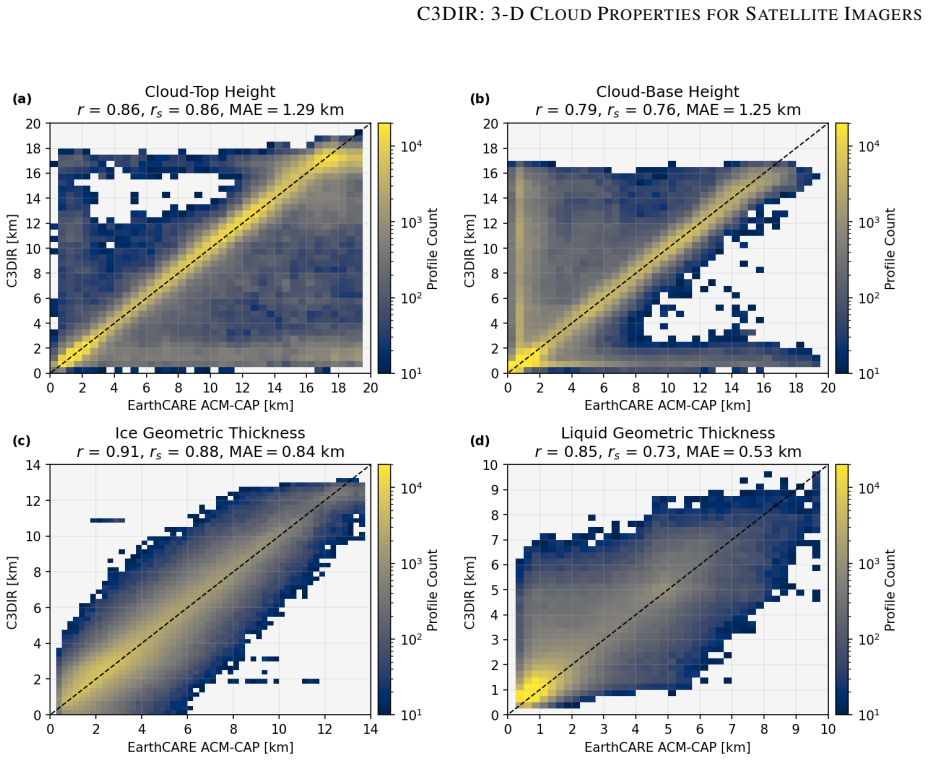
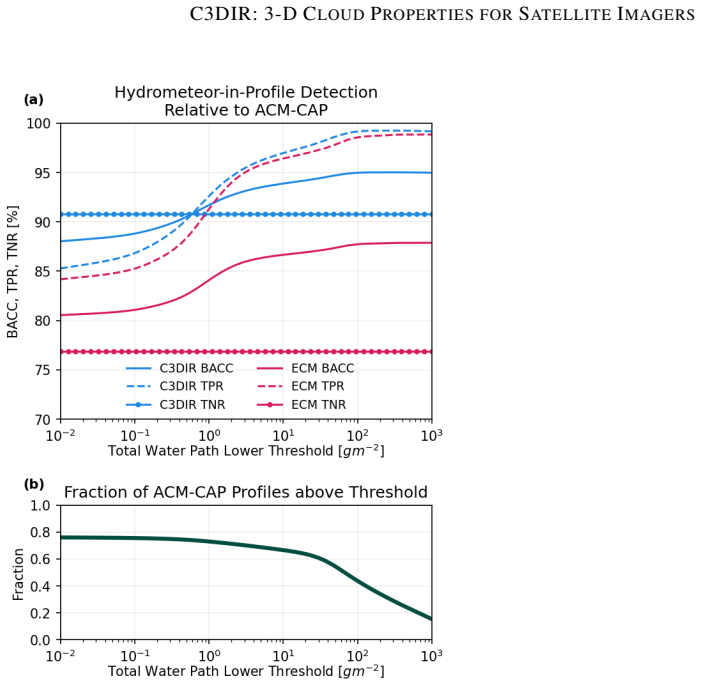
C3DIR's central claim is that a 2D convolutional network with a satellite-specific input stem, trained on sparsely collocated active-sensor profiles, can produce a complete 3D cloud volume for passive imagers. The volume is discretized into 0.25 km vertical voxels along each pixel's slant path, with outputs for the occurrence and water content of ice, liquid, and rain plus a hydrometeor mask. With a multi-task loss that also supervises cloud mask, cloud-top height, and cloud-top phase, the network matches the reference well on cloud detection, cloud-top and cloud-base heights, and column water paths, and does so with smaller errors than current operational cloud-top and water-path algorithms
What carries the argument
The voxel-to-voxel collocation scheme: instead of matching the whole active-sensor profile to one imager pixel, each vertical element of the profile is matched to the pixel whose line of sight passes through that location (within 5 km), so the model learns slanted-view geometry and can use viewing angles beyond 45 degrees. Around this, a satellite-specific stem handles spectral differences among imagers, a shared 2D ConvNeXt encoder-decoder with depth-to-space expansion produces the 3D output, and the loss is computed only on the sparsely labeled collocated voxels.
Load-bearing premise
The paper treats EarthCARE's ACM-CAP retrieval as the reference truth for training and for most evaluation; if those liquid- and rain-water fields are biased or uncertain—something the paper itself flags—then C3DIR inherits those biases and its agreement with ACM-CAP overstates physical accuracy.
What would settle it
A growing independent validation record—aircraft in-situ probes or a network of ground-based radar-lidar sites—that consistently shows C3DIR's liquid water path is substantially biased low (as the single ground-based comparison already hints) would falsify the claim that the model's column water paths are accurate across phases; equally, a reanalysis of ACM-CAP showing large liquid/rain biases would undermine the agreement metrics.
If this is right
- Operational cloud products from geostationary imagers could move from cloud-top and column-integrated quantities to vertically resolved, multi-layer cloud structure using existing instruments.
- The voxel collocation method lets the model use high viewing angles near the disk edge, expanding spatial coverage and the usable training set.
- Because one shared network serves multiple imagers, sensors with few spaceborne collocations can borrow skill learned from other sensors; adding a new sensor may only require training a small input stem.
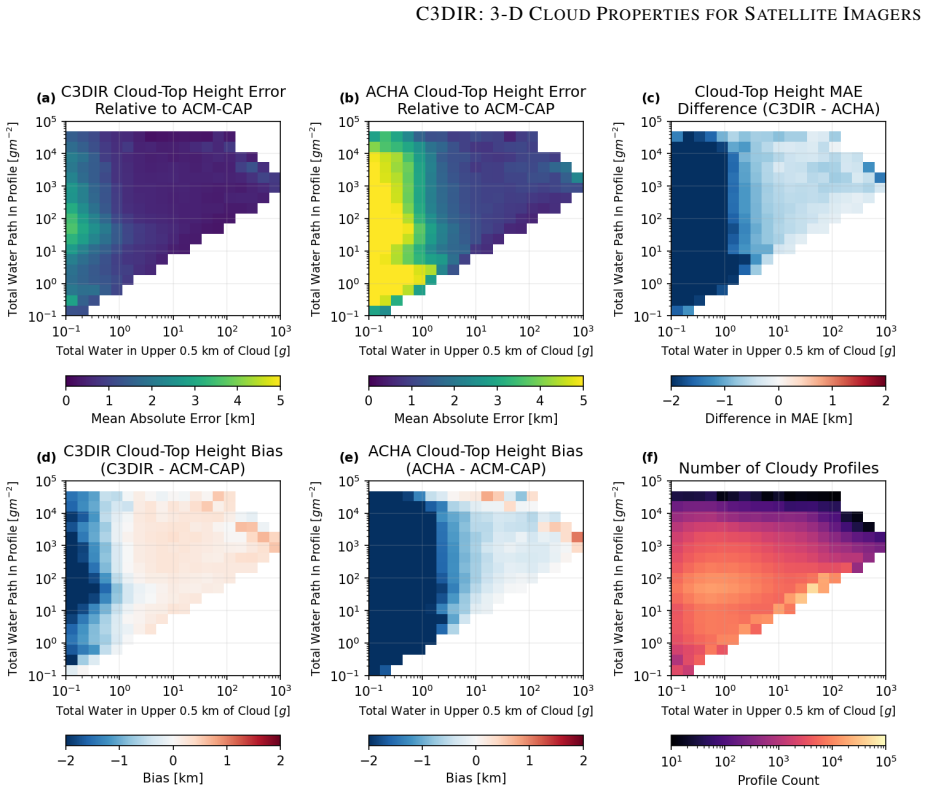
- Cloud-top height from C3DIR is closer to the active-sensor reference than the current operational cloud-top algorithm, especially for clouds with tenuous upper boundaries.
- The explicit 3D output allows downstream applications to set their own cloud definition—for example, ignoring thin cirrus below a water-content threshold—instead of being locked into a single operational cloud mask.
Where Pith is reading between the lines
- If the reported agreement holds as EarthCARE's validation matures, a natural next step is to use C3DIR's daily 3D fields as a training reference for finer-resolution imagers or as a consistency check for weather models that resolve cloud layering.
- The liquid water path low bias against ground-based measurements points to a concrete improvement: retrain the network on a reference version with better-constrained liquid phase, or add a liquid-sensitive auxiliary loss.
- The near-identical day/night skill suggests the model leans on spatial texture and infrared structure rather than visible-channel optical depth; explicitly including solar and viewing geometry could unlock more of the visible information in thick-cloud cases.
- The voxel-to-voxel collocation idea is not cloud-specific: any problem that compares a slant-viewing imager with a nadir profile—aerosol layers, trace-gas columns—could adopt the same registration to avoid parallax errors.
Editorial analysis
A structured set of objections, weighed in public.
Referee Report
Summary. The paper introduces C3DIR, a deep convolutional neural network that estimates three-dimensional cloud fields (ice, liquid, rain water content and binary masks) along the line of sight of several geostationary imagers (GOES-16/18/19 ABI, Meteosat-9/10 SEVIRI, Himawari-9 AHI). Training labels are taken from a voxel-level collocation with the EarthCARE ACM-CAP product, with auxiliary supervision from NOAA operational cloud products. The central methodological contribution is a voxel-to-voxel collocation scheme that explicitly accounts for the slant viewing geometry of passive imagers, allowing high viewing angles and avoiding profile-to-pixel mismatches. Evaluation is performed on a held-out test set against ACM-CAP, against current NOAA operational products (ACHA, ECM, DCOMP), and against ground-based SGP-ARM MICROBASE products. The paper reports good performance for ice water content, cloud-top/base height, and column-integrated water path, and explicitly acknowledges weaker skill for liquid and rain water content.
Significance. If the results hold, C3DIR is a significant step toward operational AI-based 3-D cloud retrieval: it addresses a real limitation of passive imagers, uses a conceptually clean collocation methodology that is an improvement over profile-to-pixel matching, and demonstrates plausible benefits over NOAA operational products. The paper is honest about the weak liquid/rain water content results and includes an independent ground-based comparison, which is a strength. However, the primary evaluation is against the same ACM-CAP product used to generate the training labels, so the headline agreement partly reflects the model's fit to the label distribution. The independent SGP-ARM check only partially breaks this circularity and reveals a substantial LWP low bias. Careful reframing of the physical claims and additional uncertainty quantification are needed before the central 'estimates' language is fully supported.
major comments (3)
- [§2.2, §5.2, §5.3] The primary evaluation uses the same ACM-CAP product that provides the training labels. Because Eq. (1) directly minimizes voxelwise differences against ACM-CAP, the 'broad agreement' reported in Sections 5.2 and 5.3 is largely a measure of how well the model has learned the label distribution, not independent evidence of physical accuracy. The independent SGP-ARM comparison in §5.4 is the only check that breaks this circularity, and it is limited to one site and to water-path quantities. The abstract's and Section 7's language that C3DIR 'estimates' ice/liquid/rain water content therefore overstates what the evidence supports. I request either (a) explicitly reframing the central claim as reproducing the ACM-CAP 3-D fields, or (b) adding an independent validation dataset that supports physical accuracy claims.
- [§5.4, Figure 13] The only independent evaluation shows a consistent low bias in C3DIR's liquid water path relative to SGP-ARM MICROBASE. The paper's statement that it is 'unclear whether this is a bias present in the SGP-ARM profiles, a feature of the EarthCARE ACM-CAP product inherited by C3DIR, or generalization error' is honest, but it leaves the physical accuracy of the liquid and rain water content claims unestablished. Since Figure 7 presents favorable LWC/RWC agreement against ACM-CAP, I recommend adding a direct comparison of ACM-CAP versus SGP-ARM at the same site and time, so that the bias contribution can at least be bracketed. Without this, the conclusion that 'uncertainties remain for liquid and rain water content' is not operationalized.
- [Figures 6–8, 11, 13; Table 1] No confidence intervals, uncertainty estimates, or sample sizes are reported for any of the headline metrics. Given the very large sample sizes in the ACM-CAP evaluation, small differences may appear statistically significant, while the SGP-ARM subset is small and may be noisy. I request bootstrap confidence intervals (or equivalent) and reported n for each panel and table. This is not purely presentational: the claimed improvements over ACHA and DCOMP cannot be properly assessed without some measure of uncertainty.
minor comments (6)
- [Abstract] 'occurrence water content' should be 'occurrence and water content' or 'occurrence of water content.'
- [§2.2] 'CAPTIV ATE' should be 'CAPTIVATE'; 'from theses instruments' should be 'from these instruments.'
- [§4] 'any-hydrometer mask' should be 'any-hydrometeor mask.'
- [§6] The discussion says C3DIR has similar day/night TWP performance 'in Figure 12,' but Figure 12 is the layer-count confusion matrix. The correct reference is Figure 11f.
- [§4.1, §4.2] The claims that the satellite-specific stem and asymmetrical decoder 'substantially improve' performance are not supported by any quantitative ablation. Please report the comparison experiments or soften the wording.
- [Throughout] There are several duplicated words and typos (e.g., 'Note the the beginning' in §5.1.1, 'the the' in §5.3.2, 'CLA VR-x' inconsistent spacing). A careful copyedit is needed.
Circularity Check
No significant circularity in the central retrieval: held-out ACM-CAP evaluation and independent SGP-ARM check give the main claims real content; one non-central overlap (NOAA operational algorithms used as both auxiliary training targets and comparison baselines) modestly weakens those baseline comparisons.
specific steps
-
other
[Section 2.3 (Auxiliary Labels) with Sections 5.3.1 and 5.3.2]
"we train C3DIR to additionally estimate three fields derived from the algorithms underpinning the NOAA operational products for ABI. These products are (1) a binary cloud mask derived from the Enterprise Cloud Mask (ECM; Heidinger and Straka, 2020); (2) the CTH from ACHA (Heidinger et al., 2020); and (3) a binary ice and liquid classification derived from the cloud-top phase algorithm ... Here, we compare the CTH derived from C3DIR to CTH estimated from ACHA processed within the CLA VR-x retrieval system."
The same NOAA operational algorithms used as C3DIR's auxiliary training targets (ECM cloud mask, ACHA CTH, cloud-top phase; Eq. 3) are later presented as independent baselines for comparison. Since the model was optimized to reproduce these products' outputs, the ACHA/ECM comparisons are not fully independent benchmark comparisons. The overlap is non-central: the paper's main 3D retrieval claims are evaluated against held-out ACM-CAP data and the independent SGP-ARM MICROBASE product, so the primary derivation does not reduce to this overlap.
full rationale
C3DIR's central derivation is a supervised learning task: Eq. (1) minimizes voxelwise errors against ACM-CAP labels (masks, water contents, effective radii), and Eq. (4) adds an auxiliary loss. The primary quantitative evaluation is performed on a held-out test set (Section 3.2, Figure 2a,d,e) that was 'unused during model development' (Section 4), so agreement on that test set is a genuine generalization check rather than a tautological refit of the training labels. The paper is explicit that 'The primary testing set used is the coarsened EarthCARE ACM-CAP product similarly used to train C3DIR' (Section 5), and it does not overstate this as physical truth. The independent SGP-ARM MICROBASE comparison (Section 5.4) provides an external check; it reveals a low bias in C3DIR liquid water path, and the paper candidly states that 'it is unclear whether this is a bias present in the SGP-ARM profiles, a feature of the EarthCARE ACM-CAP product inherited by C3DIR, or generalization error.' The liquid/rain uncertainty is acknowledged in the abstract and Section 6. Self-citations (e.g., White et al. 2025, Noh et al. 2022/2024) are contextual or explanatory, not load-bearing. The only notable overlap is that ACHA CTH and ECM cloud mask are used as auxiliary training targets (Section 2.3) and later as comparison baselines (Sections 5.3.1-5.3.2), which weakens those specific baseline comparisons but does not force the central results. Overall circularity is minor, hence score 2.
Axiom & Free-Parameter Ledger
free parameters (7)
- cloud-presence threshold =
1e-5 g m^-3
- log scaling constant s =
5e-5
- mask loss weight gamma_mask =
0.25
- weighting moderation lambda =
0.25
- collocation horizontal distance =
5 km
- vertical resolution =
0.25 km (80 levels)
- effective radius truncations =
140 um (ice), 35 um (liquid)
axioms (6)
- domain assumption ACM-CAP provides an adequate reference for cloud vertical structure
- domain assumption Voxel correspondence at <=5 km horizontal separation is accurate
- domain assumption Slant-path geometry captures the 3-D cloud field the passive instrument senses
- domain assumption TOA radiances, surface elevation, and GFS forecasts contain enough information to infer vertical water content
- domain assumption GFS 6-hour forecast approximates the clear-sky atmosphere
- domain assumption The test set is representative of the target population
Cite this review
Pith. "Pith review of C3DIR: A Deep Learning 3-Dimensional Cloud Property Retrieval Scheme for Passive Satellite Imagers." pith.science (2026). https://pith.science/paper/LVXP4JO5
@misc{pith2026260716929,
  author       = {Pith},
  title        = {Pith review of: C3DIR: A Deep Learning 3-Dimensional Cloud Property Retrieval Scheme for Passive Satellite Imagers},
  year         = {2026},
  howpublished = {\url{https://pith.science/paper/LVXP4JO5}},
  note         = {Machine review of arXiv:2607.16929}
}
read the original abstract
We develop the Cloud 3-Dimensional Imager Retrieval (C3DIR), a deep learning model that estimates 3-D cloud properties for multiple passive satellite imagers trained to match retrievals from the Earth Cloud Aerosol and Radiation Explorer(EarthCARE) ACM-CAP product. This work is aimed towards moving AI/ML 3-D cloud algorithms closer towards operational use. C3DIR predicts the occurrence water content of ice, cloud liquid, and rain along the imager line-of-sight and uses a voxel-level collocation approach to account for the misaligned viewing geometries of passive imagers and active profiling instruments. This precise collocation methodology allows for constructing vertical profiles using voxels contained by multiple imager pixels to facilitate comparisons with active profiling instruments. Qualitative case studies show that C3DIR can accurately depict multiple distinct overlapping cloud layers, albeit with some smoothing. Quantitative evaluations illustrate that C3DIR overall excels at hydrometeor detection which intuitively tends to be a function of water content. However, detection of voxels classified as liquid cloud remains difficult due to the their small geometric thickness, finer horizontal scale, and frequent tendency to be obscured or embedded within ice clouds. In general, water content estimation is reasonably accurate, yielding the best results in ice clouds but uncertainties remain for liquid and rain water content. Column-integrated water paths are in tighter agreement with EarthCARE. Comparisons with the algorithms underpinning current NOAA operational products highlight several areas where C3DIR may offer improvement. Overall, these results demonstrate the potential for C3DIR to provide flexible 3-D output depicting vertically resolved cloud structure which can offer broader utility for aviation applications, numerical weather modeling, and climate research.
Figures




Reference graph
Works this paper leans on
-
[1]
2015 , publisher=
Bony, Sandrine and Stevens, Bjorn and Frierson, Dargan MW and Jakob, Christian and Kageyama, Masa and Pincus, Robert and Shepherd, Theodore G and Sherwood, Steven C and Siebesma, A Pier and Sobel, Adam H and others , journal=. 2015 , publisher=
2015
-
[2]
2023 , pages=
Climate Change 2021 – The Physical Science Basis: Working Group I Contribution to the Sixth Assessment Report of the Intergovernmental Panel on Climate Change , publisher=. 2023 , pages=
2021
-
[3]
Journal of Climate
Stephens, Graeme L , title =. Journal of Climate. 2005
2005
-
[4]
Journal of Geophysical Research: Atmospheres , volume =
Oreopoulos, Lazaros and Cho, Nayeong and Lee, Dongmin , title =. Journal of Geophysical Research: Atmospheres , volume =
-
[5]
Journal of Atmospheric Sciences
Cahalan, Robert F and Ridgway, William and Wiscombe, Warren J and Bell, Thomas L and Snider, Jack B , title =. Journal of Atmospheric Sciences. 1994
1994
-
[6]
Journal of Geophysical Research: Atmospheres , volume =
Zhang, Zhibo and Platnick, Steven , title =. Journal of Geophysical Research: Atmospheres , volume =
-
[7]
and Stephens, Graeme L
Barker, Howard W. and Stephens, Graeme L. and Fu, Qiang , title =. Quarterly Journal of the Royal Meteorological Society , volume =
-
[8]
, title =
Barker, Howard W. , title =. Journal of Geophysical Research: Atmospheres , volume =
-
[9]
Aerospace Science and Technology , volume =
Cao, Yihua and Tan, Wenyuan and Wu, Zhenlong , title =. Aerospace Science and Technology , volume =. 2018 , issn =
2018
-
[10]
Solar Energy , volume =
Miller, Steven D and Rogers, Matthew A and Haynes, John M and Sengupta, Manajit and Heidinger, Andrew K , title =. Solar Energy , volume =. 2018 , note =
2018
-
[11]
Advances in Applied Energy , volume =
Paletta, Quentin and Terr. Advances in Applied Energy , volume =. 2023 , issn =
2023
-
[12]
and Liu, Hui and Lukens, Katherine E
Hoffman, Ross N. and Liu, Hui and Lukens, Katherine E. and Garrett, Kevin and Ide, Kayo , title =. Quarterly Journal of the Royal Meteorological Society , volume =
-
[13]
Journal of Applied Meteorology and Climatology
Velden, Christopher S and Bedka, Kristopher M , title =. Journal of Applied Meteorology and Climatology. 2009
2009
-
[14]
Journal of Applied Meteorology and Climatology
Heidinger, Andrew K and Evan, Amato T and Foster, Michael J and Walther, Andi , title =. Journal of Applied Meteorology and Climatology. 2012
2012
-
[15]
Bulletin of the American Meteorological Society
Mecikalski, John R and Feltz, Wayne F and Murray, John J and Johnson, David B and Bedka, Kristopher M and Bedka, Sarah T and Wimmers, Anthony J and Pavolonis, Michael and Berendes, Todd A and Haggerty, Julie and others , title =. Bulletin of the American Meteorological Society. 2007
2007
-
[16]
and Ackerman, Steven A
Frey, Richard A. and Ackerman, Steven A. and Holz, Robert E. and Dutcher, Steven and Griffith, Zach , TITLE =. Remote Sensing , VOLUME =. 2020 , NUMBER =
2020
-
[17]
and Bley, S
H\"unerbein, A. and Bley, S. and Horn, S. and Deneke, H. and Walther, A. , TITLE =. Atmospheric Measurement Techniques , VOLUME =. 2023 , NUMBER =
2023
-
[18]
and Merchant, Christopher J
Bulgin, Claire E. and Merchant, Christopher J. and Ghent, Darren and Klüser, Lars and Popp, Thomas and Poulsen, Caroline and Sogacheva, Larisa , TITLE =. Remote Sensing , VOLUME =. 2018 , NUMBER =
2018
-
[19]
Geophysical Research Letters , volume =
Martins, José Vanderlei and Tanré, Didier and Remer, Lorraine and Kaufman, Yoram and Mattoo, Shana and Levy, Robert , title =. Geophysical Research Letters , volume =
-
[20]
2026 , isbn =
Comprehensive Remote Sensing (Second Edition) , publisher =. 2026 , isbn =
2026
-
[21]
Journal of Atmospheric and Oceanic Technology
Maddux, BC and Ackerman, SA and Platnick, S , title =. Journal of Atmospheric and Oceanic Technology. 2010
2010
-
[22]
Bulletin of the American Meteorological Society
Winker, DM and Pelon, Jacques and Coakley Jr, JA and Ackerman, SA and Charlson, RJ and Colarco, PR and Flamant, P and Fu, Qinjun and Hoff, RM and Kittaka, C and others , title =. Bulletin of the American Meteorological Society. 2010
2010
-
[23]
Bulletin of the American Meteorological Society
Stephens, Graeme L and Vane, Deborah G and Boain, Ronald J and Mace, Gerald G and Sassen, Kenneth and Wang, Zhien and Illingworth, Anthony J and O'connor, Ewan J and Rossow, William B and Durden, Stephen L and others , title =. Bulletin of the American Meteorological Society. 2002
2002
-
[24]
and Kubota, T
Wehr, T. and Kubota, T. and Tzeremes, G. and Wallace, K. and Nakatsuka, H. and Ohno, Y. and Koopman, R. and Rusli, S. and Kikuchi, M. and Eisinger, M. and Tanaka, T. and Taga, M. and Deghaye, P. and Tomita, E. and Bernaerts, D. , TITLE =. Atmospheric Measurement Techniques , VOLUME =. 2023 , NUMBER =
2023
-
[25]
Bulletin of the American Meteorological Society
Illingworth, Anthony J and Barker, HW and Beljaars, A and Ceccaldi, Marie and Chepfer, H and Clerbaux, Nicolas and Cole, J and Delano. Bulletin of the American Meteorological Society. 2015
2015
-
[26]
Watts, P. D. and Bennartz, R. and Fell, F. , title =. Journal of Geophysical Research: Atmospheres , volume =
-
[27]
and Li ,Yue and Wanzong, Steve , year=
Heidinger, Andrew K. and Li ,Yue and Wanzong, Steve , year=
-
[28]
Journal of Atmospheric and Oceanic Technology
Haynes, John M and Noh, Yoo-Jeong and Miller, Steven D and Haynes, Katherine D and Ebert-Uphoff, Imme and Heidinger, Andrew , title =. Journal of Atmospheric and Oceanic Technology. 2022
2022
-
[29]
and Ding, Leah , journal=
Wang, Yiding and Gong, Jie and Wu, Dong L. and Ding, Leah , journal=. 2023 , volume=
2023
-
[30]
and Niebler, S
Br\"uning, S. and Niebler, S. and Tost, H. , TITLE =. Atmospheric Measurement Techniques , VOLUME =. 2024 , NUMBER =
2024
-
[31]
Artificial Intelligence for the Earth Systems
Jeggle, Kai and Czerkawski, Mikolaj and Serva, Federico and Le Saux, Bertrand and Neubauer, David and Lohmann, Ulrike , title =. Artificial Intelligence for the Earth Systems. 2025
2025
-
[32]
and Pfreundschuh, S
Amell, A. and Pfreundschuh, S. and Eriksson, P. , TITLE =. Atmospheric Measurement Techniques , VOLUME =. 2024 , NUMBER =
2024
-
[33]
Girtsou, Stella and Salas-Porras, Emiliano Diaz and Freischem, Lilli and Massant, Joppe and Bintsi, Kyriaki-Margarita and Castiglione, Guiseppe and Jones, William and Eisinger, Michael and Johnson, Emmanuel and Jungbluth, Anna , year=. 2501.02035 , archivePrefix=
-
[34]
Geophysical Research Letters , volume =
Sassen, Kenneth and Wang, Zhien , title =. Geophysical Research Letters , volume =
-
[35]
and Ackerman, Thomas P
Comstock, Jennifer M. and Ackerman, Thomas P. and Mace, Gerald G. , title =. Journal of Geophysical Research: Atmospheres , volume =
-
[36]
Mason, S. L. and Barker, H. W. and Cole, J. N. S. and Docter, N. and Donovan, D. P. and Hogan, R. J. and H\"unerbein, A. and Kollias, P. and Puigdom\`enech Treserras, B. and Qu, Z. and Wandinger, U. and van Zadelhoff, G.-J. , TITLE =. Atmospheric Measurement Techniques , VOLUME =. 2024 , NUMBER =
2024
-
[37]
, title =
Delanoë, Julien and Hogan, Robin J. , title =. Journal of Geophysical Research: Atmospheres , volume =
-
[38]
Globally Gridded Satellite Observations for Climate Studies
Knapp, Kenneth R and Ansari, Steve and Bain, Caroline L and Bourassa, Mark A and Dickinson, Michael J and Funk, Chris and Helms, Chip N and Hennon, Christopher C and Holmes, Christopher D and Huffman, George J and Kossin, James P and Lee, Hai-Tien and Loew, Alexander and Magnusdottir, Gudrun , title = "Globally Gridded Satellite Observations for Climate S...
2011
-
[39]
Bulletin of the American Meteorological Society
Schmit, Timothy J and Griffith, Paul and Gunshor, Mathew M and Daniels, Jaime M and Goodman, Steven J and Lebair, William J , title =. Bulletin of the American Meteorological Society. 2017
2017
-
[40]
Bulletin of the American Meteorological Society
Schmetz, Johannes and Pili, Paolo and Tjemkes, Stephen and Just, Dieter and Kerkmann, Jochen and Rota, Sergio and Ratier, Alain , title =. Bulletin of the American Meteorological Society. 2002
2002
-
[41]
2016 , publisher=
Bessho, Kotaro and Date, Kenji and Hayashi, Masahiro and Ikeda, Akio and Imai, Takahito and Inoue, Hidekazu and Kumagai, Yukihiro and Miyakawa, Takuya and Murata, Hidehiko and Ohno, Tomoo and others , journal=. 2016 , publisher=
2016
-
[42]
Mason, S. L. and Hogan, R. J. and Bozzo, A. and Pounder, N. L. , TITLE =. Atmospheric Measurement Techniques , VOLUME =. 2023 , NUMBER =
2023
-
[43]
Mason, S. L. and Chiu, J. C. and Hogan, R. J. and Tian, L. , TITLE =. Atmospheric Chemistry and Physics , VOLUME =. 2017 , NUMBER =
2017
-
[44]
Mason, S. L. and Chiu, C. J. and Hogan, R. J. and Moisseev, D. and Kneifel, S. , title =. Journal of Geophysical Research: Atmospheres , volume =
-
[45]
and Straka, William , year=
Heidinger, Andrew K. and Straka, William , year=
-
[46]
Pavolonis, Michael and Calvert, Corey , year=
-
[47]
Atmospheric Radiation Measurement (ARM) user facility , author=. 2011
2011
-
[48]
Journal of the UW-AOS , volume =
Smalley, Mark Allen , title =. Journal of the UW-AOS , volume =. 2011 , type =
2011
-
[49]
Journal of Applied Meteorology and Climatology
Baum, Bryan A and Menzel, W Paul and Frey, Richard A and Tobin, David C and Holz, Robert E and Ackerman, Steve A and Heidinger, Andrew K and Yang, Ping , title =. Journal of Applied Meteorology and Climatology. 2012
2012
-
[50]
Remote Sensing , VOLUME =
Meyer, Kerry and Platnick, Steven and Holz, Robert and Dutcher, Steve and Quinn, Greg and Nagle, Fred , TITLE =. Remote Sensing , VOLUME =. 2020 , NUMBER =
2020
-
[51]
Perez, Ethan and Strub, Florian and De Vries, Harm and Dumoulin, Vincent and Courville, Aaron , year=. 1709.07871 , archivePrefix=
-
[52]
Liu, Zhuang and Mao, Hanzi and Wu, Chao-Yuan and Feichtenhofer, Christoph and Darrell, Trevor and Xie, Saining , year=. 2201.03545 , archivePrefix=
-
[53]
and Duffy, Kate and Nachmany, Yoni and McDuff, Daniel , booktitle=
Vandal, Thomas J. and Duffy, Kate and Nachmany, Yoni and McDuff, Daniel , booktitle=. 2025 , volume=
2025
-
[54]
Loshchilov, Ilya and Hutter, Frank , year=. 1711.05101 , archivePrefix=
-
[55]
Kingma, Diederik P and Ba, Jimmy , year=. 1412.6980 , archivePrefix=
-
[56]
Schulte, R. M. and Lebsock, M. D. and Haynes, J. M. , TITLE =. Atmospheric Measurement Techniques , VOLUME =. 2023 , NUMBER =
2023
-
[57]
Schulte, R. M. and Lebsock, M. D. and Haynes, J. M. and Hu, Y. , TITLE =. Atmospheric Measurement Techniques , VOLUME =. 2024 , NUMBER =
2024
-
[58]
2013 , volume=
Di Michele, Sabatino and McNally, Tony and Bauer, Peter and Genkova, Iliana , journal=. 2013 , volume=
2013
-
[59]
Walther, Andi and Straka, William and Heidinger, Andrew K. , year=
-
[60]
Jeggle, Kai and Czerkawski, Mikolaj and Serva, Federico and Saux, Bertrand Le and Neubauer, David and Lohmann, Ulrike , year=. 2310.03499 , archivePrefix=
-
[61]
, title =
Hilburn, Kyle A. , title =. Artificial Intelligence for the Earth Systems. 2023
2023
-
[62]
and Noh, Yoo-Jeong and Haynes, John M
White, Charles H. and Noh, Yoo-Jeong and Haynes, John M. and Ebert-Uphoff, Imme , title =. Journal of Geophysical Research: Atmospheres , volume =
-
[63]
and Miller, Steven D
Noh, Yoo-Jeong and Haynes, John M. and Miller, Steven D. and Seaman, Curtis J. and Heidinger, Andrew K. and Weinrich, Jeffrey and Kulie, Mark S. and Niznik, Mattie and Daub, Brandon J. , TITLE =. Remote Sensing , VOLUME =. 2022 , NUMBER =
2022
-
[64]
Noh, Y. J. and Haynes, J. M. and Miller, S. D. and White, C. and Daub, B. and Ebert-Uphoff, I. and Yu, H. and Apke, J. and Chase, R. and Haynes, K. and Solbrig, J. and Rose, E. and King, M. and Cheatwood, L. , booktitle=. 2024 , volume=
2024
-
[65]
Journal of Applied Meteorology
Bernstein, Ben C and McDonough, Frank and Politovich, Marcia K and Brown, Barbara G and Ratvasky, Thomas P and Miller, Dean R and Wolff, Cory A and Cunning, Gary , title =. Journal of Applied Meteorology. 2005
2005
-
[66]
, title =
Jeck, Richard K. , title =. 2001 , number =
2001
-
[67]
and Marnas, F
Eisinger, M. and Marnas, F. and Wallace, K. and Kubota, T. and Tomiyama, N. and Ohno, Y. and Tanaka, T. and Tomita, E. and Wehr, T. and Bernaerts, D. , TITLE =. Atmospheric Measurement Techniques , VOLUME =. 2024 , NUMBER =
2024
-
[68]
2026 , issn =
Journal of the European Meteorological Society , volume =. 2026 , issn =
2026
-
[69]
2006 , url =
Wood, Robert , journal=. 2006 , url =
2006
-
[70]
Journal of Climate
Han, Qingyuan and Rossow, William B and Lacis, Andrew A , title =. Journal of Climate. 1994
1994
-
[71]
, title =
Bennartz, R. , title =. Journal of Geophysical Research: Atmospheres , volume =
-
[72]
Journal of Climate
Wood, Robert and Hartmann, Dennis L , title =. Journal of Climate. 2006
2006
This paper was first reviewed by deepseek-v4-flash on August 1, 2026.
discussion (0)
Sign in with ORCID, Apple, or X to comment. Anyone can read and Pith papers without signing in.