REVIEW 2 major objections 6 minor 104 references
Opportunities and challenges to study solar neutrinos with a Q-Pix pixel readout
T0 review · 2 major / 6 minor · reviewed 2026-08-06 · deepseek-v4-flash
Pith's one-line read This paper argues that a kiloton-scale underground liquid-argon detector with a Q-Pix pixel readout could study boron-8 and hep solar neutrinos above 5 MeV, but only if its two dominant unmeasured gamma backgrounds fall near the low end…
desk verdict A careful, honest feasibility study: the Q-Pix data-rate advantage is solid, and the solar-neutrino sensitivity claim is explicitly hostage to two under-measured backgrounds, so treat the >100 improvement as conditional. read the letter →
The pith
A machine-rendered reading of the paper's core claim, the machinery that carries it, and where it could break.
The reading
What carries the argument
The load-bearing object is the Q-Pix pixel readout, in which each pixel integrates charge on a feedback capacitor until a Schmitt trigger fires, records an 8-bit timestamp, resets, and repeats; the current profile is reconstructed from the times between resets rather than from recorded waveforms. That scheme is what lets the detector run continuously with no trigger and store about 1 TB per year of all events above 3 MeV. The second mechanism is the delayed-flash coincidence: charged-current events produce an excited 40K* nucleus whose 1.64 MeV de-excitation gamma arrives roughly 336 ns later, and a light-detection system covering the anode can tag that flash and reject the dominant backgrounds. Clustering, fiducialization, directionality, and pulse-shape discrimination are supporting tools that the paper layers on top of this readout.
What would settle it
Measure the gamma-ray energy spectrum at a candidate underground site between 5 and 20 MeV and measure $\alpha$-capture gamma production on argon with a tagged $\alpha$ source; if the fraction of gammas above 5 MeV approaches the top of the observed $10^{-8}$ to $10^{-5}$ range, or if the $\alpha$-capture rate matches the simulation's apparent two-order-of-magnitude overestimate of existing data, the claimed factor-of-100 sensitivity gain in the boron-8 and hep window does not survive.
Extended reading notes
Core claim
The central claim is that solar neutrino physics in a liquid-argon TPC is not closed off by the Q-Pix readout's low thresholds; rather, the readout's continuous, self-triggered nature is what makes the study possible. The paper shows that below 5 MeV, beta and gamma backgrounds exceed the solar signal by many orders of magnitude in both a conventional detector and a low-background one, so that region is abandoned. In the low-background scenario with the outer 4 m of argon used as shielding, the two dominant residual backgrounds above 5 MeV are cavern gamma rays and gamma rays from alpha capture on argon; the paper's reconstruction-level tools, including clustering, electron directionality for elastic-scattering events, pulse-shape discrimination, and a delayed 40K* gamma flash following charged-current events, push the sensitivity to boron-8 and hep neutrinos up by more than a factor of 100 in the 5 to 15 MeV range. The paper states the result as conditional: if future measurements confirm the assumed magnitude of gamma rates and alpha-capture processes, offline tools significantly enhance solar-neutrino potential in a pixelated LArTPC with effective light detection.
Load-bearing premise
The positive sensitivity result rests on an unmeasured background assumption: the true flux of cavern gamma rays above 5 MeV and the true yield of alpha-capture gamma rays must sit near the low end of the plausible range for the 6 to 12 MeV signal window to survive.
Editorial extensions
If this is right
- Below 5 MeV, solar neutrinos are not detectable in a kiloton-scale LArTPC even with a low-background design, because radioactivity outnumbers signal by roughly eight to eleven orders of magnitude.
- Above 5 MeV, in the low-background, 4 m-fiducialized configuration, the delayed-flash tag raises sensitivity by more than a factor of 100, enough for a large boron-8 sample and possibly a first look at hep neutrinos.
- Pulse-shape discrimination can reject about 99% of alpha-capture gamma events while keeping 99% of electron events, provided the alpha ionization model is correct.
- A Q-Pix detector can continuously store every event above 3 MeV at about 1 TB per year, a data volume that triggered wire- or CRP-based LArTPC readouts cannot match for solar analyses.
- A definite statement about hep neutrinos requires new measurements of both cavern gamma emission above 5 MeV and alpha-capture cross sections on argon.
Reading between the lines
- If the high-end gamma tail is real, the paper's own background model implies the 6 to 12 MeV window closes; that makes in-situ cavern gamma spectroscopy the single highest-value measurement before building such a detector.
- The delayed 40K* flash is an exclusive tag for charged-current events, so the same coincidence technique could help a future LArTPC isolate solar neutrinos from other physics backgrounds, or identify neutrino bursts, without requiring track reconstruction.
- The data-rate argument suggests that a Q-Pix-style continuous readout could be valuable beyond solar physics, for any low-energy rare-event search where the background rate is too high to trigger on but the storage cost of full readout is acceptable.
- The paper itself flags in its background section that the external gamma spectrum above 5 MeV is an arbitrary exponential extrapolation and that its alpha-capture simulation seems to overestimate existing measurements by about two orders of magnitude; those two caveats anchor the whole conditional result.
Editorial analysis
A structured set of objections, weighed in public.
Referee Report
Summary. This paper presents a Geant4/GENIE/MARLEY-based simulation study of solar neutrino detection (8B and hep CC and ES) in a kiloton-scale liquid argon TPC instrumented with Q-Pix continuous pixel readout. Two detector scenarios are considered: a high-background atmospheric-argon module and a low-background underground-argon SLoMo-like design. The authors construct a conservative background model including argon radioactivity, radon decay chains with alpha-capture and (alpha,n) processes, external neutrons and gamma rays, and then evaluate clustering thresholds, 4 m liquid-argon fiducialization, directionality, pulse-shape discrimination, and a delayed-flash coincidence tag on the 40K* de-excitation. The main quantitative claim is that in the low-background scenario with 4 m of shielding and the delayed-flash tag, sensitivity to 8B CC and hep neutrinos is improved by more than a factor of 100 in reconstructed energy between about 5 and 15 MeV (Fig. 14). The authors explicitly caveat that this conclusion depends on the poorly constrained external gamma tail and alpha-capture rates, and identify these as critical measurements for future detectors. They also stress that Q-Pix continuous readout can store all above-3-MeV data at about 1 TB/year, avoiding wire-trigger data volumes.
Significance. If the central conditional claim holds, this is a useful feasibility study for future large LArTPCs (DUNE, SOLAIRE) and for the Q-Pix collaboration. Its strengths are the unusually explicit treatment of uncertainties: the arbitrary gamma-tail extrapolation, the Geant4 overestimate of alpha-capture rates, and the 60% zero-ionization fraction in alpha transport are all stated in the text, and the main positive result is explicitly conditional on future measurements. The paper also identifies specific measurements (cavern gamma flux above 5 MeV and alpha-capture cross sections) that are currently the bottleneck, which is a valuable community contribution. The robust, background-model-independent result is the data-rate comparison: about 1 TB/year above 3 MeV with Q-Pix versus roughly 10^5 PB/year for continuous wire readout. The significance of the sensitivity claims is moderate because the quantitative improvement factor is computed from a nominally extrapolated background model rather than from a bracketed range.
major comments (2)
- [V.B.2, Fig. 14] The quantitative headline of the paper, the >100 sensitivity improvement in Figure 14, is computed from the nominal external-gamma spectrum. That spectrum is obtained by an exponential extrapolation from about 11 MeV to 20 MeV described in Section V.B.2 as 'arbitrarily' chosen, while the fraction of gamma rays above 5 MeV measured in underground facilities spans 10^-8 to 10^-5. Since 4 m of liquid argon attenuates gammas exponentially and the delayed-flash tag removes only a fixed fraction of the surviving background, the surviving rate in the 6-12 MeV window is exponentially sensitive to the tail normalization. I request an explicit sensitivity scan of the Figure 14 improvement factor as the high-energy tail is renormalized across the quoted range (or at least at the endpoints), so that the conditional claim in Section VII can be evaluated against the stated uncertainty band.
- [V.A.2, VI.D.1] The alpha-capture gamma background is one of the two backgrounds identified as critical above 5 MeV, yet the rate used in the simulation (about 10^6 per 10 kton-year) is stated to overestimate the cross-section-based estimate from Ref. [64] by about two orders of magnitude, and the PSD rejection study relies on Geant4 alpha transport that reports zero ionization for more than 60% of alpha-capture events. The authors should quantify how the Figure 14 improvement changes if the alpha-capture rate is instead normalized to the analytic estimate, and how the PSD rejection efficiency changes if the zero-ionization events are conservatively treated as not separable by pulse shape. Without this, the PSD-based component of the central claim is tied to a simulation effect the paper itself flags as unreliable.
minor comments (6)
- [V.A.1] The word 'idotopes' should be 'isotopes' in the sentence describing atmospheric argon composition.
- [V] 'Site-specific essays' should presumably read 'site-specific assays'; as written it is confusing.
- [Fig. 7] The legend entry 'Extraprolated Gammas' is misspelled, and the caption phrase 'Conservative G4 only' is unclear about which component it applies to.
- [Fig. 14 caption] 'The improvements is calculated' should be 'The improvement is calculated'.
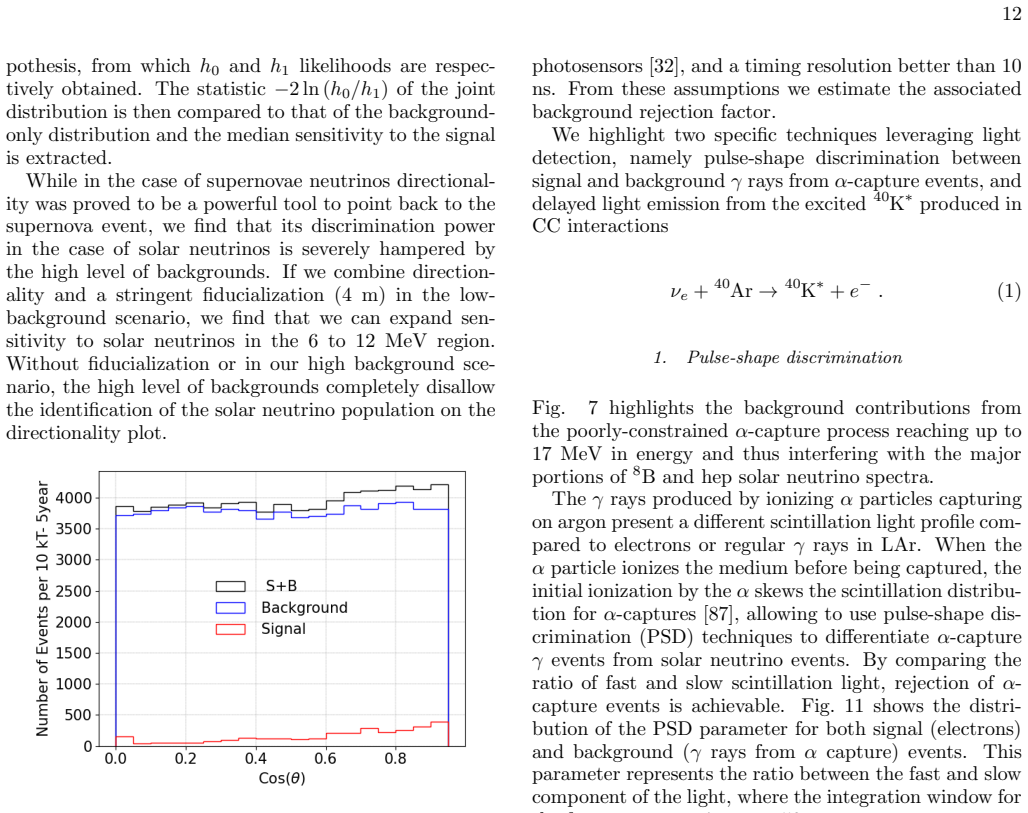
- [VI.C] The claim that directionality expands sensitivity in the 6-12 MeV region is not accompanied by any quantitative sensitivity metric; please add a number or explicitly label the statement as qualitative.
- [VI.D.2] The random-coincidence probabilities are quoted without the per-source mu values used in the Poisson product; including a small table or listing would make the calculation reproducible.
Circularity Check
No significant circularity: the solar-neutrino sensitivity and data-rate claims are conditional simulation outputs; the few self-citations are methodological, not load-bearing.
full rationale
The derivation chain runs from externally measured inputs (SSM neutrino fluxes [49], argon activities from WARP/GERDA/DEAP/DBA and DarkSide, neutron-argon cross sections, and gamma spectra from LZ plus other underground laboratories) through Geant4/MARLEY/GENIE simulation to sensitivity ratios and reset-count data rates. The central positive claim is explicitly conditional: 'If future measurements confirm that γ rates and α-capture processes fall within the assumed order of magnitude...' The two dominant high-energy backgrounds are flagged as underconstrained: the external gamma spectrum above 5 MeV is 'arbitrarily' extrapolated exponentially to 20 MeV, and the simulated α-capture rate 'seems to overestimate the measurements presented in Ref. [64]' with new measurements called 'paramount.' These are uncertainties in external inputs, not a case of the output being equivalent to the input by construction. The Q-Pix-specific results are arithmetic or simulation-derived: the 1 TB/year data rate is a count of resets using stated 8-byte timestamps and threshold parameters, and the sensitivity improvement in Fig. 14 is a ratio of s/√b values from simulated signal and background spectra. The paper cites the authors' earlier work for the Q-Pix readout concept [29,35], the QPixG4/QPixRTD simulation packages, and the clustering/directionality recipe from the supernova study [36], but these are methodological self-citations supplying reconstruction parameters rather than the solar-neutrino sensitivity being claimed. No conclusion is defined in terms of, or fitted to, a prior result of the same authors, so no circular step can be exhibited.
Assumptions & free parameters
free parameters (5)
- External gamma spectrum high-energy tail =
exponential extrapolation to 20 MeV
- Alpha-capture gamma rate normalization =
Geant4 rate ~10^6 captures per 10 kt yr
- Low-background reduction factors =
10^4 for neutrons, 10^3 for radon
- Light system coverage and efficiency =
37% coverage, 15% quantum efficiency
- Cluster threshold and coincidence window =
12 resets (3 MeV), 1500 ns
assumptions (5)
- domain assumption Geant4 with FTFP_BERT_HP, MARLEY and GENIE faithfully model low-energy neutrino and electron interactions in liquid argon.
- domain assumption Radon decay chains are in secular equilibrium within the one-year exposure window.
- domain assumption Detector component radioactivity is negligible.
- domain assumption Single 2.3x6.0 m2 anode sheet simulation scales linearly to the full 12.0x14.0x58.2 m3 fiducial volume.
- domain assumption Assumed argon activities (39Ar 1 Bq/kg, 42Ar 100 uBq/kg, 85Kr 0.1 Bq/kg) represent atmospheric argon batches.
Cite this review
Pith. "Pith review of Opportunities and challenges to study solar neutrinos with a Q-Pix pixel readout." pith.science (2026). https://pith.science/paper/LWO4YMGP
@misc{pith2026250715459,
  author       = {Pith},
  title        = {Pith review of: Opportunities and challenges to study solar neutrinos with a Q-Pix pixel readout},
  year         = {2026},
  howpublished = {\url{https://pith.science/paper/LWO4YMGP}},
  note         = {Machine review of arXiv:2507.15459}
}
read the original abstract
The study of solar neutrinos presents significant opportunities in astrophysics, nuclear physics, and particle physics. However, the low-energy nature of these neutrinos introduces considerable challenges to isolate them from background events, requiring detectors with low-energy threshold, high spatial and energy resolutions, and low data rate. We present the study of solar neutrinos with a kiloton-scale liquid argon detector located underground, instrumented with a pixel readout using the Q-Pix technology. We explore the potential of using volume fiducialization, directional topological information, light signal coincidence and pulse-shape discrimination to enhance solar neutrino sensitivity. We find that discriminating neutrino signals below 5 MeV is very difficult. However, we show that these methods are useful for the detection of solar neutrinos when external backgrounds are sufficiently understood and when the detector is built using low-background techniques. When building a workable background model for this study, we identify {\gamma} background from the cavern walls and from capture of {\alpha} particles in radon decay chains as both critical to solar neutrino sensitivity and significantly underconstrained by existing measurements. Finally, we highlight that the main advantage of the use of Q-Pix for solar neutrino studies lies in its ability to enable the continuous readout of all low-energy events with minimal data rates and manageable storage for further offline analyses.
Figures


Figures from the paper (11 more)




Reference graph
Works this paper leans on
-
[64]
Measurement of the specific activity of Ar-39 in natural argon
P. Benetti et al. (W ARP Collaboration), Nucl. Instrum. Meth. A 574, 83 (2007), arXiv:astro-ph/0603131
work page Pith review arXiv 2007
-
[1]
QPixG4: This software relies on Geant4 v4.11 [37] with the physics library FTFP BERT HP, com- bined with the low energy event generator MAR- LEY [38] and the neutrino interaction generator GENIE [39] that models neutrino interactions in 4 the detector environment
-
[2]
modified box model
QPixRTD: This standalone code transforms the Geant4 output hits into Q-Pix resets, simulating the detector response. For simulating solar neutrinos, we use the MARLEY event generator [38], which generates low-energy CC or ES neutrino events from a given neutrino spectrum. The events are then run with the QPixG4 package. In this study, the detector dimensi...
-
[3]
The only requirement is that the “spatial” resets must be contiguous
The resets are clustered on the pixel plane. The only requirement is that the “spatial” resets must be contiguous
-
[4]
At this stage, ϵ and CT are varied so that we may choose optimal parameters for each study
The resets are clustered along their temporal coor- dinates. At this stage, ϵ and CT are varied so that we may choose optimal parameters for each study. The maximum temporal separation between resets is fixed at 3 µs, equivalent to 5 mm. This interval is optimal for depositions in the MeV energy range [36]
-
[5]
bulk argon radioactivity
Energy reconstruction With the Q-Pix readout, the charge collected on the anode plane can be directly reconstructed from the num- ber N of resets produced, i.e., Qrec = N × ∆Q, where ∆Q is the pixel charge threshold. However, since ∆ Q is not infinitesimally small, some deposited charge Qdep may not be recorded in the correct event when Qdep is not an int...
-
[6]
Argon radioactivity Commercially available argon commonly used in LArT- PCs is obtained by liquefying argon from the atmosphere. In its natural isotopic composition, atmospheric argon consists of the stable 40Ar isotope and trace amounts of the radioactive idotopes 37Ar (T1/2 = 35 d, Qβ = 0.813 MeV), 39Ar (T1/2 = 268 y, Qβ = 0.565 MeV), and 42Ar 6 (T1/2 =...
-
[7]
giant resonances
Radon decay chains Radon emanates from any material that contains Ura- nium and Thorium isotopes, such as detector compo- nents and surrounding materials like rocks, concrete and shotcrete, and can diffuse inside the detector. Here, we treat radon isotopes and their daughters as an internal background since their activity will primarily occur in- side the...
Show all 104 references
-
[8]
The different detector parts contain radiocontaminants such as 238U, 235U, 232Th, 60Co or 40K that can produce background events
Radioactivity from detector components The last sources of internal background we consider are the detector components. The different detector parts contain radiocontaminants such as 238U, 235U, 232Th, 60Co or 40K that can produce background events. However, since it is expect...
-
[9]
To estimate the neutron energy spectrum from the cavern, we use the material compositions in Ref
Neutrons Neutrons are emitted in fission processes and (α, n) reac- tions created by α decays resulting from the 232Th and 238U chains. To estimate the neutron energy spectrum from the cavern, we use the material compositions in Ref. [34]. The (α, n) components of the neutron ...
-
[10]
external γ rays
γ rays The interactions of γ rays in the liquid argon are an ir- reducible background as they result in the production of single electrons via Compton scattering or pair produc- tion. It is therefore crucial to estimate the rates of γ rays produced in the detector surroundings...
-
[11]
Pulse-shape discrimination Fig. 7 highlights the background contributions from the poorly-constrained α-capture process reaching up to 17 MeV in energy and thus interfering with the major portions of 8B and hep solar neutrino spectra. The γ rays produced by ionizing α particle...
-
[12]
Light coincidence from solar neutrino CC interactions Charge current interactions from solar neutrinos on argon (1) could be isolated from background via the detection of a delayed light flash emitted by the de-excitation of the 40K∗ [88]. Fig. 12 shows the fraction of CC inte...
2020
-
[13]
D. B. Guenther, P. Demarque, Y. C. Kim, and M. H. Pinsonneault, Astrophys. J. 387, 372 (1992)
1992
-
[14]
J. N. Bahcall, M. H. Pinsonneault, and S. Basu, Astro- phys. J. 555, 990 (2001), arXiv:astro-ph/0010346
2001 arXiv
-
[15]
J. W. Harvey et al. , Science 272, 1284 (1996)
1996
-
[16]
Basu and H
S. Basu and H. M. Antia, apjl 606, L85 (2004), arXiv:astro-ph/0403485 [astro-ph]
2004 arXiv
-
[17]
Montalb´ an, A
J. Montalb´ an, A. Miglio, A. Noels, N. Grevesse, and M. P. di Mauro, in SOHO 14 Helio- and Asteroseismol- ogy: Towards a Golden Future , ESA Special Publication, Vol. 559, edited by D. Danesy (2004) p. 574, arXiv:astro- ph/0408055 [astro-ph]
2004
-
[18]
Basilico et al
D. Basilico et al. (Borexino Collaboration), Phys. Rev. D 108, 102005 (2023)
2023
-
[19]
Fischer, G
T. Fischer, G. Guo, K. Langanke, G. Martinez-Pinedo, Y.-Z. Qian, and M.-R. Wu, Prog. Part. Nucl. Phys. 137, 104107 (2024), arXiv:2308.03962 [astro-ph.HE]
2024 arXiv
-
[20]
Q. R. Ahmad et al. (SNO Collaboration), Phys. Rev. Lett. 89, 011301 (2002)
2002
-
[21]
Aardsma et al
G. Aardsma et al. , Physics Letters B 194, 321 (1987)
1987
-
[22]
Abdurashitov et al., Physics Letters B328, 234 (1994)
J. Abdurashitov et al., Physics Letters B328, 234 (1994)
1994
-
[23]
Wolfenstein, Phys
L. Wolfenstein, Phys. Rev. D 17, 2369 (1978)
1978
-
[24]
Maltoni and A
M. Maltoni and A. Y. Smirnov, Eur. Phys. J. A 52, 87 (2016), arXiv:1507.05287 [hep-ph]
2016 arXiv
-
[25]
Gando et al
A. Gando et al. (KamLAND Collaboration), Phys. Rev. D 88, 033001 (2013), arXiv:1303.4667 [hep-ex]
2013 arXiv
-
[26]
Hajjar, S
R. Hajjar, S. Palomares-Ruiz, and O. Mena, Phys. Lett. B 854, 138719 (2024), arXiv:2307.09509 [hep-ph]
2024 arXiv
-
[27]
J. N. Bahcall, Phys. Scripta T 121, 46 (2005), arXiv:hep- ph/0412068
2005
-
[28]
H¨ udepohl, B
L. H¨ udepohl, B. M¨ uller, H. T. Janka, A. Marek, and G. G. Raffelt, Phys. Rev. Lett. 104, 251101 (2010), arXiv:0912.0260 [astro-ph.SR]
2010 arXiv
-
[29]
Antonello et al
M. Antonello et al. , J. Instrum. 10 (12), P12004, arXiv:1504.01556 [physics.ins-det]
-
[30]
Acciarri et al
R. Acciarri et al. (MicroBooNE Collaboration), J. In- strum. 12 (02), P02017, arXiv:1612.05824 [physics.ins- det]
-
[31]
Acciarri et al
R. Acciarri et al. (LArIAT Collaboration), J. Instrum. 15 (04), P04026, arXiv:1911.10379 [physics.ins-det]
1911 arXiv
- [32]
-
[33]
Tufanli (SBND Collaboration), PoS HQL2016, 070 (2017)
S. Tufanli (SBND Collaboration), PoS HQL2016, 070 (2017)
2017
-
[34]
Adams, M
C. Adams, M. Del Tutto, J. Asaadi, M. Bernstein, E. Church, R. Guenette, J. M. Rojas, H. Sulli- van, and A. Tripathi, J. Instrum. 15 (04), P04009, arXiv:1912.10133 [physics.ins-det]
1912 arXiv
-
[35]
Acciarri et al
R. Acciarri et al. (MicroBooNE Collaboration), J. In- strum. 12 (08), P08003, arXiv:1705.07341 [physics.ins- det]
-
[36]
B. Abi, R. Acciarri, M. A. Acero, G. Adamov, D. Adams, M. Adinolfi, et al. (DUNE Collaboration), J. Instrum. 15 (08), T08010, arXiv:2002.03010 [physics.ins-det]
2002
-
[37]
Abed Abud et al
A. Abed Abud et al. (DUNE Collaboration), J. Instrum. 19 (08), T08004, arXiv:2312.03130 [hep-ex]
-
[38]
D. A. Dwyer et al. , J. Instrum. 13 (10), P10007, arXiv:1808.02969 [physics.ins-det]. 16
-
[39]
Abed Abud et al
A. Abed Abud et al. (DUNE Collaboration), J. Instrum. 18 (04), P04034, arXiv:2212.09807 [physics.comp-ph]
-
[40]
Anfimov et al
N. Anfimov et al. (SoLAr), JINST 19 (11), P11010, arXiv:2406.14121 [physics.ins-det]
- [41]
-
[42]
Bezerra et al., Journal of Physics G: Nuclear and Par- ticle Physics 50, 060502 (2023)
T. Bezerra et al., Journal of Physics G: Nuclear and Par- ticle Physics 50, 060502 (2023)
2023
-
[43]
A. A. Abud et al. (DUNE Collaboration), J. Instrum. 17 (01), P01005, arXiv:2108.01902 [physics.ins-det]
-
[44]
Hamamatsu Photonics K.K., https://hamamatsu.su/ files/uploads/pdf/3 mppc/s13370 vuv4- mppc b (1).pdf
-
[45]
Rooks, S
M. Rooks, S. Abbaszadeh, J. Asaadi, M. Febbraro, R. Gladen, E. Gramellini, K. Hellier, F. M. Blaszczyk, and A. McDonald, J. Instrum 18, P01029 (2023)
2023
-
[46]
Capozzi, S
F. Capozzi, S. W. Li, G. Zhu, and J. F. Beacom, Phys. Rev. Lett. 123, 131803 (2019), arXiv:1808.08232 [hep- ph]
2019 arXiv
-
[47]
P. Miao, J. Asaadi, J. B. R. Battat, M. Han, K. Keefe, S. Kohani, A. D. McDonald, D. Nygren, O. Seidel, and Y. Mei, (2023), arXiv:2311.09568 [physics.ins-det]
2023 arXiv
-
[48]
Kubota et al
S. Kubota et al. (Q-Pix), Phys. Rev. D 106, 032011 (2022), arXiv:2203.12109 [hep-ex]
2022 arXiv
-
[49]
Agostinelli et al., Nuclear Instruments and Methods in Physics Research Section A: Accelerators, Spectrometers, Detectors and Associated Equipment 506, 250 (2003)
S. Agostinelli et al., Nuclear Instruments and Methods in Physics Research Section A: Accelerators, Spectrometers, Detectors and Associated Equipment 506, 250 (2003)
2003
-
[50]
Gardiner, Computer Physics Communications 269, 108123 (2021)
S. Gardiner, Computer Physics Communications 269, 108123 (2021)
2021
-
[51]
Andreopoulos et al
C. Andreopoulos et al. , Nuclear Instruments and Meth- ods in Physics Research Section A: Accelerators, Spec- trometers, Detectors and Associated Equipment 614, 87 (2010)
2010
-
[52]
Acciarri et al
R. Acciarri et al. (ArgoNeuT Collaboration), J. Instrum. 8, P08005, arXiv:1306.1712 [physics.ins-det]
-
[53]
Y. Li, T. Tsang, C. Thorn, X. Qian, M. Diwan, J. Joshi, S. Kettell, W. Morse, T. Rao, J. Stewart, W. Tang, and B. Viren, Nuclear Instruments and Methods in Physics Research Section A: Accelerators, Spectrometers, Detec- tors and Associated Equipment 816, 160 (2016)
2016
-
[54]
Meddage (MicroBooNE Collaboration), in Meeting of the APS Division of Particles and Fields (2017) arXiv:1710.00396 [physics.ins-det]
V. Meddage (MicroBooNE Collaboration), in Meeting of the APS Division of Particles and Fields (2017) arXiv:1710.00396 [physics.ins-det]
2017 arXiv
-
[55]
Antonello et al
M. Antonello et al. , J. Instrum. 9 (12), P12006, arXiv:1409.5592 [physics.ins-det]
-
[56]
D. L. Adams et al. , J. Instrum. 15 (03), P03035, arXiv:1912.08739 [physics.ins-det]
1912 arXiv
-
[57]
Ester, H.-P
M. Ester, H.-P. Kriegel, J. Sander, and X. Xu, inProceed- ings of the Second International Conference on Knowl- edge Discovery and Data Mining , KDD’96 (AAAI Press,
-
[58]
Takahashi, M
T. Takahashi, M. Miyajima, S. Konno, T. Hamada, S. Kubota, H. Shibamura, and T. Doke, Physics Letters A 44, 123 (1973)
1973
-
[59]
Aharmim et al
B. Aharmim et al. (SNO Collaboration), Phys. Rev. D 102, 062006 (2020), arXiv:2007.08018 [hep-ex]
2020 arXiv
-
[60]
Agostini et al
M. Agostini et al. (Borexino), Phys. Rev. D 101, 062001 (2020), arXiv:1709.00756 [hep-ex]
2020 arXiv
-
[61]
J. N. Bahcall, A. M. Serenelli, and S. Basu, The Astro- physical Journal 621, L85 (2005)
2005
-
[62]
Anderson et al
M. Anderson et al. (SNO+ Collaboration), Phys. Rev. D 99, 012012 (2019), arXiv:1812.03355 [hep-ex]
2019 arXiv
-
[63]
Basilico et al
D. Basilico et al. (BOREXINO Collaboration), Phys. Rev. D 108, 102005 (2023), arXiv:2307.14636 [hep-ex]
2023 arXiv
-
[65]
Agostini et al
M. Agostini et al. (GERDA Collaboration), Eur. Phys. J. C 74, 2764 (2014), arXiv:1306.5084 [physics.ins-det]
2014 arXiv
-
[66]
A. S. Barabash, R. R. Saakyan, and V. I. Umatov, Nucl. Instrum. Meth. A 839, 39 (2016), arXiv:1609.08890 [nucl-ex]
2016 arXiv
-
[67]
Ajaj et al
R. Ajaj et al. (DEAP Collaboration), Phys. Rev. D 100, 072009 (2019), arXiv:1905.05811 [nucl-ex]
2019 arXiv
-
[68]
Caratelli et al., (2022), arXiv:2203.00740 [physics.ins- det]
D. Caratelli et al., (2022), arXiv:2203.00740 [physics.ins- det]
2022
-
[69]
Agnes et al
P. Agnes et al. (DarkSide Collaboration), Phys. Rev. D 93, 081101 (2016), [Addendum: Phys.Rev.D 95, 069901 (2017)], arXiv:1510.00702 [astro-ph.CO]
2016 arXiv
-
[70]
Agnes et al
P. Agnes et al. (DarkSide-20k Collaboration), Eur. Phys. J. C 81, 359 (2021), arXiv:2101.08686 [physics.ins-det]
2021 arXiv
-
[71]
S. S. Poudel, B. Loer, R. Saldanha, H. O. Back, and B. R. Hackett, AIP Conference Proceedings 2908, 100004 (2023), https://pubs.aip.org/aip/acp/article- pdf/doi/10.1063/5.0161208/18110420/100004 1 5.0161208.pdf
2023 doi
-
[72]
K. T. Lesko et al. , (2011), arXiv:1108.0959 [hep-ex]
2011 arXiv
-
[73]
Heise, J
J. Heise, J. Phys. Conf. Ser. 606, 012015 (2015), arXiv:1503.01112 [physics.ins-det]
2015 arXiv
-
[74]
Chan et al
Y. Chan et al. , https://sanfordlab.org/news/low- background-construction-laboratories-4850-ft- level-davis-campus
-
[75]
International Atomic Energy Agency (IAEA), https: //www.iaea.org/topics/spent-fuel-management/ depleted-uranium
-
[76]
Foote, D
G. Foote, D. Branford, D. Weisser, N. Shikazono, R. Bell, and F. Huang, Nuclear Physics A 263, 349 (1976)
1976
-
[77]
C. W. Nahm and T. T. Thwaites, Nucl. Phys. A 103, 503 (1967)
1967
-
[78]
N. G. Alenius et al. , Il Nuovo Cimento A (1965-1970) 8, 10.1007/BF02728760 (1972)
1972 doi
-
[79]
Singh and J
B. Singh and J. Chen, Nuclear Data Sheets 126, 1 (2015)
2015
-
[80]
J. B. Albert et al. (EXO-200 Collaboration), Phys. Rev. C 92, 045504 (2015), arXiv:1506.00317 [nucl-ex]
2015 arXiv
-
[81]
A. E. Monte, Alpha Radiation Studies and Related Back- grounds in the DarkSide-50 Detector , Ph.D. thesis, Mas- sachusetts U., Amherst, Massachusetts U., Amherst (2018)
2018
-
[82]
C. E. Aalseth et al. (DarkSide-20k Collaboration), Eur. Phys. J. Plus 133, 131 (2018), arXiv:1707.08145 [physics.ins-det]
2018 arXiv
-
[83]
Ajaj et al
R. Ajaj et al. (DEAP Collaboration), Phys. Rev. D 100, 022004 (2019), arXiv:1902.04048 [astro-ph.CO]
2019 arXiv
-
[84]
Westerdale, https://github.com/shawest/neucbot
S. Westerdale, https://github.com/shawest/neucbot
-
[85]
Chen, Nuclear Data Sheets 140, 1 (2017)
J. Chen, Nuclear Data Sheets 140, 1 (2017)
2017
-
[86]
S. P. MacMullin, Elastic and Inelastic Scattering of Neu- trons from Neon and Argon: Impact on Neutrinoless Double-Beta Decay and Dark Matter Experimental Pro- grams, Ph.D. thesis, North Carolina U. (2013)
2013
-
[87]
C. D. Nesaraja and E. A. McCutchan, Nucl. Data Sheets 133, 1 (2016)
2016
-
[88]
Cameron, J
J. Cameron, J. Chen, B. Singh, and N. Nica, Nucl. Data Sheets 113, 365 (2012)
2012
-
[89]
E. T. Jurney, J. W. Starner, J. E. Lynn, and S. Raman, Phys. Rev. C 56, 118 (1997)
1997
-
[90]
S. F. Mughabghab, Atlas of Neutron Resonances: Res- onance Parameters and Thermal Cross Sections. Z=1- 100; 5th ed. (Elsevier, San Diego, CA, 2006)
2006
-
[91]
International Atomic Energy Agency (IAEA), Ther- mal neutron capture γs (capgam) (2008), https://www- 17 nds.iaea.org/capgam/index.htmlx
2008
-
[92]
Meyer-Sch¨ utzmeister, Z
L. Meyer-Sch¨ utzmeister, Z. Vager, R. Segel, and P. Singh, Nuclear Physics A 108, 180 (1968)
1968
-
[93]
Akerib et al
D. Akerib et al. , Astroparticle Physics 116, 102391 (2020)
2020
-
[94]
Haffke, L
M. Haffke, L. Baudis, T. Bruch, A. Ferella, T. M. Undagoitia, M. Schumann, Y.-F. Te, and A. van der Schaaf, Nuclear Instruments and Methods in Physics Re- search Section A: Accelerators, Spectrometers, Detectors and Associated Equipment 643, 36 (2011)
2011
-
[95]
High Energy Gamma-Rays measurements in the SNO cavity, https://sno.phy.queensu.ca/str/SNO-STR-97- 009.pdf
-
[96]
Agrawal et al
A. Agrawal et al. (AMoRE Collaboration), Astropart. Phys. 162, 102991 (2024), arXiv:2401.07476 [nucl-ex]
2024 arXiv
-
[97]
Y. Shen, J. Su, W. Liu, G. Lian, L. Gan, L. Qiao, S. Yan, Y. Zhou, Q. Yue, Z. Zeng, Q. Hu, Y. Mi, and W. Zhao, Science China Physics, Mechanics & Astronomy60, 1869 (2017)
2017
-
[98]
Fukuda et al
S. Fukuda et al. , Nuclear Instruments and Methods in Physics Research Section A: Accelerators, Spectrometers, Detectors and Associated Equipment 501, 418 (2003)
2003
-
[99]
Kubota, M
S. Kubota, M. Hishida, and A. Nohara, Nuclear Instru- ments and Methods 150, 561 (1978)
1978
-
[100]
R. S. Raghavan, Phys. Rev. D 34, 2088 (1986)
1986
-
[101]
Abi et al
B. Abi et al. (DUNE Collaboration), J. Instrum. 15 (08), T08008, arXiv:2002.02967 [physics.ins-det]
2002
-
[102]
Abi et al
B. Abi et al. (DUNE Collaboration), (2018), arXiv:1807.10334 [physics.ins-det]
2018
-
[103]
D. Price, Solaire: A near-future vision for a direct dark matter and neutrino fog science experiment at the Boulby Underground Laboratory, https: //indico.global/event/5610/contributions/44727/ (2024), presented at the Dark Matter UK (DMUK) Meeting, May 13, 2024
2024
-
[104]
Baudis, Nuclear Physics B 1003, 116473 (2024), spe- cial Issue of Nobel Symposium 182 on Dark Matter
L. Baudis, Nuclear Physics B 1003, 116473 (2024), spe- cial Issue of Nobel Symposium 182 on Dark Matter
2024
Reviewed August 6, 2026 · model on record in the stance chip above.
Discussion (0). Sign in to comment.