REVIEW 4 major objections 4 minor 102 references
Quantum Codes with Arbitrary Z-Rotation logical Gates and Applications to Fault-Tolerant Code Switching
T0 review · 4 major / 4 minor · reviewed 2026-08-12 · deepseek-v4-flash
Pith's one-line read This paper constructs quantum code families whose transversal gates include logical Z-rotations at arbitrary levels of the Clifford hierarchy, and shows these codes switch fault-tolerantly with rotated surface codes.
desk verdict A useful recursive code construction with an over-sold surface-code extension: the local-geometry condition underpinning the main code-switching claim is asserted, not proved, and the simulation prepares a Clifford state, not a magic state. read the letter →
The pith
A machine-rendered reading of the paper's core claim, the machinery that carries it, and where it could break.
The reading
What carries the argument
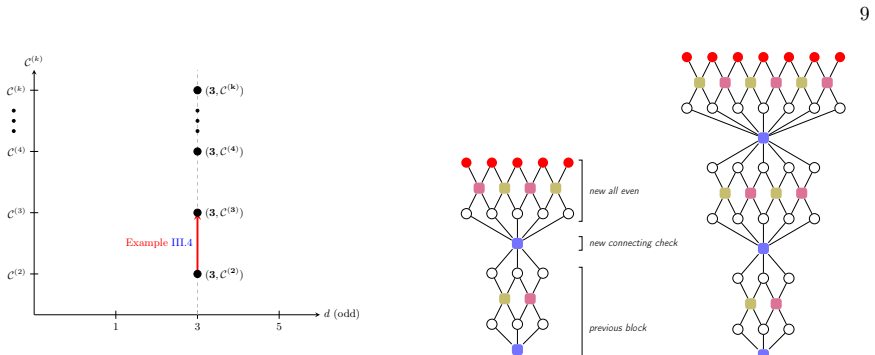
The machinery is the doubling construction, which combines a self-orthogonal seed code $Q_1$ and a smaller orthogonal or triorthogonal code $Q_2$ into a larger code whose X-stabilizer generators have a block structure assembled from $Q_1$'s stabilizer matrix $E_1$, $Q_2$'s stabilizer matrix $E_2$, and one connector row that is all ones on the two copies of $Q_1$ and $Q_2$. The paper shows this operation preserves or improves $2^r$-divisibility, so iterating it lifts the transversal gate one level up the Clifford hierarchy each time, and the length recursion $S_r(k)=2\sum_{i=1}^k S_{r-1}(i)-1$ evaluates to the closed binomial sums above. For the surface-code version, the seed is a rotated surface code plus a punctured surface code, and Definition IV.2's puncturing and shortening rules are what certify that the larger code has the local geometry of the surface code; that geometry is exactly what makes the transversal CNOT of Theorem V.1 a valid logical operation between the two codes.
What would settle it
Take one of the claimed triorthogonal codes with local surface-code geometry, such as the [[31,1,3]] code, and explicitly list its X- and Z-stabilizer generators; apply Definition IV.2's puncturing rule to the first nine qubits and the shortening rule to the Z-stabilizers supported there, and verify that the resulting check matrices are exactly those of the [[9,1,3]] rotated surface code and that the logical X and Z operators commute in the required way. If the punctured picture gives a different code or a logical algebra of the wrong dimension, the claimed transversal CNOT switch would not implement the desired logical operation.
Extended reading notes
Core claim
The central discovery is that the doubling construction, previously used to build triorthogonal codes with a logical T gate, iterates to produce $2^r$-divisible quantum codes with a transversal logical $R_Z(\pi/2^{r-1})$ gate for every $r \ge 2$. Theorem III.8 gives the color-code family $[\![ S_r(k),1,2k-1 ]\!]$ with $S_r(k)=\sum_{i=0}^r 2^i \binom{k+i-2}{i}$, whose X-stabilizer weights are divisible by $2^r$. Theorem IV.5 delivers the companion r-orthogonal family with parameters $[\![ S_r(k),1,2k-1 ]\!]$ for $S_r(k)=2^{r+2}\binom{k+r-1}{r+1}+\sum_{i=0}^{r-1}2^i\binom{k+i-2}{i}$, and with the local geometry of rotated surface codes of distance $2k-1$. Theorem V.1 then shows that whenever one code has another code's local geometry, a transversal CNOT performs fault-tolerant code switching, so the magic state $|R_Z(\theta)\rangle$ can be teleported from the large code to the surface code. The paper also constructs optimized codes by concatenating rotated surface codes with punctured ones, yielding e.g. triorthogonal [[31,1,3]] and [[113,1,5]] codes, and demonstrates the complete switching protocol for $S|+\rangle$ in a distance-three surface code using 45 physical qubits in a circuit-level simulation.
Load-bearing premise
The load-bearing premise is that the constructed r-orthogonal codes genuinely possess the local geometry of rotated surface codes required by Definition IV.2, a condition the paper asserts can be 'easily verified' and supports only with a sketched proof; if that geometry fails for a claimed family, the transversal CNOT in Theorem V.1 would not be a valid logical gate between the codes.
Editorial extensions
If this is right
- For every $r \ge 2$ and odd distance $d = 2k-1$ there exists a code of explicit length $S_r(k)$ whose transversal gate set includes the logical Z-rotation $R_Z(\pi/2^{r-1})$.
- The color-code members of the family use fewer data qubits than the traditional, capped, doubled, and stacked color-code families at the same distance and transversal gate (Table I and Figure 5).
- The construction yields triorthogonal codes with the local geometry of rotated surface codes, including [[31,1,3]] and [[113,1,5]], so T-gate switching is possible in surface-code-compatible hardware.
- The code switching protocol generalizes to any code pair satisfying the local-geometry condition, giving fault-tolerant S, T, or finer Z-rotation magic states without leaving the rotated surface code layout.
- The circuit-level simulation of the 45-qubit distance-three protocol prepares a verified $S|+\rangle$ state with conditional logical error near $10^{-5}$ at physical error rate $10^{-4}$.
Reading between the lines
- Editorial inference: if the doubling recursion works for any self-orthogonal seed with a prescribed layout, the same scheme should produce geometry-preserving code families for other topological templates such as toric or hyperbolic codes; the paper only demonstrates color-code and rotated-surface-code seeds.
- Editorial inference: the 45-qubit demonstration uses $S|+\rangle$ as a stand-in for $T|+\rangle$ and a flag-based post-selection pipeline, so the true end-to-end T-state performance, including the cost of discards and decoding, remains untested; a natural next experiment is the same protocol with the actual T gate at $d=3$ and $d=5$.
- Editorial inference: the meta-check argument for single-shot Z-syndrome decoding is developed for the doubled color-code family; transplanting it to the r-orthogonal surface-code-geometry codes would require a decoder that consumes redundant Z-syndromes, which the paper does not simulate.
- Editorial inference: if the code switching protocol's resource advantage persists beyond distance three, Clifford+$R_Z(\theta)$ compilation for algorithms like multi-controlled Toffoli networks could cut non-Clifford depth substantially, matching the synthesis-cost trend the paper cites for small-angle rotations.
Editorial analysis
A structured set of objections, weighed in public.
Referee Report
Summary. The paper develops recursive 'doubling' constructions of CSS codes whose X-stabilizers have high divisibility, producing single-logical-qubit color-code families with closed-form lengths S_r(k) and transversal logical R_Z(π/2^{r-1}) gates. It then adapts the construction to r-orthogonal codes that are claimed to have the local geometry of rotated surface codes, and uses these in a transversal-CNOT code-switching protocol to prepare logical R_Z(θ) states. The final section reports a circuit-level simulation of S|+> preparation in a distance-three rotated surface code using 45 physical qubits.
Significance. If the local-geometry claims are fully proved, the paper would materially extend code switching beyond color codes: it gives systematic closed-form families for arbitrary fine Z-rotations, improves several tabulated parameters, and provides concrete low-footprint candidates. The algebraic recurrences in Lemmas B.1 and B.2, the parameter tables, and the explicit stabilizer matrices for the [[15,1,3]] and [[31,1,3]] codes are valuable, reproducible resources. At present the advertised applications outrun the proofs: the local-geometry condition on which Theorem V.1 rests is asserted rather than demonstrated for the main constructions, and the simulated 'magic state' is actually the Clifford state S|+>, so the headline claims need qualification.
major comments (4)
- [§IV, Theorem IV.5 and Appendix C] The proof of Theorem IV.5 in Appendix C concludes that 'one can easy verify' the recursive matrix G forms an r-orthogonal quantum code, but it does not verify the local-geometry condition of Definition IV.2 for the constructed family. This condition is the load-bearing hypothesis of the paper's main application: Theorem V.1 requires that restricting the X-stabilizer space of Q1 to the first n2 coordinates gives exactly the X-stabilizer space of Q2, and that the Z-stabilizers of Q1 supported on those coordinates coincide with the Z-stabilizer space of Q2. Displaying generator rows is not sufficient, because the punctured stabilizer subgroup may be larger than the image of the listed generators. If this condition fails for a claimed family, the transversal CNOT in Theorem V.1 is not a valid logical gate between that family and the rotated surface code, so the code-switching protocol collapses. Please supply a complete verification of Definition IV.2 for the r-orthogonal families, including the distance and logical-operator representatives.
- [§IV, Theorem IV.7 and Appendix D] The symplectic-basis argument in Appendix D establishes self-orthogonality and lower-bounds the distance, but it never checks the two structural equalities required by Definition IV.2: puncturing the X-stabilizer space of Q to the first d^2 coordinates yields the surface-code X-stabilizer space, and the Z-stabilizers of Q supported on those coordinates coincide with the surface-code Z-stabilizers. These equalities are needed for the code-switching circuit of Theorem V.1, not merely for the parameter count. The proof also does not explicitly show that the logical X operator (1_{d^2},0,...,0) and the logical Z operators of the surface code survive the puncturing/shortening rules. Please provide an explicit verification for the DSPS construction and for the triorthogonal codes built from it.
- [§V, Theorem V.1] The statement of Theorem V.1 does not include the assumption, introduced only in item (3) of the proof, that the logical X and Z operators of Q1 and Q2 act transversally on the first n2 qubits. The local-geometry definition alone does not imply this property, and the proof uses it essentially to show that the transversal CNOT acts as a logical CNOT on the direct-sum code. As written, the theorem is not self-contained, and applying it to a pair of codes that satisfies only Definition IV.2 may not be justified. The theorem should either be restated with this hypothesis, or the property should be proved for each construction to which the theorem is applied.
- [Abstract and §V.B] The abstract and Section V advertise a 'fault-tolerant magic state preparation' demonstration and claim that the 45-qubit simulation 'validates the complete fault-tolerant implementation' of the proposed code-switching scheme. However, Section V.B explicitly replaces T|+> with S|+>, which is a Clifford state and not a non-Clifford magic state. The simulation therefore does not demonstrate magic-state preparation or a non-Clifford gate. Please reword these claims so that the Clifford proxy is stated as such in the abstract and conclusion, or provide an actual T|+> simulation for the same protocol.
minor comments (4)
- [Appendix B, proof of Theorem III.8] The proof states that the doubling construction yields a code with parameters [[S_r(k−1)+2S_{r−1}(k),1,2k]]; the distance should be 2k−1, not 2k. Please correct this typo.
- [Appendix C, proof of Theorem IV.4] The proof writes S2(k) = (2k−1)(2k)(2k+1)/3, but the theorem states a length d(d+1)(d+2)/3 − 1. The missing '−1' makes the displayed formula inconsistent with the stated parameters.
- [§V, Theorem V.1, Eq. (V.2)] The exponential phase 'e^{iπ/θ}' in Eq. (V.2) appears to be a typo; the expected phase is e^{iθ} (up to a global phase convention). As printed, the expression is dimensionally inconsistent.
- [§V.B and Figure 13] The text says the complete circuit uses 40 data qubits together with four ancilla qubits (three for the [[31,1,3]] code and one for the surface code), while Figure 12 and Figure 13 state that five ancilla qubits are used. This discrepancy in the 45-qubit count should be resolved.
Circularity Check
No significant circularity: the code families are explicit recursive constructions and the code-switching protocol is a standard teleportation argument; the local-geometry verification gap is an omitted proof, not a circular reduction.
full rationale
The paper's central claims are existence theorems for explicitly constructed stabilizer codes. The parameter formulas S_r(k) are derived by induction from the doubling recurrence (Appendix B, Lemma B.1; Appendix C, Lemma C.1), not fitted to data. Theorem III.8's transversal R_Z(pi/2^{r-1}) gate follows from the divisibility conditions of Theorem II.5, which is cited from the independent literature [59,60]. The code-switching theorem (Theorem V.1) is the standard CNOT-teleportation argument from [81] and [5]; its hypothesis, Definition IV.2, is an independent geometric condition, and the conclusion is not used to define that condition. The construction of r-orthogonal surface-geometry families in Theorem IV.5 is asserted with 'one can easy verify' rather than fully demonstrated, and Theorem IV.7's proof in Appendix D establishes self-orthogonality and distance but does not explicitly check the puncturing/shortening rules of Definition IV.2; this is an omitted proof and a correctness risk, not a circular step, because no quantity is defined in terms of the target result and no parameter is fit then renamed as a prediction. Self-citations such as [42], [67], and [69] are background or technique citations; the doubling method is also attributed to [40,41,76], and the transversal-gate conditions to [59,60], so the central derivation does not reduce to self-citation. The 45-qubit circuit-level simulation is an external numerical check. Accordingly, no circular step can be exhibited, and the appropriate circularity score is 0.
Assumptions & free parameters
assumptions (5)
- standard math The doubling construction of Bravyi-Cross [40-42] yields valid CSS codes with the stated stabilizer matrix (II.1).
- standard math Theorem II.5 (conditions for transversal logical phase gates) from [59,60].
- domain assumption Rotated surface codes have X-stabilizer generators that form a symplectic space and satisfy the puncturing and shortening rules of Definition IV.2.
- domain assumption Circuit-level depolarizing noise model with uniform error rate p and flag-qubit-based post-selection is an adequate model for assessing fault tolerance of the state preparation circuits.
- ad hoc to paper The [[31,1,3]] and [[39,1,3]] encoding circuits generated by MQT QECC, augmented with flag qubits, are fault-tolerant for state preparation.
Cite this review
Pith. "Pith review of Quantum Codes with Arbitrary Z-Rotation logical Gates and Applications to Fault-Tolerant Code Switching." pith.science (2026). https://pith.science/paper/LWXDKJEQ
@misc{pith2026260811160,
  author       = {Pith},
  title        = {Pith review of: Quantum Codes with Arbitrary Z-Rotation logical Gates and Applications to Fault-Tolerant Code Switching},
  year         = {2026},
  howpublished = {\url{https://pith.science/paper/LWXDKJEQ}},
  note         = {Machine review of arXiv:2608.11160}
}
abstract
A technique for realizing a universal set of fault-tolerant quantum operations is the code switching method, which leverages two quantum codes with complementary sets of transversal gates. To date, the application of this technique has been largely limited to families of color codes supporting a logical $T$ gate. No analogous code switching protocols exist for many other prominent families, such as rotated surface codes, or for finer $Z$-rotation gates. In this work, we first utilize the doubling technique as a unified framework to construct a class of quantum color codes encoding a single logical qubit with an arbitrarily large minimum distance, enabling the transversal realization of arbitrary small logical $Z$-rotation gates. We investigate the structural properties of this code family, demonstrating that they improve upon the parameters of state-of-the-art triorthogonal codes, achieve lower qubit overhead compared to certain known color codes, and admit single-shot decoding of $Z$-syndromes via meta-checks. Furthermore, we show that this framework extends beyond color codes; specifically, it enables the generation of $r$-orthogonal quantum codes, $r \ge 2$, that inherit the local geometry of rotated surface codes. We then provide an overhead optimization protocol alongside several candidate codes tailored for realizing logical $Z$-rotation gates within rotated surface codes. Finally, we extend the fault-tolerant code switching protocol based on transversal CNOT gates to incorporate fault-tolerant realization of $Z$-rotation gates at any level of the Clifford hierarchy for geometries compatible with rotated surface codes. We present the first demonstration of fault-tolerant magic state preparation by means of code switching within a distance-three rotated surface code using a total footprint of only 45 physical qubits, and evaluate its performance through a simulation.
Figures


Figures from the paper (8 more)


Reference graph
Works this paper leans on
-
[1]
Then there exists a self-orthogonal binary linear code of length3d2+1 2 with the genera- tor matrix[E E′], whereE ′ is obtained after puncturing of certain columns ofE
-
[2]
Figure 9: Geometry of punctured surface codes
IfQ 2 is anX-self-orthogonal code with parameters[ [n,1, d−2] ]andX-stabilizer generatorG, then there exists anX-self- orthogonal quantum codeQwith parameters [ [n+ 2(d2 −d+ 1),1, d] ] containing a local geometry ofQ1 in its ge- ometry. Figure 9: Geometry of punctured surface codes. The data qubits of the new code are represented by the black dots and the...
-
[3]
there exists a transversal CNOT gate be- tweenQ 1 andQ 2 in the form CNOT = n2O i=1 CNOTi
-
[4]
IfQ 1 realizes the logicalRZ(θ)gate through the physical operationO, then the outcome of the following circuit is the|RZ(θ)⟩onQ 2: Q1 |+⟩ O • MXL • Q2 |0⟩ ZL |RZ(θ)⟩ Proof.(1) LetQ 1 andQ 2 be two quantum codes with the given conditions. We have
-
[5]
for eachX-stabilizer (or logical operator) O=⊗ n1 i=1Oi ofQ 1, the operatorO 11 = ⊗n2 i=1Oi is anX-stabilizer (or logical oper- ator) ofQ 2
-
[6]
for eachZstabilizer or logical operatorO= ⊗n2 i=1Oi ofQ 2,Ois aZ-stabilizer (or logical operator) ofQ 1
-
[7]
flag detectors
TheX- andZ-logical operators of bothQ 1 andQ 2 are based on applying transversalX andZoperators acting on the firstn2 qubits, respectively. Now, consider the direct sum of theQ 1 andQ 2 codes, which is a new quantum (CSS) codeSwith two logical qubits stabilized by the stabilizers of Q1 andQ 2. The set of all stabilizers ofSare in the form ofO1 ⊗O 2 whereO...
-
[8]
Topological quantum distillation.Phys- ical review letters, 97(18):180501, 2006
Hector Bombin and Miguel Angel Martin- Delgado. Topological quantum distillation.Phys- ical review letters, 97(18):180501, 2006
2006
Show all 102 references
-
[9]
Fold- transversal clifford gates for quantum codes
Nikolas P Breuckmann and Simon Burton. Fold- transversal clifford gates for quantum codes. Quantum, 8:1372, 2024
2024
-
[10]
Class of quantum error- correcting codes saturating the quantum ham- ming bound.Physical Review A, 54(3):1862, 1996
Daniel Gottesman. Class of quantum error- correcting codes saturating the quantum ham- ming bound.Physical Review A, 54(3):1862, 1996
1996
-
[11]
Quantum error correction via codes over gf (4).IEEE Transactions on In- formation Theory, 44(4):1369–1387, 1998
A Robert Calderbank, Eric M Rains, PM Shor, and Neil JA Sloane. Quantum error correction via codes over gf (4).IEEE Transactions on In- formation Theory, 44(4):1369–1387, 1998. 21
1998
-
[12]
Again here we use the look-up table to deter- mine whether the decoder has predicated a cor- rect logical correction, or if a logical error event has happened. The simulation shows a success- Figure 12: LogicalS|+⟩state preparation as a Clifford proxy forT|+⟩state preparation ...
-
[13]
Active stabilization, quantum computation, and quantum state synthesis.Phys- ical Review Letters, 78(11):2252, 1997
Andrew M Steane. Active stabilization, quantum computation, and quantum state synthesis.Phys- ical Review Letters, 78(11):2252, 1997
1997
-
[14]
Scalable quantum computing in the presence of large detected-error rates.Phys- ical Review A—Atomic, Molecular, and Optical Physics, 71(4):042322, 2005
Emanuel Knill. Scalable quantum computing in the presence of large detected-error rates.Phys- ical Review A—Atomic, Molecular, and Optical Physics, 71(4):042322, 2005
2005
-
[15]
Efficient fault- tolerant code switching via one-way transversal cnot gates.Quantum, 9:1846, 2025
Sascha Heußen and Janine Hilder. Efficient fault- tolerant code switching via one-way transversal cnot gates.Quantum, 9:1846, 2025
2025
-
[16]
Restrictions on transversal encoded quantum gate sets.Physical review letters, 102(11):110502, 2009
Bryan Eastin and Emanuel Knill. Restrictions on transversal encoded quantum gate sets.Physical review letters, 102(11):110502, 2009
2009
-
[17]
No- go theorem on fault tolerant gadgets for multiple logical qubits.arXiv preprint arXiv:2602.13395, 2026
Aranya Chakraborty and Daniel Gottesman. No- go theorem on fault tolerant gadgets for multiple logical qubits.arXiv preprint arXiv:2602.13395, 2026
2026 arXiv
-
[18]
Multilevel distillation of magic states for quantum computing.Physical Re- view A—Atomic, Molecular, and Optical Physics, 87(4):042305, 2013
Cody Jones. Multilevel distillation of magic states for quantum computing.Physical Re- view A—Atomic, Molecular, and Optical Physics, 87(4):042305, 2013
2013
-
[19]
Surface code quan- tum computing by lattice surgery.New Journal of Physics, 14(12):123011, 2012
Dominic Horsman, Austin G Fowler, Simon De- vitt, and Rodney Van Meter. Surface code quan- tum computing by lattice surgery.New Journal of Physics, 14(12):123011, 2012
2012
-
[20]
Transversal clifford gates on folded surface codes.Physical Review A, 94(4):042316, 2016
Jonathan E Moussa. Transversal clifford gates on folded surface codes.Physical Review A, 94(4):042316, 2016
2016
-
[21]
Constant depth fault- tolerant clifford circuits for multi-qubit large block codes.Quantum Science & Technology, 5(4):045007, 2020
Yi-Cong Zheng, Ching-Yi Lai, Todd A Brun, and Leong-Chuan Kwek. Constant depth fault- tolerant clifford circuits for multi-qubit large block codes.Quantum Science & Technology, 5(4):045007, 2020
2020
-
[22]
Universal quantum computation with ideal clifford gates and noisy ancillas.Physical Review A—Atomic, Molecular, and Optical Physics, 71(2):022316, 2005
Sergey Bravyi and Alexei Kitaev. Universal quantum computation with ideal clifford gates and noisy ancillas.Physical Review A—Atomic, Molecular, and Optical Physics, 71(2):022316, 2005
2005
-
[23]
Fault-tolerant postselected quan- tum computation: Threshold analysis.arXiv preprint quant-ph/0404104, 2004
Emanuel Knill. Fault-tolerant postselected quan- tum computation: Threshold analysis.arXiv preprint quant-ph/0404104, 2004
2004 arXiv
-
[24]
Magic state distillation: Not as costly as you think.Quantum, 3:205, 2019
Daniel Litinski. Magic state distillation: Not as costly as you think.Quantum, 3:205, 2019
2019
-
[25]
Cost of universality: A compara- tive study of the overhead of state distillation and code switching with color codes.PRX Quantum, 2(2):020341, 2021
Michael E Beverland, Aleksander Kubica, and Krysta M Svore. Cost of universality: A compara- tive study of the overhead of state distillation and code switching with color codes.PRX Quantum, 2(2):020341, 2021
2021
-
[26]
Magic-state distillation with low overhead.Physical Re- view A—Atomic, Molecular, and Optical Physics, 86(5):052329, 2012
Sergey Bravyi and Jeongwan Haah. Magic-state distillation with low overhead.Physical Re- view A—Atomic, Molecular, and Optical Physics, 86(5):052329, 2012
2012
-
[27]
Dimensional jump in quan- tum error correction.New Journal of Physics, 18(4):043038, 2016
Héctor Bombín. Dimensional jump in quan- tum error correction.New Journal of Physics, 18(4):043038, 2016
2016
-
[28]
Exploring the landscape of compact magic-state distillation factories, 2026
Hugo Jacinto, Xavier Valcarce, Victor Barizien, Élie Gouzien, and Nicolas Sangouard. Exploring the landscape of compact magic-state distillation factories, 2026
2026
-
[29]
Magic state cultivation: growing t states as cheap as cnot gates.arXiv preprint arXiv:2409.17595, 2024
Craig Gidney, Noah Shutty, and Cody Jones. Magic state cultivation: growing t states as cheap as cnot gates.arXiv preprint arXiv:2409.17595, 2024
2024 arXiv
-
[30]
Efficient magic state cultiva- tion onRP 2.arXiv preprint arXiv:2503.18657, 2025
Zi-Han Chen, Ming-Cheng Chen, Chao-Yang Lu, and Jian-Wei Pan. Efficient magic state cultiva- tion onRP 2.arXiv preprint arXiv:2503.18657, 2025
2025 arXiv
-
[31]
Efficient magic state cultivation for √ Tgates, 2026
I-Chi Chen, Matheus da Silva Fonseca, and An- drew Sornborger. Efficient magic state cultivation for √ Tgates, 2026
2026
-
[32]
Cultivating t states on the surface code with only two-qubit gates.arXiv preprint arXiv:2509.05232, 2025
Jahan Claes. Cultivating t states on the surface code with only two-qubit gates.arXiv preprint arXiv:2509.05232, 2025
2025
-
[33]
Efficient magic state cul- tivation on the surface code.arXiv preprint arXiv:2502.01743, 2025
Yotam Vaknin, Shoham Jacoby, Arne Grimsmo, and Alex Retzker. Efficient magic state cul- tivation on the surface code.arXiv preprint arXiv:2502.01743, 2025
2025
-
[34]
Fault-tolerant conversion between the steane and reed-muller quantum codes.Phys- ical review letters, 113(8):080501, 2014
Jonas T Anderson, Guillaume Duclos-Cianci, and David Poulin. Fault-tolerant conversion between the steane and reed-muller quantum codes.Phys- ical review letters, 113(8):080501, 2014
2014
-
[35]
Gauge color codes: optimal transversal gates and gauge fixing in topologi- cal stabilizer codes.New Journal of Physics, 17(8):083002, 2015
Héctor Bombín. Gauge color codes: optimal transversal gates and gauge fixing in topologi- cal stabilizer codes.New Journal of Physics, 17(8):083002, 2015
2015
-
[36]
Transversal dimension jump for product qldpc codes.arXiv preprint arXiv:2510.07269, 2025
Christine Li, John Preskill, and Qian Xu. Transversal dimension jump for product qldpc codes.arXiv preprint arXiv:2510.07269, 2025
2025
-
[37]
Code switch- ing revisited: Low-overhead magic state prepara- tion using color codes.Physical Review Research, 7(2):023080, 2025
Lucas Daguerre and Isaac H Kim. Code switch- ing revisited: Low-overhead magic state prepara- tion using color codes.Physical Review Research, 7(2):023080, 2025
2025
-
[38]
Low overhead universal quantum computation with triorthogonal codes
Dawei Jiao, Mahdi Bayanifar, Alexei Ashikhmin, and Olav Tirkkonen. Low overhead universal quantum computation with triorthogonal codes. arXiv preprint arXiv:2510.05708, 2025
2025
-
[39]
Roads towards fault- tolerant universal quantum computation.Nature, 549(7671):172–179, 2017
Earl T Campbell, Barbara M Terhal, and Christophe Vuillot. Roads towards fault- tolerant universal quantum computation.Nature, 549(7671):172–179, 2017
2017
-
[40]
Constant-overhead addressable gates via single-shot code switching.arXiv preprint arXiv:2510.06760, 2025
Louis Golowich, Kathleen Chang, and Guanyu Zhu. Constant-overhead addressable gates via single-shot code switching.arXiv preprint arXiv:2510.06760, 2025
2025
-
[41]
Measurement-free code-switching pro- tocol for low-overhead quantum computation us- ing permutation-invariant codes.PRX Quantum, 6(4):040341, 2025
Yingkai Ouyang, Yumang Jing, and Gavin K Brennen. Measurement-free code-switching pro- tocol for low-overhead quantum computation us- ing permutation-invariant codes.PRX Quantum, 6(4):040341, 2025
2025
-
[42]
Exact topo- logical quantum order in d= 3 and beyond: Branyons and brane-net condensates.Physi- cal Review B—Condensed Matter and Materials Physics, 75(7):075103, 2007
H Bombin and MA Martin-Delgado. Exact topo- logical quantum order in d= 3 and beyond: Branyons and brane-net condensates.Physi- cal Review B—Condensed Matter and Materials Physics, 75(7):075103, 2007
2007
-
[43]
In Victor V
Color code. In Victor V. Albert and Philippe Faist, editors,The Error Correction Zoo. 2023
2023
-
[44]
Fault-tolerant code-switching protocols for near-term quantum processors.PRX Quantum, 5(2):020345, 2024
Friederike Butt, Sascha Heußen, Manuel Rispler, and Markus Müller. Fault-tolerant code-switching protocols for near-term quantum processors.PRX Quantum, 5(2):020345, 2024
2024
-
[45]
Transversal gatesforquan- tum css codes.arXiv preprint arXiv:2601.21514, 2026
Eduardo Camps-Moreno, Hiram H López, Gretchen L Matthews, Narayanan Rengaswamy, andRodrigoSan-José. Transversal gatesforquan- tum css codes.arXiv preprint arXiv:2601.21514, 2026
2026
-
[46]
Single- shot universality in quantum LDPC codes via code-switching.arXiv preprint arXiv:2510.08552, 2025
Shi Jie Samuel Tan, Yifan Hong, Ting-Chun Lin, Michael J Gullans, and Min-Hsiu Hsieh. Single- shot universality in quantum LDPC codes via code-switching.arXiv preprint arXiv:2510.08552, 2025. 22
2025
-
[47]
A re- source comparison of logical t-state preparation
Jianshuo Gao, Xiao Yuan, and Yuan Yao. A re- source comparison of logical t-state preparation. arXiv preprint arXiv:2605.26522, 2026
2026 arXiv
-
[48]
On op- timality of css codes for transversal t.IEEE Journal on Selected Areas in Information Theory, 1(2):499–514, 2020
Narayanan Rengaswamy, Robert Calderbank, Michael Newman, and Henry D Pfister. On op- timality of css codes for transversal t.IEEE Journal on Selected Areas in Information Theory, 1(2):499–514, 2020
2020
-
[49]
Doubled color codes.arXiv preprint arXiv:1509.03239, 2015
Sergey Bravyi and Andrew Cross. Doubled color codes.arXiv preprint arXiv:1509.03239, 2015
2015 arXiv
-
[50]
Transver- sal clifford and t-gate codes of short length and high distance.IEEE Journal on Selected Areas in Information Theory, 2025
Shubham P Jain and Victor V Albert. Transver- sal clifford and t-gate codes of short length and high distance.IEEE Journal on Selected Areas in Information Theory, 2025
2025
-
[51]
Asymptotically good CSS-T codes and a new construction of triorthogonal codes.IEEE Journal on Selected Areas in Information Theory, 2025
Elena Berardini, Reza Dastbasteh, Josu Etx- ezarreta Martinez, Shreyas Jain, and Olatz Sanz Larrarte. Asymptotically good CSS-T codes and a new construction of triorthogonal codes.IEEE Journal on Selected Areas in Information Theory, 2025
2025
-
[52]
Classifica- tion of small triorthogonal codes.Physical Review A, 106(1):012437, 2022
Sepehr Nezami and Jeongwan Haah. Classifica- tion of small triorthogonal codes.Physical Review A, 106(1):012437, 2022
2022
-
[53]
An algebraic characterization of binary css-t codes and cyclic css-t codes for quantum fault tolerance: E
Eduardo Camps-Moreno, Hiram H López, Gretchen L Matthews, Diego Ruano, Rodrigo San-José, and Ivan Soprunov. An algebraic characterization of binary css-t codes and cyclic css-t codes for quantum fault tolerance: E. camps-moreno et al.Quantum Information Processing, 23(6):230, 2024
2024
-
[54]
Exact synthesis of single- qubit unitaries over clifford-cyclotomic gate sets
Simon Forest, David Gosset, Vadym Kliuchnikov, and David McKinnon. Exact synthesis of single- qubit unitaries over clifford-cyclotomic gate sets. Journal of Mathematical Physics, 56(8):082201, 2015
2015
-
[55]
Constant-overhead magic state distilla- tion.Nature Physics, 21(11):1842–1846, 2025
Adam Wills, Min-Hsiu Hsieh, and Hayata Ya- masaki. Constant-overhead magic state distilla- tion.Nature Physics, 21(11):1842–1846, 2025
2025
-
[56]
Good binary quantum codes with transversal ccz gate
Quynh T Nguyen. Good binary quantum codes with transversal ccz gate. InProceedings of the 57th Annual ACM Symposium on Theory of Com- puting, pages 697–706, 2025
2025
-
[57]
Asymptotically good quantum codes with transversal non-clifford gates
Louis Golowich and Venkatesan Guruswami. Asymptotically good quantum codes with transversal non-clifford gates. InProceedings of the 57th Annual ACM Symposium on Theory of Computing, pages 707–717, 2025
2025
-
[58]
Quantum ldpc codes with transversal non-clifford gates via products of algebraic codes
Louis Golowich and Ting-Chun Lin. Quantum ldpc codes with transversal non-clifford gates via products of algebraic codes. InProceedings of the 57th Annual ACM Symposium on Theory of Com- puting, pages 689–696, 2025
2025
-
[59]
Quantum rainbow codes: Achieving lin- ear rate, growing distance and transversal non- clifford gates with generalised colour codes.arXiv preprint arXiv:2408.13130, 2024
Thomas R Scruby, Arthur Pesah, and Mark Web- ster. Quantum rainbow codes: Achieving lin- ear rate, growing distance and transversal non- clifford gates with generalised colour codes.arXiv preprint arXiv:2408.13130, 2024
2024
-
[60]
Ex- perimental demonstration of high-fidelity logical magic states from code switching.Physical Re- view X, 15(4):041008, 2025
Lucas Daguerre, Robin Blume-Kohout, Natalie C Brown, David Hayes, and Isaac H Kim. Ex- perimental demonstration of high-fidelity logical magic states from code switching.Physical Re- view X, 15(4):041008, 2025
2025
-
[61]
Experimental fault-tolerant code switching.Nature Physics, 21(2):298–303, 2025
Ivan Pogorelov, Friederike Butt, Lukas Postler, Christian D Marciniak, Philipp Schindler, Markus Müller, and Thomas Monz. Experimental fault-tolerant code switching.Nature Physics, 21(2):298–303, 2025
2025
-
[62]
Techniques for fault-tolerant decomposition of a multicontrolled toffoli gate.Physical Review A, 100(6):062326, 2019
Laxmidhar Biswal, Debjyoti Bhattacharjee, Anu- pam Chattopadhyay, and Hafizur Rahaman. Techniques for fault-tolerant decomposition of a multicontrolled toffoli gate.Physical Review A, 100(6):062326, 2019
2019
-
[63]
Clifford gates with logical transver- sality for self-dual CSS codes.arXiv preprint arXiv:2503.19790, 2025
Theerapat Tansuwannont, Yugo Takada, and Keisuke Fujii. Clifford gates with logical transver- sality for self-dual CSS codes.arXiv preprint arXiv:2503.19790, 2025
2025 arXiv
-
[64]
More efficient clifford+ t synthesis for small-angle rotations and application to trotterization.arXiv preprint arXiv:2605.31544, 2026
Marius Bothe, Christoph Sünderhauf, Michael J Witham, Earl T Campbell, and Nick S Blunt. More efficient clifford+ t synthesis for small-angle rotations and application to trotterization.arXiv preprint arXiv:2605.31544, 2026
2026 arXiv
-
[65]
Good quantum error-correcting codes exist.Physical Review A, 54(2):1098–1105, 1996
A Robert Calderbank and Peter W Shor. Good quantum error-correcting codes exist.Physical Review A, 54(2):1098–1105, 1996
1996
-
[66]
Multiple-particle interference and quantum error correction.Proceedings of the Royal Society of London
Andrew Steane. Multiple-particle interference and quantum error correction.Proceedings of the Royal Society of London. Series A: Math- ematical, Physical and Engineering Sciences, 452(1954):2551–2577, 1996
1954
-
[67]
In Victor V
2D color code. In Victor V. Albert and Philippe Faist, editors,The Error Correction Zoo. 2023
2023
-
[68]
Transversal diagonal logi- cal operators for stabiliser codes.New Journal of Physics, 25(10):103018, 2023
Mark A Webster, Armanda O Quintavalle, and Stephen D Bartlett. Transversal diagonal logi- cal operators for stabiliser codes.New Journal of Physics, 25(10):103018, 2023
2023
-
[69]
Transversal gates for highly asymmetric qldpc codes.arXiv preprint arXiv:2506.15905, 2025
Heather Leitch and Alastair Kay. Transversal gates for highly asymmetric qldpc codes.arXiv preprint arXiv:2506.15905, 2025
2025 arXiv
-
[70]
Efficient fault-tolerant quan- tumcomputing.Nature, 399(6732):124–126, 1999
Andrew M Steane. Efficient fault-tolerant quan- tumcomputing.Nature, 399(6732):124–126, 1999
1999
-
[71]
Cyclicquantum error–correcting codes and quantum shift regis- ters.Proceedings of the Royal Society of London
MarkusGrasslandThomasBeth. Cyclicquantum error–correcting codes and quantum shift regis- ters.Proceedings of the Royal Society of London. Series A: Mathematical, Physical and Engineering Sciences, 456(2003):2689–2706, 2000
2003
-
[72]
Universal transversal gates with color codes: A simplified approach.Physical Review A, 91(3):032330, 2015
Aleksander Kubica and Michael E Beverland. Universal transversal gates with color codes: A simplified approach.Physical Review A, 91(3):032330, 2015
2015
-
[73]
Code Tables: Bounds on the pa- rameters of various types of codes.http://www
Markus Grassl. Code Tables: Bounds on the pa- rameters of various types of codes.http://www. codetables.de/, accessed on 2026-03-25
2026
-
[74]
Remarkable degener- ate quantum stabilizer codes derived from duadic codes
Salah A Aly, Andreas Klappenecker, and Pradeep Kiran Sarvepalli. Remarkable degener- ate quantum stabilizer codes derived from duadic codes. In2006 IEEE International Symposium on Information Theory, pages 1105–1108. IEEE, 2006
2006
-
[75]
New quantum codes from self-dual codes overF4.Designs, Codes and Cryptography, 92(3):787–801, 2024
Reza Dastbasteh and Petr Lisoněk. New quantum codes from self-dual codes overF4.Designs, Codes and Cryptography, 92(3):787–801, 2024
2024
-
[76]
An infinite class of quantum codes derived from duadic constacyclic codes.Quantum Information Processing, 24(7):204, 2025
Reza Dastbasteh, Josu Etxezarreta Martinez, An- drew Nemec, Antonio deMarti iOlius, and Pedro Crespo Bofill. An infinite class of quantum codes derived from duadic constacyclic codes.Quantum Information Processing, 24(7):204, 2025
2025
-
[77]
Nonbi- nary stabilizercodes over finite fields.IEEE trans- actions on information theory, 52(11):4892–4914, 2006
Avanti Ketkar, Andreas Klappenecker, Santosh Kumar, and Pradeep Kiran Sarvepalli. Nonbi- nary stabilizercodes over finite fields.IEEE trans- actions on information theory, 52(11):4892–4914, 2006. 23
2006
-
[78]
Quan- tum css duadic and triadic codes: New insights and properties
Reza Dastbasteh, Olatz Sanz Larrarte, Josu Etx- ezarreta Martinez, Antonio deMarti iOlius, Javier Oliva del Moral, and Pedro Crespo Bofill. Quan- tum css duadic and triadic codes: New insights and properties. InInternational Workshop on the Arithmetic of Finite Fields, pages 7...
2024
-
[79]
On triply even binary codes.Journal of the London Mathematical Society, 86(1):1–16, 2012
Koichi Betsumiya and Akihiro Munemasa. On triply even binary codes.Journal of the London Mathematical Society, 86(1):1–16, 2012
2012
-
[80]
The smallest code with transver- sal T.arXiv preprint arXiv:2210.14066, 2022
Stergios Koutsioumpas, Darren Banfield, and Alastair Kay. The smallest code with transver- sal T.arXiv preprint arXiv:2210.14066, 2022
2022 arXiv
-
[81]
Methodologyforquantumlogicgatecon- struction.Physical Review A, 62(5):052316, 2000
Xinlan Zhou, Debbie W Leung, and Isaac L Chuang. Methodologyforquantumlogicgatecon- struction.Physical Review A, 62(5):052316, 2000
2000
-
[82]
An introduction to topological quantum codes.arXiv preprint arXiv:1311.0277, 2013
Héctor Bombín. An introduction to topological quantum codes.arXiv preprint arXiv:1311.0277, 2013
2013 arXiv
-
[83]
Achieving fault tolerance on capped color codes with few ancillas.PRX Quantum, 3(3):030322, 2022
Theerapat Tansuwannont and Debbie Leung. Achieving fault tolerance on capped color codes with few ancillas.PRX Quantum, 3(3):030322, 2022
2022
-
[84]
Stacked codes: Universal fault-tolerant quantum computation in a two-dimensional layout.Physical Review A, 93(2):022323, 2016
Tomas Jochym-O’Connor and Stephen D Bartlett. Stacked codes: Universal fault-tolerant quantum computation in a two-dimensional layout.Physical Review A, 93(2):022323, 2016
2016
-
[85]
Designing the quantum channels in- duced by diagonal gates.Quantum, 6:802, 2022
Jingzhen Hu, Qingzhong Liang, and Robert Calderbank. Designing the quantum channels in- duced by diagonal gates.Quantum, 6:802, 2022
2022
-
[86]
Decoding algorithms for surface codes
Antonio deMarti iOlius, Patricio Fuentes, Román Orús, Pedro M Crespo, and Josu Etxezarreta Martinez. Decoding algorithms for surface codes. Quantum, 8:1498, 2024
2024
-
[87]
In particular, we add three and six mid-circuit flag qubits to the encod- ing circuits of[ [31,1,3] ]and[ [39,1,3] ], respectively to detect certain logical errors
to design such a circuit. In particular, we add three and six mid-circuit flag qubits to the encod- ing circuits of[ [31,1,3] ]and[ [39,1,3] ], respectively to detect certain logical errors. Since both of the mentioned triorthogonal codes have distance three, they are single e...
-
[88]
Surface codes: Towards practical large-scale quantum computa- tion.Physical Review A—Atomic, Molecular, and Optical Physics, 86(3):032324, 2012
Austin G Fowler, Matteo Mariantoni, John M Martinis, and Andrew N Cleland. Surface codes: Towards practical large-scale quantum computa- tion.Physical Review A—Atomic, Molecular, and Optical Physics, 86(3):032324, 2012
2012
-
[89]
Abanin, Laleh Aghababaie-Beni, Igor Aleiner, Trond I
Rajeev Acharya, Dmitry A. Abanin, Laleh Aghababaie-Beni, Igor Aleiner, Trond I. Ander- sen, Markus Ansmann, Frank Arute, Kunal Arya, AbrahamAsfaw, NikitaAstrakhantsev, JuanAta- laya, Ryan Babbush, Dave Bacon, Brian Ballard, Joseph C. Bardin, Johannes Bausch, Andreas Bengtsson,...
2025
-
[90]
Evered, Alexan- dra A
Dolev Bluvstein, Simon J. Evered, Alexan- dra A. Geim, Sophie H. Li, Hengyun Zhou, Tom Manovitz, Sepehr Ebadi, Madelyn Cain, Marcin Kalinowski, Dominik Hangleiter, J. Pablo Bonilla Ataides, Nishad Maskara, Iris Cong, Xun Gao, Pedro Sales Rodriguez, Thomas Karolyshyn, Giulia Se...
2024
-
[91]
A fast quantum mechanical algo- rithm for database search
Lov K Grover. A fast quantum mechanical algo- rithm for database search. InProceedings of the twenty-eighth annual ACM symposium on Theory of computing, pages 212–219, 1996
1996
-
[92]
Algorithms for quantum compu- tation: discrete logarithms and factoring
Peter W Shor. Algorithms for quantum compu- tation: discrete logarithms and factoring. InPro- ceedings 35th annual symposium on foundations of computer science, pages 124–134. Ieee, 1994
1994
-
[93]
Elucidat- ing reaction mechanisms on quantum computers
Markus Reiher, Nathan Wiebe, Krysta M Svore, Dave Wecker, and Matthias Troyer. Elucidat- ing reaction mechanisms on quantum computers. Proceedings of the national academy of sciences, 114(29):7555–7560, 2017
2017
-
[94]
Michael A. Perlin. qLDPC.https://github. com/qLDPCOrg/qLDPC, 2023
2023
-
[95]
Stim: a fast stabilizer circuit sim- ulator.Quantum, 5:497, July 2021
Craig Gidney. Stim: a fast stabilizer circuit sim- ulator.Quantum, 5:497, July 2021
2021
-
[96]
The MQT handbook: Asummaryofdesignautomationtools and software for quantum computing
Robert Wille, Lucas Berent, Tobias Forster, Ja- gatheesan Kunasaikaran, Kevin Mato, Tom Pe- ham, Nils Quetschlich, Damian Rovara, Aaron Sander, Ludwig Schmid, Daniel Schoenberger, Yannick Stade, and Lukas Burgholzer. The MQT handbook: Asummaryofdesignautomationtools and softwa...
2024
-
[97]
PhD thesis, UCL (University College London), 2026
Arthur Chalom Pesah.Quantum error correction in three dimensions and beyond. PhD thesis, UCL (University College London), 2026
2026
-
[98]
Chapman and Hall/CRC, 2016
Jurgen Bierbrauer.Introduction to coding theory. Chapman and Hall/CRC, 2016. Appendix A: Color codes and logical gates Here, we provide a more detailed definition of topological color codes using the language of cell complexes and the materials of [50, 72, 88]. Let Lbe a finit...
2016
-
[99]
Here the condition is for realizing a logical gate without re- quiring a correction operator
Transversal gates For the rest of this section, we discuss the con- ditions for realizing a logical phase gate through the transversal application of different phase gates on data qubits for arbitrary CSS codes. Here the condition is for realizing a logical gate without re- qu...
-
[100]
the quantum code of distanced= 2k−3 obtained from the previous step,
-
[101]
two copies of all-even code of distance2k−1, and
-
[102]
As an example, one can see the structure of [ [17,1,5] ]in Figure 3
a new check qubit connected to all data qubits of one pair of all-even code, and con- nected to all data qubits in the top layer of the previous block. As an example, one can see the structure of [ [17,1,5] ]in Figure 3. We proceed with induction onk. The initial cases fork= 2...
Reviewed August 12, 2026 · model on record in the stance chip above.
Discussion (0). Continue with ORCID to comment.