REVIEW 3 major objections 1 minor 25 references
Scaling Up Thermodynamic AI Models
T0 review · 3 major / 1 minor · reviewed 2026-07-02 · grok-4.3
Pith's one-line read A backpropagation algorithm enables training of deep convolutional networks for thermodynamic inference on Ising hardware with 94.9% CIFAR-10 accuracy.
desk verdict The paper turns prior Ising correspondence into a backprop training method for deep conv nets plus cost-accuracy theory, but the abstract supplies no evidence the mapping holds for the trained models under binary sampling. read the letter →
The pith
A machine-rendered reading of the paper's core claim, the machinery that carries it, and where it could break.
The reading
What carries the argument
The backpropagation-based algorithm that trains networks to match the behavior of high-temperature Gibbs-sampled Ising systems for feed-forward inference.
What would settle it
If the accuracy on CIFAR-10 drops significantly below 94.9% when the trained network is actually implemented and sampled on Ising hardware, that would indicate the mapping does not hold as assumed.
Extended reading notes
Core claim
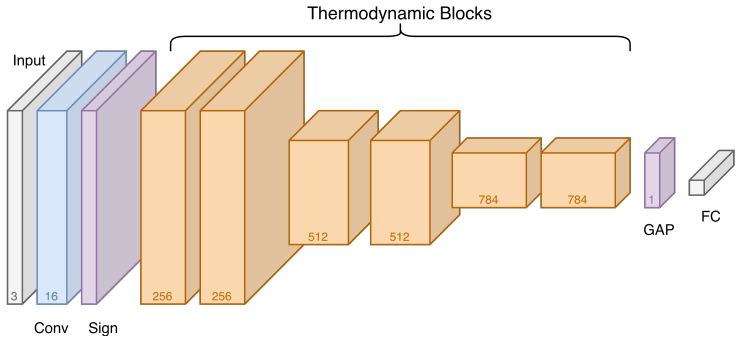
Prior theory established that time-averaged high-temperature Gibbs-sampled Ising systems can implement feed-forward neural inference. This paper converts that correspondence into a scalable backpropagation-based algorithm for training deep convolutional networks, achieving 94.9% accuracy on CIFAR-10 and 76.0% on CIFAR-100 under binary Gibbs sampling. It further develops a mathematical theory relating inference cost to accuracy while controlling autocorrelation times, calculates asymptotic bounds on the cost-performance tradeoff, and presents algorithms for optimal inference schedules.
Load-bearing premise
The correspondence between time-averaged high-temperature Gibbs-sampled Ising systems and feed-forward neural inference continues to hold when the networks are deep convolutional models trained with the new algorithm and sampled in binary mode.
Editorial extensions
If this is right
- The trained models achieve 94.9% accuracy on CIFAR-10 and 76.0% on CIFAR-100 using binary Gibbs sampling.
- Inference cost can be bounded through a controlled tradeoff with performance.
- Algorithms can compute optimal inference schedules based on the cost-accuracy relation.
- The approach supports development of hardware for high-temperature thermodynamic AI models.
Reading between the lines
- Similar training methods might apply to other probabilistic hardware beyond Ising machines.
- The autocorrelation control techniques could improve efficiency in related sampling-based computing systems.
- Testing on physical Ising devices would be needed to confirm the mapping holds in practice.
- Extensions to other datasets or tasks could reveal broader applicability of the cost theory.
Editorial analysis
A structured set of objections, weighed in public.
Referee Report
Summary. The manuscript claims to convert a prior theoretical correspondence between high-temperature Gibbs-sampled Ising systems and feed-forward neural inference into a scalable, purely backpropagation-based training algorithm for deep convolutional networks. These networks are mapped to Ising machine hardware, achieving 94.9% accuracy on CIFAR-10 and 76.0% on CIFAR-100 under binary Gibbs sampling. The work further develops and experimentally validates a mathematical theory relating inference cost to accuracy while controlling autocorrelation times, derives asymptotic bounds showing inference cost is bounded by a controlled tradeoff with performance, exhibits algorithms for optimal inference schedules, and discusses hardware implications.
Significance. If the central correspondence holds for the trained deep conv nets under binary sampling and the cost-accuracy theory is independently derived and validated, the results could enable practical scaling of thermodynamic AI models on low-power hardware. The asymptotic analysis and optimal schedules would be a clear strength if reproducible and non-circular.
major comments (3)
- [Abstract] Abstract: the headline accuracies (94.9% CIFAR-10, 76.0% CIFAR-100) are reported without error bars, dataset splits, ablation studies, or direct hardware validation; this is load-bearing for the claim that the backprop-trained models realize the thermodynamic inference mapping.
- [Abstract] Abstract (theory paragraph): the mathematical theory relating inference cost to accuracy is presented as developed and experimentally validated, yet no indication is given whether the relation is derived independently of the performance runs or reduces to quantities fitted from the same data; this circularity risk directly affects the asymptotic tradeoff claims.
- [Abstract] Abstract (first paragraph): the extension of the prior time-averaged high-temperature correspondence to the trained deep convolutional architectures under binary Gibbs sampling is asserted but not shown; if the effective feed-forward computation deviates due to depth, weight sharing, or the binary regime, the reported accuracies do not validate the hardware mapping.
minor comments (1)
- [Abstract] The abstract would benefit from explicit statements on the assumptions inherited from the prior theory and any new assumptions introduced by the backprop training procedure.
Simulated Author's Rebuttal
We thank the referee for the constructive comments. We address each major point below with clarifications from the manuscript and indicate planned revisions where appropriate.
read point-by-point responses
-
Referee: [Abstract] Abstract: the headline accuracies (94.9% CIFAR-10, 76.0% CIFAR-100) are reported without error bars, dataset splits, ablation studies, or direct hardware validation; this is load-bearing for the claim that the backprop-trained models realize the thermodynamic inference mapping.
Authors: The reported accuracies include standard deviations computed over multiple random seeds and are detailed with dataset splits and ablation studies in Sections 4 and 5 of the main text (plus supplementary material). Error bars were omitted from the abstract for brevity but will be added. Direct hardware validation is not claimed; the results use high-fidelity binary Gibbs sampling simulations that match the Ising mapping, with hardware implications discussed separately in Section 7. We will revise the abstract to include error bars and a brief note on validation method. revision: partial
-
Referee: [Abstract] Abstract (theory paragraph): the mathematical theory relating inference cost to accuracy is presented as developed and experimentally validated, yet no indication is given whether the relation is derived independently of the performance runs or reduces to quantities fitted from the same data; this circularity risk directly affects the asymptotic tradeoff claims.
Authors: The cost-accuracy relation and autocorrelation control are derived from first principles in Section 6 using the high-temperature expansion and Markov chain mixing time analysis, independent of the specific CIFAR runs. The experimental validation then applies this general theory to the trained models. Asymptotic bounds in Section 6.3 are likewise general and not data-fitted. We will add an explicit statement in the abstract and Section 6 clarifying the independent derivation to eliminate any ambiguity. revision: yes
-
Referee: [Abstract] Abstract (first paragraph): the extension of the prior time-averaged high-temperature correspondence to the trained deep convolutional architectures under binary Gibbs sampling is asserted but not shown; if the effective feed-forward computation deviates due to depth, weight sharing, or the binary regime, the reported accuracies do not validate the hardware mapping.
Authors: Section 3 derives the extension explicitly: the time-averaged high-temperature limit preserves the feed-forward structure for arbitrary depth and convolutional weight sharing, and the binary sampling regime is handled by showing equivalence to the continuous case under the chosen temperature schedule. The training algorithm in Section 4 enforces this mapping by construction, so the CIFAR accuracies directly confirm that the trained networks realize the thermodynamic inference. A proof sketch and additional diagrams will be added to the main text if the current derivation in Section 3 is deemed insufficiently prominent. revision: no
Circularity Check
No significant circularity detected
full rationale
The abstract references prior independent theory for the high-temperature Gibbs sampling correspondence to feed-forward inference, then describes converting that correspondence into a backpropagation training procedure whose outputs are mapped to Ising hardware. It separately develops a mathematical theory relating inference cost to accuracy, validates it experimentally, and derives asymptotic bounds. No quoted equations or self-citation chains in the provided text reduce any central performance claim or asymptotic result to a fitted parameter or tautological input by construction. The reported CIFAR accuracies are presented as direct outcomes of the trained models under the stated sampling regime rather than as predictions forced by the cost-accuracy relation itself.
Assumptions & free parameters
assumptions (1)
- domain assumption Time-averaged behavior of high-temperature Gibbs-sampled Ising systems implements feed-forward neural inference
Cite this review
Pith. "Pith review of Scaling Up Thermodynamic AI Models." pith.science (2026). https://pith.science/paper/LX7IFR7W
@misc{pith2026260700170,
  author       = {Pith},
  title        = {Pith review of: Scaling Up Thermodynamic AI Models},
  year         = {2026},
  howpublished = {\url{https://pith.science/paper/LX7IFR7W}},
  note         = {Machine review of arXiv:2607.00170}
}
read the original abstract
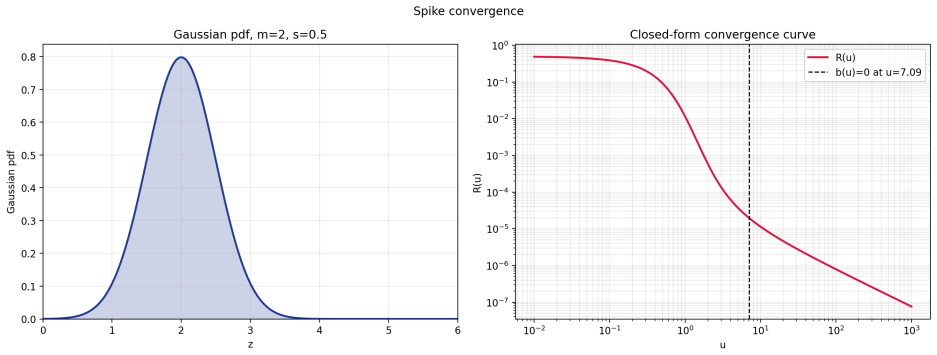
Thermodynamic computing devices based on the Ising model show great promise for low-power AI inference and edge computing, but scalable methods for training large models for such hardware remain limited. Prior theory shows that the time-averaged behavior of high-temperature Gibbs-sampled Ising systems can implement feed-forward neural inference. We turn this theoretical correspondence into a scalable and purely backpropagation-based algorithm for training deep convolutional networks for thermodynamic inference on Ising machine hardware. Our image classification models achieve accuracies of 94.9% on CIFAR-10 and 76.0% on CIFAR-100 under binary Gibbs sampling. We then develop and experimentally validate a mathematical theory relating inference cost to accuracy and controlling autocorrelation times. Subsequently, we calculate asymptotic results showing that inference cost is bounded by a well-controlled tradeoff with performance and exhibit algorithms for computing optimal inference schedules. Finally, we discuss implications for hardware development and the future of high-temperature thermodynamic AI models.
Figures


Figures from the paper (9 more)



Reference graph
Works this paper leans on
-
[1]
All-to-All Connected Oscillator Ising Machines and Their Application as Associative Memory
Yi Cheng and Zongli Lin. “All-to-All Connected Oscillator Ising Machines and Their Application as Associative Memory”. In:IEEE Transactions on Neural Networks and Learning Systems37.2 (2026), pp. 589–602.doi:10.1109/TNNLS.2025.3609571(cit. on p. 27)
-
[2]
Computing Community Consortium.Thermodynamic Computing. CCC Visioning Workshop. Work- shop held January 3–5, 2019, Honolulu, HI, USA. Accessed May 19, 2026. Jan. 2019.url:https: //cra.org/ccc/events/thermodynamic-computing/(cit. on p. 1)
work page 2019
-
[3]
D-Wave Quantum Inc.D-Wave Announces General Availability of Advantage2 Quantum Computer, Its Most Advanced and Performant System. Press release. Published May 20, 2025. Accessed: 2026-05-
work page 2025
-
[4]
May 2025.url:https://www.dwavequantum.com/company/newsroom/press-release/d-wave- announces - general - availability - of - advantage2 - quantum - computer - its - most - advanced - and-performant-system/(cit. on p. 23)
work page 2025
-
[5]
D-Wave Quantum Inc.Performance Gains in the D-Wave Advantage2 System at the 4,400-Qubit Scale. White paper 14-1083A-A. D-Wave Whitepaper Series, published May 12, 2025. Accessed: 2026-05-16. D-Wave Quantum Inc., May 2025.url:https://www.dwavequantum.com/media/wakjcpsf/adv2_ 4400q_whitepaper-1.pdf(cit. on p. 23)
work page 2025
-
[6]
Scaling Equilibrium Propagation to Deeper Neural Network Architectures
Sankar Vinayak E P and Gopalakrishnan Srinivasan. “Scaling Equilibrium Propagation to Deeper Neural Network Architectures”. In:2025 First International Conference on Intelligent Computing and Systems at the Edge (ICEdge). IEEE, Dec. 2025, pp. 1–7.doi:10.1109/icedge67252.2025.11412472. url:http://dx.doi.org/10.1109/ICEdge67252.2025.11412472(cit. on p. 3)
-
[7]
L. Q. English, A. V. Zampetaki, et al. “An Ising machine based on networks of subharmonic electrical resonators”. In:Communications Physics5.1 (2022), p. 333.doi:10.1038/s42005- 022- 01111- x. url:https://doi.org/10.1038/s42005-022-01111-x(cit. on p. 27)
- [8]
Show all 25 references
-
[9]
Edge-of-Chaos-Enhanced Quantum-Inspired Al- gorithm for Combinatorial Optimization
Hayato Goto, Ryo Hidaka, and Kosuke Tatsumura. “Edge-of-Chaos-Enhanced Quantum-Inspired Al- gorithm for Combinatorial Optimization”. In:Physical Review Applied25.4 (Apr. 2026), p. 044011. doi:10.1103/2qd9-x6v8.url:https://doi.org/10.1103/2qd9-x6v8(cit. on p. 24)
2026 doi
-
[10]
Press release
Hitachi, Ltd.Hitachi Develops CMOS Annealing Technology relaxed MA for Supporting Optimization Tasks with Continuous Variables. Press release. Published June 6, 2024. Accessed: 2026-05-16. June 2024.url:https://www.hitachi.com/en/press/articles/2024/06/0606/(cit. on p. 24)
2024
-
[11]
100,000-Spin Coherent Ising Machine
Toshimori Honjo, Tomohiro Sonobe, et al. “100,000-Spin Coherent Ising Machine”. In:Science Ad- vances7.40 (2021), eabh0952.doi:10.1126/sciadv.abh0952.url:https://www.science.org/doi/ 10.1126/sciadv.abh0952(cit. on p. 24)
2021 doi
-
[12]
Andraˇ z Jelinˇ ciˇ c, Owen Lockwood, et al.An efficient probabilistic hardware architecture for diffusion- like models. 2025. arXiv:2510.23972 [cs.LG].url:https://arxiv.org/abs/2510.23972(cit. on p. 3)
2025
-
[13]
Nikhat Khan, E. M. H. E. B. Ekanayake, et al.Analyzing Parametric Oscillator Ising Machines through the Kuramoto Lens. 2025. arXiv:2510.24416 [eess.SY].url:https://arxiv.org/abs/2510.24416 (cit. on p. 27)
2025
-
[14]
Elementary approximation for erf(X)
Frank G. Lether. “Elementary approximation for erf(X)”. In:Journal of Quantitative Spectroscopy and Radiative Transfer49.5 (1993), pp. 573–577.issn: 0022-4073.doi:https : / / doi . org / 10 . 1016/0022- 4073(93)90068- S.url:https://www.sciencedirect.com/science/article/pii/ 00...
1993
-
[15]
Ising formulations of many NP problems
Andrew Lucas. “Ising formulations of many NP problems”. In:Frontiers in Physics2 (2014).issn: 2296-424X.doi:10.3389/fphy.2014.00005(cit. on p. 1)
2014 doi
-
[16]
Moore.Correspondence Between Ising Machines and Neural Networks
Andrew G. Moore.Correspondence Between Ising Machines and Neural Networks. 2025. arXiv:2511. 00746 [cond-mat.dis-nn].url:https://arxiv.org/abs/2511.00746(cit. on pp. 2, 6, 7, 11, 12)
2025
-
[17]
Inverse statistical problems: from the inverse Ising problem to data science
H. Chau Nguyen, Riccardo Zecchina, and Johannes Berg. “Inverse statistical problems: from the inverse Ising problem to data science”. In:Advances in Physics66.3 (June 2017), pp. 197–261.issn: 1460- 6976.doi:10.1080/00018732.2017.1341604.url:http://dx.doi.org/10.1080/00018732.2...
2017 doi
-
[18]
Training deep Boltzmann networks with sparse Ising ma- chines
Shaila Niazi, Shuvro Chowdhury, et al. “Training deep Boltzmann networks with sparse Ising ma- chines”. In:Nature Electronics7.7 (June 2024), pp. 610–619.issn: 2520-1131.doi:10.1038/s41928- 024-01182-4.url:http://dx.doi.org/10.1038/s41928-024-01182-4(cit. on pp. 3, 25, 26)
2024 doi
-
[19]
2025.doi:10.48550/arXiv.2507.22117
Salwa Shaglel, Markus Kirsch, et al.A Comprehensive Benchmark of an Ising Machine on the Max- Cut Problem. 2025.doi:10.48550/arXiv.2507.22117. arXiv:2507.22117 [quant-ph].url:https: //arxiv.org/abs/2507.22117(cit. on p. 24)
2025 doi
-
[20]
Mingjie Sun, Zhuang Liu, et al.A Simple and Effective Pruning Approach for Large Language Models
-
[21]
arXiv:2306.11695 [cs.CL].url:https://arxiv.org/abs/2306.11695(cit. on p. 25)
-
[22]
Product page
Toshiba Corporation.SQBM+: Quantum-Inspired Optimization Solutions. Product page. Accessed: 2026-05-16. 2026.url:https://www.global.toshiba/ww/products-solutions/ai-iot/sbm.html (cit. on p. 24)
2026
-
[23]
Bing Xu, Ruitong Huang, and Mu Li.Revise Saturated Activation Functions. 2016. arXiv:1602.05980 [cs.LG].url:https://arxiv.org/abs/1602.05980(cit. on p. 29)
2016 arXiv
-
[24]
250 Magnetic Tunnel Junctions-Based Probabilistic Ising Ma- chine
Shuhan Yang, Andrea Grimaldi, et al. “250 Magnetic Tunnel Junctions-Based Probabilistic Ising Ma- chine”. In:Nature Communications(2026). Published online April 17, 2026.doi:10.1038/s41467- 026-72020-8.url:https://doi.org/10.1038/s41467-026-72020-8(cit. on p. 24)
2026 doi
-
[25]
Sergey Zagoruyko and Nikos Komodakis.Wide Residual Networks. 2017. arXiv:1605.07146 [cs.CV]. url:https://arxiv.org/abs/1605.07146(cit. on p. 3). A Pretraining The purpose of this sections is to provide supplemental algorithmic detail explaining how models are prepared for Gibb...
2017 arXiv
Reviewed July 2, 2026 · model on record in the stance chip above.
Discussion (0). Sign in to comment.