REVIEW 2 major objections 4 minor 37 references
In practical SNAIL parametric amplifiers, vacuum squeezing is limited by loss, not residual Kerr, so cutting resonator and chain loss is the main path to better performance.
Reviewed by Pith at T0; open to challenge. T0 means a machine referee read the full paper against a public rubric. the ladder, T0–T4 →
T0 review · grok-4.5
2026-07-14 21:28 UTC pith:LXSS3DL6
load-bearing objection Solid device paper: under fixed-frequency practical constraints, SPA squeezing is already loss-limited, not Kerr-limited; the data and leading-order theory support the design takeaway. the 2 major comments →
Practical Limits to Single-Mode Vacuum Squeezing with a SNAIL Parametric Amplifier
The pith
A machine-rendered reading of the paper's core claim, the machinery that carries it, and where it could break.
Core claim
When a SNAIL parametric amplifier is operated at fixed squeezing frequency under conditions typical of sensing or qubit readout, residual Kerr varies only modestly and does not set the achievable vacuum squeezing; the observed squeezing is instead limited by internal resonator loss and insertion loss, so reducing those losses is the primary route to improved performance.
What carries the argument
The linearized, stiff-pump input-output model of the pump-dressed SPA (Appendix A). Once the amplifier is tuned to fixed gain with Δ_eff ≈ 0, the observed squeezed-quadrature variance S_obs depends on the product of efficiencies η η_int and is independent of Kerr to leading order; Kerr enters only through a Stark shift that can be retuned away.
Load-bearing premise
The claim rests on a linearized stiff-pump Gaussian model that makes squeezing independent of Kerr once gain is fixed, and on attributing the remaining detuning dependence entirely to uncalibrated efficiency changes rather than higher-order or soft-pump effects.
What would settle it
Operate the same SPA (or an otherwise identical device) at fixed fs while independently lowering K/κ by an order of magnitude without changing κ_int/κ or chain efficiency; if measured squeezing still fails to improve once gain is matched, the claim that Kerr is already irrelevant holds; any clear improvement would falsify it.
If this is right
- Further flux or pump optimization aimed solely at nulling Kerr will not materially raise usable single-mode squeezing in present-generation SPAs when fs is fixed by a downstream cavity.
- Design effort should prioritize higher internal quality factors and lower package, circulator, and wiring loss between squeezer and sensor or qubit.
- The same loss-limited conclusion is expected to apply to other flux-tunable three-wave-mixing parametric amplifiers used as squeezers.
- Reported 2 dB of delivered squeezing already reflects realistic chain loss; device-level squeezing is higher once efficiency is calibrated out.
Where Pith is reading between the lines
- If packaging and wiring loss can be driven low enough that η η_int approaches unity, residual higher-order nonlinearities or soft-pump effects may reappear as the next ceiling, reopening a role for Kerr engineering.
- Because the paper finds S nearly constant from ~10 dB to 25 dB of gain before degradation, many practical experiments can safely operate at moderate gain without sacrificing squeezing.
- The same loss accounting implies that two-mode or multi-mode squeezed sources will face analogous efficiency floors unless the entire interconnect chain is redesigned.
Editorial analysis
A structured set of objections, weighed in public.
Referee Report
Summary. The manuscript characterizes single-mode vacuum squeezing from a SNAIL parametric amplifier (SPA) under fixed-frequency conditions typical of sensing and qubit-readout experiments. By sweeping external flux and pump power near the nominal Kerr-free point, the authors extract |K| via IMD (IIP3) and measure squeezing via heterodyne detection, calibrating the hot-chain efficiency η_hot with a Stark-shifted Ramsey protocol on a downstream 3D cavity-qubit. They report ~2 dB of usable squeezing at the qubit plane, with |K| varying by only a factor of ~2 (main cluster 40–100 kHz) and no clear correlation between S and |K|. A linearized input-output theory (Appendix A) shows that once gain is fixed and Δ_eff is retuned, S_obs is independent of K and is set by the product η_int η_cold. The residual S-versus-Δ degradation is attributed to uncalibrated efficiency variation. The central claim is that baseline K/κ ~ 10^{-3} already renders Kerr non-limiting, so loss reduction, not further Kerr suppression, is the primary route to better practical squeezing.
Significance. If correct, the result reorients device and experiment design for microwave squeezed-state applications: further engineering of the SNAIL Kerr-null point is secondary to improving internal Q and reducing package/wiring insertion loss. The work supplies a concrete experimental protocol (fixed fs, gain-targeted flux/power maps, IMD-derived |K|, qubit-plane efficiency calibration) and a transparent leading-order theory (Eqs. A13–A14, Table I) that cleanly separates Kerr Stark-shift effects from loss. These elements are directly usable by groups employing SPAs or related three-wave-mixing amplifiers for axion searches and qubit readout. The data and appendices are sufficiently detailed to allow independent assessment of the loss-dominated conclusion.
major comments (2)
- The residual S-versus-Δ trend (Fig. 4) is attributed entirely to uncalibrated η_int η_cold variation (0.22–0.42). Appendix A and Fig. 5c correctly show that S is independent of both K and Δ once gain is fixed and Δ_eff = 0, but the manuscript never measures η_int or η_cold independently across the flux/power map. A short additional measurement (e.g., flux-dependent κ_int from S11 fits already shown in Fig. 7, or a cold-chain efficiency estimate) would make this attribution quantitative rather than post-hoc and would strengthen the claim that loss, not unmodeled higher-order effects, dominates the observed variation.
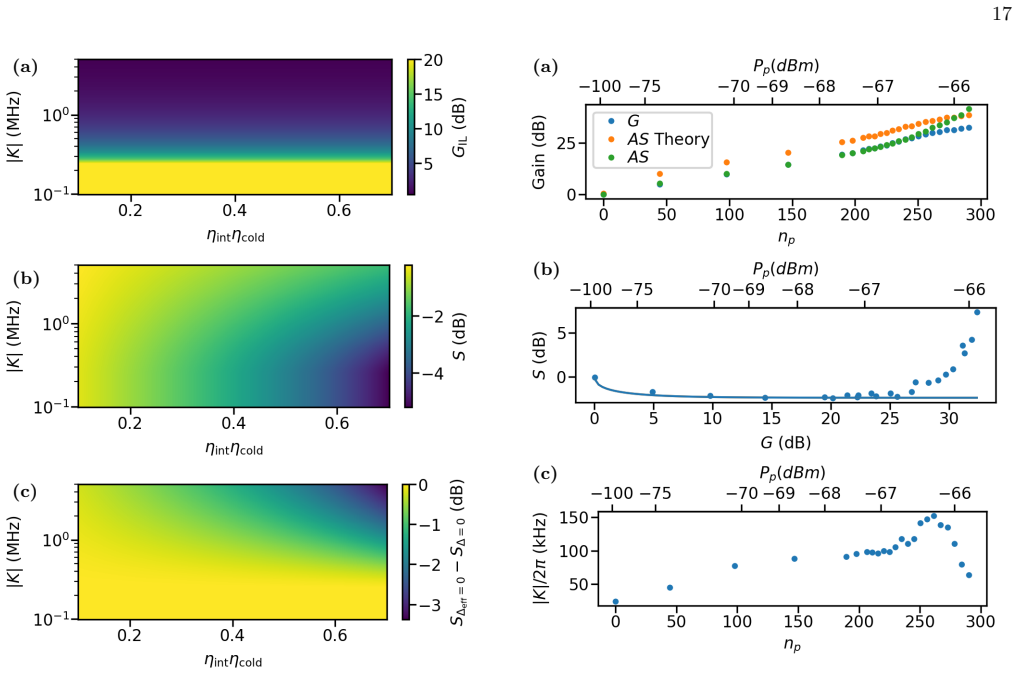
- Appendix H shows clear degradation of S above ~25 dB gain (S > 0), which the linearized stiff-pump Gaussian model does not capture. The main text correctly notes that this lies outside the model, yet the abstract and conclusion state that baseline Kerr is already too small to impose a practical limitation without quantifying the gain range over which that statement holds. Clarifying that the loss-dominated, Kerr-insensitive regime is limited to the moderate-gain window used in the main experiment (G ≤ 17.5 dB) would prevent over-generalization.
minor comments (4)
- Fig. 3(b) and Fig. 4 use the same color coding for gain settings; a single legend shared across both panels (or an explicit statement in the captions) would improve readability.
- Eq. (8) and Appendix G introduce GIL versus the experimental G; a one-sentence reminder in the main text of the numerical range of G/GIL (0 to −3.5 dB) would help readers who skip the appendices.
- Appendix F dismisses TLS as the origin of IMD artifacts on three phenomenological grounds; a brief quantitative bound on any residual TLS contribution to the low-power IIP3 used for |K| extraction would make the argument tighter.
- Typographical consistency: “P ARAMETRIC” and “DEGENERA TE” in section headings appear to contain stray spaces; likewise “SNAIL P arametric” in the title of Sec. II.
Circularity Check
No load-bearing circularity: experimental S–K independence stands on data; linearized theory derives K-independence once gain/Δ_eff fixed; η range is a post-hoc fit used only to explain residual scatter, not to force the central claim.
specific steps
-
fitted input called prediction
[Sec. IV, Fig. 3(b) and accompanying text; also Sec. V / Fig. 4]
"Matching the observed spread in S requires ηintηcold to vary from approximately 0.22 to 0.42 as the pump power and detuning are changed. ... Clusters of colored lines show theoretical predictions of S versus Δ for five representative values of ηintηcold."
The model predicts strictly constant S once gain is fixed (independent of K and Δ). The residual experimental scatter is then absorbed by freely choosing a range of the uncalibrated efficiency product so that the theory bands cover the data. This is a post-hoc fit used for interpretation, not a prediction of S from independently measured η; it is therefore a minor fitted-input step, but it is not load-bearing for the claim that S shows no significant Kerr dependence.
full rationale
The paper’s central claim (usable squeezing ~2 dB with no significant dependence on Kerr under fixed-fs operation, loss-dominated) is carried by direct measurements of Smeas (histograms + efficiency-corrected S) versus independently extracted |K| from IIP3 (Figs. 2–3) and by the analytic result that Sobs is independent of K once Δeff = 0 and gain is fixed (Eqs. 7, A13–A14, Table I). That independence follows from the standard linearized QLE + input–output map for a stiff-pump DPA; K enters only through the Stark-shifted detuning that is experimentally retuned. The only minor circular-adjacent step is the post-hoc assignment of the observed S scatter to an uncalibrated ηintηcold range (0.22–0.42) that is chosen to match the data (Figs. 3b, 4). This is acknowledged as an uncontrolled parameter rather than presented as a first-principles prediction of S, so it does not force the Kerr-irrelevance conclusion. Self-citations to prior SPA design papers supply device parameters and the IMD formula but are not used as uniqueness theorems or to smuggle the target result. High-gain degradation and IMD artifacts lie outside the model and are not claimed to be predicted by it. Overall the derivation chain is self-contained against the experimental benchmarks.
Axiom & Free-Parameter Ledger
free parameters (4)
- η_int η_cold =
0.22–0.42
- η_hot =
≈0.042
- SPA design parameters α, L_J =
α≈0.05, L_J=44 pH
- pump attenuation factor C
axioms (4)
- domain assumption Linearized quantum Langevin equation with stiff (undepleted) pump and Gaussian fluctuations yields the scattering matrix and S_obs independent of K at fixed gain when Δ_eff=0.
- domain assumption IIP3 measured with two-tone IMD, after discarding anomalous high-power features, correctly reports the effective Kerr K relevant to vacuum squeezing.
- standard math Standard input–output theory and beam-splitter model of loss convert measured variances to squeezing at the qubit reference plane.
- domain assumption The SPA Hamiltonian truncated at g4 (plus pump-induced renormalizations) is sufficient to describe the observed gain and residual Kerr.
read the original abstract
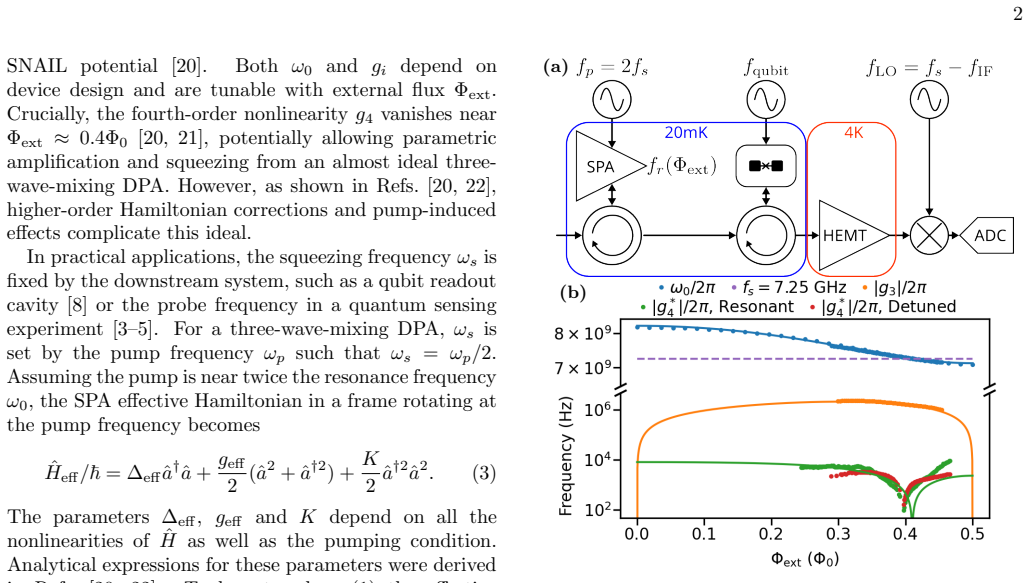
We characterize single-mode vacuum squeezing generated by a SNAIL Parametric Amplifier (SPA) operated under conditions representative of practical sensing and qubit-readout experiments. Motivated by prior expectations that Kerr-induced distortion limits squeezing in degenerate parametric amplifiers, we varied external flux and pump power to explore operating points where Kerr nonlinearity is theoretically minimized. We find that for practical applications where the squeezing frequency is fixed, the Kerr was variable by about a factor of two and the achievable squeezing showed no significant dependence on Kerr. Theoretical modeling supports this observation and indicates that baseline Kerr values in state-of-the-art SPAs are already too small to impose a practical limitation. Instead, squeezing was dominated by internal resonator loss and insertion loss in the microwave chain. These results indicate that, in practical SPAs, reducing loss, rather than suppressing Kerr, is the primary route to improved squeezing performance.
Figures


Reference graph
Works this paper leans on
-
[1]
(G2) Following Ref. [21], the power in an input tone at angular frequency ωβ can be expressed as Pβ,in = ℏω0 κext |Ωβ,in|2 ω0 ωβ 2 ≡ ν2 β ℏω0 κext |Ωβ,in|2, (G3) where νβ ≡ ω0/ωβ, Ωβ,in is the complex drive amplitude, and β ∈ { 1, 2, imd} labels the relevant tones proximal to the signal frequency. At this point, it is convenient to connect the input signa...
-
[2]
At np = 0, |K| = 12|g∗ 4|
At high G, deviations from the model are attributed to distortion of the output state from higher-order nonlinear corrections or soft pump corrections [16]. At np = 0, |K| = 12|g∗ 4|. As np increased to about 100, |K| appeared to increase linearly. However, for 100 < np < 250, |K| is approximately constant, contrary to the prediction of Eq. (4). Only with...
-
[3]
D. F. Walls and G. J. Milburn, Quantum Optics , Graduate Texts in Physics (Springer Nature Switzerland, Cham, 2025)
2025
-
[4]
The LIGO Scientific Collaboration, A gravitational wave observatory operating beyond the quantum shot-noise limit, Nature Physics 7, 962 (2011)
2011
-
[5]
Bienfait, P
A. Bienfait, P. Campagne-Ibarcq, A. Kiilerich, X. Zhou, S. Probst, J. Pla, T. Schenkel, D. Vion, D. Esteve, J. Morton, K. Moelmer, and P. Bertet, Magnetic Resonance with Squeezed Microwaves, Physical Review X 7, 041011 (2017)
2017
-
[6]
Malnou, D
M. Malnou, D. Palken, B. Brubaker, L. R. Vale, G. C. Hilton, and K. Lehnert, Squeezed Vacuum Used to Accelerate the Search for a Weak Classical Signal, Physical Review X 9, 021023 (2019)
2019
-
[7]
K. M. Backes, D. A. Palken, S. A. Kenany, B. M. Brubaker, S. B. Cahn, A. Droster, G. C. Hilton, S. Ghosh, H. Jackson, S. K. Lamoreaux, A. F. Leder, K. W. Lehnert, S. M. Lewis, M. Malnou, R. H. Maruyama, N. M. Rapidis, M. Simanovskaia, S. Singh, D. H. Speller, I. Urdinaran, L. R. Vale, E. C. van Assendelft, K. van Bibber, and H. Wang, A quantum enhanced se...
2021
-
[8]
Barzanjeh, D
S. Barzanjeh, D. P. DiVincenzo, and B. M. Terhal, Dispersive qubit measurement by interferometry with parametric amplifiers, Physical Review B 90, 134515 (2014)
2014
-
[9]
Didier, J
N. Didier, J. Bourassa, and A. Blais, Fast Quantum Nondemolition Readout by Parametric Modulation of Longitudinal Qubit-Oscillator Interaction, Physical Review Letters 115, 203601 (2015)
2015
-
[10]
Didier, A
N. Didier, A. Kamal, W. D. Oliver, A. Blais, and A. A. Clerk, Heisenberg-Limited Qubit Read-Out with Two- Mode Squeezed Light, Physical Review Letters 115, 093604 (2015)
2015
-
[11]
Eddins, S
A. Eddins, S. Schreppler, D. Toyli, L. Martin, S. Hacohen-Gourgy, L. Govia, H. Ribeiro, A. Clerk, and I. Siddiqi, Stroboscopic Qubit Measurement with Squeezed Illumination, Physical Review Letters 120, 040505 (2018)
2018
-
[12]
G. Liu, X. Cao, T.-C. Chien, C. Zhou, P. Lu, and M. Hatridge, Noise Reduction in Qubit Readout with a Two-Mode Squeezed Interferometer, Physical Review Applied 18, 064092 (2022)
2022
-
[13]
Movshovich, B
R. Movshovich, B. Yurke, P. G. Kaminsky, A. D. Smith, A. H. Silver, R. W. Simon, and M. V. Schneider, Observation of zero-point noise squeezing via a Josephson-parametric amplifier, Physical Review Letters 65, 1419 (1990)
1990
-
[14]
A. I. Lvovsky and M. G. Raymer, Continuous-variable optical quantum-state tomography, Reviews of Modern Physics 81, 299 (2009)
2009
-
[15]
Eichler, D
C. Eichler, D. Bozyigit, C. Lang, L. Steffen, J. Fink, and A. Wallraff, Experimental State Tomography of Itinerant Single Microwave Photons, Physical Review Letters 106, 220503 (2011)
2011
-
[16]
Mallet, M
F. Mallet, M. A. Castellanos-Beltran, H. S. Ku, S. Glancy, E. Knill, K. D. Irwin, G. C. Hilton, L. R. Vale, and K. W. Lehnert, Quantum State Tomography of an Itinerant Squeezed Microwave Field, Physical Review Letters 106, 220502 (2011)
2011
-
[17]
X. Zhou, V. Schmitt, P. Bertet, D. Vion, W. Wustmann, V. Shumeiko, and D. Esteve, High-gain weakly nonlinear flux-modulated Josephson parametric amplifier using a SQUID array, Physical Review B 89, 214517 (2014)
2014
-
[18]
Boutin, D
S. Boutin, D. M. Toyli, A. V. Venkatramani, A. W. Eddins, I. Siddiqi, and A. Blais, Effect of higher- order nonlinearities on amplification and squeezing in Josephson parametric amplifiers, Physical Review Applied 8, 054030 (2017)
2017
-
[19]
Malnou, D
M. Malnou, D. A. Palken, L. R. Vale, G. C. Hilton, and K. W. Lehnert, Optimal operation of a Josephson parametric amplifier for vacuum squeezing, Physical Review Applied 9, 044023 (2018)
2018
-
[20]
Perelshtein, K
M. Perelshtein, K. Petrovnin, V. Vesterinen, S. Hamedani Raja, I. Lilja, M. Will, A. Savin, S. Simbierowicz, R. Jabdaraghi, J. Lehtinen, L. Gr¨ onberg, J. Hassel, M. Prunnila, J. Govenius, G. Paraoanu, and P. Hakonen, Broadband Continuous- Variable Entanglement Generation Using a Kerr-Free Josephson Metamaterial, Physical Review Applied 18, 024063 (2022)
2022
-
[21]
J. Y. Qiu, A. Grimsmo, K. Peng, B. Kannan, B. Lienhard, Y. Sung, P. Krantz, V. Bolkhovsky, G. Calusine, D. Kim, A. Melville, B. M. Niedzielski, J. Yoder, M. E. Schwartz, T. P. Orlando, I. Siddiqi, S. Gustavsson, K. P. O’Brien, and W. D. Oliver, Broadband squeezed microwaves and amplification with a Josephson travelling-wave parametric amplifier, Nature Ph...
2023
-
[22]
Vaartjes, A
A. Vaartjes, A. Kringhøj, W. Vine, T. Day, A. Morello, and J. J. Pla, Strong microwave squeezing above 1 Tesla and 1 Kelvin, Nature Communications 15, 4229 (2024)
2024
-
[23]
N. E. Frattini, V. V. Sivak, A. Lingenfelter, S. Shankar, and M. H. Devoret, Optimizing the Nonlinearity and Dissipation of a SNAIL Parametric Amplifier for Dynamic Range, Physical Review Applied 10, 054020 (2018)
2018
-
[24]
N. E. Frattini, U. Vool, S. Shankar, A. Narla, K. M. Sliwa, and M. H. Devoret, 3-wave mixing Josephson dipole element, Applied Physics Letters 110, 222603 (2017)
2017
-
[25]
V. V. Sivak, N. E. Frattini, V. R. Joshi, A. Lingenfelter, S. Shankar, and M. H. Devoret, Kerr-free three-wave mixing in superconducting quantum circuits, Physical Review Applied 11, 054060 (2019)
2019
-
[26]
V. V. Sivak, S. Shankar, G. Liu, J. Aumentado, and M. H. 19 Devoret, Josephson Array Mode Parametric Amplifier, Physical Review Applied 13, 024014 (2020)
2020
-
[27]
Kaufman, T
R. Kaufman, T. White, M. I. Dykman, A. Iorio, G. Sterling, S. Hong, A. Opremcak, A. Bengtsson, L. Faoro, J. C. Bardin, T. Burger, R. Gasca, and O. Naaman, Josephson parametric amplifier with Chebyshev gain profile and high saturation, Physical Review Applied 20, 054058 (2023)
2023
-
[28]
C. C. Gerry and P. Knight, Introductory quantum optics , 3rd ed. (Cambridge Univ. Press, Cambridge, 2008)
2008
-
[29]
Touzard, A
S. Touzard, A. Kou, N. E. Frattini, V. V. Sivak, S. Puri, A. Grimm, L. Frunzio, S. Shankar, and M. H. Devoret, Gated conditional displacement readout of superconducting qubits, Physical Review Letters 122, 080502 (2019)
2019
-
[30]
Bizn´ arov´ a, J
J. Bizn´ arov´ a, J. Rivera Hern´ andez, D. Forchheimer, J. Bylander, D. B. Haviland, and G. Andersson, Intermodulation spectroscopy and the nonlinear response of two-level systems in superconducting coplanar- waveguide resonators, Physical Review Applied 22, 014063 (2024)
2024
-
[31]
A. Remm, S. Krinner, N. Lacroix, C. Hellings, F. Swiadek, G. J. Norris, C. Eichler, and A. Wallraff, Intermodulation Distortion in a Josephson Traveling- Wave Parametric Amplifier, Physical Review Applied20, 034027 (2023)
2023
-
[32]
R. Ott, P. Lahl, and R. W¨ ordenweber, Nonlinear microwave properties of ferroelectric thin films, Applied Physics Letters 84, 4147 (2004)
2004
-
[33]
Watanabe, K
M. Watanabe, K. Inomata, T. Yamamoto, and J.-S. Tsai, Power-dependent internal loss in Josephson bifurcation amplifiers, Physical Review B 80, 174502 (2009)
2009
-
[34]
Garc´ ıa-Mata, R
I. Garc´ ıa-Mata, R. G. Corti˜ nas, X. Xiao, J. Ch´ avez- Carlos, V. S. Batista, L. F. Santos, and D. A. Wisniacki, Effective versus Floquet theory for the Kerr parametric oscillator, Quantum 8, 1298 (2024)
2024
-
[35]
K. Peng, M. Naghiloo, J. Wang, G. D. Cunningham, Y. Ye, and K. P. O’Brien, Floquet-Mode Traveling-Wave Parametric Amplifiers, PRX Quantum 3, 020306 (2022)
2022
-
[36]
G. J. Dolan, Offset masks for lift-off photoprocessing, Applied Physics Letters 31, 337 (1977)
1977
-
[37]
Shalibo, Y
Y. Shalibo, Y. Rofe, D. Shwa, F. Zeides, M. Neeley, J. M. Martinis, and N. Katz, Lifetime and Coherence of Two- Level Defects in a Josephson Junction, Physical Review Letters 105, 177001 (2010)
2010
discussion (0)
Sign in with ORCID, Apple, or X to comment. Anyone can read and Pith papers without signing in.