REVIEW 3 major objections 2 minor 73 references
A minimal two-qubit Heisenberg model with tunable couplings shows mutual information measures evolving like black hole entropy, Hawking entropy, and the Page curve.
Reviewed by Pith at T0; open to challenge. T0 means a machine referee read the full paper against a public rubric. the ladder, T0–T4 →
T0 review · grok-4.3
2026-06-30 09:22 UTC pith:LXZN24XZ
load-bearing objection The paper gives a two-qubit antiferromagnetic model whose mutual information curves track something like the Page curve at a quantum phase transition, with an effective temperature read off from energy versus information. the 3 major comments →
Tracking Entanglement Transfer: Emergence of Thermodynamics from Quantum Information
The pith
A machine-rendered reading of the paper's core claim, the machinery that carries it, and where it could break.
Core claim
In this unitary qubit-bath model, carefully chosen mutual information measures between the d'-d subsystem and the environment reproduce the dynamical signatures of black-hole evaporation, including an effective temperature that scales with coupling ratio in the same way Hawking temperature scales with inverse black-hole mass, while non-Fermi-liquid signatures appear near the quantum critical point.
What carries the argument
Bipartite and tripartite mutual information quantities that track the redistribution of entanglement across the quantum phase transition induced by the ratio of Kondo to Heisenberg couplings.
Load-bearing premise
Qualitative similarities between the model's mutual information curves and black-hole thermodynamic quantities reflect a genuine physical analogy rather than model-specific numerical coincidence.
What would settle it
An experimental realization of the two-qubit antiferromagnetic Heisenberg chain coupled to a fermionic bath in which the measured mutual information fails to produce a Page-curve-like dip and recovery would falsify the claimed analogy.
If this is right
- The effective temperature derived from energy versus mutual-information variation supplies a concrete scale for information scrambling inside a fully unitary quantum system.
- Non-Fermi-liquid behavior near the critical point supplies a lattice realization of strange-metal physics expected near an event horizon.
- The model supplies a minimal, controllable platform for studying entanglement transfer without invoking gravity or holography.
- The observed analogy suggests that black-hole information-paradox questions can be addressed through ordinary quantum-information quantities in open quantum systems.
Where Pith is reading between the lines
- If the analogy survives in larger qubit arrays, the same mutual-information diagnostics could map out information flow in other many-body systems that exhibit quantum critical points.
- The temperature extraction method could be applied to any quantum system where ground-state energy can be differentiated with respect to a chosen information measure, offering a route to thermodynamic analogies without explicit gravity.
- Experimental tests in cold-atom or superconducting-qubit platforms could directly measure whether the Page-curve shape persists when the bath is made finite rather than infinite.
Editorial analysis
A structured set of objections, weighed in public.
Referee Report
Summary. The manuscript examines a minimal model of two qubits coupled antiferromagnetically to each other ( ilde{J}) with one additionally coupled to a fermionic bath (J_K). Tuning the ratio J_K/ ilde{J} drives a T=0 quantum phase transition that redistributes entanglement from the qubit subsystem to the bath. The authors report that suitably chosen bipartite and tripartite mutual-information quantities exhibit qualitative behaviors analogous to black-hole entropy, Hawking entropy, and the Page curve during evaporation. An effective temperature is extracted from the derivative of the ground-state energy with respect to the subsystem-bath mutual information; this T_eff grows with the coupling ratio in a manner stated to resemble the Hawking temperature's dependence on inverse black-hole mass. Non-Fermi-liquid signatures near the critical point are noted to resemble strange-metal physics expected from holographic duality.
Significance. If the reported analogies can be placed on a firmer footing with an explicit mapping or quantitative correspondence, the work would supply a fully unitary, few-body platform for exploring entanglement transfer and information scrambling relevant to the black-hole information paradox. The minimal character of the model is a genuine strength, permitting direct identification of the entanglement redistribution at the QPT. The paper does not mention machine-checked proofs or open reproducible code, but the use of standard mutual-information diagnostics on an exactly solvable two-qubit system is methodologically transparent.
major comments (3)
- [results section on T_eff] Definition of effective temperature (results section on T_eff): T_eff is obtained directly as the variation of ground-state energy with respect to the bipartite mutual information I between subsystem and bath. Because the claimed resemblance to Hawking temperature follows immediately from this definitional choice and the observed monotonic growth of T_eff with J_K/ ilde{J}, an independent thermodynamic or holographic justification is required to establish that the analogy is not tautological.
- [section presenting bipartite/tripartite measures] Mutual-information analogy to Page curve (section presenting bipartite/tripartite measures): The manuscript selects particular combinations of I_{d'-d}, I_{d'-bath}, and tripartite quantities to match the expected Page-curve shape. No a-priori dictionary or continuum-limit argument is supplied that would map these quantities onto black-hole entropy and radiation entropy; without such a mapping or a quantitative functional-form comparison, the analogy remains a qualitative resemblance whose generality is unclear.
- [discussion of strong-coupling phase] Non-Fermi-liquid claim near QCP (discussion of strong-coupling phase): The emergence of non-Fermi-liquid behavior is asserted to resemble strange-metal physics, yet no derivation of the same scaling exponents or transport properties from the microscopic Heisenberg couplings is provided. This observation therefore does not yet constitute an independent test of the holographic analogy.
minor comments (2)
- [abstract] Abstract: subject-verb agreement error ('displays behaviour' should be 'display behaviour').
- [throughout] Notation: the coupling ratio is written both as J_K / ilde{J} and J_K/Jtilde; consistent typesetting would aid readability.
Simulated Author's Rebuttal
We thank the referee for the careful reading and constructive comments on our manuscript. We address each major comment point by point below, indicating revisions where we agree they strengthen the presentation.
read point-by-point responses
-
Referee: Definition of effective temperature (results section on T_eff): T_eff is obtained directly as the variation of ground-state energy with respect to the bipartite mutual information I between subsystem and bath. Because the claimed resemblance to Hawking temperature follows immediately from this definitional choice and the observed monotonic growth of T_eff with J_K/tilde{J}, an independent thermodynamic or holographic justification is required to establish that the analogy is not tautological.
Authors: The definition of T_eff is chosen to parallel the thermodynamic relation T = δE/δS, with the mutual information serving as the information-theoretic proxy for entropy in this setting. This is motivated by the quantum-information approach to black-hole thermodynamics rather than being purely arbitrary. We agree that additional context would help avoid any perception of tautology. In the revised manuscript we will expand the T_eff section with a paragraph providing thermodynamic motivation drawn from the literature on information thermodynamics and explicitly note the suggestive character of the resulting resemblance to Hawking temperature. revision: partial
-
Referee: Mutual-information analogy to Page curve (section presenting bipartite/tripartite measures): The manuscript selects particular combinations of I_{d'-d}, I_{d'-bath}, and tripartite quantities to match the expected Page-curve shape. No a-priori dictionary or continuum-limit argument is supplied that would map these quantities onto black-hole entropy and radiation entropy; without such a mapping or a quantitative functional-form comparison, the analogy remains a qualitative resemblance whose generality is unclear.
Authors: The selected mutual-information combinations follow directly from the model's natural partitions, with the two-qubit subsystem identified as the black-hole degrees of freedom and the fermionic bath as the radiation field; the tripartite quantity tracks the redistribution during the QPT. We concur that the analogy is qualitative and that an explicit continuum dictionary is absent. In the revision we will insert a dedicated subsection explaining the partition rationale, stating the qualitative nature of the comparison, and underscoring the utility of the exactly solvable model for visualizing entanglement transfer. revision: yes
-
Referee: Non-Fermi-liquid claim near QCP (discussion of strong-coupling phase): The emergence of non-Fermi-liquid behavior is asserted to resemble strange-metal physics, yet no derivation of the same scaling exponents or transport properties from the microscopic Heisenberg couplings is provided. This observation therefore does not yet constitute an independent test of the holographic analogy.
Authors: The non-Fermi-liquid signatures are identified from the model's spectral and correlation functions near the QCP. While these features are reminiscent of strange-metal phenomenology, the minimal two-qubit Heisenberg model does not permit derivation of the specific large-N scaling exponents characteristic of holographic strange metals. We will revise the discussion to present the resemblance as a phenomenological observation suggesting possible broader connections, rather than an independent test of the duality. revision: partial
Circularity Check
Effective temperature defined from dE/dI derivative; resemblance to Hawking T follows by construction from that choice
specific steps
-
self definitional
[Abstract]
"An effective temperature scale is obtained from the variation of the ground state energy with respect to changes in the bipartite mutual information between the subsystem and the bath. A steady growth of this temperature with the coupling ratio resembles that of the Hawking temperature with the inverse mass of the black hole."
T_eff is constructed by definition as a derivative (or finite difference) of E_gs with respect to the chosen mutual information I. The subsequent claim that this T_eff 'resembles' Hawking temperature is therefore a direct consequence of how E and I vary with the single tuning parameter J_K/J; the resemblance is not an independent prediction but follows tautologically from the definitional choice.
-
fitted input called prediction
[Abstract]
"Carefully selected bipartite and tripartite mutual information measures displays behaviour analogous to the dynamical evolution of black hole entropy, Hawking entropy, and the Page curve expected during the process of evaporation."
The mutual-information quantities are chosen ('carefully selected') so that their curves versus coupling ratio match the qualitative shape of the Page curve. The analogy is then presented as a result, but the selection criterion is precisely the desired analogy, rendering the match a re-labeling of the model's entanglement data rather than an emergent prediction.
full rationale
The paper's central analogy to black-hole thermodynamics rests on two load-bearing choices: (1) selecting specific bipartite/tripartite mutual informations that are stated to 'display behaviour analogous' to the Page curve, and (2) defining an effective temperature directly as the variation of ground-state energy with respect to the subsystem-bath mutual information, then noting that this T_eff grows with coupling ratio 'resembling' Hawking T ~ 1/M. Both steps are internal reparametrizations of the model's outputs rather than independent derivations or mappings. No external thermodynamic identity, continuum limit, or dictionary is supplied that would make the resemblance non-accidental. The non-Fermi-liquid observation is likewise presented as resemblance without derivation from the same rules. This produces partial circularity (score 6) but the underlying numerics on the two-qubit model remain independently computable.
Axiom & Free-Parameter Ledger
free parameters (1)
- coupling ratio J_K / Jtilde
axioms (2)
- domain assumption The qubit-qubit and qubit-bath interactions are described by antiferromagnetic Heisenberg exchange Hamiltonians.
- standard math Bipartite and tripartite mutual informations are well-defined and computable from the ground state of the system.
read the original abstract
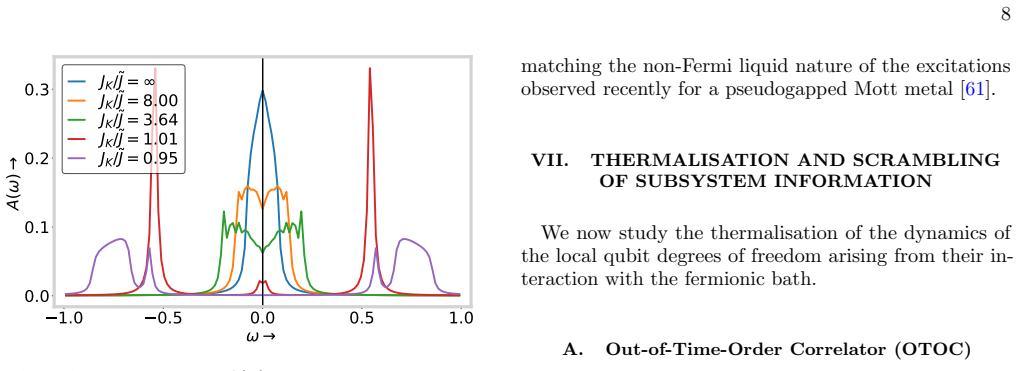
We study entanglement transfer in a minimal model of two qubits that are coupled with one another through an antiferromagnetic Heisenberg exchange ($\tilde{J}$), and where one of them is additionally coupled to a fermionic environment through another antiferromagnetic Heisenberg exchange ($J_{K}$). By tuning the coupling ratio $J_{K}/\tilde{J}$, the system undergoes a quantum phase transition at $T=0$, accompanied by a redistribution of entanglement from the $d'-d$ qubit-subsystem to the environment. Remarkably, the resulting physics exhibits properties that bear analogy with a quantum-information theoretic perspective of the physics of black hole thermodynamics. Carefully selected bipartite and tripartite mutual information measures displays behaviour analogous to the dynamical evolution of black hole entropy, Hawking entropy, and the Page curve expected during the process of evaporation. An effective temperature scale is obtained from the variation of the ground state energy with respect to changes in the bipartite mutual information between the subsystem and the bath. A steady growth of this temperature with the coupling ratio resembles that of the Hawking temperature with the inverse mass of the black hole. Concomitantly, the emergence of non-Fermi liquid behaviour observed near the quantum critical point and in the strong-coupling phase resembles strange-metal-like physics expected near the event horizon from a holographic duality perspective. Our results establish the minimal model as a platform for studying entanglement transfer and information scrambling within a fully unitary quantum framework, and offer new insights into a resolution of the black hole information paradox.
Figures




Reference graph
Works this paper leans on
-
[1]
On the other hand, the off-diagonal part of eq.(1) can be written in terms of scattering processes that involve particle-like excitations H I 1 = X |k|<Λ,q J z K 2 Sz d c† k↑cq↑ − J z K 2 Sz d c† k↓cq↓ +1 2 X |k|<Λ,q J ⊥ K S+ d S− kq +S − d S+ kq ,(13) and those that involve hole-like excitations H I 0 = X |k|<Λ,q J z K 2 Sz d c† q↑ck↑ − J z K 2 Sz d c† q...
-
[2]
is zero in the weak-coupling phase, as it is altogether decoupled from the subsystem of qubits and is only coupled through hopping to the other bath sites. In the strong coupling phase, the effective coupling J ∗ K dominates over ˜J, and increases with JK/ ˜J. Thus, for J ∗ K >> ˜J, the d-qubit forms a singlet with the 0th bath site, resulting in a vanish...
-
[3]
This gives the eigenvalueλ 4 = 1/4, and
|↑d′↑d⟩, or |↓d′↓d⟩, or triplet between d′ and d where bath 0th site can take double occupancy or 0 occupancy. This gives the eigenvalueλ 4 = 1/4, and
-
[4]
This gives the eigenvalue λ5 =−3/4
Singlet between d′ and d where bath 0th site can take either double or 0 occupancy. This gives the eigenvalue λ5 =−3/4. We can see from Fig. 15 that λ2 is the minimum eigen- value: the results above show that the ground state has a two-fold degeneracy for JK/ ˜J > 0. The two degenerate ground states are from theS z total =± 1 2 sectors: Sz total = 1 2 :|ψ...
-
[5]
Quantum information or entanglement transfer between subsystems
Steven B Giddings and Massimiliano Rota. Quantum information or entanglement transfer between subsystems. Physical Review A, 98(6):062329, 2018
work page 2018
-
[6]
Black holes and quantum information
Juan Maldacena. Black holes and quantum information. Nature Reviews Physics, 2(3):123–125, 2020
work page 2020
-
[7]
Zhuoying Li, Haoshen Fan, Xingwen Zhao, Qinfei Wu, Ji Bian, Yang Liu, and Le Luo. Simulating the evolution of von neumann entropy in black hole hawking radiation using biphoton entanglement.Entropy, 27(3):236, 2025
work page 2025
-
[8]
Page curves and replica wormholes from random dynamics
Jan de Boer, Jildou Hollander, and Andrew Rolph. Page curves and replica wormholes from random dynamics. Journal of High Energy Physics, 2024(7):1–41, 2024
work page 2024
-
[9]
Information flow in black hole evaporation.Journal of High Energy Physics, 2020(3):152, 2020
Hong Zhe Chen, Zachary Fisher, Juan Hernandez, Robert C Myers, and Shan-Ming Ruan. Information flow in black hole evaporation.Journal of High Energy Physics, 2020(3):152, 2020
work page 2020
-
[10]
Hanteng Wang, Chang Liu, Pengfei Zhang, and Antonio M Garc´ ıa-Garc´ ıa. Entanglement transition and replica worm- holes in the dissipative sachdev-ye-kitaev model.Physical Review D, 109(4):046005, 2024
work page 2024
-
[11]
Page curve from non-markovianity.Journal of High Energy Physics, 2021(6):1–18, 2021
Kaixiang Su, Pengfei Zhang, and Hui Zhai. Page curve from non-markovianity.Journal of High Energy Physics, 2021(6):1–18, 2021
work page 2021
-
[12]
A random unitary circuit model for black hole evaporation
Lorenzo Piroli, Christoph S¨ underhauf, and Xiao-Liang Qi. A random unitary circuit model for black hole evaporation. Journal of High Energy Physics, 2020(4):63, 2020
work page 2020
-
[13]
Hong Liu and Shreya Vardhan. A dynamical mechanism for the page curve from quantum chaos.Journal of High Energy Physics, 2021(3):88, 2021
work page 2021
-
[14]
Black holes are about quantum information, December 2025
Aude Corbeel and Sebastian De Haro. Black holes are about quantum information, December 2025
work page 2025
-
[15]
Patrick Hayden and John Preskill. Black holes as mirrors: quantum information in random subsystems.Journal of high energy physics, 2007(09):120–120, 2007
work page 2007
-
[16]
Role of mutual information in the page curve.Physical Review D, 106(8):086019, 2022
Anirban Roy Chowdhury, Ashis Saha, and Sunandan Gangopadhyay. Role of mutual information in the page curve.Physical Review D, 106(8):086019, 2022
work page 2022
-
[17]
Marcel Franz and Moshe Rozali. Mimicking black hole event horizons in atomic and solid-state systems.Nature Reviews Materials, 3(12):491–501, 2018
work page 2018
-
[18]
Samuel L Braunstein, Stefano Pirandola, and Karol ˙Zyczkowski. Better late than never: information retrieval from black holes.Physical review letters, 110(10):101301, 2013
work page 2013
-
[19]
Hawking radiation from decoherence.Clas- sical and Quantum Gravity, 18(22):L151–L154, 2001
Claus Kiefer. Hawking radiation from decoherence.Clas- sical and Quantum Gravity, 18(22):L151–L154, 2001
work page 2001
-
[20]
Steven B Giddings. Nonviolent unitarization: basic pos- tulates to soft quantum structure of black holes.Journal of High Energy Physics, 2017(12):1–27, 2017
work page 2017
-
[21]
Ahmed Almheiri, Alexey Milekhin, and Brian Swingle. Universal constraints on energy flow and syk thermal- ization.Journal of High Energy Physics, 2024(8):1–43, 2024
work page 2024
-
[22]
Abanin, Ehud Altman, Immanuel Bloch, and Maksym Serbyn
Dmitry A. Abanin, Ehud Altman, Immanuel Bloch, and Maksym Serbyn. Colloquium: Many-body localization, thermalization, and entanglement.Rev. Mod. Phys., 91:021001, May 2019
work page 2019
-
[23]
Particle creation by black holes
Stephen W Hawking. Particle creation by black holes. Communications in mathematical physics, 43(3):199–220, 1975
work page 1975
-
[24]
Anirban Mukherjee and Siddhartha Lal. Holographic unitary renormalization group for correlated electrons-i: A tensor network approach.Nuclear Physics B, 960:115170, 2020
work page 2020
-
[25]
Anirban Mukherjee and Siddhartha Lal. Holographic unitary renormalization group for correlated electrons- ii: Insights on fermionic criticality.Nuclear Physics B, 960:115163, 2020
work page 2020
-
[26]
Scaling theory for mott–hubbard transitions: I
Anirban Mukherjee and Siddhartha Lal. Scaling theory for mott–hubbard transitions: I. t= 0 phase diagram of the 1/2-filled hubbard model.New Journal of Physics, 22(6):063007, 2020
work page 2020
-
[27]
Anirban Mukherjee and Siddhartha Lal. Scaling the- ory for mott–hubbard transitions-ii: quantum criticality of the doped mott insulator.New Journal of Physics, 22(6):063008, 2020. 14
work page 2020
-
[28]
Santanu Pal, Anirban Mukherjee, and Siddhartha Lal. Correlated spin liquids in the quantum kagome antiferro- magnet at finite field: a renormalization group analysis. New Journal of Physics, 21(2):023019, 2019
work page 2019
-
[29]
Origin of topologi- cal order in a cooper-pair insulator.Physical Review B, 104(14):144514, 2021
Siddhartha Patra and Siddhartha Lal. Origin of topologi- cal order in a cooper-pair insulator.Physical Review B, 104(14):144514, 2021
work page 2021
-
[30]
Anirban Mukherjee, Siddhartha Patra, and Siddhartha Lal. Fermionic criticality is shaped by fermi surface topol- ogy: a case study of the tomonaga-luttinger liquid.Jour- nal of High Energy Physics, 2021(4):148, 2021
work page 2021
-
[31]
Anirban Mukherjee, Abhirup Mukherjee, NS Vidhyadhi- raja, A Taraphder, and Siddhartha Lal. Unveiling the kondo cloud: unitary renormalization-group study of the kondo model.Physical Review B, 105(8):085119, 2022
work page 2022
-
[32]
Abhirup Mukherjee, NS Vidhyadhiraja, A Taraphder, and Siddhartha Lal. Kondo frustration via charge fluctuations: a route to mott localisation.New Journal of Physics, 25(11):113011, 2023
work page 2023
-
[33]
Debraj Debata, Abhirup Mukherjee, and Siddhartha Lal. Kondo breakdown as an entanglement transition driven by continuous measurement.arXiv preprint arXiv:2602.20600, 2026
-
[34]
Chaos in quantum channels.Journal of High Energy Physics, 2016(2):4, 2016
Pavan Hosur, Xiao-Liang Qi, Daniel A Roberts, and Beni Yoshida. Chaos in quantum channels.Journal of High Energy Physics, 2016(2):4, 2016
work page 2016
-
[35]
Holographic mutual information is monogamous
Patrick Hayden, Matthew Headrick, and Alexander Mal- oney. Holographic mutual information is monogamous. Physical Review D—Particles, Fields, Gravitation, and Cosmology, 87(4):046003, 2013
work page 2013
-
[36]
Stranger than metals.Science, 377(6602):eabh4273, 2022
Philip W Phillips, Nigel E Hussey, and Peter Abbamonte. Stranger than metals.Science, 377(6602):eabh4273, 2022
work page 2022
-
[37]
Bekenstein-hawking entropy and strange metals.Physical Review X, 5(4):041025, 2015
Subir Sachdev. Bekenstein-hawking entropy and strange metals.Physical Review X, 5(4):041025, 2015
work page 2015
-
[38]
From black holes to strange metals
Thomas Faulkner, Nabil Iqbal, Hong Liu, John McGreevy, and David Vegh. From black holes to strange metals. arXiv preprint arXiv:1003.1728, 2010
work page internal anchor Pith review Pith/arXiv arXiv 2010
-
[39]
Resistance minimum in dilute magnetic alloys
Jun Kondo. Resistance minimum in dilute magnetic alloys. Progress of theoretical physics, 32(1):37–49, 1964
work page 1964
-
[40]
Philip W Anderson and Gideon Yuval. Exact results in the kondo problem: equivalence to a classical one-dimensional coulomb gas.Physical Review Letters, 23(2):89, 1969
work page 1969
-
[41]
Exact re- sults in the kondo problem
Philip W Anderson, G Yuval, and DR Hamann. Exact re- sults in the kondo problem. ii. scaling theory, qualitatively correct solution, and some new results on one-dimensional classical statistical models.Physical Review B, 1(11):4464, 1970
work page 1970
-
[42]
PW Anderson. A poor man’s derivation of scaling laws for the kondo problem.Journal of Physics C: Solid State Physics, 3(12):2436–2441, 1970
work page 1970
-
[43]
Ralf Bulla, Theo A Costi, and Thomas Pruschke. Numer- ical renormalization group method for quantum impurity systems.Reviews of Modern Physics, 80(2):395–450, 2008
work page 2008
-
[44]
Kenneth G Wilson. The renormalization group: Critical phenomena and the kondo problem.Reviews of modern physics, 47(4):773, 1975
work page 1975
- [45]
-
[46]
Quantum tunnelling in a dissipative system.Annals of Physics, 149(2):374–456, 1983
AO Caldeira and A J Leggett. Quantum tunnelling in a dissipative system.Annals of Physics, 149(2):374–456, 1983
work page 1983
-
[47]
Dynamics of the two-state system with ohmic dissipation.Physical review letters, 52(1):5, 1984
Sudip Chakravarty and Anthony J Leggett. Dynamics of the two-state system with ohmic dissipation.Physical review letters, 52(1):5, 1984
work page 1984
-
[48]
Bosonization of a two-level system with dissipation.Physical Review B, 32(7):4410, 1985
F Guinea, V Hakim, and A Muramatsu. Bosonization of a two-level system with dissipation.Physical Review B, 32(7):4410, 1985
work page 1985
-
[49]
A. J. Leggett, S. Chakravarty, A. T. Dorsey, Matthew P. A. Fisher, Anupam Garg, and W. Zwerger. Dynamics of the dissipative two-state system.Rev. Mod. Phys., 59:1–85, Jan 1987
work page 1987
- [50]
-
[51]
Black holes in the quantum universe
Steven B Giddings. Black holes in the quantum universe. Philosophical Transactions of the Royal Society A: Math- ematical, Physical and Engineering Sciences, 377(2161), 2019
work page 2019
-
[52]
Fabio Caceffo and Vincenzo Alba. Negative tripartite mutual information after quantum quenches in integrable systems.Physical Review B, 108(13):134434, 2023
work page 2023
-
[53]
Quantum entanglement and hawking temperature.The European Physical Journal C, 76(7):400, 2016
S Santhosh Kumar and S Shankaranarayanan. Quantum entanglement and hawking temperature.The European Physical Journal C, 76(7):400, 2016
work page 2016
-
[54]
Entanglement tempera- ture and perturbed ads 3 geometry.Physical Review D, 93(12):126002, 2016
GC Levine and Bassir Caravan. Entanglement tempera- ture and perturbed ads 3 geometry.Physical Review D, 93(12):126002, 2016
work page 2016
-
[55]
Entanglement temperature with gauss–bonnet term.Nuclear Physics B, 898:401–414, 2015
Shesansu Sekhar Pal and Sudhakar Panda. Entanglement temperature with gauss–bonnet term.Nuclear Physics B, 898:401–414, 2015
work page 2015
-
[56]
From black holes to strange metals.Physics Today, 65(6):68–69, 2012
Hong Liu. From black holes to strange metals.Physics Today, 65(6):68–69, 2012
work page 2012
-
[57]
Sung-Sik Lee. Non-fermi liquid from a charged black hole: A critical fermi ball.Physical Review D—Particles, Fields, Gravitation, and Cosmology, 79(8):086006, 2009
work page 2009
-
[58]
Strange connections to strange metals
Philip W Anderson. Strange connections to strange metals. Physics Today, 66(4):9–10, 2013
work page 2013
-
[59]
Holographic strange metals for philosophers and physicists.Foundations of Physics, 56(1):8, 2026
Enrico Cinti, Sebastian De Haro, Mark S Golden, Umut G¨ ursoy, and Henk TC Stoof. Holographic strange metals for philosophers and physicists.Foundations of Physics, 56(1):8, 2026
work page 2026
-
[60]
Kondo effect in real metals.Journal de Physique, 41(3):193–211, 1980
Ph Nozieres and Annie Blandin. Kondo effect in real metals.Journal de Physique, 41(3):193–211, 1980
work page 1980
-
[61]
Philippe Nozieres. A “fermi-liquid” description of the kondo problem at low temperatures.Journal of low temp´ erature physics, 17(1):31–42, 1974
work page 1974
-
[62]
Qimiao Si and Gabriel Kotliar. Metallic non-fermi-liquid phases of an extended hubbard model in infinite dimen- sions.Physical Review B, 48(18):13881, 1993
work page 1993
-
[63]
Singular or non-fermi liquids.Physics Reports, 361(5-6):267–417, 2002
Chandra M Varma, Zohar Nussinov, and Wim Van Saar- loos. Singular or non-fermi liquids.Physics Reports, 361(5-6):267–417, 2002
work page 2002
-
[64]
Gabriel Kotliar and Qimiao Si. Quantum chemistry, anomalous dimensions, and the breakdown of fermi liquid theory in strongly correlated systems.Physica Scripta, 1993(T49A):165–171, 1993
work page 1993
-
[65]
Abhirup Mukherjee, S R Hassan, Anamitra Mukher- jee, N S Vidhyadhiraja, A Taraphder, and Siddhartha Lal. Mott criticality as the confinement transition of a pseudogap-mott metal.New Journal of Physics, 28(1):013503, jan 2026
work page 2026
-
[66]
Efim B Rozenbaum, Sriram Ganeshan, and Victor Gal- itski. Lyapunov exponent and out-of-time-ordered corre- lator’s growth rate in a chaotic system.Physical review letters, 118(8):086801, 2017
work page 2017
-
[67]
A bound on chaos.Journal of High Energy Physics, 2016(8):106, 2016
Juan Maldacena, Stephen H Shenker, and Douglas Stan- ford. A bound on chaos.Journal of High Energy Physics, 2016(8):106, 2016
work page 2016
-
[68]
Chenghao Zhang, Sohang Kundu, Nancy Makri, Martin 15 Gruebele, and Peter G Wolynes. Quantum information scrambling and chemical reactions.Proceedings of the Na- tional Academy of Sciences, 121(15):e2321668121, 2024
work page 2024
-
[69]
Quantum information scrambling in molecules.Physical Review A, 105(3):033322, 2022
Chenghao Zhang, Peter G Wolynes, and Martin Gruebele. Quantum information scrambling in molecules.Physical Review A, 105(3):033322, 2022
work page 2022
-
[70]
Zhilong Liu, Ying Li, Zehua Tian, and Jieci Wang. Scrambling-enhanced quantum battery charging in black hole analogues.Advanced Science, 13(11):e20281, 2026
work page 2026
-
[71]
Jan C Louw, Linda M van Manen, and Rishabh Jha. Ther- modynamics and dynamics of coupled complex syk mod- els.Journal of Physics: Condensed Matter, 36(49):495601, 2024
work page 2024
-
[72]
DI Pikulin and Marcel Franz. Black hole on a chip: Proposal for a physical realization of the sachdev-ye- kitaev model in a solid-state system.Physical Review X, 7(3):031006, 2017
work page 2017
-
[73]
Many-body chaos in the sachdev-ye-kitaev model.Physical review letters, 126(3):030602, 2021
Bryce Kobrin, Zhenbin Yang, Gregory D Kahanamoku- Meyer, Christopher T Olund, Joel E Moore, Douglas Stanford, and Norman Y Yao. Many-body chaos in the sachdev-ye-kitaev model.Physical review letters, 126(3):030602, 2021
work page 2021
discussion (0)
Sign in with ORCID, Apple, or X to comment. Anyone can read and Pith papers without signing in.